Influence of Continuous Organic Amendments on Growth and Productivity of Red Pepper and Soil Properties
Youngho Seo*, Sewon Kim, Seungchul Choi, Byeongchan Jeong, and Yeong-Sang Jung
1Gangwon Agricultural Research & Extension Services, Chuncheon 200-150, Korea
1
Kangwon National University. Chuncheon 200-701, Korea
Organic farming has rapidly increased in Gangwon province, but there is a concern about nutrient accumulation and nutrient imbalance in the soil of organic farming. This study was conducted to investigate the impact of continuous application of organic amendments on growth and yield of red pepper and soil characteristics compared with chemical fertilizers application for four years. Treatments of organic amendments including oil cake, rice straw compost, amino acid compost, rice bran compost, and mushroom media (spent substrate) compost resulted in comparable growth and yield of pepper to chemical fertilizers. Organic amendments improved soil physical and chemical characteristics. Especially, rice bran compost and oil cake significantly increased soil organic matter compared with chemical fertilizer application and mushroom media compost and rice straw compost significantly improved soil aggregate stability. On the other hand, available phosphate level in the soil amended with rice bran compost or mushroom media compost was relatively high compared with the other treatments due to relatively high phosphate levels in the composts. It is not easy to adjust nutrient composition in the organic materials. Therefore, the results obtained from the study imply that nutrient imbalance needs to be carefully considered in organic farming without use of chemical fertilizers.
Key words: Organic farming, Soil properties, Nutrient balance, Red pepper
Received : January 10. 2012 Accepted : January 26. 2012
*Corresponding author : Phone: +82332486096 E-mail: [email protected]
Introduction
Organic farming has rapidly increased in response to consumer’s preference to safe food, farmer’s desire to live in a clean environment, and government’s policy to reduce fertilizers use. Certified number of farms, area, and products for organic farming increased from 442, 450 ha, and 10,672 Mg in 2001 to 10,790, 15,517 ha, and 122,243 Mg in 2010, respectively (National Agricultural Products Quality Management Service, 2012). In Gangwon province, the number of farms, area, and products increased from 62, 66 ha, and 1,391 Mg in 2001 to 1,021, 1,636 ha, and 14,385 Mg in 2010, respectively.
There is a concern, however, about nutrient accum- ulation and nutrient imbalance in the soil of organic farming and nitrate contamination to ground water due to over-application of livestock compost and organic amendments including oil cake. Lee et al. (2006)
reported that organic farmers generally applied greater amounts of organic amendments including livestock compost than recommended level. Nitrate level in surface soils of organic Chinese cabbage fields was 3.6 times higher than that of conventional farming and 4.7 times for sub-soils (Sohn et al., 1996). Phosphate and electrical conductivity also showed similar trend.
Sohn and Han (2000) reported that nitrate level of organic farming soils in Paldang region was four to seven times greater than conventional farming soils nearby, and two times for available phosphate. Cho et al. (2009) also reported that 1.4 times phosphate and 1.5 times potassium for organic farming upland compared with conventional one. In addition, livestock compost has been commonly used in organic farming (Lee et al., 2006). Recently, several researches showed residual veterinary antibiotics in livestock feces and urines (Seo et al., 2007a). Therefore, we need to investigate more organic amendments than livestock compost for organic farming.
The objective of the study was to investigate the
influence of continuous application of organic amendments
Table 1. Selected soil chemical characteristics of the greenhouse and the field used in the study.
Site pH Electrical conductivity Organic matter Avail. P
2O
5Exch. Cation
Ca K Mg
H
2O, (1:5) dS m
-1g kg
-1mg kg
-1--- cmol
ckg
-1---
Greenhouse 6.3 1.3 18 489 6.0 0.55 2.0
Field 6.3 0.11 15 456 4.3 0.51 1.3
Table 2. Chemical composition of the organic amendments used in the study.
Organic amendment Organic matter T-N P
2O
5K
2O CaO MgO
--- g kg
-1fresh weight basis ---
Rice straw compost 180 7 2.0 6.5 6.6 2.9
Rice bran compost 477 19 14.0 6.3 11.2 27.6
Mushroom media compost 297 14 9.8 7.8 5.1 3.5
Oil cake 754 47 21.4 11.1 5.9 6.0
Amino acid compost 246 52 5.6 25.1 21.9 13.2
on growth and yield of red pepper and soil characteristics compared with chemical fertilizers application.
Materials and Methods
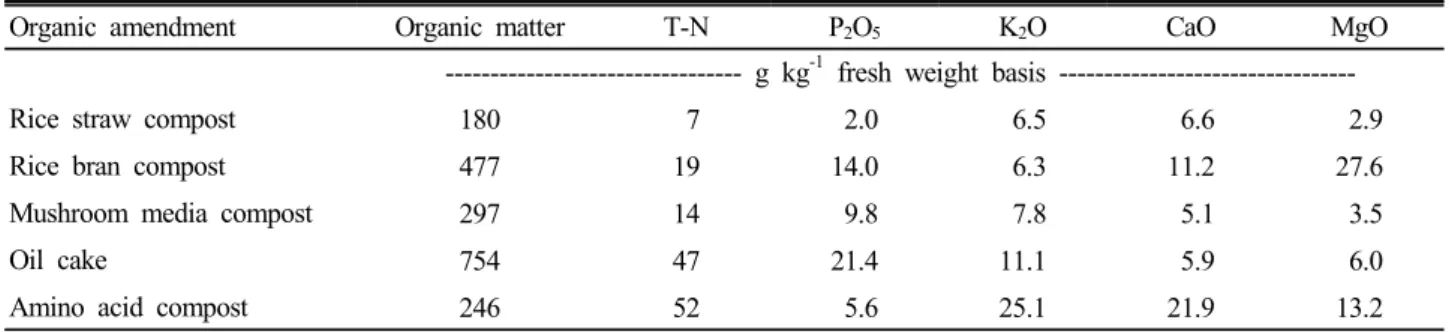
A four-year experiment was performed at the Gangwon Agricultural Research and Extension Services greenhouse and field in Chuncheon from 2007 to 2010. The soil in the greenhouse and the field is classified to Gyuam silty loam (coarse silty, mixed, nonacid, mesic Aquic Fluventic Eutrochrepts) and the selected chemical properties of the soils are shown in Table 1. Red pepper (Capsicum annuum) was cultivated with organic amendments including oil cake, rice straw compost, amino acid compost, rice bran compost, and mushroom media (spent substrate) compost before transplanting of red pepper seedlings. Chemical composition of the organic amendments on a fresh weight basis is shown in Table 2.
The application rates of organic amendments were determined based on recommended nitrogen fertilization rate after soil testing and nitrogen content of the organic amendments. As a result, less or excess amounts of phosphate and potassium was applied depending on relative nutrient composition of the organic amendments.
For instance, phosphate was over-applied for rice bran compost and mushroom media compost and potassium was less-applied for oil cake and rice bran compost compared to recommended fertilization based on soil testing.
The treatments were arranged in a randomized block design with three replicates. All statistical analyses were performed with the SAS (ver. 9.2, SAS, Cary, NC) program. An alpha value of 0.05 was chosen to indicate statistical significance.
The surface soils collected at the 15-cm depth from each plot were air-dried, passed through a 2 mm sieve, and used to determine soil chemical properties including soil pH, electrical conductivity (EC), soil organic matter, available phosphate, and exchangeable cations by soil analysis method recommended by National Institute of Agricultural Science and Technology (2000). Briefly, soil pH and EC were measured after mixing soil with H
2O at a ratio of 1:5. Soil organic matter and available phosphate were determined by Tyurin and Lancaster method, respectively. Exchangeable cations such as potassium, calcium, and magnesium were analyzed by extracting them with 1 N ammonium acetate (pH 7).
Amounts of exchangeable cations were determined by inductively coupled plasma spectrophotometer (ICP, GBC Integra XMP, GBC Scientific Equipment Pty Ltd, Victoria, Australia).
Soil bulk density and aggregate stability were measured
to determine the soil physical characteristics. Core
cylinders with a size of 100 cm
3were pressed to the
surface soil and the soil in the core cylinders was
dried in the oven set at 105℃. The bulk density was
calculated by weight of oven-dry soil in the core
cylinders divided by bulk volume, 100 cm
3. For aggregate
stability determination, 4 g of 1- to 2-mm air-dried soil
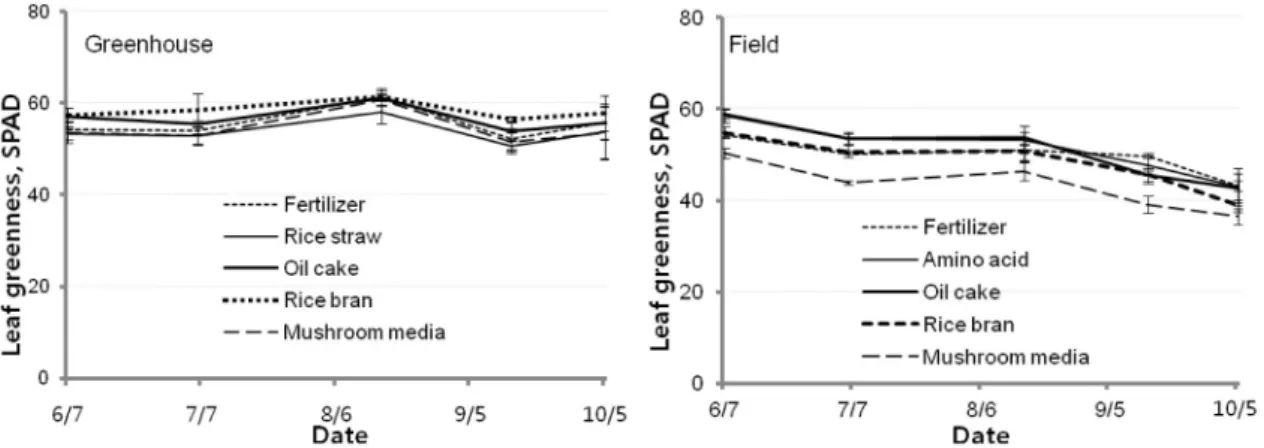
Fig. 1. Leaf greenness of red pepper in greenhouse (left) and field (right). Error bars indicate ± 1 standard deviation.
Fig. 2. Yield of red pepper in greenhouse (left) and field (right). Error bars indicate ± 1 standard deviation.
aggregates was evenly spread over the 750 μm sieve.
The sieve with aggregate sample was placed in the bucket filled with water and moved up and down in the water at the rate of about 34 times per minute for 3 min. The weight of soil in the bucket was determined after drying at 105℃. Water aggregate stability was calculated by weight of aggregate after dispersing in the water divided by weight of aggregate sample, 4 g.
Results and Discussion
Leaf greenness of red pepper for the organic amend- ments was comparable to that for chemical fertilizer in the greenhouse, while low leaf greenness for mushroom media compost in the field (Fig. 1). Decomposition of mushroom media (spent substrate) compost seemed to be relatively slow due to high content of lignin, 60%.
Productivity of red pepper for the organic amendments was also comparable to that for chemical fertilizer in the greenhouse, while low yield for mushroom media compost in the field (Fig. 2). The mushroom media
compost may improve soil physical properties rather than supply sufficient nutrients to red pepper. Buckerfield and Webster (2002) reported soil physical improvement, soil biological property improvement, and soil moisture conservation effect of mushroom media compost.
Therefore, amendment with mushroom media compost is thought to be proper under a greenhouse condition having sufficient plant nutrients including nitrate, phosphate, and potassium rather than open field with relatively low soil fertility.
Application of organic amendments resulted in increase in soil pH and organic matter (Table 3, 4).
In terms of increase in soil organic matter, rice bran
compost and oil cake were more effective than the
other organic materials. Kim et al. (2004) reported that
soil organic matter enhancement effect of organic
amendments was in the order of oil cake > pig
manure > compost, green manure, rice straw > hairy
vetch. Levels of soil available phosphate for rice bran
compost and mushroom media compost treatments were
relatively high compared with the other treatments
possibly due to high ratio of phosphorus to nitrogen
Table 3. Soil chemical properties in the greenhouse after harvesting red pepper.
Treatment pH
†EC Organic matter Avail. P
2O
5Exch. Cation
Ca K Mg
H
2O, (1:5) dS m
-1g kg
-1mg kg
-1--- cmol
ckg
-1---
Chemical Fertilizer 6.3bc 2.1a 18c 504b 6.7a 0.43b 2.0a
Rice straw compost 6.7a 1.9a 19bc 572ab 6.8a 0.76a 2.2a
Rice bran compost 6.4bc 2.2a 20ab 622a 6.5a 0.42b 2.3a
Mushroom media compost 6.6ab 1.9a 20a 602a 7.0a 0.80a 2.4a
Oil cake 6.2c 2.1a 20ab 516b 6.2a 0.25c 1.9a
†
Treatments with same letter in each column are not significantly different at the 0.05 probability level.
Table 4. Soil chemical properties in the field after harvesting red pepper.
Treatment pH
†EC Organic matter Avail. P
2O
5Exch. Cation
Ca K Mg
H
2O, (1:5) dS m
-1g kg
-1mg kg
-1--- cmol
ckg
-1---
Chemical Fertilizer 6.2c 0.29a 15c 503b 4.6b 0.67a 1.1a
Amino acid compost 6.1c 0.22a 15c 496b 6.6a 0.49b 1.5a
Rice bran compost 6.8a 0.14b 17a 620a 4.7b 0.33c 1.2a
Mushroom media compost 6.8a 0.10b 16b 623a 5.0b 0.58a 1.5a
Oil cake 6.3b 0.13b 16ab 492b 5.1b 0.25c 1.5a
†
Treatments with same letter in each column are not significantly different at the 0.05 probability level.
Table 5. Soil physical properties after harvesting red pepper.
Treatment Bulk density
†Aggregate
Greenhouse Field Greenhouse Field
--- g cm
-3--- --- % ---
Chemical Fertilizer 1.12b 1.03a 34.5a 41.6a
Rice straw compost 1.08a 1.03a 39.1b 54.0b
Rice bran compost 1.08a 1.01a 36.1ab 48.6ab
Mushroom media compost 1.09a 1.02a 38.3b 54.7b
Oil cake 1.10ab 1.03a 36.9ab 50.7ab
†