Abstract
BACKGROUND: To investigate mineralization characteristics of organic resources in the soil, five materials (rice straw, cow manure sawdust compost, microorganism compost, mixed oil-cake, and amino acid fertilizer) were treated according to the nitrogen content, and an indoor incubation experiment was conducted for 128 days. The results of this analysis were applied to determine the nitrogen mineralization pattern of these organic resources.
METHODS AND RESULTS: During the constant temperature incubation period, the nitrogen net mineralization rate of the organic resources was the highest in the amino acid fertilizer with the highest nitrogen content, and the lowest in the rice straw with the lowest nitrogen content. A positive correlation (0.96) was observed between the potential nitrogen mineralization rate and total nitrogen content. The mineralization rate constant, k, was negatively correlated with the organic matter (-0.96) and carbon content (-0.97). The nitrogen mineralization rate during the first cropping season, as estimated by the model, was 6.6%, 11.6%, 30.9%, 70.7%, and 81.0% for
the rice straw, the cow manure sawdust compost, the microorganism compost, the mixed oil-cake, and the amino acid fertilizer, respectively.
CONCLUSION: The nitrogen mineralization rate varies depending on the type of organic resources or the nitrogen content; thus, it can be used as an index for determining the nitrogen supply characteristics of the organic resource. Organic resources such as compost with low nitrogen content or those undergoing fermentation contain organic nitrogen. Organic nitrogen is stabilized during the composting process. Therefore, as the nitrogen mineralization rate of these resources is lower than that of non-fermented organic resources, it is desirable to use the fermented organic materials only to improve soil physical properties rather than to supply nutrients for the required amount of fertilizer.
Key words: Incubation experiment, Nitrogen content, Nitrogen mineralization, Organic amendment, Upland soil
서 론
유기농업에서는 생태적인 환경과 자원의 순환이라는 생태 의 원칙에 따라 작물을 재배하고 관리하도록 하고 있다. 유기 농업도 경제적인 활동이라 수확량을 우선으로 작물을 재배할
*Corresponding author: Jin-Soo Lim
Phone: +82-43-833-5004; Fax: +82-43-833-2959;
E-mail: [email protected]
Korean J Environ Agric. 2019;38(4):262-268. Korean Online ISSN: 2233-4173
Published online 2019 November 9. https://doi.org/10.5338/KJEA.2019.38.4.35 Print ISSN: 1225-3537
밭토양 조건에서 질소함량별 유기자원의 질소 무기화율 추정
임진수*, 이방현, 강승희
사단법인 흙살림연구소
Estimation of Nitrogen Mineralization of Organic Amendments Affected by Nitrogen Content in Upland Soil Conditions
Jin-Soo Lim*, Bang-Hyun Lee and Seung-Hee Kang (Heuksalim Soil Research Institute, Goesan 28002, Korea)
Received: 10 October 2019/ Revised: 30 October 2019/ Accepted: 2 November 2019 Copyright ⓒ 2019 The Korean Society of Environmental Agriculture
This is an Open-Access article distributed under the terms of the Creative Commons Attribution Non-Commercial License (http://creativecommons.org/licenses/by-nc/3.0) which permits unrestricted non-commercial use, distribution, and reproduction in any medium, provided the original work is properly cited.
ORCID Jin-Soo Lim
https://orcid.org/0000-0003-0655-5245
Bang-Hyun Lee
https://orcid.org/0000-0001-5409-8419
Seung-Hee Kang
https://orcid.org/0000-0002-6649-4510
262
Open Access
Research Article-Soil Environment
수 밖에 없는데, 작물의 수량을 높이기 위해서는 작물이 필요 로 하는 만큼의 양분을 땅에 넣어주어야 한다. 녹색혁명이라는 화학 의존형 농업이 나타나기 전에는 작물이 필요로 하는 양 분은 거의 지역적 순환으로 가능했었다. 그러나 녹색혁명 이후 양분, 즉 유기물의 지역적 순환이라는 고리가 무너지면서 농촌 의 공동체는 무너지기 시작하였다(Frances et al., 2003).
지속가능하고 건강한 농업, 농촌사회를 만들기 위해서는 물질의 지역적 순환이 필요하다. 경축순환 유기농업을 통해 양분의 순환 등 물질의 순환구조를 완성하는 자원순환형 농 업모델(Yoon and Park, 2009)이 가능하며, 양분의 지역적 순환의 중심은 유기물이다(Yoon et al., 2009). 과거 퇴구비 를 주 유기물원으로 사용하던 시대보다 화학비료가 국내 농 업에 투입된 이후 국내농경지의 유기물함량은 90년대 중반부 터 2000년대 초반까지 낮아지다가 현재는 일정비율을 유지하 고 있다(Kim et al., 2010).
식물이 유기물을 이용하기 위해서는 유기물이 분해되어야 하는데, 유기물의 분해에는 토양온도(Joa et al., 2012), 토양 수분(Kim et al., 1997), 토양미생물(An et al., 2015), 유기 자원의 탄소함량, 질소함량 및 탄질비(Janssen, 1996) 등 다 양한 인자가 영향을 미친다. 전 국토내의 탄소함량은 80년대 이 후 계속 낮아지고 있으며, 토양 내 탄소증가는 유기물 공급 증 가 및 대기 중 이산화탄소 농도를 낮추는 효과가 있다(Korea Environment Institute Report, 2009). 퇴비의 시용이 증가 할수록 토양탄소가 증가하지만 토양탄소는 강우 시 유출수에 의한 수질을 오염시킬 수 있다(Lee et al., 2013). 토양 내 질 소 증가는 유기자원의 분해율을 증가시키지만 분해 단계에서 의 질소 시비는 미생물의 활성을 억제시켜 분해를 저해한다 (Chae et al., 2013).
유기자원의 사용목적은 토양에 탄소 및 질소 등 영양성분 의 축적으로 작물생육을 도모하기 위함이다. 유기자원은 탄소 의 양에 따라 작물이 필요로 하는 질소의 함량도 달라진다.
때문에 탄소와 질소의 비, 즉 탄질비에 따라 유기자원의 질이 평가되며(Probert et al., 2005), 질소의 분해양상도 다르다 (Janssen, 1996). 유박, 퇴비 등 유기자원의 질소 이용 효율 은 장기적으로 볼 때 화학비료 대비 높다(Cho et al., 2012).
특히 탄질율이 높을수록 높은데 이는 서서히 분해되어 화학 비료 대비 유실이 적기 때문이다. 또한 유기자원의 질소 무기 화율은 토양 깊이(Ok et al., 2016) 및 시비시기(Im et al.,
2015; Moon et al., 2017)에 따라 달라진다. 이처럼 유기자원 사용시 고려해야 할 요소는 탄소, 질소 및 탄질비 등이 있으나 특히 중요한 것은 유기자원의 질소성분이며(Ryoo, 2012; Ryoo and Choi, 2012; Lee et al., 2015), 토양 유기물에 함유되 어 있는 양분 중에서 가장 중요한 것은 질소이다(Chang and Sohn, 2000).
본 연구는 유기재배 농가에서 주로 사용하고 있는 유기자 원 중 질소 함량별로 5개를 선정하여 질소의 무기화율 특성 을 구명하고자 항온배양실험을 실시하였다. 이를 통해 유기자 원을 이용한 비료 사용 처방 모델을 구축하기 위한 기초자료 를 확보하는데 목적을 두고 수행 하였다.
재료 및 방법
공시 재료 및 토양 무기태 질소 분석
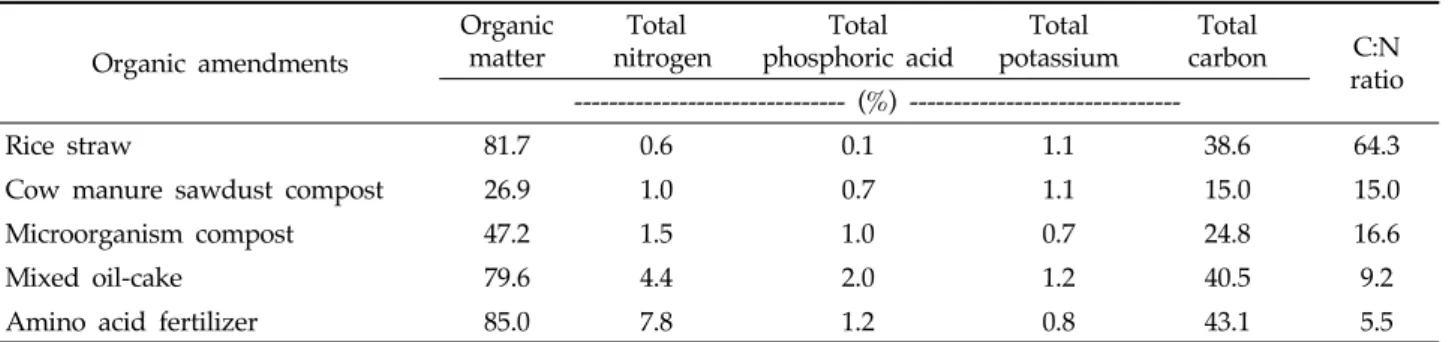
농가에서 주로 사용하고 있는 유기자원 중 질소 함량별 5 개를 선정하여 항온배양실험에 사용하였다(Table 1). 유기자 원의 무기성분은 농촌진흥청에서 제시한 농업과학기술 연구조 사분석기준(Rural Development Administration, 2012)에 준하여, 80℃에서 24시간 건조 후 분쇄하여 분석용 시료로 사 용하였다. 유기자원을 황산으로 습식 분해하여 전질소 함량은 Kjeldahl 증류법, 전인산 함량 및 전칼륨 함량은 ICP(SPECTRO, GENESIS FEE, Germany)로 정량 하였다.
유기물 함량은 회화법(600~700℃에서 2시간 이상 회화)으로 정량 하였다. 유기자원 각각의 탄소함량은 Nam 등(1998)이 제시한 식(1)에 의하여 계산하였다.
탄소함량(%) = 1.995 + 0.484 × 유기물함량(%) (1)
토양의 무기태 질소(NH4+-N과 NO3--N) 함량은 증류법으 로 분석하였다. 암모니아태 질소 함량은 토양 10 g을 100 ml 삼각플라스크에 취하고 2 M KCl 50 ml를 가하여 30분간 진 탕한 후 여과하였다. 100 ml 삼각플라스크에 2% 붕산용액 10 ml를 넣어 수기로 사용하였다. 일정량의 여액을 Semi-micro kjeldahl flask에 넣고 0.2~0.3 g의 MgO를 가하여 증류하 였다. 질산태 질소 함량은 MgO를 가하여 암모니아태(NH4+) 를 추출한 후 devarda's alloy를 가하여 질산태 질소를 암모 니아태 질소로 전환시켜 증류법에 의해 정량하였다.
Organic amendments
Organic matter
Total nitrogen
Total phosphoric acid
Total potassium
Total
carbon C:N
ratio --- (%) ---
Rice straw 81.7 0.6 0.1 1.1 38.6 64.3
Cow manure sawdust compost 26.9 1.0 0.7 1.1 15.0 15.0
Microorganism compost 47.2 1.5 1.0 0.7 24.8 16.6
Mixed oil-cake 79.6 4.4 2.0 1.2 40.5 9.2
Amino acid fertilizer 85.0 7.8 1.2 0.8 43.1 5.5
Table 1. Characteristic of organic amendments for the aerobic incubation experiment
항온배양실험
유기자원이 시용된 밭 토양에서 질소의 무기화 양상을 파 악하기 위하여 호기성 조건에서 재료가 처리된 토양에 대한 실내 항온배양실험을 수행하였다. 실험에 사용된 토양은 미사 질 양토였다(Table 2).
유기자원 재료는 건조하여 믹서로 간 후 골고루 혼합하 여 준비하였고, PE병에 건토 중량 100 g을 평량하여 수분 함량을 포장용수량의 60%로 조절하였다. 준비된 재료는 30 kgN·10a-1에 해당하는 비율로 토양에 혼합한 후 항온 배양기 에서 25℃ 조건을 유지하였다. 각 시료는 3반복으로 처리하 였다. 토양수분은 동일한 중량이 유지되도록 3~4일 간격으로 보충하였다. 수분의 증발량은 토양수분 함량의 10% 미만이었 다. 시료는 각각 1, 2, 4, 8, 16, 32, 64, 91, 128일차, 총 9회 수거하여 분석에 사용하였다.
잠재적 질소의 무기화율 및 무기화 속도상수 추정 질소의 잠재적 무기화율(
N0
)과 무기화 속도상수(k
)는 항 온배양실험의 시기별 질소 무기화율을 이용하여 Stanford 와 Smith (1972)가 제시한 식 (2)에 의해서 계산하였다. (식 2) 의 모델식에서 각각의 파라미터는 R프로그램의 “linpack.lm"패키지 안의 nlsLM 함수를 통해 비선형모형의 모수를 추정 하였다(Elzhov et al., 2016).
N =
N0
[1– exp(-k·t
)] (2)N은 시간(t)에 대한 질소 무기화율,
N0
는 잠재적 질소 무 기화율,k
는 질소 무기화 속도상수이다.통계
잠재적 질소 무기화율(
N0
)과 무기화 속도 상수(k
)의 상관 분석은 R프로그램의 cor.test( ) 함수를, ANOVA 분석은 aov 함수를 사용하였고, 다중비교는 “agricolae” 패키지 안의 scheffe.test( ) 함수(P
=0.05)를 사용하였다. 모든 분석은 R 프로그램(ver. 3.4.4)을 이용하였다.결과 및 고찰
유기자원의 질소 순 무기화율
유기재배 농가에서는 다양한 유기자원을 활용하여 양분관 리를 하고 있다. 유기자원을 시비처방에 활용하기 위해서는 토양분석 후 처방된 질소, 인산, 칼륨 값을 유기자원으로 환 산하여 적용해야 한다. 이때 각 유기자원 성분의 무기화율을 감안하여 투입량을 계산한다. 따라서 유기자원의 무기화율을 알아야 한다. 유기자원의 질소 함량별 무기화율을 분석하여 질소의 순 무기화율을 분석하였다(Fig. 1). 질소의 무기화율 은 전질소 함량에서 무기태 질소(NH4+-N과 NO3--N)로 변 화된 양을 백분율로 나타낸 것이며, 이 비율에서 무처리 된 비 율을 뺀 값이 순 무기화율이다. 질소 함량이 높은 자원일수록 초기부터 무기화율이 높았으며, 최종 128일의 무기화율도 높
Soil type Total N (%) SOM (%) Soil texture
Sand (%) Silt (%) Clay (%)
Silt loam 0.12 2.15 31.7 63.2 5.0
Table 2. Total nitrogen, organic matter, and soil texture of the soil used for aerobic incubation experiment
Fig. 1. Cumulative nitrogen mineralization over 128 days in soil amended with organic
amendments.
았다. Sung 등(2008)은 녹비작물에서, Yoon 등(2010)은 퇴 비에서 질소함량이 높을수록 질소의 무기화량이 많다고 하였 으며, 질소함량이 높은 퇴비일수록 무기화율이 높고(National Institute of Agricultural Sciences, 1999), 유기자원의 질소 투입량이 증가될수록 무기화율이 높은 결과를 보였다(Im et al., 2015). 질소함량이 낮고 탄소함량이 높아 탄질율이 64.3 인 볏짚의 경우에는 배양 초기에 음의 무기화율을 나타내었 는데, 이는 질소의 고정화가 일어났음(Shin et al., 2016;
Yoo and Matsuguchi, 1983)을 보여준다. 항온배양실험 결 과 질소의 함량별로 질소의 무기화율은 다르게 나타났다. 질소 의 함량이 낮을수록 128일 후 질소의 순 무기화율은 낮았다.
잠재적 질소 무기화율과 무기화 속도상수 및 무기성분과 의 상관관계
유기자원의 질소 무기화는 C:N율과 밀접한 관련이 있음을 보고하였다(Probert et al., 2005). 항온배양 128일차의 잠재 적 질소 무기화율(
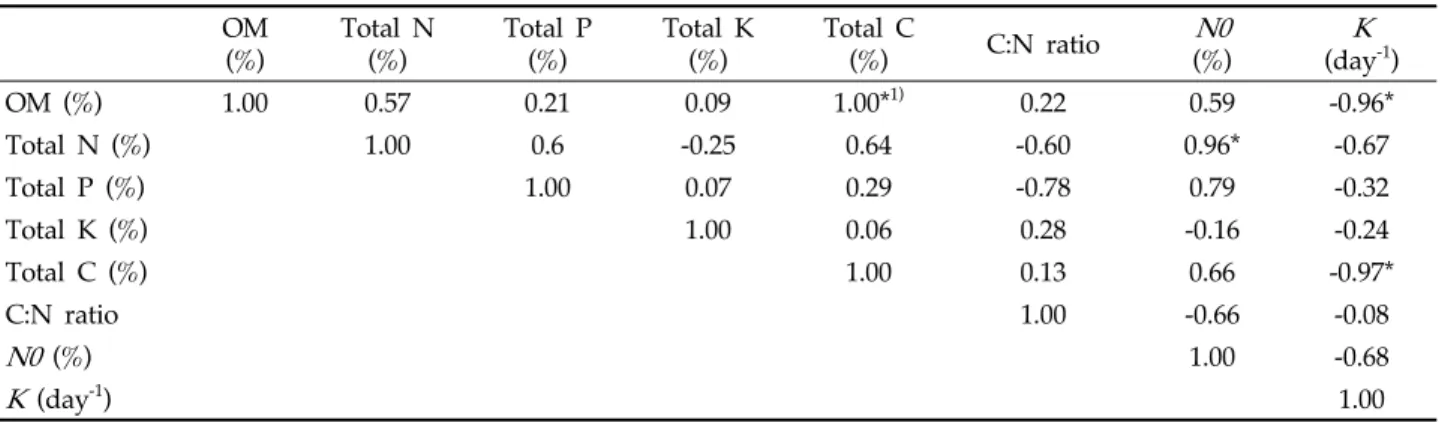
N0
)은 질소 함량과 양의 상관관계(0.96)가 인정되었다(Table 3). Zhonglu 등(2015)도 유기자원의 질소 함량과 무기화율은 양(+)의 상관관계를 보인다고 하였다. 무 기화 속도상수k
는 유기물(-0.96)과 탄소(-0.97)와는 음의 상 관관계가 인정되었다.k
값과N0
값 사이에는 유의한 상관관 계는 없었는데, Yoon 등(2010)과 Im 등(2015)도k
값과N0
값 사이에는 유의한 상관관계가 보이지 않는다고 하여 같은 결과를 보였다.질소 무기화율 추정
질소함량이 다른 유기자원을 미사질 양토에 처리 후 질소 무기화 항온배양실험 결과를 N =
N0
[1- exp(-k·t
)] 식에 적 용하여 질소 무기화 속도상수(k
) 및 포텐셜(N0
)을 계산한 결 과는 Fig. 2와 같다. 볏짚, 우분퇴비, 균배양체, 유박, 아미노 볼의N0
값은 각각 7.8, 12.5, 33.2, 90.6, 109.5로 전질소 함 량이 높을수록 높았는데 Yoon 등(2010)도 토양 중 전질소 함량이 증가할수록N0
값도 증가한다고 하였다.각각의 유기자원 C:N율과
N0
값은 음의 관계였는데(-0.66), Shin 등(2016)도 탄질율과 무기화량은 음(-)의 상관관계가 보여짐을 확인하였다. 우분퇴비의 C:N율은 15.0으로 균배양체 의 16.6보다 낮음에도 불구하고
N0
값은 12.5로 높지 않았는 데, 이는 우분퇴비의 경우 발효기간이 1년 이상 유지됨으로써 유기태질소가 안정화되어 무기화율이 더 낮아(Eghball, 2000) 진 결과로 보이며, 가축분 퇴비의 경우 C:N율이 낮음에도 무 기태 질소양이 많지 않다(Shin et al., 2016). 질소 무기화 속 도k
를 추정한 결과N0
값이 가장 높은 아미노볼에서 가장 낮은 0.011을 보인 반면 발효가 진행되어 유기태질소가 안정 화 된 우분퇴비와 균배양체에서 높은 값(0.043, 0.041)을 보였 다.N0
값과k
값으로 추정한 128일 동안 질소의 무기화율은 볏짚 6.6%, 우분퇴비 11.6%, 균배양체 30.9%, 유박 70.7%이었으며 아미노볼은 81.0%를 나타냈다.
우분퇴비와 유박의 질소 무기화율은 각각 12%와 71%로 Lee 등(2012)의 결과와 비슷하였다. Im 등(2015)은 질소함량 이 많은 유기자원일수록 무기화량이 높다고 하였는데, 본 연구 에서도 질소함량이 가장 많은 아미노볼에서 무기화율이 가장 높았다. 질소함량이 가장 낮았던 볏짚의 무기화율은 10% 미만 이었는데, Han 등(2017)은 볏짚퇴비는 토양 물리성 개선에 적 합하다고 하였으며, Lim 등(2011)은 볏짚의 연용은 토양 물리 성 개선에 효과적이라고 하였다. Kang 등(2011)은 탄소함량이 높은 볏짚 등 유기자원은 시설재배지에서 염류집적을 경감시 킨다고 하였다. 연구결과 질소함량이 1% 내외로 낮고 1작기 동안의 무기화율이 10% 내외인 볏짚과 우분퇴비의 경우 양분 의 공급보다는 토양 물리성 개선을 목적으로 사용하는 것이 바람직할 것으로 판단된다. Kim 등(2004)도 볏짚, 퇴비는 토 양 물리성 개선효과가 높다고 하였다. 퇴비 등 질소함량이 낮 은 유기자원의 농경지 처리효과는 장기적으로 연용할 경우 토 양의 물리성이 더 높아짐을 확인하였다(Yun et al., 2007).
발효된 유기자원인 우분퇴비, 균배양체와 무발효된 유기자 원인 볏짚, 유박, 아미노볼의 그룹별 비교에서 발효된 유기자 원은 무발효된 유기자원보다 무기화 속도상수
k
값이 3배 이 상 높은 값을 보이고 있다(Table 4). 따라서 발효된 퇴비 등의 유기자원을 시비하고자 할 경우 이점을 감안하여야 할 것이 다. 또한 본 연구는 질소함량이 다른 유기자원의 무기화율을 추정하였지만, 질소함량이 같은 유기자원일 경우에는 탄질율OM (%)
Total N (%)
Total P (%)
Total K (%)
Total C
(%) C:N ratio
N0(%)
K
(day
-1)
OM (%) 1.00 0.57 0.21 0.09 1.00*
1)0.22 0.59 -0.96*
Total N (%) 1.00 0.6 -0.25 0.64 -0.60 0.96* -0.67
Total P (%) 1.00 0.07 0.29 -0.78 0.79 -0.32
Total K (%) 1.00 0.06 0.28 -0.16 -0.24
Total C (%) 1.00 0.13 0.66 -0.97*
C:N ratio 1.00 -0.66 -0.08
N0
(%) 1.00 -0.68
K
(day
-1) 1.00
1)
*: Significant at the 0.05 probability levels, respectively.
Table 3. Correlations between the elements of organic amendments and the N mineralization potential
Fig. 2. Predicted and observed inorganic N mineralized from organic amendments treatment (A) Rice straw, (B) Cow manure sawdust compost, (C) Microorganism compost, (D) Mixed oil-cake, (E) Amino acid fertillzer.
Organic amendments
N0(%)
K(day
-1) Ratio of
k(a/b)
Fermented organic amendments (a) 22.9±12.0
1)0.042±0.001 a
2)Non-fermented organic amendments (b) 69.3±48.4 0.014±0.003 b 3
1)
All values are means±SD (standard deviation)
2)
Means followed by the same letter within a column are not significantly different according to Scheffe’s multiple range test at P < 0.05.
Table 4. Comparison of N mineralization potential (
N0) and mineralization rate constant (
k) of fermented with
non-fermented organic amendments
에 따라 무기화율이 다름을 조사하였다(Lee et al., 2012). 이 러한 부분도 유기자원 활용시 특별히 고려되어야 한다.
적 요
토양에서 유기자원의 무기화 특성을 구명하기 위하여 질소 함량별로 볏짚, 우분퇴비, 균배양체, 유박, 아미노볼 등 총 5가 지를 각각 처리하여 128일 동안 실내 항온배양실험을 실시하 였으며, 이 분석결과를 질소 무기화 모형에 적용하여 유기자원 의 질소 무기화 양상을 구명하였다. 항온배양 기간 동안 유기 자원의 질소 순 무기화율은 질소함량이 가장 높은 아미노볼에 서 가장 높았고, 질소함량이 가장 낮은 볏짚에서 가장 낮았다.
잠재적 질소 무기화율은 전질소 함량과는 양의 상관관계(0.96) 가 인정되었다. 무기화 속도상수
k
는 유기자원의 유기물(-0.96) 및 탄소함량(-0.97)과 음의 상관관계가 인정되었다. 모형에 의 해 추정된 1작기 동안의 질소 무기화율은 볏짚 6.6%, 우분퇴비 11.6%, 균배양체 30.9%, 유박 70.7%이었으며 아미노볼은 81.0%를 나타냈다. 질소 무기화율은 유기자원의 종류 또는 질 소함량에 따라 다르게 나타나 질소 무기화율을 유기자원의 질 소 공급 특성을 결정하는 지표로 사용할 수 있다. 질소함량이 낮거나 발효과정을 거치는 퇴비 등의 유기자원은 퇴비화 과정 에서 유기태 질소가 안정화되어 질소의 무기화율이 무발효 유 기자원보다 낮으므로 시비량 결정시 양분공급의 목적보다는 토 양 물리성 개량을 목적으로 사용하는 것이 바람직하다.Note
The authors declare no conflict of interest.
Acknowledgement
This work was supported by Korean Institute of Planning and Evaluation for Technology in Food, Agriculture, and Forestry (IPET) through Agri- Bioindustry Technology Develoment Program, funded by Ministry of Agriculture, Food and Rural Affairs (MAFRA) (No.316032-5).
References
An, N. H., Ok, J. H., Cho, J. L., Shin, J. H., Nam, H. S.,
& Kim, S. C. (2015). Effects of organic matter application on soil microbial community in a newly reclaimed soil. Korean Journal of Organic Agriculture, 23(4), 767-779.
Chae, H. M., Lee, S. H., Cha, S. S., & Shim, J. K. (2013).
Effects of soil nitrogen addition on microbial activities and litter decomposition. Journal of Ecology and Environment, 46(2), 276-288.
Chang, K. R., & Sohn, S. M. (2000). Sustenance and enhancement of soil fertility for organic farming by legumes and green manure. Korean Journal of Organic Agriculture, 8(2), 97-110.
Cho, J. L., Choi, H. S., Lee, Y., Lee, S. M., & Jung, S. K.
(2012). Effect of organic materials on growth and nitrogen use efficiency of rice in paddy. Korean Journal of Organic Agriculture, 20(2), 211-220.
Eghball, B. (2000). Nitrogen mineralization from field- applied beef cattle feedlot manure or compost. Soil Science Society of America Journal, 64(6), 2024-2030.
Elzhov, T. V., Mullen, K. M., Spiess, A., & Bolker, B. (2016).
R interface to the levenberg-marquardt nonlinear least- squares algorithm found in MINPACK, plus support for bounds. Retrieved from https://cran.r-project.org/
web/packages/minpack.lm/index.html
Frances, M. L., Joseph, C., Peter, R., & Luis, E. (2003).
World hunger
, pp. 148-151, Changbi Publishers, Korea.Han, K. H., Jung, K. H., Cho, H. R., Lee, H. S., Ok, J. H., Zhang, Y. S., Kim, G. S., & Seo, Y. H. (2017). Effect of crop yield and soil physical properties to application of organic resources in upland. Journal of the Korea Organic Resources Recycling Association, 25(4), 15-22.
Im, J. U., Kim, S. Y., Yoon, Y. E., Kim, J. H., Lee, S. B.,
& Lee, Y. B. (2015). Nitrogen mineralization in soil amended with oil-cake and amino acid fertilizer under a upland condition. Korean Journal of Organic Agriculture, 23(4), 867-873.
Janssen, B. H. (1996). Nitrogen mineralization in relation to C:N ratio and decomposability of organic materials.
Plant and Soil, 181(1), 39-45.
Joa, J. H., Moon, K. H., Kim, S. C., Moon, D.G., & Koh, S.
W. (2012). Effect of temperature condition on nitrogen mineralization of organic matter and soil microbial community structure in non-volcanic ash soil. Korean Journal of Soil Science and Fertilizer, 45(3), 377-384.
Kang, B. G., Lee, S. Y., Lim, S. C., Kim, Y. S., Hong, S. D., Chung, K. Y., & Chung, D. Y. (2011). Establishment of application level for the proper use of organic materials as the carbonaceous amendments in the greenhouse soil. Korean Journal of Soil Science and Fertilizer, 44(2), 248-255.
Kim, L. Y., Cho, H. J., & Han, K. H. (2004). Changes of physical properties of soils by organic material application in farm land. Korean Journal of Soil Science and Fertilizer, 37(5), 304-314.
Kim, M. S., Kim, W. I., Lee, J. S., Lee, G. J., Jo, G. L., Ahn, M. S., Choi, S. C., Kim, H. J., Kim, Y. S., Choi, M. T., Moon, Y. H., Ahn, B. K., Kim, H. W., Seo, Y. J.,
Lee, Y. H., Hwang, J. J., Kim, Y. H., & Ha, S. K.
(2010). Long-term monitoring study of soil chemical contents and quality in paddy fields. Korean Journal of Soil Science and Fertilizer, 43(6), 930-936.
Kim, P. J., Chung, D. Y., Chang, K. W., & Lee, B. L.
(1997). Mineralization of cattle manure compost at various soil moisture content. Korean Journal of Environmental Agriculture, 16(4), 295-303.
Lee, K. S., Yoon, K. S., Choi, D. H., Jung, J. W., Choi, W.
J., & Lim, S. S. (2013). Agricultural soil carbon management considering water environment. Journal of Environmental Impact Assessment, 22(1), 1-17.
Lee, Y., Choi, H. S., Lee, S. M., Jung, J. A., & Kuk, Y. I.
(2012). Effects of organic materials on changes in soil nutrient concentrations and nutrient uptake efficiency in sorghum-sudangrass hybrid (
sorghum bicolor
(L.) moench). Journal of Bio-Environment Control, 21(2), 108-113.Lee, Y. J., Yun, H. B., Song, Y. S., Lee, C. H., Sung, J. K.,
& Ha, S. K. (2015). Effects of organic matter sources on nitrogen supply potential in arable land. CNU Journal of Agricultural Science, 42(4), 431-437.
Lim, T. J., Park, J. M., Lee, S. E., Jung, H. C., Jeon, S. H.,
& Hong, S. D. (2011). Optimal application rate of mixed expeller cake and rice straw and impacts on physical properties of soil in organic cultivation of tomato. Korean Journal of Environmental Agriculture, 30(2), 105-110.
Moon, Y. H., Ahn, B. K., Lee, G. J., Seo, K. W., Ko, D. Y., Choi, S. W., Kim, J. H., & Choi, I. Y. (2017). Effects on application time of mixed expeller cake fertilizer in organic farming soil and rice yield. Korean Journal of Organic Agriculture, 25(2), 475-487.
Nam, J. J., Cho, N. J., Jung, K. Y., & Lee, S. H. (1998).
Conversion factor for determinating carbon contents from organic matter contents in composts by ignition method. Korean Journal of Soil Science and Fertilizer, 31(4), 380-383.
Ok, J. H., Cho, J. L., Lee, B. M., An, N. H., Shin, J. H., &
Lee, Y. (2016). Effect of oil cake banding application on growth and nutrient use efficiency in maize. Korean Journal of Organic Agriculture, 24(4), 907-917.
Probert, M. E., Delve, R. J., Kimani, S. K., & Dimes, J. P.
(2005). Modelling nitrogen mineralization from manures:
representing quality aspects by varying C:N ratio of
sub-pools. Soil Biology and Biochemistry, 37(2), 279-287.
Ryoo, J. W. (2012). Assessment of regional-based nitrogen loading and recycling capacity of livestock manure.
Journal of Livestock Housing and Environment, 18(3), 235-246.
Ryoo, J. W., & Choi, D. C. (2012). Assessment of n-loading and manure units for regional recycling farming -case study in Yeoju-Gun region. Korean Journal of Organic Agriculture, 20(1), 21-36.
Shin, J. H., An, N. H., Lee, S. M., Ok, J. H., & Lee, B. W.
(2016). Estimation of N mineralization potential and N mineralization rate of organic amendments as affected by C:N ratio and temperature in paddy soil. Korean Journal of Soil Science and Fertilizer, 49(6), 712-719.
Stanford, G., & Smith, S. J. (1972). Nitrogen mineralization potentials of soil. Soil Science Society of America, 36(6), 465-472.
Sung, J. K., Lee, S. M., Jung, J. A., Kim, J. M., Lee, Y. H., Choi, D. H., Kim, T. W., & Song, B. H. (2008). Effects of green manure crops, hairy vetch and rye, on N supply, redpepper growth and yields. Korean Journal of Soil Science and Fertilizer, 41(4), 247-253.
Yoo, I. D., & Matsuguchi, T. (1983). Effects of rice straw application on the biological nitrogen fixation of paddy fields. I. Effects of application method of rice straw on the nitrogen fixing activity. Korean Journal of Soil Science and Fertilizer, 16(1), 77-83.
Yoon, S. Y., & Park, S. H. (2009). The study of resource cycling agriculture furtherance scheme. Korean Journal of Agriculture Management and Policy, 36(1), 158-178.
Yun, H. B., Lee, Y., Yu, C. H., Yang, J. E., Lee, S. M., Shin, J. H., Kim, S. C., & Lee, Y. B. (2010). Soil nitrogen mineralization influenced by continuous application of livestock manure composts. Korean Journal of Soil Science and Fertilizer, 43(3), 329-334.
Yun, H. B., Lee, Y., Yu, C. Y., Yang, J. E., Lee, Y. B., &
Lee, K. S. (2007). Soil organic matter fractions in upland soil under successive application of animal manure composts. Korean Journal of Soil Science and Fertilizer, 40(5), 400-404.
Zhonglu, G., Shuhua, Z., Juan, J., & Chongfa, C. (2015).
Nitrogen mineralization controlled by N/P ratio of plant residues from riparian buffer strip. European Journal of Soil Biology, 67, 5-11.