8 1 2019. 6 59-62 https://doi.org/10.22645/udi.2019.6.30.059
1. Narrative Statement of History and Significance of the Building and its Site
The analysis subject is the First Baptist Church near the downtown Urbana, IL. Since the First Baptist Church was started 166 years ago by 13 former Ohio residents, it has been Champaign County s oldest church congregation. ʼ The Baptist Church was originally organized at Brumley s school house, two miles east of the ʼ city, and met there for a decade after which it moved to Urbana and became the First Baptist Church. In 1856 the church erected a building on Cunningham Avenue, the first in the county with a bell. Standing at the northwest corner of Race and Illinois streets, the present church was constructed in 1895 [1]. Mr. Stanford Hall, a member of the church and a student in architecture at the University of Illinois, designed the new church and supervised its construction.
In November 1925 the church voted to attempt an addition at the rear of the church for Sunday school facilities. The cornerstone was laid in 1926 and the educational building was dedicated Feb. 14, 1927 at a cost of more than $45,000. In 1873, a parsonage was built on the rear of the lot where the educational
building was later built. It was a two-story, seven room house costing $2,500. It was used until the new church was built in 1895 when a lot was purchased at 403 W. Illinois to which the building was moved and gas and water installed. When the present church was built, the old church building was sold to the Urbana School Board and moved to Leal School grounds where it provided school rooms for several years. From that time on, many efforts, including several restoration works and alternations were made to maintain this old historical church.
The brief history of the church is as follow [2].
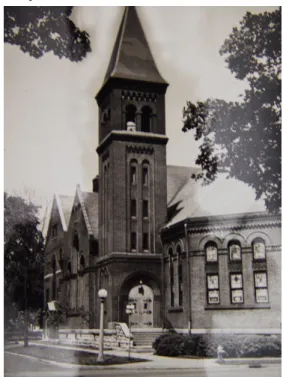
1838- The church was organized with 13 members with Rev. Isaaca Newell pastor 1840- The first Methodist church was built in Urbana. The lot cost $3. It was 30x40feet.
1851- Our church formed a committee to arrange for its first church building.
1856- Our first church building was completed and dedicated
1896- The present building housing our sanctuary was dedicated
1902- Pipe organ was dedicated 1926- The west wing was dedicated
인천대학교 도시과학대학 도시건축학부 조교수 ([email protected])
Restoration Review of the First Baptist Church in Urbana, Illinois (1838-)
Abstract: The purpose of this study was to analyze the history and significance of the building and its site of First Baptist Church in Urbana, Illinois. Before the full-scale restoration work is initiated, historical confirmation of the building is necessary. Therefore, this paper examined the historical significance of the church through the in-depth literature review and examined the interior and exterior conditions thoroughly. Ultimately, this paper can contribute to make up the restoration work list and to determine the priority of them.
Key Words: Restoration, Stained Glass Windows, First Baptist Church in Urbana
60 8 1 2019. 6
2. Building Description
Mr. Stanford Hall, a member of the church and a student in architecture at the University of Illinois, designed the new church and supervised its construction. The building is 72 ft by 114ft and the tower was 98ft high. It is of German Romanesque architecture in brick and gray stone [3].
Figure 1. View from the east, W. Illinois street
Figure 2. View from the south, S. Race street
The entire facade is made of red brick and the foundation was built as gray stone. The approach to the church is from Illinois Street.
(Figure 1) Above the two entrances there are flanking towers. However, the left one is used as the main entrance from Race Street. (Figure 2) There are three vertical stained glass windows at each side of the elevation. From the south and north elevation, the gable with three large stained glass window is expressed as down-up-down. As we see the western addition, used as the Sunday school and office, there are six windows going up along the stairway which shows the difference in the leveling between two buildings.
As the current building was built around more than 100 years ago, it is not hard to find the
deteriorated parts as the conjunction between the two buildings. Cracks, footprints of the addition from the south elevation can be observed as shown in Figure 3. They indicate the failure of brickwork caused by differential expansion done in 1926 between the brick masonry and steel framing [4].
Figure 3. Cracks in south elevation
The present church shows an octagonal plan as a symbol of regeneration. Since the world started on the eighth day of Creation, it was pertinent to represent the meaning of resurrection of Christ. That is, the floor plan is true to the principle of this church-baptism.
There are two major components in this church-the pipe organ and the stained glasses around the wall. The members of the Urbana First Baptist Church wished to have pipe organ early in this century. On Dec 3rd, 1902, a committee was formed to raise funds for a pipe organ. The organ took about four months to build. A portion of the roof had to be raised to accommodate the organ. It was dedicated with a two hour concert on September 10th, 1903. It – sits at the focal point of the church and it has 1037 pipes, 18 stops, 2 manual key boards, and a pedal board. Originally, air for the organ was provided by hand pumping the large bellows.
The lowest, right hand stop operated a lever in
the back, used to signal the pumper to start
and to stop. Around 1930, an electric motor
located in the church basement operated the
pump, replacing the hand pumping. (Figure 4)
Stained glass windows are radiating around
the chapel with translucent pictures. As the
glass is a form of matter with gas, liquid and
solid state properties, it captures light and
61
glows from within. Viewed from the ground, the windows appear not only as a picture but also as a network of black lines and colored light which made this church that special, sacred dwelling place of an all powerful God. (Figure 5)
Figure 4. Pipe organ
Figure 5. Stained glass windows
3. Past Restoration Attempts
In 1942-43, the sanctuary was redecorated and some of the exterior walls were repainted.
The stained glass windows in the building were taken out, cleaned and tightened up in 1944. In 1954, Reverend Goodwin started plans for renovating and redecorating the church, mainly the sanctuary. In the sanctuary it was found necessary to remove the plaster all over the room. Fresh plaster was put on with the acoustics blended right in with the plaster. That made service and the music easy to hear. A soft-green paint was chosen for the walls, and asphalt tile was put on the floor. During these repairs, services took place in the east room [6].
In 1961 removal of the two towers from the First Baptist Church of Urbana began as part of a building renovation program because of the high cost of tuck-pointing. The higher tower, housing the historic old bell, has been removed from the protrusion and bricks in the foreground were laid up to about 30 inches and a new, lower roof was placed over the bell.
(Figure 6&7) In 1967 the storm windows were added on the outside of the big stained glass windows. The building was last completely tuck-pointed in 1969 [7].
Figure 6. Church before demolition of bell tower
Figure 7. Current appearance after towers lowered since 1961
62 8 1 2019. 6
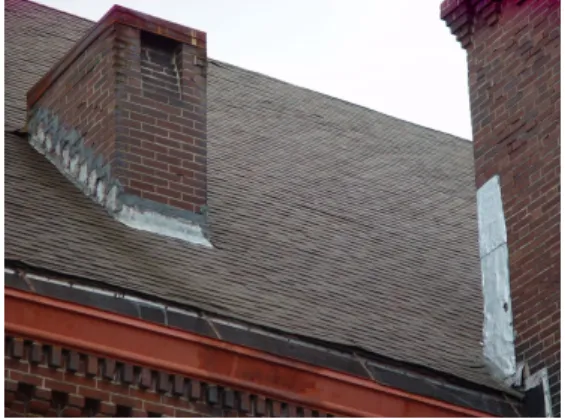
In 1980 the West Addition was re-roofed as well as the flat roofs over the areas between the buildings, and additional roofing was added around the towers. In 1982 the rusted area on the boiler was removed and the boiler overhauled with 27 thermostats added to the radiators. On March 30
thand 31st, 1988, the felt roofing covering the portion of the roof over the organ that had not been re-shingled blew off and water from heavy rain poured into the old wooden organ. The amount of the insurance received for the damage was $58,648.
At a church business meeting held August 21st, 1988, it was approved with no dissenting votes that an additional $17,250 would be added to the insurance amount and the organ would be totally repaired and restored. The total cost was to be $75,898 and the work was to be done by the John-Paul Buzard Organ Craftsmen, Inc., Urbana, IL. Repairs and restoration were completed in 1989.
Figure 8. Roof condition before restoration work