한국 속리산 국립공원 지역집단에서 이용되는 약용동물의 구전 전통지식에 대한 민족동물학적 연구
송미장#*
전주대학교 생명자원융합과학과
Ethnozoological Study of Medicinal Animals for Orally Transmitted Knowledge Utilized in the Local Communities of Songnisan National Park, Korea
Mi-Jang Song
#*Department of Integrated Bio-Resource Science, Jeonju University
ABSTRACT
Objectives : This study aims to record and conserve oral traditional knowledge of medicinal animals from the indigenous people living in the local communities of Songnisan National Park, Korea.
Methods : Data was collected by participatory observations and in-depth interviews with semi-structured questionnaires. Quantitative comparative analyses were accomplished through data received from the following three methods: informant consensus factor (ICF), fidelity level (FL), and network analysis.
Results : The investigation reveals that the indigenous people have used 49 species of medicinal animals distributed within 45 genera, belonging to 39 families with 336 different usages. According to the distribution of recorded families, the most representative families were Scolpendridae and Phasianidae, which were utilized 36 times each (10.71 % each). The category with the highest degree of consensus from informants was disorders related to the nervous system (0.97). 16 species were classified with a fidelity level of 100 %. The network analysis revealed that a lack of vigor was related to 23 species, including
Agkistrodon blomhoffii,
Gallus domesticus, and
Canis familiaris, among the total 49 species investigated.
Conclusions : This documentation can help preserve the traditional knowledge and local health traditions of Korea that are disappearing due to rapid industrialization, urbanization, and death of the elderly with traditional knowledge.
Additionally, the animals investigated in this study can be developed into medicinal food and drug for treating specific health conditions through further research.
1)
Key words : Traditional knowledge, Informant Consensus Factor, Fidelity Level, Network analysis, Songnisan National Park
Ⅰ. Introduction
The study of medicinal compounds derived from animals in traditional medicine is pivotal since it has been estimated that over 80 % of the global population possesses a health system based on traditional medicine,
using primarily plants and animals
1).
Traditionally, the use of animal products for the treatment of human or animal diseases has been utilized all over the world. Research studies in this area have been conducted in China (1,500 species)
2), North America (584 species)
3,4), India
5-7), Brazil
8), and Indonesia
9).
#*Corresponding and First author : Mi-Iang Song, Department of Integrated Bio-Resource Science, Jeonju University, 303 Cheonjam-ro, Wansan-gu, Jeonju-si, 55069, Republic of Korea.
·Tel : +82-63-220-4672 ·E-mail : [email protected]
·Received : 18 September 2019 ·Revised : 21 October 2019 ·Accepted : 30 November 2019
The national park in Korea is particularly worth preserving due to their outstanding natural ecology and rich biodiversity as regions of protection designated officially by the Ministry of environment
10). For these reasons, Songnisan was designated as a national park on March 24, 1970 and orally transmitted traditional knowledge, using both animals and plants have been passed down from generation to generation
11).
Traditional knowledge of using medicinal animals in Korea was rarely performed except for the research conducted in Wolchulsan National Park and Jeju Island by Kim
12,13).
The flora of Songnisan National Park was conducted by Kim et al. (1990)
14), Oh and Choi (2009)
15)however, its fauna and traditional knowledge have rarely been considered. The traditional knowledge is not inherited from generation to generation due to rapid industrialization and urbanization, so there is a risk that it will disappear if not documented.
This study aims to record and analyze the traditional knowledge of medicinal animals utilized by residents living in the local communities of Songnisan National Park in Korea.
Ⅱ. Materials and Methods
1. Study area
The study area is located in the center of South Korea, including two provinces (Chungcheongbuk-do, Gyeongsangbuk-do), two cities (Sangju-si, Mungyeong- si), and two counties (Boeun Gun, Goesan Gun) in its administrative district
10). The area measures 284.4 ㎢ and lies between 127° 47′ 20″ E to 127° 58′ 00″ E longitude and 36° 28′ 05″ N to 36° 46′ 30″ N latitude (Fig. 1).
Songnisan is 1,058 m above sea level, while the annual average temperature is 11.5℃, with an annual precipitation of approximately 1,088.7 mm
16).
Fig. 1. Investigation sites in Songnisan National Park, Korea.
2. Investigative Method
Data was collected using participant observations and in-depth interviews, as the informants also become investigators themselves through attending informal meetings, open and group discussions, and overt observations with semi-structured questionnaires
17,18).
The content of the semi-structured questionnaires was composed of diverse ethnozoological information, including local names, animal parts used, ailments, methods of preparation, manufacturing and administration, dosage, and the usable duration regarding each curable formula
18-20).
Animal specimens were collected during a proper collecting period and were organized utilizing the normal specimen manufacturing method
21). The voucher specimens were deposited for preservation in the herbarium of Jeonju University.
The precise identification and scientific names of animals were confirmed by the National Knowledge and Information System for Biological Species of Korea
22), Catalogue of Life, and 2019 Annual Checklist
23).
3. Quantitative Analysis
1) Informant Consensus Factor (ICF)The ICF was used to identify the ethnozoological importance of the collected animal species and to analyze the agreement degree of the informants’ knowledge about each category of ailments
24,25). The range of the value is from 0 to 1, with a larger value determining the higher degree of agreement.
The ICF was calculated using the following formula:
ICF
= (
nur-
nt) / (
nur- 1), where
nuris the number of times an ailment was mentioned in each category, and
ntis the number of animal species used in the research.
2) Fidelity Level (FL)
The FL was employed to determine the most important animal species used for treating certain diseases by the local elderly people living in the study area
12,13). The range of the value is from 1% to 100%, and the percentage correlates to the use of the same animal for certain medical treatments.
The FL value is determined using the following
formula:
FL(
%) =
Np× 100/
N, where
Npis the number
of informants that mentioned the specific animal species
used to treat certain ailments and
Nis the total number
of the informants who utilized the animals as medicine
for treating any given ailment.
3) Network Analysis
The network analysis was applied to analyze the relationship between ailments and animals
13,26). The network map of ailments-animals was constructed using the following parameters:
(1) The matrix of the ailments-animals was constructed from the number of informants who mentioned specific animals to treat certain ailments.
(2) The matrix map was analyzed and drawn by the software NetMiner (Ver. 4.3, Cyram Inc., Seoul, Korea).
Ⅲ. Results and Discussion
1. Demographic Characteristics of Informants
Field interviews were conducted from May 2014 to August 2014. All 97 key informants (23 men and 74 women) were randomly selected from 19 sites, which included community halls, senior welfare centers, and traditional markets (Fig.1).
The average age of the informants was 78 years, and they ranged from age 58-92, with residents living more than 40 years in the study areas. People in their seventies and eighties constituted 91.7 % of the total.
The residents in these communities have hardly been affected by modern culture and education as 36 of them never received any formal education (Table 1).
Demographic characteristics Number (%) Gender
Male 23 (30.36%)
Female 74 (69.64%)
Age
50-59 1 (1.0%)
60-69 5 (5.1%)
70-79 52 (53.6%)
80-89 37 (38.1%)
90-99 2 (2.0%)
Educational attainment
Never attended school 36 (37.1%) Never completed elementary school 24 (24.7%) Completed elementary school 30 (30.9%) Never completed middle school 1 (1.0%) Completed middle school 3 (3.0%) Never completed high school 1 (1.0%)
Completed high school 2 (2.0%)
Table 1. Demographic characteristics.
2. Ethnozoological Knowledge of medicinal animals
The traditional knowledge recorded from the Songnisan National Park communities included 336 ethnomedicinal practices classified within 39 families, 45 genera, and 49 species (Table 2).
Family Scientific name Korean name Used part Preparation Application Ailments FL
Acrididae Oxya japonica japonica Byeomettugi Whole part Fried Oral Lack of vigor 100.00
Anatinae Anas platyrhynchos Cheongdungori Whole part Infusion Oral Paralysis 100.00
Raw Oral Paralysis 100.00
Anas platyrhynchos domesticus Ori Egg Infusion Oral Lumbago 9.09
Oral Paralysis 33.33
Whole part Infusion Oral Lack of vigor 54.55
Oral Paralysis 33.33
Raw Oral Paralysis 33.33
Blood Raw Oral Paralysis 33.33
Oral Detoxification 3.03
Anguillidae Anguilla japonica Baemjangeo Whole part Infusion Oral Lung diseases 25.00
Simmer Oral Lack of vigor 75.00
Decoction Oral Lack of vigor 75.00
Apidae Apis cerana Fabricius Jaeraekkulbeol Honey Raw Topical Bee sting 29.27
Topical Stomatitis 34.15
Table 2. Animal species used for medicinal purposes in the local communities of Songnisan National Park.
Family Scientific name Korean name Used part Preparation Application Ailments FL
Topical Bee sting 29.27
Warm up in a
double boiler Oral Cough 7.32
Boiling Oral Common cold 9.76
Poultice Topical Stomatitis 34.15
Dissolution Oral Stomatitis 34.15
Pupa Roasting Oral Sexual decline 9.76
Hive Raw Oral Common cold 9.76
Boiling Oral Common cold 9.76
Infusion Oral Convulsions 4.88
Oral Measles 2.44
Poultice Topical Postpartum myofascial
pain syndrome 2.44
Bombycidae Bombyx mori Nuenabang Cocoons Raw Topical Burn 5.88
Pupa Powder Oral Cancer 17.65
Raw Oral Paralysis 11.76
Roasting Oral Paralysis 11.76
Whole part Powder Oral Glycosuria 41.18
Powder, dissolution Oral Glycosuria 41.18
Oral Cardiovascular disease 23.53
Bovidae Bos taurus So Dung Raw Topical Burn 33.33
Fumigation Topical Hemorrhoids 11.11
Blood Raw Oral Lung diseases 44.44
Urine Raw Topical Lacquer poisoning 11.11
Capra hircus Yeomso Whole part Infusion Oral Lack of vigor 56.25
Simmer Oral Lack of vigor 56.25
Roasting Oral Lack of vigor 56.25
Extraction Oral Lack of vigor 56.25
Oral Panic disorder 12.50
Infusion Oral Panic disorder 12.50
Oral Woman diseases 31.25
Simmer Oral Woman diseases 31.25
Capra aegagrus hircus Heungnyeomso Whole part Simmer Oral Sexual decline 100.00
Buforidae Bufo bufo gargarizans Dukkeobi Oil Oil Topical Boils 100.00
Cambaridae Cambaroides similis Gajae Whole part Maceration Oral Measles 97.22
Oral Convulsions 2.78
Infusion Oral Measles 97.22
Canidae Canis familiaris Gae Whole part Infusion Oral Tuberculosis 3.70
Oral Lack of vigor 66.67
Oral Sexual decline 3.70
Fur Burn Topical Dog bite 25.93
Cervidae Capreolus capreolus Noru Whole part Infusion Oral Lack of vigor 88.24
Oral Sexual decline 11.76
Raw Oral Lack of vigor 88.24
Roasting Oral Lack of vigor 88.24
Family Scientific name Korean name Used part Preparation Application Ailments FL
Cervus nippon Saseum Horn Raw Oral Lack of vigor 50.00
Simmer Oral Lack of vigor 50.00
Cetoniidae Protaetia brevitarsis seulensis Huinjeombagikkonmuji Whole part Infusion Oral Gastric cancer 12.50
Powder Oral Cancer 62.50
Oral Glycosuria 6.25
Oral Gastric cancer 12.50
Roasting Oral Cancer 62.50
Oral Indigestion 12.50
Oral Paralysis 6.25
Channidae Channa argus Gamulchi Whole part Simmer Oral Lack of vigor 50.00
Oral Postpartum care 50.00
Cobitidae Misgurnus mizolepis Mikkuraji Whole part Boiling Oral Lack of vigor 100.00
Colubridae Dinodon rufozonatus Neunggureongi Whole part Brewing Oral Lumbago 12.50
Oral Lack of vigor 62.50
Infusion Oral Lack of vigor 62.50
Simmer Oral Lung diseases 25.00
Oral Lack of vigor 62.50
Elaphe schrenckii Gureongi Whole part Infusion Oral Lack of vigor 17.86
Oral Panacea 28.57
Roasting Oral Panacea 28.57
Oral Myalgia 42.86
Simmer Oral Myalgia 42.86
Oral Lung diseases 10.71
Oral Lack of vigor 17.86
Natrix tigrina lateralis Yuhyeolmogi Whole part Simmer Oral Myalgia 50.00
Roasting Oral Myalgia 50.00
Infusion Oral Lack of vigor 8.33
Oral Lumbago 8.33
Oral Panacea 16.67
Roasting Oral Sexual decline 16.67
Egg Roasting Oral Sexual decline 16.67
Cyprinidae Carassius carassius Bungeo Whole part Simmer Oral Lack of vigor 100.00
Cyprinus carpio Ingeo Whole part Simmer Oral Postpartum care 50.00
Oral Lack of vigor 50.00
Diaspididae Pseudaulacaspis pentagona Ppongnamukkakjibeolle Whole part Juice Oral Indigestion 100.00
Gadidae Theragra chalcogramma Myeongtae Whole part Soup Oral Hangover 28.57
Oral Postpartum care 28.57
Head Infusion Oral Typhoid fever 42.86
Hirudinidae Hirudo nipponia Geomeori Whole part Raw Topical Pus 75.00
Topical Boils 25.00
Hominidae Homo sapiens Saram Urine Raw Topical Chapped skin 13.04
Stool Dissolution Oral Bone diseases 30.43
Oral Extravasated blood 21.74
Family Scientific name Korean name Used part Preparation Application Ailments FL
Oral Bruising 4.35
Umbilical cord Raw Oral Lung diseases 8.70
Maceration Topical Atopic dermatitis 4.35
Powder Oral Epilepsy 17.39
Leporidae Lepus brachyurus Santokki Dung Infusion Oral Measles 21.05
Powder, dissolution Oral Measles 21.05
Whole part Infusion Oral Lack of vigor 68.42
Oral Liver cirrhosis 10.53
Simmer Oral Lack of vigor 68.42
Roasting Oral Lack of vigor 68.42
Lepus sinensis coreanus Mettokki Dung Infusion Oral Measles 100.00
Lumbricidae Lumbricus terrestris Jireongi Whole part Infusion Oral Sexual decline 66.67
Oral Malnutrition 33.33
Mantidae Tenodera angustipennis Saussure Samagwi Whole part Raw Topical Skin diseases 80.00
Powder Topical Tonsillitis 20.00
Muridae Rattus norvegicus Jwi Whole part Brewing Oral Paralysis 76.92
Infusion Oral Paralysis 76.92
Rat Brewing Oral Facial nerve paralysis 23.08
Mustelidae Meles meles Osori Oil Oil Topical Burn 73.91
Oral Burn 73.91
Oral Gastroenteric disorder 8.70
Topical Burn 73.91
Gall bladder Raw Oral Convulsions 8.70
Dissolution Oral Lack of vigor 8.70
Whole part Oil Topical Burn 73.91
OphichthidaeOphisurus macrorhynchus Mulbaem Whole part Infusion Oral Panacea 100.00
Phasianidae Gallus domesticus Dak Foot Infusion Oral Arthritis 13.41
Oral Lumbago 8.54
Oral Arthritis 13.41
Oral Arthrodynia 2.44
Simmer Oral Arthritis 13.41
Egg Infusion Oral Diarrhea 2.44
Maceration Oral Convulsions 1.22
Raw Topical Centipede bite 1.22
Topical Bruising 9.76
Topical Lacquer poisoning 12.20
Topical Extravasated blood 3.66
Whole part Infusion Oral Lacquer poisoning 12.20
Oral Lack of vigor 30.49
Oral Pleuritis 3.66
Oral Abdominal cold
hypersensitivity 7.32
Oral Lumbago 8.54
Oral Heat Stroke 3.66
Family Scientific name Korean name Used part Preparation Application Ailments FL
Raw Topical Lacquer poisoning 12.20
Phasianus colchicus Kkwong Whole part Infusion Oral Lack of vigor 54.55
Oral Sexual decline 18.18
Roasting Oral Paralysis 9.09
Simmer Oral Lack of vigor 54.55
Oral Tonic 18.18
PleuroceridaeSemisulcospira libertina Daseulgi Whole part Powder Oral Gastroenteric disorder 87.50
Oral Liver diseases 12.50
Ploceidae Passer montanus Chamsae Whole part Roast Oral Lack of vigor 100.00
Ranidae Rana nigromaculta Chamgaeguri Leg Simmer Oral Asthenia 15.79
Ootheca Raw Topical Burn 7.89
Whole part Fried Oral Lack of vigor 34.21
Infusion Oral Sexual decline 10.53
Oral Scrotum eczema 2.63
Oral Lung diseases 15.79
Pot stew Oral Lack of vigor 34.21
Raw Topical Snakebite 2.63
Roasting Oral Lack of vigor 34.21
Oral Malnutrition 10.53
Simmer Oral Malnutrition 10.53
Sarcophagidae Musca domestica Jippari Whole part Roasting Oral Malnutrition 100.00
ScolpendridaeScolopendra subspinipes mutilans Jine Whole part Brewing Oral Lumbago 24.77
Oral Chronic myofascial
pain 55.96
Decoction Oral Osteoporosis 1.83
Infusion Oral Lumbago 24.77
Oral Pleuritis 2.75
Oral Chronic myofascial
pain 55.96
Maceration,
dissolution Oral Glycosuria 3.67
Oral Cardiovascular disease 3.67
Powder Oral Chronic myofascial
pain 55.96
Oral Lumbago 24.77
Powder, dissolution Oral Chronic myofascial
pain 55.96
Oral Lumbago 24.77
Oral Sinews and joint pain 7.34
Simmer Oral Chronic myofascial
pain 55.96
Sepiidae Sepia esculenta Chamgabojingeo Bone Powder Topical Abrasions 100.00
Sergestidae Acetes japonicus Jeotsaeu Whole part Wrap Topical Whitlow 100.00
Siluridae Silurus asotus Megi Whole part Simmer Oral Lack of vigor 100.00
Suidae Sus scrofa Metdwaeji Whole part Infusion Oral Sexual decline 100.00
Sus scrofa domesticus Dwaeji Skin Raw Topical Snakebite 21.13
Family Scientific name Korean name Used part Preparation Application Ailments FL
Foot Infusion Oral Oligogalactia 39.44
Simmer Oral Oligogalactia 39.44
Infusion Oral Convulsions 9.86
Oral Lumbago 7.04
Oral Postpartum edema 8.45
Fat Infusion Oral Lung diseases 5.63
Raw Topical Snakebite 21.13
Roasting Oral Lung diseases 5.63
Heart Warm up in a
double boiler Oral Convulsions 9.86
Infusion Oral Convulsions 9.86
Mouth Dried Topical Salivation 5.63
Whole part Infusion Oral Lack of vigor 2.82
Talpidae Talpa micrura coreana Dudeoji Whole part Infusion Oral Salivation 26.09
Oral Lack of vigor 43.48
Oral Liver cirrhosis 17.39
Roasting Oral Salivation 26.09
Oral Lack of vigor 43.48
Oral Paralysis 4.35
Simmer Oral Malnutrition 8.70
Trionychidae Tryonyx sinensis Jara Whole part Infusion Oral Paralysis 50.00
Body Steam Oral Tonic 50.00
Vespidae Vespula Vulgaris Ttangbeol Hive Infusion Oral Asthma 23.08
Whole part Infusion Oral Headache 38.46
Roasting Oral Malnutrition 38.46
Viperidae Agkistrodon blomhoffii Salmusa Whole part Brewing Oral Lack of vigor 43.59
Decoction Oral Lack of vigor 43.59
Infusion Oral Lung diseases 26.92
Oral Lack of vigor 43.59
Oral Sexual decline 5.13
Oral Panacea 5.13
Oral Tuberculosis 2.56
Roasting Oral Myalgia 15.38
Oral Lack of vigor 43.59
Oral Lung diseases 26.92
Oral Sexual decline 5.13
Simmer Oral Myalgia 15.38
Oral Lack of vigor 43.59
Oral Lung diseases 26.92
According to the recorded families, the most representative families were Scolpendridae and Phasianidae, which were utilized 36 times each (10.71
%, each), followed by Viperidae at 26 times (7.74 %) (Fig. 2).
Fig. 2. Number of animal species by most representative family used for medicinal purpose.
Regarding the animal species mentioned most often,
Scolopendra subspinipes mutilanswas mentioned 36 times (10.7 %) followed by
Gallus domesticuswith 31 recordings (9.23 %) and
Agkistrodon blomhoffiiwith 26 recordings (7.74 %).
The most utilized animal for ailments was
Gallus domesticus, which was used for 13 different ailments:
extravasated blood, lacquer poisoning, arthritis, centipede bites, convulsions, diarrhea, lack of vigor, pleuritis, bruising, lumbago, abdominal cold hypersensitivity, heat stroke, and arthrodynia. The following species will be able to develop into functional medicine in the near future.
Our analysis reveals that a total of 26 animal parts were selected as medicinal ingredients, with the top three parts being the whole animal (235 recordings, 69.94 %), the foot (18 recordings, 5.36 %), and honey (11 recordings, 3.27 %) (Fig. 3).
The results have revealed 23 modes of preparation for the medicinal animals, with the most common methods being infusion (35.11 %), powder (11.52 %), and raw (10.96 %) (Table 2).
The data reveals that the residents living in Songnisan National Park used medicinal animals as they could be easily obtained. Through further studies, the medicinal animals can easily be developed into suitable ingredients for pharma-foods in accordance with their availability.
Fig. 3. Animal parts used for their medicinal properties (Number of use-report).
In the context of Korean culture and tradition, our results reported overall 32 species of animals that have been mentioned in KIOM, Dongui Bogam
27). Among them, 10 species were in agreement at the level of generic names with species mentioned in Dongui Bogam. The scientific names of 7 species, namely,
Anguilla joponica,
Bombyx mori,
Misgurnus mizolepis,
Cyprinus carpio,
Phasianus colchicus,
Silurus asotus, and
Sus scrofawere exactly in agreement. The other 15 species were in agreement with common names (Korean names).
Only a single case of indication, which is using infused heart of
Sus scrofa domesticusfor convulsions, identically matched with Dongui Bogam. These results were due to the fact that Dongui Bogam had not been organized following the present nomenclature system.
3. Quantitative Analysis
1) Informant Consensus Factor (ICF)The values of ICF ranged from 0.67 to 0.97 (Table 3).
The categories with the highest degree of consensus
from the informants was nervous system disorders
(0.97) and pain (0.95). Two other disorders which ranked
considerably high were muscular-skeletal disorders
(0.91) and birth-related disorders (0.91). The lowest
degree of consensus was for genitourinary system
disorders (0.67) (Table 3). The data exposes the fact
that the residents who mainly do farm work in these
communities tend to treat more nervous system
disorders and pain ailments using medicinal animals
than any other health condition.
Symptom and ailment categories Taxons Use citations ICF
Nervous system disorders 3 68 0.97
Pain 7 121 0.95
Muscular-skeletal disorders 5 45 0.91
Birth-related disorders 5 45 0.91
Circulatory system disorders 33 291 0.89
Respiratory system disorders 14 103 0.87
Poisonings 7 43 0.86
Inflammation 7 40 0.85
Cuts and wounds 3 14 0.85
Skin diseases and disorders 6 32 0.84
Diabetes 3 12 0.82
Other conditions 17 85 0.81
Liver complaints 3 9 0.75
Gastrointestinal disorders 6 19 0.72
Genitourinary system disorders 12 34 0.67
Table 3. Category of ailments and their informant consensus factor (ICF) according to Heinrich et al. (1998).
2) Fidelity Level (FL)
The FL is useful for identifying the key informants' most preferred species to use for treating certain ailments. The FL values in this study varied from 1.22
% to 100 % (Table 2).
Generally, an FL of 100 % for a species of animal indicates that all of the use-reports mentioned the same animal for a specific treatment.
This research classified 11 species of animals with fidelity levels of 100 %, even without considering animals that were mentioned only once for better accuracy.
This information revealed that the informants had a tendency to rely on one specific animal species with one preparation method than using several preparatory methods
18).
Special attention was given to the important species (N, N
p) of animals with an FL of 100 %:
Musca domestica
(6, 6),
Anas platyrhynchos(6, 6),
Sepia esculenta(5, 5),
Passer montanus(5, 5),
Oxya japonica japonica(5, 5),
Ophisurus macrorhynchus(4, 4),
Acetes japonicas(3, 3),
Sus scrofa(2, 2),
Silurus asotus(2, 2),
Capra aegagrus hircus(2, 2), and
Lepus sinensis coreanus(2, 2).
These 11 species possess a much higher potential for being used in the development of functional medicine for specific ailments in the future.
3) Network Analysis
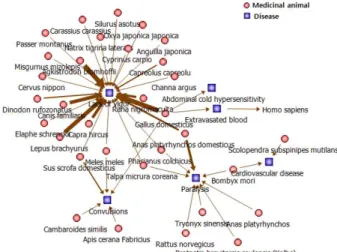
Analyzing the interrelationships among 66 ailments and 49 medicinal animals that were recorded in the study area revealed that
Canis familiariswas used the most (Fig. 4).
Fig. 4. The network map of ailments - medicinal animals in Songnisan National Park.
The highest associated category recorded is the lack
of vigor within circulatory system disorders. Treatment
for this medical concern is connected with the following
three species:
Agkistrodon blomhoffi, Gallus domesticus,and
Canis familiaris,along with 23 species among the
49 total species (Fig. 5).
Fig. 5. The network map for circulatory system disorders.