Kor. J. Hort. Sci. Technol. 31(3):317-321, 2013 DOI http://dx.doi.org/10.7235/hort.2013.12189
절화 장미 ‘Brut’의 절화수명에 미치는 유리염소의 항균효과
이영분1ㆍ김완순1,2*
1서울시립대학교 환경원예학과, 2서울시립대학교 자연과학연구소
Antimicrobial Effect of Free Available Chlorine on Postharvest Life of Cut Rose ‘Brut’
Young Boon Lee
1and Wan Soon Kim
1,2*1
Department of Environmental Horticulture, The University of Seoul, Seoul 130-743, Korea
2
Natural Science Research Institute, The University of Seoul, Seoul 130-743, Korea
Abstract. This study was conducted to investigate the antimicrobial effect of freely available chlorine (FAC) on the vase life of cut rose ‘Brut’ (Rosa hybrida L.). Postharvest treatments to extend the vase life of cut roses were divided into holding solution treatment and pulsing solution treatment. In holding solution treatment, the cut roses were treated with the preservative solutions containing FAC (0, 10, 20, and 40 mg・L
-1) and sucrose (0 and 2%, w/v). In pulsing solution treatment, cut roses were dipped into the FAC solutions of 100, 200, and 400 mg・L
-1for 10 seconds. The longest vase life of cut roses was observed in the holding solution with FAC 20 mg・L
-1as 12 days, followed by pulsing with 400 mg・L
-1as 11 days, which were four or five days longer than the control. In addition, relative fresh weight and water uptake were the highest in the holding solutions with FAC 20 and 40 mg・L
-1. The antimicrobial effect of FAC in vase solution was lasted for eight days after treatment, which was offset by sucrose addition. FAC contents in the FAC holding solution mixed with sucrose were exhausted by 88% two days after treatment, whereas only 15% of FAC was reduced in the holding solution without sucrose. This study indicated that FAC can be applied to extension of the postharvest life of cut roses by antimicrobial activity.
Additional key words: bacteria, preservative solution, pulsing, sucrose
*Corresponding author: [email protected]
※ Received 25 September 2012; Revised 23 January 2013; Accepted 21 February 2013. 본 논문은 농촌진흥청 공동연구사업(과제번호:
PJ9070501506)의 지원에 의해 이루어진 것임.
서 언
장미는 다른 절화류와 달리 잎이 많고 넓기 때문에 재배 기간 중 수분요구도가 매우 높은 작물이며(Kim and Lieth, 2012), 수확 후에도 원활한 수분 공급이 장미 절화수명 연 장에 가장 중요하다(de Stigter and Broekhuysen, 1989). 절 화의 수명단축을 초래하는 수분결핍 증상은 수확과정에서 줄기 절단에 의한 도관조직의 물리적 폐쇄나 도관 내 공기 층 형성, 유기물질 축적이나 세균 등 미생물 증식으로 인한 도관 막힘에 의해 주로 발생하는데, 절화 장미의 경우 세균 증식에 의한 도관 막힘과 절단부위 부패가 주된 원인으로 보고되었다(de Witte and van Doorn, 1988; van Doorn, 1989). 그동안 절화 장미의 수명 연장을 목적으로 aluminum
sulfate, Physan 20
TM, 8-hydroquinoline sulfate(8-HQS), silver nitrate 등의 살균제를 농가에서 수확 후 저장 단계에서 침지 용으로 사용하거나 수송 및 유통 과정에서 보존용액에 혼합 하여 사용해 왔다(Knee, 2000; van Doorn et al., 1990).
하지만 이들 살균제들은 폐기 과정에서 환경오염을 유발 하는 문제로 상업적 이용이 점차 제한되면서 친환경 대체 물질에 대한 요구가 늘어나고 있다(Gebhart and Kappauf, 1980).
유리염소(free available chlorine, FAC)는 식수나 신선
청과물의 살균 및 세척에 사용되고 있으며, 다른 살균제와
는 달리 용해 후 일정 시간이 지나면 기화되어 폐기물이
발생하지 않는 장점을 갖고 있다(Macnish et al., 2010; van
Doorn et al., 1990). 또한 절화의 수확 후 보존용액이나 선
별과정에서 세균 번식을 억제시키는데 유용한 것으로 알려 져 있다(Knee, 2000; van Doorn et al., 1989). 염소(Cl)는 pH 7.5 물에 용해되면 유리염소 상태인 HOCl(hypochlorous acid)과 OCl
-(hypochlorite ion)이 평형상태를 유지하게 되는 데, 이 때 HOCl이 세균과 같은 미생물의 세포벽, 단백질, 핵산 을 산화시켜 미생물을 파괴하는 강력한 살균력을 가지는 것으 로 알려져 있다(McDonnell and Russell, 1999). 이 외에도 염 소는 NaOCl(sodium hypochlorite), DICA(dichloroisocyanuric acid, C
3HCl
2N
3O
3) 등의 형태로 이용되며(Macnish et al., 2010; Xie et al., 2008), 그 중 NaOCl은 폐기과정에서 화학 물질이 남지 않고 비용이 저렴한 물질로 절화의 보존용액, 장비소독, 과일과 채소 표면의 세균 소독에 사용되고 있다 (van Doorn et al., 1990). 한편, 장미 절화에서 NaOCl을 전 처리제로 사용하여 잿빛곰팡이병 발생이 억제되었고(Macnish et al., 2010), DICA를 보존용액에 처리했을 때 절화의 수명 이 연장되었다(Xie et al., 2008). 따라서 본 연구는 식수와 신선채소 살균 및 세척용으로 사용되고 있는 FAC를 대상으 로 장미 절화수명 연장효과를 알아보고자 수행되었다.
재료 및 방법
식물 재료 및 FAC 처리
2011년 4월 27일 오전 9시 고양시 소재 화훼단지 내 생산 농가에서 양액재배로 생산된 스탠다드 절화장미 ‘Brut’ 품 종을 상업적 수확단계(Kumar et al., 2008)에 길이 70cm로 수확하여 1시간 물올림 한 후 흑색 비닐로 밀봉하여 암・건 식 조건으로 1시간 이내 서울시립대 환경화훼연구실로 수송 하였다. 수송된 절화의 줄기를 45cm 길이로 물 속에서 재절 단하고 잎은 줄기 기부방향으로 3매엽 2개와 5매엽 1개를 남기고 모두 제거하였다. 줄기 기부로부터 1cm 상부의 직경 이 7-9mm에 해당하는 절화를 선별하여 실험재료로 사용하 였다. 유리염소 발생장치(Enogen, Duk Young Engineering Inc, Korea)를 이용하여 유리염소를 조제하여 보존용액(holding solution)과 침지(pulsing solution) 처리를 실시하였다. 보존 용액처리는 FAC의 항균효과와 더불어 sucrose와 혼용 가 능성을 확인하기 위하여 FAC 단용처리(Cl 0, 10, 20, 40 mg・L
-1)와 2% sucrose와의 혼용처리(Cl 10mg・L
-1+ sucrose 2%, Cl 20mg・L
-1+ sucrose 2%, Cl 40mg・L
-1+ sucrose 2%)로 구분하였다. 침지처리는 Cl 100, 200, 400mg・L
-1에 줄 기 끝을 10초간 침지한 후 증류수에 옮겨 절화수명을 조사하 였다. 각 처리별로 400mL의 보존용액 혹은 증류수가 담긴 유 리용기에 절화 1주씩 배치하였고 이를 10반복하였다. 실험환 경은 기온 23 ± 2°C, 상대습도 40 ± 5%, 광도 3µmol・m
-2・ s
-1,
일장 12시간으로 조절하였다.
절화수명
절화수명조사는 매일 오전 10시에 실시하였고, 절화수명 한계시점은 꽃목이 30° 이상 굽거나, 꽃잎이 시들거나 잎이 마르는 때로 정하였다(Lee and Kim, 2001). 실험 시작 전 절화의 초기 생체중을 측정하여 실험기간 동안 2일 간격으 로 생체중의 변화를 초기 생체중에 대한 백분율로 구하였으 며, 용액 흡수율 역시 초기 생체중당 흡수량으로 계산하였 다(Chamani and Esmaeilpour, 2007).
항균효과
항균효과를 확인하고자 절화수명이 가장 길었던 Cl 20 mg・L
-1를 대상으로 Cl 20mg・L
-1+ sucrose 2% 처리구와 2 일 간격으로 보존용액 내 유리염소의 잔존농도 변화와 세균 수를 조사하였다. 이때 유리염소의 잔존농도가 식물체 유무 에 영향을 받는지도 알아보고자 각 처리는 보존용액이 담긴 유리 용기에 절화가 들어있는지의 유무로 구분하였고, 유리 염소분석기(HI 96771 chlorine ultra high range ISM, Hanna instruments Inc. USA)를 이용하여 유리염소의 잔존 농도를 조사하였다. 처리 별 세균수 측정을 위해 보존용액을 1mL 씩 채취하여 2일 간격으로 nutrient agar 배지(NA, Difco)에 28°C에서 3일간 배양한 후 희석평판법으로 조사하였다(van Doorn et al., 1989).
통계처리
통계분석용 프로그램인 SAS package(Statistical analysis system, version 9.2, SAS Institute Inc., USA)를 이용하여 ANOVA(Analysis of variance) 분석을 실시하였으며 각 처 리간의 유의성은 DMRT(Duncan’s new multiple range test) 5% 수준으로 하였다.
결과 및 고찰
절화수명
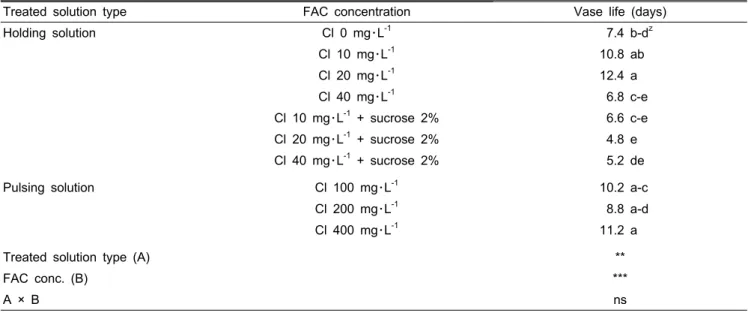
절화수명은 보존용액처리의 경우 염소 단용처리인 Cl 10
mg・L
-1과 Cl 20mg・L
-1에서 10.8, 12.4일로 대조구(7.4일)
에 비해 각각 3.4일, 5일씩 절화수명을 연장시켰으나, Cl 40
mg・L
-1에서는 대조구보다 0.6일 감소하였다(Table 1). Xie
et al.(2008)은 Cl이 30mg・L
-1이상의 농도에서는 독성을
나타내 오히려 절화수명이 단축되었다고 보고하였는데, 본
실험에서도 Cl 40mg・L
-1에서는 침지된 줄기의 일부분인
1-2cm에 백화현상이 나타나는 등 고농도 피해가 확인되었
Table 1. Effect of free available chlorine (FAC) on vase life of cut flowers of ‘Brut’ rose. The room conditions were air temperature 23 ± 2°C, RH 40 ± 5%, and light (photosynthetically active radiation, PAR) 3 µmol・m-2・s-1 (12 hours daylength). Values are mean of ten replicates.
Treated solution type FAC concentration Vase life (days)
Holding solution Cl 0 mg・L-1 7.4 b-dz
Cl 10 mg・L-1 10.8 ab
Cl 20 mg・L-1 12.4 a
Cl 40 mg・L-1 6.8 c-e
Cl 10 mg・L-1 + sucrose 2% 6.6 c-e
Cl 20 mg・L-1 + sucrose 2% 4.8 e
Cl 40 mg・L-1 + sucrose 2% 5.2 de
Pulsing solution Cl 100 mg・L-1 10.2 a-c
Cl 200 mg・L-1 8.8 a-d
Cl 400 mg・L-1 11.2 a
Treated solution type (A) **
FAC conc. (B) ***
A × B ns
zMean separation within columns by Duncan’s multiple range test, P = 0.05.
ns,**,***Nonsignificant or significant at p = 0.01, or 0.001, respectively.
Fig. 1. Effect of free available chlorine (FAC) on vase life of cut flowers of ‘Brut’ rose on fourth day after holding solution treatment. A, view of experiment; B, Cl 20 mg・L-1; C, Cl 20 mg・L-1 + sucrose 2%; D, stem bleaching arrows at Cl 40 mg・L-1. The room conditions were air temperature 23 ± 2°C, RH 40 ± 5%, and light (photosynthetically active radiation, PAR) 3 µmol・m-2・s-1 (12 hours daylength).
다(Fig. 1). 한편 Cl 농도와 관계없이 sucrose 첨가로 오히려 절화수명이 단축되었다(Table 1). Sucrose는 절화의 에너지 원으로 절화수명 연장에 필요하지만 동시에 미생물 번식에 용이하므로 살균제와 혼용하여 사용하는 것이 일반적이다 (Marousky, 1971). 본 실험에서도 미생물 증식억제를 위한 Cl과 절화 에너지원인 sucrose를 혼용하여 절화수명 기간을 연장시킬 수 있을 것으로 기대하였으나, 오히려 초기에 꽃
목굽음이 발생하여 절화수명이 단축되었다(Fig. 1). 이것은 Cl과 sucrose의 혼합과정에서 FAC의 살균력을 감소시키는 화학적 반응이 일어난 것으로 판단되는데, 보존용액 내 Cl 의 잔존량과 박테리아 밀도를 통해 이를 뒷받침할 수 있다 (Fig. 3).
Cl 100, 200, 400mg・L
-1침지처리에서도 절화수명이 연 장되었으며, 특히 Cl 400mg・L
-1에서 11.2일로 가장 효과적 이었다(Table 1). 이러한 결과는, 절화 장미 ‘Akito’, ‘Gold Strike’를 대상으로 한 NaOCl 0, 100, 200, 400, 800µL・L
-110초간 침지처리에서 Cl 400µL・L
-1에서 절화수명 연장효과 가 가장 우수하였고, 800µL・L
-1침지처리에서는 잿빛곰팡 이 발생이 억제되었으나 줄기의 백화현상도 나타났다는 보 고와 유사하였다(Macnish et al., 2010).
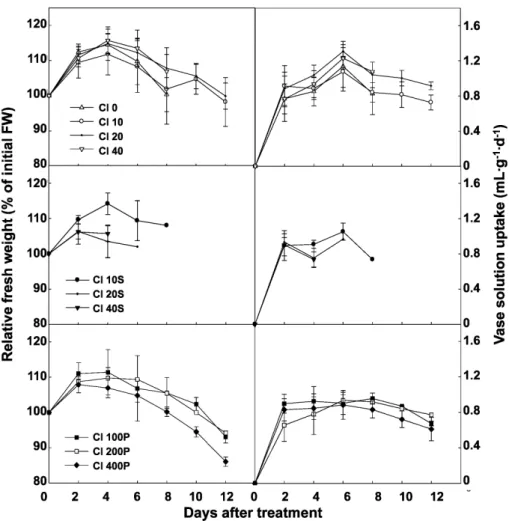
상대 생체중은 전반적으로 처리 4일째부터 감소하였으
며, 절화수명이 가장 짧았던 Cl 20mg・L
-1+ sucrose 2%와
Cl 40mg・L
-1+ sucrose 2% 보존용액처리에서 생체중 감소
율이 크게 나타났다(Fig. 2). 용액 흡수율 역시 절화수명이
가장 길었던 Cl 20mg・L
-1처리에서 가장 높았으며, Cl 단용
보존용액처리에서는 처리 후 6일까지 지속적으로 증가하였
으나 sucrose 혼용 보존용액처리 및 침지처리에서는 일정한
수준을 유지하였다(Fig. 2). 이상에서 장미 절화의 수명은
생체중과 용액흡수율과 밀접한 관계가 있으며, 처리 2-6일
경에 뚜렷한 경향을 보이므로 FAC에 의한 절화수명 연장효
과는 이 시기에 집중되는 것으로 판단된다.
Fig. 2. Effect of free available chlorine on relative fresh weight and solution uptake by cut flowers of ‘Brut’ rose. Cl 0, Cl 0 mg・L-1 (control); Cl 10, Cl 10 mg・L-1; Cl 20, Cl 20 mg・L-1; Cl 40, Cl 40 mg・L-1; Cl 10S, Cl 10 mg・L-1 + sucrose 2%; Cl 20S, Cl 20 mg・L-1 + sucrose 2%; Cl 40S, Cl 40 mg・L-1 + sucrose 2% (holding solution). Cl 100P, Cl 100 mg・L-1; Cl 200P, Cl 200 mg・L-1, and Cl 400P, Cl 400 mg・L-1 for 10 seconds (pulsing solution). The room conditions were air temperature 23 ± 2°C, RH 40
± 5%, and light (photosynthetically active radiation, PAR) 3 µmol・m-2・s-1 (12 hours daylength). Vertical bars indicate the standard error (n = 10).
항균효과
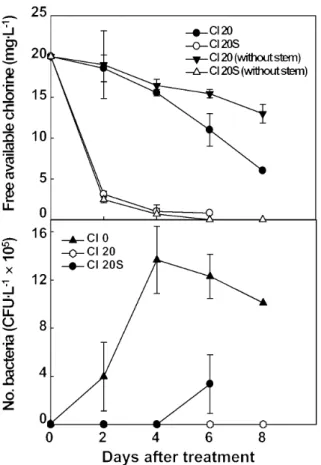
FAC의 항균효과를 알아보고자 절화수명 기간이 가장 길 었던 Cl 20mg・L
-1처리구와 가장 짧았던 Cl 20mg・L
-1+ sucrose 2% 처리구를 대상으로 식물체 유무 조건에서 FAC 잔존량을 측정하였다. 그 결과 sucrose를 넣지 않은 Cl 20 mg・L
-1처리구에서는 FAC 농도가 처리 후 4일까지는 식물 체 유무에 상관없이 약 15% 감소하였으나, 이후 식물체 유 무에 따라 8일째 각각 70%, 35% 감소하였다(Fig. 3). 이것 은 Grevillea ‘Crimson Yul-lo’를 대상으로 Cl 10-40mg・L
-1보존용액 처리 시 FAC의 대부분이 Cl 10mg・L
-1에서는 2일, Cl 20mg・L
-1에서는 4일, Cl 40mg・L
-1은 8일이 경과 후 소진 되었다는 보고와 유사하였다(Xie et al., 2008). Fig. 2에서 Cl 40mg・L
-1처리구의 경우 처리 초기인 2일까지는 생체중 과 용액흡수율이 대조구보다 낮았으나 4일 이후 오히려 증 가된 것은 용액 내 FAC의 농도가 적정 범위로 낮아졌기 때 문으로 생각된다. 따라서 FAC 잔존 정도가 절화수명에 직
접적인 영향을 주고 있음을 확인할 수 있다. 한편, sucrose가 포함된 Cl 20mg・L
-1+ sucrose 2% 처리구에서는 FAC 농도 가 식물체 유무와 상관없이 처리 후 2일째 88%가 감소하였 고, 4일째부터는 거의 검출되지 않아 유리염소의 감소가 sucrose와 관련 있을 것으로 판단되나, 기작에 대한 관련 보 고가 없어 추가적인 연구가 필요할 것으로 생각된다.
보존용액 내 세균수 역시 FAC 잔존 유무에 의존적이었다 (Fig. 3). 대조구의 경우 처리 후 2일째부터 세균이 검출되었 으나, Cl 20mg・L
-1처리구에서는 8일 동안 검출되지 않았 고, Cl 20mg・L
-1+ sucrose 2% 처리에서는 처리 6일째부터 검출되기 시작했다. 따라서 보존용액 내 유리염소가 세균의 발생억제에 직접적으로 작용하며 이러한 유리염소의 항균효 과는 장미의 절화수명 연장에 효과적인 것으로 확인되었다.
이상의 연구 결과에서 유리염소를 처리한 보존용액이 절화
장미의 수명연장에 효과적이었으며, 보존용액 내 유리염소
의 적정 농도 범위는 10-20mg・L
-1로 나타났다. 유리염소 침
Fig. 3. Changes in concentration of free available chlorine and number of bacteria in the vase solution with or without cut rose stem. For treatments, refer to Table 1. The room conditions were air temperature 23 ± 2°C, RH 40 ± 5%, and light (photosynthetically active radiation, PAR) 3 µmol・m-2・s-1 (12 hours daylength). Vertical bars indicate the standard error (n = 10).
지처리의 경우 적정농도는 Cl 400mg・L
-1이 효과적이었으 나, 항균 효과의 지속도 측면에서 침지처리보다는 보존용액 처리가 수출용 장기 습식수송에는 적합할 것으로 판단된다.
초 록
본 연구는 유리염소(free available chlorine, FAC)의 항 균 효과가 장미 ‘Brut’ 품종의 절화수명에 미치는 영향을 알아보고자 실시하였다. 절화수명 연장처리는 보존용액처 리와 침지처리로 구분하였다. FAC 보존용액처리는 FAC 단용처리(Cl 0, 10, 20, 40mg・L
-1)와 sucrose와의 혼용처리 (Cl 10mg・L
-1+ sucrose 2%, Cl 20mg・L
-1+ sucrose 2%, Cl 40mg・L
-1+ sucrose 2%)로 구분하여 실시하였고, FAC 침지처리는 Cl 100, 200, 400mg・L
-1에서 10초 동안 실시하 였다. 장미 절화수명은 Cl 20mg・L
-1보존용액처리에서 12 일로 가장 길었고, Cl 400mg・L
-1침지처리에서 11일로 나타 났으며, 이들 처리는 대조구보다 4-5일 연장효과를 나타냈 다. 생체중과 용액흡수율 역시 Cl 20-40mg・L
-1보존용액처
리에서 가장 높았다. 최대 8일간 지속된 FAC 항균효과는 sucrose 혼용으로 상쇄되었다. FAC의 잔존량은 처리 2일째 sucrose 첨가 시 88%가 감소한 반면, Cl 20mg・L
-1단독 처 리에서는 15%만이 감소하였다. 이상의 결과에서 장미 절화 수명 연장에 FAC의 항균효과가 인정되었다.
추가 주요어 : 세균, 보존용액, 침지처리, 당
인용문헌
Chamani, E. and B. Esmaeilpour. 2007. Thidiazuron effects on physiochemical characteristics of carnation during pre and postharvest periods. J. of Appl. Hort. 9:115-117.
de Stigter, H.C.M. and A.G.M. Broekhuysen. 1989. Secondary gas embolism as an effect of disturbed water balance in cut roses. Acta Hort. 261:17-26.
de Witte, Y. and W.G. van Doorn. 1988. Identification of bacteria in the vase water of roses, and the effect of the isolated strains on water uptake. Scientia Hort. 35:285-291.
Gebhart, E. and H. Kappauf. 1980. The action of three anticlastogens on the induction of sister chromatid exchange by Trenimon and 8-hydroxyquinoline sulfate in human lymphocyte cultures.
Environ. Mutagen. 2:191-200.
Kim, W.S. and H. Lieth. 2012. Simulation of year-round plant growth and nutrient uptake in Rosa hybrida over flowering cycles. Hort. Environ. Biotechnol. 53:193-203.
Knee, M. 2000. Selection of biocides for use in floral preservatives.
Postharvest Biol. Technol. 18:227-234.
Kumar, N., G.C. Srivastava, and K. Dixit. 2008. Hormonal regulation of flower senescence in roses (Rosa hybrida L.).
Plant Growth Regul. 55:65-71.
Lee, J.S. and Y.A. Kim. 2001. Effects of harvesting stages and holding solutions on quality and vase life of cut ‘Madelon’
rose flowers. J. Kor. Soc. Hort. Sci. 42:743-747.
Macnich, A.J., K.L. Morris, A. de Theije, and M.G.J. Mensink.
2010. Sodium hypochlorite: A promising agent for reducing Botrytis cinerea infection on rose flowers. Postharvest Biol.
Technol. 3:262-267.
Marousky, F.J. 1971. Inhibition of vascular blockage and increased moisture retention in cut rose induced by pH, 8-hydrowyquinoline citrate, and sucrose. J. Amer. Soc. Hort. Sci. 96:38-41.
McDonnell, G. and A.D. Russell. 1999. Antiseptics and disinfectants:
Activity, action and, resistance. Clin. Microbiol. Rev. 12:147-179.
van Doorn, W.G. 1989. Role of physiological processes, micro- organisms and air embolism in vascular blockage of cut rose flowers. Acta Hort. 261:27-34.
van Doorn, W.G., K. Schurer, and Y. de Witte. 1989. Role of endogenous bacteria in vascular blockage of cut rose flowers.
J. Plant Physiol. 134:375-381.
van Doorn, W.G., Y. de Witte, and R.R.J. Perik. 1990. Effect of antimicrobial compounds on the number of bacteria in stems of cut rose flowers. J. Appl. Bacteriol. 68:117-122.
Xie, L., D.C. Joyce, D.E. Irving, and J.X. Eyre. 2008. Chlorine demand in cut flower vase solutions. Postharvest Biol. Technol.
47:267-270.