복분자 에탄올 추출물의 식중독 관련 위해 세균에 대한 항균활성 분석
전연희·순샤오칭·김미라1†
경북대학교 식품영양학과, 1경북대학교 식품영양학과·장수생활과학연구소
Antimicrobial Activity of the Ethanol Extract from Rubus coreanum against Microorganisms Related with Foodborne Illness
Yeon-Hee Jeon, Xiaoqing Sun and Meera Kim1†
Department of Food Science and Nutrition, Kyungpook National University,
1Department of Food Science and Nutrition, Center for Beautiful Aging, Kyungpook National University
Abstract
This study analyzed the antibacterial activity of a Rubus coreanum (Bokbunja) ethanol extract. The antimicrobial activity was determined by disc diffusion, minimum inhibitory concentration (MIC), and growth inhibition methods with seven kinds of bacteria related to foodborne illness (Bacillus cereus, Escherichia coli, Escherichia coli O157:H7, Listeria monocytogenes, Pseudomonas aeruginosa, Staphylococcus aureus, and Salmonella typhimurium). In the results, disc diffusions of the ethanol extract from R. coreanum (9.8-17.5 mm at 4,000 μg/disc) clearly showed the antimicrobial activity of the extract against all tested microorganisms. Rubus coreanum promoted an inhibitory effect as follows:
E. coli O157:H7 ˃ P. aeruginosa ˃ L. monocytogenes ˃ E. coli ˃ S. aureus ˃ B. cereus ≥ S. typhimurium. In the MIC test, R. coreanum showed high antimicrobial effect against L. monocytogenes at 500 ppm. Moreover, the R. coreanum ethanol extract showed strong growth inhibition against microorganisms, similar to the MIC results. These results show that a R. coreanum ethanol extract has powerful antimicrobial activity against all tested microorganisms, suggesting that R. coreanum will be useful as a potential natural preservative.
Key words : Rubus coreanum, antimicrobial activity, growth inhibition
I. 서 론1)
식품의약품안전청의 통계 자료 시스템에 따른 최근 몇 년 간 국내의 식중독 발생현황을 보면 2002년부터 식중독 발생 건수가 꾸준히 증가하다가 2008년과 2009년에는 감소하는 추 세를 보였으나 2010년에는 식중독 발생건수 및 환자수가 다 시 증가하였다. 또한 식중독 발생 원인으로는 물리ㆍ화학ㆍ생 물학적인 다양한 요소들이 존재하나 미생물에 의한 식중독 발생률이 높은 비율을 차지하고 있다. 이에 대한 국내 원인 균별 식중독 발생건수를 보면 병원성 대장균이 가장 큰 식중
†Corresponding author : Meera Kim, Department of Food Science and Nutrition, Kyungpook National University, Daegu, 702-701, South Korea.
Tel: +82-53-950-6233 Fax: +82-53-950-6229 E-mail: [email protected]
독 원인균이 되고 있고 살모넬라와 황색포도상구균 및 바실 러스 등이 주요 식중독 원인균으로 대두되고 있다(Available from: http://e-stat.kfda.go.kr. Accessed Sep. 10, 2011). 따라서 미생물로부터 식품의 안전성을 확보하기 위해 항균 물질에 대한 다양한 연구들이 보고되고 있으며 인체에 유해하지 않 은 천연 항균 물질의 개발 요구도가 높아지고 있다.
천연에 존재하는 항균물질로는 동ㆍ식물 내의 단백질, 효 소, 유기산, 중급지방산, 식물의 정유성분, 색소, humulones, lupulones, hydroxycinnamic acid 배당체, oleuropein, caffein, theophylline, theobromine, phytoalexins 등이 알려져 있으며 (Beuchat LR와 Golden DA 1989), 유기산 및 phytochemical인 phenolic acid와 flavonoid 화합물의 함량이 항균 활성과 비례 적인 상관관계를 나타내는 것으로 보고되었다(Jang JS 등 2007, Kim JY 등 2007). 그 밖에 천연 항균 물질 개발을 위 한 연구의 일환으로 최근 국내에서는 약리작용이 있는 한약 재를 이용한 항균성 물질의 탐색이 활발히 진행되고 있다(Lee
BW와 Shin DH 1991, Chung HY 등 2000, Lee YC 등 2002, Doh ES 2010, Yu YE 등 2010).
복분자(Rubus coreanum)는 전통주 제조와 음료 등의 식용 원료와 화장품의 원료로 이용될 뿐만 아니라 예로부터 한방 에서는 복분자 미숙과를 당뇨병 및 발기부전 치료, 청량(淸
凉), 지갈(止渴), 강장약(强壯藥) 등의 한약재로 사용하고 있다
(배기환 2000, Moon GS 1991). 복분자의 생리활성에 관한 연 구들로는 항돌연변이 활성과 암세포 성장 억제 효과(Jeon YH 등 2009)와 항종양 효과(Park JH 등 2006), 면역활성 증진 효 과(Kim DH 등 2005) 및 식품의 저장성에 미치는 효과 등이 보고되었고(Cho EJ 등 2006, Oh SW 등 2002), Han SH 등
(2006)은 복분자의 잎과 줄기에 항균활성 물질로 알려진
tannin 및 flavonoids 화합물이 함유되어 있다고 보고하였다. 복분자는 차와 주류 및 다양한 식품의 재료로 사용되고 있어 이들의 항균성은 식품 안전성 면에서 중요한 의미를 가지고 있다. 따라서 본 연구에서는 항균성을 가지고 있는 천연소재 를 탐색하기 위하여 복분자 에탄올 추출물의 항균 활성을 측 정하고 항균성과 관련된 복분자에 함유된 총 폴리페놀 및 총 플라보노이드 함량을 측정하였다.
II. 재료 및 방법
1. 실험 재료
1) 실험재료 및 시약
본 실험에서 사용된 복분자는 전라남도 고창에서 재배하여 수확된 제품을 구입하여 냉동보관하며 시료로 사용하였다. 균 배양을 위한 nutrient broth와 nutrient agar 및 tryptic soy broth 는 Acumedia Co.(Michigan, USA)에서 구입하였고, dimethyl sulfoxide(DMSO)는 Duksan Chemical Co.(Kyungkido, Korea)로 부터 구입하여 사용하였으며, 실험에 사용된 모든 증류수는 3 차 증류수를 멸균하여 이용하였다.
2) 추출물 제조
복분자 100 g을 분쇄하여 여기에 70% 에탄올 2 L를 가하 여 실온에서 12시간 진탕한 후 여과지(Toyo No. 2, Advantec.
Japan)로 여과하였다. 여과액은 감압농축기(EYELA, N-1000, Rikakikai Co. Japan)를 이용하여 농축한 후 동결건조를 통해 건조시켰으며 건조된 추출물은 –20℃에서 냉동 보관하였다. 실험에 사용된 모든 시료 용액은 syringe filter(Advantec 0.2 μm, Japan)로 제균하여 사용하였다.
3) 실험 균주의 배양
식중독 관련 미생물인 총 7개의 균주를 이용하여 시료의 항균 활성을 측정하였으며, 실험에 사용된 균주와 배지는
Table 1과 같다. 균주는 한국생명공학연구원 생명자원센터에
서 공급받았고 각 균에 적합한 배지를 이용하여 37℃ 배양기 에서 24시간 계대배양하며 실험에 이용하였다.
Microorganisms Strain Medium
Gram positive
Bacillus cereus KCTC 1012 Nutrient broth Listeria monocytogenes KCTC 3569 Tryptic soy broth
Staphylococcus aureus KCTC 1916 Nutrient broth Gram negative
Escherichia coli KCTC 1682 Nutrient broth Escherichia coli O157:H7 ATCC 43894 Nutrient broth Pseudomonas aeruginosa KCTC 1750 Nutrient broth Salmonella typhimurium KCTC 2515 Nutrient broth Table 1. Microorganisms and culture medium used for antimicrobial
activity tests
2. 항균성 측정
1) 생육저해환(Disc diffusion) 측정
각 균에 대한 항균활성 측정을 위해 각 균에 적합한 액체 배지를 이용해 37℃에서 12시간 동안 배양한 미생물 배양액 을 UV/Vis spectrophotometer(Beckman, USA)를 600 nm에서 흡광도가 0.3이 되도록 희석한 후, 100 μL를 취해 nutrient agar plate에 도말하고 4℃에서 2시간 동안 고착시켰다. 고착 된 균 위에 멸균된 paper disc(직경 6 mm, Advantec, Japan) 를 놓고, 농도별 시료를 20 μL씩 각 paper disc에 분주한 후 37℃의 incubator에서 배양하였다. 24시간 배양한 후 paper
disc 주위에 생성된 clear zone의 크기를 측정하였다
(McFarland J 1907, Bauer AW 등 1966, Kwak DJ 등 2002).
2) 최소생육저해농도(Minimum inhibition concentration, MIC) 측정
실험에 이용된 미생물에 대한 시료의 최소저해농도를 측정 하기 위하여 micro-well dilution법(Demircia F 등 2008)을 실 시하였다. 배양한 미생물을 희석하여 96-well plate의 각 well 에 100 μL씩 분주하였다. 배양액을 분주한 각 well에 시료 100 μL를 첨가하여 최종 농도가 4,000 ppm, 2,000 ppm, 1,000 ppm, 500 ppm이 되도록 two-fold dilution으로 희석한 후 ELISA reader(Tecan-Sunrise, Komabiotech, Australia)를 이용
해 600 nm에서 흡광도를 측정하였다. 흡광도를 측정한
96-well plate를 37℃에서 24시간 배양한 후 동일한 파장에서
ELISA reader로 흡광도를 측정하여 흡광도의 증가가 나타나지
않는 최소 농도를 확인하였다.
Concentration
(μg/disc) Clear zone (mm)1)
B. cereus E. coli E. coli O157:H7 L. monocytogenes P. aeruginosa S. aureus S. typhimurium 500 6.0±0.02)D3)e4) 7.5±0.4Cb 9.0±0.0Bc 6.0±0.0Dc 9.7±0.5Ab 6.0±0.0Dc 6.0±0.0Dc 1,000 6.8±0.2CDd 7.7±0.5Cb 13.2±1.3Ab 7.0±0.1CDc 10.3±0.5Bb 6.0±0.0Dc 6.0±0.0Dc 2,000 7.8±0.2Cc 8.0±0.0Cb 14.3±1.7Ab 12.0±0.1Bb 11.0±0.8Bb 8.3±0.5Cb 9.0±0.0Cb 3,000 8.8±0.2Db 9.7±0.9Dab 16.7±0.5Aa 13.5±0.1Bab 11.8±0.2Cb 9.7±0.5Da 9.5±0.7Dab 4,000 9.8±0.2Da 11.0±2.2CDa 17.5±0.4Aa 15.0±0.1BCa 15.0±2.8ABa 10.3±0.9Da 9.8±0.4Da
1) Clear zone on plate (disc size: 6.0 mm)
2) Mean±SD of triplicated experiments
3)A~D
significance among microorganisms at the same concentration (p˂0.05)
4) a~d
significance among different extract concentrations against the same microorganism (p˂0.05) Table 2. Disc diffusion of ethanol extracts from Rubus coreanum against target microorganisms
3) 생육저해도(Growth inhibition) 측정
미생물 생육에 미치는 시료의 영향력을 평가하기 위해 Turbidimetric assay를 이용하였다(Davidson PM과 Parish ME 1989, Cho GS와 Kim HY 2003, Oh DH 등 1999). 미생물 배 양액에 시료를 넣은 후 UV/Vis spectrophotometer를 이용하여 24시간 동안 배양액의 흡광도를 측정하였다. 액체배지에서 12 시간 동안 배양한 미생물 배양액의 흡광도가 0.3이 되도록 희 석한 뒤, 멸균된 conical tube에 희석한 균 액 100 μL와 시료의 최종 농도가 1,000 ppm, 3,000 ppm이 되도록 시료 1 mL를 첨가하고 액체 배지를 넣어 총 부피를 30 mL로 맞추었다. 이 들 conical tube를 37℃ 진탕배양기에서 배양하면서 사용되는 배양액과 600 nm에서 4시간 마다 흡광도를 측정하였다.
3. 총 폴리페놀 및 총 플라보노이드 함량 측정
복분자 에탄올 추출물에 함유된 총 폴리페놀 및 총 플라보 노이드 함량을 측정하였다. 총 폴리페놀 함량은 Folin-Denis 법(Singleton VL과 Rossi JA 1965) 측정을 위해 증류수 5 mL와 시료 1 mL 및 Folin-Ciocalteau 시약 0.5 mL를 순서대로 혼합 하여 8분간 반응 후, 7% Na2CO3 10 mL를 첨가하였다. 증류 수를 이용하여 최종 부피를 25 mL로 맞추고 2시간 후에 750 nm에서 흡광도를 측정하였다. 총 폴리페놀 함량을 측정하기 위하여 gallic acid를 표준물질로 하여 검량곡선을 구하였다.
총 플라보노이드 함량은 Moreno MI 등(2000)의 방법에 따 라 10% aluminum nitrate 0.1 mL와 1 M potassium acetate 0.1 mL 및 80% 에탄올 4.3 mL 혼합액에 시료 0.5 mL를 첨 가하여 40분간 방치한 후 510 nm에서 흡광도를 측정하여 총 플라보노이드 함량을 구하였다. 총 플라보노이드 함량은
quercetin을 표준물질로 하여 검량곡선을 구하여 산출하였다.
4. 통계분석
본 연구의 통계처리는 SPSS (version 18.0) 프로그램을 이용 하였고, 평균값의 유의성은 p<0.05 수준에서 일원분산분석과
Duncan의 다중범위분석을 이용하여 검증하였다.
III. 결과 및 고찰
1. 생육저해환
70% 에탄올을 이용하여 복분자를 추출한 결과 7.9%의 추 출수율을 나타내었고, 추출된 복분자 에탄올 추출물을 이용하 여 7가지의 식중독 관련 균주에 대한 생육저해환을 측정한 결과는 Table 2와 같다. 복분자 에탄올 추출물은 모든 균주에 대해 추출물의 농도가 높아질수록 각 균에 대한 생육저해환 의 크기가 증가하는 양상을 나타내었고, 균주에 따라 동일한 농도에서도 각기 다른 크기의 생육저해환을 나타내었다. 따라 서 같은 속 균주라 하더라도 종에 따라 항균제에 대한 활성 이 다르게 나타난다는 Shin DH 등(1997)과 Lee KU 등(1994) 의 보고와 같이 각 균에 대한 복분자 에탄올 추출물의 감수 성이 다른 것으로 확인되었다. 복분자 에탄올 추출물은 대부분 의 농도에서 E. coli와 E. coli O157:H7에 대한 생육저해환의 크 기가 다른 균에 비해 크게 나타났으나 저농도인 500 μg/disc에 서는 P. aeruginosa에 대한 생육저해환이 9.7 mm로 가장 크 게 나타났다. 또한 실험에 사용된 추출물의 농도 중 가장 고 농도인 4,000 μg/disc에서 복분자 에탄올 추출물은 E. coli O157:H7 ˃ P. aeruginosa ˃ L. monocytogenes ˃ E. coli ˃ S. aureus ˃ B. cereus ≥ S. typhimurium 순으로 항균활성을 나타내어 7가지 균주에 대해 9.8~17.5 mm의 뚜렷한 생육저 해환을 나타내었다(Table 2). Lee KI 등(2011)은 복분자 메탄 올 추출물의 S. aureus에 대한 생육저해환이 3,000 μg/disc에
서 복분자의 부위에 따라 9.71~11.65 mm로 나타나 본 연구 결과에서 나타난 9.7 mm와 비슷하거나 다소 높은 생육저해 환을 나타내었으나, Kim HY 등(1999)의 천연물에 대한 항균 실험 결과에서는 B. cereus와 L. monocytogenes에 대한 복분 자 메탄올 추출물의 생육저해환은 나타나지 않았다. 또한 Lee YC 등(2002)이 62 종의 약용식물에 대한 항균 활성 측정 결 과 복분자 80% 에탄올 추출물의 E. coli와 L. monocytogenes 에 대한 높은 항균력이 보고되어 추출 용매의 종류에 따라 항균력에 차이가 있는 것으로 나타났다. 본 연구에서는 복분 자 에탄올 추출물이 7가지 균주에 대해 뚜렷한 생육저해환을 나타냄으로써 다양한 식중독 관련균주에 대한 높은 항균력을 가지고 있음을 확인할 수 있었으며, 그 중에서도 E. coli O157:H7과 P. aeruginosa은 Figure 1과 같이 복분자 추출물에 대해 뚜렷한 생육저해환을 나타내었다.
E. coli O157:H7 P. aeruginosa
Figure 1. Clear zone of the ethanol extract from Rubus coreanum against E. coli O157:H7 and P. aeruginosa.
(①: 500 μg/disc, ②: 1,000 μg/disc, ③: 2,000 μg/disc, ④: 3,000 μg/disc,
⑤: 4,000 μg/disc)
2. 최소생육저해농도
Disc diffusion을 통해 복분자 에탄올 추출물이 높은 항균력 을 갖고 있음을 확인하였고, 이를 기초로 7가지 식중독 관련 균주의 생육을 저해시키는 최소저해농도인 MIC를 측정한 결
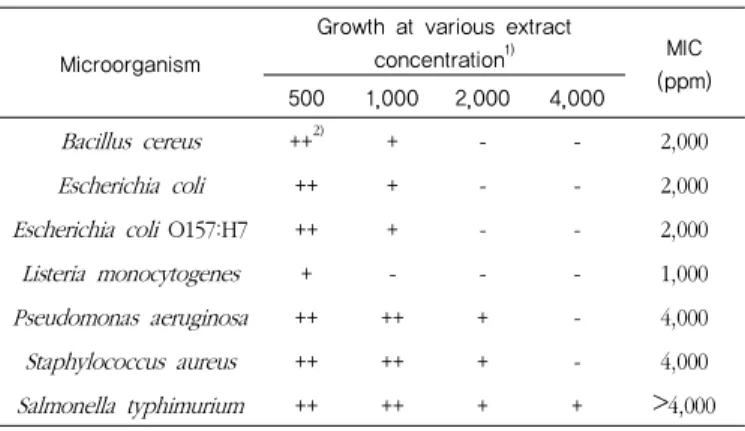
과 Table 3과 같은 결과를 얻었다. 복분자 에탄올 추출물은
본 연구에서 사용된 농도범위에서 S. typhimurium을 제외한 다른 모든 균에 대한 완전한 생육 저해 효과를 나타내었다. 복분자 에탄올 추출물은 E. coli와 E. coli O157:H7, B. cereus 에 대해서는 2,000 ppm의 농도에서 생육이 관찰되지 않아 2,000 ppm의 MIC를 나타내었고, P. aeruginosa와 S. aureus의 생육에 대해서는 4,000 ppm의 MIC값을 나타내어 앞의 생육 저해환 측정을 통한 항균력 측정 결과와 같이 E. coli와 E.
coli O157:H7에 대한 항균활성이 큰 것으로 나타났다. 또한 복분자 에탄올 추출물은 L. monocytogenes의 증식에 대한 MIC가 1,000 ppm으로 가장 낮은 농도의 추출물에 의해 생육 이 저해되는 것으로 나타나 L. monocytogenes에 대한 항균활 성이 가장 높게 나타났다. 이는 E. coli에 대한 항균 활성이 가장 높았던 생육저해환 측정에 의한 항균 활성 결과와는 다
소 다른 양상을 나타낸 것으로 Tabak M 등(1996)과 Lee JJ 등(1999), Kang SK(1995)에 의해 보고된 것과 같이 고체를 이 용한 배양법과 액체를 이용한 배양법에서 추출물이 확산되는 정도의 차이에 기인한 것으로 사료된다.
Microorganism
Growth at various extract
concentration1) MIC
(ppm) 500 1,000 2,000 4,000
Bacillus cereus ++2) + - - 2,000
Escherichia coli ++ + - - 2,000
Escherichia coli O157:H7 ++ + - - 2,000
Listeria monocytogenes + - - - 1,000
Pseudomonas aeruginosa ++ ++ + - 4,000
Staphylococcus aureus ++ ++ + - 4,000
Salmonella typhimurium ++ ++ + + ˃4,000
1)extract concentration: ppm
2)++: Growth, +: Inhibition of microorganism, -: No growth
Table 3. Minimum inhibitory concentration (MIC) against target microorganisms of the ethanol extracts from Rubus coreanum
3. 생육저해도
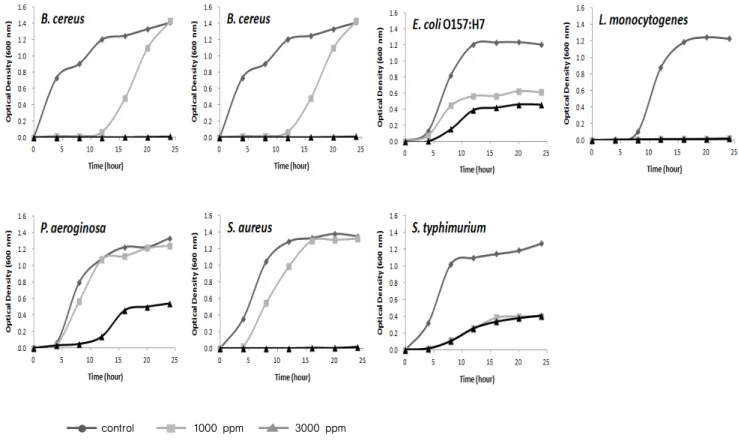
복분자 에탄올 추출물을 첨가한 미생물의 생육저해곡선을 24시간 동안 측정한 결과는 Figure 2와 같다. 앞서 언급한 MIC 결과에서 복분자 에탄올 추출물은 S. typhimurium을 제 외한 균주들에 대해 1,000~4,000 ppm의 범위에서 MIC값을 나 타내었으므로 이를 고려하여 추출물 1,000 ppm과 3,000 ppm 에 대한 미생물의 생육저해곡선을 측정하였다. Figure 3에서 나타난 바와 같이 추출물을 첨가하지 않은 7가지 미생물의 성장곡선은 균주에 따라 차이는 있었으나 대부분 4시간가량 의 짧은 유도기와 대수기를 거쳐 12시간을 기점으로 정지기 를 나타내었다. 복분자 에탄올 추출물을 첨가한 각 미생물 배양액에서 미생물의 생육곡선은 추출물의 농도와 추출물에 대한 미생물의 감수성에 따라 다양하게 나타났다. 3,000 ppm 의 농도에서 복분자 에탄올 추출물은 B. cereus와 E. coli, L.
monocytogenes 및 S. aureus에 대해 거의 완전한 생육저해를 나타내었고 E. coli O157:H7, P. aeruginosa, S. typhimurium의 경우에는 유도기 연장 및 대수기에 생육저해를 나타내었다. 또한 복분자 에탄올 추출물은 비교적 낮은 농도인 1,000 ppm 에서도 B. cereus와 S. aureus에 대해서 유도기 연장을 보였 고, S. typhimurium에 대해서는 대수기에 생육 저해작용을 나 타내었다. 특히 L. monocytogenes의 경우에는 1,000 ppm의 복분자 에탄올 추출물에 의해 완전한 생육저해를 나타냄으로 서 MIC 결과와 동일한 양상을 보여주었다.
세 가지 실헙법을 통한 복분자 에탄올 추출물의 항균 활성 측정 결과, 복분자 에탄올 추출물은 고체배지를 이용한 생육 저해환 측정법에서는 E. coli O157:H7에 대해 가장 큰 항균 활성을 나타낸 반면 액체배지를 이용한 최소생육저해농도 및
Figure 2. Effect of the ethanol extract from Rubus coreanum on growth inhibition of microorganisms during 24 hr incubation.
생육저해도 측정법에서는 L. monocytogenes에 대해 항균 활 성을 가장 크게 나타내 사용된 배지의 형태에 따른 균의 감 수성 차이를 나타내었다. 그러나 복분자 에탄올 추출은 E.
coli O157:H7과 L. monocytogenes에 대해 높은 항균활성을 나 타내었고 이들 외에 실험에 사용된 다른 모든 균주에 대해서 도 생육의 일부 저해 또는 완전 억제능을 나타내어 식중독 관련 균주에 대한 천연항균제로서의 이용 가능성을 보여주었 다. 한편 복분자 에탄올 추출물의 항균활성은 총 폴리페놀 및 플라보노이드 함량이 높게 나타난 분획물 층에서 항산화 및 항균력 결과가 모두 우수하게 나타난 것으로 보고된 Kim
JY 등(2011)의 선행연구와 더불어 복분자에 함유된 것으로 밝
혀진 다양한 유기산과 색소성분 및 폴리페놀 화합물 등 구성 성분의 항균성에 기인한 것으로 사료된다. 따라서 복분자 에 탄올 추출물의 총 폴리페놀 및 총 플라보노이드 함량을 측정 하였다.
4. 총 폴리페놀 및 총 플라보노이드 함량
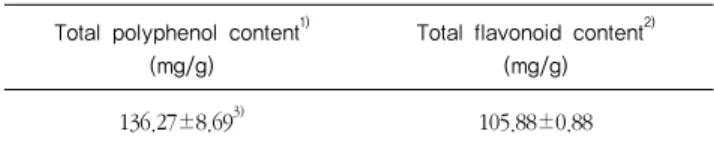
각각 gallic acid와 quercetin을 기준물질로 이용하여 산출한 복분자 에탄올 추출물의 총 폴리페놀 및 총 플라보노이드 함
량은 Table 4와 같다. 총 폴리페놀 함량을 측정하기 위하여
gallic acid를 표준물질로 구한 검량곡선은 gallic acid 0~100 ppm의 농도범위에서 R2=0.9991의 선형관계를 나타내었고, 총
플라보노이드 함량을 측정하기 위하여 quercetin을 표준물질 로 구한 검량곡선은 0~100 ppm의 농도범위에서 R2=0.9999의 선형관계를 나타내었다. 실험결과 복분자 에탄올 추출물은 136.27 mg/g과 105.88 mg/g의 총 폴리페놀 화합물 및 총 플 라보노이드 화합물을 함유하고 있는 것으로 분석되어, 복분자 에탄올 추출물에 함유된 것이 Park YS(2002)의 결과에 나타난 다양한 한약재들의 폴리페놀 함량(4.92~16.59 mg/g)과 플라보 노이드 함량(1.37~9.42 mg/g)보다 높게 나타났다. 또한 복분 자 에탄올 추출물의 총 폴리페놀 함량은 Kwak CS 등(2004)에 의해 보고된 메밀, 수수, 기장, 율무의 총 폴리페놀의 함량 (0.66~1.21 mg/g)보다 매우 높은 것으로 나타났는데, 이는 곡 류와 과실 ․ 채소류에 존재하는 구성성분들의 특성에 기인한
것으로, 곡류의 phytochemical이 불용성의 결합물 형태로 존
재하는 반면 복분자와 같은 과실이나 채소류는 대부분 유리 형 또는 수용성 포합형의 phytochemical을 가지고 있기 때문 으로 보여진다(Bunzel M 등 2001, Sosulski F 등 1982).
폴리페놀 화합물과 같은 phytochemical은 식물의 2차 대사 산물로 자연계에 널리 분포되어 있고 phenolic hydroxyl
group으로 인해 다양한 생리활성을 나타내며, 단백질과 결합
하는 성질이 세포에 작용하여 미생물의 성장저해를 야기함으 로써 항균효과 등의 생리활성 기능을 나타내는 것으로 알려 져 있다(Liu RH 2004, Ryu SW 등 2006). 뿐만 아니라, Jeon TW 등(2005)은 안토시아닌 등의 색소 물질이 Gram(+) 중 B.
control 1000 ppm 3000 ppm
cereus와 Gram(-) 중 E. coli에 대해 높은 항균활성을 나타내 는 것으로 보고하였고, Youn AR 등(2009)은 복분자에 30.79
mg/100 g의 비타민C를 함유되고 있는 것으로 보고하였는데,
비타민 C는 자체가 항균 활성을 나타낼 뿐만 아니라(Tabak
M 등 2003) 다른 항균제들에 대한 상승효과를 나타내는 것으
로 보고되었다(Cursino L 등 2005). 따라서 본 연구 결과 나 타난 복분자 에탄올 추출물의 높은 항균 활성은 복분자 에탄 올 추출물에 함유된 총 폴리페놀과 총 플라보노이드 성분 외 에도 여러 성분들의 복합․상승작용에 기인한 것으로 사료되 며, 이를 규명하기 위해 복분자의 항균 활성을 주는 성분들의 작용과 항균 mechanism을 규명하기 위한 후속 연구가 진행되 어야 할 것이다.
Total polyphenol content1) (mg/g)
Total flavonoid content2) (mg/g)
136.27±8.693) 105.88±0.88
1)Total polyphenol content was based on gallic acid as a standard.
2)Total flavonoid content was based on quercetin as a standard.
3)Data were expressed as mean±SD of triplicate determinations.
Table 4. Total polyphenol content and total flavonoid content of the ethanol extract of Rubus coreanum
IV. 요약 및 결론
천연 항균 소재를 탐색하기 위하여 복분자 에탄올 추출물 을 이용하여 7종의 식품위해성 미생물(B. cereus, E. coli, E.
coli O157:H7, L. monocytogenes, P. aeruginosa, S. aureus, S.
typhimurium)에 대한 생육저해환과 최소저해농도 및 생육저해 도를 통한 항균활성을 측정하였다. 그 결과 추출물의 농도가 증가할수록 항균활성이 증가하였고, 복분자 에탄올 추출물은 4,000 μg/disc에서 E. coli O157:H7 ˃ P. aeruginosa ˃ L.
monocytogenes ˃ E. coli ˃ S. aureus ˃ B. cereus ≥ S.
typhimurium 순으로 큰 생육저해환을 나타내었다. 복분자 에 탄올 추출물의 MIC 값은 1,000~4,000 ppm의 범위로 나타났고 L. monocytogenes에 대해 가장 낮은 농도인 1,000 ppm의 MIC를 나타내었으며, 생육저해도 또한 1,000 ppm의 농도에서 L. monocytogenes에 대한 생육 곡선이 나타나지 않았다. 복 분자 에탄올 추출물은 각각 미생물의 종류에 따른 감수성의 차이는 있었으나, Gram(+)균과 Gram(-)균의 종류에 관계없이 모든 균에 대한 항균 활성을 나타내어 복분자 에탄올 추출물 의 천연 항균소재로서의 가능성을 보여주었다.
V. 감사의 글
본 연구는 경북대학교특성화사업비 지원에 의하여 이루어 졌으며, 이에 감사드립니다.
참고문헌
배기환. 2000. 한국의 약용식물. 교학사. 서울. pp 127-129
Bauer AW, Kirby WMM, Sherris JC, Turck M. 1966. Antibiotic susceptibility testing by a standardized single disk method. Am J Clin Pathol 45:493-496
Beuchat LR, Golden DA. 1989. Antimicrobials occurring naturally in foods. Food Technol 43(1):134-142
Bunzel M, Ralph J, Martia JM, Hatfield RD, Steinhart H. 2001.
Diferulates as structural components in soluble and insoluble cereal dietary fiber. J Sci Food Agric 81:653~660
Cho EJ, Yang MO, Hwang CH, Kim WJ, Kim MJ, Lee MK. 2006.
Quality characteristics of Sulfidduk added with Rubus coreanum Miquel during storage. J East Asian Soc Dietary Life 16(4):458-467
Cho GS, Kim HY. 2003. Screening of antimicrobial activity from Castanea crenata Sieb. et Zucc. leaves and flowers. Ⅱ.
Screening of antimicrobial activities. J Korean Soc Agric Chem Biotechnol 46(3):262-267
Chung HY, Jung DH, Park YJ. 2000. The screening and pattern comparison of organic acids in 3 kinds of medicinal herbal extracts. Korean J Food Sci Technol 32(5):997-1001
Cursino L, Chartone-Souza E, Nascimento AMA. 2005. Synergic interaction between ascorbic acid and antibiotics against Pseudomonas aeruginosa. Braz Arch Biol Technol 48(3):379-384 Dabidson PM, Parish ME. 1989. Methods for testing the efficacy of
food antimicrobials. Food Technol 43:148-155
Demircia F, Guvenb K, Demircia B, Dadandic MY, Basera KHC.
2008. Antibacterial activity of two Phlomis essential oils against food pathogens. Food Control 19(12):1159-1164
Doh ES. 2010. Antibacterial activity of medicinal plant extracts to S.
aureus KCCM12256 and V. parahaemolyticus KCCM11965. J East Asian Soc Dietary Life 20(6):881-887
Han SH, Woo NRY, Lee SD, Kang MH. 2006. Antioxidative and antibacterial activities of endemic plants extracts in Korea.
Korean J Medicinal Crop Sci 14(1):49-55
Jang JS, Lee HJ, Oh BY, Lee JM, Go JM, Kim YH. 2007. Inactivation of Escherichia coli O157:H7, Salmonella and Listeria monocytogenes by organic acid. Kor J Env Hlth 33(5):403-407 Jeon TW, Cho YS, Lee SH, Cho SM, Cho HM, Chang KS, Park HJ.
2005. Studies on the biological activities and physicochemical characteristics of pigments extracted from Korean purple-fleshed potato. Korean J Food Sci Technol 37(2):247-254
Jeon YH, Choi SW, Kim MR. 2009. Antimutagenic and cytotoxic activity of ethanol and water extracts from Rubus coreanum.
Korean J Food Cookery Sci 25(3):379-386
Kang SK. 1995. Isolation and antimicrobial activity of antimicrobial substance obtained from leaf mustard (Brassica juncea). J Korean Soc Food Nutr 24(5):695-701
Kim DH, Park JH, Kim JH, Kim CH, You JH, Kwon MC, Lee HY.
2005. Enhancement of immune activities of Ephedrae herba and Rubi fructus at low temperature extraction. Korean J Medicinal Crop Sci 13(3):81-86
Kim HY, Lee YJ, Kim SH, Hong KH, Kwon YK, Lee JY, Ha SC, Cho HY, Chang IS, Lee CW, Kim KS. 1999. Studies on the development of natural preservatives from natural products.
Korean J Food Sci Technol 31(6):1667-1678
Kim JY, Lee JA, Kim KN, Song GP, Park SY. 2007. Antioxidative and antimicrobial activities of Euphorbia helioscopia extracts. J Korean Soc Food Sci Nutr 36(9):1106-1112
Kim JY, Yoon WJ, Yim EY, Park SY, Kim YJ, Song GP. 2011.
Antioxidative and antimicrobial activities of Castanopsis cuspidata var. sieboldii extracts. Korean J Plant Res 24(2):200-207
Kwak CS, Lim SJ, Kim SA, Park SC, Lee MS. 2004. Antioxidative and antimutagenic effects of Korean buckwheat, sorghum, millet and Jop's tears. J Korean Soc Food Sci Nutr 33(6):921-929
Kwak DJ, Nam SY, Lee DS. 2002. Antibacterial activity of phellodendri cortex on dental caries bacteria Sterptococcus sanguis. J Kor Aca Den Technol 24(1):43-49
Lee BW, Shin DH. 1991. Antimicrobial effect of some plant extracts and their fractionates for food spoilage microorganisms. Korean J Food Sci Technol 23(2):205-211
Lee JJ, Kim SH, Chang BS, Lee JB, Huh CS, Kim TJ, Baek YJ. 1999.
The antimicrobial activity of medicinal plants extracts against Helicobacter pylori. Korean J Food Sci Technol 31(3):764-770 Lee KI, Kim SM, Kim SM, Pyo BS. 2011. Comparison of fatty acids
and antibacterial activity against pathogen of acne in different parts of ripened black raspberry (Rubus coreanus Miquel). J Korean Soc Food Sci Nutr 40(3):466-469
Lee KU, Ju YR, Park MS, Oh KS, Kang YS, Lee KJ, Lee YJ. 1994.
Evaluation of the antimicroial activity of disinfectants using in Korea. The Report of National Institute of Health 31(1):60-71 Lee YC, Oh SW, Hong HD. 2002. Antimicrobial characteristics of
edible medicinal herbs extracts. Korean J Food Sci Technol 34(4):700-709
Liu RH. 2004. Potential synergy of phytochemicals in cancer prevention: mechanism of action. J Nutr 134:3479-3485
McFarland J (1907). Nephelometer: an instrument for estimating the number of bacteria in suspensions used for calculating the opsonic index and for vaccines. J Am Med Assoc 14:1176-1178 Moon GS. 1991. Constituents and uses of medicinal herbs.
Ilweolseogak. Seoul. pp 310-311
Moreno MI, Isla MI, Sampetro AR, Vattuone MA. 2000. Comparison of the free radical-scavenging activity of propolis from several regions of Argentina. J Ethnopharmacol 71:109-114
Oh DH, Lee MK, Park BK. 1999. Antimicrobial activities of commercially available tea on the harmful foodborne organisms.
Korea Soc Food Sci Nutr 28(1):100-106
Oh SW, Lee YC, Hong HD. 2002. Effects on the shelf-life tofu with ethanol extracts of Rubus coreanus Miquel, Therminalia chebula Retz and Rhus javanica. Korean J Food Sci Technol 34(4):746-749
Park JH, Oh SM, Lim SS, Lee YS, Shin HK, Oh YS, Choe NH, Park JHY, Kim JK. 2006. Induction of heme oxygenase-1 mediates the anti-inflammatory effects of the ethanol extract of Rubus coreanus in murine macrophages. BBRC 351:146-152
Park YS. 2002. Antioxidative activities and contents of polyphenolic compound of medicinal herb extracts. J Fast Asian Soc Dietary Life 12(1):23-31
Ryu SW, Jin CW, Lee HS, Lee JY, Sapkota K, Lee BG, Yu CY, Lee MK, Kim MJ, Cho DH. 2006. Changes in total polyphenol, total flavonoid contents and antioxidant activities of Hibiscus cannabinus L. Kor J Med Crop 14(5):307-310
Shin DH, Kim MS, Han JS. 1997. Antimicrobial effects of ethanol extracts from some medicinal herbs and their fractionates against food-born bacteria. Korean J Food Sci Technol 29(4):808-186 Singleton VL, Rossi JA. 1965. Colorimetry of total phenolics with
phosphomolybdic-phosphotungstic acid reagents. Am J Enol Vitic 16(3):144-158
Sosulski F, Krygier K, Hogge L. 1982. Free, esterified, and insoluble-bound phenolic acids. 3. Composition of phenolic acids in cereal and potato flours. J Agric Food Chem 30:337-340 Tabak M, Armom R, Potasman I, Neeman I. 1996. In vitro inhibition
of Helicobacter pylori by extracts of thyme. J Appl Bacteriol 80:667-672
Tabak M, Armon R, Rosenblot G, Stermer E, Neeman I. 2003. Divers effect of ascorbic acid and palmitoyl ascorbate on Helicobacter pylori survival and growth. FEMS Microbiol Lett 224:247-253 Youn AR, Kwon KH, Kim BS, Noh BS, Cha HS. 2009. Quality
changes in Rubus coreanus Miquel during frozen storage.
Korean J Food Preserv 16(5):618-622
Yu YE, Park EY, Jung DH, Byun SH, Kim SC. 2010. Antibacterial activity of oriental medicinal herb extracts against skin pathogens. J Life Sci 20(7):1143-1150.
http://e-stat.kfda.go.kr. Accessed Sep. 10, 2011