A Convergence Structural Model for Self-leadership among Female Freshmen in Health Majors Studying TOEIC
Soo-Mi Hong, Sang-Yun Bae
*Professor, Dept. of Health Administration, Vision University of Jeonju
TOEIC을 학습하는 보건계열 신입 여대생의 셀프리더쉽에 관한 융복합적 구조모형
홍수미, 배상윤
*전주비전대학교 보건행정학과 교수
Abstract This study ascertained convergent influence on self-leadership and its association with self-competence, self-efficacy and locus of control among female freshmen in health majors studying TOEIC. Data collection was carried out using a self-administered questionnaire from April 29, 2019 to May 10, 2019 and the target was randomly selected 201 female freshmen in health majors in TOEIC class from college located in J city. Self-leadership was positively correlated with self-competence, self-efficacy and locus of control. The covariance structure analysis showed that the higher self-competence, the higher self-efficacy and the lower locus of control tend to increase self-leadership.
The results of the study indicate that the efforts, to increase self-competence and self-efficacy, to decrease locus of control, are required to improve self-leadership of female freshmen in health majors studying TOEIC. These results are expected to be used for educational counseling and intervention efforts to enhance self-leadership among female freshmen in health majors studying TOEIC. In future studies, further research on additional factors affecting self-leadership is needed.
Key Words : Convergence, Self-leadership, Female freshmen, TOEIC, Self-competence, Self-efficacy, Locus of control
요 약 본 연구는 토익을 학습하는 보건계열 신입 여대생의 자기유능감, 자기효능감 및 통제위치와 셀프리더쉽의 관련 성을 파악하고 셀프리더쉽에 미치는 융복합적 영향을 분석하였다. 자료수집은 2019년 4월 29일부터 2019년 5월 10 일까지 자기기입식 설문지를 사용하였으며, 조사대상은 임의로 선정된 J시 소재 대학의 보건계열 토익학습반에 참여하 는 신입 여대생 201명으로 하였다. 셀프리더쉽은 자기유능감, 자기효능감 및 통제위치와 양의 상관관계를 보였다. 공분 산 구조분석 결과, 자기유능감이 높아질수록, 저기효능감이 높아질수록, 통제위치가 낮아질수록 셀프리더쉽을 증가시 키는 것으로 나타났다. 이러한 결과를 볼 때, 토익을 학습하는 보건계열 신입 여대생의 셀프리더쉽을 높이기 위해서는 자기유능감, 자기효능감을 높이고 통제위치를 낮추는 노력이 필요하다. 이러한 결과는 토익을 학습하는 보건계열 신입 여대생의 셀프리더쉽을 높이는 교육적 상담 및 개입 노력에 활용이 기대된다. 추후연구에서는 셀프리더쉽에 영향을 미치는 부가요인에 대한 조사가 필요하다.
주제어 : 융복합, 셀프리더쉽, 보건계열 여대생, 토익, 자기유능감, 자기효능감, 통제위치
*Corresponding Author : Sang-Yun Bae([email protected])
Received August 12, 2019 Revised September 15, 2019
Accepted November 20, 201 Published November 28, 2019
1. Introduction
The health and medical service environment is surrounded by internal and external changes due to increased importance of primary prevention, higher social need for high-quality medical service, and intensified need for active accommodation of global medical service rising as the task for the community[1]. Also, development in medical technology, enhancement of hospital information system, and increase in qualitative and quantitative diversity in contacts with hospital customers are increasing hospital workers’ job level. Even more, continues demand for higher job performance is taken for granted[2]. Workforces in hospitals perform their tasks in the form of intensive labor divided based on binary medical and administrative system[1].
Furthermore, strengthening of hospital workers’
knowledge, attitude, skills on their work is regarded as an essential element for enhancing community medical care’s quality and strengthening hospital’s internal competitiveness[3].
Female freshmen in health majors are in the stage of establishing a desirable value in the aspect of cognitive, definitive, psychomotor areas, learning necessary knowledge and skills, and developing into future personnel for medical service and hospital administration[4]. In response, students decide their career through liberal arts and major courses, accept constant changes to prepare themselves as a member of society, and have ‘Self-Leadership’ as a basic virtue for overcoming such changes[5].
In response to vitalization of global medical service and increasing need for personnel able to perform globalized hospital works, the importance of English ability is increasing[6].
Also, in the globalized hospital work for foreign customers, hospital workers are required to strengthen self-leadership as independent decision-making and coping ability[7]. Those two elements of English and leadership are requiring
female freshmen in health majors to strengthen self-leadership for communicating in English during hospital affairs, motivating oneself voluntarily, and accomplishing the goals[8].
Female freshmen majoring in health science may strengthen self-leadership in English communication to develop into a professional fulfilling task of globalized hospital through TOEIC, one of the various English education and evaluation programs available in Korea[9]. TOEIC tests the examinee’s practical English ability by focusing on communication ability as the original linguistic ability. TOEIC is used on tests for measuring the practical English ability at various institutes and universities[10]. TOEIC’s emphasis on practical English makes the female freshmen in health majors to strengthen English communication and self-leadership ability and build up competence in performing globalized hospital affairs[9,10]. For this reason, university should focus on TOEIC learning, English communication, and self-leadership as a way for adopting the need for competence in globalized hospital affair required for female freshmen in health majors[9,10]. Self-leadership has characteristics such as cognitive and strategic behavior influencing on oneself[11], process of controlling oneself and overcoming external environment[12], and ability for coping to situation[13] As female freshmen in health majors cultivate competence in globalized hospital affair requiring adaptability, independence, autonomy, and cooperation[14] self-leadership is seen as basic grounding and essential learning goal.
To establish a causal relationship model influencing on English communication and self-leadership of female freshmen in health majors learning TOEIC for preparation of globalized hospital affairs, this study reviewed the existing researches. The result showed that self-competence, self-efficacy, and locus of control were related to TOEIC learning.
‘Self-Competence’ represents the confidence in
accomplishing the goal and it showed relationship with TOEIC learning in the existing research[6,10]. ‘Self-Efficacy’ is the belief on appropriate response toward situation and it was reported to have relationship with self-leadership that maximizes the ability for coping with situation through positive thinking and intrinsic reward in the previous research[11,15,16]. Also,
‘Locus of Control’ indicates the degree of one’s control and influence on the case and it showed relationship with emotional and mental issues of female university students[17]. According to the previous researches, self-leadership of hospital workers influence on practical and communicative ability[14], and the researches also reported connection between female university students’ English communication ability and self-leadership[12,18]. Although existing researchers analyzed partial relationship between self-leadership and individual elements, the lacked analysis on correlation and influence of self-competence, self-efficacy, and locus of control. In response, this study assumed that self-competence, self-efficacy, and locus of control are correlated and that mutual interactions would promote self-leadership. Thus, this study seeks to make a convergence approach for suggesting a structural model on correlation between elements by referring existing researches and for analyzing the relative importance and mutual influence between self-competence, self-efficacy, locus of control, and self-leadership.
The purpose of this study is to identify the correlation between self-competence, self-efficacy, locus of control, and self-leadership of female freshmen in health majors learning TOEIC. Also, this study seeks to analyze the structural model to identify elements’ convergent influence on self-leadership, and suggest basic data on educational consulting and intervention for enhancing self-leadership of female freshmen majoring in health science.
2. Study method
2.1 Subject of survey
For the research subjects, this study randomly selected female freshmen in health majors from TOEIC class from college located in City J from April 29, 2019 to May 10, 2019. The appropriate sample size was calculated with G*Power 3.1 Program[19] In calculating power by setting power of 0.95, effect size of 0.15, and significance level of 0.05 in linear multiple regression: fixed model, R
2deviation from zero analysis, F-rejection region was 1.75 and minimum required sample size was 194. Then, this study randomly selected 250 subjects considering the drop-out rate. The distributed questionnaires were returned from 221 students (88.4%) and this study statistically processed 201 questionnaires after excluding 20 unfaithfully filled out questionnaires. To observe research ethics and enhance survey accuracy, a researcher visited TOEIC class in person and explained about the right to refuse survey, privacy statement, research purpose and contents, and questionnaire completion method during the break time. Then, the researcher distributed structured self-administered questionnaire to subjects who agreed to participate in the research. Also, the subjects were asked to fill out questionnaire in self-enumeration method without putting a name on the questionnaire.
2.2 Survey tool
This study composed the questionnaire with self-competence, self-efficacy, locus of control, and self-leadership.
For self-competence, a scale[21] was restructured by adapting the measuring tool[20] of Hemandez and higher score refers to higher self-competence.
In the Cronbach’s α indicating the inner confidence,
the figure was .820[21] in the existing research and
.828 in this research.
For self-efficacy, this study applied a scale[23]
by restructuring a test tool of Tipton and Worthington[22] and higher score refers to self-efficacy. In the Cronbach’s α indicating the inner confidence, the figure was .880[23] in the existing research and .849 in this research.
In locus of control, this study applied and verified a Korean version of scale on locus of control by adapting and revising the short forms of locus of control scale by Levenson[24,25]. The lower score referred to higher locus of control. The sub-areas were composed of internal locus of control, chance-oriented locus of control, and external locus of control. In the Cronbach’s α indicating the inner confidence, the figure was .667[17] in the existing research and .658 in this research.
For self-leadership, this study applied a scale[27] suggesting validity by adapting and supplementing measuring tool of Manz[26] and higher score meant higher self-leadership. The sub-areas were composed of self-expectation, rehearsal, goal setting, self-reward, self-criticism, and constructive idea. In the Cronbach’s α indicating the inner confidence, the figure was .870[27] in the existing research and .871 in this research.
Table 1 indicates measuring tools such as self-competence, self-efficacy, locus of control, number of questions for self-leadership, range of score, average, standard deviation, normality, validity, and reliability. The normality of the surveyed scale is regarded to be proven as values of skewness and kurtosis are below the absolute value of 2. Also, the validity of the used scale was secured as standard factor loading(λ), χ
2/df, p, NFI(Normed Fit Index), CFI(Comparative Fit Index), TLI(Tucker-Lewis Index), RMSEA(Root
Mean Square Error of Approximation) of confirmatory factor analysis satisfied the criteria.
The reliability of the surveyed scale was acceptable in analysis with Cronbach’s α.
2.3 Research design
This study identified that female freshmen learning TOEIC in health science field showed significant correlation in self-competence, self-efficacy, locus of control, and self-leadership.
Then, this study organized a research model to analyze how self-competence, self-efficacy, and locus of control influence on self-leadership. The analysis results suggested that TOEIC learning is related to self-competence indicating the confidence in accomplishing the goal[6,10] and that English communication ability influenced on the self-leadership of female freshmen[12,18].
Self-efficacy is an ability to respond to situation appropriately and it had been assumed to influence on the self-leadership[11,15,16]. In addition, locus on control was reported to be related to emotion and psychological problems of female freshmen[17]. Based on the path analysis on self-leadership, the study model assumed that self-competence, self-efficacy, and locus of control of female freshmen majoring health science would influence on self-leadership.
Then, the model set latent variables with self-competence, self-efficacy, locus of control, and self-leadership that cannot be measured directly.
For observed variable of self-competence, self-efficacy, locus of control, and self-leadership, this study used the score measured with the measuring tool from 2.2. Also, the score measured from the criteria was applied on
Scale
Sub-domains No. Range Mean±SD
Normality Validity Reliability
Min Max Skewness Kurtosis λ
>.5 CMIN/DF
<3 p
>.05 NFI
>.9 CFI
>.9 TLI
>.9 RMSEA
<.08
Cronbach'α (%)
Self-competence 6 6-24 16.73±3.22 7 24 .09 .16 .69 82.8
Self-efficacy 18 18-12677.36±11.98 36 111 -.11 .50 .72 84.9
Locus of control 7 7-28 21.60±2.86 12 28 -.14 -.06 .12 .88 .99 .99 .99 .01 65.8
Self-leadership 18 18-90 59.65±8.92 27 85 -.08 .75 1.71 .10 .96 .98 .96 .06 87.1
Table 1. The normality, validity and reliability of used scale
observed variable for self-leadership. To discuss the causal relationship between the latent variables, this study constructed a causal relationship structure model and verified the model through covariance structure analysis. The theoretical model is as Fig. 1.
Self -leadership Locus of control
V7 Self
-competence
Self -efficacy
V1
V4
V6 V8
V2
V10
V9 V11
V5 V3
V1 Self-competence V7 Self-leadership-Rehearsal V2 Self-efficacy V8 Self-leadership-Goal setting V3 Internal locus of control V9 Self-leadership-Self reward V4 Chance locus of control V10 Self-leadership-Self criticism V5 External locus of control V11 Self-leadership-Constructive area V6 Self-leadership-Self expectation
Fig. 1. Theoretical model of this study
2.4 Data treatment
This study identified Pearson Correlation Coefficient for self-competence, self-efficacy, locus of control, and self-leadership. In the structural equation model, this study estimated the population parameter based on Maximum Likelihood Estimation. Then, this study set latent variable with each model’s components and set observed variable with variable for each component. In selection of variable, this study selected variables that has a significant relation in individual simple analysis for each path, supports theoretical model, and composes appropriate model for model fit test. In the structural equation model, exogenous latent variable included self-competence while endogenous latent variable contained self-efficacy, locus of control, and self-leadership. For path coefficient, this study indicated significant coefficient on a path diagram. Also, this study set the significance level for all test statistics to p<.05
3. Study result
3.1 Demographic factors of subjects
Table 2 indicates the demographic factors of the research subjects. For age, 15.4% of subjects were under 19, 73.1% were 19, and 11.4 % were over 20. Also, 93.0% of the subjects were satisfied with family life while 7.0% was not. For school life satisfaction, 87.6% of subjects were satisfied while 12.4% were not. 25.9% of subjects answered they eat regularly while 25.9% of them answered they don’t eat regularly. For regular exercise, 19.9% of subjects answered they exercise regularly while 80.1% said they don’t. In regard to sleeping hours, 52.2% slept less than 7 hours while 47.8% slept more than 7 hours. Also, 51.2% of subjects answered that their hobby and leisure time are enough while 48.8% answered that they are not enough. When subjects were asked to self-rate their health status, 78.1% of subjects answered they are healthy while 21.9% answered they are not.
Demographic factors Classification N(%)
Age(year) <19 31(15.4)
19 147(73.1)
20≤ 23(11.5)
Family life satisfaction Satisfied 187(93.0)
Dissatisfied 14( 7.0)
School life satisfaction Satisfied 176(87.6)
Dissatisfied 25(12.4)
Regular Eating Yes 52(25.9)
No 149(74.1)
Regular exercise∥ Yes 40(19.9)
No 161(80.1)
Sleeping time(hr) <7 105(52.2)
7≦ 96(47.8)
Hobbies & leisure life Enough 103(51.2)
Not enough 98(48.8)
Subjective Health status Good 157(78.1)
Bad 44(21.9)
∥: More than 3 times a week, 30 minutes or more once
Table 2. Demographic factor of subjects(n=201)
3.2 Correlation between self-leadership and relevant variables
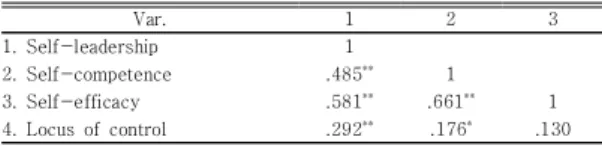
As shown in Table 3, self-leadership had a significant
positive correlation with self-competence(r=.485),
self-efficacy(r=.581), and locus of control(r=.292).
Var. 1 2 3
1. Self-leadership 1
2. Self-competence .485** 1
3. Self-efficacy .581** .661** 1
4. Locus of control .292** .176* .130
* : p<.05, ** : p<.01.
Table 3. Correlation coefficients between model factors
3.3 Result of covariance structure analysis
This study constructed a model by setting 1 exogenous concept (self-competence) and two endogenous concepts (self-efficacy, locus of control, and self-leadership) as a theoretical variable.
For the observed variable of theoretical variable, this study set self-competence, self-efficacy, internal locus of control, chance-oriented locus of control, and external locus of control as sub-areas of locus of control, self-expectation, goal setting, self-reward, self-criticism, and constructive idea as sub-areas of self-leadership.
Model Fit
Absolute fit index
χ2= 49.023(df = 35), χ2/df = 1.401, p = .058 RMR(Root Mean square Residual) = .041 GFI(Goodness of Fit Index) = .958 AGFI(Adjusted Goodness of Fit Index) = .920 RMSEA(Root Mean Square Error of Approximation) = .045
Incremental fit index
NFI(Normed Fit Index) = .943 TLI(Tucker-Lewis Index) = .972 CFI(Comparative Fit Index) = .982
Table 4. Model identification
The goodness of the fit for the model in Table 4 was as follows. Goodness of fit was χ2= 49.023(df=35) and χ2/df=1.401 in absolute fit index with standard value below 3. Also, P-value was p=.058 higher than standard value of .05. In addition, goodness of fit index was .958, higher than .09 while adjusted
goodness of fit index was .920 higher than .9. In addition, root mean square error or approximation was 0.45 below .08. Meanwhile, in incremental fix index, the normed fit index was .943 over .9 and Tucker-Lewis Index was .972 over .9. Also, comparative fit index was .982 over .9. Based on above figures, the model is regarded as a fitted model.
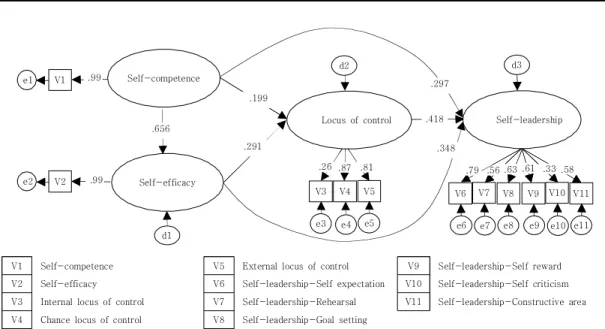
In setting the effects of exogenous latent variable toward endogenous latent variable as a standard path coefficient in Table 5 and Fig.2, self-competence had a direct positive effect of .656 on self-efficacy, direct positive effect of .199 on locus of control, and direct positive effect of .297 on self-leadership. In setting the effects between endogenous variable as a standard path coefficient, self-efficacy had a direct positive effect of .291 on locus of control and direct positive effect of .348 on self-leadership.
Also, locus of control had a direct positive effect of .418 on self-leadership. Furthermore, in squared multiple correlation(SMC) for independent variable’s explanation on dependent variable, self-competence explained self-efficacy by 43.0%, self-competence and self-efficacy explained locus of control by 20.1% while self-competence, self-efficacy, and locus of control explained self-leadership by 73.9%. The path coefficient of self-competence toward self-leadership was 5% and all other path coefficients were significant within the level of 1%.
4. Consideration
This study was implemented to identify the convergent influence of self-competence, self-efficacy, and locus of control on self-leadership of female
Endogenous variable Exogenous variable Error Coefficient of determination
Self-efficacy Locus of control Self-competence Z SMC
Self-efficacy .656** .193 .430
Locus of control (.291**)∥ .191* .025 .201
Self-leadership .348** .418** .297** .023 .739
* : p<.05 , **: p<.01, ¶ : Squared Multiple Correlations(SMC), ∥ : Standardized Regression Weights
Table 5. Structural model of endogenous and exogenous variables
freshmen in health majors learning TOEIC.
In examination of correlation between self-leadership and related factors, self-leadership showed a significant correlation with self-competence, self-efficacy, and locus of control. Also, psychological factors[28,29] such as the self-competence[12], self-efficacy[11,15,16], and locus of control[17] having correlation with self-leadership also appeared similarly on research subjects, female freshmen in health majors. The significant relation between self-competence and self-leadership[12]
was also found similarly on this study and it demonstrated that self-competence where one makes accomplishments with confidence in one’s ability influenced on the self-leadership by inducing self-control and autonomous motivation. The influence of self-efficacy on self-leadership[11,15,16]
also appeared similarly on this study. Self-efficacy is one’s belief on coping with situation changes appropriately. With self-efficacy, one motives oneself and performs behavior suitable for the situation to influence on leader-ship for a positive reward. The relationship between locus of control and female university students’
emotional and psychological issues[17] was also
similar in this study. In locus of control, one regards that result is made by own controlling process, luck, or external environment. Such locus of control showed a significant relationship with self-leadership. Especially, chance-oriented locus of control and external locus of control regards that the result is driven by external factors such as luck that cannot be controlled by one’s will. Such chance-oriented locus of control and external locus of control lowered self-leadership. These results implied as follows.
In order to respond to increasing globalized hospital affairs accept requirements for such hospital workers actively, and enhance English communication and self-leadership of female freshmen in health majors, it is necessary to provide educational consulting and intervention that support students in strengthening the confidence over accomplishing goal, responding to situations appropriately, and enhancing the control for self-regulation and self-management[11,12,17].
To identify the casual relationship between self-competence, self-efficacy, and locus of control influencing on self-leadership, this study conducted a covariance structure analysis by
d3
Self-leadership .199
.291
Locus of control
V7 .418 Self-competence
Self-efficacy
.297
.348 V1
e1 .99
V4 .87
e4
.56
e7 .656
V6 .79
e6 V8
.58
e8 d1
V2
e2 .99
V10
e10 V9
e9 V11
e11 .63 .61 .33 d2
V5
e5 V3
e3
.26 .81
V1 Self-competence V5 External locus of control V9 Self-leadership-Self reward
V2 Self-efficacy V6 Self-leadership-Self expectation V10 Self-leadership-Self criticism V3 Internal locus of control V7 Self-leadership-Rehearsal V11 Self-leadership-Constructive area V4 Chance locus of control V8 Self-leadership-Goal setting
Fig. 2. Path diagram of structural equation modeling
setting self-competence as exogenous latent variable and setting self-efficacy, locus of control, and self-leadership as endogenous latent variable. In the analysis result, the goodness of fit for the model was favorable. In the standard path coefficient, self-efficacy was .656 from self-competence, locus of control was .199 from self-competence and .291 from self-efficacy. Also, self-leadership was .297 from self-competence, .348 from self-efficacy, and .418 from locus of control. The scale of influence on self-leadership was higher in the order of locus of control, self-efficacy, and self-competence. According to existing report, the self-leadership was higher when self-competence increased[6,10]. when self-efficacy was strengthened[11,15,16], and when locus of control decreased[17]. Also such result appeared similarly on the female freshmen in health majors learning TOEIC. To improve the level of self-leadership of female freshmen in health majors learning TOEIC, the educational consulting and intervention program shall be implemented proactively. These educational consulting and intervention program enhances self-leadership which solves problems through creative and voluntary efforts. Also, they promote confidence over accomplishment of goal, belief on behaving properly depending on the situation, enhance sympathy toward others, and help one to decide and control the result independently.
Furthermore, self-leadership can be enhanced by personal efforts and external supports on self-competence over goal accomplishment, self-efficacy for behaving appropriately for the situation, and self-control for managing and influencing on case independently.
As this study is a cross-sectional study targeting small-scale sample in one region, there are limits in applying the study results on overall female freshmen in health majors learning TOEIC. Furthermore, the measurement of scale used in this study relied on the respondent’s subjective self-administered questionnaire. As a
result, the risk of response bias cannot be excluded. However, this study holds significance in examining the factors influencing on the self-leadership of female freshmen in health majors and trying to apply them on education for strengthening English and self-leadership ability for performing globalized medical service affairs under the current situation with lack of researches on self-leadership of female freshmen majoring in health. The further researches need to have extensive analysis covering additional factors related to self-leadership of female freshmen in health majors learning TOEIC.
5. Conclusion
This study identified how self-competence,
self-efficacy, and locus of control of female
freshmen in health majors learning TOEIC have a
convergent influence on self-leadership. This
study conducted a survey from April 29, 2019 to
May 10, 2019 on randomly selected 201 female
freshmen in health majors learning TOEIC at the
college located in J City. According to the survey
analysis results, self-leadership showed a positive
correlation with self-competence, self-efficacy, and
locus of control. Also, the covariance structure
analysis result demonstrated the causal relationship
between self-competence, self-efficacy, locus of
control, and self-leadership. Also, the self-leadership
was higher when self-competence got higher, when
self-efficacy got higher, and when locus of control
got lower. Thus, it is necessary to manage factors
such as self-competence, self-efficacy, and locus
of control as they have a convergent influence on
self-leadership. Also, the study hopes that the
study results would be utilized on educational
consulting and intervention for enhancing
self-leadership of female freshmen in health
majors learning TOEIC.
REFERENCES
[1] S. M. Hong & S. Y. Bae. (2018). Convergent influence of self efficacy, academic control and school resilience on TOEIC learning flow among health college students.
Journal of Digital Convergence, 16(12), 373-381.
DOI : 10.14400/JDC.2018.16.11.373
[2] S. M. Hong, S. H. Kim & S. Y. Bae. (2017). An analysis on structure equation model of convergent influence on academic burnout of health major students in studying for TOEIC. Journal of Digital Convergence, 15(7), 329-342.
DOI : 10.14400/JDC.2017.15.7.329
[3] S. M. Hong & S. Y. Bae. (2018). Convergent influence of job seeking stress, self efficacy and academic burnout on TOEIC test anxiety at TOEIC study among health college students. Journal of Digital Convergence, 16(7), 289-298.
DOI : 10.14400/JDC.2018.16.7.289
[4] S. M. Hong & S. Y. Bae. (2019). Convergence factors related with communication competency of students in health majors in studying for TOEIC. Journal of Digital Convergence, 17(5), 257-266.
DOI : 10.14400/JDC.2019.17.5.257
[5] L. Xie, J. Lu & C. A. Joo. (2016). A study on the research trends of college students' leadership in Korea, Journal of Educational Innovation Research, 26(2), 25-46.
DOI: 10.21024/pnuedi.26.2.201608.25
[6] S. M. Hong & S. Y. Bae. (2018). Convergent influence of job seeking stress, self efficacy and academic burnout on TOEIC test anxiety at TOEIC study among health college students. Journal of Digital Convergence, 16(7), 289-298.
DOI : 10.14400/JDC.2018.16.7.289
[7] S. M. Hong & S. Y. Bae. (2018). Convergent factors related to TOEIC learning flow of some college students in health care. Journal of Digital Convergence, 16(11), 383-392.
DOI : 10.14400/JDC.2018.16.11.383
[8] S. M. Hong & S. Y. Bae. (2018). Convergent influence of self efficacy, academic control and school resilience on TOEIC learning flow among health college students.
Journal of Digital Convergence, 16(12), 373-381.
DOI : 10.14400/JDC.2018.16.11.373
[9] S. M. Hong, S. H. Kim & S. Y. Bae. (2017). An analysis on structure equation model of convergent influence on academic burnout of health major students in studying for TOEIC. Journal of Digital Convergence, 15(7), 329-342.
DOI : 10.14400/JDC.2017.15.7.329
[10] S. M. Hong, S. H. Kim & S. Y. Bae. (2017). A study on convergence factors related with academic burnout of students in health majors in studying for TOEIC.
Journal of Digital Convergence, 15(6), 315-327.
DOI : 10.14400/JDC.2017.15.6.315
[11] I. C. Ryu, C. G. Hwang & D. K Lee. (2017). On the effect of character traits of employees of consulting firms on job satisfaction through self-leadership and
self-efficacy, Journal of the Korea Society of Digital Industry and Information Management, 13(3), 167-183.
DOI : 10.1762/ksdim.2017.13.3.167
[12] S. Y. Lee, H. J. Lee, J. W. Yoon & G. S. Kwon. (2017).
Measuring the performance of world friends IT volunteers, Informatization Policy, 24(2), 68-86.
DOI : 10.22693/NIAIP.2017.24.2.068
[13] H. J. Kim. (2019). The effects of self-leadership on organizational citizenship behavior and turnover intention in beauty salon employees, The Journal of the Korea Contents Association, 19(1), 484-495.
DOI : 10.5392/JKCA.2019.19.01.484
[14] E. H. Park & Y. R. Chae. (2018). The Effects of self-leadership reinforcement program for hospital nurses, Journal of Korean Biological Nursing Science, 20(2), 132-140.
DOI : 10.7586/jkbns.2018.20.2.132
[15] D. Y. Lee & J. H. Cho. (2018). Convergence influence of self-resilience, critical thinking, and academic self-efficacy on self-leadership of nursing students, Journal of the Korea Convergence Society, 9(10), 561-569.
DOI : 10.15207/JKCS.2018.9.10.561
[16] I. S. Jung. (2018). A study on related factors of nursing student' self-efficacy, self-leadership and academic performance, Journal of Convergence for Information Technology, 8(5), 51-58.
DOI : 10.22156/CS4SMB.2018.8.5.051
[17] S. Y. Bae & S. H. Kim. (2016). Analysis of convergent influence of self esteem, depression, hopelessness, locus of control and type a behavior pattern on job seeking stress among some college women, Journal of Digital Convergence, 14(12), 323-333.
DOI : 10.14400/JDC.2016.14.12.323
[18] I. S. Jung. (2018). Convergence effects of collaborative peer tutoring on communication ability and self-leadership of nursing students, Journal of the Korea Convergence Society, 9(10), 533-540.
DOI : 10.15207/JKCS.2018.9.10.533
[19] F. Faul, E. Erdfelder, A. Lang & A. Buchner. (2007).
G*Power 3: A flexible statistical power analysis program for the social, behavioral, and biomedical sciences, Behavior Research Methods, 39(2), 175-191.
DOI : 10.3758/BF03193146
[20] L. P. Hemandez. (1993). The role of protective factors in the school resilience of Mexican American high school students, Doctoral dissertation, Stanford University.
[21] H. S. Park. (1998). The school resilience of Korean adolescents in poverty, Doctoral dissertation, Seoul National University, Seoul.
UCI : G901:A-0004796457
[22] R. M. Tipton & E. L. Worthington. (1984). The measurement of generalized self-efficacy: A study of construct validity, Journal of Personality Assessment, 48(5), 545-548.
DOI : 10.1207/s15327752jpa4805_14
[23] S. M. Yang. (2000). The development and effectiveness
of group program on empowerment for the parents with mentally retarded adults, Doctoral Dissertation.
Seoul National University, Seoul.
UCI : G901:A-0004899932
[24] H. Levenson. (1973). Multidimensional locus of control in psychiatric patients. Journal of Consulting and Clinical Psychology, 41(3), 397-404.
DOI : 10.1037/h0035357
[25] S. J. Chang. (2001). A study on the distribution and risk factors for psychosocial distress, and the development worksite stress reduction program, Ministry of Health & Welfare. Seoul.
UCI : G901:A-0006007686
[26] C. C. Manz. (1992). Mastering self-leadership:
Empowering yourself for personal excellence.
Englewood Cliffs, New Jersey: Prentice-Hall.
[27] H. S. Kim. (2003). The relationship between teachers' self-leadership and the job satisfaction at secondary schools, Master Thesis, Soongsil University, Seoul.
UCI: G901:A-0005060014
[28] I. S. Jung. (2018). Effects of classwide peer tutoring on academic achievement, self-leadership and interpersonal ability of nursing students, Journal of Convergence for Information Technology, 8(4), 55-62.
DOI : 10.22156/CS4SMB.2018.8.4.055
[29] S. M. Hong & S. Y. Bae. (2019), Convergent influence of ego-resilience, nunchi and self-leadership on communication competency among students in health majors in studying for TOEIC. Journal of Digital Convergence, 17(6), 229-238.
DOI : 10.14400/JDC.2019.17.6.229
홍 수 미(Soo-Mi Hong) [정회원]
․ 2003년 5월 : Purdue University (Dept. of Health Science)
․ 2018년 2월 : 전주대학교 대학원(영문 학박사)
․ 2012년 3월 ~ 현재 : 전주비전대학교 보건행정학과 교수
․ 관심분야 : 영어교육, TOEIC학습
․ E-Mail : [email protected]
배 상 윤(Sang-Yun Bae) [정회원]