Received: December 17, 2018 Revised: January 16, 2019 Accepted: January 20, 2019
박수옥 ・이주열 남서울대학교 치위생학과
A literature review on measurement tools for dental hygienist turnover intention in Korea
Soo-Auk Park ・Ju-Yul Lee
Department of Dental Hygiene, Namseoul University
Corresponding Author: Soo-Auk Park, Department of Dental Hygiene, Namseoul University, Seonghwan- Eup Seobuk Gu Chonan 31020, Korea, Tel: +82-10-7177-7918, E-mail: [email protected]
Abstract
This study investigates the overall research trends and related factors affecting the turnover of dental hygienists in Korea during the past 10 years (2007-2017) and analyzed the differences in the results of the research according to the main measurement tools. The literature review focused on turnover of dental hygienists in Korea. Inclusion criteria of selected studies were as follows: the domestic and foreign academic journals and theses published for the past 10 years (between 2007-2017). The most commonly used tool for measuring dental hygienist turnover was a tool developed by Lawler. The most used significant general characteristics is age and income, Job satisfaction (57.1%) and organizational commitment (40.0%) were the most frequently used predictors of turnover. The variables used for each turnover measurement tool were different, showing that the study results was different from according to the variables and significance level. Although there have been many studies related to the turnover of dental hygienists, different results have been shown depending on the measurement tools. When conducting research related to dental hygienist turnover, specific and clear presentation of measurement tool selection or development is needed.
Key Words: Dental hygienist, Measurement tool, Review, Turnover intention 색인: 문헌고찰, 이직의도, 측정도구, 치과위생사
서론
2017년 통계청 자료에[1] 따르면, 치과병의원 외래환자수는 2014년은 234,629명, 2015년 312,242
명, 2016년 335,215명이었다. 치과 진료환자 수의 증가뿐만 아니라 전문적이고 질 높은 의료서비스에 대한 요구도 증가하고 있다. 이러한 국민들의 요구에 부응하기 위해서는 치과위생사 인력을 효과적으로 활용 하는 방안이 심도 있게 검토될 필요성이 있다. 전문 인력을 효과적으로 관리한다면, 양질의 의료서비스 제 공과 치과 의료의 생산성을 향상시키고 업무의 효율성과 직무만족을 높일 수 있을 것이다[2].
치과위생사 배출은 2018년의 경우 5,690명이 면허시험에 응시하여, 83.2%인 4,710명이 면허를 취득하 였다[3]. 2017년에 치과위생사 면허 보유자는 75,883명으로 조사되었고[4], 2016년 면허신고를 기준으로 국민건강보험 공단에 등록된 치과위생사는 33,392명으로 면허자의 54%가 의료기관에 근무하지 않은 것 으로 파악되었다[4]. 매년 면허를 취득한 치과위생사 수를 고려하면 공급이 과잉되고 있지만, 현장에서는 치과의료기관 73.1%가 인력부족과 수급 문제를 겪고 있다[5]. 이러한 사실은 치과위생사 관련 학과를 신 설하여 치과위생사 배출을 늘리는 방법으로는 문제를 해결할 수 없다는 것을 의미한다. 따라서 현재 활동 하고 있는 치과위생사를 적극 활용하는 것이 중요하며, 이를 위해서는 이직 또는 퇴직을 감소시키려는 노 력이 필요하다.
이직은 사회이동의 자연스런 역동과정으로서 조직의 새로운 변화를 촉진하고 유능한 인력으로의 대체 가 가능하다는 긍정적인 견해도 있으나[6], 치과위생사의 이직 및 퇴직은 해당 치과 의료기관에 새로운 구 성원의 선발 및 훈련과 관련하여 경제적 부담을 주게 된다. 또한, 남아있는 동료들에게 스트레스와 업무량 을 증가시켜서, 이것이 또 다른 이직 또는 퇴직 사유가 되는 부정적 영향을 미칠 수도 있다. 치과위생사 의 취업유지를 위협하는 원인에 대한 근본적인 문제를 해결하기 위해서는 이직의도 요인을 파악하는 것이 중요하다. 이를 위하여 이번 연구에서는 지난 10년간 국내에서 발표된 치과위생사 이직관련 선행 논문들을 체계적으로 고찰하였다. 치과위생사의 이직의도와 관련된 선행연구들은 이직의도와 직무만 족[2,7-42], 조직몰입[2,17,18,20,23,28,32,42-45], 직무스트레스[7,25,27,28-30,37,40,43,46-56], 소진 [8,14,15,23,25,27,28,39,43,46,55,57-60], 근무환경[24,33,48,61-67], 감정노동[35,39,51,52,54,59,68,69], 자기효능감[2,42,70], 기타[71-88] 등으로 구분될 수 있다. 그런데 선행 연구결과들을 세부적으로 살펴보면, 측정도구에 따라 이직의도에 영향을 미치는 요인이 달라지는 점을 발견할 수 있었다. 또한, 같은 측정도구 를 사용하였음에도 불구하고 연구결과에 차이가 있는 경우도 있었다. 본 연구에서는 선행연구를 분석하 여 치과위생사 이직의도에 관한 측정도구에 따라 연구결과에 어떤 차이가 발생하는지를 알아보았다. 특히 본 연구는 치과위생사 이직의도를 파악하려고 할 때 사용 가능한 각 측정도구별 특성 및 가장 영향력이 큰 변수를 알아보려고 하였다.
본론
1. 문헌검색과 선정
1) 문헌검색
본 연구의 분석대상은 2007년부터 2017년까지 국내·외 학술지에 게재된 논문과 석·박사 학위논문이다.
주요 문헌 데이터베이스는 국외 3개와 국내 6개를 이용하여 치과위생사 이직을 주제로 하였고, 검색어는 국문으로 ‘치과위생사 이직’과 영문으로 ‘dental hygienist turnover’로 제한하였다. 국외문헌은 MEDLINE(PubMed), Web of science, Google scholar에서 검색하였고, 국내문헌은 KMBASE(한국의 학논문 데이터베이스, http://kmbase.medric.or.kr), KISS(학술데이터베이스검색, http://kiss.kstudy.
com), KoreaMed(https://koreamed.org/SearchBasic.php),국회도서관(http://www.nanet.go.kr), DBpia(http://www.dbpia.co.kr), RISS(학술연구정보서비스, http://www.riss4u.net/index.jsp) 총 9개를 기반으로 진행하였다.
2) 문헌선정
1차적으로 검색된 국내 문헌은 KMBASE 28편, KISS 116편, KoreaMed 1편, 국회도서관 116편, DBpia 19편, RISS 234편이며, 총 514편이었다. 선정된 논문은 제목으로 필터링하여 중복되는 문헌과 선정 연도 이외의 문헌을 제외하고 총 227개를 2차로 선택하였다. 다시 초록과 원문을 검토하여 간호사 등 타 직종 이 직만을 다룬 문헌을 배제하고, 최종적으로 선정된 83편의 원문(학술지 54편, 학위논문 29편)을 전수 확보 하여 분석하였다.
2. 문헌 분석
연구대상으로 선정된 문헌들이 언급한 이직관련 측정도구에서 개발한 원논문의 측정도구를 중심으로 분석하였다. 최종 선정된 문헌 83편에서 측정도구의 언급 자체가 없는 경우, 측정도구의 언급은 있으나 재 인용한 경우, 재인용한 논문을 찾았을 때 측정도구의 확인이 어려운 경우, 이직과 관련 없는 측정도구를 사 용한 26편의 논문은 제외하였다. 결과적으로 57편의 측정도구만을 분석하였다. 사용한 측정도구를 우선 갯수별로 분류하였고, 많이 사용한 측정도구 순서대로 알파벳 A에서 S로 나열하였다. 최근 10년 동안 이 직과 관련된 측정도구는 총 18개가 언급되고 사용되어왔다. 이중 본 연구에서는 많이 사용되고 있는 8개 의 측정도구(43편)를 위주로 분석하였다. 분류 과정에서 측정도구를 1개 이상 참고하여 사용한 경우는 중 복(*)으로 표시하였다<Table 1>.
3. 연구 승인
OO대학교 생명윤리심의위원회의 연구승인(1041479-HR-201805-016)을 받은 후, 진행하였다.
결론
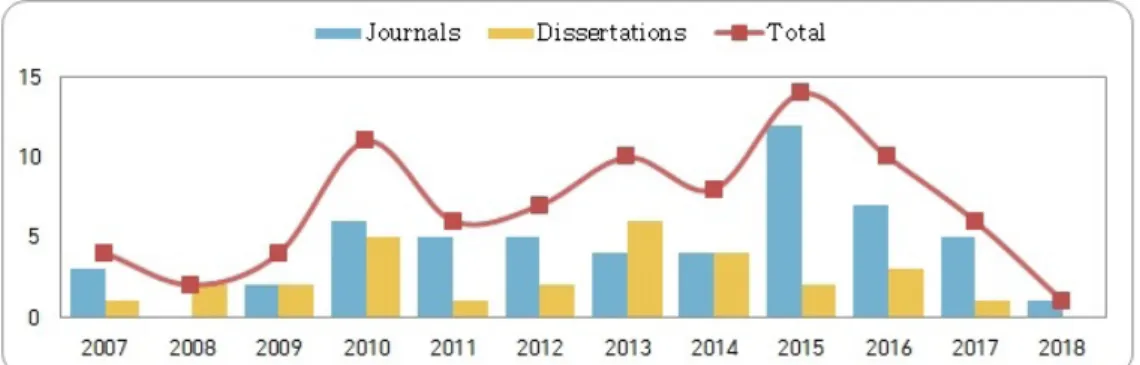
본 연구의 분석대상인 총 83편 논문의 발행 연도는 <Fig. 1>과 같으며, 치과위생사 이직관련 측정도구 를 다룬 57편 문헌내용은 <Table 1>과 같다. <Table 2>는 학술지 및 학회지 연구를 다룬 저널을 문헌수로 비교하였고, <Table 3-5>는 8개의 측정도구를 가장 많이 사용된 순으로 분석하였다.
<Table 1>은 치과위생사 이직에 대한 측정도구를 사용한 결과이다. 많은 연구들이 Lawer[89]의 측정도 구를 가장 많이 사용해왔으며, 이[93], Price와 Mueller[94], Mobley[98] 순으로 연구되어졌다. 원문의 측 정도구들은 최근 10년 동안 인용되거나 재인용되었다. 그 중에서 Lawer[89]의 측정도구는 박[90], 서[91], 김[92] 등, Price와 Mueller[94]는 서와 고[95], 김[96], 강[97] 등, Price와 Mueller[99]는 김[100] 등, Price 와 Mueller[102]는 서와 고[103] 등이 수정·보완 또는 재구성하여 사용하였다. Slavitt 등[104]이 개발한 측 정도구는 주[105]가 구성타당도를 검증하여 사용하였고, 이[112]는 Price와 Mueller[94]가 개발한 도구를 참고해 자체 개발하였다. 또 이[111]는 Mobley 등[110]의 도구를 번역하여 한국어판으로 사용하였다. 이 중에서 이[93]의 측정도구는 국내에서 개발된 도구 중 사용 빈도가 가장 많은 도구이며, 최근에 사용된 18 개의 측정도구 중에서도 두 번째로 많이 인용되는 도구이다. 이[93]는 이(1995), 정(1999), 김(2003)이 사용 한 설문지를 수정·보완하여 연구목적에 부합하도록 사회체육전문가와 경호학 전문가들에게 내용타당도 (content validity) 검증을 거친 후 수정·보완하여 개발하였다.
1. 연도별 추이
본 연구의 분석대상인 총 83편 논문의 발행 연도는 <Fig. 1>과 같다. 2008년에는 감소하다가 2009년부 터 다시 증가하는 추세를 보였으며, 2011년에 급격히 감소하였다. 다시 2013년부터 증가하여 2015년에는 가장 많았는데, 특히 학술지 논문이 많았다. 2008년에는 이직으로 다룬 주제가 학위논문만 있었다. 전체적 으로 2007년부터 최근까지 국내 학술지에 치과위생사 이직 관련 주제가 꾸준히 게재되고 있었다.
2. 학회지별 문헌 수
최근 10년간 국내 학회지에 게재된 치과위생사 이직 관련 논문 현황은 <Table 2>와 같다. 총 54편의 논 문이 14개 학회지에 게재되었는데, 한국치위생학회지가 19편으로 가장 많았다. 다음으로는 한국치위생과 학회지 11편, 대한예방치과·구강보건학회지 4편이었다.
Table 1. Introduction to all measurement tools (N=57)
Measuring tools N Measuring tools N
A Lawer EE. (1983)[89]
→ Park HS (2002)[90], Seo EH (2003)[91], Kim YR (2007)[92]
8 J Mobley WH et al. (1978)[108]*
→ Lee DS (1996)[109] 2
B Lee SR (2005)[93] 7 K Mobley WH et al. (1979)[110]
→ Lee GH (2004)[111] 2
C Price JL, Mueller CW. (1981)[94]
→ Seo YJ, Go JU (1997)[95], Kim HS (2003)[96], Kang OH (2004)[97]
6 L Lee SM (1995)[112] 2
D Mobley WH. (1982)[98]* 6 M Steers RM, Mowday RT. (1981)[107]*
→ Lee DS (1996)[109], Jeong MS (1999)[113] 1 E Price JL, Mueller CW. (1986)[99]*
→ Kim SJ (2007)[100] 5 N Bluedorn AC. (1982)[114]*
→ Jeong MS (1999)[113] 1
F Michaels CE, Spector PE. (1982)[101]* 4 O Morris JA, Feldman DC. (1996)[115] 1 G Price JL, Mueller CW. (1990)[102]*
→ Seo YJ, Go JU (2002)[103] 4 P Ahn YS et al. (2006)[116] 1
H Slavitt DB et al. (1978)[104]
→ Ju JH (2009)[105] 3 Q Netemeyer RG et al. (1997)[117] 1
I Mobley WH. (1977)[106]*
→ Steers RM, Mowday RT (1981)[107] 2 R Yeun EJ, Kim HJ (2013)[118] 1
*Including the number of papers in which the measurement tools mentioned in the previous research are overlapped with each other.
Fig. 1. Yearly trend of literature about turnover(N=83)
3. 측정도구별 활용된 변수
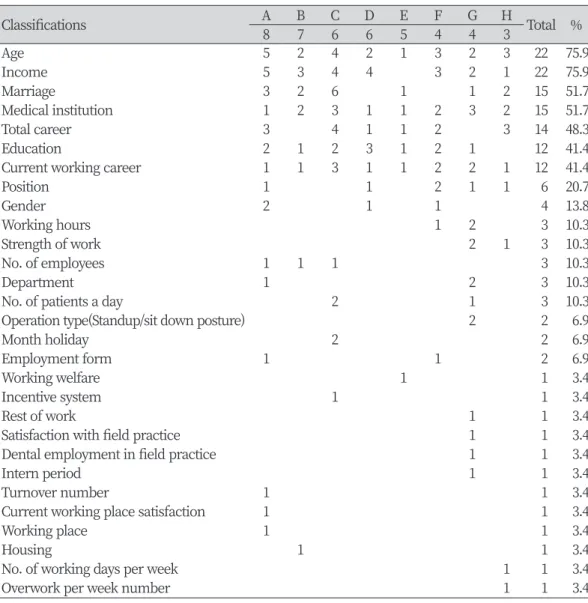
8개의 측정도구별로 활용된 변수를 일반적 특성에 따른 변수와 유의한 예측변수로 구분하여 분석하였 다. 일반적 특성으로 사용된 <Table 3-a> 중에서 ‘연령’과 ‘급여’가 이직 원인에 가장 큰 영향을 미쳤으며, 다음으로는 ‘결혼유무’와 ‘근무기관 형태’ 순이었다. 10개 이상 많이 사용된 일반적 특성 변수가 7개이며, 모 든 측정도구에 영향을 미친 변수는 ‘연령’, ‘근무기관 형태’, ‘현 근무지 경력’이다. A와 F도구는 연령과 급여, B도구는 급여, C도구는 결혼유무, D도구는 급여, G도구는 근무기관 형태, H도구는 연령과 총 근무경력이 이직에 영향을 미쳤다.
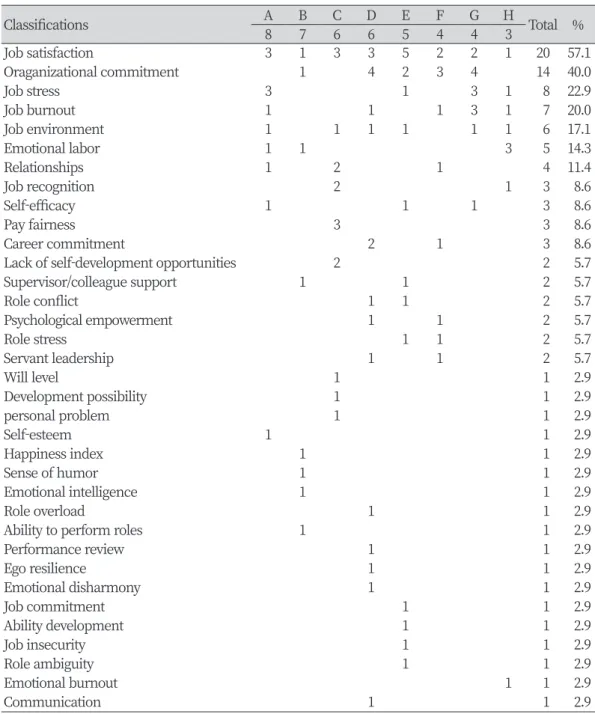
이직원인에 유의한 예측 변수로는 35개가 사용되었다<Table 3-b>. 이 중에서 10개 이상 사용된 변수는
‘직무만족’, ‘조직몰입’ 순이었고, 영향을 미치는 변수에는 ‘직무스트레스’, ‘직무소진’, ‘직무환경’, ‘감정노 동’, ‘인간관계’ 등이다. 전체 도구에서 모두 사용된 변수는 ‘직무만족’ 이었다. 도구별로 살펴본 결과 A도구 에서 ‘직무만족’과 ‘직무스트레스’, C와 E도구에서는 ‘직무만족’이 가장 많이 사용되었다. D, F, G도구에서 는 ‘조직몰입’이 많이 사용되었다. 한편, ‘직무만족’을 가장 많이 사용한 측정도구는 E도구였다. 두 번째로 많이 사용되었던 ‘조직몰입’은 D와 G도구에서 많이 다루었고, ‘직무스트레스’는 A와 G도구에서, ‘직무소 진’은 G도구, ‘감정노동’은 H도구, ‘인간관계’는 C도구였다. ‘직무환경’은 B와 F를 제외한 나머지 도구에서 고르게 사용되어 직무만족 다음으로 여러 측정도구에서 언급되었다.
4. 측정도구별 변수에 따른 연구결과
8개의 측정도구별 변수에 따른 연구결과를 살펴보기 위하여, 일반적 특성 변수와 예측변수로 나누어 분 석한 결과는 <Table 4>와 같다. A도구에서는 ‘직무만족’과 ‘직무스트레스’가 많이 사용되었으며 모두 ‘직무 만족이 낮을수록’, ‘직무스트레스가 높을수록’ 이직의도가 높다는 결과에 유의하였다. B도구에서는 ‘직무 만족’이 이직의도와 관계가 없다는 연구결과가 ‘직무만족이 낮을수록’ 유의한 결과보다 많았다. B도구에 서의 ‘직무소진’은 이직의도와 영향을 미치지 않는 변수였다. C도구는 ‘직무만족이 낮을수록’ 유의한 결과 가 대부분 이였으나 관계없다는 결과도 있었고, ‘직무환경이 낮을수록’ 보다는 이직의도와 관계없다는 연 구가 많았다. D와 F도구에서는 ‘직무만족’과 ‘조직몰입’ 모두 낮을수록 이직의도에 유의하였다. E도구에서 는 분석한 논문 전체에서 ‘직무만족’을 변수로 사용하였고, 모두 ‘직무만족이 낮을수록’ 이직의도가 유의성 Table 2. Number of turnover literature according to journal (N=54)
Journal N Journal N
Journal of Korean Society of Dental Hygiene
(J Korean Soc Dent Hyg) 19 Korea Academia-Indust rial cooperation Society
(KAIS) 2
Journal of Dental Hygiene Science
(J Dent Hyg Sci) 11 The Korea Contents Association 2
Journal of Korean Academy of Oral Health
(J Korean Acad Oral Health) 4 Journal of Korean Academy of Dental Hygiene
Education(J Korean Acad Dent Hyg) 1 Korean Journal of Health Service
Management(Korean J Health Serv Manag) 3 Korean Academy of Dental Administration
( KADA) 1
Korea Entertainment Industry Association 3 Korean Public Health Research
(Korean Public Health Res) 1
Journal of the Korea Convergence Society 3 Journal of the Korean Dental Association
(J Korean Dent Assoc) 1
Journal of the Korean Academy of Dental
Hygiene(J Korean Dent Assoc) 2 Korean Journal of Hospital Management
(Korean J Hosp Manage) 1
Dissertation(graduate/master's/doctoral) not included
있게 높았다. 또한 ‘조직몰입’이 낮을수록 이직의도에 영향을 미치지만 유의하지 않다는 결과도 있었다. G 도구는 ‘조직몰입이 낮을수록’, ‘직무스트레스가 높을수록’, ‘직무소진이 높을수록’ 이직의도에 유의하였고, H도구는 사용된 변수 중 특히 ‘감정노동이 높을수록’ 유의하였다.
5. 변수에 따른 측정도구 간 연구결과 비교
이직의도에 영향을 미치는 유의한 예측변수를 측정도구 간 비교한 결과는 <Table 5>와 같다. 모든 측정도 구에서 ‘직무만족’을 예측 변수로 사용하였다. A, D, E, F, H도구에서는 모두 ‘직무만족이 낮을수록’ 이직의도 에 유의하다는 결과였으나, B, C, G도구에서는 이직의도와 직무만족이 관계가 없다는 결과도 있었다. 다음으 로 많이 사용된 ‘조직몰입’은 낮을수록 유의한 결과가 대부분이었으나 E도구에서 유의하지 않다는 결과도 있 었다. ‘직무스트레스’와 ‘직무소진’은 높을수록 이직의도에 영향을 주었으나 F도구에서 ‘직무스트레스’가 유 의하지 않다는 결과가 있었고, B도구에서는 ‘직무소진’이 이직의도와 관계가 없었다. ‘직무환경 및 복지’가 낮 을수록 이직의도에 유의한 영향을 미쳤으나 C도구에서 직무환경과 이직의도가 관계가 없다는 결과도 있었 다. A, B, H도구에서 ‘감정노동이 높을수록’ 이직의도에 유의한 영향을 주는 반면 A와 B도구에서는 ‘감정노
Table 3-a. Significant general characteristics by measurement tools (N=29)
Classifications A8 B7 C6 D6 E5 F4 G4 H Total %3
Age 5 2 4 2 1 3 2 3 22 75.9
Income 5 3 4 4 3 2 1 22 75.9
Marriage 3 2 6 1 1 2 15 51.7
Medical institution 1 2 3 1 1 2 3 2 15 51.7
Total career 3 4 1 1 2 3 14 48.3
Education 2 1 2 3 1 2 1 12 41.4
Current working career 1 1 3 1 1 2 2 1 12 41.4
Position 1 1 2 1 1 6 20.7
Gender 2 1 1 4 13.8
Working hours 1 2 3 10.3
Strength of work 2 1 3 10.3
No. of employees 1 1 1 3 10.3
Department 1 2 3 10.3
No. of patients a day 2 1 3 10.3
Operation type(Standup/sit down posture) 2 2 6.9
Month holiday 2 2 6.9
Employment form 1 1 2 6.9
Working welfare 1 1 3.4
Incentive system 1 1 3.4
Rest of work 1 1 3.4
Satisfaction with field practice 1 1 3.4
Dental employment in field practice 1 1 3.4
Intern period 1 1 3.4
Turnover number 1 1 3.4
Current working place satisfaction 1 1 3.4
Working place 1 1 3.4
Housing 1 1 3.4
No. of working days per week 1 1 3.4
Overwork per week number 1 1 3.4
동’이 유의하지 않거나 이직의도와 관계가 없다는 결과가 있었다. A, C, F도구 모두에서 ‘인간관계가 안 좋을 수록’ 이직의도가 유의하게 높았다.
모든 측정도구에서 ‘직무만족’을 변수로 사용하였으나 직무만족이 낮을수록 이직의도에 영향을 준다는 연 구들과 직무만족이 이직의도와 관계가 없다는 연구들로 인해 결과는 조금씩 달랐다. 이외에도 ‘조직몰입’, ‘직 무스트레스’, ‘직무소진’, ‘직무환경 및 복지’, ‘감정노동’은 각 변수를 사용한 측정도구 간 같은 결과였으나 유 의하지 않거나 이직의도와 해당변수가 관계가 없다는 연구도 소수 있었다. 그러나 ‘인간관계’는 상위 예측변 수 중 유일하게 측정도구 간 모두 동일한 결과였다.
체계적 문헌고찰은 특정 연구 분야와 관련한 질문에 대해 전체 논문을 검색하여 최선의 사용 가능한 연구
Table 3-b. Significant turnover intention characteristics by measurement tools (N=35)
Classifications A8 B7 C6 D6 E5 F4 G4 H Total %3
Job satisfaction 3 1 3 3 5 2 2 1 20 57.1
Oraganizational commitment 1 4 2 3 4 14 40.0
Job stress 3 1 3 1 8 22.9
Job burnout 1 1 1 3 1 7 20.0
Job environment 1 1 1 1 1 1 6 17.1
Emotional labor 1 1 3 5 14.3
Relationships 1 2 1 4 11.4
Job recognition 2 1 3 8.6
Self-efficacy 1 1 1 3 8.6
Pay fairness 3 3 8.6
Career commitment 2 1 3 8.6
Lack of self-development opportunities 2 2 5.7
Supervisor/colleague support 1 1 2 5.7
Role conflict 1 1 2 5.7
Psychological empowerment 1 1 2 5.7
Role stress 1 1 2 5.7
Servant leadership 1 1 2 5.7
Will level 1 1 2.9
Development possibility 1 1 2.9
personal problem 1 1 2.9
Self-esteem 1 1 2.9
Happiness index 1 1 2.9
Sense of humor 1 1 2.9
Emotional intelligence 1 1 2.9
Role overload 1 1 2.9
Ability to perform roles 1 1 2.9
Performance review 1 1 2.9
Ego resilience 1 1 2.9
Emotional disharmony 1 1 2.9
Job commitment 1 1 2.9
Ability development 1 1 2.9
Job insecurity 1 1 2.9
Role ambiguity 1 1 2.9
Emotional burnout 1 1 2.9
Communication 1 1 2.9
결과를 종합하여 체계적으로 분석하는 연구방법이다. 한 연구만 검토하는 것은 다른 연구의 결과를 놓칠 수 있기 때문에 이상적으로 한 주제와 관련된 모든 연구가 수집되어야 한다. 이러한 점을 고려하여, 본 연구에서 Table 4. Research results based on measurement tools (N=43) Tools Job satisfaction Oraganizational commitment Job stress Job burnout Job environment Emotional labor Relationships
A 1
2 H*** H
3
4 L*** H***
5 L*** H***
6 L** L**
7 L** H*
8 H***
B 1 N
2 N N H
3 N N H*
4 L***
5 L***
6 N
7
C 1 L*** N
2 N N
3 L*** L*
4
5 L*** N
6 L** L**
D 1 L*** L***
2 L***
3 L*** L***
4 L**
5 L** H**
6 L***
E 1 L** L**
2 L*
3 L** L H*
4 L*
5 L*** L*** L***
F 1 H H*** L*
2 L*** L***
3 L***
4 L*** L***
G 1 L*** H** H***
2 N L*** H*** H**
3 L*** L* H* H***
4 L*** L*** L***
H 1 H**
2 H** H**
3 L*** H** L*** H**
*p<0.05, **p<0.01, ***p<0.001 H: higher, L: lower, N: no relation
는 2007년부터 2017년까지 국내에서 발표된 치과위생사 이직의도와 관련된 총 83편 논문을 모두 수집한 후 주요 측정도구와 관련된 43편의 논문을 분석하였다.
측정도구에서 가장 많이 사용된 일반적 특성 변수는 ‘연령’과 ‘급여’였으며, 그 다음으로 ‘근무기관’, ‘결혼’, ‘ 학력’, ‘총 근무년수’, ‘현 근무지 근무기간’ 순이었다. 가장 많이 사용된 ‘연령’은 A도구에서 20-25세, 20-29세,
26-29세, 36-40세 등 이직에 유의한 영향을 미쳤고, B도구는 25세미만, 26-30세 등, G도구는 25-29세, 연령이 많을수록 등, H도구는 25세 이하, 26-29세, 26-30세 등이었다. 반면 D와 F도구는 25-29세에서 유의하였고, 이 와 비슷하게 C도구는 25-30세, 26-30세에서 유의하였다. 한편 E도구는 22-25세에서 이직의도가 높았으나 유 의하지는 않았다. 한편, ‘급여’에서 A도구는 급여가 낮을수록, 250만원 미만, 150-199만원, 160-189만원, 연봉 2,500만원 미만 등 유사하나 다양하였고, C도구는 150-199만원, 150-200만원으로 유사한 결과였다. B도구는 181만원 이상이 유의하였고, 250만원 이상은 높게 나왔으나 유의하지는 않았다. D도구는 급여에 불만족할수 록, 100-199만원, F도구는 150-200만원, 100-199만원, 불만족할수록, G도구는 150-199만원, 급여가 적을수록,
H도구는 100-149만원, 연봉 2,000-2,500미만일 때 이직의도에 유의성 있게 높다는 결과였다.
일반적 특성 변수 중 ‘결혼’에서는 미혼이 이직의도가 높아짐에 유의한 영향을 준다는 결과가 대부분이었 으나 기혼에서 유의하다는 결과도 있었고, 결혼유무와 이직 의도는 관련이 없다는 연구결과도 있었다. ‘근무 기관’에서는 치과의원일수록, 치과병원일수록 이직의도에 유의한 영향을 미친다는 결과와 함께 치과의원과 치과병원에 각각 높은 결과를 보였으나 유의하지 않다는 결과도 있었다. 일반적 특성 변수인 ‘학력’, ‘총 근무 년수’, ‘현 근무지 근무기간’에서도 매우 다양한 결과가 나타났다. 이직의도 연구에서 그동안 사용된 일반적 특 성 변수들은 연구결과에 직·간접적인 영향을 다양하게 미치고 있었다. 이는 일반적 특성 변수를 사용할 때 인 구집단 선정을 신중하게 고려하여 통제해야할 필요가 있으며, 이직의도와 관련해서 일반적 특성 변수의 표준
화가 필요하다는 것을 보여준다.
한편, 치과위생사 이직의도에 유의한 예측변수 중 ‘직무만족’이 가장 많이 사용되었다. 다음으로 ‘조직몰입’,
‘직무스트레스’, ‘직무소진’, ‘직무환경’, ‘감정노동’, ‘인간관계’ 순으로 많이 사용되었다. 치과위생사 이직의도 와 관련하여 가장 많이 사용된 유의한 예측변수는 직무만족이었고, 직무만족을 많이 다룬 측정도구는 E도구 인 Price와 Mueller[99]였다. 직무만족을 다룬 모든 측정도구에서 직무만족이 낮을수록 이직의도가 유의하 게 높았다.
이번 연구에서는 치과위생사 이직과 관련한 83편 논문 중 최종적으로 43편만을 분석하였는데, 그 이유는 측정도구의 출처가 불분명하거나 연구자가 임의적으로 측정도구를 수정 및 재구성하여 사용한 경우는 분석 Table 5. Comparison of research results between measurement tools (N=43) Tools Job satisfaction Oraganizational commitment Job stress Job burnout Job environment Emotional labor Relationships
A(8) L**/ L*** H*/H*** H*** L** H/H*** L**
B(7) N/L*** L*** N N/H*
C(6) N/L*** N/L** L*/L**
D(6) L**/ L*** L*** H** L**
E(5) L*/L*/L** L/L*/L** H* L***
F(4) L*** L*** H H*** L*
G(4) N/L*** L*/L*** H*/H*/H** H**/H*** L***
H(3) L*** H** H** L*** H**
*p<0.05, **p<0.01, ***p<0.001 H: higher, L: lower, N: no relation
에서 제외하였기 때문이다. 선행연구들이 참고한 원논문과 개발된 측정도구를 찾으려 해도 참고문헌에 실리 지 않았거나 제시하지 않은 경우가 많아 문헌 선정에 한계가 있었다. 또한, 이직의도 측정도구를 직무만족, 조 직몰입, 자아존중 등 다른 측정도구와 혼합하여 사용하여 이직의도만을 측정한 것으로 보기 어려운 경우도 빈번하였다. 이번 문헌고찰 분석에서 밝혀진 것 중의 하나는 측정도구를 사용할 때 원논문의 문항수를 그대 로 사용한 경우는 거의 없었으며, 연구자가 임의적으로 선택한 경우가 대부분이었다. 특히 연구자가 임의적 으로 측정도구를 재구성할 때에도 새로운 측정도구에 대한 신뢰도 및 타당도 검증을 언급한 경우는 없었다.
따라서 체계적 문헌고찰(systemic review)를 하기에는 제한점이 많았다. 앞으로 연구자가 치과위생사 이직 의도와 관련된 연구를 할 경우에는 측정도구 선택 또는 개발에 관심을 기울여야 할 것이다.
그 동안 치과위생사의 이직의도와 관련된 많은 연구가 있었지만, 측정도구에 따라 서로 다른 연구결과를 보이고 있다. 본 연구에서는 측정도구 간에 어떤 차이가 발생하는지를 심층적으로 알아보기 위하여 선행연 구를 분석하였다. 문헌고찰을 통하여 치과위생사 이직의도와 관련된 각 측정도구별 특성 및 활용된 변수의 영향을 알아보았다. 이러한 목적을 달성하기 위하여 2007년부터 2017년까지 국내에서 발표된 학술지와 학위 논문 중에서 치과위생사 이직의도와 관련된 83편의 논문을 중심으로 분석하였다. 특히 이직의도 측정도구로 언급된 18개 중에서 많이 사용된 8개의 측정도구를 다룬 43편의 논문을 집중 분석하였다. 연구결과를 요약하 면 다음과 같다.
1. 지난 10년간 치과위생사 이직의도를 파악하는 논문에서 가장 많이 사용된 측정도구는 Lawler[89]가 개 발한 도구였으며, 국내 측정도구 중에서는 이[93]가 개발한 도구가 가장 많이 사용되었다.
2. 모든 측정도구에서 이직의도와 유의한 공통 예측변수는 ‘직무만족’이었다. 또한 가장 많이 사용된 유의 한 예측변수는 ‘직무만족’과 ‘조직몰입’이다. 모든 측정도구에서 이직의도와 유의한 일반적 특성의 공통 변수 는 ‘연령’, ‘근무기관 형태’, ‘현 근무지 경력’이며, 가장 많이 사용된 일반적 특성 변수는 ‘연령’과 ‘급여’였다.
3. 모든 측정도구에서 공통적으로 사용된 ‘직무만족’을 측정하는 방법은 ‘Price와 Mueller[99]’가 개발한 도 구를 가장 많이 사용하였다.
4. 측정도구 간 이직의도에 영향을 미치는 변수에 일부 차이는 있었지만, 전체적으로 직무만족, 조직몰입, 직무환경은 ‘낮을수록’, 직무스트레스와 직무소진, 감정노동은 ‘높을수록’, 인간관계가 ‘안 좋을수록’ 이직의도 가 높아진다는 결과는 동일하였다.
측정도구에 따라 이직의도에 영향을 미치는 요인이 달라진다는 결과로 볼 때 치과위생사 이직의도에 대한 연구를 할 경우 측정도구의 신중한 선택과 이직의도만을 다루는 측정도구를 개발하는 것이 필요할 것이다.
또한 이직의도에 가장 큰 영향력이 있는 변수를 발굴하여 치과위생사의 이직률을 감소시킬 수 있는 구체적 인 방안을 마련할 수 있어야 할 것이다.
Conflicts of interest
The authors declared no conflict of interest.
References
[1] Korean Statistical Information Service[Internet]. [cited 2018 Mar 31]. Available from:
http://kosis.kr/statisticsList/statisticsListIndex.do?menuId=M_01_01&vwcd=MT_ZTITL E&parmTabId=M_01_01.
[2] Kim HY, Choi JO, Seong MG. The effect of self-efficacy and job satisfaction of dental
hygienists′on the organizational commitment and turnover intention. J Korean Soc Dent Hyg 2012;12(1):213-23. https://doi.org/10.13065/jksdh.2012.12.1.213
[3] National Health Personnel Licensing Examination Board. National examination pass rate by year[Internet]. [cited 2018 Mar 31]. Available from: http://www.kuksiwon.or.kr/
publicity/Examstatistic.aspx?sitegnb=5&SiteLnb
[4] Yoon MS. Suggestions for settlement stable employment culture of dental hygienist. J Dent Hyg Sci 2017;17(6):463-71. https://doi.org/10.17135/jdhs.2017.17.6.463
[5] Kim JH, Kim HY, Lee SK, Cho YS, Park YD. A survey on working conditions and manpower among dental auxiliary personnel in dental clinics. J Korean Acad Dent Health 2008;32(4):540-50.
[6] Hayes LJ, O’Brien-Pallas L, Duffield C, Shamian J, Buchan J, Hughes F, et al. Nurse turnover: A literature review. International Journal of Nursing Studies 2006;43(2):237- 63. https://doi.org/10.1016/j.ijnurstu.2005.02.007
[7] Han SY, Cho YC. Covariance structure analysis on the impact of job stress, fatigue symptoms and job satisfaction on turnover intention among dental hygienists. Korea Academia-Industrial Cooperation Society 2016;17(7):629-40. https://doi.org/10.5762/
KAIS.2016.17.7.629
[8] Lee BH, Kim JS. Analysis of the correlation of burnout, job satisfaction and turnover of dental hygienists. International Journal of Contents 2010;10(11):217-27. https://
doi.org/10.5392/JKCA.2010.10.11.217
[9] Go EJ, Cho YH, Yoon HS. Relative factors intent to Leave for dental hygienists. J Korean Soc Dent Hyg 2009;9(4):1-19.
[10] Choi HN, Bae HS, Cho YS. Effect of gap between expected job and performed job on turnover intention and job satisfaction in clinical dental hygienists. J Dent Hyg Sci 2011;11(5):463-9.
[11] Choi MS, Ji DH. The comparative study on changes in job satisfaction and turnover intention according to the convergence mediating factors and the level of emotional labor in dental hygienists. Journal of the Korea Convergence Society 2015;6(6):27-34.
https://doi.org/10.15207/JKCS.2015.6.6.027
[12] Song KH, Kim YJ. A study on the job satisfaction and turnover intention of the dental hygienists and nursing aids. J Korean Dent Assoc 2013;15(1):1-11.
[13] Ji MG. Analysis of the correlation of job satisfaction, professionalism and turnover intention. Journal of Korea Entertainment Industry Association 2015;9(4):343-50.
https://doi.org/10.21184/jkeia.2015.12.9.4.343
[14] Jeong SB, Choi EM, Choi JS. The effects of emotional labor on burnout, turnover intention, and job satisfaction among clinical dental hygienists. J Korean Acad Oral Health 2014;38(1):50-8. https://doi.org/10.11149/jkaoh.2014.38.1.50
[15] Kang MH, Jang SJ. Convergent relationship between emotional labor, burnout, job satisfaction and turnover intention in the dental hygienists. Journal of the Korea Convergence Society 2017;8(8):95-103. https://doi.org/10.15207/JKCS.2017.8.8.095 [16] Lee CS, Park SY, Park HM, You Y, Shin EK, Chae SI, et al. Influential job-related
characteristics for the job satisfaction and turnover possibility of dental hygienists. J Dent Hyg Sci 2012;12(6):666-74.
[17] Park YN, Choi YK, Ryu DY. Influence of organizational communication satisfaction on job satisfaction, organizational commitment, and turnover intention: focused on the mediated effects of interpersonal stress. J Korean Soc Dent Hyg 2015;15(5):797-804.
https://doi.org/10.13065/jksdh.2015.15.05.797
[18] Park EC. Impact of servant leadership perception on job satisfaction, organizational commitment and turnover intention of dental hygienists. Korean J Hosp Manage 2011:16(4): 1-16.
[19] Jeon JH. Influence of humor sense on job satisfaction and turnover intention in clinical dental hygienists. J Korean Soc Dent Hyg 2014;14(6):821-30. https://doi.org/10.13065/
jksdh.2014.14.06.821
[20] Yun HK, Choi MS, Choi GY. Effect of mentoring function on job satisfaction, organization commitment, and turnover intention in the newly employed dental hygienists. J Korean Soc Dent Hyg 2016;16(1):69-75. https://doi.org/10.13065/jksdh.2016.16.01.69 [21] Lee CS, Lim SH, Han JH. The effect of the intramural marketing activities in dental
hygienist` on job Satisfaction and turnover intention in dental hygienist. J Dent Hyg Sci 2012;12(1):15-22.
[22] Ju OJ, Kim KS, Lee HO. Analysis of the correlation of job satisfaction to turnover among dental hygienists in the region of J. J Dent Hyg Sci 2007;7(4):251-6.
[23] Choi HN, Lim SR, Cho YS. Factors associated with turnover intention of dental hygienist. J Korean Soc Dent Hyg 2010;10(6):973-81.
[24] Kim JS. The factors determining the intention and practical action of job change of dental hygienist. J Korean Soc Dent Hyg 2007;13(1):101-5.
[25] Min HH, Jeon JH, Kim YS. Influencing factors of turnover intention in the clinical dental hygienists. J Korean Soc Dent Hyg 2015;15(5):831-9. https://doi.org/10.13065/
jksdh.2015.15.05.831
[26] Lee SM, Choi YJ, Han GS, Kim CH. Influencing factors of turnover intention of dental hygienists using by the path analysis. J Korean Soc Dent Hyg 2013;13(6):941-9. https://
doi.org/10.13065/jksdh.2013.13.06.941
[27] Min HH, Kim YS. Factors influencing turnover intention in new dental hygienists. J Korean Soc Dent Hyg 2016;16(6):1047-55. https://doi.org/10.13065/
jksdh.2016.16.06.1047
[28] Choi HN, Lee JW, Cho YS. Factors associated with turnover intention of public health dental hygienist. J Korean Soc Dent Hyg 2011;11(3):343-51.
[29] Kim YK, Kwon HJ. The influence of job stress and job satisfaction on turnover intention for male dental hygienists. J Dent Hyg Sci 2016;16(2):142-9. https://doi.org/10.17135/
jdhs.2016.16.2.142
[30] Kim YK, Choi MS. The influence of job stress of male and female dental hygienists on turnover intention. J Korean Dent Assoc 2017;19(2):67-78.
[31] Gwon MY. Study on the factors that affect the intent of changing occupation of dental hygienists. J Korean Acad Dental Hygiene Education 2007;7(4):395-403.
[32] Gwon AR, Han SJ. Effect of communication competence on the organizational effectiveness in dental hygienists. J Korean Soc Dent Hyg 2015;15(6):1009-17. https://
doi.org/10.13065/jksdh.2015.15.06.1009
[33] Lee KJ, Bae HS. The Factors Affecting the Intention of Career Discontinuity of a Married Women Dental Hygienist. J Dent Hyg Sci 2015;15(6):786-93. https://doi.org/10.17135/
jdhs.2015.15.6.786
[34] Go EJ. Factors affecting intent to leave for dental hygienists[Master's thesis]. Gimhae:
Univ. of Inje, 2009.
[35] Bae SY. The effect of emotional labor on job satisfaction and turnover intention of
dental hygienist[Master's thesis]. Gimhae: Univ. of Inje, 2014.
[36] Jeong HM. Influence of new dental hygienests' job factors and job satisfaction on turnover intention[Master's thesis]. Seoul: Univ. of Kyunghee, 2011.
[37] Han SY. Effects of job stress, fatigue symptoms and job satisfaction on turnover intention among dental hygienists[Doctoral dissertation]. Daejeon: Univ. of Chungnam National, 2016.
[38] Doe YJ. Influence of disc behavioral type on job satisfaction and turnover intention on dental hygienist[Master's thesis]. Suwon: Univ. of Ajou, 2017.
[39] Jeong SB. The effect of emotional labor on burnout, job satisfaction and turnover intension among clinical dental hygienists[Master's thesis]. Seongnam: Univ. of Gachon, 2013.
[40] Go KH. Influences of job stress and satisfaction on turnover intention among dental hygienists[Master's thesis]. Jinju: Univ. of Gyeongsang, 2013.
[41] Kim YJ. A study on the job satisfaction and turnover lntention of the dental hygienists and nursing aids[Master's thesis]. Seoul: Univ. of Hongik, 2010.
[42] Kim SJ. The effect of self-efficacy of dental hygienists and nurse's aides on the job satisfaction, organizational commitment and turnover intention[Master's thesis]. Seoul:
Univ. of Kyunghee, 2007.
[43] Ji MG. The Effect of turnover intention on the job stress, burn out and organizational commitment - focused on new dental hygienists. Journal of Korea Entertainment Industry Association. 2016;10(6):379-87. https://doi.org/10.21184/jkeia.2016.12.10.6.37 [44] Yeon MR. The relationship of professionalism and organizational commitment with intention to change jobs among dental hygienists[Master's thesis]. Suwon: Univ. of Ajou, 2012.
[45] Gang JY. The effect of interpersonal conflict in hospital organization on organization immersion and turnover intention : focused on dental hospitals and clinics[Master's thesis]. Daegu: Univ. of Keimyung, 2010.
[46] Heo SE, Ji JH. The mediating effects of burnout on the relationships between job stress and turnover intention for dental hygienists. Korean Public Health Res 2010;36(2):35-55.
[47] Lee BH, Kim JS. Moderating effects of internal marketing on the relationship between job stress and turnover intention among dental hygienists. Journal of the Korea Convergence Society 2016;7(5):79-87. https://doi.org/10.15207/JKCS.2016.7.5.079 [48] Kim JH, Kim HJ. Relationship between turnover and job stress of dental hygienists. J
Dent Hyg Sci 2011;11(1):47-53.
[49] Lee ML, Lee HC. The effect of job stress and turnover intention in dental hygienists.
Journal of Korea Entertainment Industry Association 2017;11(3):249-58. https://
doi.org/10.21184/jkeia.2017.04.11.3.249
[50] Yun HK. Effect of newly appointed dental hygienists' job stress on organization effectiveness. International Journal of Contents 2014;14(2):442-9. https://
doi.org/10.5392/JKCA.2014.14.02.442
[51] Choi BK, Kim JS, Ha MN. Effects of emotional labor and job characteristics on job stress and turnover intention in dental hygienists using the structural equation model. J Korean Soc Dent Hyg 2018;2018;18(1):31-42. https://doi.org/10.13065/
jksdh.2018.18.01.31
[52] Park HY, Jang GW, Lee GH, Lee MK, Lee GW, Lim Y, et al. The effects of emotional
labor of dental hygienist on the job stress, anxiety and sleep. J Korean Soc Dent Hyg 2017;17(3):449-63. https://doi.org/10.13065/jksdh.2017.17.03.449
[53] Lee MH. The influence of job stresses on the intention of resignation of dental hygienists of daegu city[Master's thesis]. Gyeongsan: Univ. of Yeungnam, 2013.
[54] Moon SJ. Effect of dental hygienists' emotional labor on job stress and turnover intention[Master's thesis]. Iksan: Univ. of WonKwang, 2014.
[55] Heo SE. The effect of job stress on burn-out and intention to change a job for dental hygienists[Master's thesis]. Gimhae: Univ. of Inje, 2010.
[56] Choi EJ. Job stress and intention to leave for dental hygienists[Master's thesis]. Seoul:
Univ. of Catholic, 2010.
[57] Jeong KY, Han OS. A study on emotional labor, emotional burnout, turnover intention of dental hygienist. J Dent Hyg Sci 2015;15(3):280-6. https://doi.org/10.17135/
jdhs.2015.15.3.280
[58] Oh HS. Relationship between emotional labor, burnout and turnover intention in the dental hygienists. J Korean Soc Dent Hyg 2015;15(4):641-8. https://doi.org/10.13065/
jksdh.2015.15.04.641
[59] Kim JM. The relations among emotional labor, burn out and turnover intention of dental hygienists[Master's thesis]. Jinju: Univ. of Gyeongsang, 2013.
[60] Cho MM. Impact of incivility experienced by dental hygienists on organizational achievement : as a mediating effect of emotional exhaustion[Doctoral dissertation].
Busan: Univ. of Dong-Eui, 2016.
[61] Bae SM, Kim HK. A status of determinant of the intention to turnover for dental hygienists. Journal of the Korea Academia-industrial 2012;13(12):5986-92. https://
doi.org/10.5762/KAIS.2012.13.12.5986
[62] Jang JE, Jeong SR. Work environment and conflict level of dental hygienists affect turnover. Korean J Health Serv Manag 2015;9(3):107-14. https://doi.org/10.12811/
kshsm.2015.9.3.107
[63] Yoo JH, Noh HJ. The relationship between the factors of job selection and movement- based on dental hygienists who graduated college in metropolitan area. J Korean Acad Oral Health 2009;33(4):664-72.
[64] Lee JH, Kim HE, Choi JS. The relationship between role stress and turnover among dental hygienists: mediating effects of commitment. J Korean Acad Oral Health 2015;39(2):119-26. https://doi.org/10.11149/jkaoh.2015.39.2.119
[65] Lee ML, Lee HC. The effect influence of job satisfaction on turnover intention in dental hygienists. J Korean Soc Dent Hyg 2016;16(2):303-11. https://doi.org/10.13065/
jksdh.2016.16.02.303
[66] Choi WJ. Factors affecting employment separation intentions dental hygienists[Master's thesis]. Seongnam: Univ. of Gachon, 2012.
[67] Kawk MH. The effect of work environment on the turnover in dental hygienists[Master's thesis]. Daegu: Univ. of Catholic, 2010.
[68] Lee MJ, Kim YN, Lee SY. A study on factors affecting emotional labor of clinical dental hygienists. J Dent Hyg Sci 2015;15(2):113-8. https://doi.org/10.17135/jdhs.2015.15.2.113 [69] Han SR. The effect of emotional labor on the intention to leave among female
employees at dental clinics and the moderating effect of internal marketing[Master's thesis]. Gimhae: Univ. of Inje, 2014.
[70] Park SY, Kim JS. A study on the self-efficacy and turnover intention of dental
hygienists. Korean J Health Serv Manag 2013;7(4):23-32. https://doi.org/10.12811/
kshsm.2013.7.4.023
[71] Kim KY. A study on the impact of psychological empowerment on job attitudes and turnover intention of dental hygienists. Korean J Health Serv Manag 2010;4(2):1-10.
[72] Son JL, Jang JH. The relationship between dental hygienist's exposure to incivility at workplace and their turnover intention. J Korean Soc Dent Hyg 2017;17(5):779-89.
https://doi.org/10.13065/jksdh.2017.17.05.779
[73] Lee JH, Choi JM, Lee YA. The help of experienced dental hygienists turnover verbal abuse and emotional reaction, and the resulting relationship. J Dent Hyg Sci 2014;14(4):563-70. https://doi.org/10.17135/jdhs.2014.14.4.563
[74] Min HH. Influencing factors on happiness index in clinical dental hygienists. J Korean Soc Dent Hyg 2015;15(1):1-9. https://doi.org/10.13065/jksdh.2015.15.01.1
[75] Yoo EM, Han HJ. A study on the work and turnover of clinical dental hygienists. J Dent Hyg Sci 2011;11(1):41-6.
[76] Kim JS, Won YS, Park SY. A study on self-esteem and turnover intention according to dental hygienists in part of Jeonbuk area. J Korean Soc Dent Hyg 2012;12(2):307-15.
[77] Kim GY, Chung WG. Impact of human resource management and development on turnover intention of dental hygienist in Korean dental settings - focusing on the moderating effect of career commitment. J Korean Acad Oral Health 2010;34(4):505-15.
[78] Lee JW, Kim MG. The effects of personality types on turnover intention and job retention. J Korean Dent Assoc 2010;48(10):738-53.
[79] Lee JW. Differences among dental hygienists in job retainment possibility and job maintenance possibility according to MBTI personality type. Journal of Korean Academy of Dental Administration 2013;1(1):43-59.
[80] Yu HS. Influence factors on dental hygienists' turnover intention[Master's thesis].
Seoul: Univ. of Kyunghee, 2008.
[81] Son JL. Effects of experienced incivility in the workplace on turnover intention of dental hygienist[Master's thesis]. Seosan: Univ. of Hanseo, 2016.
[82] Kim YH. A study on the effect of morals on dental hygienists intention to leave[Master's thesis]. Yongin: Univ. of Dankook, 2013.
[83] Baek SM. The influence of the internal marketing factors in dental hospitals and clinics on the dental hygienist's turnover intention[Master's thesis]. Seoul: Univ. of Chungang, 2009.
[84] Kim CR. The anlysis of mediating and moderation variable in the relationship between emotional dissonance and organizational effectiveness among clinical dental hygienists[Master's thesis]. Seongnam: Univ. of Gachon, 2015.
[85] Gwon AR. Effect of communication competence on the organizational effectiveness in dental hygienists[Master's thesis]. Seongnam: Univ. of Gachon, 2015.
[86] Yoo YS. Workplace friendship and organizational effectiveness[Master's thesis]. Wonju:
Univ. of Yonsei, 2009.
[87] Lee JH. The multiple commitment and organizational effectiveness among clinical dental hygienists[Master's thesis]. Seongnam: Univ. of Gachon, 2014.
[88] Han HK. A study on the organizational satisfaction of dentists and dental care providers working in dental hospitals and dental clinics[Master's thesis]. Iksan: Univ. of WonKwang, 2013.
[89] Lawer EE. Stisfaction and behavior. New York: McGrow Hill; 1983: 287-301.
[90] Park HS. Relationship between perceived nursing care role orientation, job characteristics, and turnover among nurses[Master's thesis]. Wonju: Univ. of Yonsei, 2002.
[91] Seo EH. The relationship between job satisfaction, organizational commitment and turnover intention of kindergarten teachers[Master's thesis]. Seoul: Univ. of Catholic, 2003.
[92] Kim YR. A study on the turnover intention of the oncology nurse[Master's thesis].
Gwangju: Univ. of Chonnam National, 2007.
[93] Lee SR. The bodyguard job stress on job satisfaction and turnover intention is influenced[Doctoral dissertation]. Wonju: Univ. of Yonsei, 2005.
[94] Price JL, Mueller CW. A causal model of turnover for nurses. Academy of Management Journal 1981;24(3):543-65.
[95] Seo YJ, Ko JW. The determinants of propensity to stay among hospital nurses. Korean J Hosp Manage 1997;2(1):137-61.
[96] Kim HS. The determinants of the job satisfaction and intent to leave among hospital foodservice employees[Master's thesis]. Wonju: Univ. of Yonsei, 2003.
[97] Kang OH. The determinants of intent to leave of dental hygienists at dental clinics[Master's thesis]. Wonju: Univ. of Yonsei, 2004.
[98] Mobley WH. Some unanswered question in turnover and with drawal research.
Academy of Management Review 1982;7(1):111-6.
[99] Price JL, Mueller CW. Absenteeism and turnover of hospital employees. Greenwich, CT: JAI press; 1986: 1-282.
[100] Kim SJ. The effect of self-efficacy of dental hygienists and nurse's aides on job satisfaction, organizational commitment and turnover intention. Health Service Management Review 2007;3(1):1-10.
[101] Michaels CE, Spector PE. Causes of employee turnover: a test of the mobley, griffeth, hand, and meglino model. Journal of Applied Psychology 1982;67(1):53-9.
[102] Price JL, Mueller CW. Wilford hall medical center retention survey. Lackland Air Force base, TX, 1990.
[103] Seo YJ, Go JU. Determinants of intent to leave among physicians working at general hospitals after the separation program of prescribing and dispensing. Health Policy and Management 2002;12(4):68-90. https://doi.org/10.4332/KJHPA.2002.12.4.068
[104] Slavitt DB, Stamps PL, Piedmont EB, Hasse AM. Nurse’s satisfaction with there work satisfaction. Nursing Research 1978;27(2):114-20.
[105] Ju JH. ER Nurses`s job stress main factors influencing on the organizational effectiveness[Master's thesis]. Seoul: Univ. of Kyunghee, 2009.
[106] Mobley WH. Intermediate linkages in the relationship between job satisfaction and employee turnover. Journal of Applied Psychology 1977;62(2):237-40.
[107] Steers RM, Mowday RT. Employee turnover and post decision accommodation processes. In Staw BM, Cummings LL (Eds.). Research in Organizational Behavior Vol. 3.
Greenwich. CT: JAI Press; 1981: 235-281.
[108] Mobley WH, Horner SO, Hollingsworth AT. An evaluation of precursors of hospital employee turnover. Journal of Applied Psychology 1978;63(4):408-14.
[109] Lee DS. The effects of job stress on job turnover among leisure sport instructors[Doctoral dissertation]. Seoul: Univ. of Konkuk, 1996.
[110] Mobley WH, Griffeth RW, Hand HH, Meglino BM. Review and conceptual analysis of
the employee turnover process. Psychological Bulletin 1979;86(3):493-522.
[111] Lee GH. The impact of career plateau on turnover intentions: concerning on bank employees[Master's thesis]. Seoul: Univ. of Hanyang, 2004.
[112] Lee SM. The effect of job characteristics and personal factors on work stress, job satisfaction and turnover intention. Journal of Korean Academy of Nursing 1995;25(4):790-806.
[113] Jeong MS. Effects of sport and leisure leaders' satisfaction with their jobs and organizations on turnover[Doctoral dissertation]. Daegu: Univ. of Keimyung, 1999.
[114] Bluedorn AC. A unified model of turnover from organizations. Human Relations 1982;35(2):135-53. https://doi.org/10.1177/001872678203500204
[115] Morris JA, Feldman DC. The dimensions, antecedents and consequences of emotional labor. Academy ot Management Review 1996;21(4):986-1010.
[116] Ahn YS, Shin SJ, Jung SH, Lee YS, Lim DS. Comparison of job description and turnover trend among dental hygienists and assistant nurses in dental clinics. J Korean Acad Dent Health 2006;30(3):303-15.
[117] Netemeyer RG, Boles JS, Mckee DO, McMurrian R. An investigation into the antecedents of organizational citizenship behavior sina personal selling context.
Journal of Marketing 1997;61:85-98.
[118] Yeun EJ, Kim HJ. Development and testing of a nurse turnover intention scale (NTIS).
Journal of Korean Academy of Nursing 2013;43(2):256-66. https://doi.org/10.4040/
jkan.2013.43.2.256