가상현실 게임 경험에 대한 한국 대학생들의 관점연구
Study of Korean College Students’ Perspectives on Virtual Reality Game Experience
엄남현 홍익대학교 광고홍보학부
Namhyun Um([email protected])
요약
한국에서는 아직 가상현실 게임에 대한 연구는 활발하지 않은 편이다. 따라서, 본 연구는 가상현실 게임에 대한 대학생들의 인식, 가상현실 게임의 동기 요인들 및 가상현실 게임의 주요 특성들을 살펴보고자 한다.
본 연구는 가상현실 게임을 최근 경험한 대학생들 10명의 심층인터뷰를 바탕으로 구성되었으며, 연구 결과, 가상현실 게임을 즐긴 참여자들은 높은 가상 현실감, 몰입도 및 통제성을 느낀 것으로 나타났다. 이러한 요인들은 모바일, PC, 비디오 게임에서는 쉽게 나타나지 않는 특징들로 가상현실 게임의 변별적 특징으로 규정될 수 있다. 게이머의 재방문 의사에 미치는 요인들로는 가상현실게임에서 4D 효과, 다양한 가상현실 콘텐츠, 게임에서의 자유, 독특한 경험, 실재감, 긴장감, 액션 기반 경험, 그리고 그룹 게임 가능성 등이 있다.
본 연구결과, 가상현실 게임에서 주요한 특징인 몰입, 참여, 및 가상 존재감이 가상현실 게임 태도에 긍정적 인 영향을 미치는 주요한 역할을 하는 것으로 나타났다. 따라서, 가상현실 게임 콘텐츠를 제작함에 있어 게이머들의 몰입, 참여, 가상 존재감을 높일 수 있는 장치들을 사전에 고려함으로써 소비자들의 만족도 제 고에 노력해야 한다.
■ 중심어 :∣가상현실게임∣가상현실∣가상 존재감∣가상 현실감∣몰입감∣참여∣
Abstract
In Korea there has been scant research on VR games. This work focuses then on college students’ perceptions of VR games, factors motivating them to experience VR games, the important features of VR games. This study presents the results of in-depth interview with 10 college students who had recently experienced VR games. VR games, it is found, provide a high level of virtual reality, immersiveness, and controllability. Such attributes may be considered distinctive to mobile, PC, and video games. Gamers’ intention to re-experience VR games is influenced by the following important factors: 4D effects in VR games, various VR game contents, freedom in games, unique experience chances, sense of reality, sense of thrill, action-based experiences, and playing in group (multiple player). Study findings also suggest that three important features in VR games known as immersion, engagement, and virtual presence play a pivotal role in influencing positive attitudes toward VR games. Practical implications are also discussed.the help of information technology.
■ keyword :∣VR Game∣Virtual Reality∣Virtual Presence∣Social Presence∣Immersiveness∣Engagement∣
접수일자 : 2018년 10월 23일 수정일자 : 2018년 12월 03일
심사완료일 : 2018년 12월 05일
교신저자 : 엄남현, e-mail : [email protected]
I. Introduction
While still in its inceptive stage, the VR industry is poised for rapid growth, as its ecosystem has been strongly built up. The smartphone has changed Information and Communications Technology (ICT) fundamentals from PC to mobile; new ICT innovation is now expected to be led by VR technology[1]. To date, device markets are leading the VR industry, but content markets are forecast to lead, in the near future, the VR industry at a rapid pace. VR technology has been providing users with a great deal of immersiveness, a quality that TV, computer, and mobile devices are unable to provide. According to the Korean Ministry of Science and ICT, in 2017 the world’s VR industry market reached US$2.2 billion and by 2025 is expected to have grown to US$80 billion[2].
Not only global ICT companies such as Google and Facebook but other global manufacturing, telecommunication, and broadcasting companies have begun investing in VR ecosystems[3]. Global ICT companies are now focused on VR-related devices such as cameras and Head Mounted Display (HMDs), but are expected to move to the platform business to occupy a pivotal role in the VR ecosystem. With the introduction of new VR devices and the improvement of VR content production environments, VR technology has expanded to many other industries.
For instance, VR technology has been applied to clinical practices, education, shopping, entertainment, and more. VR is certainly revolutionizing the healthcare field. Indeed, VR experiences provide a controlled environment in which patients can face their fears and even practice coping strategies, as well as try to break patterns of avoidance[4]. Similar to exposure therapy for phobias and anxieties, virtual reality is being put to use to help soldiers with
post-traumatic stress disorder (PTSD). VR plays a significant role in meeting a student’s learning requirements and offers a platform from which students may learn efficiently without fear of discrimination. Moreover, teachers can create for students an immersive learning experience catered to their level of understanding of the subject.
In terms of VR shopping, Amazon, Alibaba, Google, and many other giants of e-commerce are acting as first movers[5]. For instance, as an early player in VR e-commerce, Alibaba launched Taobao VR shopping device. Alibaba is just one of a growing number of companies using either VR or AR (augmented reality) to enhance online experiences. In 2016 shoppers were able to purchase an Alibaba virtual reality headset, virtually transporting them to international retail outlets and enabling them to experience the entire shopping experience from finding products to payment[5].
Finally, VR has been vastly applied in entertainment businesses including video games, museums, galleries, theaters, virtual theme parks, and music. For example, VR gaming is where a person can experience being in a three-dimensional virtual reality entertainment environment and interact with it during a game. The VR game industry is the fastest growing sector among VR entertainment businesses.
The British Museum worked with long-term partner Samsung to produce a VR-enhanced exhibition[6]. In a specially created VR dome, visitors witnessed life in the Bronze Age, through the lens of a Samsung Gear VR headset. In 2016, the rock band Queen collaborated with Google Play and Enosis VR to create a 360-degree virtual reality (VR) take of the groundbreaking video for the band's 1975 hit. As well as giving music fans more exciting, immersive videos to watch, VR has great potential in the live music space as well.
This study focuses on applications of VR games since, to date, video games have been the primary use case and source of excitement for VR. In particular, this study deals with how Korean college students view VR game experiences. This study is designed to investigate features of VR game content and factors which may play successful roles in satisfying users, consequently resulting in revisiting for VR games.
For this study, researchers conducted in-depth interviews with 10 college students who had recently experienced VR games. This study will shed light on the VR game content business.
The text must be in English. The submitted typeset script of each contribution must be in its final form and have a good appearance, because it will be printed directly without any editing. It is essential that the “camera-ready copies” be absolutely clean and unfolded. The copy should be printed evenly using a high-quality (300 dots/inch or higher) laser printer. No corrections should be made on the printed pages. Your paper must be printed actual size (exactly how it is to appear in the Journal) in two columns. The document you are reading is printed in the format that should be used in your paper.
II. Background Information
1. Virtual Reality(VR) in Gaming – Worldwide Market
In 2016, according to Grand View Research[3], the global Virtual Reality gaming market was estimated at US$4.29 billion. The industry’s growth may be attributed to such factors as growing demand for the latest technologies in electronic games by the younger generation, rising disposable income of buyers in the emerging countries, and increasing competition for developing VR technology in computerized games.
One of the most recent trends in the electronic games industry is the reliance of crowdfunding by start-ups to develop innovative software, accessories, and wearables.
Accounting for the highest revenue share in 2015, in terms of devices, was the gaming console segment.
This segment is expected to predominate in the adopting of artificial simulation technology in electronic games. The consoles are compatible with popular Head Mounted Devices (HMDs) such as Oculus VR and HTC Vive which provide artificial simulation effect in the games. Smartphones are expected to emerge as the fastest growing devices for the adoption of the virtual reality technology in digital games. They provide gamers with a more cost-effective and portable solution as compared to gaming dedicated consoles and desktops. Google Cardboard headset is a head mount display which can be used with a smartphone for experiencing the virtual world of a computerized game. Experts expect a key trend to be using smartphones to play VR-enabled games.
In the global VR gaming market, market leaders are currently the U.S., China, Germany, Japan, and Brazil.
In 2015, according to Grand View Research[3], the highest revenue share in the gaming market belonged to North American virtual reality. This may be attributed to the high purchasing power in the region coupled with the presence of substantial number of gamers. By 2025, however, China is expected to supplant the U.S. as the largest region for video games equipped with VR technologies. The technology has been in place for a considerable amount of time in countries such as Korea, Japan, and China. Its penetration of other Asian Pacific countries, however, is relatively low.
2. Virtual Reality(VR) in Gaming – Domestic Market
In 2015, according to Korean Creative Content Agency[1], Korea’s game industry was calculated to be worth KRW10.7223 trillion, an increase of 7.5%
over 2014. Mobile games have expanded their market share, while the market share of online games in 2015 decreased to 49.2%. Meanwhile, PC Bangs (LAN Gaming Centers) achieved the highest growth rate of 35.2% and acquired a 15.5% market. However, the national game industry still tends to focus on the online and mobile game industry, which makes up 81.7% of the market. In Korea, the gaming industry has been investing more heavily in VR games.
VR in South Korea has been less focused on game and entertainment applications, and more on industrial use cases, such as architecture and engineering.
Government investment has been part of a joint public/private effort to encourage the development of gaming, entertainment, and education platforms.
Hardware companies such as Samsung Electronics and LG Electronics offer a variety of VR devices including headsets and 360-degree cameras, but software and content for VR has been less of a focus.
Not all areas of VR were affected equally by the government cuts. Investment in game content was not reduced.
Mainly, the VR gaming market is divided into mobile VR games and stationary VR games. The advantages of mobile VR games are that gamers can connect a VR device to their smartphones and enjoy VR games without having to make a substantial initial investment in a VR controller. However, since mobile VR games are not equipped with a controller, they are somewhat limited in how much enjoyment deliver. Stationary VR games provide gamers with a high level of engagement and immersiveness.
Notwithstanding such advantages, the high prices of
VR game devices discourage many VR gamers from purchasing them.
Thus, in Korea licensed affiliates have expanded stationary VR games to “VR Game Rooms” or small-sized “VR Theme Parks.” Korea Telecom (KT) recently opened in Seoul its first VR Theme Park, calling it “Vright” and announced their goal of expanding their VR theme parks nationwide.
According to Korean Creative Content Agency[1], the Korean VR gaming market will be increased to 5.7 Trillion Won by 2020. To grow the VR gaming market in Korea, it is advised that the VR gaming industry innovate game contents that make it worthwhile for gamers to visit VR game rooms or VR theme parks.
3. Three Important Features in VR Games:
Immersion, Engagement, Virtual Presence
Three important features in VR games are immersion, engagement, and virtual presence.Immersion is a metaphorical term derived from a psychological experience of being submerged in water[7]. In a game context, immersion refers to a situation in which players are caught up in the world of the game’s story (the diegetic level) or the players’
love of the game and the strategy that goes into it (the nondiegetic level;[8]. Immersion in virtual reality entails the paradoxical perception of being physically present in a non-physical world. The perception is created by inundating the user with images, sound, and other stimuli.
According to Adams[9], immersion can be categorized into three types—tactical, strategic, and narrative. People are likely to experience tactical immersion when performing physical operations that involve a certain degree of skill[9]. This is summed up by players feeling “in the zone” while perfecting specific actions that lead to success. People are likely
to experience strategic immersion when undertaking a mental challenge. This is best exemplified by chess players choosing the correct move among a broad range of possibilities. People are likely to experience narrative immersion when they become invested in a storyline. This is similar to what occurs when a person becomes engrossed in a movie or a book.
VR companies market their immersive technology as providing a more engaging experience[10]. The experiential nature of our interaction with media technologies is considered to be also important in VR games. Engagement, characterized as a primarily emotional state with cognitive components, serves as a critical factor in engendering a feeling of first-personness[11]. Game makers try to enhance engagement by encouraging the user to develop a first person rather than a third person. Thanks to the inventiveness of VR technology, people are more likely to play VR games with a feeling of first-personness rather than third-personness.
Presence, a shortening of “telepresence,” is a phenomenon enabling people to interact with and feel connected, via technology, to the world lying beyond their physical bodies[12]. It is defined as a person’s subjective sensation of being in a scene depicted by a medium, usually virtual in nature. To create realistic, high-fidelity virtual worlds , game makers have, up to now, focused on technology. However, to truly achieve a state of presence, they must also take into consideration human factors.
The first step towards attaining presence are virtual reality headsets. These allow users to feel part of an entirely simulated environment. Presently, this feeling is entirely subjective and depends on the quality and engineering of the technology. The visceral reactions VR developers crave can only be achieved through technology that serves these experiences with a precise level of tracking and low
latency. Virtual presence in VR games could be enhanced by such factors as 1080p or better resolution, 80 degrees or better field of view, low pixel persistence, a high refresh rate, global display where all pixels are illuminated simultaneously, optical calibration, top quality movement tracking, and low latency
III. Research Questions and Method
Prior research on VR games has mainly focused on the interactivity between game players and VR game.
However, what features of VR games provide users with unique experience has been scarce. This research aims to fill a gap that pertains to Korean college students’ perceptions of VR games and features that make VR games stand out from mobile, PC, and video games. This exploratory study asks seven important questions:
RQ1: What are the Korean college students’
perceptions of VR games?
RQ2: What factors motivate people to re-experience VR games?
RQ3: How do people perceive immersion in VR games?
RQ4: How do people perceive engagement in VR games? RQ5: How do people perceive virtual presence in VR games?
Among other qualitative research methods used to address these questions, this study employs in-depth interviews, as the aim is to explore Korean college students’ perceptions of VR games. In-depth interview is deemed appropriate when the research objective is to understand perception, values, or attitudes[13][14]. Unlike quantitative research which is more appropriate when predicting future behavior or generalizing study findings to the general
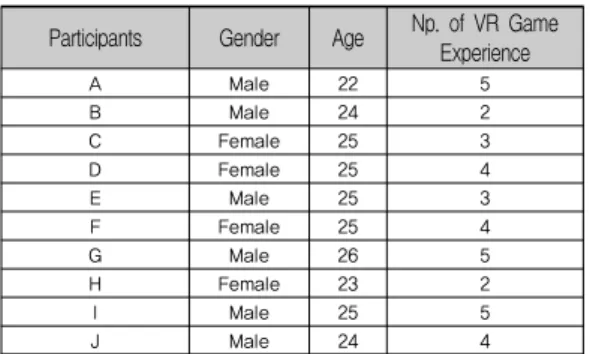
population, in-depth interviews are useful when extending understanding of some current phenomenon(Dexter, 1970)[15]. For this study, in-depth interviews with 10 college students who experienced VR games were conducted on a day of experiencing VR games in order to capture participants’ most recent memories. Each in-depth interview lasted from 40 to 60 minutes. College students were deemed appropriate for this study because the primary target of VR games in Korea is known to be college students. This study used a structured questionnaire because an in-depth interview is useful in collecting rich and complicated qualitative research data[16][17]. The in-depth interview focuses on depth rather than on breadth to get answers on proposed research questions. For this study, as mentioned in [Table 1], a total of 10 students participated in return for a monetary reward.
Participants Gender Age Np. of VR Game Experience
A Male 22 5
B Male 24 2
C Female 25 3
D Female 25 4
E Male 25 3
F Female 25 4
G Male 26 5
H Female 23 2
I Male 25 5
J Male 24 4
Table 1. Demographics of In-Depth Interview Participants
1. Testing of Validity in Qualitative Research
Qualitative research often invites criticism from quantitative researchers because of its inability to measure validity and reliability which provide credibility of the research findings in the quantitative research. However, according to Lincoln and Guba[18], a member check is considered to be one of the most important methods to enhance researchcredibility. Thus, for this purpose, research participants received and reviewed their interview summaries. By going through this process, this study enhanced the research credibility.
IV. Results
1. Korean College Students ’ General Perception on VR Games
In-depth interview participants commonly stated that VR games provided a high level of virtual reality, immersiveness, and controllability. These important attributes of VR games could be considered distinctive to mobile, PC, and video games.
When I play a PC or mobile game, I am represented by another character or an avatar.
However, I find myself playing inside of the game when playing VR games. In addition, unlike a PC or mobile game, I feel that I have more controls over game contents. That helps me to be immersed with the game contents and gain a sense of controllability.
(B, age 24, male)
VR games make me feel that I am in the center of the game. In other words, when playing VR games, I feel I am a part of the game contents. I understand that VR games offer a high level of immersiveness, interactivity and actions. It is really amazing that VR games have their own unique features depending on their game contents. VR games have lots of freedom and each game is very sophisticated. (C, age 25, female)
I thought VR games are a passing fad. But after
playing VR games I changed my minds. VR games
guarantee gamers a strong sense of immersiveness
and virtual reality. That is very attractive
characteristics of VR games which make VR games
different from othr types of games. (D, age 25,
female)
I am not a kind of person who often play an online game. But VR games are definitely exciting and fun.
Unlike other online games, I feel like I am a part of a game while playing VR games. It would be great if there are variety of VR game contents. In particular, among other VR games, the action-based VR games are more of realistic. (F, age 25, female) I believe VR games became a new trend among 2030 generation in Korea because of its uniqueness such as a high level of reality and immersiveness. I think sense of sight, sense of sound, and sense of touch when playing VR games increases sense of immersiveness and doubles excitement. (J, age 24, male)
2. Factors Motivating Re-experiencing VR Games
The factors that are considered to impact gamers’
intention to re-experience VR games include 4D effects in VR games, various VR game contents, freedom in games, unique experience chances, sense of reality, sense of thrill, action-based experiences, and playing in group.
When playing VR games in a VR game playroom, 4D effects such as water, wind, vibration tend to make games more exciting and immersive. I think 4D effects are well used depending on VR game contents. These 4D effects are really a plus when enjoying VR games and a motivator to revisit a VR game playroom. (A, age 22, male)
So far there are various VR games to play. When I go to a VR game playroom, generally each game lasts 10 to 15 minutes. I cannot play all VR games a day. It is really good that there many option to choose from. But I strong believe VR games should be updated on a regular basis if they want attract more gamers. (B, age 24, male)
It may be an advantage that VR games have much freedom to play. What I meant by freedom is that players can choose many different options when playing VR games. The same VR game can be played in many different ways. That makes a VR game unique and different from other online games.
(C, age 25, female)
Adventurous activities in reality such as parachuting and waterfall rafting can be experienced through VR games. Because of these unique experiences I am really into VR games nowadays. In VR games I can even ride a broom like a witch. This is so awesome. (F, age 25, female)
When playing VR games, sense of reality and sense of thrill are enhanced thanks to VR game features. Compared to theme park rides, I feel VR games are safer and more stable. When I wear a HMD device, screens in front my eyes make me feel that I am in the middle of game. In many VR games I have to walk and run depending on VR games contents. I can exercise enough in a VR game playroom. (H, age 23, female)
VR games I really enjoy much are mostly action-based games such as HADO, Bullet Sorrow, Arizona Sunshine, and Raw Data. These games can be played in group. I mean up to 8 people can join the same VR game and have a fun together. As for me, playing VR games became a weekend ritual. (I, age 25, male)
3. Immersion in VR Games
All interviewees suggested that VR games have higher immersiveness than PC/mobile and video games. VR game players wearing headsets are completely immersed in the content, meaning fewer distractions and more attention to the message.
Immersiveness in VR games could be achieved two ways, physically and emotionally. Since players have
to wear gear such as HMDs or carry guns depending on games contents, perfect isolation from the outside world can exist in VR games. External noises (i.e., sound, inattentiveness) can be minimized or prevented while players experience VR games. Emotionally, immersiveness in VR games can be enhanced when players have empathy with game characters and virtual presence.
Compared to mobile and PC games, VR games have higher immersiveness. That’s for sure. Before enjoying VR games, we need to wear HMD and necessary gears. These gears help gamers focus on a game itself because we are totally isolated from outside of the world. But I think heavy gears tend to make gamers weary. That decreases immersiveness.
(A, age 22, male)
When we play online games with a smartphone, we’re likely to be distracted by many things. But once I wear HMD and gears, virtual world appears in front of my eyes. I feel like I am a game character in the VR game. Total immersion takes places in VR games. And sense of reality is really greater than other online games. (B, age 24, male)
In a VR game called “Richie’s Plank Experience,”
I sit on an 80-story building and pick up cakes. I feel it’s real and feel my fear of heights even though I know it’s not real. I feel I am a game character. I feel high empathy with a game character. That makes me more immersed with a VR game. (F, age 25, female) Definitely, VR games have higher immersiveness than other games. For example, when I ride VR roller coaster game, I feel like I am really riding a roller coaster. There are 4D effects like wind and sound. Even beautiful scenery appears in front of my eyes. That makes me feel I am really inside the game. (J, age 24, male).
4. Engagement in VR Games
The intensity of VR experience is greater than those of traditional media. They generate strong emotions in users, which are linked to real behavior change. Likewise, in VR games players enjoy various games in the first-person view, not the third-person view. This unique feature of VR games is likely to generate stronger emotions than PC/mobile games.
Since players wear HMDs and the requisite gear for each selected VR game, they are likely to receive instant stimulus. Players in VR games tend to move and use their muscles depending on VR game content.
Thanks to 4D effects, integration of three senses (i.e., sight, sound, touch) in VR games also influences the game’s impactfulness, making VR games more memorable. Lastly, the high level of interactivity laid out within VR games makes them more enjoyable and interesting.
In VR games I am a character myself. In other video games I control my character as well as other game environments. However, when I play VR games, I found myself inside of the game. And as I walk, the background of the VR game changes constantly. It is very unique that my behavior is reflected in the virtual world. (B, age 24, male)
When I play mobile or PC games, I just sit back and relax. But when I play VR games, I need to use my hands and sometimes I have to run. After completing VR games, I feel even muscle pain or body ache. I think people are more engaging in VR games than other video games. And that makes VR games more attractive. (D, age 25, female)
I always thought that games can be played when players sit or lay down. Nintendo Wii is a bit different from other games. But VR games are more dynamic than Nintendo Wii. For instance, when I play a VR rhythm game I feel I am with the rhythm.
It is hard to explain, but VR games require players’
all senses. (H, age 23, female)
I think senses like sight, sound, and touch are all integrated in VR games. Many games can be enjoyed only in sight and sound. But in VR games, thanks to 4D effects, everything looks realistic. That makes players engaging in the game. VR games are really unique and become one of must-play games among college students. (J, age 24, male)
5. Virtual Presence in VR Games
Presence helps people to interact with and feel connected to the world outside their physical bodies via technology, i.e., virtual reality. Interviewees suggest that they feel connected and interact with the virtually created environment while playing VR games. VR gear such as HMDs and 4D effects are likely to enhance players’ perceived level of virtual presence.
I think unlike PC and mobile games, VR games give players a sense of virtual presence. In other words, when playing VR games, I exist in a virtual world. As a screen is big and the quality of graphic and sound is good, I am more likely to be immersed in a VR game. Especially, 4D effects enhances the sense of virtual presence. (D, age 25, female)
Unlike other games, I feel like I am really inside of the other world because of realistic surroundings.
For example, thunderstorms in VR games are very similar to ones in real world. Graphics in VR games are really great. Sophisticated graphics and sounds make me feel I am really in the game. (H, age 23, female)
When I was 20 years old, I played a real survival game with my friends. A few days ago, I played a VR survival game with my friend who once played a real survival game 5 years ago. We all felt the same that the VR survival game is just like a real survival game. I also felt like I am in a mountain, holding a gun, and hiding from our enemies. One of my favorite
VR games is a VR FPS (First-Person-Shooter) game. (I, age 25, male)
IV. Discussion
This study has provided a baseline understanding of the growth possibility of VR games in Korea.
Unlike other games, VR games are likely to have high levels of immersion, engagement, and virtual presence. These important features of VR games are likely to lead to increases in the number of VR game players. The VR game industry has yet to grow as fast as game industry experts have expected. Hence, this study puts forward the following recommendations to the VR game industry.
First, a variety of high-quality VR game contents should be continually introduced to the market. To date, the number of high-quality VR games is limited.
Yet high-quality VR games can increase immersiveness, maintain current VR game players, and also attract new players. VR game content with low interactivity and low resolution can deter VR game players from further VR games experiences.
The VR game market may grow quickly if VR game contents provide players with possibilities to play and compete with remote players.
Second, mobile VR game contents are needed to increase the number of VR game players. Due to the high cost of acquiring VR gear, only a relatively small portion of people can afford to enjoy VR games at home. Today, many VR games could be enjoyed in VR play rooms, similar to theme parks. To extend the VR game market, mobile VR game contents should be introduced so that people can enjoy VR games at home. Mobile VR games may become a leader in making VR games accessible to everyone.
Third, the greatest limitation to current VR games
is that most of them are created for one-time use.
Once people experience a VR game, they will eventually tire of it, attenuating their desire to re-experience it. Thus, VR game makers must strive to create content novel enough to attract players’
interest and with enough narrative arc to prolong their curiosity.
Fifth generation wireless systems (5G) are improved networks being deployed in 2018 and later.
Virtual reality applications will lean heavily on a fully functioning 5G network. Many experts within the industry believe that the arrival of 5G will unlock the full potential of VR and AR technology. Current 4G network standards severely curtail what can be done thanks to limitations in bandwidth, latency, and uniformity. 5G’s significantly faster speeds and lower latency will have a great impact on the VR game markets. 5G will bring about a ten-fold improvement in throughput, a ten-fold decrease in latency, a 100-fold improvement in traffic capacity, and a 100-fold improvement in network efficiency[19]. This portends a greatly improved environment for mobile VR games.
참 고 문 헌
[1] Korean Creative Content Agency, Korean Game
Industry Whitepaper, 2017.
[2] S. Oh,
VR industry, information &
communication technology is leading,
NamdoIlbo, 2018.[3] https://www.grandviewresearch.com/industry-a nalysis/virtual-reality-in-gaming-market, 2018.
10.15.
[4] https://www.techrepublic.com/article/10-ways- virual-reality-irevolutionizing-medicine-and-he althca re, 2018.9.23.
[5] https://lifehacker.com/virtual-reality-is-the-fut ure-of-shopping-1796454556, 2018.8.15.
[6] M. Kennedy, British Museum uses virtual
reality to transport visitors to the bronze age,
The Guardian, 2015.[7] J. Murray, Hamlet on the holodeck: The future
of narrative in cyberspace, MIT Press, 2017.
[8] A. McMahan, “Immersion, engagement and Presence : A Method for Analyzing 3-D Video Games,” The video game theory reader, Taylor
& Francis Group, pp.67-86, 2013.
[9] https://www.designersnotebook.com/Columns/0 63_Postmodernism/063_postmodernism.htm., 201 8.10.20.
[10] M. Pierce, P. Young, and S. Doherty,
“Engagement and Competence in VR and non-VR \Environments,” In Proceedings of the Human Factors and Ergonomics Society Annual Meeting, Sage CA: Los Angeles, CA: SAGE Publications, Vol.61, No.1, pp.2082-2085, 2017.
[11] B. Laurel, Computers as theatre, MA:
Addison-Wesley, 1991.
[12] J. Steuer, “Defining virtual reality: Dimensions determining telepresence,” Journal of Communication, Vol.42, No.4, pp.73-93, 1992.
[13] G. McCracken, The Long Interview, Newbury Park CA: Sage Publications, 1988.
[14] A. Strauss, Qualitative Analysis for Social
Scientists, Cambridge University Press, 1987.
[15] L. Dexter, Elite and Specialized Interviewing, ECPR Press, 2006.
[16] J. Creswell, Qualitative Inquiry and Research
Design: Choosing among Five Traditions,
Thousand Oaks, CA: Sage, 1998.[17] S. Kvale, “Chapter 7: The interview situation,”
In Interviews: An Introduction to Qualitative
Research Interviewing,
London: Sage, pp.124-135, 1996.[18] Y. Lincoln and E. Guba, Naturalistic Inquiry, Beverly Hills, CA: Sage, 1985.
[19] https://5g.co.uk/guides/5g-virtual-reality-and- augmented-Reality, 2018.7.28.
저 자 소 개
엄 남 현(Namhyun Um) 정회원
▪1999년 12월 : 미국 워싱톤 주립 대(석사)
▪2011년 8월 : 미국 텍사스 대학 교(박사)
▪2015년 9월 ~ 현재 : 홍익대학 교 광고홍보학부 교수
<관심분야> : 유명인 광고, 정치광고, 게이광고, 모바 일 광고