http://crossmark.crossref.org/dialog/?doi=10.14474/ptrs.2017.6.2.83&domain=pdf&date_stamp=2017-6-25
Received: 11 May, 2017 Revised: 14 June, 2017 Accepted: 15 June, 2017 Corresponding author: Jongeun Yim
Department of Physical Therapy, College of Health Science and Social Welfare, Sahmyook University, 815 Hwarang-ro, Nowon-gu, Seoul 01795, Republic of Korea
Tel: 82-2-3399-1635 Fax: 82-2-3399-1639 E-mail: [email protected]
This is an Open-Access article distributed under the terms of the Creative Commons Attribution Non-Commercial License (http://creativecommons.org/licens es/by-nc/4.0) which permits unrestricted non-commercial use, distribution, and reproduction in any medium, provided the original work is properly cited.
Copyright © 2017 Korean Academy of Physical Therapy Rehabilitation Science
https://doi.org/10.14474/ptrs.2017.6.2.83 pISSN 2287-7576
eISSN 2287-7584
Phys Ther Rehabil Sci 2017, 6 (2), 83-89 www.jptrs.org
Comparison of the effects of muscle stretching exercises and cupping therapy on pain thresholds, cervical range of motion and angle: a cross-over study
Jongeun Yim
a, Junhyuck Park
b, Hongseop Kim
a, Juyeon Woo
a, Soyeong Joo
a, Sumin Lee
a, Jewon Song
aaDepartment of Physical Therapy, College of Health Science and Social Welfare, Sahmyook University, Seoul, Republic of Korea
bDepartment of Physical Therapy, School of Health and Welfare, Yeungnam University College, Daegu, Republic of Korea
Objective: Computers and smartphones have become a necessity for modern people, and the use of these things in an in- appropriate position has increased the number of people who complain about neck problems. The purpose of this study was to compare the changes of cervical angle, range of motion (ROM) and pain threshold according to the McKenzie stretching and dry cupping therapy.
Design: Cross-over design.
Methods: We included 12 male and 6 female college students in their twenties, and conducted a pre- and post-test to evaluate the changes of each variable after the application of the McKenzie stretching and dry cupping therapy.
Results: Neither the cervical spine angle nor the turtle neck angle showed any change in both the McKenzie stretching and the dry cupping treatment. In the McKenzie stretching, the pain threshold decreased, and the ROM of the cervical spine increased in all directions but there was no significant difference. The pain threshold was increased in the dry cupping treatment, and the ROM of the cervical spine was significantly increased in all directions (p<0.05). Comparisons of the McKenzie stretching and cupping treatment showed that the cupping treatment produced significantly greater pain thresholds and improvements in ROM of the cer- vical spine than the McKenzie stretching technique (p<0.05).
Conclusions: Cupping treatment is more effective in improving ROM of the cervical spine and pain thresholds than the McKenzie stretching technique. In the future, cupping treatment will be one of the treatment options for pain and ROM impair- ments of the cervical spine.
Key Words: Articular, Cupping therapy, Muscle stretching exercise, Range of motion, Shoulder pain
Introduction
Computers and smartphones have become an important necessity for modern people. According to the Pew Research Center, the use of computers and smartphones average to ap- proximately 5.1 hours during the weekdays and 5.6 hours during the weekends. Incorrect postures during long hours of use of smartphones and computers cause musculoskeletal problems [1]. The prolonged use of the computer and smart- phone also promotes the repeated use of certain muscles and
frequently causes damage and tension in the muscles of the neck and shoulders as a result of cumulative damage.
Repeated cumulative trauma on the neck and shoulder may
cause a specific musculoskeletal disorder, including turtle
neck, which causes weakness of the middle and lower parts
of the trapezius and rhomboid muscles, creating shoulder re-
traction and causing shortening of the main muscles of the
chest and neck extensors. It also increases the activity of the
upper trapezius, which causes most patients to suffer from
excessive muscular pain [2]. Neck pain is one of the most
frequently occurring diseases in everyday life [3]. The nor- mal curvature of the spine maintains good posture with a uniform distribution of body weight, minimizing the burden on each joint, and preventing tension and deformation of the soft tissue. It also distributes the body weight evenly, mini- mizing the burden on each joint, and prevent tension and de- formation of the soft tissue [4]. Recently, the development of the biomechanical concept of the spine has increased the im- portance of the curvature itself in the normal functioning of the vertebrae as well as the importance of vertebral curva- ture in relation to various disease states of the vertebrae [5].
Using a smartphone and a computer for a long time in the wrong posture leads to a posture that allows the head and shoulder to move forward. Epidemiologic studies have shown that the posture that a forward protrusion of the head and the shoulder is the most common prevalence of spinal diseases in children and adolescents [6].
Flexibility and range of motion (ROM), as well as the lor- dosis of the cervical vertebrae, are very important factors in sports, rehabilitation, and musculoskeletal pain [7]. Flexibility can be defined as the ability of the muscle to stretch and move one or more joints as far as the ROM, which is an es- sential component of normal biomechanical function [7].
Because of this, accurate measurement of the ROM of the cervical spine can be an objective indicator of neck disease [8].
The McKenzie stretches for the neck are expected to have an effect on the correction of the posture of the cervical spine, and the treatment program with exercise can improve the pa- tient’s function and reduce stress and chronic myalgia [9].
Cupping therapy is an ancient treatment that applies suc- tion onto the skin. Historically, cupping therapy has been used not only for musculoskeletal disorders but also for many diseases such as gynecology, ear diseases, and lung diseases [3]. Applying cupping therapy increases the thresh- old for immediate pressure pain, accelerates the removal of waste and toxins from the body, and stimulates metabolism, resulting in vasodilation and devoted blood circulation. This has been shown to be effective for muscle relaxation and chronic neck pain [10].
Previous studies have scientifically proved the effects of McKenzie stretching and cupping. However, there have been many studies to investigate changes in cervical spine angles and pain thresholds with the McKenzie stretching, and cupping therapy has been studied in terms of changes in angle and ROM of the cervical spine. There are a lack of studies comparing the McKenzie’s stretch and the cupping therapy to the cervical spine. The purpose of this study was
to investigate the differences in the angle of the cervical spine and the pain thresholds around the cervical vertebrae by applying the McKenzie exercise and the cupping therapy.
Methods Subjects
Participants in this study were 12 males and 6 females stu- dents in their twenties who were studying at Sahmyook Uni- versity. The subjects who participated in the experiment were selected as those who voluntarily agreed to the experiment and those who had no restrictions on the ROM of the neck, those without disk disorder, and those who had no open wounds at the sites where the cupping therapy was applied.
All protocols and procedures were approved by the in- stitutional review board of Sahmyook University (IRB No.
2-1040781-AB-N-01-2016088HR), and all of the partic- ipants signed a statement of informed consent.
Intervention
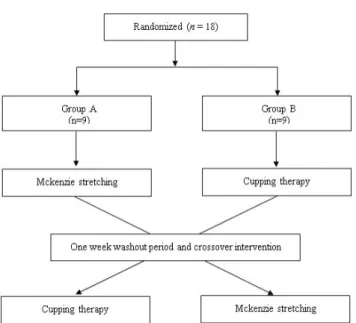
In this experiment, a cross-over design was used in which each treatment was sequentially applied at a time interval to each of the experimental groups. In this design, subjects were subjected to continuous intervention, and the effects of each intervention were compared. The advantage of this ex- perimental design is that it can compare the effects of the in- tervention within the subjects of one group rather than com- paring the results between different groups and can reduce the measurement variance. In this study, pre- and post-inter- vention evaluations were conducted to determine the changes in the angle of the cervical vertebrae, the changes in the pain thresholds around the cervical vertebrae, and the ROM of the cervical vertebrae following the McKenzie’s stretching exercise and dry cupping therapy. In order to minimize the learning effect of the subjects, the single blind method was applied which does not allow the subjects to be aware of the purpose of the study (Figure 1).
McKenzie stretching
1. Head retraction and neck extension was performed in a sitting position.
2. Head retraction and neck flexion was performed in a supine position.
3. The right hand was placed on the opposite side shoulder and head-turning was performed sin a sitting position.
This was repeated in the opposite direction.
4. Neck flexion was performed in a sitting position.
Figure 1. Flow diagram of total experimental procedure.
5. Left and right lateral bending was performed in a sit- ting position.
To assess the maximal muscle contraction of the subject, a 7-second contraction was performed 10 times for each operation. The above operation was applied for a total of 8 minutes. The time, posture and frequency of administration were supervised to ensure that all subjects were able to per- form same as much as possible [11].
Dry cupping
The cupping technique was applied to each subject’s leva- tor scapular and upper trapezius one by one, respectively. A plastic cup of 25 to 50 mm size was selected according to the application area of the subject. After applying the plastic cup to the site, air was taken out by the compressor to create a vacuum state. The application time of the cupping was ap- plied for 8 minutes.
Measurements
Smartphone goniometer
The smartphone was placed on a tripod and positioned horizontally. Setting the distance between the shoulder tip of the subject and the tripod was 1.0 meters, and the distance between the eye and the tripod of the subject was 0.3 meters [12].
A1: Investigator A measured the craniovertebral angle by palpating the spinous process of C7 and pointed it to the finger. Investigator B used the “On protractor” application to measure the angle between the transverse plane of the spi-
nous process of C7 and the tragus of ears around C7.
A2: To measure the head position angle, investigator A pointed to the jugular notch with the fingertip. Investigator B measured the angle between the jaw and the jugular notch around the tragus of ears.
Algometer
After assuming a sitting position on the chair, the subject measured the pressure pain threshold according to the pres- sure of the upper trapezius using an Algometer (J-tech Medical, Midvale, UT, USA). In order to measure the pres- sure pain threshold, the Algometer was applied at a rate of 1 kg/sec vertically to the test site. The moment when subject sent the signal voice of ‘Ah’, it was regarded as the begin- ning of pain sensation and was measured in units of kg/cm
2. The same investigator measured three consecutive times and calculated the mean values. The most severe painful trigger point on the left and right upper trapezius were measured be- fore and after each treatment.
Cervical range of motion instrument
Cervical ROM (CROM) was measured by the Cervical Range of Motion Instrument (CROM3, Performance Attain- ment Associates and MedNet Technologies, New York, USA) and was applied for cervical flexion, extension, left lateral flexion, and right lateral flexion. Active ROM of the subject was measured by placing the foot on a fixed chair and attaching it to the floor with both hands stretched out lightly towards the knees. Measurements were done once before and after. The ROM of the cervical spine was up to 80° to 90° in flexion, and extension was normally limited to 70° [13]. Left right cervical flexion were approximately 25°
to 45°, occurring mostly between the occipital bone and the first cervical vertebrae, and between the first and second cer- vical vertebrae.
Data analysis
The data collected in this study were statistically proc-
essed using IBM SPSS Statistics ver. 20.0 (IBM Co.,
Armonk, NY, USA). To investigate the effect of each treat-
ment method on the dependent variables, the paired t-test
was used to calculate and compare the mean values of the
measurements. Independent t-test was performed to verify
the difference between before and after intervention. The
statistical significance level was set at α=0.05.
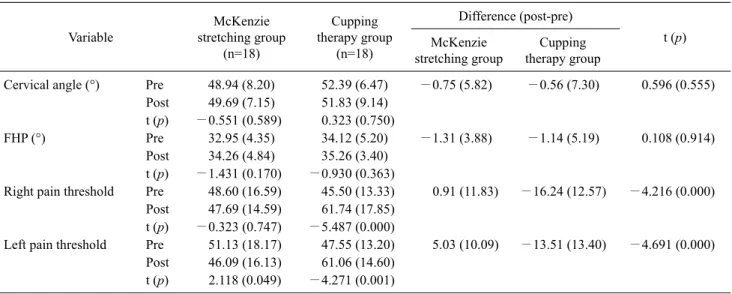
Table 2. Changes in the cervical angle, FHP angle and pain threshold at pre- and post-program (N=36) Variable
McKenzie stretching group
(n=18)
Cupping therapy group
(n=18)
Difference (post-pre)
t (p) McKenzie
stretching group
Cupping therapy group
Cervical angle (°) Pre 48.94 (8.20) 52.39 (6.47) −0.75 (5.82) −0.56 (7.30) 0.596 (0.555) Post 49.69 (7.15) 51.83 (9.14)
t (p) −0.551 (0.589) 0.323 (0.750)
FHP (°) Pre 32.95 (4.35) 34.12 (5.20) −1.31 (3.88) −1.14 (5.19) 0.108 (0.914)
Post 34.26 (4.84) 35.26 (3.40) t (p) −1.431 (0.170) −0.930 (0.363)
Right pain threshold Pre 48.60 (16.59) 45.50 (13.33) 0.91 (11.83) −16.24 (12.57) −4.216 (0.000) Post 47.69 (14.59) 61.74 (17.85)
t (p) −0.323 (0.747) −5.487 (0.000)
Left pain threshold Pre 51.13 (18.17) 47.55 (13.20) 5.03 (10.09) −13.51 (13.40) −4.691 (0.000) Post 46.09 (16.13) 61.06 (14.60)
t (p) 2.118 (0.049) −4.271 (0.001) Values are presented as mean (SD).
FHP: forward head posture.
Table 1. General characteristics of the participants (N=18)
Characteristic Value
Sex 18
Male 12
Female 6
Age (yr) 22.66 (2.98)
Height (cm) 166.58 (5.57)
Weight (kg) 59.5 (5.01)
Values are presented as number only or mean (SD).
Results
General characteristics of subjects
This study consisted of 18 subjects including 12 males and 6 females. The average age of subjects was 22.66 years, with a height of 166.58 cm and a body weight of 59.5 kg (Table 1).
Within subject changes before and after the McKenzie stretching method
The angle of the cervical spine A1 increased by −0.75±
5.82° and the turtle neck angle A2 increased by −1.31±3.88°.
Both the angle A1 and A2 had no significant difference (Table 2).
The pain threshold was decreased by 0.91±11.83 in the right upper trapezius but there was no significant differ- ences. The left upper trapezius was decreased by 5.03±10.09 and there was a significant difference (p<0.05; Table 2).
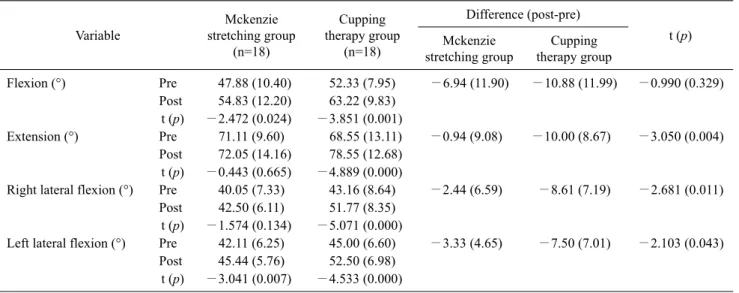
The ROM in cervical spine flexion increased by −6.94±
11.90° and there was a significant difference (p<0.05).
Cervical spine extension increased by −0.94±9.08° but there was no significant difference. Right lateral flexion in- creased by −2.44±6.59° but there was no significant differ- ence. Left lateral flexion increased by −3.33±4.65° and there was a significant difference (p<0.05; Table 3).
Within subject changes before and after the cupping treatment
The angle of the cervical spine A1 decreased by −0.56±
7.30° but there was no significant difference. The turtle neck angle A2 increased by −1.14±5.19° but there was no sig- nificant difference (Table 2).
Pain threshold was increased by −16.24±12.57 in the right upper trapezius and there was a significant difference (p<0.05). The left upper trapezius was increased by −13.51±
13.40 and there was a significant difference (p<0.05; Table 2).
The ROM in cervical spine of flexion increased by −10.88±
11.99° and there was a significant difference (p<0.05). The extension increased by −10.00±8.67° and there was a sig- nificant difference (p<0.05). The right lateral flexion in- creased by −8.61±7.19° and there was a significant differ- ence (p<0.05). The left lateral flexion increased by −7.50±
7.01° and there was a significant difference (p<0.05; Table 3).
Comparison between the McKenzie stretching group and cupping group
In the comparison of the difference both pain threshold.
Table 3. Changes in the cervical range of motion at pre- and post-program (N=36) Variable
Mckenzie stretching group
(n=18)
Cupping therapy group
(n=18)
Difference (post-pre)
t (p) Mckenzie
stretching group
Cupping therapy group
Flexion (°) Pre 47.88 (10.40) 52.33 (7.95) −6.94 (11.90) −10.88 (11.99) −0.990 (0.329) Post 54.83 (12.20) 63.22 (9.83)
t (p) −2.472 (0.024) −3.851 (0.001)
Extension (°) Pre 71.11 (9.60) 68.55 (13.11) −0.94 (9.08) −10.00 (8.67) −3.050 (0.004) Post 72.05 (14.16) 78.55 (12.68)
t (p) −0.443 (0.665) −4.889 (0.000)
Right lateral flexion (°) Pre 40.05 (7.33) 43.16 (8.64) −2.44 (6.59) −8.61 (7.19) −2.681 (0.011) Post 42.50 (6.11) 51.77 (8.35)
t (p) −1.574 (0.134) −5.071 (0.000)
Left lateral flexion (°) Pre 42.11 (6.25) 45.00 (6.60) −3.33 (4.65) −7.50 (7.01) −2.103 (0.043) Post 45.44 (5.76) 52.50 (6.98)
t (p) −3.041 (0.007) −4.533 (0.000) Values are presented as mean (SD).
We found significant difference between the groups (p<0.05; Table 2). In the comparison of the difference cer- vical extension, both lateral flexion. We found significant difference between the groups (p<0.05; Table 3).
Discussion
Among the various causes of cervical spinal pain, me- chanical dysfunction is the most common cause, and dys- function of the intervertebral joints reduces the mobility of the cervical spine segments. If the clinical diagnosis is judged to be a functional dysfunction of the intervertebral joint, joint mobilizations or chiropractic are selected for the treatment. McKenzie’s [14] cervical exercise is expected to be effective in correcting posture of the neck, and exercise can indirectly reduce stress and chronic myalgia previously experienced by the patient. Many of the therapists have de- veloped cupping therapy for the treatment of muscu- loskeletal disorders through diverse studies that expected to be a new trend in the field of sports medicine when applied in conjunction with movement patterns or functional ex- ercises [10].
Clare et al. [11] suggested that the angle of the cervical vertebrae was significantly smaller in the group with pain, and that the smaller the angle of the cervical vertebrae, the greater the forward head posture (FHP). Increased load on the cervical spine muscles and joints caused by FHP is a ma- jor cause of work-related musculoskeletal pain and disease [15]. FHP is associated with pain, fatigue, and limited move-
ment of the cervical vertebrae in relation to muscle im- balance [16]. To cope with these problems, Sling exercises [17], McKenzie exercises [11], and the hold-relax method of proprioceptive neuromuscular stimulation [18] have been used and are effective on cervical spine angles, in max- imizing muscle strength of deep neck flexors, and control- ling the level of pain. In this study, the effects of the McKenzie stretching and cupping treatments were assessed after a single intervention, which resulted in minimal effects on the structural changes of the skeleton. It is anticipated in the future studies that a long-term repeated treatment would be more effective.
Although pain does not cause neurotrophic muscle weak- ness, such as cervical neuromuscular lesions, it limits not only the ROM of the joints, but also causes many obstacles to daily activities [19]. In this study, after the McKenzie stretches, pain thresholds decreased with no significant dif- ference in the upper right trapezius and a significant de- crease in the upper left trapezius. This was due to poor blood supply and muscle ischemia. Hypoxia or vigorous or un- familiar exercises may cause an accumulation of by-prod- ucts, such as lactic acid and potassium, in the muscles and may result in temporary increased muscle tone [20].
Currently, the physiologic mechanisms of pain relief using
the cupping method is not well known, but there are several
theories. Firstly, as in acupressure or acupuncture, it releases
a chemical transmitter that can block pain, such as serotonin,
endorphin, and cortisol, which ultimately acts as an element
that can alleviate the pain [21]. Secondly, nociceptor activa-
tion causes pain [22], presumably because the cupping treat- ment reduces pain by the antinociceptive and counter-irrita- tion effect [23]. Thirdly, all non-invasive and non-pharma- cological treatments have placebo effects. In a recent randomized trial, it was reported that a sham device was more effective in relieving pain than the placebo [24]. In pre- vious studies, the pain threshold of the dry-bulging group in- creased in a randomized trial of 15 painful chronic neck pain patients compared to the pain thresholds of the dry-cupping group and the control group [3]. Neurophysiological mecha- nism increased the pain threshold by the application of cup- ping treatment, and the same result was confirmed in this study.
Decreased joint mobility in the neck affects the adjacent joints as a compensatory action to produce the pathological movement chain of the entire vertebra [25]. Therefore, the two functions of mobility and stability must be mutually in- tertwined to functionally carry out daily life and desired tasks. Tension headaches also have been reported to be in- versely correlated with the ROM of the cervical vertebrae [26]. In this study, although the ROM of the cervical verte- brae tended to increase in all directions in the McKenzie stretching group, cervical flexion and left lateral flexion in- creased significantly but extension and right lateral flexion were not significantly different. Personal differences in strength and characteristics may have accounted for this.
The ROM of the cervical vertebrae in the cupping group in- creased significantly with flexion, extension, and right and left lateral flexion, which may be attributed to the mechan- ical effects of the cupping. Cupping has the capacity of ef- fective manipulation of body structures such as tissues, fas- cia, skin, and muscle tissue, which increases the neuro- physiological activity levels. As a result, cupping can even- tually be explained by a study that can lead to strong relaxa- tion [27]. Cupping treatment is more effective in improving the ROM of the cervical spine and pain thresholds compared to the McKenzie stretching method. In the future, cupping treatment may be considered as one of the treatment options for managing pain and ROM limitations of the cervical spine.
Conflict of Interest
The authors declared no potential conflicts of interest with respect to the authorship and/or publication of this article.
References
1. Lee S, Kang H, Shin G. Head flexion angle while using a smartphone. Ergonomics 2015;58:220-6.
2. Xie Y, Szeto GP, Dai J, Madeleine P. A comparison of muscle ac- tivity in using touchscreen smartphone among young people with and without chronic neck-shoulder pain. Ergonomics 2016;59:61-72.
3. Lauche R, Cramer H, Choi KE, Rampp T, Saha FJ, Dobos GJ, et al. The influence of a series of five dry cupping treatments on pain and mechanical thresholds in patients with chronic non-spe- cific neck pain--a randomised controlled pilot study. BMC Complement Altern Med 2011;11:63.
4. Christie HJ, Kumar S, Warren SA. Postural aberrations in low back pain. Arch Phys Med Rehabil 1995;76:218-24.
5. Gelb DE, Lenke LG, Bridwell KH, Blanke K, McEnery KW. An analysis of sagittal spinal alignment in 100 asymptomatic middle and older aged volunteers. Spine (Phila Pa 1976) 1995;20:1351-8.
6. Straker LM, Coleman J, Skoss R, Maslen BA, Burgess-Limerick R, Pollock CM. A comparison of posture and muscle activity during tablet computer, desktop computer and paper use by young children. Ergonomics 2008;51:540-55.
7. Krauss J, Creighton D, Ely JD, Podlewska-Ely J. The immediate effects of upper thoracic translatoric spinal manipulation on cer- vical pain and range of motion: a randomized clinical trial. J Man Manip Ther 2008;16:93-9.
8. Tousignant M, de Bellefeuille L, O’Donoughue S, Grahovac S.
Criterion validity of the cervical range of motion (CROM) goni- ometer for cervical flexion and extension. Spine (Phila Pa 1976) 2000;25:324-30.
9. Rainville J, Hartigan C, Martinez E, Limke J, Jouve C, Finno M.
Exercise as a treatment for chronic low back pain. Spine J 2004;
4:106-15.
10. Chi LM, Lin LM, Chen CL, Wang SF, Lai HL, Peng TC. The ef- fectiveness of cupping therapy on relieving chronic neck and shoulder pain: a randomized controlled trial. Evid Based Com- plement Alternat Med 2016;2016:7358918.
11. Clare HA, Adams R, Maher CG. Reliability of McKenzie classi- fication of patients with cervical or lumbar pain. J Manipulative Physiol Ther 2005;28:122-7.
12. Quek J, Brauer SG, Treleaven J, Pua YH, Mentiplay B, Clark RA. Validity and intra-rater reliability of an android phone appli- cation to measure cervical range-of-motion. J Neuroeng Rehabil 2014;11:65.
13. de Koning CH, van den Heuvel SP, Staal JB, Smits-Engelsman BC, Hendriks EJ. Clinimetric evaluation of active range of mo- tion measures in patients with non-specific neck pain: a system- atic review. Eur Spine J 2008;17:905-21.
14. McKenzie R. The cervical and thoracic spine: mechanical diag- nosis and therapy. Waikanae, New Zealand: Spinal Publications (N.Z.) Ltd.; 1990.
15. Grace EG, Sarlani E, Reid B. The use of an oral exercise device in the treatment of muscular TMD. Cranio 2002;20:204-8.
16. Mohammed S. Myofascial pain and fibromyalgia syndromes: a clinical guide to diagnosis and management. London: LWW;
2003.
17. Vikne J, Oedegaard A, Laerum E, Ihlebaek C, Kirkesola G. A
randomized study of new sling exercise treatment vs traditional physiotherapy for patients with chronic whiplash-associated dis- orders with unsettled compensation claims. J Rehabil Med 2007;39:252-9.
18. Puentedura EJ, Huijbregts PA, Celeste S, Edwards D, In A, Landers MR, et al. Immediate effects of quantified hamstring stretching: hold-relax proprioceptive neuromuscular facilitation versus static stretching. Phys Ther Sport 2011;12:122-6.
19. Loew M, Heichel TO, Lehner B. Intraarticular lesions in primary frozen shoulder after manipulation under general anesthesia. J Shoulder Elbow Surg 2005;14:16-21.
20. Kim SJ. Influences of cryotherapy and intermittent compression on experimental delayed onset muscle soreness [Master thesis].
Daegu: Daegu University; 2001.
21. Schulte E. Acupuncture: where east meets west. RN 1996;59:
55-7.
22. Torebjörk E. Nociceptor activation and pain. Philos Trans R Soc
Lond B Biol Sci 1985;308:227-34.
23. Michalsen A, Bock S, Lüdtke R, Rampp T, Baecker M, Bachmann J, et al. Effects of traditional cupping therapy in pa- tients with carpal tunnel syndrome: a randomized controlled trial. J Pain 2009;10:601-8.
24. Kaptchuk TJ, Stason WB, Davis RB, Legedza AR, Schnyer RN, Kerr CE, et al. Sham device v inert pill: randomised controlled trial of two placebo treatments. BMJ 2006;332:391-7.
25. Kim EJ, Kim JW, Park BR. Effects of sling exercise program on muscle activity and cervical spine curvature of forward head posture. J Digit Contents Soc 2011;11:213-20.
26. Sohn JH, Choi HC, Lee SM, Jun AY. Differences in cervical mus- culoskeletal impairment between episodic and chronic ten- sion-type headache. Cephalalgia 2010;30:1514-23.
27. Musial F, Spohn D, Rolke R. Naturopathic reflex therapies for the treatment of chronic back and neck pain-part 1: neuro- biological foundations. Forsch Komplementmed 2013;20:219-24.