A software-controlled bandwidth allocation scheme for multiple router on-chip-networks
Phan-Duy Bui
*, Chanho Lee
*★Abstract
As the number of IP cores has been increasing in a System-on-Chip (SoC), multiple routers are included in on-chip-networks. Each router has its own arbitration policy and it is difficult to obtain a desired arbitration result by combining multiple routers. Allocating desired bandwidths to the ports across the routers is more difficult. In this paper, a guaranteed bandwidth allocation scheme using an IP-level QoS control is proposed to overcome the limitations of existing local arbitration policies. Each IP can control the priority of a packet depending on the data communication requirement within the allocated bandwidth. The experimental results show that the proposed mechanism guarantees for IPs to utilize the allocated bandwidth in multiple router on-chip-networks. The maximum error rate of bandwidth allocation of the proposed scheme is only 1.9%.
Key words:on-chip-network, SoC, bandwidth allocation, QoS, arbitration, multiple routers
* Dept. of Information Technology and Telecommunication Engineering, Soongsil University
★ Corresponding author
E-mail:[email protected], Tel:+82-2-820-0710
※ This work was supported by the National Research Foundation of Korea (NRF) grant (NRF-2016R1D1A1B01008846).
The EDA tools were supported by IDEC.
Manuscript received Nov. 27, 2019; revised Dec. 11, 2019; accepted Dec. 16, 2019.
This is an Open-Access article distributed under the terms of the Creative Commons Attribution Non-Commercial License (http://creativecommons.org/licenses/by-nc/3.0) which permits unrestricted non-commercial use, distribution, and reproduction in any medium, provided the original work is properly cited.
Ⅰ. Introduction
As the number of IP cores has been increasing in a system-on-chip (SoC), multiple routers (or interconnects) are included in on-chip-networks because multiple small routers are more efficient than a single large router[1]. The arbitration stages of routers determine the request to be granted to access to a channel according to arbitration policies such as static-priority (static), round-robin (RR), time division multiple access (TDMA) and lottery[2, 3]. A communication bandwidth can be allocated to each IP or to each port of routers according to demands using the TDMA or the lottery scheme. The arbitration policies can be easily implemented in a single
router. However, they require very complex analysis to implement in multiple-router systems, and the complexity increases rapidly as the number of routers increases. In addition, the allocated bandwidths may be changed according to the revised software running on the system.
However, another complex analysis and re-design of the arbitration logic are required if the values of bandwidths change and the conventional arbitration policies are used. That is, the dynamic reconfigurations of the bandwidths are impossible.
In this paper, we present a software-controlled
arbitration scheme to guarantee bandwidth allocation
for multiple router on-chip-networks. An IP
generates packets with a priority (or QoS packets)
by software according to the bandwidths allocated
88
to the corresponding port. The allocated bandwidths are guaranteed regardless of the arbitration policy of routers if the routers support the QoS packet transfers. The bandwidth allocation can be modified dynamically at runtime. The proposed arbitration scheme was implemented for a dual router system and it was verified that the actually allocated bandwidths were very close to the desired bandwidths by simulation.
Ⅱ. Proposed arbitration scheme
The proposed programmable arbitration scheme utilizes the QoS functions of network interface protocols. Most of the modern protocols such as AXI and USIP support QoS packets which are processed with higher priority on on-chip-networks [4, 5]. Once the desired bandwidth for a master is determined and configured, the master sends normal packets as long as the actually allocated bandwidth by on-chip-networks is similar to the desired one. However, the master generates QoS packets if it encounters a deadline of an operation, which means the allocated bandwidth is less than the desired one. The QoS packets arrive at slaves with the minimum latencies since they are processed with higher priority in each router of the on-chip-networks regardless of the arbitration policy of the router.
The number of QoS packets would not be large because the normal packets from the masters with high desired bandwidths usually have high priorities. The QoS packets would be generated at the masters with low desired bandwidth and priority in routers. Therefore, the QoS packets rarely compete with others. The proposed scheme may be implemented by software or programmable hardware, and the desired bandwidth can be modified dynamically.
The software implementation enables the modification of the policy of the QoS packet generation. The main difference between the proposed scheme and others is that arbitrations
are made based on the variable priorities of incoming packets in the proposed scheme while arbitrations of the conventional schemes are made among masters according to fixed policies.
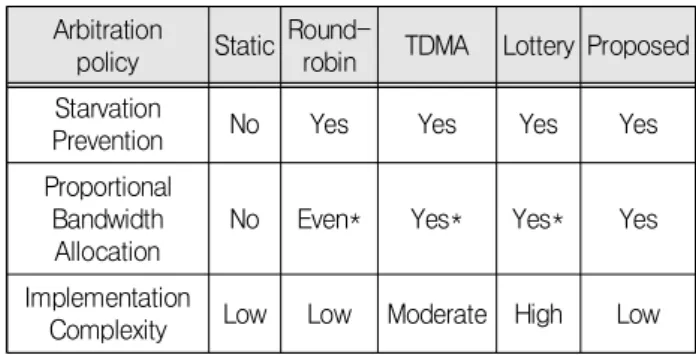
The arbitration policies are compared in Table 1.
The proposed scheme requires a negligible hardware overhead at a router as only a simple static priority logic and multiplexors are added.
In addition, the interface logics of masters need to support the QoS packet injection, which is included in modern network interface protocols.
Table 1. Comparison of conventional and proposed arbitration policies.
Arbitration
policy Static Round-
robin TDMA Lottery Proposed Starvation
Prevention No Yes Yes Yes Yes
Proportional Bandwidth Allocation
No Even* Yes* Yes* Yes
Implementation
Complexity Low Low Moderate High Low
* Single router system only.