222
and Safety
Available online at http://www.foodhygiene.or.kr
http://dx.doi.org/10.13103/JFHS.2013.28.3.222
GC-ECD 및 GC-MS를 이용한 현미 중 chloropicrin의 잔류시험법 개발
도정아
1·최정희
1·박혜진
1·박용춘
2·윤혜정
3·최동미
4·오재호
5*1식품의약품안전처 식품의약품안전평가원 식품위해평가부 잔류물질과
2식품의약품안전처 식품의약품안전평가원 식품위해평가부 신종유해물질팀
3식품의약품안전처 서울지방청 유해물질분석과, 4식품의약품안전처 식품영양안전국 신소재식품과
5식품의약품안전처 식품의약품안전평가원 식품위해평가부 식품위해평가과
Development of an Analytical Method for Chloropicrin Determination in Hulled Rice by GC-ECD and GC-MS
Jung-Ah Do1, Jeong-Heui Choi1, Hyejin Park1, Yong-Chun Park2, Hae-Jung Yoon3, Dongmi Choi4, and Jae-Ho Oh5*
1Pesticide and Veterinary Drug Residues Division, National Institute of Food and Drug Safety Evaluation, MFDS, Osong, Chungbuk 363-700, Korea
2New Hazardous Substances Team, National Institute of Food and Drug Safety Evaluation, MFDS, Osong, Chungbuk 363-700, Korea
3Hazardous Substances Analysis Division, Seoul Reginal Food and Drug Administration, MFDS, Osong, Chungbuk 363-700, Korea
4Novel Food Division, Food Nutrition and Dietary Safety Bureau, MFDS, Osong, Chungbuk 363-700, Korea
5Food Safety Risk Assessment Division, National Institute of Food and Drug Safety Evaluation, MFDS, Osong, Chungbuk 363-700, Korea
(Received February 19, 2013/Revised June 10, 2013/Accepted July 29, 2013)
ABSTRACT - A simple and sensitive analytical method was developed using gas chromatograph with electron capture detector (GC-ECD) and gas chromatograph-mass spectrometer (GC-MS) for determination and identification of chloropicrin. Because of small molecular weight and high volatile properties of chloropicrin, analytical method was developed utilizing headspace extraction and direct injection to the GC. The developed method was validated using hulled rice sample spiked with chloropicrin at different concentration levels, 0.1 and 0.5 mg/kg. Average recoveries of chloropicrin (using each concentration three replicates) ranged 77.7~79.3% with relative standard deviations less than 10% and calibration solutions concentration in the range 0.005~0.5µg/mL, and limit of detection (LOD) and limit of quantification (LOQ) were 0.004 and 0.01 mg/kg, respectively. The result showed that developed analytical methods was successfully applied to detect a small amount of chloropicrin in hulled rice.
Key words: chloropicrin, headspace extraction, hulled rice, GC-ECD, GC-MS
서 론
Chloropicrin은 단일 탄소 유기분자(single-carbon organic molecule)로 분자량이 164.4로 매우 작아 토양 중 확산이 빠르고 강력한 자극성 최루 증기를 내는 무색 액체로 일
반적으로 뿌리를 파괴하는 곰팡이에 대해 선택적인 독성 을 가지고 있으며1-3), 식물 정식 14일 전 토양 표면으로부 터 약 15-25 cm 정도 깊이에 액체 상태로 주입되고 48시 간 이내에 대상 곰팡이와 일부 뿌리 파괴 선충, 토양 곤 충 및 기타 해충을 방제3)하는 것으로 알려져 있다.
Chloropicrin은 1917년부터 살충제로 사용되었고, 1920 년에 토양훈증제(preplant soil fumigant)로 처음 연구4-5) 되 었으며, 1957년 과일과 채소 재배에 있어 chlorpicrin과 methyl bromide (MeBr)의 혼합 사용은 거대한 도약을 이 끌었다. 많은 토양전염병에 chloropicrin이 단독으로 쓰이기
*Correspondence to: Jae-Ho Oh, Food Safety Risk Assessment Divi- sion, National Institute of Food and Drug Safety Evaluation, MFDS, Osong, Chungbuk 363-700, Korea
Tel: 82-43-719-4207, Fax: 82-43-719-4200 E-mail : [email protected]
도 하지만, MeBr의 탁월한 제초효과나 1,3-dichloropropene (1,3-D)의 광범위한 살선충효과를 가지고 있지 않기 때문 에 대안으로 MeBr (20~33% chloropicrin)이나 1,3-D 또는 광범위한 제초 특성을 가지는 metam sodium, dazomet, pebulate와 같은 화합물과 함께 혼합사용이 이루어지고 있 다. Chloropicrin/MeBr 조합은 예측 가능 수확량(predictable crop yields)을 높임과 동시에 비료의 사용을 줄이고 또한 과일과 채소의 연작을 가능케 하였다. 환경적으로 chloro- picrin은 햇빛에 빠르게 분해되기 때문에 중요한 오존 고 갈 가능성(ozone depletion potential)이 없고 토양 내에서 이산화탄소로 대사되며, 혐기/수중(anaerobic/aquatic) 상태 에서 수 시간 이내 nitromethane으로 변환된다. 방사선 표 지된(radiolabelled) chloropicrin을 처리한 토양을 이용한 식 물대사 연구에서 어떠한 식물조직이나 수확물에서 chloro- picrin이나 nitromethane이 발견되지 않았다고 보고되었다
6). 또한 토양 중에서 chloropicrin의 분해물(이산화탄소, 질 산염, 염화물)은 식물뿐만 아니라 토양 내 서식하는 미생 물에게 기본적인 영양소로 이용되기도 한다. Chloropicrin 은 물에 낮은 용해도(1.6 g/L, 25oC)를 갖고 있기 때문에 수중환경에서 빠르게 움직이지 않는다7-8). 물속에서 햇빛 에 노출시 chloropicrin의 반감기는 31.1 시간이었고, 이산 화탄소, 중탄산염, 염화물, 질산염 및 아질산염이 최종산 물이었으며, 햇빛이 없는 환경에서 chloropicrin은 가수분 해를 하지 않는다고 보고9)되었다.
대부분의 훈증제처럼, chloropicrin은 사용이 제한된 농 약으로, 사용량과 분포는 철저히 통제된다. Chloropicrin은 중국에서 딸기, 땅콩, 생강, 가지, 참외 등에 훈증제, 살균 제, 살선충제 및 저장 곡물의 살충제로 사용되고 있으며, 곡류, 채소류, 콩류에 잔류허용기준이 0.1 mg/kg으로 설정10) 되어 있다. 국내에서는 사용되지 않고, 식품의약품안전처 공고 제2010-29411)에 따라 불검출을 원칙으로 하는 농약 이다. 하지만 식품 중 상당 부분을 수입에 의존하는 국내 식품 산업의 특성상 chloropicrin과 같은 국내 기준 미설 정 농약이 수입 식품에 잔류하여 반입될 가능성이 있기 때문에 국내 미등록 농약에 대한 시험법 확립이 필수적이다.
외국에서 chloropicrin 측정을 위해 대기12-14), 토양15), 물16-18) 등에서 spectrometer와 gas chromatography 등을 이용한 시 험법이 다양하게 보고되었지만 농산물 중에 잔류하는 chloropicrin 분석 방법에 대한 보고는 거의 없다. 따라서 본 연구는 국내 기준규격 미설정 농약 chloropicrin에 대한 식품 중 잔류농약 안전성을 확보하기 위해서 chloropicrin을 신속하고 빠르게 검출할 수 있고 정확하고 신뢰성 있는 공 정 시험법을 확립하기 위해 수행되었다.
재료 및 방법
시약 및 재료
Chloropicrin 표준품(95.0%)은 Accustandard (Connecticut, USA)에서 구입하였고, acetone과 ethyl acetate는 HPLC grade로써 Merck (Darmstadt, Germany)에서, sodium sulfate anhydrous는 Wako (Osaka, Japan)에서 구매하였다. 멤브레 인 필터(0.45 µm, PTFE)는 Advantec (Tokyo, Japan)에서 headspace 바이알과 마개는 Agilent (Agilent Technologies, USA)에서 구입하였다.
검체인 현미는 유기농 친환경 제품을 대형유통마트에서 구입한 후 분쇄하여 420 µm 채에 통과시켜 균질화한 후 폴리에틸렌 지퍼백에 담아 −50oC에 보관, 실험에 사용하 였다.
표준원액 및 표준용액
Chloropicrin 표준물질 0.0526 g을 정밀히 달아 acetone 100 mL에 용해하여 500 µg/mL (500 ppm)이 되도록 표준 원액을 조제하였고, 이를 ethyl acetate로 희석하여 0.005, 0.01, 0.02, 0.05, 0.1 및 0.5 µg/mL의 표준용액을 준비하였 다. 표준원액은 갈색병에 담아 4oC에 보관하였으며, 표준 용액은 사용시 조제하여 실험에 사용하였다.
추출 및 정제
현미 5 g을 정밀히 달아 sodium sulfate anhydrous 2 g이 들어있는 20 mL 헤드스페이스 바이알에 넣었다. 여기에 ethyl acetate 10 mL를 첨가한 후 헤드스페이스 바이알용 마개로 밀봉하였다. 바이알을 10분간 심하게 흔들어 5분 간 정치한 다음 주사기로 상층액 약 3 mL를 취해 멤브레 인 필터로 여과하여 시험용액으로 하였다.
확립된 chloropicrin의 시험법을 flow chart로 나타내었다 (Fig. 1).
기기분석
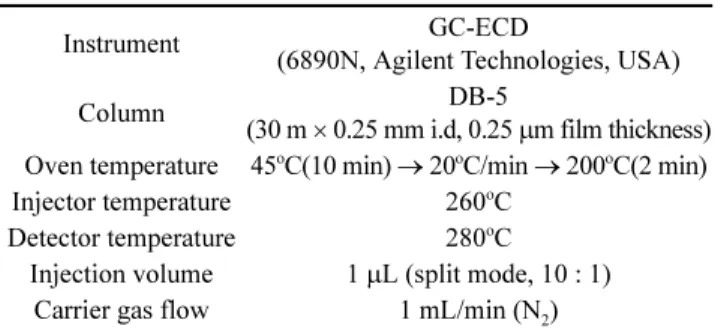
Chloropicrin 분석을 위해 현미 시료 추출을 통해 얻어 진 시험용액을 DB-5(30 m × 0.25 mm i.d × 0.25 µm film thickness)가 장착된 gas chromatograph-electron capture detector (GC-ECD, Agilent 6890, Agilent tedhnologies, USA) Fig. 1. Flow chart for chloropicrin analysis.
에 1 µL를 주입하였다. 승온 조건 및 자세한 기기분석 조 건은 Table 1에 나타내었다.
확립된 시험법을 이용하여 분석된 잔류분의 신뢰성을 확 보하기 위하여 gas chromatograph-mass spectrometer(GC- MS, 5973 MSD, Agilent Technologies, USA)를 이용하여 재확인 과정을 수행하였다. GC-MS 분석 조건은 Table 2 에 나타내었다.
결과 및 고찰
기기선정과 GC 분석조건 최적화
Chloropicrin은 Log Pow값이 2.5인 비극성에서 중간극성 의 해리성이 없는 중성화합물로 증기압이 26,660 mPa (25oCPa)로 높아 휘발성이 강하여 분석을 위한 기기로 GC 를 선정하였다. 또한 분자 내에 halogen(염소원자 3개)과 nitro기를 보유하고 있어 ECD에서 높은 감도를 나타낼 것 으로 판단되어 검출기로 선택하였다. 확립된 기기분석 조 건(Table 1)으로 분석한 결과 6.5분대의 안정적인 머무름 시간을 확인할 수 있었다.
추출 과정 최적화
Chloropicrin은 단일 탄소 유기분자(single-carbon organic molecule)로 분자량이 164.4로 매우 작고 증기압이 매우 높 기 때문에 기존의 농약 추출법에서 같이 감압농축이나 질 소 가스 농축을 수행한다면 대부분 손실될 우려가 높다.
예비실험에서 시험관에 chloropicrin 표준용액과 2% diethyl-
ene glycol 함유 acetone 0.2 mL을 함께 넣고 질소 가스로 농축 후 acetone에 재용해하여 분석한 결과 chloropicrin은 전혀 검출되지 않아 농축과정 중 chloropicrin이 모두 휘 발됨을 확인할 수 있었다. 그래서 헤드스페이스 추출법을 활용하여 검체 추출액을 직접 GC에 주입하는 시험법을 개발하였다. Headspace 추출법은 추출·포집과정에서 고 유 휘발성 성분의 변화나 손실을 최소화하는 측면에서 유 리하지만, 추출효율이 떨어지는 문제점을 가지고 있다19). 검체를 밀봉된 상태에서 추출하고 추출액 중 일부를 외부 와의 접촉을 최소화하여 취하여 GC에 주입해야 하기 때 문에 헤드스페이스 바이알과 전용 마개를 사용하였다. 추 출용매로는 ethyl acetate를 사용하여 chloropicrin의 높은 회수율은 유지하면서 불순물을 최소화할 수 있었다.
Table 1. Analytical conditions for chloropicrin
Instrument GC-ECD
(6890N, Agilent Technologies, USA)
Column DB-5
(30 m× 0.25 mm i.d, 0.25 µm film thickness) Oven temperature 45oC(10 min)→ 20oC/min→ 200oC(2 min) Injector temperature 260oC
Detector temperature 280oC Injection volume 1µL (split mode, 10 : 1)
Carrier gas flow 1 mL/min (N2) Table 2. Confirmative conditions for chloropicrin
Instrument GC-MS
(5973 MSD, Agilent Technologies, USA)
Column DB-5MS
(30 m× 0.25 mm i.d, 0.25 µm) Oven temperature 40oC(10 min)→ 20oC/min→ 200oC(2 min) Injector temperature 200oC
Interphase temperature 280oC
Ion source 230oC
Quadruple temperature 150oC Injection volume 1µL (splitless mode)
Carrier gas flow 1 mL/min (He)
Fig. 2. GC-ECD chromatograms of chloropicrin standard (A), con- trol hulled rice (B), and fortified hulled rice at 0.1 mg/kg (C).
직선성(Linearity)
Chloropicrin 표준원액 500 µg/mL를 ethyl acetate로 0.005, 0.01, 0.02, 0.05, 0.1 및 0.5 µg/mL의 농도로 희석하여 위 에서 제시한 GC 분석조건으로 측정한 결과, 표준곡선의 상관계수(r2)가 0.999로써 높은 직선성을 나타내었다.
선택성(Selectivity)
Fig. 2에서 보는 바와 같이 현미 무처리 검체 중 chloro- picrin과 같은 머무름 시간을 갖는 어떤 방해물질도 검출 되지 않음으로써 현미 중 chloropicrin을 분석하기 위한 본 시험법이 높은 분리능과 선택성을 가짐을 확인할 수 있었다.
정확성과 정밀성(Accuracy and Precision)
현미 중 시험법의 정확성을 평가하기 위하여 처리농도 0.1 및 0.5 mg/kg에서 chloropicrin의 회수율 실험을 3반복 으로 수행한 결과 각 농도에서 회수율은 평균 77.7 ± 1.0%
와 79.3 ± 0.7%이었다(Table 3). 코덱스 가이드라인(CAC/GL 40)에서는 회수율의 적정법위를 70~120%, 분석오차 10%
이하를 적정 범위로 제시하고 있으므로, 본 시험법의 정 확성이 양호함을 확인할 수 있었다21). 또한 3반복 실험에 대한 표준편차가 10% 미만으로 개발된 시험법이 정밀성 측면에서도 양호함을 확인할 수 있었다20).
검출한계 및 정량한계
본 연구에서 확립한 시험용액 조제 및 기기시험법을 이 용하여 현미 중 chloropicrin의 검출한계와 정량한계를 구 하였다. 검출한계는 최소검출량이 0.002 ng (S/N = 3)이었 고 아래의 계산식21)에 따라 0.004 mg/kg으로 나타냈고, 정 량한계는 최소검출량이 0.005 ng (S/N = 10)으로 아래의 계 산식21)에 따라 0.01 mg/kg으로 나타났다.
검출한계(mg/kg) = 최소검출량(ng) ×
정량한계(mg/kg) = 최소검출량(ng) ×
GC-MS를 이용한 시험법의 재확인
본 연구에서 확립된 시험법을 이용하여 분석된 잔류분 의 신뢰성을 확보하기 위하여 재확인 과정을 수행하였다.
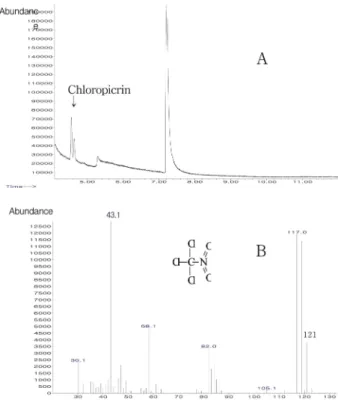
GC-MS의 분자량 범위를 50~180 m/z로 스캔하여 검체 중 chloropicrin을 확인하였으며, 분석 조건은 Table 4에 나타 내었다.
확인조건에서 얻은 total ion chromatogram (TIC)과 mass spectra로 selected-ion monitoring (SIM) 분석을 위한 최적 특성이온을 선정하였으며(Fig. 3) 주요 특성이온의 m/z 값 은 82, 117, 121, 43로 나타났다.
요 약
Chloropicrin은 국내에서는 사용되지 않으며, 잔류허용기 준이 불검출로 설정된 농약이다. 그러나 중국에서는 훈증 제, 살균제, 살선충제 및 저장 곡물의 살충제로 사용되고 있으며, 잔류허용기준이 설정되어 있다. 따라서 본 연구에 서는 중국 등에서 수입하는 식품 중 국내에서 사용하지 않 는 농약에 대한 안전성을 확보하기 위하여 해당 농약을 신 속하고 빠르게 검출할 수 있는 시험법을 개발하고자 하였
1 시료량(g) --- 최종희석부피 mL( )
시료 주입량( )µL ---
× 0.002 ng( ) 1
5 g( )
--- 10 mL( ) 1 µL( ) --- 0.04=
×
×
=
1 시료량(g) --- 최종희석부피 mL( )
시료 주입량( )µL ---
× 0.005 ng( ) 1
5 g( )
--- 10 mL( ) 1 µL( ) --- 0.01=
×
×
=
Fig. 3. Total ion chromatogram (A) and ms spectrum (B) of chlo- ropicrin.
Table 3. Validation results of analytical method for chloropicrin in hulled rice
Sample Fortification (mg/kg) Recovery* (%)
Hulled rice 0.1
0.5
77.7 ± 1.0 79.3 ± 0.7
*Mean values of triplicates with standard deviation
Table 4. Selected-ion of GC-MS for chloropicrin Retention time
(min) M.W. Exact mass Fragment monitored (m/z)
4.5 164.4 162.9 82, 117, 121, 43
다. Chloropicrin은 분자량이 작고 휘발성이 큰 화합물이므 로 헤드스페이스 추출법을 활용하여 검체 추출액을 직접 GC에 주입하는 시험법을 개발하였으며, 확립된 시험법을 검증한 결과 회수율이 77.7~79.3%로 조사되어 코덱스 국 제가이드라인(CAC/GL 40)에 적합함을 확인하였다. 정량 한계 또한 0.05 mg/kg 이하로 매우 우수한 감도를 가지고 있음을 확인하였으며, GC-MS를 이용한 재확인과정을 추 가로 확립하여 본 시험법의 신뢰도를 높였다. 확립된 시험 법은 식품에 잔류할 수 있는 농약의 기준 준수여부에 대 한 적합성을 판단하기 위한 공정시험법으로 활용되고 있다.
감사의 글
본 연구는 2009년도 식품의약품안전처 연구개발과제의 연구개발비 지원(09071식품안015)에 의해 수행되었으며, 이에 감사드립니다.
참고문헌
1. Wilhelm S.N. : Chloropicrin as a Soil Fumigant. Niklor Chem- ical Company, Inc., Chairman, Chloropicrin Manufacturers Task Force, Long Beach, CA 90810-1695. Available at http://
www.ars.usda.gov/is/np/mba/july96/wilhel1.html (1996).
2. O'Neil M.J. : The Merck Index-An Encyclopedia of Chemi- cals, Drugs, and Biologicals (14th Edition - Version 14.9).
Merck Sharp & Dohme Corp., a subsidiary of Merck & Co., Inc.. Online version available at: http://www.knovel.com/web/
portal/browse/display?_EXT_KNOVEL_DISPLAY_bookid=
1863&VerticalID=0 (2012).
3. Meister R.T. and Sine C. : Farm Chemicals Handbook. Meis- ter Publishing Company. Willoughby, Ohio, USA (1998).
4. Roark R.C. : USDA Miscellaneous Publication No. 176. A Bibliography of Chloropicrin 1848 - 1932. United States De- partment of Agriculture. Washington, DC (1934).
5. Agnihothrudu V. and Mithyantha M.S. : Pesticide Residues - a review of Indian Work. Rallis India Ltd., Bangalore (1978).
6. US Environmental Protection Agency. Pesticide Environmen- tal Fate One Line Summary: Chloropicrin. US EPA Environ- mental Fate and Effects Division. Washington, DC (1992).
7. Shepler K, Hatton C, and Ruzo L. : Aerobic Soil Metabolism of [14C]Chloropicrin. PTRL West Inc. Richmond, CA.
(Unpublished study submitted to USEPA) (1995).
8. Hazardous Substances Data Bank (HSDB) : Accession Num- ber 977. National Library of Medicine, Bethesda, MD. CD ROM version: Micromedix Inc., Denver CO. (1993).
9. Lee H. and Moreno T. : Photohydrolysis of Chloropicrin.
Bolsa Research Associates. Hollister, CA. (Unpublished study submitted to USEPA) (1993).
10. 중화인민공화국위생. 식품 중 농약 최대잔류허용량. 중국
국가표준화관리.
11. 식품의약품안전청, 식품의약품안전청 공고 제2010-294호, 식품의 기준 및 규격 일부개정고시안 행정예고 (2010).
12. Muir B., Carrick W.A. and Cooper D.B. : Application of cen- tral composite design in the optimisation of thermal desorption parameters for the trace level determination of the chemical warfare agent chloropicrin. Analyst 127(9), 1198-1202 (2002).
13. OSHA. Chloropicrin Method PV2103. Salt Lake City, UT:
U.S. Department of Labor, OSHA Salt Lake Technical Cen- ter (1991).
14. Carrick WA, Cooper DB and Muir B. : Retrospective identifica- tion of chemical warfare agents by high-temperature automatic thermal desorption-gas chromatography-mass spectrometry. J.
Chromatogr A 925(1-2), 241-249 (2001).
15. Guo M., Papiernik S.K., Zheng W. and Yates S.R. : Forma- tion and extraction of persistent fumigant residues in soils.
Environ Sci Technol ASAP Article 10.1021/es0262535 S0013-936X(02)06253-3 (2003).
16. Castro J.A. and Godoy H. : Spectrophotometric determination of chloropicrin in water. Anal Chim Acta 33, 679-683. (1965).
17. US EPA. Method 551.1 : Determination of chlorinated disin- fection byproducts, chlorinated solvents, and halogenated pes- ticides/herbicides in drinking water by liquid/liquid extraction and gas chromatography with electron capture detection. Cin- cinnati, OH: U.S. EPA Office of Ground Water and Drinking Water/Technical Support Center (1995).
18. Nikolaou A.D., Lekkas T.D., Golfinopoulos S.K. and Kosto- poulou M.N. : Application of different analytical methods for determination of volatile chlorination by-products in drinking water. Talanta, 56(4), 717-726 (2002).
19. Kobayashi A. : Recent progress in flavor research. Nippon Shokuhin Kagaku Kogaku Kaishi, 44, 169-176 (1997).
20. Codex Alimentarius Commission. Guidelines on good labora- tory practice in residue analysis, CAC/GL 40, Rome, Italy (2003).
21. Lee Y.D : Practical book of Korea Food Code pesticide residue analysis method. third ed. KFDA, Korea. pp. 79 (2012).