Tuberc Respir Dis 2011;71:114-119
CopyrightⒸ2011. The Korean Academy of Tuberculosis and Respiratory Diseases. All rights reserved.
호흡기내과 외래로 내원한 환자들에 대한 금연프로그램의 단기간 효과
가톨릭대학교 의과대학 내과학교실
여창동, 강현희, 강지영, 김성경, 김명숙, 김승수, 이상학, 문화식
A Short-Term Effectiveness of Smoking Cessation Intervention in Outpatient Department of Pulmonology
Chang Dong Yeo, M.D., Hyeon Hui Kang, M.D., Ji Young Kang, M.D., Sung Kyoung Kim, M.D., Myung Sook Kim, M.D., Seung Soo Kim, M.D., Sang Haak Lee, M.D., Hwa Sik Moon, M.D.
Department of Internal Medicine, The Catholic University of Korea College of Medicine, Seoul, Korea
Background: There is very limited data present on smoking cessation rates in outpatient departments of pulmon- ology. In this study, we aimed to investigate the effectiveness of a brief smoking cessation intervention program in an outpatient department of pulmonology and identify predictors of smoking cessation failure.
Methods: After a brief recommendation of smoking cessation from pulmonologists, smokers willing to quit smoking were given individual counseling and supplement drugs. Fifty smokers were included in this study and baseline characteristics, smoking history and success rate were reviewed at 3 months.
Results: The mean age of the patients was 58.3±14.6 years and the total group of patients included 3 women.
The rate of smoking cessation success was 74% at 3 months, and there were no differences in age, spirometric indexes and associated diseases between the smoking cessation success and failure group. The rate of supplement drug usage was not different in both groups either. However, body weight, mean number of cigarette usage per day and nicotine dependence scores in the failure group were significantly higher than in the success group. In multivariate analysis, body weight and mean number of cigarette usage per day were significant. Two smokers with a depressive disorder failed the smoking cessation.
Conclusion: A smoking cessation intervention program in the outpatient department of pulmonology showed a favorable success rate. More intensive interventions are needed to unfavorable groups which include the obese and heavy smokers.
Key Words: Smoking Cessation; Outpatients
Address for correspondence: Sang Haak Lee, M.D.
Division of Pulmonary, Critical Care and Sleep Medicine, Department of Internal Medicine, St. Paul's Hospital, The Catholic University of Korea College of Medicine, 620-56, Jeonnong 1-dong, Dongdaemun-gu, Seoul 130-709, Korea Phone: 82-2-961-4500, Fax: 82-2-968-7250
E-mail: [email protected] Received: Jun. 14, 2011 Accepted: Jul. 23, 2011
서 론
흡연은 만성 폐쇄성 폐질환, 폐암 등의 호흡기질환뿐만 아니라 다른 암의 발생과 중대한 심혈관 합병증과 관련되 어 있는 등, 그 심각성이 널리 알려져 있다. 하지만 흡연은
극복하기 어려운 중독행위로, 본인의 의지만으로 금연을 시도하는 사람 중 2∼3%만이 1년 후에도 금연을 유지할 정도로 성공률이 매우 낮다1. 그리고 의료기관에서 시행 하는 금연프로그램에 대한 인식이 낮아, 미국의 경우 흡연 자의 70%가 금연에 관심을 가지고 있고, 그 중 40%는 금 연을 시도하고 있지만, 실제로 5∼14%만이 금연프로그램 을 이용하고 있는 실정이다2. 우리나라에서도 2008년 기 준으로 성인남성의 흡연율이 40.4%로 여전히 높아3, 선진 국 수준으로 흡연율을 감소시키고자, 보건복지부의 '2005 년도 국가 흡연예방 및 금연사업' 등의 활발한 금연사업이 시행되고 있다4.
현재 시행 중인 대부분의 금연프로그램은 금연에 대한
Table 1. Baseline characteristics of the subjects
Clinical characteristics n=50
Age 58.3±14.6
Sex (male/female) 47 (94)/3 (6)
BMI, kg/m
222.0±3.3
Smoking history
Mean number of cigarettes/day 21.1±9.6
Pack-years 38.1±21.6
Smoking start age 21.6±5.4
Previous quit attempt 15 (30)
FTND 4.9±2.0
Pulmonary function test, %
FEV
1pred. 81.6±28.1
FVC pred. 87.1±20.8
FEV
1/FVC 65.5±16.9.
Associated diseases
Hypertension 12 (24)
Diabetes mellitus 5 (10)
Bronchial asthma 8 (16)
COPD 21 (42)
Depression 2 (4)
Values are expressed as mean±SD or number (%)
BMI: body mass index; FTND: fagerström test for nicotine de- pendence; FEV
1: forced expiratory volume at one second; FVC:
forced vital capacity; COPD: chronic obstructive pulmonary dis- ease; SD: standard deviation.
교육 및 상담 등을 통한 행동요법과 환자 개개인에 맞는 니코틴 대체요법, 약물요법의 조합으로 구성된다5. 하지 만 지금까지 발표된 금연프로그램의 효과에 대한 보고는 금연의지가 있는 건강한 성인을 대상으로 한 것이 대부분 이어서6, 호흡기내과 진료실에서 접하는 흡연자집단에 대 한 보고는 잘 알려져 있지 않다. 이에 본 연구에서는 호흡 기내과로 내원한 흡연자에게 의사가 간략한 금연권유를 한 후, 이에 동기화 된 흡연자들을 대상으로 금연프로그램 의 3개월 단기간 효과를 평가하고, 흡연재발에 영향을 미 치는 인자를 규명하고자 하였다.
대상 및 방법
2007년 1월부터 2007년 7월까지 가톨릭대학교 성바오 로병원 호흡기내과를 방문할 당시 일 년 이상, 하루 평균 5개비 이상 흡연하고 있던 환자를 대상으로, 3개월 이상 추적관찰이 가능하였던 연속적인 환자 50명을 후향적으 로 조사하였다. 대상자들은 의사가 진료 시 흡연력을 물 어본 후 간략한 금연권유를 하였고, 이에 금연동기화가 이루어진 경우, 자기기입식 설문지를 작성하고, 금연상담 간호사가 금연교육을 시행하였다. 금연상담 간호사의 교 육내용으로는 금연으로 인한 신체적 이득을 설명하고, 식 이요법, 운동요법 및 금단증상에 대처하는 방법 등의 중재 에 대한 내용을 안내 받았으며, 이후 3개월 동안 금연상담 간호사가 금연여부를 확인하고, 금연을 지속하도록 격려 하였다. 약물요법은 담당의사가 환자와 상의한 후 개별적 으로 bupropion 150 mg을 하루 두 차례 복용하도록 하였 다.
해당 환자들의 의무기록을 임상적 특징, 흡연력, 기저 병력, 폐기능 검사 등의 네 가지로 분류하여 평가하였다.
임상적 특징으로는 성별, 나이, 체중, 체질량 지수(body mass index, BMI), 음주력, 내원 이유를 조사하였다. 흡연 력으로 흡연 시작 연령(smoking start age), 일일 흡연 개 비 수(mean number of cigarettes/day), 총 흡연량(pack- year), 과거 금연시도 횟수(previous quit attempt), 니코 틴의존도(nicotine dependence score)를 확인하였다. 이 중 니코틴의존도는 자기기입식 설문인 Fagerström Test for Nicotine Dependence (FTND)를 이용하였다. 기저 병 력으로 고혈압, 당뇨, 결핵, 천식, 만성 폐쇄성 폐질환, 간 질환, 우울증 등으로 구분하여 조사하였고, 폐기능 검사 항목으로 1초간 노력성 호기량(forced expiratory volume in one second, FEV1), 노력성 폐활량(forced vital ca-
pacity, FVC), FEV1/FVC, 총 폐용적(total lung capacity, TLC), 잔기량(residual volume, RV), 폐확산능(Diffusing capacity for carbon monoxide, DLCO) 등을 확인하였다.
대상자들은 매월 방문하여 금연여부에 대해 응답하였으 며, 의사 및 금연상담 간호사가 금연지속을 격려하였다.
금연시작 3개월째에 한 개비의 담배도 피지 않았다고 응 답한 대상자 중, 소변 코티닌 검사가 음성인 경우를 금연 성공군으로 분류하였고, 그 외에는 금연실패군으로 판정 하였다.
모든 통계분석은 SPSS version 11.5 (SPSS Inc., Chicago, IL, USA) 프로그램을 이용하였다. 기술적 자료 의 표시는 평균±표준편차 및 백분율로 나타내었고, 각 군간의 범주형 변수의 경우에는 Chi-square 검정 또는 Fisher's exact test를, 연속형 변수의 경우에는 unpaired t-test 또는 Mann-Whitney test를 시행하였고, logistic re- gression analysis를 사용하여 금연 성공과 관련된 인자를 분석하였다. p값이 0.05 미만인 경우를 통계적으로 유의 한 차이가 있는 것으로 처리하였다.
Table 2. Comparison of clinical data with quitters and non-quitters
Quitter (n=37) Non-quitter (n=13) p-value
Age, yr 60.6±13.8 51.7±15.4 0.06
Sex (male/female) 34/3 13/0 0.56
Weight, kg 58.7±8.6 66.9±11.6 0.01
BMI 21.5±3.0 23.6±3.9 0.07
Smoking history
Mean number of cigarettes/day 18.6±7.1 28.5±12.1 0.003
Pack-years 36.6±19.9 42.3±26.3 0.41
Smoking start age 21.7±5.7 21.5±4.4 0.95
Previous quit attempt 13/37 (35.1) 2/13 (15.4) 0.29
FTND 4.5±1.8 5.9±2.2 0.04
Pulmonary function test, %
FEV
1pred. 80.8±29.2 84.1±25.1 0.75
FVC pred. 87.6±21.9 85.1±17.1 0.75
FEV
1/FVC 64.2±17.3 70.0±15.8 0.34
FEV
1/FEV <70 20/37 4/13 0.47
Associated disease
Hypertension 8/37 (21.6) 4/13 (30.8) 0.71
Diabetes mellitus 5/37 (13.5) 0/13 (0.0) 0.31
Bronchial asthma 7/37 (18.9) 1/13 (7.7) 0.66
COPD 16/37 (43.2) 5/13 (38.5) 0.76
Depression 0/37 (0.0) 2/13 (15.4) 0.06
Supplement drug 21/37 (56.8) 8/13 (61.5) 0.76
Values are expressed as mean±SD or number (percent).
BMI: body mass index; FTND: Fagerström test for nicotine dependence; FEV
1: forced expiratory volume at 1 second; FVC: forced vital capacity; COPD: chronic obstructive pulmonary disease; SD: standard deviation.
결 과
1. 대상 환자의 특성
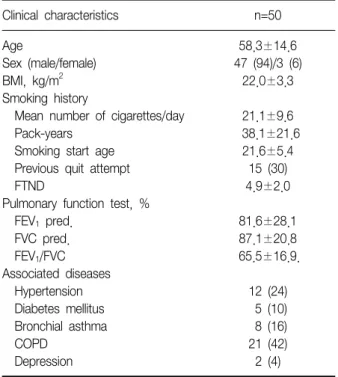
총 50명 중 남자는 47명이었고, 평균 나이는 58.3세(범 위, 21∼82세)였고, 모두 기침 및 객담, 호흡곤란 등의 증 상과 호흡기질환의 평가를 위해 내원한 환자들이었다. 대 상자 모두에게 적극적인 금연상담 및 교육이 이루어졌고, 약물요법으로 bupropion을 투여받은 환자는 그 중 29명 이었다. 흡연력은 평균 일일 흡연량은 21.1개비, 총 흡연 량은 38.1갑년, 과거에 금연을 시도했던 자는 15명이었고, FTND로 측정한 니코틴의존도는 평균 4.9점이었다(Table 1). 폐기능 검사에서는 FEV1/FVC이 평균 65.5%로 감소되 어 있고, FEV1이 평균 81.6%로 측정되어, 대상자들은 전 반적으로 폐쇄성 폐질환의 양상을 보였다. 동반질환으로 는 만성 폐쇄성 폐질환이 21명으로 많았으며, 기관지 천 식 8명, 우울증이 2명 있었다.
2. 금연 성공군과 실패군의 비교
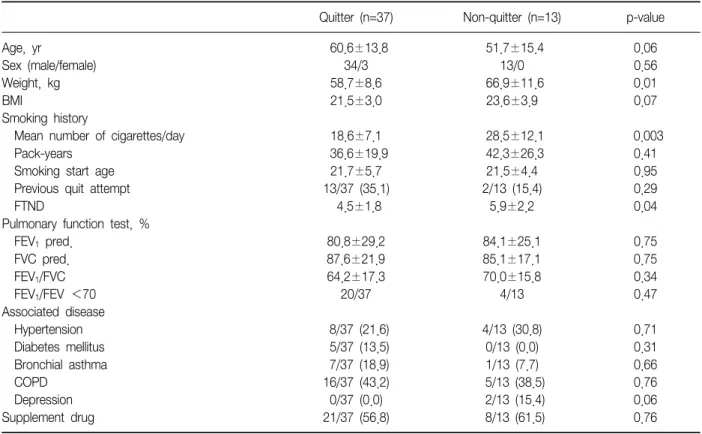
총 50명 중, 3개월째 금연에 성공한 자는 37명으로 금 연성공률은 74%였다. 금연성공군과 금연실패군간 임상적 특징의 비교에서, 여성은 3명 모두 금연에 성공하였으나, 성별에 따른 통계학적 차이는 없었다. 음주력도 결과에 영향을 미치지 못하였으나, 금연실패군에서 체중이 유의 하게 높았다(Table 2). 흡연력의 비교에서는 총 흡연량과 흡연시작 나이, 과거 금연시도 횟수는 유의하게 차이를 보이지 않았으나, 일일 평균 흡연 개비 수와 니코틴의존도 를 나타내는 FTND 점수는 금연실패군에서 의미 있게 높 은 결과를 보였다. 약물요법이 금연성공에 끼치는 영향을 알아보기 위해 양 군을 각각 비교하였으나, 유의한 차이는 관찰되지 않았다. 동반질환에 대한 분석에서, 고혈압, 당 뇨병, 천식, 결핵, 만성 폐쇄성 폐질환의 경우에 양 군간에 빈도의 차이는 없었으나, 우울증의 경우 2명 모두 금연에 실패하여, 경계역의 차이를 보였다. 폐기능 검사 수치에 서 양 군간의 의미 있는 차이는 없었고, 폐쇄성 지표를
Table 3. Multivariate logistic regression analysis of factors predicting smoking cessation success
Variables OR 95% CI p-value
Weight 1.154 1.032∼1.292 0.012
Mean number of 1.158 1.001∼1.340 0.049 cigarettes/day
FTND 1.377 0.744∼2.548 0.308
FTND: Fagerström test for nicotine dependence; OR: odds ra- tio; CI: confidence interval.
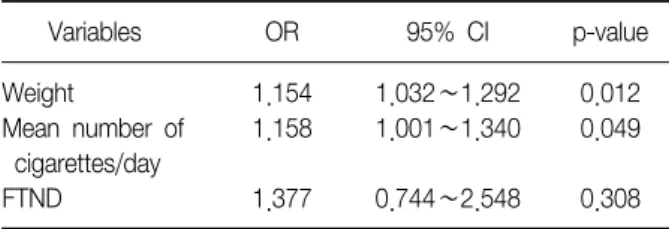
나타내는 FEV1/FVC를 0.7 기준으로 나누어 비교한 분석 에서도 양 군간의 의미 있는 성공률의 차이는 없었다. 단 변량 분석에서 차이를 보인 체중, 일일 평균 흡연 개비 수, FTND 점수 등의 변수들을 다중 회귀분석 방법으로 분석한 결과, 체중과 일일 평균 흡연 개비수가 통계적으로 유의한 차이가 있음이 관찰되었다(Table 3).
고 찰
금연이 건강한 사람에서 흡연과 관련된 암 및 여러 폐 질환의 발생을 예방한다는 것은 주지의 사실이다. 그리고 건강한 사람이 아닌 호흡기질환이 있는 환자에게서도 금 연이 기저 질환의 악화를 예방하고, 예후를 향상시킨다고 알려져 있다. 조기 폐암환자에서 적극적인 금연으로 생존 율 및 재발률이 의미있게 향상되었으며7, 만성 폐쇄성 폐 질환환자에게서도 금연이 호흡기 증상의 개선과 폐기능 의 악화 예방 및 사망률의 감소에 중요한 효과가 있음이 널리 밝혀져 있다8. 이러한 사실은 건강한 성인뿐만 아니 라, 이미 호흡기 증상 또는 질환이 있는 흡연자들에게도 적극적으로 금연을 권고하고, 금연을 치료의 중요한 부분 으로 인식해야 하는 근거가 된다.
본 연구에서는 3개월 금연성공률이 74%로 비교적 높게 측정되었다. 국내에서 발표된 한 자료에 의하면, 농촌지 역의 건강한 성인흡연자들을 대상으로 한 금연프로그램 에서 행동요법만을 시행하였을 때 1개월 성공률 65.5%, 3개월 54.5%, 6개월 54.5%로 보고되었으며9, Gonzales 등10 의 보고에서는 약물요법으로 bupropion과 varenicline을 각각 투여한 흡연자에게 12주째 조사한 금연성공률이 각 각 29.5%, 44.0%로 알려져 있다. 따라서 본 연구의 3개월 금연성공률은 상당히 높은 수치라 평가할 수 있는데, 이는 대상자들이 건강한 성인이 아닌 호흡기 증상을 보이는 흡 연자여서, 금연에 대한 동기부여가 더 많이 되었을 가능성
이 있다. 또한 각각 독립적인 금연효과가 있는 행동요법 과 약물요법을 적극적으로 병행한 상승작용의 효과로 설 명할 수 있다. 따라서 본 연구의 결과는 금연에 대한 의사 의 관심과 적극적인 금연 중재프로그램 이용으로 많은 호 흡기질환자에게 금연치료를 성공적으로 이끌 수 있음을 보여주는 고무적인 결과이다.
금연치료는 크게 행동요법과 약물요법으로 나눌 수 있 다11. 행동요법은 의사의 간단한 금연권유부터 금연상담 간호사에 의한 금연교육, 문자메시지나 이메일을 이용한 안내, 금연장려금 지급 등의 다양한 방법이 포함되며, 약 물치료는 흡연자 개개인에 맞는 니코틴 대체요법과 bu- propion, varenicline 등의 금연보조제를 투여하는 방법이 이에 해당된다. 환자의 기저질환과 특성을 고려하여, 여 러 금연중재 방법들을 함께 사용하는 경우, 금연성공에 상승적인 효과가 있음이 널리 알려져 있고12,13, 이는 비 용·효과적인 측면에서도 매우 경제적인 방법으로 보고 되었다14. 이러한 이유로 American College of Chest Phy- sicians (ACCP)가 발표한 가이드라인에 따르면, 금연의지 가 있는 흡연자에게는 five As모델을 (① Ask about to- bacco use at every visit, ② Advise tobacco users to quit, ③ Assess the willingness to attempt quitting, ④ Assist the patient with method for quitting, ⑤ Arrange for follow-up contact via phone or face to face), 금연의 지가 없는 흡연자에게는 five Rs모델을 (① Relevance of quitting for the patient, ② Risk of illness related to con- tinued tobacco use, ③ Rewards/benefits of smoking cessation, ④ Roadblocks for quitting, internal and ex- ternal, ⑤ Repetition of the motivation intervention at each encounter) 제시하였고, 이로써 홉연자들을 많이 진 료하는 호흡기내과 의사의 역할을 명확히 하였다.
금연실패와 관련되어 알려진 주요 원인들로는 스트레 스, 주변 환경, 개인의 의지부족, 강한 니코틴중독 등이 알려져 있는데, Kenford 등15은 니코틴 의존도(FTND), 일 일 흡연량, 혈중 니코틴 농도, 호기 이산화탄소 농도가 금 연 실패와 강한 연관이 있다고 보고하였다. FTND는 1978 년도부터 사용되어, 현재에도 니코틴의존도를 평가하는 데 가장 널리 이용되는 도구이다16. 이 설문은 총 6가지 문항으로 구성되어 있으며, 4개 문항은 0∼1점, 2개 문항 은 0∼3점으로 배정하여 총 점수의 범위는 0∼10점이며, 점수가 높을수록 니코틴의존도가 높음을 의미한다. 본 연 구에서도 금연실패군에서 일일 흡연 개비 수와 FTND점 수가 유의하게 높아, 기존 보고와 일치라는 결과를 보였
다. 또한 흡연과 비만은 유전적으로 공통된 뇌의 보상경 로를 갖고 있어, 비만인 흡연자들은 금연 후 나타나는 긍 정적 강화에 취약한 것으로 알려져 있다17. 따라서, 니코틴 의존도가 높고 비만인 흡연자에서 금연실패의 위험성이 높게 예상이 되므로, 이러한 흡연자들에게는 더욱더 다양 하고 적극적인 중재프로그램이 이루어지고, 반복적인 교 육과 장기간의 추적관찰이 필요할 것이다.
흡연과 우울증과의 상호관련성은 이미 여러 보고를 통 해 잘 알려져 있다. Glassman 등18의 보고에 의하면, 흡연 자들이 비흡연자에 비해 더 많은 우울 증상을 보였으며, 과거 주요 우울 삽화가 있는 흡연자는 금연실패율이 2배 높았다19. 또한 우울증이 있었던 흡연자들에서 금연 초기 에 더욱 강렬한 금단증상을 보였으며, 심한 금단증상은 금연실패와 연관이 있는 것으로 알려져 있다20. 본 연구에 서도 2명의 우울증환자에서 모두 금연에 실패하여, 위 보 고와 일치하는 결과를 보여주었다. 금연실패와 관련된 위 험인자로서 우울증상이 영향을 끼칠 뿐만 아니라, 우울증 발생의 위험인자로서도 흡연이 관련되어 있음이 알려져 있으므로21, 이는 많은 흡연자들을 진료하는 호흡기내과 의사에게, 우울증상에 대한 관심과 치료가 금연성공률을 높이는 중요한 접근방법임을 시사하는 결과이다.
결론적으로 본 연구는 많지 않은 환자들을 대상으로, 3개월이라는 짧은 기간의 추적관찰을 후향적으로 조사한 제한점은 있으나, 호흡기내과로 내원한 흡연자에게 의사 의 간략한 금연권유와 금연상담 간호사에 의한 적극적인 금연 중재프로그램은 상당히 높은 금연성공률을 보여주 었고, 체중이 높고, 일일 흡연 개비 수가 많거나 니코틴의 존도가 높았던 경우, 우울증이 동반된 경우에는 금연실패 의 위험이 높음을 제시하였다.
감사의 글
We authors thank Sun Hee Gang, a nurse in out- patient department of pulmonology, for data collection and management.
참 고 문 헌
1. Volpp KG, Troxel AB, Pauly MV, Glick HA, Puig A, Asch DA, et al. A randomized, controlled trial of finan- cial incentives for smoking cessation. N Engl J Med 2009;360:699-709.
2. Fiore MC, McCarthy DE, Jackson TC, Zehner ME, Jorenby DE, Mielke M, et al. Integrating smoking ces- sation treatment into primary care: an effectiveness study. Prev Med 2004;38:412-20.
3. Kim YH, Lee SH. Smoking cessation. Tuberc Respir Dis 2010;69:153-62.
4. Kim MH. Updates in smoking cessation programs.
Korean J Health Psychol 2005;10:259-76.
5. Goodfellow LT, Waugh JB. Tobacco treatment and pre- vention: what works and why. Respir Care 2009;54:
1082-90.
6. Cheong YS, Ahn SH. Effect of multi-modal inter- ventions for smoking cessation in a university setting:
a short course of varenicline, financial incentives, e-mail and short message service. Korean J Fam Med 2010;31:355-60.
7. Parsons A, Daley A, Begh R, Aveyard P. Influence of smoking cessation after diagnosis of early stage lung cancer on prognosis: systematic review of observa- tional studies with meta-analysis. BMJ 2010;340:b5569.
8. Andreas S, Hering T, Mühlig S, Nowak D, Raupach T, Worth H. Smoking cessation in chronic obstructive pul- monary disease: an effective medical intervention.
Dtsch Arztebl Int 2009;106:276-82.
9. Seo NS, Kim YH, Kang HY. The effects of a group smoking cessation program among adult smokers in a rural community. J Korean Acad Nurs 2007;37:1139-48.
10. Gonzales D, Rennard SI, Nides M, Oncken C, Azoulay S, Billing CB, et al. Varenicline, an alpha4beta2 nic- otinic acetylcholine receptor partial agonist, vs sus- tained-release bupropion and placebo for smoking ces- sation: a randomized controlled trial. JAMA 2006;296:
47-55.
11. Pohlig C. Smoking cessation counseling: a practice management perspective. Chest 2006;130:1231-3.
12. Bars MP, Banauch GI, Appel D, Andreachi M, Mouren P, Kelly KJ, et al. "Tobacco free with FDNY": the New York City Fire Department World Trade Center tobacco cessation study. Chest 2006;129:979-87.
13. Hotta K, Kinumi K, Naito K, Kuroki K, Sakane H, Imai A, et al. An intensive group therapy programme for smoking cessation using nicotine patch and internet mailing supports in a university setting. Int J Clin Pract 2007;61:1997-2001.
14. Rennard SI, Daughton DM. Smoking cessation. Chest 2000;117(5 Suppl 2):S360-4.
15. Kenford SL, Fiore MC, Jorenby DE, Smith SS, Wetter D, Baker TB. Predicting smoking cessation. Who will quit with and without the nicotine patch. JAMA 1994;
271:589-94.
16. Heatherton TF, Kozlowski LT, Frecker RC, Fagerström KO. The Fagerström test for nicotine dependence: a re- vision of the Fagerström tolerance questionnaire. Br J Addict 1991;86:1119-27.
17. Lerman C, Kaufmann V, Rukstalis M, Patterson F, Perkins K, Audrain-McGovern J, et al. Individualizing nicotine replacement therapy for the treatment of to- bacco dependence: a randomized trial. Ann Intern Med 2004;140:426-33.
18. Glassman AH, Stetner F, Walsh BT, Raizman PS, Fleiss JL, Cooper TB, et al. Heavy smokers, smoking cessa-
tion, and clonidine. Results of a double-blind, random- ized trial. JAMA 1988;259:2863-6.
19. Anda RF, Williamson DF, Escobedo LG, Mast EE, Giovino GA, Remington PL. Depression and the dy- namics of smoking. A national perspective. JAMA 1990;
264:1541-5.
20. Niaura R, Britt DM, Shadel WG, Goldstein M, Abrams D, Brown R. Symptoms of depression and survival ex- perience among three samples of smokers trying to quit. Psychol Addict Behav 2001;15:13-7.
21. Kim TS, Kim DJ. The association between smoking and depression. Korean J Psychopharmacol 2007;18:393-8.