환경·생태학적 기법을 이용한 혼합폐수 처리장의 생물학적 처리공정 내의 미생물 군집 특성 분석
손형식1, 이상준1, 손희종2*
Analysis of Microbial Community Structure in Biological Wastewater Treatment Process of Mixed Wastewater Treatment Facility using Environmental·Ecological Technique
Hyeng-Sik Son1, Sang-Joon Lee1, and Hee-Jong Son2*
접수: 2013년 3월 13일 / 게재승인: 2013년 3월 28일
© 2013 The Korean Society for Biotechnology and Bioengineering
Abstract: The bacterial community structure in a biological reactor fed influent from a wastewater treatment system was investigated by denaturing gradient gel electrophoresis (DGGE) and in situ hybridization. Sludges were collected from three biological reactors (aerobic,oxic,and anoxic tanks) at the M wastewater treatment facility (WTF). The influent of the MWTF consisted of mixed tannery wastewater (40~65%) and seafood wastewater (35~60%). The treatment processes resulted in a removal efficiency for BOD (biochemical oxy- gen demand) and COD (chemical oxygen demand) of 83.6~
98.2% and 72.8~84.6%, respectively for tannery wastewater than for seafood wastewater resulted in greater survival of biomass in the biological reactors and a higher removal of BOD, COD, and T-N of about 8~18%. In contrast, addition of greater amounts of seafood wastewater decreased the amount of biomass in the bioreactors due to the increasing concentra- tion of chromium from that wastewater and it also. The domi- nant bacterial species during the high seafood wastewater input period were Burkholderia cepacia (JX901049) and an uncultured bacterium (JF247555), while Pseudomonas genic-
ulata (HQ256559) was dominant during the high tannery waste- water input period. Flavobacteriumsp. BF.107 (FM173271) and Hyphomicrobium zavarzinii (Y14306) were dominant under anoxic conditions.
Keywords: Mixed Wastewater, Biological Wastewater Treat- ment, Microbial Community, DGGE, Chromium
1. 서론
하·폐수처리 공정에서의 유기성 오염물질이나 질소 및 인의 제거는 다양한 공법의 생물학적 처리공정들에서 이루어진다.
생물학적 처리공정에 존재하는 다양한 박테리아들은 하·폐 수의 특성에 따라 다양한 박테리아 군집 (consortium)을 형성 하여 존재한다. 따라서 생물학적 처리공정을 효율적으로 운 전하기 위해서는 처리조 내에 존재하는 다양한 박테리아들 의 활성이나 생체량과 같은 생물학적인 인자들의 변화를 파 악하는 것이 매우 중요하다 [1-4]. 일반적으로 도시 하수나 산업 폐수를 처리하는 생물학적 처리공정에서는 30종 이상 의 다양한 박테리아들이 존재하며 [1,5], 이들은 유입수의 성 상 및 수온과 같은 외부 환경적 요인의 변화에 따라 군집 패 턴에 많은 변화를 유발하기 때문에 생물학적 처리공정 내에 존재하는 다양한 박테리아 군집들을 관찰·해석하려는 연구 들이 많이 시도되었다 [6-9].
박테리아 군집을 해석하는 방법으로 FISH (fluorescent in
1부산대학교 미생물학과
1Department of Microbiology, Pusan National University
2부산시 상수도사업본부 수질연구소
2Water Quality Institute, Busan Water Authority Tel: +82-51-669-4797, Fax: +82-51-669-4609 e-mail: [email protected]
연구논문
situ hybridization)와 DGGE (denaturing gradient gel electro- phoresis) 기법과 같은 분자유전학적 방법들이 최근까지 많 이 이용되고 있다 [10-14]. 이러한 기법들은 박테리아 배양이 필요치 않는 비배양적인 방법으로 박테리아 군집의 시간·공 간적 변화를 in situ 상태로 파악하는 데에 효과적이다[15,16].
생물학적 처리공정은 일반적으로 물리·화학적 처리공정 들에 비해 많은 장점들을 가지지만 오염물질 농도 부하, 수 온, pH 및 용존 산소 등과 같은 유입수의 성상 변화에 매우 민감하기 때문에 처리효율에 많은 영향을 받는다 [17]. 특히, 피혁 폐수와 같은 산업 폐수의 경우는 중금속 등을 포함한 다양한 생물학적 독성 유발물질들이 함유되어 있어 유입수 의 성상 변화는 생물학적 처리조의 운전효율에 많은 영향을 미친다 [18,19]. 따라서 생물학적 처리공정에서는 실제 현장 에서의 효율적인 처리공정의 설계와 운영을 위하여 폐수의 성상변화에 따라 형성되는 박테리아 군집의 구조와 밀도를 파악하는 연구가 매우 중요하다.
본 연구에서는 피혁 폐수와 수산 폐수를 혼합하여 처리하 는 생물학적 폐수처리 공정의 단위공정들 내에 형성된 박테 리아 군집의 구조와 밀도를 DGGE 기법을 이용하여 계절 변 화 및 유입수의 성상 변화에 따른 생물학적 처리공정에서의 박테리아 군집들의 변화 특성을 평가하였다.
2. 재료 및 방법 2.1. 유입수
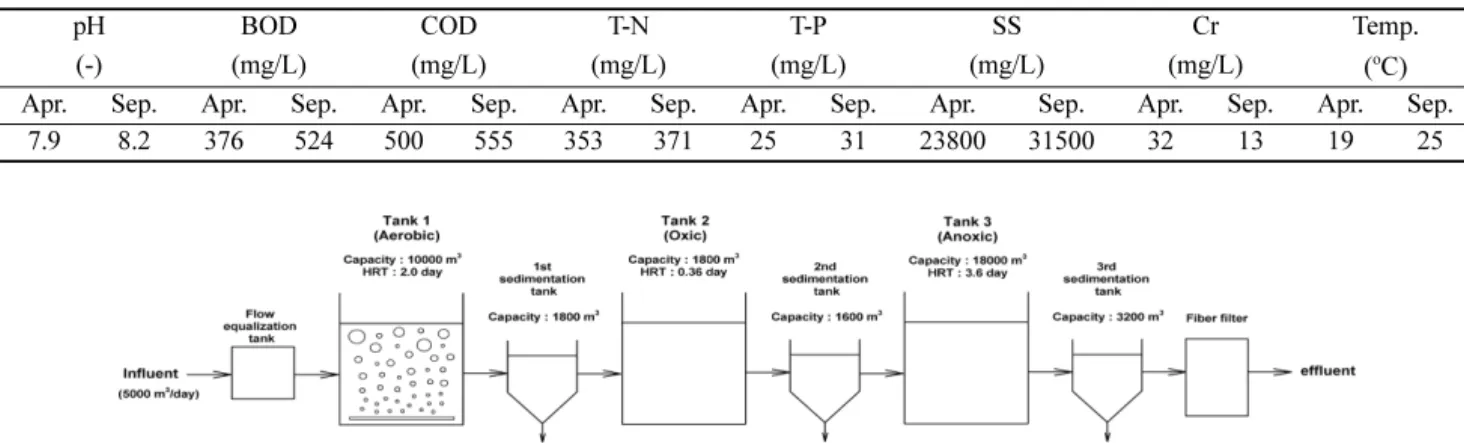
생물학적 폐수처리 공정으로 유입되는 폐수는 부산시 M 공단의 피혁 폐수와 수산시장에서 발생하는 수산 폐수가 혼 합된 혼합 폐수로 실험기간 중의 폐수의 혼합비율은 2009년 4월의 경우는 피혁 폐수가 65%, 수산 폐수 35%의 비율이었 으며, 2009년 9월은 피혁 폐수 40%, 수산 폐수 60%의 비율 을 나타내었다. 생물학적 폐수처리 공정으로 유입되는 유량 은 평균 5,000톤/일 정도였고, Table 1에 실험기간 중의 혼합 폐수의 성상을 나타내었다. 실험 기간 동안 유입되는 혼합 폐수의 pH는 7.9~8.2의 범위로 나타났고, BOD와 COD의 농
도는 각각 376~524 mg/L 및 500~555 mg/L로서 COD 구성물 질 중에서 BOD가 차지하는 비율은 68~91%의 범위로 나타 났다. T-N과 T-P의 경우는 각각 353~371 mg/L 및 25~31 mg/L 의 범위로 나타났다. 또한, 피혁 폐수의 유입비율에 따라 피 혁 폐수 중에 함유된 총 크롬 농도도 4월과 9월에 각각 32 mg/L와 13 mg/L로 많은 농도 차이를 보였다.
2.2. 처리공정 및 시료 채취
본 실험에 사용된 M 공단에 위치한 혼합 폐수처리장의 전체 처리공정을 Fig. 1에 개략적으로 나타내었다. 처리공정은 유 량 조정조, 호기조 (Tank 1), 1차 침전조, 산소조 (Tank 2), 2차 침전조, 무산소조 (Tank 3), 3차 침전조, 섬유여과 공정으로 구성되어져 있다. 평균 체류시간은 호기조 (Tank 1)는 2일, 산소조 (Tank 2)는 0.36일이며 무산소조 (Tank 3)는 3.6일 이다. 또한, 호기조 (Tank 1)에는 폭기 시설이 설치되어져 있 어 충분한 용존산소의 공급이 이루어진다. 시료 채취는 2009 년 4월 및 2009년 9월에 유입되는 혼합 폐수와 각 반응조에 서 처리된 처리수를 채수하여 수질분석을 하였으며, 각 반응 조(Tank 1~3) 내의 슬러지를 채집하여 박테리아 군집을 조사 하였다.
2.3. DGGE를 이용한 박테리아 군집분석
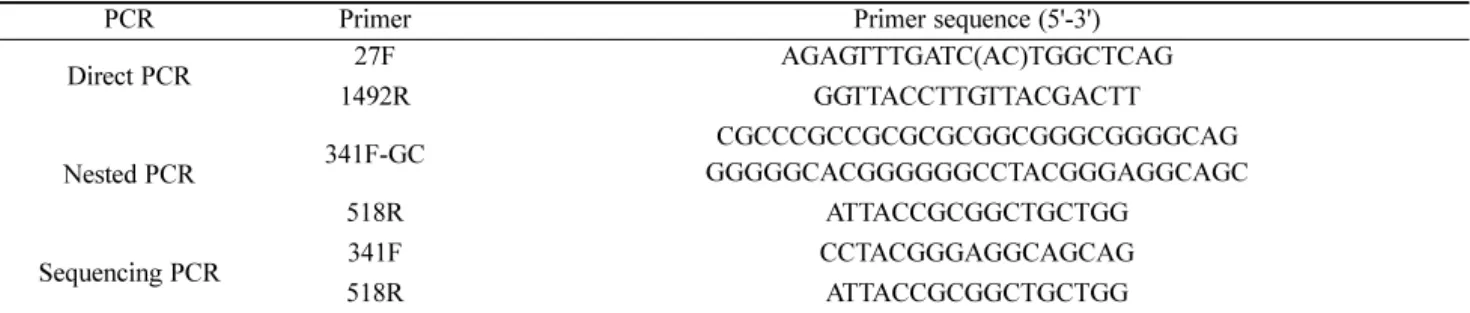
채취한 슬러지 600 µL를 fast DNASPIN for soil kit (MP Biomedicals, France)를 이용하여 chromosomal DNA를 추출 하였다. 추출된 chromosomal DNA를 주형으로 27F와 1492R primer를 이용하여 16S rDNA 부분을 direct PCR한 후에, GC- clamp가 달린 341F-GC와 518R primer를 이용하여 nested PCR을 진행하였다. 증폭된 PCR 산물은 PCR 정제 kit로 DNA를 정제하였다 [20]. 본 연구에 사용된 primer의 종류를 Table 2에 나타내었다. PCR을 통해 증폭하여 정제된 DNA 2 µg/ µL을 8% acrylamide gel에 loading하였다. Gel의 농도 구배는 urea와 formamide를 변성제로 사용하여 30~50%로 하였다. 전기영동은 Bio-Rad사의 D-Code system (USA)을 이용하여 60oC에서 20 V로 30분간 pre-running 후, 200 V로 210분간 running하였다. 0.01% SYBR Gold (invitrogen)를 이
Table 1. Characteristics of influent waters
pH BOD COD T-N T-P SS Cr Temp.
(-) (mg/L) (mg/L) (mg/L) (mg/L) (mg/L) (mg/L) (oC)
Apr. Sep. Apr. Sep. Apr. Sep. Apr. Sep. Apr. Sep. Apr. Sep. Apr. Sep. Apr. Sep.
7.9 8.2 376 524 500 555 353 371 25 31 23800 31500 32 13 19 25
Fig. 1. Schematic diagram of wastewater treatment process.
용하여 20분간 staining하였으며, UV tansilluminator (MyImager 1000TM, SLB, USA)로 관찰하였다 [20]. DGGE band로부터 획득한 DNA를 주형으로 GC-clamp가 없는 341F, 518R primer 를 사용하여 PCR을 진행하였다. T-blunt vector (Solgent co., Ltd., Korea)를 이용해 16S rDNA 단편을 plasmid에 삽입하여 염기서열 분석을 진행하였다. 분석된 16S rDNA 염기서열을 CLUSTAL W (Ver 2.0)를 이용해 정렬하였다 [21]. Phylogenetic analysis에 사용한 16S rDNA sequence는 NCBI data base에 근거하였다. Phylogenetic tree는 neighbor-joining method를 사용하였고, MEGA (Ver 4.0) 프로그램을 이용해 1,000번의 bootstrap analysis를 진행하여 박테리아의 종 유연성 분석을 하였다 [22].
2.4. 박테리아 생체량 분석 [23-25]
박테리아 생체량 분석을 위해 시료 (습중량 1 g)를 4% para- formaldehyde solution (시료:고정액 = 1:3)으로 4oC에서 16 시 간 동안 고정시켰다. 고정된 시료를 4oC, 12,000rpm의 조건으 로 20분 동안 원심분리하여 상등액을 제거하고 phosphate buffered saline (PBS)으로 고정액을 세척하여 Eubacteria 및 total bacteria 분석에 사용하였다.
FISH법을 이용하여 Eubacteria 분석을 하였으며, 고정된 시 료를 gelatin으로 코팅된 slide glass에 놓고, probe 2 µL (5 µg/
µL)와 hybridization buffer (0.9 mM NaCl, 0.01% SDS, 20 mM Tris/HCl, formamide 20%) 16 µL를 첨가하여 46oC에서 90분 동안 반응시켰다. 미리 가열된 washing buffer로 48oC에 서 15분 동안 세정하고 공기 중에서 건조시켰다. 형광현미경 (Axioskop 2 plus, Carl Zeiss, Germany)과 scanning confocal laser microscopy (LSM 510, Carl Zeiss, Germany)를 사용하 여 800배 및 400배의 배율에서 field내에 나타난 박테리아 등
을 10회 이상 계수하여 그 평균값을 계산하였다.
Total bacteria 분석은 고정된 시료 2 Gl를 gelatin으로 코팅 된 slide glass에 놓고, DAPI (4',6-diamidino 2-phenylindole; 1 Gg/mL;Sigma, USA)로 5분 동안 염색하였다. 염색된 시료는 멸균 증류수로 세척한 후 형광현미경(Axioskop2 plus, Carl Zeiss, Germany)로 계수하였다.
3. 결과 및 고찰
3.1. 생물학적 처리공정의 처리효율 평가
각각의 생물학적 처리공정에서의 BOD, COD 및 총질소 (T- N)에 대한 제거율을 Table 4에 나타내었다. BOD 제거율은 Tank 1 (호기조)에서 약 75~90% 정도가 되었으며, Tank 2 (산 소조), Tank 3 (무산소조)에서 약 8~9% 정도 제거되어, 전체 적으로 최대 98% 이상의 제거율을 나타내었으나 피혁 폐수 의 비율이 높았던 2009년 4월은 BOD 제거율이 83% 정도로 낮게 나타났다. COD 제거율은 Tank 1에서 65~77% 제거되 었으며, Tank 2와 Tank 3에서는 8~9% 정도 제거되어 최종 적으로 73~85% 정도의 제거율을 보였으며, 피혁 폐수의 비 율이 높았던 2009년 4월에는 10% 이상 제거율이 저하되 었다. T-N 제거율은 Tank 1~Tank 3을 거치면서 61~79% 정도 였으며, Tank 3에서 총 제거된 T-N의 60% 이상이 제거되 었다.
Table 2. Synthetic oligonucleotide primers for PCR amplication
PCR Primer Primer sequence (5'-3')
Direct PCR 27F AGAGTTTGATC(AC)TGGCTCAG
1492R GGTTACCTTGTTACGACTT
Nested PCR 341F-GC CGCCCGCCGCGCGCGGCGGGCGGGGCAG
GGGGGCACGGGGGGCCTACGGGAGGCAGC
518R ATTACCGCGGCTGCTGG
Sequencing PCR 341F CCTACGGGAGGCAGCAG
518R ATTACCGCGGCTGCTGG
Table 3. Characteristics of oligonucleotide probes used in this study
Probe Probe sequence(5'-3') Specificity Dye Ref.
EUB338 GCTGCCTCCCGTAGGAGT Eubacteria FITC [23]
Table 4. Removal efficiencies of unit biological reactors in wastewater treatment
BOD COD T-N
Apr. 2009 Sep. 2009 Apr. 2009 Sep. 2009 Apr. 2009 Sep. 2009
Influent conc. (mg/L) 376 524 500 555 371 353
Tank 1 removal (%) 75.2 90.4 65.2 77 4.5 5.5
Tank 2 removal (%) 4.5 4.3 4.2 4.1 18.2 22.5
Tank 3 removal (%) 3.9 3.5 3.4 3.5 38.6 51.2
Total removal (%) 83.6 98.2 72.8 84.6 61.3 79.2
Effluent conc. (mg/L) 61.7 9.4 136 85.5 143.6 73.4
3.2. DGGE를 이용한 생물학적 처리공정들 내의 박테리 아 군집 분석
각각의 생물학적 처리공정에서 채취한 슬러지로부터 추출 된 DNA를 주형으로 16S rDNA 부위를 direct PCR한 결과, 실험결과는 나타내지 않았으나 약 1460 bp의 size로 1%
agarose gel에서 밴드가 확인되었으며, direct PCR을 통해 증 폭된 16S rDNA를 주형으로 DGGE를 위한 nested PCR을 진 행한 결과 150~170 bp의 size로 1% agarose gel에서 밴드가 확인되었다. DGGE gel의 농도구배는 30~50%로 설정하여 20 V에서 30분, 200 V 200분 running한 후, 0.01% SYBR gold 로 염색하였다. 시기별 각각의 생물학적 반응조별 분석결과 (band profile)를 Fig. 2에 나타내었다. Fig. 2에서 보는 바와 같이 4월에 Tank 1 (T1)~Tank 3 (T3)에서 관찰된 총 band의 개수는 12개 정도였으며, 9월의 T1~T3에서의 총 band 개수 는 15개 정도로 나타났고, 4월에 T1~T3에서 관찰된 band들 은 9월의 band 분석결과에서 대부분이 존재하였다. T1~T3의 명도 변화를 보면 4월의 경우는 큰 변화가 없는 반면, 9월의 경우를 보면 3번, 5번, 7번 band는 T1에서 명도가 가장 높게 나타났으며, 8번, 9번 band는 T3에서 높게 나타났다. T1은 호 기조로 유기물질의 제거 및 질산화가 일어나며, T3는 무산소 조로 탈질반응이 일어나는 반응조이다.
Fig. 2에 나타낸 2009년 4월 (T1~T3)과 2009년 9월 (T1~
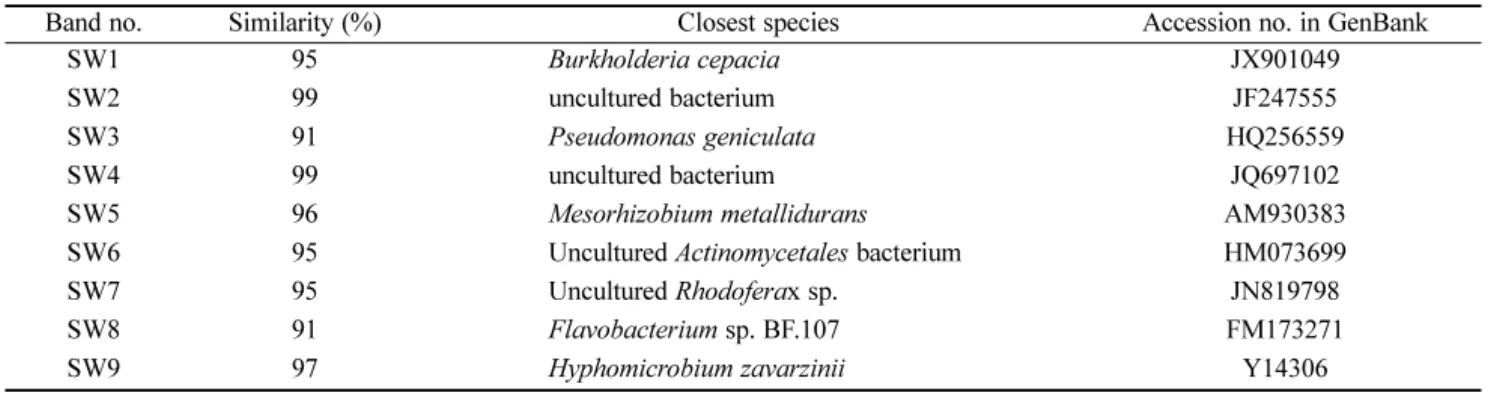
T3)의 DGGE band들의 분석결과를 Fig. 3과 Table 5에 나타 내었다. 각각의 생물학적 반응조 (T1~T3)들에서 1번 band (Burkholderia cepacia (JX901049))와 2번 band (uncultured bacterium (JF247555))는 존재하였고, 특히 피혁 폐수의 함량 이 전체 폐수 유입량의 65% 정도로 높은 비율을 차지한 2009년 4월에는 T1~T3에 걸쳐 1번 band와 2번 band가 양적 인 우점을 보였으나 피혁 폐수의 함량이 전체 폐수 유입량의 40% 정도로 나타났던 2009년 9월에는 1번 band와 2번 band 의 명도가 낮게 나타났다. Burkholderia cepacia는 Wani 등 [18]의 연구결과에서 독성이 강한 6가 크롬에 대한 환원능 및 고농도의 크롬이 함유된 경우에도 잘 성장하는 것으로 보 고되었다. uncultured bacterium (JF247555)의 경우도 크롬에 대한 내성을 가지며, 크롬을 이용하는 박테리아일 가능성이 높은 것으로 판단된다. 3번 band (Pseudomonas geniculata (HQ256559))는 피혁 폐수 비율이 낮았던 9월에만 나타난 것 으로 보아 유입수에 함유된 크롬 등의 중금속이 이들 박테리 아들의 생장에 영향을 저해하여 나타난 결과로 판단된다.
4번 band (uncultured bacterium (JQ697102))와 5번 band (Mesorhizobium metallidurans (AM930383))의 경우는 band 들의 명도에 차이는 있었으나 4월과 9월 모두 band가 존재하 였다. 4번과 5번 박테리아는 유입수 중의 크롬농도에 관계없 이 잘 생장하였으며, Wani 등 [26]은 Mesorhizobium의 경우 크롬 환원능 및 크롬이 존재하는 환경에서 잘 생장하는 것 으로 보고하고 있다. 6번 band (uncultured Actinomycetales bacterium (HM073699))와 7번 band (Uncultured Rhodoferax
Fig. 2. DGGE analysis of PCR-amplified 16S-rDNA fragments of total bacterial population from sludge samples.
Fig. 3. Phylogenetic tree based on the 16S rRNA gene sequences of DGGE bands from sludge samples.
Table 5. Phylogenetic affiliations of 16S rDNA sequences obtained from DGGE bands
Band no. Similarity (%) Closest species Accession no. in GenBank
SW1 95 Burkholderia cepacia JX901049
SW2 99 uncultured bacterium JF247555
SW3 91 Pseudomonas geniculata HQ256559
SW4 99 uncultured bacterium JQ697102
SW5 96 Mesorhizobium metallidurans AM930383
SW6 95 Uncultured Actinomycetales bacterium HM073699
SW7 95 Uncultured Rhodoferax sp. JN819798
SW8 91 Flavobacterium sp. BF.107 FM173271
SW9 97 Hyphomicrobium zavarzinii Y14306
sp. (JN819798))의 경우 4월의 band 분석결과에서는 희미하 게 윤곽만 나타났으나, 9월의 band 분석결과에서는 선명한 band를 나타내었다. Rhodoferax sp.는 철 환원박테리아로 잘 알려져 있으며 [27], 침출수에서 흔히 발견되는 것으로 보고 되어 [28] 크롬과 같은 중금속에 대한 내성이 있는 균으로 판 단된다. 8번 band (Flavobacterium sp. BF.107 (FM173271))와 9번 band (Hyphomicrobium zavarzinii (Y14306))는 피혁 폐수 함량이 높았던 4월의 경우는 T1~T3에서 명도에 별 차이가 없이 희미하게 나타났으나, 피혁폐수 함량이 함량이 낮았던 9월의 band 분석결과에서는 T1과 T2에 비해 T3에서는 확연 히 선명한 band를 나타내었다. 이전의 여러 연구결과들에서 Flavobacterium sp.와 Hyphomicrobium zavarzinii는 탈질 관 련 박테리아로 보고되고 있으며 [29-31], 4월과 9월의 T-N 제 거율에서 많은 차이를 보이는 이유도 Flavobacterium sp.와 Hyphomicrobium zavarzinii의 band 분석결과와 관련이 있을 것으로 판단된다.
3.3. 생물학적 처리공정 내의 박테리아 생체량 평가 4월과 9월의 유입수의 성상변화에 따른 각각의 생물학적 처 리공정들에서 채취한 슬러지에 대한 박테리아 생체량 분석 결과를 Fig. 4에 나타내었다. Fig. 4에 나타낸 피혁 폐수와 수 산 폐수의 비율이 6.5:3.5 (2009년 4월), 4.0:6.0 (2009년 9월) 였을 때의 박테리아 생체량 결과를 비교해 보면 Eubacteria 와 total bacteria의 생체량은 4월에 비해 9월의 경우가 약 3배 이상 높게 나타나 유입수 중의 피혁 폐수 비율이 생물학적 처리조내 박테리아들의 생체량에 많은 영향을 미치는 것으 로 나타났다. 생물학적 처리조 별로 보면 Tank 1 (T1)과 Tank 2 (T2)에서 보다 Tank 3 (T3)에서 Eubacteriat/total bacteria 비율이 감소하는 것으로 보아 Tank 3 (T3)에서 탈질 관련 Eubacteria 이외의 여러 균들이 다수 존재한 것으로 판단된다.
BOD/T-N의 비율은 4월에 1.01, 9월에 1.5로 나타났으며, 가 장 높은 생체량을 보인 9월에 처리효율 또한 높게 나타났다.
4. 결론
본 연구에서는 DGGE를 이용하여 혼합 폐수의 생물학적 처 리공정들의 박테리아의 군집을 분석한 결과, 다음과 같은 결 론을 얻을 수 있었다.
① M 하수처리장으로 유입되는 유입수는 계절별로 피혁 폐수와 수산 폐수의 유입비율의 차이로 인하여 오염물 질의 성상에 많은 차이를 나타내었다.
② 수산 폐수의 유입비율이 높았던 시기에는 피혁 폐수 의 혼합비율이 높은 시기보다 생물학적 처리조들 내의 박테리아들의 생체량이 월등히 높았으며, BOD, COD 및 T-N의 제거율도 8~18% 정도 높게 나타난 반면 피 혁 폐수의 유입비율이 높은 시기에는 피혁 폐수 중에 함유된 크롬 농도의 증가 영향으로 인해 각각의 생물 학적 처리조 내의 박테리아들의 생체량이 감소함에 따 라 오염물질들에 대한 처리효율이 저하되었다.
③ 피혁 폐수의 유입비율이 높은 시기에는 Burkholderia cepacia (JX901049)와 uncultured bacterium (JF247555)가 우점하였으며, 수산 폐수의 유입비율이 높을 시기에는 Pseudomonas geniculata (HQ256559)이 우점하였으며, Flavobacterium sp. BF.107 (FM173271)와 Hyphomicrobium zavarzinii (Y14306)는 무산소조에서 우점을 보였다.
REFERENCES
1. Eikelboom, D. H. (1975) Filamentous organisms observed in acti- vated sludge. Water Res. 9: 365-388.
2. Richard, M., O. Hao, and D. Jenkins (1985) Growth kinetics of Sphaerotilus species and their significance in activated sludge bulking. J. Water Pollut. Con. F. 57: 68-81.
3. Andreasen, K. and P. H. Nielsen (1997) Application of microauto- radiography to the study of substrate uptake by filamentous micro- organisms in activated sludge. Appl. Environ. Microbiol. 63: 3662- 3668.
4. Nielsen, P. H., K. Andreasen, M. Wagner, L. L. Blackall, H. Lem- mer, and R. J. Seviour (1998) Variability of type 021N in activated sludge as determined by in situ substrate uptake pattern and in situ hybridization with fluorescent rRNA targeted probes. Water Sci.
Technol. 37: 423-440.
5. Eikelboom, D. H. (2000) Process Control of Activated Sludge Plants by Microscopic Investigation. IWA Publishing, London.
6. Ohashi, A., D. G. Viraj de Silva, B. Mobarry, J. A. Manem, D. A.
Stahl, and B. E. Rittmann (1995) Influence of substrate C/N ratio on the structure of multi-species biofilms consisting of nitrifiers and heterotrophs. Water Sci. Technol. 32: 75-84.
7. Zhang, T. C. and P. L. Bishop (1996) Evaluation of substrate and pH effects in a nitrifying biofilm. Water Environ. Res. 68: 1107- 1115.
8. Lazarova, V., D. Bellahcen, J. Manem, D. A. Stahl, and B. E. Ritt- mann (1999) Influence of operating conditions on population dynamics in nitrifying biofilms. Water Sci. Technol. 39: 5-11.
9. Kloep, F., I. Roske, and T. R. Neu (2000) Performance and micro- Fig. 4. Variations of bacterial biomass (Eubacteria and total
bacteria) in the biological reactors (T1~T3) at Apr. and Sep. 2009.
Parenthesis is the percentage of Eubacteria/total bacteria.
bial structure of a nitrifying fluidized-bed reactor. Water Res. 34:
311-319.
10. Kim, D. J., D. W. Han, S. C. Lee, B. G. Park, I. Kwon, C. K. Sung, and W. C. Park (2002) Wastewater treatment and microbial struc- ture analysis by fluorescence in situ hybridization in a biofilm reactor. Korean J. Biotechnol. Bioeng. 17: 80-87.
11. Wong, M. T., T. Mino, R. J. Seviour, M. Onuki, and W. T. Liu (2005) In situ identification and characterization of the microbial community structure of full-scale enhanced biological phospho- rous removal plants in Japan. Water Res. 39: 2901-2914.
12. Araya, R., K. Tani, T. Tagaki, N. Yamaguchi, and M. Nasu (2003) Bacterial activity and community composition in stream water and biofilm from an urban river determined by fluorescent in situ hybridization and DGGE analysis. FEMS Microbiol. Ecol. 43:
111-119.
13. Patil, S. S., M. S. Kumar, and A. S. Ball (2010) Microbial commu- nity dynamics in anaerobic bioreactors and algal tanks treating pig- gery wastewater. Appl. Microbiol. Biotechnol. 87: 353-363.
14. Dong, X. and G. B. Reddy (2010) Soil bacterial communities in constructed wetlands treated with swine wastewater using PCR- DGGE technique. Bioresour. Technol. 101: 1175-1182.
15. Mino, T., H. Satoh, M. Onuki, T. Akiyama, T. Nomura, and T.
Matsuo (2001) Strategic approach for characterization of bacterial community in enhanced biological phosphate removal (EBPR) process," In: T. Matsuo, K. Hanaki, S. Takizawa, and H. Satoh (Eds.), Advances in Water and Wastewater Treatment Technology:
Molecular Technology, Nutrient Removal, Sludge Reduction and Environmental Health, Elsevier, London, UK.
16. Nielsen, P. H., C. Kragelund, R. J. Seviour, and J. L. Nielsen (2009) Identity and ecophysiology of filamentous bacteria in acti- vated sludge. FEMS Microbiol. Rev. 33: 969-998.
17. Jang, A., P. L. Bishop, S. Okabe, S. G. Lee, and I. S. Kim (2002) Effect of dissolved oxygen concentration on the biofilm and in situ analysis by fluorescence in situ hybridization (FISH) and micro- electrodes. Water Sci. Technol. 47: 49-57.
18. Wani, R., K. M. Kodam, K. R. Gawai, and P. K. Dhakephalkar (2007) Chromate reduction by Burkholderia cepacia MCMB-821, isolated from the pristine habitate of alkaline crater lake, Appl.
Microbial. Biotechnol. 75: 627-632.
19. Son, H. S., H. J. Son, M. Kim, E. Y. Ryu, G. Lee, and S. J. Lee (2010) Changes of microbial community structure according to a changes of season and influent characteristics in biological waste- water treatment. Korean J. KSEE. 32: 780-786.
20. Kim, G. T., G. Webster, J. W. Wimpenny, B. H. Kim, H. J. Kim,
and A. J. Weightman (2006) Bacterial community structure, com- partmentalization and activity in a microbial fuel cell. J. Appl.
Microbiol. 101: 698-710.
21. Thompson, J. D., D. G. Higgins, and T. J. Gibson (1994) CLUSTAL W: Improving the sensitivity of progressive multiple sequence alignment through sequence weighting, position specific gap pen- alties and weightmatrix choice. Nucleic. Acids Res. 22: 4673-4680.
22. Ryu, E. Y., M. Kim, and S. J. Lee (2011) Characterization of microbial fuel cells enriched using Cr(VI)-containing sludge. J.
Microbiol. Biotechnol. 21: 187-191.
23. Wagner, M., R. Amann, H. Lemmer, and K. Scheleifer (1993) Probing activated sludge with oligonucleotides specific for proteo- bacteria: inadequacy of culture-dependent methods for describing microbial community structure. Appl. Environ. Microbiol. 59:
1520-1525.
24. Glckner, F. O., B. M. Fuchs, and R. Amann (1999) Bacterioplank- ton compositions of lakes and oceans: a first comparison based on fluorescence in situ hybridization. Appl. Environ. Microbiol. 65:
3721-3726.
25. Wagner, M., R. Erhart, W. Manz, R. Amann, H. Lemmer, D. Wedi, and K. H. Schleifer (1994) Development of an rRNA-targeted oli- gonucleotide probe specific for the genus acinetobacter and its application for in situ monitoring in activated sludge. Appl. Envi- ron. Microbiol. 60: 792-800.
26. Wani, P. A., M. S. Khan, and A. Zaidi (2008) Chromium-reducing and plant growth-promoting Mesorhizobium improves chickpea growth chromium amended soil. Biotechnol. Lett. 30: 159-163.
27. Shi, L., K. M. Rosso, J. M. Zachara, and J. K. Fredrickson (2012) Mtr extracellular electron-transfer pathways in Fe(III)-reducing or Fe(II)-oxidizing bacteria: a genomic perspective. Biochem. Soc.
Trans. 40: 1261-1267.
28. Rlling, W. F., B. M. van Brewkelen, M. Braster, B. Lin, and H. W.
van Verseveld (2001) Relationships between microbial commu- nity structure and hydrochemistry in a landfill leachate-populated aquifer. Appl. Environ. Microbiol. 67: 4619-4629.
29. Chneby, D., L. Philippot, A. Hartmann, C. Henault, and J. C. Ger- mon (2000) 16S rDNA analysis for characterization of denitrify- ing bacteria isolated from three agricultural soil. FEMS Microbiol.
Ecol. 34: 121-128.
30. Otlanabo, N. L. (1993) Denitrification of Ground Water for Pota- ble Purposes. WRC report 403/1/93.
31. Zumft, W. G. (1992) The denitrifying prokaryotes, In: A. Balows, H. G. Truper, M. Dworkim, W. Harder and K. H. Schleifer (eds.), The Prokaryotes: Springer-verlag, New York, USA.