1. Introduction
1.1. Background and Objective of the Research
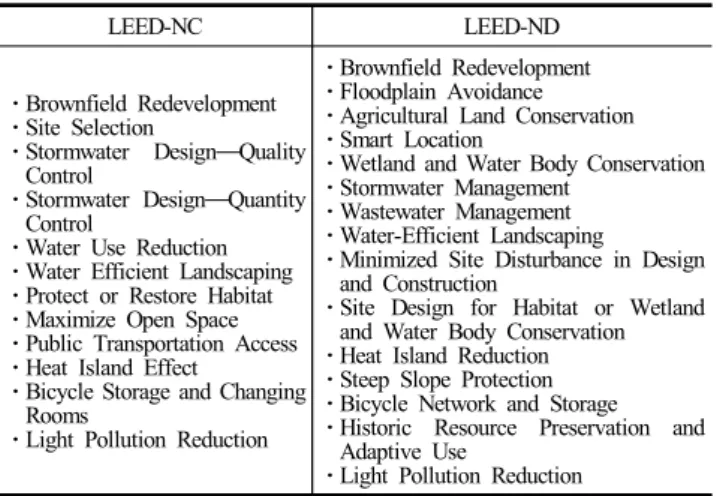
Environmental and resource issues such as global warming, resource depletion, water shortage, and green house gas emissions have been raised since 1990, many countries have introduced green building certification systems for development that could adapt to climate change. The UK first developed a certification system called BREEAM in 1991, followed by the US introducing LEED V1.0 in 1998. Korea also introduced its green building certification system in 2002. These certification systems have evolved to address new markets and building types, adveances in practice and technology, and various project scopes. Individual buildings were the focus of the certification systems at the initial stage, but the focus has shifted to environmental issues in a city or a neighbor unit. Therefore, green building certification systems in many countries have evaluation systems for cities and/or neighbor units independent from those for individual buildings. Such examples are BREEAM-Communities of the UK, CASBEE CITY of Japan, and LEED-ND of the US.
Another improvement to green building certification systems is that the assessment items for sustainable site development and eco-friendly outdoor environment have been developed and
pISSN 2288-968X, eISSN 2288-9698 http://dx.doi.org/10.12813/kieae.2014.14.4.011
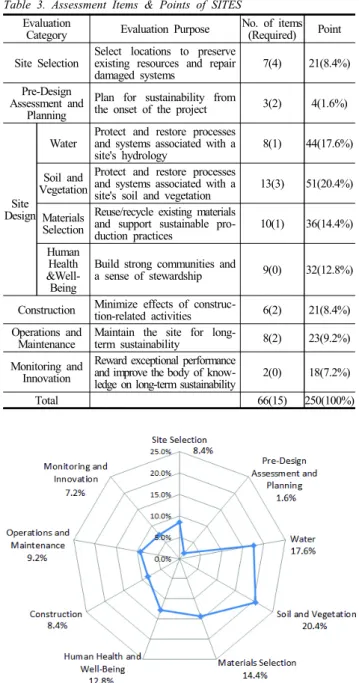
expanded. In the US, the Sustainable Sites Initiative (SITES) was created in 2012 in order to ensure the sustainable development of landscape and outdoor environment of all sites such as an outdoor space of a building, parks, and open spaces. This type of system covers from the site development planning to design and maintenance to ensure integrity and sustainablity of design and provides comprehensive evaluation items. On the other hand, Korea’s green certification system mainly emphasize energy performance of a building, and has a limited number of items for outdoor environment that should be considered at a construction planning stage (Park C. H. et al., 2009). Furthermore, the outdoor environment evaluation is getting more important in other countries, the number of items for outdoor environment evaluation has been reduced in Korea’s green certification system after several revisions (Park C, H, et al., 2009; Yoon Y. H. et al., 2011). There have been calls for review and supplementation of the certification system due to lack of assessment items related to ecological and outdoor environment (Seong S. T. et al., 2012), any visible improvements have not been made.
This research aims to analyze evaluation items and methods of SITES, a rating system for sustainable site development and outdoor environment, and compare it with outdoor environment assessment items of LEED and Korea’s green building certification so as to seek improvements for outdoor environment evaluation items. Under the circumstance that there is a insufficient number of outdoor environment and green space assessment items, this
KIEAE Journal
Korea Institute of Ecological Architecture and Environment
68
1)
Assessment Items of Outdoor Environment through Analysis of SITES
- Focused on the Comparison with G-SEED and LEED - Lee, Hyung-Sook
** Corresponding Author, Ph.D., RLA, Dept. of Landscape Architecture, Gachon University, South Korea ([email protected])
A B S T R A C T K E Y W O R D
Although assessing outdoor environment and green space in terms of sustainability and environmental performance is perceived as an important issue, most existing green building certification systems are more focused on buildings and indoor environment. Recently, the Sustainable Site Initiatives (SITES) has been developed by American Society of Landscape Architecture in order to evaluate sustainability of site development and outdoor environment. Separate from LEED, the SITES are increasingly receiving attentions as a reliable certification system in the United States. As a preliminary study to develop the items of outdoor environmental assessment, the present study is purposed to analyze the assessment items, grading system and applicability of SITES for better understanding on the system. Also it was compared to existing green building certification criteria, including G-SEED, LEED-NC, and LEED-ND in order to investigate similarities and discrepancies. The results would provide insights and basic data to improve assessment items for outdoor environment of G-SEED.
ⓒ 2014 KIEAE Journal
Sustainable Site Initiatives (SITES), Assessment of outdoor environment, G-SEED,
LEED
A C C E P TA N C E IN F O Received June 3, 2014
Final revision received July 31, 2014 Accepted August 4, 2014