CopyrightⒸ2014 KSAE / 127-24 pISSN 1225-6382 / eISSN 2234-0149 DOI http://dx.doi.org/10.7467/KSAE.2014.22.1.183 Transactions of KSAE, Vol. 22, No. 1, pp.183-192 (2014)
바이오디젤 연료의 혼합기 형성 및 미립화 증진 방안
서 현 규*
공주대학교 기계자동차공학부
A Review on the Mixture Formation and Atomization Characteristics of Oxygenated Biodiesel Fuel
Hyun Kyu Suh*
Division of Mechanical & Automotive Engineering, Kongju National University, Chungnam 331-717, Korea (Received 1 July 2013 / Revised 22 July 2013 / Accepted 10 August 2013)
Abstract : In this work, the mixture formation and atomization characteristics of biodiesel fuel were reviewed under various test conditions for the optimization of compression-ignition engine fueled with biodiesel. To achieve these, the effect of nozzle caviting flow, group-hole nozzle geometry and injection strategies on the injection rate, spray evolution and atomization characteristics of biodiesel were studied by using spray characteristics measuring system. At the same time, the fuel heating system was installed to obtain the effect of fuel temperature on the biodiesel fuel atomization.
It was revealed that cavitation in the nozzle orifice promoted the atomization performance of biodiesel. The group-hole nozzle geometry and split injection strategies couldn't improve it, however, the different orifice angles which were diverged and converged angle of a group-hole nozzle enhanced the biodiesel atomization. It was also observed that the increase of fuel temperature induced the quick evaporation of biodiesel fuel droplet.
Key words : Atomization characteristics(미립화특성), Biodiesel(바이오디젤), Cavitation(캐비테이션), Group-hole nozzle(그롭홀 노즐), Injection rate(분사율), SMD(Sauter Mean Diameter, D32, 액적 평균 입경), Spray tip penetration (분무도달거리)
Nomenclature
1)D : diameter, μm
L : length, mm m : fuel mass, mg P : pressure, MPa t : time, ms W : width, mm
Subscripts amb : ambient
asoi : after start of injection inj : injection
*Corresponding author, E-mail: [email protected]
m : main p : pilot
1. 서 론
압축착화엔진(Compression ignition engine)의 대
체 연료로서 바이오디젤은 연료 자체에 11~15%의
산소를 포함하고 있어
1,2)연료와 공기의 산화 과정
이 촉진되어 연소, 열효율 및 연비 향상에 큰 영향을
주는 것으로 알려져 있다. 따라서, 바이오디젤을 주
요 엔진 부품들의 수정 없이 압축착화엔진에 사용
하기 위하여 많은 연구자들이 바이오디젤 연료 엔
진의 기준 및 제원 최적화에 관하여 연구를 수행하
고 있다. 하지만, 바이오디젤의 대표적인 물성치들
서 현 규
Fig. 1 Schematics of spray characteristics measuring system13)
인 밀도(Density), 점도(Viscosity) 및 표면장력(Sur-
face tension)은 디젤과 다른 특성을 가지고 있어
1,2)압축착화엔진에서 바이오디젤의 직접적인 사용은 연료 분무의 미립화 특성의 저하와
3)인젝터 및 밸브 작동에 문제를 일으키는 것으로 알려져 있다.
4)또 한, 바이오디젤은 저온의 운전 조건에서 연료의 유 동성이 나빠서 저온 시동성 악화를 유발하는 것으 로 보고되었다.
연소기관에서 우수한 분무 미립화 특성은 기관의 연소 가능 범위를 넓히고, 배출가스를 저감하는데 영향을 미친다.
5-7)연료 분무의 미립화를 증진시키 는 방법은 다양하지만, 미립화 특성은 연료의 분사 압력(Injection pressure) 및 분사 전략(Injection stra- tegy), 분사 노즐의 형상(Nozzle geometry) 및 분위기 조건(Ambient condition)의 영향을 직접적으로 받는 다.
5-7)따라서, 이와 같은 주요 영향 인자들에 대한 최적화 연구는 엔진 실린더 내의 균일 혼합기 형성 을 포함한
8-12)연소기관의 최적화는 물론 배출물 저 감을 위해서도 반드시 선행되어야 한다.
따라서, 본 연구에서는 압축착화엔진의 대체 연 료로 주목받는 바이오디젤의 혼합기 형성(Mixture formation) 과정을 규명하고, 기존 디젤 연료와 비교 하여 좋지 않은 것으로 알려진 분무 미립화 특성 (Spray atomization characteristics)을 향상시키기 위
하여 수행된 다양한 실험적 연구를 정리하였다. 이 를 통하여, 바이오 디젤 분무 미립화 개선 방안을 제 시하고, 향후 바이오디젤 압축착화엔진의 설계 및 제작에 필요한 최적화 자료를 제시하고자 하였다.
2. 실험 장치 및 방법
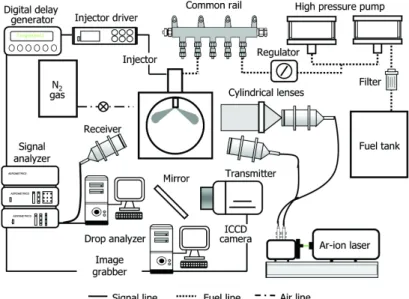
바이오디젤의 혼합기 형성 및 분무 미립화 특성 을 디젤 연료와 비교 연구하기 위하여, 연료의 분사 율(Injection rate), 분무 가시화(Spray visualization) 및 미립화(Atomization) 특성 측정이 가능한 분무 특성 측정 장비(Spray characteristic measuring system)를 Fig. 1과 같이 설치하였다.
13)분무 특성 측정 장비의 자세한 제원은 Table 1과 같다.
13)바이오디젤의 혼합기 형성 및 미립화 증진 방안 에 관한 연구를 위하여, 연료 분사용 인젝터 노즐 내 부에서 발생하는 캐비테이션(Cavitation) 유동
14,15)이 바이오디젤 연료의 미립화 증진에 미치는 영향을 실험적으로 분석하여 제시하였다. 또한, 많은 선행
연구들
16-20)에서 연료 미립화 특성 개선에 영향이 있
는 것으로 알려진 그룹홀 노즐(Group-hole nozzle)을
이용하여 다양한 노즐 형상(Nozzle geometry), 분사
전략(Injection strategy) 및 분사 조건(Injection condi-
tion)에서의 미립화 증진 특성에 대하여 비교 연구
하고 규명하였다.
21,22)바이오디젤 연료의 혼합기 형성 및 미립화 증진 방안
(a) Single injection (b) Pilot injection
Fig. 3 Spray tip penetration of diesel and biodiesel in single and pilot injection (Pinj= 60, 100MPa, Pamb= 4MPa)13) Table 1 Specifications of spray characteristics measuring
system13)
Spray visualization
Light source Ar-ion laser
Wave length 514.5nm
Laser power 1.2W
Pixel size 6.7μm × 6.7μm Resolution 1280(H) × 1024(V)
PDPA measurement
Burst threshold 0.5mV Mixer frequency 36MHz, 40MHz
Filter frequency 40MHz
PMT voltage 500V
Diameter sub-range 2 μm -100 μm
마지막으로, 분무 미립화에 큰 영향을 미치는 연 료 물성치들(Fuel properties)을 디젤의 물성치와 유 사하게 변화시키기 위하여, 다양한 연료 온도 조건 에서 바이오디젤 연료의 미립화 특성을 분석하여 체계적으로 정리하였다.
23,24)각 실험별 자세한 실험 조건과 사용된 실험 장비 및 인젝터 노즐들의 제원 은 각 참고 문헌들
14,15,21-24)에 자세히 나타나 있다.
3. 실험 결과 및 고찰
본 연구에서는 압축착화엔진에서 바이오디젤의 대체 연료로서의 가능성을 평가하기 위하여 다양한 실험 조건에서의 비교 연구를 정리하고, 바이오디 젤 연료의 분사 및 분무 미립화 특성 개선 방안을 제 시하고자 하였다.
3.1 바이오디젤의 분사 및 미립화 특성13)
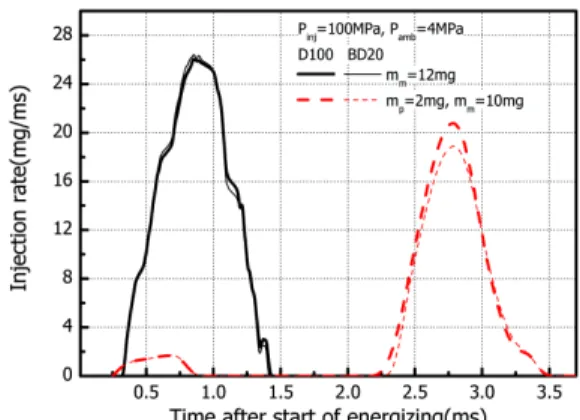
Fig. 2와 같이 동일 분사조건에서 디젤과 바이오
Fig. 2 Injection rate characteristics of diesel and biodiesel in single and pilot injection (Pinj= 100MPa, Pamb= 4MPa)13)
디젤의 분사율 특성을 비교한 결과, 단일분사(Single injection)의 경우, 분사율 특성은 큰 차이가 없는 것 으로 나타났다. 반면에, 파일럿 분사(Pilot injection) 의 경우, 바이오디젤 주 분사의 최대 분사율(Max.
injection rate value)값이 다소 낮았다.
단일 분사 및 파일럿 분사 전략이 분무도달거리
(Spray tip penetration)에 미치는 영향을 Fig. 3에 나타
내었다. 단일 분사의 경우에 연료 혼합에 따른 분무
도달거리에 큰 차이가 없는 것으로 나타났다. 반면
에 파일럿 분사의 경우, 디젤 파일럿 분사의 분무도
달거리가 바이오디젤보다 긴 것으로 나타났으나,
주 분사의 경우에는 큰 차이가 없었다. 이는 소량의
연료를 분사할 경우, 바이오디젤의 높은 점성(Vis-
cosity)로 인해, 분무가 충분히 발달하지 못한 것으
로 판단되고, 소량의 바이오디젤 연료 분사 시 디젤
Hyun Kyu Suh
(a) SMD (b) Mean velocity Fig. 4 Atomization characteristics of diesel and biodiesel (Pinj= 60, 100MPa, Pamb= 4MPa)13)
과 동등한 분무도달거리를 기대하기 위해서는 높은 분사압력이 필요할 것으로 판단된다.
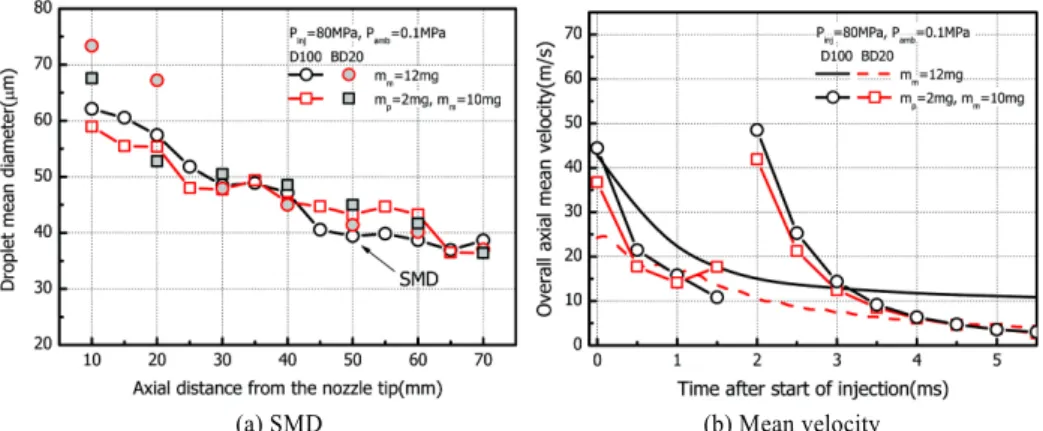
연료 액적의 직경(SMD)은 압축착화엔진의 연소 및 배출물 특성에 큰 영향을 미치는 분무 특성에 매 우 중요한 인자이다. 따라서, 디젤과 바이오디젤의 분무 미립화(Atomization) 특성을 Fig. 4(a)와 같이 비 교한 결과, 바이오디젤이 전 측정 조건에서 높은 SMD 분포를 보였다. 이는 디젤과는 다른 바이오디 젤의 물성치들(높은 Viscosity 및 Surface tension)이 연료 액적의 미립화를 저하시키고, Fig. 4(b)에 나타 낸 바와 같이 연료의 평균 분사속도(Mean velocity) 에도 영향을 미쳐 전 실험 영역에서 바이오디젤의 분사 속도가 느린 것으로 나타났다.
이와 같은 바이오디젤의 열악한 분무 미립화 특 성은 결론적으로 엔진의 성능, 연비 및 배출물 특성 을 저하시키는 원인이 된다. 따라서, 바이오디젤의 혼합기 형성과정을 규명하고, 미립화 성능 개선을 위하여 다음과 같은 연구들을 수행하였다.
3.2 Nozzle Cavitation의 영향14,15)
선행 연구들
5,25)을 참조하여 Fig. 5와 같은 형상비 (L/W)를 가진 Nozzle을 제작하여 다양한 분사조건 에 따른 바이오디젤의 Nozzle caviation 특성을 가시 화하고, Nozzle내부에서 Cavitation 발생이 바이오디 젤의 미립화 증진에 미치는 영향을 연구하였다. Fig. 5 에 나타낸 바와 같이, 분사유량이 증가할수록 Nozzle 내에 Cavitation bubble이 생성되었고, Cavitation이 점차 성장할수록 Nozzle 외부의 분무각도 넓어지는
(a) L/W=1.8
(b) L/W=2.7
Fig. 5 Nozzle flow characteristics of biodiesel in a different L/W ratio14)
것으로 나타났다. 이러한 현상은 Nozzle의 형상비
(L/W)가 증가하여도 동일한 결과를 보였다. 반면에,
연료 유량이 계속 증가하여 일정 수준이상이 되면,
A Review on the Mixture Formation and Atomization Characteristics of Oxygenated Biodiesel Fuel
(a) Overall axial SMD
(b) Overall radial SMD (LZ= 70mm) Fig. 6 Effect of flow characteristics on the overall SMD of biodiesel15)
Cavitation flow 특성이 Hydraulic flip flow 특성으로 변화하고, 분무각이 좁아지는 것을 확인하였다. 이 와 같은 Nozzle cavitation의 발생이 분무 미립화 특 성에 미치는 영향을 Fig. 6과 같이 SMD를 측정하여 실험적으로 분석하였다. 연구 결과, 전체 축 방향 (Axial direction) 및 반경 방향(Radial direction)에서 Cavitating flow의 SMD가 작은 결과를 보였다.
이와 같은 결과는 Cavitation의 발생이 바이오디 젤의 분무 미립화를 증진시키는 주요 인자임을 나 타낸다. 이는, Cavitation bubble이 분열될 때, Bubble 표면에 저장되어 있던 Cavitation의 분열 에너지 (Breakup energy)가 바이오디젤의 미립화에 영향을 미치기 때문이다. 즉, Turbulent flow보다 높은 유량 조건에서 발생되어, 높은 분열 에너지를 가지는 Cavitation flow에서 바이오디젤의 미립화 특성 개선 을 기대할 수 있을 것으로 사료된다.
3.3 Group-hole Nozzle의 영향
일반적으로 연료의 분사량(Injection mass)과 분사
율(Injection rate) 특성은 분사 Nozzle 형상에 영향을 받는다.
5,6)따라서, 바이오디젤의 미립화 증진 방안에 대한 연구를 선행 연구들
16-20)에서 미립화 특성 향상 에 영향이 있는 것으로 알려진 Group-hole nozzle을 적용하여 연구를 수행하였다.
3.3.1 Single Injection의 영향21)
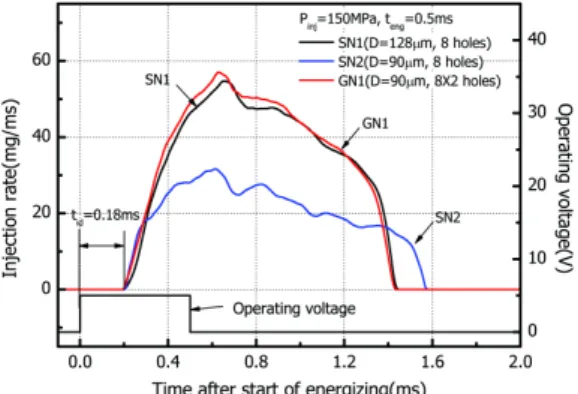
Fig. 7과 같이 동일한 조건에서의 Single-hole 및 Group-hole nozzle의 분사율 특성을 비교하였다.
Group-hole nozzle은 Single-hole nozzle과 동일한 유 효 면적으로 제작이 되어서 거의 동일한 분사 지연 기간(Injection delay time), 최대 분사율(Max. injection rate value), 실제 분사기간(Real injection duration)특 성을 보였다.
분무 가시화 장비를 통해 촬영한 바이오디젤의
분무 영상을 분석하여 분무도달거리를 Fig. 8과 같
이 비교하였다. 분사 초기에는 동일한 유효 면적에
도 불구하고, Group-hole nozzle의 약간 짧은 도달 거
리를 보였다. 반면에, 분사 시작 후 시간(Time after
서 현 규
(a) Overall SMD (b) Overall mean velocity
Fig. 9 Overall atomization characteristics of biodiesel in SN and GN injectors (Pinj= 80MPa, Pamb= 0.1MPa, teng= 0.5ms)21) Fig. 7 Injection rate characteristics of biodiesel fuel, SN and
GN indicate the single- and group-hole nozzle. (Pinj= 150MPa, teng= 0.5ms)21)
Fig. 8 Spray tip penetration of biodiesel fuel in SN and GN injectors. (Pinj= 150MPa, teng= 0.5ms)21)
start of injection, t
asoi)이 1.4ms 이후에 Single-hole nozzle 분사의 경우, 바이오디젤의 분무 운동량 감소로 인해 분무 도달 거리 증가가 둔화되었으나, Group-
hole nozzle은 서로 다른 홀에서의 연료 분사가 액적 의 운동량을 보상하여
17-20)도달거리가 계속 증가하 는 것을 확인하였다. 즉, Group-hole nozzle은 동일 분 사 압력에서 더 긴 도달거리를 기대할 수 있었다.
분무 미립화 측정 장치를 이용하여 분사 시작 후 시간(t
asoi)에 따른 바이오디젤의 SMD 및 Mean velocity를 Fig. 9에 비교 분석하였다. 본 연구에서 바 이오디젤의 미립화 증진 효과를 기대하였음에도 불 구하고, Fig. 9(a)처럼 전 측정기간 동안 Group-hole nozzle의 SMD가 가장 큰 것으로 나타났고, Mean velocity도 느린 것으로 나타났다. 이와 같은 결과로 부터, Single injection 조건에서 Group-hole nozzle의 사용은 동일한 분사율(Injection rate) 및 분무 도달 거리(Spray tip penetration) 특성의 향상은 기대할 수 있으나, 미립화(Atomization) 특성의 향상은 기대할 수 없는 것으로 판단된다.
3.3.2 Split Injection의 영향21)
Group-hole nozzle에 Split injection을 적용하여 바 이오디젤의 미립화 향상에 관하여 연구를 수행하였 다. 동일한 인젝터 통전 기간(Energzing time, t
eng)으 로 연료를 분사한 결과, Split injection시 전체 분사량 이 감소하였으며, 최대 분사율 및 도달 시간도 Single injection과 비교하여 차이가 나는 것을 Fig. 10 과 같이 확인하였다.
이러한 분사율 특성은 분무 발달 및 도달 거리에
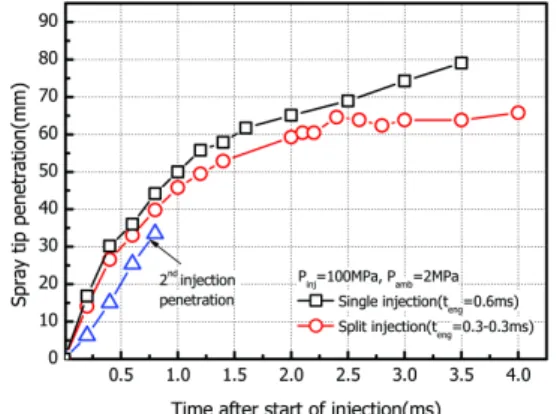
도 영향을 주어, Fig. 11과 같이 전체 측정 시간 동안
Split injection의 분무도달거리가 짧은 것으로 나타
났다. 특히, 두 번째 분사시의 도달거리가 가장 짧은
바이오디젤 연료의 혼합기 형성 및 미립화 증진 방안
Fig. 12 Spray droplet size of biodiesel single and split injection in GN injector (Pinj= 80MPa, Pamb= 0.1MPa)21) Fig. 10 Injection rate characteristics of single and split
injection of biodiesel in GN injector (Pinj= 100MPa, Pamb= 2MPa)21)
Fig. 11 Spray tip penetration of biodiesel fuel in SN and GN injectors in split injection (Pinj= 100MPa, Pamb= 2MPa)21)
것으로 나타났는데, 분사율 측정 결과에서 두 번째 분사시 최대 분사율(Max. injection rate value)이 가 장 낮은 것과 동일한 경향의 결과를 보였다. 이러한 결과는 Split injection 조건에서, 첫 번째 분사 후 순
간적인 분사 압력 강하가 두 번째 분사에 영향을 주 어 동일한 분사압력과 분사량으로 연료 분사가 되 지 않았기 때문으로 판단된다.
Single 및 Split injection 조건에서 바이오디젤의 평균 분무 입경인 SMD와 AMD (Arithmetic mean diameter, D
10)를 측정하여 Fig. 12에 나타내었다. 비 교 결과, Group-hole nozzle의 Split injection 전략은 Single injecton 전략보다 높은 SMD 및 AMD를 보여 미립화 특성을 오히려 나쁘게 만드는 것으로 나타 났다. 이는, Split injection시 첫 번째 연료분사로 인 한 인젝터 내부의 순간적인 압력 강하로 인하여 두 번째 연료 분사시 분사량 및 분사속도가 저하된 영 향으로 판단된다.
3.3.3 Orifice Angle의 영향22)
Group-hole nozzle의 Orifice angle의 변화가 바이 오디젤의 분무 미립화 특성에 미치는 영향을 연구 하였다. Nozzle orifice의 각도가 변화할 경우, 연료 분사 초기 속도의 변화에 영향을 주기 때문에 Fig. 13 에 나타낸 바와 같이 Parallel orifice와 비교하여 Diverged orifice의 경우 분무도달거리가 짧아지고, Converged orifice의 경우 분무도달거리가 길어졌다.
Group-hole nozzle에서 Orifice angle의 변화에 따 른 바이오디젤의 분무 미립화 특성을 Fig. 14와 같이 비교하였다. 연구 결과, Parallel orifice nozzle의 SMD 가 가장 큰 것으로 나타났고, Diverged 및 Converged orifice nozzle의 사용이 분무 미립화 성능을 개선하 는 것으로 나타났다.
특히, Converged nozzle의 경우에는 연료 분사시
서로 간섭하는 Orifice 분사각이 액적의 분열 및 운
동량에 상호 영향을 주어 분사 초기의 분무 속도 또한
Hyun Kyu Suh
(a) Overall SMD (b) Overall mean velocity
Fig. 14 Effect of nozzle orifice angle on the overall SMD and mean velocity of biodiesel in GN (Pinj= 80MPa, Pamb= 2MPa)22) Fig. 13 Effect of orifice angle on the biodiesel spray tip
penetration in GN injector (Pinj= 80MPa, Pamb= 2MPa)22)
Parallel nozzle과 거의 동일하였다. 반면에 Diverged nozzle의 경우, Orifice 분사각이 서로 외각으로 향하 여 분무 미립화는 개선되나, 분사 속도는 감소하는 결과를 보였다.
3.4 Fuel Temperature의 영향24)
일반적으로 미립화 특성은 밀도(Density), 점도 (Viscosity) 및 표면장력(Surface tension)과 같은 연료 물성치에 직접적인 영향을 받는다. 따라서, 연료 온 도를 변화시켜 바이오디젤의 상이한 물성치를 디젤 과 비슷한 수준으로 변화시키고, 이에 따른 미립화 특성의 향상에 대하여 연구하였다. 두 연료의 물성 치를 실험적으로 측정 비교하였으며 연구 결과를 참조하여 300K ~ 360K의 연료 온도 범위에서 실험
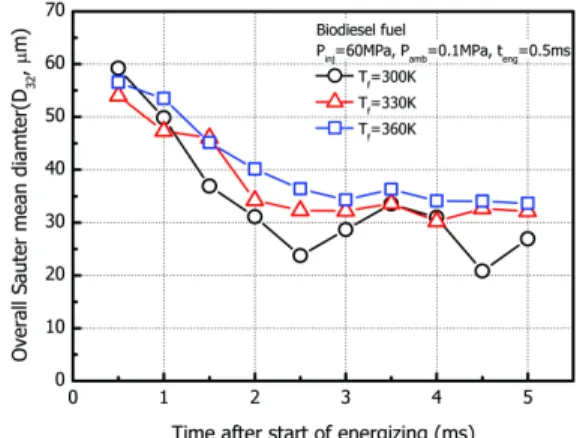
Fig. 15 Effect of fuel temperature on the SMD distributions of biodiesel (Pinj= 60MPa, Pamb= 0.1MPa, teng= 0.5ms)24)
을 수행하였다.
24)Fig. 15는 연료 온도 변화에 따른 바이오디젤의 SMD를 측정한 결과이다. 연료 온도가 300K에서 360K로 증가할수록, SMD가 증가하는 것으로 나타 났는데, 이는 작은 입경의 바이오디젤 분무 액적들 이 분사와 동시에 증발하여 주변 공기와 혼합되고, 상대적으로 큰 입경의 액적들이 측정된 결과로 판 단된다.
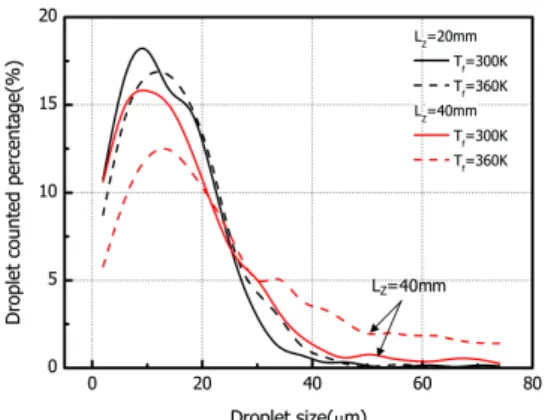
연료 온도 변화에 따른 액적 크기 분포를 연구하
기 위하여 Fig. 16과 같이 측정된 액적들을 크기별로
분류하여 분석하였다. 분석 결과, 연료 온도가 증가
할수록, 증발로 인해 작은 입경의 액적들의 수는 감
소하고, 큰 입경의 액적들의 수는 증가하는 것을 확
인하였다. 이러한 결과들은 고온의 연료 분사시에
A Review on the Mixture Formation and Atomization Characteristics of Oxygenated Biodiesel Fuel
Fig. 16 Detected droplet percentage distributions of biodiesel (Pinj= 60MPa, Pamb= 0.1MPa, teng= 0.5ms)24)
입경의 분포 특성에 큰 영향을 줄 것으로 판단된다.
특히, 이러한 경향은 측정점이 하류로 이동할수록 커졌는데, 연료의 증발 및 미립화가 동시에 일어난 결과로 판단된다.
4. 결 론
본 연구에서는 압축착화엔진의 대체연료인 바이 오디젤의 혼합기 형성 및 미립화 증진에 관하여 다 양한 조건에서 연구를 수행하였고, 다음과 같은 결 론을 얻었다.
1) Nozzle orifice 내부의 Cavitation 발생이 바이오디 젤의 분무 미립화를 증진시키는 주요인자임을 확인하였다. 이는 Cavitation bubble이 분열될 때, Bubble 표면에 저장되어있던 분열에너지(Breakup energy)가 Turbulent flow보다 높아 미립화를 증 진시키는 것으로 판단된다.
2) 단일 분사조건에서 Group-hole nozzle의 사용은 Single-hole nozzle과 동일한 분사율 및 분무도달 거리 특성을 기대할 수 있었으나, 미립화 특성의 향상은 기대할 수 없었다. 특히, Group-hole nozzle 에서 다단 분사를 한 경우에는 바이오디젤의 미 립화 특성이 오히려 더 나빠지는 결과를 보였다.
3) Group-hole nozzle의 Orifice angle의 변화에 따른 미립화 특성의 개선 효과는 Parallel orifice의 SMD 가 가장 큰 것으로 나타났고, Diverged와 Converged orifice의 경우 미립화 특성이 개선되는 결과를 보 였다.
4) 바이오디젤의 연료 온도 변화에 따른 미립화 특 성은 고온의 연료 분사시 입경이 작은 액적들의 증발로 인해 작은 입경의 수는 감소하고, 큰 입경 의 수는 증가하는 결과를 보였다.
References
1) Annual Book of ASTM Standards ASTM D6751-02 Standard Specification for Biodiesel Fuel (B100) Blend Stock for Distillate Fuels, pp.1131-1136, 2003.
2) R. Sarin, M. Sharma, S. Sinharay and R. K.
Malhotra, “Jatropha-palm Biodiesel Blends: An Optimum Mix for Asia,” Fuel, Vol.86, Issues 10-11, pp.1365-1371, 2007.
3) C. S. Lee, S. W. Park and S. I. Kwon, “An Experimental Study on the Atomization and Combustion Characteristics of Biodiesel-blen- ded Fuels,” Energy & Fuels, Vol.19, No.5, pp.2201-2208, 2005.
4) A. S. Ramadhas, S. Jayaraj and C. Muraleed- haran, “Biodiesel Production from High FFA Rubber Seed Oil,” Fuel, Vol.84, No.4, pp.335- 340, 2005.
5) A. H. Lefebvre, Atomization and Sprays, Taylor & Francis, New York, 1989.
6) J. B. Heywood, “Internal Combustion Engine Fundamentals,” McGraw Hill, New York, 1988.
7) S. H. Park, H. J. Kim, S. H. Kim and C. S. Lee,
“Spray-atomization Characteristics of Biodiesel Fuel with Multiple Injection,” Transactions of KSAE, Vol.18, No.4, pp.40-47, 2010.
8) S. W. Park and C. S. Lee, “Macroscopic Struc- ture and Atomization Characteristics of High- speed Diesel Spray,” Int. J. Automotive Tech- nology, Vol.4, No.4, pp.157-164, 2003.
9) S. E. Gupta, R. Sekar and R. Poola, “Effect of Injection Parameter on Diesel Spray Charac- teristics,” SAE 2000-01-1600, 2000.
10) C. S. Lee, K. H. Lee, R. D. Reitz and S. W.
Park, “Effect of Split Injection on the Macro- scopic Development and Atomization Charac- teristics of a Diesel Spray Injected through a Common-rail System,” Atomization and Sprays,
서 현 규
Vol.16, No.5, pp.543-562, 2006.
11) S. H. Park, H. K. Suh, H. J. Kim and C. S. Lee,
“Spray Characteristics of Biodiesel Fuel by Blending Other Fuels in a Common Rail Injection System,” KSAE Spring Conference Proceedings, pp.456-461, 2008.
12) Y, T. Seo, H. K. Suh, S. H. Park and C. S. Lee,
“Effect of Fuel Injection Conditions on the Injection Rate Characteristics of Biodiesel Blended Diesel Fuel,” KSAE Fall Conference Proceedings, pp.495-500, 2007.
13) H. K. Suh, H. G. Roh and C. S. Lee, “Spray and Combustion Characteristics of Biodiesel/Diesel Blended Fuel in a Direct Injection Common- rail Diesel Engine,” Journal of Engineering for Gas Turbines and Power-Transactions of the ASME, Vol.130, No.3, pp.032807/1-032807/9, 2008.
14) S. H. Park, H. K. Suh and C. S. Lee, “Effect of Cavitating Flow on the Flow and Fuel Atomi- zation Characteristics of Biodiesel and Diesel Fuels,” Energy & Fuels, Vol.22, No.1, pp.605- 613, 2008.
15) H. K. Suh and C. S. Lee, “Effect of Cavitation in Nozzle Orifice on the Diesel Fuel Atomi- zation Characteristics,” International Journal of Heat and Fluid Flow, Vol.29, No.4, pp.1001- 1009, 2008.
16) H. Tokudo, S. Itoh and M. Kinugawa, “Denso Common Rail Technology to Successfully Meet Future Emission Regulation,” Proceedings of the 26th Bienna Motor Symposium, 2005.
17) J. Gao, Y. Matsumoto, M. Namba and K.
Nishida, “Group-hole Nozzle Effect on Mixture Formation and In-cylinder Combustion Pro- cesses in Direct-injection Diesel Engines,” SAE 07 FFL-98, 2007.
18) K. Nishida, S. Nomura and Y. Matsumoto,
“Spray and Mixture Properties of Group-hole Nozzle for D.I. Diesel Engines,” Proceedings
of ICLASS-2006, ICLASS 06-171, 2006.
19) Y. Zhang, K. Nishida, S. Nomura and T. Ito,
“Spray Characteristics of Group-hole Nozzle for D.I. Diesel Engine,” SAE 2003-01-3115, 2003.
20) P. H. Adomeit, H. Rohs, T. Kȍrfer and H.
Busch, “Spray Interaction and Mixture Forma- tion in a Diesel Engines with Grouped Hole Nozzles,” THIESEL Conference on Thermo-and Fluid Dynamics Processes in Diesel Engines, pp.1-12, 2006.
21) H. K. Suh, S. W. Park and C. S. Lee, “Effect of Group-hole Nozzle Geometry on the Improve- ment of Biodiesel Fuel Atomization Charac- teristics in a Compression Ignition Engine,”
Proceedings of the Institution of Mechanical Engineers, Part D: Journal of Automobile Engineering, Vol.223, pp.1587-1600, 2009.
22) H. K. Suh and C. S. Lee, “Impact of Orifice Angle Configurations on the Droplet Atomiza- tion Enhancement of Diesel Fuel in a Group- hole Nozzle,” Journal of Engineering for Gas Turbines and Power-Transactions of the ASME, Vol.133, No.11, pp.112802/1-112802/7, 2011.
23) S. H. Park, S. H. Yoon, H. K. Suh and C. S.
Lee, “Effect of the Temperature Variation on Properties of Biodiesel and Biodiesel-Ethanol Blends Fuels,” Oil & Gas Science and Techno- logy-Revue De L Institut Francais Du Petrole, Vol.63, No.6, pp.737-745, 2008.
24) S. H. Park, H. J. Kim, H. K. Suh and C. S. Lee,
“Experimental and Numerical Analysis of Spray-atomizatoin Characteristics of Biodiesel Fuel in Various Fuel and Ambient Temperature Conditions,” International Journal of Heat and Fluid Flow, Vol.30, No.5, pp.960-970, 2009.
25) R. Payri, X. Margot and F. J. Salvador, “A Numerical Study of the Influence of Diesel Nozzle Geometry on the Inner Cavitating Flow,”
SAE 2002-01-0215, 2002.