․투고일: 2016.08.25, 심사일: 2016.11.03, 게재확정일: 2016.11.01
․Corresponding author: Jun-yong Choi School of Korean Medicine, Pusan National University, Mulgeum-eup, Yangsan-si, Gyeongsangnam-do, Rep. of Korea TEL: 055-360-5953 FAX: 055-360-5519 E-mail: [email protected]
점액성 선암종으로 폐의 쐐기절제술을 시행한 환자에 대한 한방치료 1례
홍미나1,2, 박혜림1,2, 조재현1,2, 최진용1,2, 배고은1,2, 한창우1,2 박성하1,2, 김소연1,2, 이 인1,2, 홍진우1,2, 최준용1,2
1부산대학교 한방병원 한방내과, 2부산대학교 한의학전문대학원 한의학과
A Case Report of a Mucinous Adenocarcinoma Patient Treated with Korean Medicine after Wedge Resection of the Lung
Min-na Hong1,2, Hye-lim Park1,2, Jae-hyun Cho1,2, Jin-yong Choi1,2, Go-eun Bae1,2, Chang-woo Han1,2 Seong-ha Park1,2, So-yeon Kim1,2, In Lee1,2, Jin-woo Hong1,2, Jun-yong Choi1,2
1Dept. of Internal Medicine, Korean Medicine Hospital of Pusan National University
2Dept. of Korean Medicine, School of Korean Medicine, Pusan National University
ABSTRACT
The purpose of this study is to report and demonstrate the effect of Korean medical treatment on a wedge resection of a lung patient with mucinous adenocarcinoma.
The patient was an 84-year-old female who was diagnosed with mucinous adenocarcinoma and underwent wedge resection.
The patient was treated with acupuncture and herbal medicine (Banhahubak-tang and Gamiondam-tang).
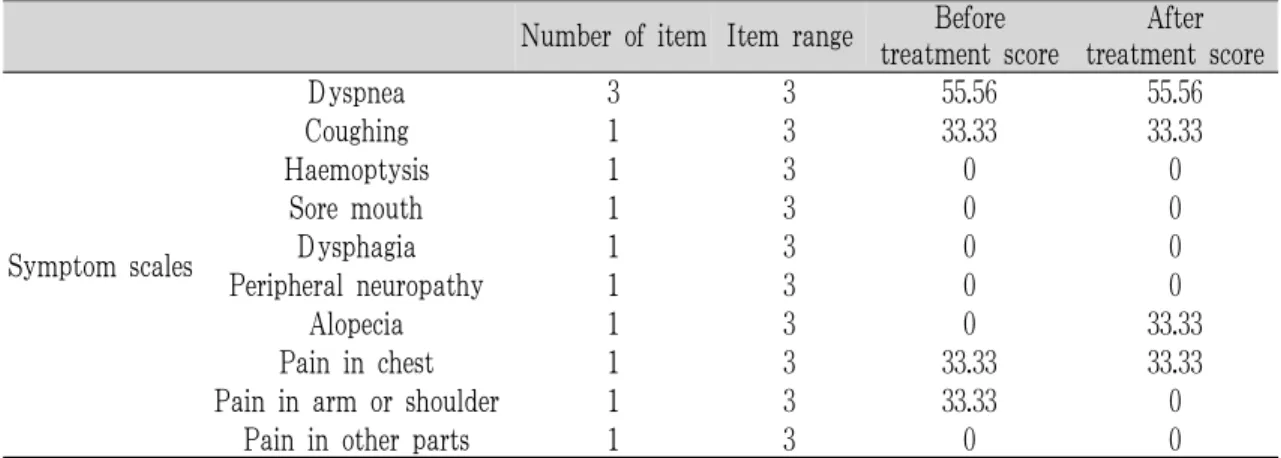
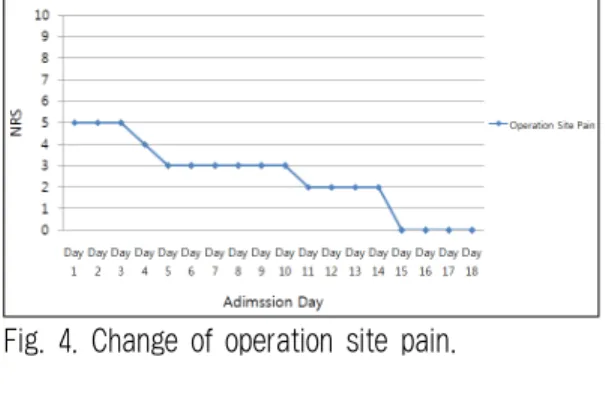
The EORTC Quality of Life Questionnaire, Core 30 (EORTC QLQ-C30), EORTC Quality of Life Questionnaire, Lung Cancer 13 (EORTC QLQ-LC13), numeric rating scale (NRS), and the Global Assessment (G/A) were used to assess the changes in symptoms, including operation site pain and dyspnea.
After treatment, the patient showed improvement in operation site pain and dyspnea, based on the NRS and G/A. However, dyspnea and pain were aggravated based on the EORTC QLQ-C30 and EORTC QLQ-LC13. Therefore, Korean medicine may have a substantial benefit for patients with mucinous adenocarcinoma after wedge resection of the lung.
Key words: mucinous adenocarcinoma, wedge resection, Korean medicine