Influence of Rainfall During the Ripening Stage on Pre-Harvest Sprouting, Seed Quality, and Longevity of Rice ( Oryza sativa L.)
Jung-Sun Baek and Nam-Jin Chung†
Department of Crop Science and Biotechnology, Chonbuk National University, Jeonju 561-756, Republic of Korea
406
†Corresponding author: (Phone) +82-63-270-2512 (E-mail) [email protected]
<Received 25 June 2014; Revised 13 October 2014; Accepted 15 October 2014>
한작지(Korean J. Crop Sci.), 59(4): 406~412(2014) DOI : http://dx.doi.org/10.7740/kjcs.2014.59.4.406
ABSTRACT The influence of rainfall during the ripening stage on pre-harvest sprouting, seed viability, and seed quality was investigated in two Korean rice cultivars, Shindongjin and Hopum. When the rainfall was artificially treated in a greenhouse, HP started to pre-harvest sprouting at three days of rainfall treatment (DRT), but Shindongjin did not show pre-harvest sprouting at 40 DAH treatment and just 0.3~0.8% at 50 DAH, which was much lower than 15.3~
25.8% of Hopum in the same treatment. After harvest, the seed germination of Hopum decreased about 10~25% compared to non-treated seeds, but that of Shindongjin decreased much little rate than that of Hopum. The seed longevity tested by accelerated aging decreased with prolonged rainfall period in both cultivars, but the varietal difference was clear; Shin- dongjin could withstand longer accelerated aging than Hopum.
Shindongjin maintained its germination (>50%) ability after 15 days of accelerated aging regardless of the rainfall treatment period and time, but Hopum dropped below 50% germination ability after only 5 days of accelerated aging. In conclusion, rainfall during the ripening stage induced not only pre-harvest sprouting, but also reduced seed quality and longevity during storage, which varied between two cultivars.
Keywords : pre-harvest sprouting, seed quality, accelerated aging, seed degeneration, rainfall at ripening stage
Due
to climatic changes caused by global warming, high temperature and substantial precipitation will directly impact crops and pests in agriculture (Chakraborty et al., 2000;Morton, 2007; Legzdina et al., 2013). Untimely rainfall occurring during the rice ripening stage induces serious problems. One of the most significant problems is pre-harvest sprouting, the germination of mature seeds while still on the mother plant, which occurs in wet or humid conditions prior to harvest (Rodríguez et al., 2009; Chono et al., 2013; Liu, 2013). These
also influence the pre-harvest sprouting of seeds, which in turn affect the quality and production of rice.
Temperature and moisture are the main environmental factors affecting pre-harvest sprouting. The major factors affecting pre-harvest sprouting tolerance other than environmental conditions are seed dormancy, seed coat permeability and color, α-amylase activities, and endogenous hormones levels (Chen et al., 2008;
Gao et al., 2013).
Seed dormancy at harvest is a desired trait because it prevents the early germination of grains in the head following exposure to moist conditions. However, excessive dormancy can also be problematic because treatments might be required to promote germination (Gubler et al., 2005; Finch-Savage and Leubner- Metzger, 2006; Schenkelaars, 2007). Seeds subject to pre-harvest sprouting offer reduced seed viability and hydrolysis of starch and protein in the endosperm, which creates a favorable environment for serious infection by saprophyte fungi. This causes not only reduced grain yield, but also damages the quality of the end-product, resulting in economic losses (Gubler et al., 2005; Yang et al., 2007; Huang et al., 2012).
The accelerated aging test is recognized as an accurate indicator of seed vigor and storability (Tekrony, 2003; Abdellaoui et al., 2013; Parmoon et al., 2013) and is very effective in testing the relative storage potential of seed lots (McDonough et al., 2004; Babiker et al., 2010). High vigor seed lots withstand accelerated aging stress and deteriorate more slowly than low vigor seed lots. The germination differences of high and low quality seed lots after accelerated aging showed a similar trend to the germination of the same seed lots after warehouse storage. With longer storage periods, the progressive loss of seed quality reduces the rate of germination and eventually results in loss of viability (Thant et al., 2010;
Bewley et al., 2013). In the present study, the influence of ISSN 2287-8432(Online)
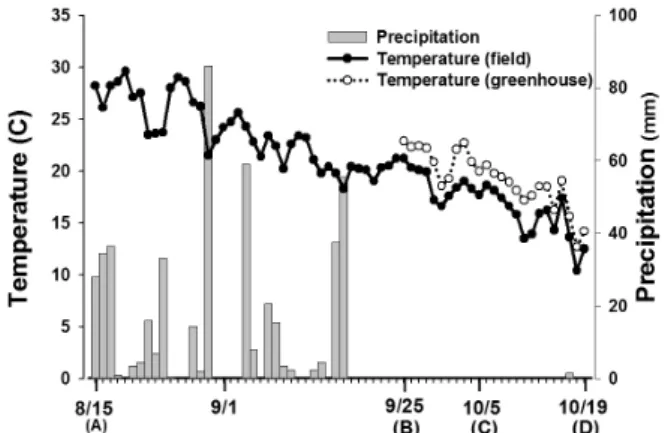
Fig. 1. Meteorological data of precipitation and average daily temperature (field and greenhouse) from days preceding rice harvest in 2012 (A): heading stage, (B): 40 days after heading (first rainfall treatment), (C): 50 days after heading (second rainfall treatment), (D): harvest.
rainfall during the ripening stage on pre-harvest sprouting and seed viability was investigated, and the seed longevity of rainfall-treated seeds by accelerated aging test was reported in two Korean-bred rice cultivars.
Materials and methods
Plant materials
Two medium-late maturing japonica rice cultivars, Shindongjin and Hopum, high quality japonica-type rice cultivars, were used in the experiment. Shindongjin is a low-tillering heavy panicle type, whereas Hopum is an active tillering type cultivar.
In a former experiment on pre-harvest sprouting of the two varieties, the pre-harvest sprouting resistance of Shindongjin was higher than that of Hopum because the seed dormancy of Shindongjin was much higher than that of Hopum at the ripening stage (Bark and Chung, 2014). The two varieties were cultivated in an experimental field of Chonbuk National University located at the latitude of 35º 49’ and longitude of 127º 9’ in Jeonju-city in 2012. The 30-day nursery seedlings of rice cultivars were transplanted Jun. 1 and were harvested at 65 days after heading (DAH) (Oct. 19). The heading date of both cultivars was Aug. 15.
Artificial rainfall treatment and pre-harvest sprouting survey
The influence of rainfall during the ripening stage on pre- harvest sprouting was investigated. For the rainfall treatment,
rice plants (20 hills a treatment) grown in the field were moved to a side-opened greenhouse, some at 40 DAH (Sept. 25) and some at 50 DAH (Oct. 5). The greenhouse was equipped with vertical spraying sprinklers. Artificial rainfall was applied to the rice plants for different durations of 0, 3, 5, 7 or 10 days.
The percent of pre-harvest sprouting was investigated at harvest (64 DAH).
Meteorological data in the field and greenhouse during the experiment period is shown in Fig. 1. The average temperature during the ripening stage was 21.0℃, and the total precipitation was 477.7 mm (Aug. 15 to Oct. 19). Average field and greenhouse temperatures during the treatment period (from Sep. 25 to Oct. 19) were 16.8℃ and 19.2℃, respectively. The average greenhouse temperature was about 2.4℃ higher than that of the field during the same period.
Seed viability, vigor, and longevity of artificial rainfall-treated seeds
To investigate the quality change in harvested seeds treated with artificial rainfall during the ripening stage, seed germination, vigor, and accelerated aging tests were conducted. The seeds were harvested and dried at room temperature to an approximate 14% moisture content, and then germinability and vigor were tested. Germination testing was conducted at 25℃ for 14 days with four replicates of 100 seeds each, and vigor was evaluated by germination percentage at five days after imbibition (ISTA, 2009).
In the accelerated aging test, the same germination test procedures as above were followed, except high temperature and high relative humidity treatments were included before the germination test. The seeds were placed in a desiccator containing 100 ml of distilled water, and the desiccator was kept in an incubator at 40±1℃ for 30 days (Kim 2004).
Subsequently, the seeds from the desiccator were sampled, and the seed viabilities were tested at five-day intervals.
Statistical analysis
The experiment was arranged in a completely randomized design (CRD) with four replicates, and all collected data were subjected to analysis of variance using Statistical Analysis System (SAS 9.1). The treatment means were compared using Duncan’s Multiple Range Test (DMRT) or t-test.
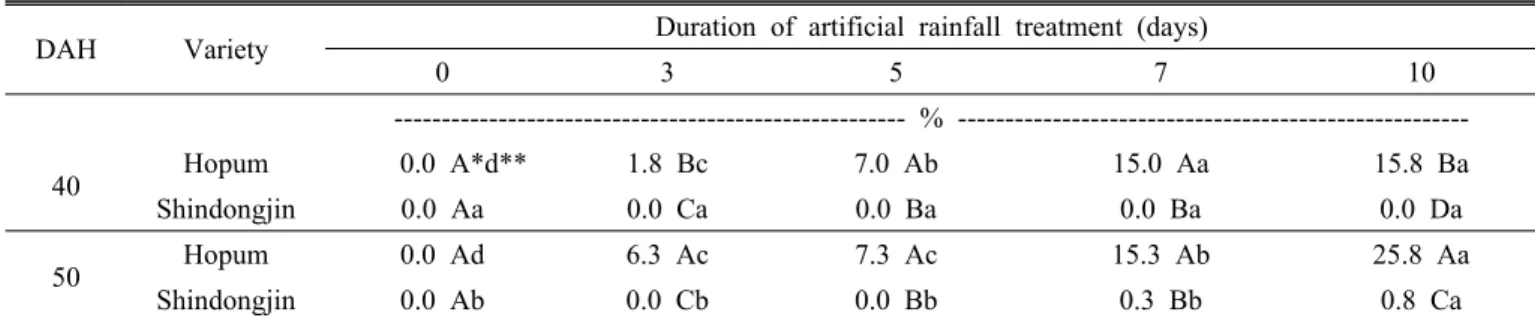
Table 1. Percentage of pre-harvest sprouting seeds after harvest according to rainfall duration during the ripening stage in rice.
DAH Variety Duration of artificial rainfall treatment (days)
0 3 5 7 10
--- % ---
40 Hopum 0.0 A*d** 1.8 Bc 7.0 Ab 15.0 Aa 15.8 Ba
Shindongjin 0.0 Aa 0.0 Ca 0.0 Ba 0.0 Ba 0.0 Da
50 Hopum 0.0 Ad 6.3 Ac 7.3 Ac 15.3 Ab 25.8 Aa
Shindongjin 0.0 Ab 0.0 Cb 0.0 Bb 0.3 Bb 0.8 Ca
*Different capital letters in the same column and **different small letters in the same row indicate a significant difference in means at α = 0.05 by Duncan’s Multiple Range Test (DMRT).
Fig. 2. Seed vigor and germination (%) of two rice varieties after harvest. (*Different capital letters on the same date indicate a significant difference in means at α = 0.05 by t-test. **Different small letters for the same variety indicate a significant difference in means at α = 0.05 by Duncan’s Multiple Range Test (DMRT)).
Results
Pre-harvest sprouting according to artificial rainfall periods
The influence of rainfall during the ripening stage on pre- harvest sprouting was investigated, and the results are shown in Table 1. The timing of artificial rainfall treatment was determined at 40 DAH and 50 DAH on the basis of seed germinability after heading. Seed germinabilities were different
at 40 DAH (26.3% in Shindongjin and 63.9% in Hopum) but similar at 50 DAH (about 76% in both cultivars), as shown in Table 1. When the artificial rainfall was administered at 40 DAH, Hopum showed 1.8% pre-harvest sprouting at three days of rainfall treatment (DRT) and 7.0%, 15.0%, and 15.8%
at five, seven, and ten DRT, respectively. Pre-harvest sprouting increased with an increase in the rainfall period. On the other hand, Shindongjin did not demonstrate pre-harvest sprouting at 40 DAH, regardless of rainfall treatment.
Table 2. Seed viability tested after accelerated aging in two rice varieties following the rainfall treatment.
Days of
accelerated aging† DAH varieties Days of rainfall treatment
0 3 5 7 10
--- % ---
0
40 Shindongjin 100.0 A*a** 99.0 Aa 99.3 Aa 98.5 Aa 98.8 Aa
Hopum 99.3 ABa 90.8 BCb 84.3 Cc 83.3 Dc 81.8 Dc
50 Shindongjin 100.0 Aa 98.7 Ab 97.3 Ab 94.3 Bc 92.0 Bd
Hopum 99.5 ABa 87.5 Cb 82.8 CDc 80.3 Dc 74.8 Ed
5
40 Shindongjin 96.8 ABCa 93.3 Bb 92.3 Bbc 91.4 BCbc 89.5 BCc
Hopum 93.5 CDa 73.0 Eb 62.0 Gc 63.5 Fc 47.5 GHd
50 Shindongjin 96.3 BCa 90.4 BCb 88.2 Bc 87.9 Cc 85.2 CDd
Hopum 91.3 Da 59.8 Gb 62.8 Gb 57.8 Gb 45.0 Hc
10
40 Shindongjin 95.3 Ca 91.3 BCb 89.3 Bc 88.7 Cc 85.5 CDd
Hopum 83.8 Fa 61.5 FGb 50.7 Hc 49.3 Hc 35.0 Id
50 Shindongjin 94.7 Ca 90.1 BCb 88.7 Bc 88.5 Cc 84.7 CDd
Hopum 82.5 Fa 64.7 Fb 68.0 Fb 54.3 Gc 46.0 Hd
15
40 Shindongjin 88.0 Ea 77.7 Db 77.7 Eb 70.7 Ec 56.0 Fd
Hopum 59.3 Ha 47.0 Hb 32.0 Jc 15.0 Ld 12.3 Kd
50 Shindongjin 85.0 EFa 77.7 Db 79.5 DEc 68.0 Ed 51.2 Ge
Hopum 62.7 Ga 46.0 Hb 40.7 Ibc 38.7 Ibc 34.0 Ic
20
40 Shindongjin 36.0 Ia 34.0 Ia 31.3 Ja 29.0 Jab 23.3 Jb
Hopum 12.7 La 13.3 KLa 10.5 Na 10.0 Ma 9.3 Ka
50 Shindongjin 32.8 Ja 31.8 IJab 30.1 Jb 27.8 Jc 24.3 Jd
Hopum 31.3 Ja 29.3 Jab 24.7 Kbc 21.3 Kc 12.7 Kd
25
40 Shindongjin 18.9 Ka 15.4 Kb 14.5 Lb 10.9 Mc 11.5 Kc
Hopum 6.7 Ma 6.5 Ma 3.4 Ob 3.0 Nb 2.9 Lb
50 Shindongjin 17.9Ka 14.3 KLb 13.5 LMb 10.2 Mc 9.8 Kc
Hopum 10.6La 10.9 La 9.8 NMa 7.6 Mb 2.1 Lc
30
40 Shindongjin 0.8 Na 0.0 Na 0.0 Oa 0.0 Na 0.0 La
Hopum 1.3 Na 0.0 Na 0.0 Oa 0.0 Na 0.0 La
50 Shindongjin 1.2 Na 0.0 Na 0.0 Oa 0.0 Na 0.0 La
Hopum 2.0 Na 0.0 Na 0.0 Oa 0.0 Na 0.0 La
†Accelerated aging temperature 40±1℃
*Different capital letters in a same column and **different small letters in a same row indicate significant difference of means at α = 0.05 by Duncan’s Multiple Range Test (DMRT).
At 50 DAH, the pre-harvest sprouting of Hopum was higher than that at 40 DAH, but the germination trends were similar.
The pre-harvest sprouting was 6.3% at three DRT, 7.3% at five DRT, 15.3% at seven DRT, and 25.8% at ten DRT. In contrast, pre-harvest sprouting of Shindongjin was only observed in the plants receiving more than seven days of rainfall at 50 DAH, and its germination percentages were also very low
(0.3% at seven DRT and 0.8% at ten DRT) compared to those of Hopum.
Seed vigor and germinability after harvest The vigor and germinability of harvested seeds treated with artificial rainfall at 40 DAH and 50 DAH are shown in Fig. 2.
In the seeds treated with artificial rainfall at 40 DAH,
Shindongjin did not show a change in vigor or germination percentage regardless of rainfall treatment period. However, Hopum showed an approximately 10% decrease in vigor and a 10 to 20% decrease in germination compared to the non-treated seeds. When the artificial rainfall was applied at 50 DAH, the seed vigor and germination percentage decreased with increased rainfall duration in both cultivars. However, the decrease was much greater in Hopum than in SDJ.
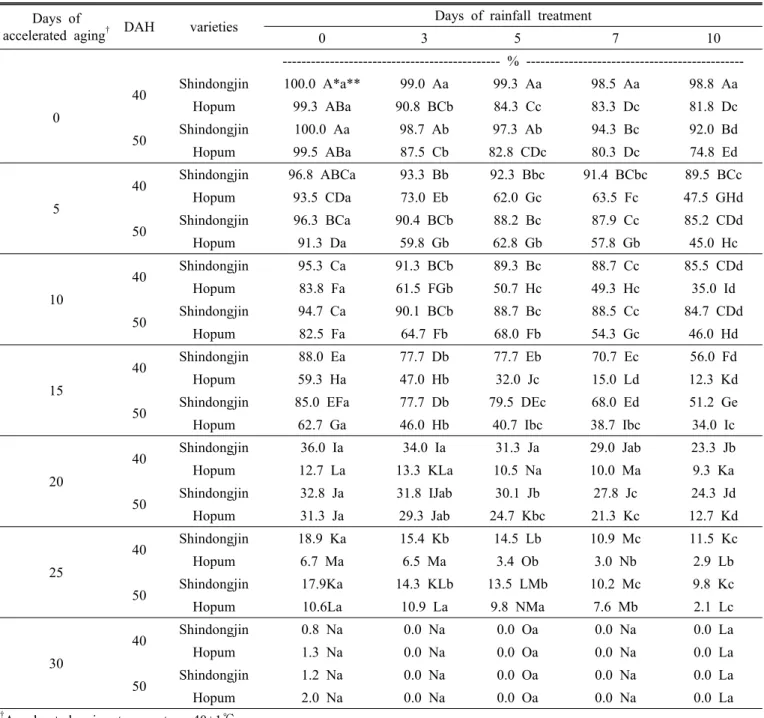
Seed longevity according to artificial rainfall period The accelerated aging test was conducted with seeds treated with artificial rainfall during the ripening stage. The seed viabilities with different accelerated aging treatments from 0 to 30 days are shown in Table 2.
There was no cultivar viability difference in control seeds (non-rainfall treatment and non-accelerated aging seeds). However, accelerated aging differentiated seed longevity between the two cultivars. Cultivar differences were not observed up to five days of accelerated aging in non-artificial rainfall-treated seeds. Starting from ten days of accelerated aging, cultivar viability differences became clear; seed germination of Shindongjin was 10% higher than that of Hopum. After 15 days of accelerated aging, the viability difference between the two cultivars was much larger; Shindongjin showed 86.5% germination, but Hopum showed only 61.0%. In the seeds subjected to more than 20 days of accelerated aging, seed viability rapidly decreased in both cultivars, but the viability of Shindongjin was still higher than that of Hopum until 25 days of accelerated aging. At 30 days of accelerated aging, most seeds in both cultivars were non-viable.
Period of artificial rainfall affected seed longevity during accelerated aging. The viability of accelerated aging seeds decreased with prolonged rainfall period during the ripening stage. In the seeds subjected to only five days of accelerated aging, ten days of rainfall at the ripening stage decreased seed viability (average of 40 DAH and 50 DAH) from 96.6% to 87.4% in Shindongjin and from 92.4% to 46.3% in Hopum, respectively. In the case of 15 day- accelerated aging seeds, a ten day rainfall reduced seed viability from 86.5% to 53.6% in Shindongjin and from 61.0% to 23.2% in Hopum.
Concerning cultivar variation of seed longevity between Shindongjin and Hopum, the decrease in viability in response to rainfall treatment was observed to occur faster in Hopum
than in Shindongjin. Shindongjin maintained its germination (>50%) ability for up to 15 days of accelerated aging regardless of DRT or DAH. However, Hopum dropped below 50%
germination after as little as five days of accelerated aging in ten DRT-seeds and in 15 days of accelerated aging in three, five, and seven DRT-seeds.
Discussion
The two varieties used in this study showed regarding the artificial rainfall treatment time, Hopum showed similar pre-harvest sprouting responses to rainfall at 40 DAH and 50 DAH. In contrast, Shindongjin showed pre-harvest sprouting only at 50 DAH, and its germination percentage was much lower than that of Hopum. These results imply that Hopum is susceptible to unpredictable rainfall occurring after 40 DAH, and even a short duration of rain (three days) can cause pre-harvest sprouting.
Seed longevity was affected by rainfall during the ripening stage. Based on the accelerated aging test of rainfall-treated seeds, both cultivars demonstrated decreased longevity, and longer rainfall duration further reduced seed longevity. Lee et al. (2006) also reported that seed longevity and pre-harvest sprouting were linearly correlated, with a highly negative correlation coefficient. The reduced seed longevity in response to rainfall period was also faster in Hopum than Shindongjin.
In the seeds demonstrating pre-harvest sprouting, the germination process was disrupted by desiccation after radicle emergence.
In this case, grains maintain their viability, but seed longevity is reduced dramatically. If damp conditions in the field persist longer, the germination process may proceed toward a point of no return, beyond which the embryo loses desiccation tolerance (Rodríguez et al., 2001; Gualano and Benech-Arnold, 2009;
Gerjets et al., 2010). Even mild levels of sprouting damage can substantially reduce grain storage life (Li et al., 2004).
Recently, there were more rainy days in Korea during the rice ripening stage. Consequently, many rice cultivars failed to achieve good seedling establishment because of poor germination and low viability of rice seed. Among them, Hopum was one of the varieties that failed to germinate and grow in the field (Kim et al., 2008; Korean Rural Economic Institute, 2012;
RDA, 2013). Therefore, the present study verified that the varietal difference between Hopum and Shindongjin, as related
to pre-harvest sprouting response to rainfall during the ripening stage, could make difference in seed viability and longevity after harvest and storage. Seed dormancy and pre-harvest sprouting are expressed as quantitative traits that are strongly influenced by environment, as well as interactions between genotype and environment (Liu et al., 2008). Early disruption of seed dormancy in wet or humid conditions prior to harvest generally causes pre-harvest sprouting, although cultivars with strong seed dormancy are more resistant to pre-harvest sprouting.
Our results show that rice seeds of pre-harvest sprouting rapidly lose viability during storage. pre-harvest sprouting tolerance is related to seed viability and longevity during storage. The long-term solution to pre-harvest sprouting relies on the development of cultivars that are able to tolerate pre-harvest sprouting during the maturation period and to resist degeneration after harvest and climate change (Li et al., 2004; Gao et al., 2008). In conclusion, rainfall during the ripening stage induced not only pre-harvest sprouting, but also reduced seed quality and longevity during storage, which varied between two cultivars.
REFERENCES
Abdellaoui, R., A. Souid, D. Zayoud, and M. Neffati. 2013.
Effects of natural long storage duration on seed germination characteristics of Periploca angustifolia Labill. African Journal of Biotechnology. 12 : 1760-1768.
Babiker, A. Z., M. E. Dulloo, E. Balla, M. Mustafa, and E. T.
Ibrahim. 2010. Effects of low cost drying methods on seed quality of Sorghum bicolor (L.) Monech. African Journal of Plant Science. 4 : 339-345.
Baek, J. S. and N. J. Chung. 2014. Pre-harvest sprouting variation of rice seeds located on each panicle position according to grain filling days. Korean. J. Crop Sci. 59(1) : 22-26.
Bewley, J. D., K. J. Bradford, H. W. Hilhorst, and H. Nonogaki.
2013. Longevity, Storage, and Deterioration. Seeds: physiology of development, germination and dormancy. 3ed. 41-376.
Chakraborty, S., A. Tiedemann, and P. Teng. 2000. Climate change:
potential impact on plant diseases. Environmental Pollution.
108 : 317-326.
Chen, C. X., S. B. Cai, and G. H. Bai. 2008. A major QTL controlling seed dormancy and pre-harvest sprouting resistance on chromosome 4A in a Chinese wheat landrace. Molecular Breeding. 21 : 351-358.
Chono, M., H. Matsunaka, M. Seki, M. Fujita, C. Kiribuchi-Otobe, S. Oda, H. Kojima, D. Kobayashi, and N. Kawakami. 2013.
Isolation of a wheat (Triticum aestivum L.) mutant in ABA 8′
-hydroxylase gene: effect of reduced ABA catabolism on germination inhibition under field condition. Breeding science.
63 : 104-115.
Finch-Savage, W. E. and G. Leubner-Metzger. 2006. Seed dormancy and the control of germination. New Phytologist. 171 : 501-523.
Gao, F., G. Ren, X. Lu, S. Sun, H. Li, Y. Gao, H. Luo, W. Yan, and Y. Zhang. 2008. QTL analysis for resistance to preharvest sprouting in rice (Oryza sativa). Plant Breeding. 127 : 268-273.
Gao, X., C. Hu, H. Li, Y. Yao, M. Meng, J. Dong, W. Zhao, Q.
Chen, and X. Li. 2013. Factors affecting pre-harvest sprouting resistance in wheat (triticum aestivum L.): A review. The Journal of Animal & Plant Sciences. 23 : 556-565.
Gerjets, T., D. Scholefield, M. J. Foulkes, J. R. Lenton, and M. J.
Holdsworth. 2010. An analysis of dormancy, ABA responsiveness, after-ripening and pre-harvest sprouting in hexaploid wheat (Triticum aestivum L.) caryopses. Journal of experimental botany. 61 : 597-607.
Gualano, N. A. and R. L. Benech-Arnold. 2009. Predicting pre- harvest sprouting susceptibility in barley: Looking for “sensitivity windows” to temperature throughout grain filling in various commercial cultivars. Field crops research. 114 : 35-44.
Gubler, F., A. A. Millar, and J. V. Jacobsen. 2005. Dormancy release, ABA and pre-harvest sprouting. Current opinion in plant biology. 8 : 183-187.
Huang, T., B. Qu, H. P. Li, D. Y. Zuo, Z. X. Zhao, and Y. C. Liao.
2012. A maize viviparous 1 gene increases seed dormancy and preharvest sprouting tolerance in transgenic wheat. Journal of Cereal Science. 55 : 166-173.
ISTA, 2009. International rules for seed testing. The International Seed Testing Association. Bassersdorf, Switzerland.
Kim, S. H. (2004). “The latest technology of seed vigor testing.”
The Korea Society for Seed Science & Industry (KOSID) 1(1) : 67-101.
Kim, S., J. Won, D. Ahn, S. Park, and C. Choi. 2008. Influence of Viviparous Germination on Quality and Yield in Rice. Korean Journal of Crop Science. 53 : 15-18.
Korean Rural Economic Institute, 2012. Typoon (Bolaven, Tenbin) damage and its effect on supply and demand of farm product.
Lee, S., J. Ahn, H. Kim, J. Bae, and M. Eun. 2006. Relationships among Viviporous Germination, Dry-heat Tolerance and Seed Longevity in Milyang 23/Gihobyeo RILs. Journal of Bio- Environment Control. 15 : 421-427.
Legzdina, L., M. Bleidere, G. Usele, D. Vilcane, I. Beinarovica, I.
Mezaka, Z. Jansone, and N. Rostoks. 2013. Phenotypic Evaluation of Spring Barley RIL Mapping Populations for Pre-harvest Sprouting, Fusarium Head Blight and β-Glucans. Advance in Barley Sciences. 441-452.
Li, C., P. Ni, M. Francki, A. Hunter, Y. Zhang, D. Schibeci, H. Li, A. Tarr, J. Wang, and M. Cakir. 2004. Genes controlling seed dormancy and pre-harvest sprouting in a rice-wheat-barley comparison. Functional & integrative genomics. 4 : 84-93.
Liu, S., S. Cai, R. Graybosch, C. Chen, and G. Bai. 2008.
Quantitative trait loci for resistance to pre-harvest sprouting in US hard white winter wheat Rio Blanco. Theoretical and applied genetics. 117 : 691-699.
McDonough, C., C. Floyd, R. Waniska, and L. Rooney. 2004.
Effect of accelerated aging on maize, sorghum, and sorghum meal. Journal of Cereal Science. 39 : 351-361.
Morton, J. F. 2007. The impact of climate change on smallholder and subsistence agriculture. Proceedings of the National Academy of Sciences. 104 : 19680-19685.
Parmoon, G., A. Ebadi, S. Jahanbakhsh, and M. Davari. 2013.
The Effect of Seed Priming and Accelerated Aging on Germination and Physiochemical Changes in Milk Thistle (Silybum marianum). Notulae Scientia Biologicae. 5 : 204-211.
RDA, 2013. Functional analysis of seed germination control genes. National academy of agricultureal scirence.
Rodríguez, M. V., M. Margineda, J. F. González-Martín, P.
Insausti, and R. L. Benech-Arnold. 2001 Predicting Preharvest Sprouting Susceptibility in Barley. Agronomy Journal. 93 : 1071-1079.
Rodríguez, M. V., G. M. Mendiondo, L. Maskin, G. E. Gudesblat,
N. D. Iusem, and R. L. Benech-Arnold. 2009. Expression of ABA signalling genes and ABI5 protein levels in imbibed Sorghum bicolor caryopses with contrasting dormancy and at different developmental stages. Annals of botany. 104 : 975-985.
Schenkelaars, P. 2007. Novel aspects of the environmental risk assessment of drought-tolerant genetically modified maize and omega-3 fatty acid genetically modified soybean. Commissioned by the GMO Office of the National Institute for Public Health and the Environment. the Netherlands.
Tekrony, D. 2003. Precision is an essential component in seed vigour testing. Seed science and technology. 31 : 435-447.
Thant, K. H., J. Duangpatra, and K. Romkaew. 2010. Appropriate temperature and time for an accelerated aging vigor test in sesame (Sesamum indicum L.) Seed. Kasetsart Journal : Natural Science. 44 : 10-16.
Yang, Y., Y. Ma, Z. Xu, X. Chen, Z. He, Z. Yu, M. Wilkinson, H.
Jones, P. Shewry, and L. Xia. 2007. Isolation and characterization of Viviparous-1 genes in wheat cultivars with distinct ABA sensitivity and pre-harvest sprouting tolerance. Journal of experimental botany. 58 : 2863-2871.