활 후 총 학
Bis(pyronyl)acrylic Acid Ester 유도체의 함성
남 승 욕 *^** • 김 동 하 * 섬*'**•끓
* 경희대학교 약학대학 나노의 약생명과학과 의약화학실, ** 경희동서 약학연구소 (Received March 17, 2009; Revised April 1, 2009: Accepted April 2, 2009)
Synthesis of Bis(pyronyl)acrylic Acid Ester Derivatives
Seung Ok Nam*'**, Dong Han K im *쟈* and Yong Sup
"^Medicinal Chemistry Laboratory, Department of Life and Nanopharmaceutical Science,
^Kyung Hee East-West Pharmaceutical Research Institute, College of Pharmacy, Kyung Hee University, Seoul 130-701, Korea
Abstract — Dicaffeoyltartaric acid has a structural feature consisting of two caffeic acid units separated by tartaric acid linker and has been found to be a potent inhibitor of HIV-1 integrase and an antioxidant. In this study, bis(pyronyI)acrylic acid esters joined through a 5-membered ring as a linker were synthesized as the analogues of dicaffeoyltartaric acid.
Keywords □ dicaffeoyltartaric acid, chicoric acid, bis(pyronyl)acrylic acid, caffeic acid, antioxidant
Ferulic acid caffeic acid^j- hydroxylated cinnamic acid들은 phenylpropanoid 계열에 속하는 천연물로 항산화/^ 항 암,^* 항염증^* 작용 등 다양한 효능이 보고되어 많은 연구의 관 심의 대상이 되어 왔다. 이들 화합물들은 자연계에서 수식되지 않는 상태 또는 mono-ester 형태로 많이 발견되지만 dicaffeoyl- tartaric acid(l, DCTA, L-chicoric acid)에서와 같이 두 개의 caffeic acid가 ester 결합으로 연결된 형태로노 발견되고 있다.왼 DCTA는 항산화 효과뿐만 아니라,® 특히 HIV integrase를 억제 함 ^ 써 HIV 증식을 억제할 수 있다고 보고된 이후 이돌 화합 물들의 구조률 번경한 새로운 항 러 스 제 률 합성하기 위한 연 구가 활발하게 진행되어 오고 있 다 .® 본 연구팀에서도 caffeic acid가 glucose 또는 헤테로고리률 통하여 연결된 새로운 HIV integrase 저해제룰 디자인하식 발표한 바가 있다5®^
Kojic acid(5-hydroxy-2-(hydroxymethyl)-4//-pyran-4-one)는 누 둑 곰 뿐 ] (/Ispergillus oryzaeM 비롯한 각중 Aspergillus 균의 곰 평<>1의 대사 물질로서 얻어지며 항균성이 있다고 알려져 었다.오간그 Kojic acid의 5-hydroxy-4-oxo-4//-pyran(이하 pyrone) 고러는 C- 4 위처에 carbonyl파 C-5 위처의 hydroxyl group이 존재하므로
약I 논문에 관한 문의는 저자서1게로 (견화) 02-961-0370 (팩스) 02-966-3885 (E-mail) [email protected]
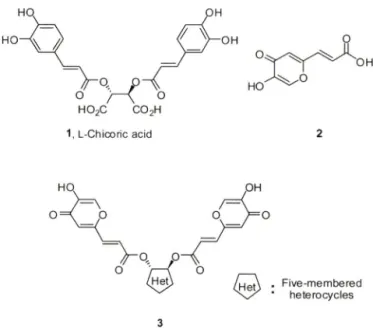
caffeic acid의 유사 구조로 볼 수 있다고 생각되었다. 따라서 본 연구에서는 caffeic acid의 isostere로 (pyronyl)acrylic acid 2률 디자인하고, 이를 다양한 헤테로고러 화합물에 ester 형태로 연 결한 새로운 구조의 bis(pyronyl)acrylic acid ester 화합물 3을 합성하고자 하였다(Fig. 1).
, L-Chicoric acid
Five-membe red hetero cycles
Fig. 1 - Structures of L-chicoric acid and target compounds.
89
90 님승윽 • 김동한 • 이^긴
실험 방법
시약및기기
Melting point는 Thomas Hoover melting point 장처를 이용 하여 보정 없이 기록하였다. 띤 - 및 ^\:-NMR spectrum은 Varian Gemini 300(300 MHz) 또는 Brucker Avance 300 spectrometers(300 ]VIHz)S: 사용■하여 얻었으며 , chemical shift는 tetramethylsilaneCTMS)을 내부 표준물질로 사용하였으며 S 값 으로 표시 하였다, Optical Rotation은 Autopol III automatic polarimeter(Rudolph Reserch CO.)률 사용하여 죽정하였으며, HRMS(high resolution mass spectra)는 VG70-VSEQ를 사용하 여 측정하였다. 박층 크로마토그래피 (TLC)는 precoated silical gel(silicagel 60, F254E, 0.25 mm 두께 Merk)를 사용하였고, 화 합물의 정제를 위한 flash column chromatogrophy는 Kiesegel 60(230-400 mesh, Merck)을 사용하였다. 시험에서 사용한 대 부분의 시약들은 Aldrich 동에서 구입한 시약을 사용하였으며, 정제가 필요한 경우에는 기존의 알려진 방법대로 정제하여 사용 하였다.
PMB-protected bis(pyronyl)acrylic acid estei들의 일반적 언 합성 방법(6a내 h) - 화합물 5(182 mg, 0.60 mmol)룰 DMF (Im /)에 녹인 후 CH2Cl2(10 m/)로 희석하고 과 carbonyldiimi- dazole(117 mg, 0.66 mmol)을 가하였다. 반응용액을 1시간 동안 환류시킨 후 온도를 실온까지 낮추고, diol 화합물 4a<-4e(0.2 mmol)와 촉매량의 NaNHg률 넣은 후 밤새 교반하였다. 반응 흔 합물을 물에 희석시킨 후 C H ^ C l^ 3회에 걸쳐서 추출하였다.
모두 합친 유기층을 포화 NaHCOa과 소금물로 씻은 후 무수 MgS04로 건조하고, 감압하여 농죽한 후, flash column chro- matography(EtOAc ; CH2Cl2= l : 10)로 정 제하여 화합물 6a—6e 를 얻었다.
Bis(pyronyl)acrylic acid ester들의 얼 반적인 함성 방법 (3a~
3h) - 상기 화합물 6a*"^6e(0.029 mmol)률 0 1 ^ 2(5 m/)에 녹인 후 trifluoroacetic acid(0.02 vcd, 0.29 mmol)를 가하고 실온에서 6 시간 동안 교반하였다. 반응 흔밥물을 감압하에서 능측하여 용 매를 완전히 제거한 후, 적절한 용매에서 재결정하여 화합물 3a*^3e률 얻었다.
(3i?,4R)-Bis[3-{5-(p-methoxy benzyloxy)} -4-pyronyl- acryloyoxy]-l-methyl-pyrrolidine-2,5-dione(6a) - 연 노 란 색 고체, 수율: 58%, mp 181-^182°C, 요강 =+30;r fc 1.13, CHCI3), 도H-NMRCCDCy 5 7.56(s, 2H, pyrone-W-^fi'l 7.31(d, 2X2H, ^toz_y/-H-3,5,3',5', /=8.5 Hz), 7.28(d, 2 x iH , -CH=
CH-CO2CH2, / = 15.6 Hz), 6.89(d, 2 X 2H, phenyl-H-2A,2\A\
/=8.5 Hz), 6.63(d, 2X1H, -CH=Cfi-C02CH-, / = 15.6 Hz), 6.52 s, 2 X IH , pyrone-W-'i,'^'), 5.71(s, 2H, pyrrolidine-H-3,4), 5.04(s, 2 X 2H, phenyl-CErl 3.81(s, 2X3H, OCKi), 3.15(s,
3H, -NC^3), 고그C-NMR(CDCy 6 174.8, 169.1, 164.3, 160.3, 157.7, 148.0, 142.4, 137.7, 130.1, 127.9, 122.8, 119.0, 114.5, 73.6, 72.3, 55.7, 25.9.
(3i?,4i?)-Bis[3-(5-hydroxy)-4-pyronylacryloyoxy]-l- methyl-pyrrolidine-2,5Kiione(3a) - 연노란색 고체, 수율: 96%, mp 130X(dec.), [a]/*= +105.6%:. 0.25, DMSO), HRMS(FAB) cald for C^iHigNOisCM+tT) 474.0673, found 474.0677, NMR(DMSO-d^) 6 8.30(s, 2H, pyrone^H-6fi'\ 7.71(d, 2H, -CH=CH-C02-, 7=15.8 Hz), 7.09(s, 2H, pyrone-R-3;3'\ 6.86 (d, IH , -CH=C^-C02CH2, / = 15.8 Hz), 6.23(s, 2H, -CH-), 3.15(s, 3H, ^^C-NMRCDMSO-fifg) 5 174.6, 170.3, 164.8, 158.2, 147.6, 140.9, 138.5, 122.5, 117.6, 73.8, 25.9.
(37?,4/?)-Bis[3-{5-(p-methoxybenzyloxy)}-4-pyronyl- acryloyoxyJ-pyrrolidine-2,5-dione(6b) - 같색 고체, 수율:
54%, mp 126-128X, [a]i/ 강 = + 1841%:. 0.06, CHCy, NMRCCDCy 5 7.59(s, 2H, pyrone-H-6,6'), 7.30(m, 6H, phenyl-H-3,3,3\5\ -C^=CH-C02CH2), 6.88(d, 2x2H, phenyl- H-2,4,2',4' J=7.7 Hz), 6.63(d, 2X1H, -CH=CH-C02CH-, J=
16.4Hz), 6.57(s, 2x IH, pyrone-H-3), 5.67(bs, 2x IH, pyrrolidim- H-3,3'), 4.99(s, 2X2H, phenyl-CH.^-), 3.79(s, 2X3H, O C ^),
^^C-NMR(CDCl3) 5 175.0, 169.0, 164.4, 160.3, 158.0, 148.1, 142.1, 137.6, 130.1, 127.8, 124.2, 118.7, 118.6, 114.5, 72.2, 55.7, 30.1.
(3i?,4/?)-Bis[3-(5-hydroxy)-4-pyronylacryloyoxy]-pyrro- lidine-2,5"dione(3b)-연노란색 고체, 수율: 80%, mp 133X (dec.), [a]/^=+325.(f(c. 0.12, CH3OH), HRMS(FAB) cald for C^oHuNOi2(M+H+) 460.0516, found 460.0522, ^H-NMR (CD3OD+pyridine■싸) 5 7.98 (s, IH , pyrone-Y{-^), 7.64 (d, IH, -Cfl:=CH-C02-, 7=15.5 Hz), 6.88(d, IH, -CU=CH-C02~, / = 15.5 Hz), 6.87(s, IH , pyrone-H-3), 6.28(bs, IH, pyrrolidine- H-3), 조그C-NMR(DMSCky 5 176.0, 171.4, 165.4, 159.6, 148.5, 141.2, 138.4. 123.6, 117.6, 71.8.
(3i2,4S)-Bis[3- {5-(p-methoxy benzyloxy)} -4-pyronyl- acryloyoxy]-l-methyl-pyrrolidin-2-one(6c) - 연노란색 고체, 수율: 48%, mp r79~18(fC, [a]n요감 = + 185.(f(c. 0.94, CHCI3),
^H-NMR(CDCl3) 5 7.55(s, 2H, pyrom-}\-6fi'\ 7.31(d, 2X2H, phenyl-U-3,5,3\5\ /=8.4 Hz), 7.25(d, IH , -Ca^CH-COsCH;^, / = 15.8 Hz), 7.23(d, IH , -Cfi=CH-C02CH2, /=15.8 Hz), 6.89 (d, 2X2H, phenyl-H-2A,2'A\ J= SA Hz), 6.63(d, IH , -CH=
C^-C02CH-, / = 15.8 Hz), 6.59(d, IH , -CH^C^-COsCH-, J=
15.8 Hz), 6.51(s, IH, pyrone-U-3), 6.50(s, IH , pyrone-H-3')y 5.59(m, IH, pyrrolidine-RS), 5.49(m, IH, pyrrolidine-R-A), 5.03(s, 2 X2H, phenyl-CH2-), 3.90(dd, IH, pyrrolidine-H~S, J=
10.5, 8.63 Hz), 3.81(s, 2x3H, O C ^), 3.37(dd, IH, pyrrolidine-
J. Pharm. Soc. Korea
Bis(pyronyl)acrylic Acid Ester 유도체의 합성 91
H-5', 7=10.5, 5.48 Hz), 2.94(s, 3H, -NC^), ^^C-NMRCCDCy 5 174.8, 166.8, 164.4, 160.2, 158.1, 157.9, 147.9, 142.2, 136.8, 130.1, 127.9, 123.8, 123.7, 118,7, 118.6, 114.5, 75.2, 72.3, 72.2, 55.7, 51.5, 30.4.
(3i?,4S)-Bis[3-{5-(p-hydroxy)}-4-pyronylacryloyoxy]-l- methyl-pyrrolidm-2-one(3c) - 연노란색 고체 , 수율: 81%, mp 138T(dec.), [a][/잠 =+200.7°(c. 0.29, CHCVCH30H = 1 :1), HRMS(FAB) cald for CjiHigNOnOVT+H'') 460.0880, found 460.0862, ^H-NMR(DMSO-rfg) 5 7.93(s, IH, pyrone-W-&), 7.92(s, IH, pyrom-W-&), 7.32(d, IH, -C//=CH-C02-, /=15.9 Hz), 7.29(d, IH, -C//=CH-C02-, / = 15.9 Hz), 6.71(s, 1H, pyrone-\{-?>), 6.69(s, IH, pyrone-W-"^'), 6,47(d, IH , -CH=C^- CO2-, 7=15.9 Hz), 6.45(d, IH , -CH=C^-C02-, / = 15.9 Hz), 5.46(d, IH, pyrrolidine-H3, J-5.9 Hz), 5.34(m, IH, pyrrolidine- H4), 3.69(dd, IH , pyrrolidine-H5, /=10.1, 8.2 Hz), 3.26(dd, IH , pyrrolidine-H5\ /=10.1, 5.8 Hz), 2.64(s, 3H, -CH3), ^^C- NMR(DMSCk4) 5 174.1, 166.3, 164.6, 164.3, 157.9, 147.0, 140.3, 137.2, 136.9, 122.9, 122.7, 116.9, 116.8, 75.2, 72.0, 29.8.
(3JR,4S)-Bis[3-{5-(p-methoxy benzyloxy)} -4-pyronyl- acryloyoxy]-pyrrolidin-2"One(6d) - 연 갈색 고체, 수율: 24%, mp 115---lirC, M l/ 결 = + 150.{f(c. 0.05, CHCI3), 또H-NMR (CDCI3) 6 7.48(s, 2H, pyrone-H-6,6'X 7.31(d, 2X2H, phenyl- H-3,5,3',5', 7=8.4 Hz), 7.25(d, IH , -CH^Cll-CO^CK^, J=
15.8 Hz), 7.23(d, IH, -Cff=CH-C02CH2, / = 15.8 Hz), 6.89(d, 2X2H, phenyl-R~2A,2\^, J= SA Hz), 6.63(d, IH , -CH=Cff- CO2CH-, 7=15.8 Hz), 6.59(d, IH , -CH=C//-C02CH-, /=15.8 Hz), 6.50(s, IH , pyrone-H-3), 6.50(s, IH , pyrone-U-3'), 5.59(d, IH, pyrrolidine-R-3), 5.49(m, IH, pyrrolidine-H-4), 5.03(s, 2x 2H, phenyl-CH2~), 3.90(dd, IH, pyrrolidine-U~5, J= 10.5, 8.6 Hz), 3.81(s, 2X3H, OCH^), 3.37(dd, IH , pyrrolidme-R-5\ / = 10,5, 5.5 Hz), 2.94(s, 3H, -NC^), ^^C-NMRCCDCy 5 174.5, 169.3, 164.0, 159.8, 157.6, 151.4, 147.6, 141.6, 136.5, 129.7, 127.4, 123.3, 118.3, 115.7, 114.1, 73.5, 71.8, 55.9, 55.3, 44.0.
(3i?,4S)-Bis[3-(5-hydroxy)]-4-pyronylacryloyoxy]-pyr- rolidin-2-one(3d) - 연노란색 고체, 수&■: 98%, mp 135T(dec.), [a]i/신=+231.0°(c. 0.03, CH3OH), HRMS(FAB) cald for C2oHigNO„(M+H+) 446.0723, found 446.0726, ^H-NMR (CD3OD) 6 8.00(s, IH , pyrone-H~6), 7.99(s, IH, pyrone-H-6'), 7.41(d, IH, -Cfl=CH-C02-, / = 15.9 Hz), 7.39(d, IH , -CH^
CH-CO2-, 7=15.9 Hz), 6.69(s, IH , pyrone-l{-3), 6.68(s, IH, pyrone-H-3'), 6.64(d, IH , -CH=C또 CO2-, /=15.9 Hz), 6.60(d, IH, -CH=Cg-C02-, 7=15.9 Hz), 5.83(d, IH , pyrrolidine-H3, J=6.7 Hz), 5.7(m, IH, pyrrolidine-¥\A\ 3.93(m, IH , pyrrolidine-
H5), 3.43(m, IH , pyrrolidine-HS'), ^^C-NMR(CD30D) 5 176.6.
171.6, 166.3, 166.1, 160.3, 149.2, 141.7, 117.6, 76.5, 75.7, 45.4.
(3i?,4R)-Bis[3-{5-(p-methoxy benzyloxy)} -4-pyronyl- acryloyoxy]-tetrahydrofuran(6e) - 흰색 고체 , 수율: 45%, mp 196-197X, +113.5%. 0.27, CHCI3), ^H-NMR (CDCI3) 5 7.55(s, 2H, pyrone-H-6,6'), 7.32 (d, 2X2H, phenyl- H-3,5,3',5', 7=8.4 Hz), 7.22(d, 2 x m , -Cfl;=CH-C02CH2, / - 15.8 Hz), 6.90(d, 2X2H, phenym~2A2'A\ /- 8 ,4 Hz), 6.59(d, 2X1H, -CH^CfrCO^CH-, /-15.8 Hz), 6.51(s, 2X1H, pyrone- H-3), 5.36(bs, 2X1H, furan-H-3,3% 5.04(s, 2X2H, phenyl- CH^-), 4.20(dd, 2 x IH , furan-H-2,5, J=10.7, 4.45 Hz), 3.88(d, 2 XIH , furan-U-2,5\ J=10.7 Hz), 3.81(s, 2x3H, OC^-j), 도크C- NMRCCDCy 5 174.8, 166.8, 164.4, 160.2, 158.1, 157.9, 147.9, 142.2, 136.8, 130.1, 127.9, 123.8, 123.7, 118.7, 118.6, 114.5, 75.2, 72.3, 72.2, 55.7, 51.5, 30.4.
(3i?,4i?)-Bis[3-(5-hydroxy)-4-pyronylacryloyoxy]-tetra- hydrofuran(3e) - 연노란색 고체, 수율: 78%, mp 192X(dec), [ a ] / ^ + 118.6°(c. 0.14, CHCVCH30H=1 ; 1), HRMS(FAB) cald for C^oHiyOnCM+H'^) 433.0771, found 433.0777, NMR(DMS0-6?6) 5 8.10(s, IH, pyrone-H-6), 7.47(d, IH , -CH=
CH-CO2-, 7=15.8 Hz), 6.86(s, IH , pyrone-R-3\ 6.62(d, IH, -CH=C^-C02-, /=15.8 Hz), 5.35(bs, IH , furan-H-3), 4.12 (del, IH , furan-H-3, J= 10.5, 4.4 Hz), 3.82(d, IH , furan-Y{-^\
7=10.5 Hz, ^^C-NMRCDMSO-ifg) 5 174.6, 164.8, 158.5, 147.5, 140.8, 137.1, 123.8, 117.2, 78.4, 71.9.
실험결과 및 고찰
본 연구에서는 항산화 및 항바이러스 효능을 가지는 새로운 화합물을 개발하기 위한 일환으로 이들 효능이 보고된 dicaffeoyltartaric acid의 유사체로서 bis(pyronyl)acrylic acid ester 화합물듬을 합성하고자 하였다. 목적 화합물 3은 Scheme 1에 나타낸 바와 같이 bis-diol을 가진 헤테로고리 화합물 4률 pyrone 고리 의 5-위처 가 PMB group으로 보호된 두 개 의 (pyronyl)acrylic acid 5와 coupling 하여 화합물 &을 제조한 루, PMB 보호기를 산성조건에서 제거하o i 합성하고자 하였다. Bis- diol 화합물 4는 질소 또는 산소를 가진 5원환의 헤테로고리 화합물 5종을 사용하였다. 화합물 5는 본 연구실에서 최근에 보고된 방법에 따라 kojic acid를 출발물질로 사용하여 PMB-protection, oxidation, Horner-Emmons reaction에 의한 (pyronyl)acrylic acid methyl ester의 제조에 이은 에스테르 가 수분해반응에 의하여 제조하여 사 용 하 였 다 .^^> 1.5 당량의 (pyronyl)acrylic acid 5를 DMF와 CH2CI2에 녹인 후 1.5 당량의
Vol. 53, No. 2, 2009
92 남승윽 • 김동한 • 이 ■§십
coupling reaction
HQ pH
•
Scheme 1
A^^-carbonyldiimidazole(CDI)를 가하여 carboxylic acid V a 활성화 시킨 후, 촉매량의 NaNH2 존재 하에서 diol 화합물 4와 couplingSH 미 PMB로 보호된 화합물 6§- 24~81%의 수율로 얻 었다. 화합물 6의 PMB 보호기는 CH2CI2 용매에서 trifluoroacetic acids. 이탈시켜 최중 화합물 3을 78~98%의 수율로 얻었다.
결론적으로 본 연구에서는 dicaffeoyltartaric add의 유사체로 서 두 개의 (pyronyl)acrylic acid가 5원환의 헤테로고리률 통하 여 연걸된 새로운 구조의 bis(pyronyl)acrylic acid ester 화합물 들을 합성하였다. 향후, 합성된 화합물들의 항산화 및 HIV integrase 저해력을 검색하여 생러활성이 우수한 후보물질의 도 출에 응용하고자 한다.
감사의 말씀
본 연구는 경희대학교 대학원의 2008학년도 1차 우수연구논 문 장학금으로 지원 받 연 구 되 었 습 니 다 .
참고문헌
1) Cheng, J.-C., Dai, E, Zhou, B., Yang, L. and Liu, Z.-L. : Antioxidant activity of hydroxycinnamic acid derivatives in human low density lipoprotein: Mechanism and structure- activity relationship. Food Chemistry 104, 132 (2007).
2) Fiuza, S. M., Gomes, C., Teixeira, L. J., Girao da Cruz, M. T, Cordeiro, M. N. D. S., Milhazes, N., Borges, E and Marques, M. P. M. : Phenolic acid derivatives with potential anticancer properties-a structure-activity relationship study. Part 1:
methyl, propyl and octyl esters of caffeic and gallic acids.
Bioorg. Med. Chem. 12, 3581 (2004).
3) Uwai, K., Osanai, Y, Imaizumi, T, Kanno, S.-i., Takeshita, M.
and Ishikawa, M. : Inhibitory effect of the alkyl side chain of caffeic acid analogues on lipopolysaccharide-induced nitric oxide production in RAW264.7 macrophages. Bioorg. Med.
Chem. 16, 7795 (2008).
4) Scarpati, M. L. and Oriente, G .: Chicoric acid (dicaffeyltartaric acid): Its Isolation from chicory (Chicorium intybus) and synthesis. Tetrahedron 4, 43 (1958).
5) Thygesen, L , Thulin, J., Mortensen, A., Skibsted, L. H. and Molgaard, R : Antioxidant activity of cichoric acid and alkamides from Echinacea purpurea, alone and in combination.
Food Chemistry 101, 74 (2006).
6) Charvat, T. T, Lee, D. J., Robinson, W E. and Chamberlin, A. R. : Design, synthesis, and biological evaluation of chicoric acid analogs as inhibitors of HIV-1 integrase. Bioorg. Med.
Chem. 14, 4552 (2006).
7) King, R J., Ma, G., Miao, W, Jia, Q., McDougall, B. R., Reinecke, M. G., Cornell, C., Kuan, J., Kim, T R. and Robinson, W. E. Jr. : Structure-Activity Relationships: Analogs of the Dicaffeoylquinic and Dicaffeoyltartaric Acids as Potent Inhibitors of Human Immunodeficiency Virus Type 1 Integrase and Replication. J. Med. Chem. 42, 497 (1999),
8) Hwang, D. J., Kim, S. N., Choi, J. H. and Lee, Y. S .: Dicaffeoyl- or digalloyl pyrrolidine and furan derivatives as HIV integrase inhibitors. Bioorg. Med. Chem. 9, 1429 (2001).
9) Kim, S. K , Lee, J. Y, Kim, H. J., Shin, C. G., Park, H. and Lee, Y. S. : Synthesis and HIV-1 integrase inhibitory activities of caffeoylglucosides. Bioorg. Med. Chem. Lett. 10, 1879-82 (2000).
10) Bringmann, G., Gunther, C. and Jumbam, D. N. : Isolation of 4-0-p-D-glucopyranosylcaffeic acid and gallic acid from Cyathea dregei KUNZE (Cyatheaceae). Pharmaceutical and Pharmacological Letters 9, 41 (1999).
11) Kang, S. S., Kim, H. J., Jin, C. and Lee, Y. S. : Synthesis of tyrosinase inhibitory (4-oxo-4H-pyran-2-yl)acrylic acid ester derivatives. Bioorg. Med. Chem. Lett. 19, 188 (2009).
12) Ohta, S., Shimabayashi, A., Aono, M. and Okamoto, M. : A general convenient one-pot procedure for the conversion of carboxylic acids into their tert-butyl esters which is also applicable to aliphatic carboxylic acids. Synthesis 833 (1982).
/. Pharm. Soc. Korea