약학회지 제39권제2호 103-112(1995)
Yakhak Hoeji
Vol. 39. No. 2버모수적 기대최대처(NPEM) 연산방법에 의한 미국인과 재이동포
층수돌기염 환자에게 겐타마어신의 모접단 약물동태학
범 진 필 " • 최 준 식 * • Stanford Jhee** ■ M a rk A. Gill**
조선대학교간호전문대학, *조선대학교약학대학, **University of Southern California (Received December 17, 1994)
Population Pharmacokinetics for Gentamicin in American and Korean-American Appendicitis Patients Using Nonparametric
Expected Maximum(NPEM) Algorithm
Jin-Pil Burm**, Jun-Shick Choi*, Stanford Jhee** and M ark A. G ill**
College of Junior Nursing, Chosun University, Kwangju 501-140, Korea
^College of Pharmacy, Chosun University, Kwangju 501-759, Korea
**School of Pharmacy, Department of Clinical Pharmacy, University of Southern California, Los Angeles, CA 90033, USA
Abstract—Population pharmacokinetics for gentamicin were compared with 24 American patients (16 male and 8 female) and 16 Korean-American appendicitis patients(12 male and 4 female). Two to six blood specimens were collected from all patients at the following times: just before a re
gularly scheduled infusion and at 1/2 hour after the end of a 1/2 hour infusion. Nonparametric expected maximum(NPEM) algorithm for population modeling was used. The estimated parame
ters were the elimination rate constant(K), the slope of the relationship between K versus crea
tinine clearance(KS), the apparent volume of distribution(V), the slope of the relationship betw
een V versus weight(VS), gentamicin clearance(CL) and the slope of the relationship between CL versus creatinine clearance and the VS(CS). The output includes a 3-dimensional plot of the joint probability density function(PDF), two marginal PDF, means, medians, modes, variance, skewness, kurtosis, and CV%. The mean K(KS) were 0.424± 0.139(0.00429± 0.00164) and 0.411+0.135 hr >
(0.00475± 0.00180[hr*niL/min/1.73 m^] *) for American and Korean-American populations, respe
ctively. The mean V(VS) were not different at 15.6± 4.77(0.233± 0.0526) and 15.1 ± 3.84L(0.239±
0.0492 L/kg) for American and Korean-American populations, respectively (P>0.2). The mean CL (CS) were 6.28± 1.85(0.0634± 0.0191) and 5.70± 1.77 L/hr(0.0701± 0.0215 L/kg[hr- mL/min/1.73 n f)']
for American and Korean-American populations, respectively. There are no differences in gentamicin pharmacokinetics between American and Korean-American appendicitis patients.
Keywords □ Gentamicin, population pharmacokinetics, American, Korean-American appendicitis patient, nonparametric expected maximum(NPEM) algorithm, Bayesian analysis.
치료적 약물농도 검사(therapeutic drug monitor ing, TDM)와 환자 개개인에 대한 투여계획외 관심 이 최근들어, 우리나라룔 비롯해 일본 및 중국 동 아 시아 국가에서 늘어나고 었 다 . ^ 우 러 나 라 에 서 는 Bayesian 약물동태학 프로그램이 이용되고 었으나, 이 Bayesian법을 위한 모집단 약물동태학적 번수로
"본 논문에 관한 문외는 이 저자에게로
외국인의 번수를 사용하고 있으며 최근에 약물동태 학에 있어서 인종간에 차이가 있옴이 보 고 가 되고 었
1 :i 5)
다.
모집 단 약물동태학의 목 적온 어떤 환자외 모 집 단 (population)에서 표본을 추출하여 그 환자집단의 특 성을 갖는 약물동태학적 변수를 찾아 그 환자집단의 개개 인에 대한 투여 계획을 설정하여 보 다 효 과 적 이 고
103
104 범진필 • 최준식 ' Stanford Jhee • Mark A. Gill
합러적으로 치료하는 데 있 다 / ^ 이 모집단 약물동 태학을 모델화하는 대표적인 방법에는 표준2단계(sta- ndard two-Stage, STS)범 모수적 비선형 혼합효과 모델화(nonlinear mixed effect modeling, NON M E M )범/고 ***' 버모수적 최우도(nonparametric ma
ximum likelihood, NPNIL)범띠®^ 및 비모수적 기대 최대 치(nonparametric expected maximum, NPEM) 법 *^* 등이 있다. 최근에 N P E M 방법에 의한 약물동태 학 모델화가 몇몇 연구자에 외헤 보고되어 있다.*' 겟*
저자 등은 이 N PEM 방법을 사용하여 미국인과 재미 동포 층수돌기염 수술환자에 서 겐타마이신외 모집단 약물동태학적 번수를 찾아 투여계획에 이용하며 또한 두 인종간에 차이를 비교하였다.
설험 방법
환자 접단一 남가주 대학(University of Southern California, DSC) 병원에 업원한 미국인{남 16, 여자 8)과 재미동포(남 12, 여 4) 충수돌기염 수술환자를 대상으로 하였다. 모든 완자들은 정상 신기능을 갖지 앉거나{혈청 크레아티닌> 2 .5 mg/d/) 체중이 40kg 이하이거나 패혈증 등 특별한 감염이 있는 환자는 새외시켰다. 이 임상연구를 위해 임상연구심사위원 회의 승인을 받아 각 환자에게 이 연구의 목 적과 방 법을 자세히 설명한 후 허락을 받은 후 실험하였다.
약울투여 및 혈액채취■충수돌기염 수술 직후 겐 타마이신파 크린다마이신 600 mg을 8시간 간격으로 병용투여하였다. 환자 개개인의 겐타마이신외 초기 용량(loading dose, LD)은 다음 식에 의해 투여하였 으며
LD = desired Cpnm (V) V = 0.25 L/k gX iB W
IB W = 5 0 kg X 2.3 kg/inch greater 5ft(male) IB W = 45 kg X 2.3 kg/inch greater 5ft(female)
IB W : ideal body weight(kg)
유지용량(maintenance dose, M D )은 다음 식에 의해 결정하여 투여하였다.
Desired Cp„..x (K) (V) (t) (1 - e *스') M.D = --- ---
1- e K = 0.0034Ccr + 0.01
^ (140-age) X IBW
Ccr = ---^ ---X 0.85(female) 72(Scr)
t: infusion time(hr) T: dosing interval(hr) Ccr: creatinine clearance(mL/min) Scr: serum creatinine(mg/dL)
센타마이신 투여 24시간 후 등속주입 하기 적전 (trough)과 30분 동안 주입하고 30분 후(peak)에 혈 액을 채취하였다. peak 농도가 5- 성 mg/L 그리고 trough 농도가 2 mg/L을 범위를 벗어났을 때 다시 다옴 식에 의해 구한 변수를 이용해 유지용량을 재 결정하여 투여하고 24시간 후 peak와 trough 농도를 측정하였다.
K=
Vd =
In C p e a k - ln Ctrough At
M D ( l- e
(K) (t) [actual Cp^ax-actual Cpmin(e ^')']
Cprnax^Cpeak (e러 Cpmm = Ctrough (e *키
At: time interval between peak and trough(hr)
At: time interval between actual Cpmnx (Cpmm) and Cpeak(Ctrough) (hr)
겐타마이신 분석 ■혈 청 겐타마이신 분석은 u s e 병원의 임상검사실에서 enzyme multiplied im mu
noassay technique(EMIT, Syva Auto-Lab 6000 sy stem, Palo Alto, Calif.)에 의해 결정하였다. 분석오 차는 젠타마이 신 농도(C) 에 대한 표준편차<SD)의 다 음 다항식에 의해 분석오차의 양상을 알 수 있으며, 각 혈중도에 분산(SD^)외 역수로 가중치를 주므로서^^^
정확한 약물동태학적 번수외 모델화를 할 수 있다.
SD(mcg/mL) = 0.2061 - (0.0081C) + (0.0098C 자 N P E M 분석 ■ 환자의 각 혈중농도를 포함한 이상 의 모든 임 상정보가 Roger W. Jelliffe 등 뻬 개발한 u s e ♦ PACK PC 프로그램내외 PASTRX 프로그램 에서 정러되어진 후 NPEM 프로그램으로 분석하였 다. 1-콤파토멘트 모델을 위한 모집단 약물동태학적 번수는 2개의 번수를 사용한 4가지 방범으로 하였다.
첫째, 소실속도상수(K)와 겉보기 분포용적(V)을 분 석하였다. 둘째, K 와 크레아티닌 클러어란스(Ccr)의
]. Pharm . Soc. Korea
비모수적 기대최대치 연산방법에 의한 겐타마이신외 모집단 약물동태학 105
Table I —Characteristics of American and Korean-American appendicitis patients
Number Age Weight Creatinine Clearance
Type of Patients (female) (year) (kg) (mL/min/1.73 m요)
American 24(8) 29.2± 9.80 66.7± 11.2 101.1± 18.0
Korean-American 16(4) 35.5± 11.3 63.3± 10.3 85.8± 10.3
Mean± SD
상관비 (KS, K = K S X C cr + K I)와 체중과 V와 상관 비(VS, V - V S X W T )!- 분석하였다. 이때 K I는 non- renal intercept로 0.00693 hr ^로 고정하였다. 셋째, 겐타마이신 클리어란스(CL)와 V를 분석하였다. 넷째, C L과 Ccr 및 V외 상관비(CS, C L = (C S X C c r X C I/
V)와 VS을 분석하였다. 이때 CI는 nonrenal cleara
nce intercept로 0.00255로 고정하였다. NPEM 방범 은 정규분포 가정 하에 분석처 않으므로 각 번수외 범위는 K는 0 ~ 1 .2 h r ■, KS는 0-0.017(hr-mL/
min/1.73 m^) \ V는 0-50L, VS는 0~0.5L/kg, CL는 0 ^1 5 L /h r 및 CS는 0M ).2 L/kg(hr-mL/min/1.73 nVO값을 주었다. 분석은 로그-우도(log-likelihood) 함 수치가 전 주기와 차이가 0.0()1보다 적어질 때까지
최대 1 0 0주기가 주어졌으며 이 로그-우도치가 적을
수록 이론적 모형이 제시하는 가능성파 설제 자료가 가지는 가능성외 차이는 적어진다. 분석결과는 3 차 원적으로 두 변수의 결함(joint) 확를밀도함수(proba- bility density function, PDF)를 30 X 30의 900 그러 드상에 번수외 크기를 보여주며 또한 2차원적으로 주변(marginal) PDF을 표현하였다. 또한 각 번수외 평균값(means), 중앙값(medians), 최빈값(mode), 표 준편차(SD ), 분산(variance), 비 대 청도 (skewness), 첨도(kurtosis), 변이계수(coefficient of variation, CV%) 및 상관계수(correlation coefficient) 값을 나 타내주었다.
Bayesian 분 석 ■ 우 리 가 찾은 새 모집단 약물동태 학적 변수를 사용하여 각 환자를 Bayesian분석을 하 였다. 이 분석은 u s e ♦ PACK PC 프로그램내외 Bayesian 방법을 사용하였다. Bayesian분석은 다움 식으로 표현된다.^>
^ (Cobs —Cmod)*
Z ― SD',― +
(Ppop —Pmod)^
S D ^~
측정된 환자외 혈중농도(Cobs)와 모델 fitting한 후 농도(Cmod) 그리고 모집단 약물동태학 번수(Ppop)와
모델 fitting한 변수(Pmod)의 차에 자 승 을 그 분산 (SI>0값으로 나누었을 때 합이 최소 가 될 때 외 변수를 찾는다.
통 게 처 러 一 두 변수간외 차이는 Student's t-test로 검 정 하였으며 환자 특성은 Wilcoxon rank sum test을 사용하여 p 값이 0.05보다 적을 때 유 의 차 가 있는 것 으로 처리하였다.
결 과
환자 집 단 " 미국인과 재미동포 충수들기염 수술 환자의 특성은 Table I 과 같다. 체중은 미국인이 66.7
±9.8 kg으로 재미동포 63.3±11.2에 버 헤 약간 무거 웠고 나이는 재미동포가 35.5± 11.3세로 미국인 29.2
±9.8보다 많아 크레아티닌 클 리 어 란 스 치 는 재머동 포가 낮았다.
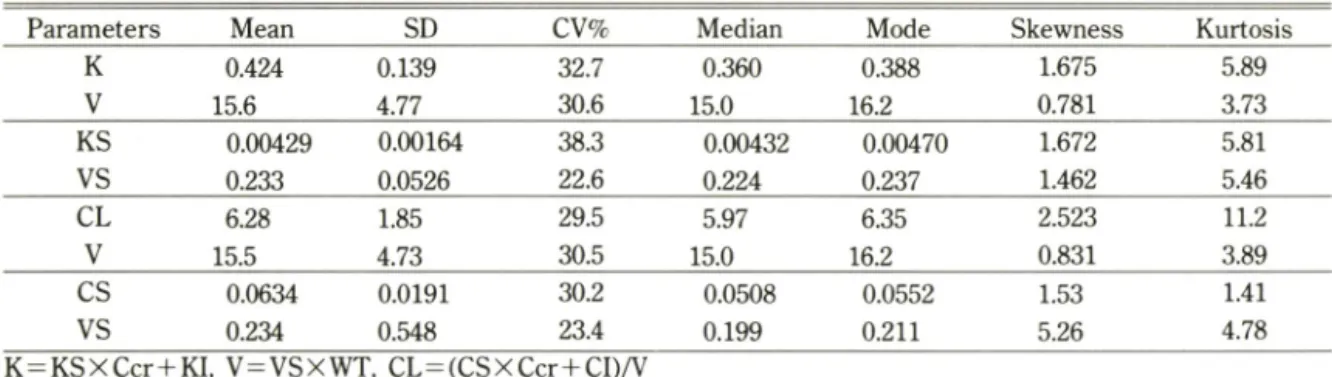
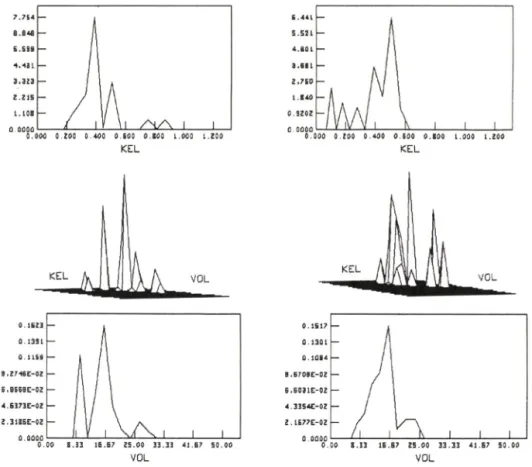
K 와 V의 변 수 화 ■ 미 국 인 과 재 미동포 충수돌기염 환자에 서 K 와 V 의 번 수화는 주기 가 47과 35에 서 로 그-우도처가 각각 一44.640파 -88.228이었 다 . 두 번 수의 평균값, S.D, CV%, 중 앙 값 , 최 빈값 , 비대청도 및 첨도는 Table II, III 및 IV 와 같으며 3 차원적인 두 변수의 결함 P D F와 2차원적인 주번 PDF는 Fig. 1과 같다. 이 두 번수의 상관계수는 미 국 인 과 재미동포 에서 각각 一0.533과 一0.690이었 다 . 이상에서 미국 인과 재미동포 충수돌기염 환자에서 K 와 V 값에는 유의성 있는 차이가 없었다<p>0.2).
K S와 VS의 변 수 화 " 미국 인 과 재 미 동 포 충수돌기 염 환자에서 K S와 VS외 변 수화는 주 기 가 50과 56 에서 로그-우도치가 각각 ~ 44.610과 ~ 99.141 이었다.
두 변수외 평균값, S.D, CV%. 중 앙 값 , 최 빈 값 , 비대 청도 및 첨도는 Table II, III 및 IV 와 같으며 3 차원 적인 두 번수외 결합 PD F와 2차원적인 주변 PDF는 Fig. 2와 같다. 이 두 변수의 상 관계 수 는 미 국 인 과 재 미동포에서 각각 "0 .5 1 6 과 ~ 0.617이 었 다 . 이상에서 미국인과 재미동포 충수돌기염 환자에서 K S와 VS
Vol. 39. No. 2. 1995
범전필 ' 최준식 • Stanford Jhee • Mark A. Gill
Table II —New population parameters of gentamicin American appendicitis patients using nonparametric expected maximum(NPEM) algorithm
Parameters Mean SD CV% Median Mode Skewness Kurtosis
K 0.424 0.139 32.7 0.360 0.388 1.675 5.89
V 15.6 4.77 30.6 15.0 16.2 0.781 3.73
KS 0.00429 0.00164 38.3 0.00432 0.00470 1.672 5.81
VS 0.233 0.0526 22.6 0.224 0.237 1.462 5.46
CL 6.28 1.85 29.5 5.97 6,35 2.523 11.2
V 15.5 4.73 30.5 15.0 16.2 0.831 3.89
CS 0.0634 0.0191 30.2 0.0508 0.0552 1.53 1.41
vs 0.234 0.548 23.4 0.199 0.211 5.26 4.78
K = K S X C c r + K I, V = V S X W T . C L = (C S X C cr+ C I)/V
Table III —New population parameters of gentamicin in Korean-American appendicitis patients using nonparametric expected maximum(NPEM) algorithm
Parameters Mean SD CV% Median Mode Skewness Kurtosis
K 0.411 0.135 32.9 0.418 0.508 -1.09 3.08
V 15.1 3.844 25.4 15.0 16.2 0.422 3.12
KS 0.00475 0.00180 38.0 0.00432 0.00470 0.331 4.14
VS 0.239 0.0492 20.6 0.224 0.237 0.220 2.07
CL 5.70 1.77 31.1 5.22 5.59 -1.760 3.74
V 15.5 3.61 23.3 15.0 16.2 0.360 3.66
CS 0.0701 0.0215 30.7 0.0600 0.0647 -0.289 3.46
VS 0.239 0.0527 22.0 0.224 0.237 0.683 2.50
K = K S X C c r + KI, V - V S X W T , C L = (C S X C cr+ C I)/V
Table IV —Comparison of new population parameters of gentamicin in American and Korean-American appendicitis patients using nonparametric expected maximum(NPEM) algorithm
American Korean-American
Parameters Mean SD CV% Mean SD cv%
K 0.424 0.139 32.7 0.411 0.135 32.9
V 15.6 4.77 30.6 15.1 3.84 25.4
KS 0.00429 0.00164 38.3 0.00475 0.00180 38.0
VS 0.233 0.0526 22.6 0.239 0.0492 20.6
CL 6.28 1.85 29.5 5.70 1.77 31.1
V 15.5 4.73 30.5 15.5 3.61 23.3
CS 0.0634 0.0191 30.2 0.0701 0.0215 30.7
vs 0.234 0.0548 23.4 0.239 0.0527 22.0
K = K S X C c r + K I. V = V S X W T . C L = (C S X C cr+ C I)/V
값에는 유외성 있는 차이가 없었다<p>0.2).
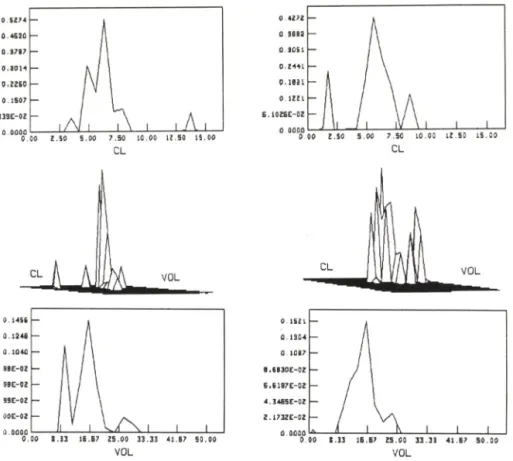
C L와 V의변수화一미국인과 재미동포 충수돌기염 환자에서 CL와 V의 변수화는 주기가 48과 49에서 로그-우도처가 각각 ~ 44.148과 一88.190이었다. 두 변수의 평균값, S.D, CV%, 중앙값, 최빈값, 비대청도 및 첨도는 Table II, III 및 IV 와 같으며 3차원적 인 두
번수외 결함 PDF와 2차원적 인 주변 PDF는 Fig. 3과 같다. 이 두 번수의 상관계수는 미국인파 재미동포 에서 각각 ~ 0.400과 ~ 0.153이었다. 이상에서 미국 인파 재미동포 충수돌기염 환자에서 CL와 V 값에는 유의성 있는 차이가 없었다(p >0.2).
C S와 V S의변수화■미국인 과 재미동포 충수돌기
J. Pharm . Soc. Korea
비모수적 기대최대처 연산방법에 외한 겐타마이신의 모짐단 약물동태학 107
K E L KEL
V O L V O L
Fig. 1 ― Three-dimensional plot of the joint probability density function(middle) and two marginal probability density function(top and bottom) using the elimination rate constant(K) and the apparent volume of distribution(V) for 24 American patients(left) and 16 Korean-American appendicitis patients(right).
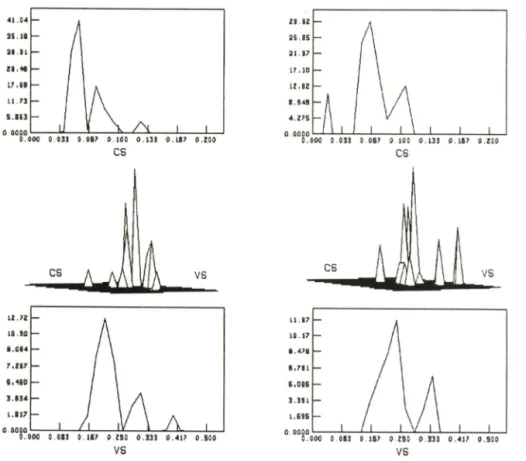
염 환자에 서 CS와 VS의 번수화는 주기 가 57과 63에 서 로그-우도치가 각각 ~ 45.873과 ~ 95.588이었다. 두 번수의 평균값 S.D, CV%, 중앙값, 최빈값, 비대청도 및 첨도는 Table I I III 및 IV와 같으며 3차원적 인 두 번수외 결합 PDF와 2차원적인 주번 PDF는 Fig. 4와 같다. 이 두 번수의 상관계수는 미국인과 재미동포 에서 각각 一0.142와 一0.337이었다. 이상에서 미국 인과 재미동포 충수돌기염 환자에서 CS와 VS값에는 유의성 있는 차이가 없었다(p >0.2).
Bayesian 분석 一USC * PACK PC 프로그램 내 에 서 사용하고 있는 겐타마이신의 일반적인 완자 모집단 번수는 VS 가 0.250 L/kg, KS가 0.00318(hr • mL/
min/1.73 m^) ' 및 K I가 0.00693 h r ' 이 다, 이 연구에 서 미국인과 재미동포 충수돌기염 환자의 세 변수는 V S가 각각 0.233± 0.0526, 0.239+ 0.0492 L/kg이 었으 며 KS는 각작" 0.00429± 0.00164, 0.00475± 0.00180 (hr • mL/min/1.73 이었다. 이들 값을 사용하여
모든 환자룔 다시 Bayesian 분 석 을 한 후, 구한 번수외 평균값은 Table V와 같다. 미국인 충수돌기염 환 자 에서 VS, KS, K 및 K I값이 유 의 성 (P<0.01) 이 있는 차를 나타내고 있으며 재미동포 환자에서도 V S와 K I에서 유외성(P<0.01) 있는 차를 나 타내고 있다 . 이와 같이 어 떤 환자 집단에서 새로운 변수를 찾아서 환자 개개인에게 투여 설 계 들 함으로서 정확하고 효 과적인 치료를 할 수 있다.
고 찰
임상에서 환자 개개인에 대해 투여설 계 를 해 야 하 는 이유는 환자간외 개체 차가 있기 때문이다. 즉 나 이 , 체중, 신장 및 성별이 다 르 며 , 신 및 간장 기능의 차 이가 있으며 또한 병 용 투 여 한 약물의 분포외 영 향 , 흡연, 옴주 등의 차이가 있다.
일반적으로 혈중농도에서 아미노배당체 항생제 외
Vol. 39, No. 2, 1995
범진필 • 최준식 • Stanford Jhee • Mark A. Gill
vs
function(top and bottom) using the slope of the relationship between K versus creatinine clearance(KS) and the slope of the relationship between V versus weight(VS) for 24 American patients(left) and 16 Ko
rean-American appendicitis patients(right).
약물동태학적 변수를 찾는 방법에 선형 최소자승희 귀(linear least squares regression)분석온 전통적인 방법으로 임상에서 전에측정한혈중농도나분석오차,
모집단약물동태학적 변수롤 사용하지 않으며 비선형 최소자승희귀(nonlinear least squares regression) 분석도 일반적인 환자의 임상정보를 고려하지 않는 다 20_24) Bayesian분석방법은 이런모든 점을고려하는 가장정확한방법이 다 . 그 래 서임상에서개개인에 대한 투여설계를 위한Bayesian 분석을 위해서는 환 자의 임상적인 모든 정보 즉 체중, 신기능, 용량. 등 속주업의 시작과끝나는 시간동이 필요하며, 측정된 혈중농도와그SD값, 모집단약물동태학적 번수와그 S D값 및 분석오차 같은 버임상적 요인도 필요하
다 31- 33)
모집단 약물동태학 모델방법에는 Naive pooling, Hierarchical Bayesian(HB) 및 standard two-stage
method(STS)법이 있다; STS법은 첫단계에서 비 선형최소자승회귀분석에 의해각환자외번수를구한 후 평균값과 표준편차의 도수분포를 검사하는 방법 이다. 그러니 이런 방법들은 계획된 실험방법에 외헤 구해지며 여러 차례의 혈액채취와 그에 따른 비용 등으로 임상에서 이용되기는 어려움이 있다. 최근에 임상에서 실제 사용할 수 있는 모집단 약물동태학 모델방법에는 정규분포 가정 하에서 주로 소표본에 이용되는 모수적 방법에 Beal과 Sheiner에 외해 개 발된 N O N M E M방 범 이 있다. 이 방법이 최초의 모집단 약물동태학 모델 프로그램으로 각번수의 평 균값과 표준편차 및 분산값을 보여준다. 이 방법을 좀더 개선한, 정규분포를 가정하지 않고대표본에 이 용되는 비모수적 방법에 M allet가 개발한 N PM L방 법 1 U6)과Schumitzky가개발한NPEM 방법• 이 있다.
이 방범은 각 환자에서 한차례의 혈액채취만으로도
/
Pharm. Soc. Korea비모수적 기대최대치 연산방법에 의한 겐타마이신외 모집단 약물동태학
V O L
Fig. 3 ― Three-dimensional plot of the joint probability density function(middle) and two marginal probability de
nsity function(top and bottom) using the gentamicin clearance(CL) and the apparent volume of distribu- tion(V) for 24 American patients(left) and 16 Korean-American appendicitis patients(right).
Table V —Comparison of mean parameters of gentamicin after Bayesian analysis with general and new population parameter in American and Korean-American appendicitis patients
American Korean-American
Parameters General Parameter New Parameter General Parameter New Parameter
VS 0.246± 0.039 0.227 ± 0.036** 0.265± 0.041 0.226± 0.056**
KS 0.00361 0.0008 0.0041 ±0.0012** 0.0038+ 0.0010 0.0045± 0.0014
K 0.377 ±0.069 0.421 ±0.102** 0.338± 0.107 0.405± 0.143
KI 0.00696 ± 4.37-05 0.00693± 1.62-05* 0.00696± 0.0011 0.00692 ± 6.45-05**
M e a n iS D *P<0.05 **P<0.01
분석가능하며 환자 개개의 변수롤 구하지 않고 전 번수를 pooling하여 기대되는 최대치가 두 번수간에 어떤 결함 확률밀도함수로 나타나는가를 보여주며 번수룔 구하게 된다.
본 연구에서는 미국인과 재미동포 충수돌기염 수 술환자의 Bayesian 분석을 위한 모집단 약물동태 학적 번수를 이 N P E M 방법을 이용하여 찾아서 투여계획에 이용하며 두 인종간외 차이를 비교하였다. 약물동태
학외 인종간에 차이에 대한 연 구 가 많은 약물에서 보고되어 있으나" 대부분 간에서 대사 되 어지는 제 제였다. 에를 들면, Potkin 등 ®과 Lin 등^^>온 아시아 인과 코카시안 환자에서 할로페리돌외 혈중농도에 차이가 있다고 보고하였 다 . 신 장으 로 배설되는 약물 로는 Honda 등™이 코카시안이 리륨 클리 어 란 스 와 분포용적이 다른 인종에 비해 더 높 았 다 고 보고 했 으나 다른 약물동태학 연구®•에서는 인종간에 차이가 없
Vol. 39. No. 2. 1995
110 범진필 - 최준식 • Stanford Jhee • Mark A. Gill
C S C S
vs
Fig. 4—Three-dimensional plot of the joint probability density function(middle) and two marginal probability density function(top and bottom) using the slope of the relationship between CL versus creatinine clearance, the VS(CS) and the slope of the relationship between V versus weight(VS), for 24 American patients(left) and 16 Korean-American appendicitis patients(right).
다 고 보고하였 다.
겐타마이 신은 그람옴성 감염증에 전세계적으로 폭 넓게 사용되는 아미노배당체 항 생 제 로 신장 및 청 각장애 등외 부작용« 으로 TDM 이 요구되는 약물이 다. 위에서 언급한 N P EM 방법과 다른 약물동태학 모 델화하는 프로그램이 미국에서는 임상에서 사용되고 있으나 아직 우리나라에 서는 이용되고 있지 않으므로 미국에서 미국인과 재미동포환자에서 겐타마이신외 약물동태학의 차이를 비교한 결과 인종간에 차이가 없었다. 또한 한국인과 재미동포 및 미국인과의 비 교도 필요할 것으로 생각되며 국내에서는 이러한 프 로 그램 을 이용하여 투여설계가 가능하러라 사료된다.
결 론
환자에서 겐타마이신의 모집단 약물동태학을 비교한 결과 평균 K 값은 미국인과 재미동포 환자에서 각각 0.424± 0.139 및 0.411± 0.135 h r '이었으며 V는 각각 15.6± 4.77 및 15.1±3.84L로 유외 성 있는 차(P>0.2) 가 없었다. 평균 KS는 미국인과 재미동포 환자에서 각각 0.00429+ 0.00475 및 0.00475+ 0.00180(hr-mL/
min/1.73 m') '이 었으며 VS는 각각 0.233± 0.0526 및 0.239+0.0492 L/kg로 유의 성 있는 차(P>0.2)가 없었 다. 평균 (도는 미국인과 재미동포 환자에 서 각각 6. 28± 1.85 및 5.70± 1.77 L/hr이었으며 CS는 각각 0.0 634± 0.0191 및 0.0701± 0.0215 L/kg(hr • m L/min/
1.73 m^)로 유외 성 있는 차(P>0.2)가 없었다. 이 상에서 미국인과 재미동포 충수돌기염 환자에서 겐타마이신 외 약물동태학은 인종간의 유의성었는 차가 없었다.
버모수적 기대최대치(NPEM) 연산방법을 이용한 24명의 미국인과 16명의 재미동포 충수돌기염 수술
문 헌
]. Pharm . Soc. Korea
비모수적 기대최대치 연산방법에 의한 겐타마이신의 모집단 약물동태학 111
1) Kim, J. K., Yoo, D. S., Shin, H. T., Kim, N. D., Kim, J. K.. Kim, G. Y. and Kim, Y. K.: Theophylline clearance of Korean population in comparison with American. / Kor. Soc. Hosp. Pharm. 4, 36-39 (1987).
2) Shin, H. T.: Development of therapeutic drug mo
nitoring program. ]. Kor. Med. Associ. 31, 369-374 (1988).
3) Bond. W. S.: Ethnicity and psychotropic drugs. Clin.
Pharm. 10, 467-470 (1991).
4) Kalow, W.: Ethnic differences in drug metabolism.
Clin. Pharmacokinet 7, 373-400 (1982).
5) Wood, A. and Zhou, H.: Ethnic differences in drug disposition and responsiveness. Clin. Pharmacoki
net. 20. 350-373 (1991).
6) Sheiner. B. B., Beal, S.. Rosenberg, B. and Marathe, V. V.: Forecasting individual pharmacokinetics.
Clin. Pharmacol. Ther. 31, 294-305 (1979).
7) Maire, P. H., Jelliffe. R. W. and Dumarest, C.: Co- ntrole adaptaif optimal des posologies: experience des aminosides en geriatrie In: Venot A, Degoulet P, eds.
Informatique et medicaments, comptes rendus du colloque AIM-IF et IRT. Paris: December 1989. In:
Degoulet PA. Volume 2 of Informatique et Sainte.
Paris: Springer Verlag, 2, 154-169 (1989).
8) Jelliffe, R. W., Iglesias, T., Hurst, A., Foo, K. and Rodriguez, J.: Individualizing drug dosage regi
mens: A review with comparison of two types of pharmacokinetic models of gentamicin, three me
thods of fitting serum level data and d-optimal ve
rsus conventional monitoring strategies. Clin Pha
rmacokinet (in press).
9) Hurst, A., Yoshinaga, M., Mitani, G., Foo, K., Jelliffe, R. W. and Harrison, E.: Application of a bayesian method to monitor and adjust vancomycin dosage regimens. Antimicrob. Agents Chemother. 34, 1165- 1171 (1990).
10) Vozeh, S. and Steimer, J. L : Feedback control me
thods for drug dosage optimization. Clin. Pharma- cokinet. 10, 457-476 (1985).
11) Jelliffe. R. W.: Clinical applications of pharmacoki
netics and control theory: planning, monitoring, and adjusting dosage regimens of aminoglycosides, lido
caine. digitoxin and digoxin. In Maronde, R. F., eds.
Topics in clinical pharmacology and therapeutics.
New York, Springer-Verlag, 26-82 (1986).
12) Beal, S.: Population pharmacokinetic data and pa
rameter estimation based on their first two stati
stical moments. Drug Metab. Rev. 16, 173-193 (1984).
13) Beal, S.: Asymptotic properties of optimization esti
mates for the independent net identically distributed case with application to extended least-squares esti
mate. Technical report of the Division of Clinical Pharmacology. University of Califormia, San Fran
cisco (1984).
14) Beal, S. and Sheiner, L : NONMEM users guide-part 1: Users basic guide. Technical report of the division of Clinical Pharmacology, University of Califormia, San Francisco (1980).
15) Mallet, A.: A maximum likelihood estimation m e
thod for random coefficient regression models.
Biometnka, 73. 645-656 (1986).
16) Mallet. A., Mentre, F., Steimer, J. L. and Lookiec, F.: Nonparametric maxmum likelihood estimation for population pharmacokinetics with application to cyclosporine. /. Pharmacokinet. Biopharm. 16, 311- 327 (1988).
17) Dodge, W. F., Jelliffe, R. W., Richardson, C. J. and McCleery, R. A.: Gentamicin population pharm a
cokinetic models for low birth weight infants using a new nonparametric method. Clin. Pharmacol.
Ther. 50, 25-31 (1991).
18) Gill, M. A., Okamoto, M. P., Nakahiro. R. K., Chin, A., Inagaki, K. and Sclar, D.: Pharmacokinetic po
pulation parameters for amionglycosides in chole
cystitis patients. Ther. Drug. Monit. 14, 107-111 (1992).
19) Gilman, T. M., Brunnemann, S. R. and Segal, J. L.:
Comparison of population pharmacokinetic models for gentamicin in spinal cord-injured and able-bo
died patients. Antimicrob. Agents Chemother. 37, 93-99 (1993).
20) Jelliffe, R. W. and Schumitzky, A.: User manual for the nonparametric EM program for population pha
rmacokinetic modeling version 1. University of Sou
thern California, School of Medicine, Los Angeles, Calfornia (1989).
21) Jelliffe, R. W.: Explicit determination of laboratory
Vol. 39, No. 2, 1995
112 범진필 • 최준식 * Stanford Jhee • Mark A. Gill
assay error pattems-a useful aid in therapeutic drug monitoring. ASCP Clinical Pharmacology Check Sample No. DM 89-4(DM-56). Chicago, Illinois, American Society of Clinical Pathologists. (1989).
22) Jelliffe, R. W., D'Argenio, D. Z., Schumitzky, A., Hu, L. and Liu, M.: The USC * PACK PC programs for planning, monitoring and adjusting drug dosage re
gimens. Proceedings of the twenty-third annual meeting of the Association for the Advancement of Medical Instrumentation. Washington, DC, May, pp.
13-18 (1988).
23) Press, S. J.: Bayesian statistics: Principles, models, and application. John Wiley & Sons, Inc., Appen
dices 1-4, pp. 175-217 (1989).
24) Sawchuk, R. J. and Zaske, D. E.: Pharmacokinetics of dosing regimens which utilize multiple intrave
nous infusions: Gentamicin in burn patients. }.
Pharmacokinet Biopharm., 4» 183-195 (1976).
25) Jelliffe, R. W., Iglesias, T., Hurst, A., Foo, K. and Rodriguez, J.: Individualizing gentamicin dosage regimens. A comparative review of selected models, data fitting methods and monitoring stategies. Clin.
Pharmacokinet., 21, 461-478 (1991).
26) Erdmann, S. M., Rodvold, K. A. and Pryka, R. D.:
An updated comparison of drug dosing methods.
Part III: amionglycoside antibiotics. Clin. Pharma
cokinet 20, 374-388 (1991).
27) Burton, M. E., Brather, D. C., Chen, P. S., Day, R.
B., Huber, J. J. and Vasko, M. R.: A Bayesian fee
dback method for aminoglycoside dosing. Clin.
Pharmacol. Ther. 37, 349-357(1985).
28) Hurst, A. K., Iseri, K. T., Gill, M. A., Noguchi, J.
G., Gilman, T. M. and Jelliffe, R. W.: Comparison of four methods for predicting serum gentamicin concentrations in surgical patients with perforated or gangrenous appendicitis. Clin. Pharm. 6, 234-238 (1987).
29) Maire, P. H., Dumarest, C., Roux, D., Chauvet, C., Vermeulen, E.. Courpron, P, Brazier, J. L. and Je- lliffe, R. W.: Prediction of serum amikacin conce
ntrations in geriatrics. Europ. J. Clin. Pharmacol. 36, A64 (1989).
30) Thomson, A. H. and Whiting, B: Bayesian para
meter estimation and population pharmacokinetics.
Clin. Pharmacokinet. 22, 447-467 (1992).
31) Jelliffe, R. W., Schumitzky, A. and Van Guilder. M.:
Nonpharmacokinetic factors affecting aminoglyco
side therapeutic precision: A simulation study.
Drug Invest 4, 20-29 (1992).
32) Pleasants, R. A., Sawyer, W. T., Williams, D. M., McKenna, W. R. and Powell, J. R.: Effect of four intravenous infusion methods on tobramycin pha
rmacokinetics. Clin. Pharm. 7, 374-379 (1988).
33) Antal, E. J., Grasela, T. H. and Smith, R. B.: An evaluation of population pharmacokinetics in the
rapeutic trials. Part III: prospective data collection versus retrospective data assembly. Clin. Pharma
col. Ther. 46, 552-559 (1989).
34) Steimer, J. L., Mallet, A. and Mentre, F.: Estimating interindividual pharmacokinetic variability. In va
riability if drug therapy: description, estimation, and control, ed by Rowland, M., Sheiner, L. and Scei- mer, J. L , Raven Press, New York, pp. 65-111 (1985).
35) Racine-Poon, A. and Smith, A. F. M: Population models. In statistical methodology in the pharmaceu
tical sciences., ed by Berry, D. A. and Marcel Dekker, pp. 139-162 (1990).
36) Potkin, S. G., Shen, Y., Pardes, H., Phelps, B. H..
Zhou, D., Shu, L , Korpi, E. and Wyatt, F. J.: Ha- loperidol concentrations elevated in Chinese pa
tients. Psychiarty Res. 12, 167-172 (1984).
37) Lin, K. M., Poland, R. E., Lau, J. K. and Rubin, R.
T.: Haloperidol and prolactin concentrations in Asians and Caucasians. J. Clin. Psychopharmacol. 8, 195-201 (1988).
38) Honda, Y. and Suzuki, T.: Transcultural pharma
cokinetic study on lithium concentration in plasma and saliva. Psychopharmacol. Bull. 15. 37-39 (1979).
39) Shelley, R. K.: Are there ethnic differences in li
thium pharmacokinetics and side effect?. Int. Clin.
Psychopharmacol. 2, 337-342 (1987).
40) Garrison, M. W., Zaske, D. E. and Rotschafer, J. C.:
Aminoglycosides: another perspective. DICP Ann.
Pharmacother. 24, 267-272 (1990).
41) Kahlmeter, G. and Dahlager, J. J.: Aminoglycoside toxicity: a review of clinical studies published be
tween 1975 and 1982. J. Antimicrob. Chemother. 13, (suppl. A), 9-22 (1984).
J. Pharm. Soc. Korea