• 검색 결과가 없습니다.

고성능 평면 슈퍼커패시터를 위한 얇고 유연한 폴리아닐린 전극 제작

N/A
N/A
Protected

Academic year: 2021

Share "고성능 평면 슈퍼커패시터를 위한 얇고 유연한 폴리아닐린 전극 제작"

Copied!
6
0
0

로드 중.... (전체 텍스트 보기)

전체 글

(1)

Article https://doi.org/10.14478/ace.2021.1050

1. Indtroduction 1)

The rapid development of portable, wearable, and highly integrated electronic devices has led to increasing global demand for the develop- ment of high-energy and high-power energy storage devices and tech- nologies[1-3]. Supercapacitors (SCs) have attracted considerable atten-

† Corresponding Author: J. M. Jeong: Korea Institute of Geoscience and Mineral Resources (KIGAM), Resources Utilization Research Center, Daejeon 34132, Republic of Korea; B. G. Choi: Kangwon National University, Department of Chemical Engineering, Samcheok 25913, Republic of Korea

Tel: J. M. Jeong: +82-42-868-3503; B. G. Choi: +82-33-570-6545

E-mail: J. M. Jeong: [email protected]; B. G. Choi: [email protected]

pISSN: 1225-0112eISSN: 2288-4505 @ 2021 The Korean Society of Industrial and

Engineering Chemistry. All rights reserved.

tion as efficient power sources in electrochemical energy storage de- vices owing to their high power density, fast charge/discharge ability, long cycle life, and safe operation[4,5]. Typically, three types of SCs, such as electric double-layer capacitors, pseudocapacitors, and hybrid capacitors, have been developed, but their conventional structural fea- tures of a vertical sandwich structure restrict the size reduction of the microdevices[6,7]. Planar SCs, which is an emerging branch of SCs, can be a good solution for making progress with regard to the minia- turization of electrinic devices because planar SCs are composed of thin-film electrodes with in-plane interdigital structures[8,9]. Planar SCs with interdigitated electrodes and coated electrolytes on the sur- face can significantly decrease the thickness in the vertical direction, making compact device design possible[10]. The diffusion of electro-

고성능 평면 슈퍼커패시터를 위한 얇고 유연한 폴리아닐린 전극 제작

손선규⋅김서진⋅신준호

*

⋅류태공

*

⋅정재민

*

,†ㆍ최봉길

강원대학교 화학공학과, * 한국지질자원연구원

(2021년 5월 24일 접수, 2021년 6월 7일 수정, 2021년 6월 9일 채택)

Fabrication of a Thin and Flexible Polyaniline Electrode for High-performance Planar Supercapacitors

Seon Gyu Son, Seo Jin Kim, Junho Shin * , Taegon Ryu * , Jae-Min Jeong *

,†

and Bong Gill Choi

Department of Chemical Engineering, Kangwon National University, Samcheok 25913, Republic of Korea

*Resources Utilization Research Center, Korea Institute of Geoscience and Mineral Resources (KIGAM), Daejeon 34132, Republic of Korea

(Received May 24, 2021; Revised June 7, 2021; Accepted June 9, 2021)

초 록

본 논문에서는 얇고 유연한 평면 슈퍼 커패시터(PSC)를 스크린 인쇄된 탄소 전극에 폴리아닐린(PANI)을 코팅하여 제 작하였습니다. 스크린 프린팅 방법을 사용하여 유연한 폴리에틸렌 테레프탈레이트에 탄소 잉크를 코팅한 후 희석 중 합 법을 사용하여 탄소 표면에 PANI 박막을 코팅하였습니다. 서로 맞물린 구조의 얇은 유연한 PANI 전극을 폴리머 겔 전해질로 조립하여 평면 모양의 슈퍼 커패시터(PSC) 장치를 만들었습니다. 상기 제조된 PANI/PSC는 매우 얇고

유연 하였으며, 10 mV/s에서 409 µF/cm

2

의 높은 면적 정전용량을 나타내었습니다. 이 값은 500 mV/s에서 원래 값의

46%로 유지되었습니다. 유연한 PANI/PSC는 180°의 구부러진 상태와 100번째의 반복적인 피로도 테스트에서도 82%

의 높은 정전 용량 유지를 보여주었습니다.

Abstract

In this study, a thin and flexible planar supercapacitor (PSC) was fabricated by coating polyaniline (PANI) on a screen-printed carbon electrode. Carbon ink was coated onto the flexible polyethylene terephthalate using a screen-printing method; sub- sequently, a thin film of PANI was coated onto the carbon surface using a dilute polymerization method. A thin flexible PANI electrode in an interdigitated structure was assembled with a polymer gel electrolyte that resulted in planar-shaped su- percapacitor (PSC) devices. The as-obtained PANI/PSC was very thin and flexible, exhibiting a high areal capacitance of 409 µF/cm was obtained at a rate of 10 mV/s. This capacitance retains 46% of its original value at 500 mV/s. The flexible PANI/PSC exhibited an excellent capacitance retention of 82% even under bent states of 180° and 100 repetitive bent cycles.

Keywords: Planar supercapcitor, Polyaniline, Carbon ink, Screen printing

(2)

2 3 2

(PANI) and polypyrrole (PPy)], have been extensively explored as ac- tive electrode materials for improving the energy densities of planar SCs[11-13]. Among the wide variety of active electrode materials with pseudocapacitive properties, PANI has been considered to be one of the suitable active electrode materials owing to its number of advan- tages, for examples, high theoretical capacity and conductivity, fast re- versible electrochemical behavior, low cost, and good environmental friendly[14-16]. Despite the aforementioned advantages, PANI has lim- ited capacity and poor cycling stability owing to its compactness and volume changes during repetitive charging/discharging processes[15].

Several attempts have been made to improve its performance. For ex- ample, composite PANI with other materials (e.g., metal oxides, car- bon-based materials, and metal-organic framework materials) has been considered a common method. The synergies of these materials with PANI can help improve the capacitance, rate capability, and cycle sta- bility[17-19]. In addition, nanostructured PANI (e.g., nanotubes, nano- fibers, and nanowires) is another approach to improve performance [20-22]. Several methods have been developed for synthesizing nano- structured PANIs, such as dilution polymerization, stepwise electro- chemical deposition, electrospinning, seeding, and template synthesis.

While this strategy can effectively improve the electrochemical per- formance of PANI-based electrode materials, the use of hazardous ma- terials, harsh experimental conditions, complex multi-step processes, and expensive or time-consuming systems limit their practical applications.

In this study, we designed and successfully fabricated a one-step di- luted polymerization of PANI on a flexible carbon electrode. The flexi- ble carbon electrode was prepared using the screen-printing method.

This process enabled us to produce highly flexible planar SCs (PSCs) using a high-speed, cost-effective, and simple step technique. The elec- trochemical results showed that the flexible PANI (f-PANI) PSCs ex- hibited a high areal capacitance of 409 µF/cm

2

at 10 mV/s, an im- pressive high-rate performance of 46% capacitance retention in the range 10~500 mV/s, and a high capacitance retention of 82% even un- der bent states of 180° and 100 repetitive bent cycles,

2. Experimental

2.1. Preparation of f-PANI PSCs

Prior to PANI synthesis, a flexible carbon electrode was prepared via screen printing on a polyethylene terephthalate (PET) substrate us- ing carbon ink (FTU-16, Asahi Chemical) as an electrical circuit. The resulting electrode was annealed at 200 ℃ for 2 h. PANI was synthe- sized on the surface of a carbon electrode via dilute polymerization.

The PET film was immersed in 1 M perchloric acid (70%, JUNSEI), 6 mM ammonium sulfate (98%, Sigma-Aldrich), 30 mM aniline (99%, Sigma-Aldrich), and deionized (DI) water. The f-PANI PSC film was

the generated f-PANI PSCs were sealed with a heat-resistant tape.

2.2. Characterization

The morphology was observed using an injection electron micro- scope (FE-SEM; Magellan 400, FEI Company) and an optical micro- scope (OM; BX53MTRF-S, OLYMPUS) were used. High-performance liquid chromatography (Dionex Ultimate 3000) was used to measure the chemical state of PANI. The PANI chemical structures were exam- ined using Fourier transform infrared (FT-IR) spectroscopy (FT-IR 4600, JASCO Company).

2.3. Electrochmical measurement

All electrochemical measurements of cyclic voltammetry (CV), gal- vanostatic charge and discharge (GCD), and electrochemical impedance spectroscopy were performed using a VersaSTAT 4 (Princeton Applied Research). The electrochemical performance of the electrodes was eval- uated using an f-PANI PSC film. The specific capacitance was calcu- lated from the CV curve using the following formula:

Areal capacitance (C

area

): C

area

=

∆ 

    (1)

where C

area

is the specific capacitance, v is the scan rate (V s

-1

), ΔV is the potential window (V), A is the surface area of the electrode (cm

2

), and i is the current (A). Based on the GCD curve, the energy (E, Wh/cm

2

) and power (P, W/cm

2

) densities were calculated as follows:

E =



 

(2)

P =

∆

 × 

(3)

where I denotes the discharge current density (A/cm

2

), V is the cell voltage after the iR drop (V), and t is the discharge time (s).

3. Results and Discussion

Figure 1 illustrates the layout of flexible PANI PSCs in a three-step

procedure: (i) fabrication of carbon electrodes via carbon ink

screen-printing, (ii) PANI polymerization onto the carbon surface, and

(iii) coating the PVA layer onto the PANI surface. To obtain a flexible

carbon electrode, commercial carbon ink was screen-printed onto a

PET substrate, followed by annealing at 200 ℃ for 2 h. Thereafter, the

dilute polymerization method, which is a fast and simple one-step pro-

cedure, allows for the growth of PANI onto carbon electrodes. After

(3)

coating with the PVA/H

2

SO

4

gel electrolyte, the planar SC was as- sembled completely and ready for electrochemical testing under me- chanical fatigue.

Material characterization of the as-prepared flexible PANI PSCs was carried out via various analytical measurements. Carbon and PANI were successfully coated via screen printing and dilute polymerization methods. The observation of OM and SEM images before and after coating revealed that carbon and PANI (Figure 2a~f) were well dis- tributed and covered the surface of the flexible PET substrate. SEM images (Figure 2g and h) of the cross-section of carbon and PANI showed a thin stacked coating layer approximately 1 µm thick, indicat- ing that a tightly packed smooth structure was formed during the screen printing and dilute polymerization processes. This indicates that the screen printing and polymerization processes are suitable methods for the fabrication of thin and flexible PANI film electrodes.

To gain insight into its chemical states, the PANI electrode was in- vestigated using FT-IR spectroscopy (Figure 3). The peaks at 1554, 1469, 1299, 1236, 1120, and 798 cm

-1

are the characteristic peaks of PANI in the emeraldine salt form. The peaks located at 1554 and 1469 cm

-1

demonstrated the existence of quinoid (Q) and bezenoid rings (B) caused by the N=Q=N and N-B-N stretching vibrations. The peaks at 1299 and 1236 cm

-1

were attributed to the C-N-C and C-N stretching of the aromatic amine. The peak at 798 cm

-1

is related to the out-of-plane bending vibrations of C-H and C-C in the benzenoid units. According to the discussed results, the PANI sample was successfully introduced into the emeraldine salt form with high electrical conductivity during the synthesis process.

The electrochemical performance of the f-PANI electrode was inves- tigated by CV measurements using a three-electrode system. The CV

Figure 3. FT-IR spectra of f-PANI electrode (inset: schematic of eme- raldine salt foam of PANI).

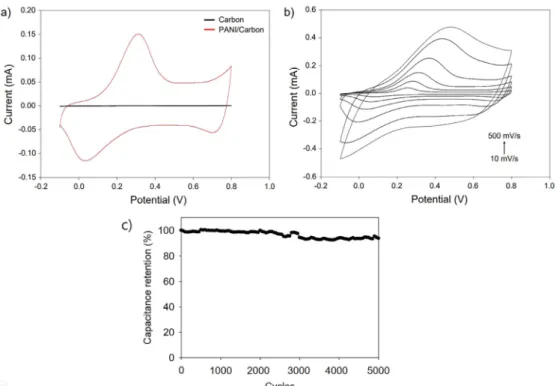
experiment was performed from -0.1 to 0.8 V at a scan rate of 25 mV/s (Figure 4a). The f-PANI shows the typical CV redox peaks of PANI, attributed to the reversible faradaic reaction of PANI due to doping/dedoping of dopants. The f-PANI electrode exhibited a sig- nificantly higher enclosed area of the CV curves compared to the car- bon electrode, indicating a higher pseudocapacitance of the f-PANI electrode. The CV measurements were further performed with increas- ing scan rates from 10 to 500 mV/s (Figure 4b). According to the scan rates, the peak current increased, and the CV shapes showed redox peaks, indicating the good pseudocapacitive characteristics of the f-PANI electrode. Figure 4c shows the superior long-term cycle life of the f-PANI electrode. Repeating charge/discharge measurement was Figure 1. Schematic illustration for the fabrication of f-PANI/PSCs.

Figure 2. Optical images of (a) carbon-coated and (b) PANI-deposited electrodes. SEM images of carbon electrodes (c) before and (d) after screen-prin-

ting of carbon inks. SEM images of PANI electrodes (e) before and (f) after diluted polymerization of PANI. SEM images of cross-section of

(g) carbon and (h) PANI electrodes.

(4)

tested at a high scan rate of 50 mV/s during 5,000 cycles. The f-PANI electrode maintained high capacitance retention of 92% with high Coulombic efficiency of 98%.

A symmetric all-solid-state flexible PSC device with a planar struc- ture was fabricated by coating a 1 M H

2

SO

4

-PVA gel electrolyte onto the interdigitated f-PANI electrodes. As expected, f-PANI/PSC ex- hibited stable CV curves in the scan rate range of 10~500 mV/s (Figure 5a). Similar results were observed when f-PANI/PSC was test- ed by GCD measurements at 1 mA/cm

2

(Figure 5b). The high specific areal capacitance of f-PANI/PSC based on the device area reached 409 µF/cm

2

at 10 mV/s (Figure 5c). More importantly, f-PANI/PSC main- tained 46% of its initial capacitance at a high scan rate of 500 mV/s, thereby indicating an excellent rate capability of f-PANI/PSC.

To further demonstrate the mechanical robustness of f-PANI/PSC, CV measurements were performed under mechanically normal and bent conditions. The all-solid-state f-PANI/PSC exhibited excellent mechan- ical resistance. The CV measurements of f-PANI/PSC were performed

at different bending angles in the range of 0~180°, resulting in a high capacitance retention of over 85%, even at a completely folded angle of 180° (Figure 6a). The fatigue test was also performed on f-PANI/

PSC through CV measurements after repetitive bending cycles (Figure 6b). The device exhibited remarkable flexibility and performance sta- bility with a high capacitance retention of 82% after 100 bending cycles. Figure 6c shows the Ragone plots (E vs. P) of our f-PANI/PSC based on the device area. The f-PANI/PSC delivered a high energy density of 0.11 mWh/cm

2

at a power density of 9.0 mW/cm

2

, which is comparable to and higher than that reported in the literature[23-29].

4. Conclusion

Flexible PANI electrodes for planar supercapacitors were fabricated by the one-step diluted polymerization of PANI on screen-printed car- bon electrodes. The deposited PANI exhibited a conductive emeraldine salt form that was protonated and transformed from the meraldine-based Figure 4. (a) CV curves of carbon and f-PANI electrodes measured at a scan rate of 10 mV/s. (b) CV curves of f-PANI electrode measured at a scan rate range from 10 to 500 mV/s. and (c) Cycling performance of f-PANI electrode measured at 50 mV/s.

Figure 5. (a) CV curves of f-PANI/PSC device. (b) GCD curves of f-PANI/PSC measured at a current density of 1 mA/cm

2

. and (c) Rate capability

of f-PANI/PSC.

(5)

form. The resulting f-PANI electrode had a high areal capacitance of 0.9 mF/cm

2

at 10 mV/s. A flexible, thin, all-solid-state supercapacitor device was fabricated by assembling two f-PANI electrodes. The as-ob- tained f-PANI/SC exhibited a high areal capacitance of 409 µF/cm

2

at 10 mV/s. A remarkable capacitance retention of 46% is observed as the scan rate increases from 10 to 500 mV/s. The electrochemical per- formance was maintained even in a mechanically bent state and after the fatigue test. Moreover, f-PANI/PSC exhibits high energy and power densities. The thin and flexible f-PANI electrodes offer great promise for improving the electrochemical performance of flexible electro- chemical devices.

Acknowledgements

This work was supported by the National Research Foundation of Korea (NRF) grant funded by the Korea government (MSIT) (No.

2021R1A2C1009926). This Research has been performed a by the Industrial Strategic Technology Development Program-Strategic core material Independent technology development project (20010193, De- velopment of Electrode Fabrication Technology using Pitch for MCDI System Applied to Lithium Recovery from Low Grade Brine and Waste Solution and Manufacturing Technology of Lithium Compound for anode material of Lithium secondary batteries) funded by the Ministry of Trade, Industry & Energy (MOTIE, Korea).

References

1. M. Beidaghi and Y. Gogotsi, Capacitive energy storage in mi- cro-scale devices: Recent advances in design and fabrication of mi- cro-supercapacitors, Energy Environ. Sci., 7, 867-884 (2014).

2. H. Hu, Z. Pei, and C. Ye, Recent advances in designing and fab- rication of planar micro-supercapacitors for on-chip energy storage, Energy Storage Mater., 1, 82-102 (2015).

3. T. Lv, M. Liu, D. Zhu, L. Gan, and T. Chen, Nanocarbon-based materials for flexible all-solid-state supercapacitors, Adv. Mater., 30, 1705489-1705505 (2018).

4. A. Tyagi, K. M. Tripathi, and R. K. Gupta, Metal-organic frame- work immobilized cobalt oxide nanoparticles for efficient photo- catalytic water oxidation, J. Mater. Chem. A, 3, 22507-20613 (2015).

5. N. A. Kyeremateng, T. Brousse, and D. Pech, Microsupercapacitors as miniaturized energy-storage components for on-chip electronics, Nat. Nanotechnol., 12, 7-15 (2017).

6. D. Pech, M. Brunet, T. M. Dinh, K. Armstrong, J. Gaudet, and D.

Guay, Influence of the configuration in planar interdigitated electro- chemical micro-capacitors, J. Power Sources, 230, 230-235 (2013).

7. J. Zhang, G. Zhang, T. Zhou, and S. Sun, Recent developments of planar micro-supercapacitors: Fabrication, properties, and applica- tions, Adv. Funct. Mater., 30, 1910000-1910020 (2020).

8. N. Liu and Y. Gao, Recent progress in micro-supercapacitors with in-plane interdigital electrode architecture, Small, 13, 1701989- 1701998 (2017).

9. D. Qi, Y. Liu, Z. Liu, L. Zhang, and X. Chen, Metal thio- and selenophosphates as multifunctional van der Waals layered materi- als, Adv. Mater., 29, 1602802-1602840 (2017).

Figure 6. Capacitance retention values of f-PANI/PSC obtained (a) at different bending angles (inset: photographs of f-PANI/PSC under mechanically

normal, and bent states) and (b) after bending cycles (inset: photographs of a fatigue test). and (c) Ragone plot of f-PANI/PSC.

(6)

12. N. R. Chodankar, H. D. Pham, A. K. Nanjundan, J. F. S. Fernando, K. Jayaramulu, D. Golberg, Y. K. Han, and D. P. Dubal, True meaning of pseudocapacitors and their performance metrics: Asy- mmetric versus hybrid supercapacitors, Small, 16, 2002806-2002840 (2020).

13. M. M. Farid, A. M. Khudhair, S. A. K. Razack, and S. Al-Hallaj, A review on phase change energy storage: Materials and applica- tions, Energy Convers. Manage., 45, 1597-1615 (2004).

14. R. Srinivasan, E. Elaiyappillai, E. J. Nixon, I. Sharmila Lydia, and P. M. Johnson, Enhanced electrochemical behavior of Co-MOF/

PANI composite electrode for supercapacitors, Inorg. Chim. Acta, 502, 119393-119403 (2020).

15. E. Payami, R. Teimuri-Mofrad, I. Ahadzadeh, and R. Mohammadi, A novel composite electrode material derived from bisferro- cenyl-functionalized GO and PANI for high performance super- capacitor, Electrochim. Acta, 354, 136712-136724 (2020).

16. P. Du, Y. Dong, H. Kang, J. Li, J. Niu, and P. Liu, Superior cycle stability carbon layer encapsulated polyaniline nanowire core-shell nanoarray free-standing electrode for high performance flexible solid-state supercapacitors, J. Power Sources, 449, 227477-227489 (2020).

17. K. Gholami Laelabadi, R. Moradian, and I. Manouchehri, One-step fabrication of flexible, cost/time effective, and high energy storage reduced graphene oxide@PANI supercapacitor, ACS Appl. Energy Mater., 3, 5301-5312 (2020).

18. S. Yu, B. Patil, and H. Ahn, PANI//MoO

3

fiber-shaped asymmetric supercapacitors with roll-type configuration, Fibers Polym., 21, 465-472 (2020).

19. M. Z. Iqbal, M. M. Faisal, S. R. Ali, S. Farid, and A. M. Afzal, Co-MOF/polyaniline-based electrode material for high performance supercapattery devices, Electrochim. Acta, 346, 136039-136040 (2020).

20. T. Zhang, H. Yue, X. Gao, F. Yao, H. Chen, X. Lu, Y. Wang, and X. Guo, High-performance supercapacitors based on polyaniline nanowire arrays grown on three-dimensional graphene with small pore sizes, Dalton Trans., 49, 3304-3311 (2020).

21. R. Awata, M. Shehab, A. El Tahan, M. Soliman, and S. Ebrahim, High performance supercapacitor based on camphor sulfonic acid doped polyaniline/multiwall carbon nanotubes nanocomposite, Electrochim. Acta, 347, 136229-136242 (2020).

22. Y. Shen, Z. Qin, S. Hu, L. Yang, X. Xu, L. Ding, and Y. Zhang, In-situ hybridization of graphene sheets onto polyaniline nanofiber arrays grown on the surface of carbon cloth under high electric

printing of nanotextured electrodes for high-performance flexible planar micro-supercapacitors, Chem. Eng. J., 353, 499-506 (2018).

25. J. Yun, D. Kim, G. Lee, and J. S. Ha, All-solid-state flexible mi- cro-supercapacitor arrays with patterned graphene/MWNT electro- des, Carbon, 79, 156-164 (2014).

26. B. Shen, J. Lang, R. Guo, X. Zhang, and X. Yan, Engineering the electrochemical capacitive properties of microsupercapacitors based on graphene quantum dots/MnO

2

using ionic liquid gel electro- lytes, ACS Appl. Mater. Interfaces, 7, 25378-25389 (2015).

27. R. Guo, J. Chen, B. Yang, L. Liu, L. Su, B. Shen, and X. Yan, In-plane micro-supercapacitors for an integrated device on one piece of paper, Adv. Funct. Mater., 27, 1702394-1702404 (2017) 28. J. Li, S. S. Delekta, P. Zhang, S. Yang, M. R. Lohe, X. Zhuang,

X. Feng, and M. Östling, Scalable fabrication and integration of graphene microsupercapacitors through full inkjet printing, ACS Nano, 11, 8249-8256 (2017).

29. S. Liu, J. Xie, H. Li, Y. Wang, H. Y. Yang, T. Zhu, S. Zhang, G. Cao, and X. Zhao, Nitrogen-doped reduced graphene oxide for high-performance flexible all-solid-state micro-supercapacitors, J.

Mater. Chem. A, 2, 18125-18131 (2014).

Authors

Seon Gyu Son; B.Sc., Graduate Student, Department of Chemical Engineering, Kangwon National University, Samcheok 25913, Republic of Korea; [email protected]

Seo Jin Kim; B.Sc., Graduate Student, Department of Chemical Engineering, Kangwon National University, Samcheok 25913, Republic of Korea; [email protected]

Junho Shin; M.Sc., Graduate Student, Resources Utilization Research Center, Korea Institute of Geoscience and Mineral Resources (KIGAM), Daejeon 34132, Republic of Korea; [email protected] Taegon Ryu; Ph.D., Principal Research Scientist, Resources Utilization

Research Center, Korea Institute of Geoscience and Mineral Resources (KIGAM), Daejeon 34132, Republic of Korea; tgryu@

kigam.re.kr

Jae-Min Jeong; Ph.D., Senior Research Scientist, Resources Utilization Research Center, Korea Institute of Geoscience and Mineral Resources (KIGAM), Daejeon 34132, Republic of Korea; jmjeong

@kigam.re.kr

Bong Gill Choi; Ph.D., Professor, Department of Chemical Engineering, Kangwon National University, Samcheok 25913, Republic of Korea;

[email protected]

수치

Figure  3.  FT-IR  spectra  of  f-PANI  electrode  (inset:  schematic  of  eme-  raldine  salt  foam  of  PANI).
Figure  5.  (a)  CV  curves  of  f-PANI/PSC  device.  (b)  GCD  curves  of  f-PANI/PSC  measured  at  a  current  density  of  1  mA/cm 2
Figure  6.  Capacitance  retention  values  of  f-PANI/PSC  obtained  (a)  at  different  bending  angles  (inset:  photographs  of  f-PANI/PSC  under  mechanically normal,  and  bent  states)  and  (b)  after  bending  cycles  (inset:  photographs  of  a

참조

관련 문서