P2-90 / S. J. Lee
IMID 2009 DIGEST •
Abstract
High performance resistive type touch panel was fabricated on flexible polyethylene terephthalate (PET) substrates coated with Al- and Ga-codoped ZnO (AGZO) films. The AGZO films were deposited by roll-to-roll direct current magnetron sputter at room temperature. The AGZO thin films on PET substrates showed high transparency (> 85 % at 550 nm) and low sheet resistance (450 Ω/sq.). These values were similar to those of commercial ITO films used for resistive type touch panel.
1. Introduction
Recently there has been much research effort on the transparent conductive oxide (TCO) film due to their potential applications in touch panel, flat panel display and solar cell, etc [1]. Indium tin oxide (ITO) thin film deposition is widely used in TCO film due to its high transmittance and low sheet resistance properties. However, the chemical instability, toxic nature of indium, and high cost of ITO target have led researchers to seek an alternative candidate for TCO films [2]. Al- and Ga-codoped ZnO (AGZO) thin film has shown promising results as an alternative with its
electrical and optical properties comparable to those of ITO. In this work we studied the process parameters of AGZO thin film deposition by using roll-to-roll sputter for touch panel application.
2. Experimental
The roll-to-roll DC magnetron sputter used in our experiment is shown in Figure 1 . AGZO target had of size was 100 x 250 mm2.
Fig.1.The roll-to-roll sputter system and rectangu lar cathode used in the AGZO thin film deposition.
Transparent Conductive AGZO-PET Film by Roll-to-Roll
Sputter and Its Application to Resistive Type Touch Panel
Fabrication
Sang Ju Lee
1, Sang-Mun Lee
2, Yoon-Su Lee
2, Tae Hoon Kim
3Lee Soon Park
1,2,31Dept. of Polymer Science, Kyungpook Nat. Univ., Daegu, 702-701, Korea
2Advanced Display Manufacturing Research Center, Kyungpook Nat. Univ, Daegu, 702-701, Korea
3Mobile Display Research Center, Kyungpook Nat. Univ, Daegu, 702-701, Korea TEL: 82-53-950-5627, e-mail: [email protected]
P2-90 / S. J. Lee
• IMID 2009 DIGEST
Figure 2. shows the fabrication process of touch panel utilizing the AGZO deposited PET film.
Fig. 2. Schematic diagram of touch panel fabrication
The polyethylene terephthalate(PET) film was treated with plasma before deposition of AGZO conducting film to increase the adhesion of the AGZO thin film on PET substrate. The plasma treatment condition of the PET film is shown in Table 1.
Table 1. Plasma treatment conditions of PET film
Ar O2 RF Power Time Reapeat
8slm 80sccm 100w 1 1mm/sec
The AGZO thin film deposition condition is shown in Table 2 by using roll-to-roll DC magnetron sputter. Table 2. Conditions of sputtering process
3. Results and Discussion
Figure 1 shows the roll-to-roll DC magnetron sputter used in our experiment. AGZO films were deposited on polyethylene terephthalate(PET) substrate to a 200 µm thickness by using roll-to-roll sputter at room temperature under the optimized conditions of constant Ar flow rate of 150 sccm, DC power of 400 W, working pressure of 8 mTorr, and roll speed of 0.01 m/min. The AGZO thin films on PET substrates showed high transparency (> 85 % at 550 nm) and low sheet resistance (≅ 450 Ω/sq.) as shown in Table 3. The uniformity of resistivity of AGZO thin film was below 7% measured by multiple 4 point probe method. These values were similar to those of the commercial ITO films used in the resistive type touch panel.
Table 3. Sheet resistance standard deviation of AGZO and ITO PET film.
Fig. 3. The Contact angle of PET film after plasma treatment .
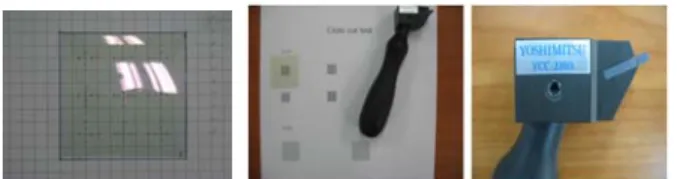
The cross-cut test also exhibited good adhesion between AGZO film and PET substrate as shown in Fig. 5. The adhesion of AGZO thin film on PET substrate was not story when PET bare film was used in the roll-to-roll magnetron sputter. After the plasma treatment of PET film the adhesion of the AGZO film on PET substrate was improved to a level of commercial conducting film with ITO thin film of PET substrate. This was considered to be due to the hydrophilic surface formation on PET film as shown in Fig. 3. AGZO film was annealed at 150°C for 30 min after Ag paste printing on the resistive touch panel. High performance resistive touch panel was
obtained by attaching the AGZO-PET film on the commercial ITO glass substrate.
Fig. 4. AGZO-PET film 150 x 600 mm (left) and UV-visible spectrum of the AGZO-PET film (right) obtained by roll-to-roll sputter
Target ZnAlGaO
Substrate PET (Toray)
Condition DC400 W, Ar flow rate : 150 sccm, Roll speed : 0.01 m/min
Rs(Ω/sq) No. L M R average standard deviation 475.2 406.7 480.5 454.13 422 456 476.3 451.43 AG ZO-PET Film 483.4 436.2 412 443.87 31 437.4 455.6 446.5 446.50 475.3 490.6 503.2 489.70 ITO-PET Film (Oike) 484.8 452.1 460.7 465.87 22
P2-90 / S. J. Lee
IMID 2009 DIGEST • Fig. 5. The cross cutting test of AGZO film
(100ea/100ea)
A 4 inch size resistive type touch panel could be fabricated utilizing the AGZO-PET film obtained as shown in Figure 6. These results indicated that the AGZO-PET films made by roll-to-roll sputter could be used in touch panel fabrication as transparent electrodes substituting ITO-PET films.
Fig. 6. A 4 inch resistive type touch panel fabricated with the AGZO-PET film obtained by roll-to-roll sputter.
4.Summary
Resistive touch panel was fabricated on flexible polyethylene terephthalate (PET) substrates coated with Al- and Ga-codoped ZnO (AGZO) films. The AGZO films were deposited by roll-to-roll direct current magnetron sputtering at room temperature. The AGZO thin films on PET substrates showed high transparency (> 85 % at 550 nm) and low sheet resistance ( 450 /sq.). These values were simil ar with those of commercial ITO-PET films used in the resistive touch panel fabrication. Moreover, cross-cut test exhibited a good adhesion strength between AGZO film and PET substrate. These results indicate that the AGZO-PET thin films are promising candidate which can substitute ITO-PET film as transparent electrodes in touch panel applications.
(http://www.imid.or.kr/2009/sub0202.asp).
5. References
[1] L Raniero, I. Ferreira, A. Pimentak, A. Goncalves, P. Canhola, E. Fortunato and R. Martins, Thin
Solid Films 511-512, 295(2006).
[2] K. Nomura, H. Ohta, A. Takagi, T. Kamiya, M. Hirano, and H. Hosono, Nature, 432, 488(2004).