P1-122 / Y. Lee
• IMID 2009 DIGEST
Abstract
Flexible, transparent thin-film transistor with active layers composed of carbon nanotube-based conducting ink were fabricated on a plastic substrate by ink-jet printing. The properties of the formulated conducting ink containing carbon nanotubes, a conducting polymer, and additives were characterized and optimized. The conducting ink was applied to flexible thin-film transistors using ink-jet printing.
1. Introduction
The flexible and transparent thin-film transistors (TFTs) have attracted great interest in the display market. Genereally, more and more rollable, bendable, thin, and light-weight flexible displays are required in contrast to the widely used fragile and non-deformable substrates.[1] For the fabrication of suitable TFTs on flexible substrates, there are several restrictions forthe fabrication such as compatibility between the TFT and substrates as well as sdifficulties in the manufacturing process. Therefore, it is essential to develop flexible displays with plastic substrates based on low temperature processes.[2] In this study, a novel ink based on carbon nanotubes and a conducting polymer was developed in order to apply the ink-jet printing process for the fabrication of flexible TFTs.
2. Experimental
Fot the formulation of the conducting ink, the conducting materials such as the single-walled carbon nanotubes (SWNT: purity: >95 wt %) and poly(3-hexylthiophene-2,5-diyl) (P3HT) were purchased
from BuckyUSA and Rieke Metals, Inc., respectively. Toluene (Junsei Chemical Co., Ltd.) and o-dichloro-benzene (o-DCB, Daejung Chemical & Metals Co., Ltd.) were used as solvents. The Additive-1 and Additive-2 were added in order to control the viscosity of the conducting ink. The polymer film substrate was applied to the flexible substrate. First of all, the P3HT, Additive-1, and Additive-2 were dissolved. Then, the SWNT were dispersed and ultrasonication (Sonics and Materials, Inc., Model VC 750) and centrifugation (VISION, VS-15000N) applied. Finally, the supernatant was collected for use of the conducting ink.
The stability of the conducting ink was evaluated by UV-Vis spectroscopy (Perkin Elmer Lambda 750 UV/VIS Spectrometer). The microscopic tests were performed with a Hitachi S-4700 field emission scanning electron microscope (FE-SEM) and transmission electron spectroscope (TEM, JEOL TEM-2100, accelerating voltage = 200 kV). The viscosity of the formulated ink was measured with a
Rheometer (AR G2, TA INC) and the surface tension measured with a Sigma 701/KAV. The resulting conducting ink was applied to ink-jet printing using a ink-jet printer developed by STI, South Korea (nozzle size: 19 µm×19 µm). Finally, the electrical properties were evaluated using a probe station I-V measurement system.
3. Results and discussion
In order to apply the ink-jet printing process, one of the important challenges is the ink formulation. The ink has to meet a series of strict physicochemical properties such as viscosity, surface tension, and
Flexible, Transparent Thin-Film Transistors Fabricated by
Ink-Jet Printing with Carbon Nanotube-Based Conducting Ink
Yeonju Lee
1, Woo-Suk Lee
1, Soo Kyeong Jeong
1, Seok-Ju Choi
1,2, Hye
Min Kim
3, Jin Young Chun
3, Sungho Kim
3and Kurt E. Geckeler
1,2*
1Department of Materials Science and Engineering, Gwangju Institute of Science and Engineering (GIST), Gwangju 500-712, Korea
Tel.:82-62-970-2316, E-mail: [email protected]
2Department of Nanobio Materials, and Electronics, World-Class University (WCU), Gwangju Institute of Science and Engineering (GIST), Gwangju 500-712, Korea 3LG Innotek Co., Ltd., LG Components R&D Center, 1271, Sa-Dong, Sanggrok-Gu,
P1-122 / Y. Lee
IMID 2009 DIGEST • adhesion to the substrate,in order to achieve optimum
performance and reliability of the printing system and to obtain the best printed pattern. The inks are icomposed of a large number of components such as binders, humectants, wetting and dispersing agents, buffer components, chelating agents, defoamers, etc. To optimize the ink properties in this study the surface tension, viscosity, and interaction with the substrate were considered.
We designed a novel nanocomposite based on single-walled carbon nanotubes (SWNTs) and a conducting polymer to take advantage of the outstanding properties of SWNTs.[3] Because of the surface properties of SWNTs, which are difficult to disperse in solvents, the ratio between the conducting materials (SWNT and conducting polymer) and solvents is an important issue that should be considered in order to formulate a high-performance ink. Therefore, a commercially available method of producing conducting ink was developed by ultrasonication. The well-dispersed conducting ink was characterized by UV-Vis spectroscopy (Figure 1) and TEM (Figure 2).
Figure 1. UV-Vis spectra of (1) SWNT, (2) SWNT+Additive-1, (3) SWNT+Additive-2, and (4) SWNT+Additive-1+Additive-2
(inset: visual appearance of dispersions corresponding the UV-Vis spectra)
The key point for the fabrication of flexible TFTs is the patterning of the active layer using the ink-jet printing process. Although ink formulations for the ink-jet printing should meet several requirements, mainly viscosity and surface tension, and it is also very difficult to obtain a high-performance ink, the ink-jet printing process is low-cost process, non-contact printing method, high precision deposition,
and flexible manufacturing process. Therefore, this is one of best processes to fabricate flexible TFT.
Figure 2. Well-dispersed ink containing SWNTs, Additive-1, and Additive-2 (inset: visual appearance of the resulting conducting ink)
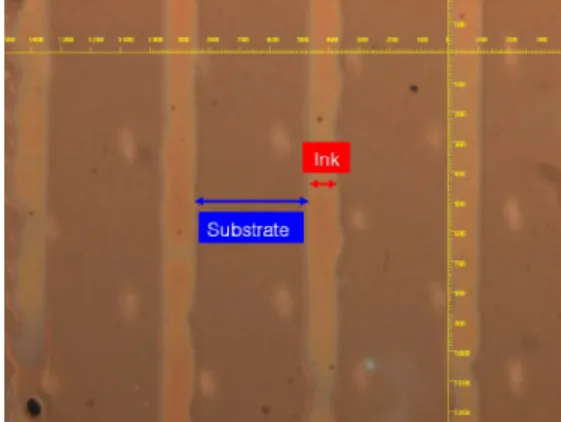
In order to fabricate a well-aligned pattern, the surface tension of the conducting ink and the interaction between the substrate and the ink were considered and evaluated. We evaluated properties of the substrate such as thermal stability, interaction between the substrate and solvent in the ink, and the wetting of the ink on substrate (data not shown). Using this conducting ink we could successfully produce patterns on the polymer substrate (Figure 3). The characteristics of the TFT such as the on/off current ratio and the field-effect mobility were also evaluated.
Figure 3. Optical microscopic image of the ink-jet printing pattern using the conducting ink on the polymer substrate
4. Summary
P1-122 / Y. Lee
• IMID 2009 DIGEST
printing the formulation of a high-performance conducting ink is an essential prerequisite. In addition, the properties of the conducting ink should have the proper viscosity and surface tension for the application of the ink-jet printing. Therefore, a conducting ink containing carbon nanotubes and a conducting polymer as well as a commercially available preparation method were developed while considering the properties of each component. The well dispersed ink with the proper viscosity and surface tension was then successfully applied to ink-jet printing
Acknowledgement
This work was financially supported through the Industry-Academic Cooperation Research Develop-ment Project supported by LG Innotek Co.
5. References
1. G. H. Gelinck, H. E. A. Huitema, E. van Veenendaal, E. Cantatore, L. Schrijnemakers, J. B. P. H. van der Putten, T. C. T. Geuns, M. Beenhakkers, J. B. Giesbers, B.-H. Huisman, E. J. Meijer, E. M. Benito, F. J. Touwslager, A. W. Marsman, B. J. E. van Rens, D. M. de Leeuw, Nat. Mater. 3, 106 (2004).
2. K. Dongjo, M. Jooho, Electrochem. Solid-State Lett.. 8, J30 (2005).
3. K. E. Geckeler, E. Rosenberg, Functional Nano-materials, American Scientific Publishers, Valencia, USA (2006).