• 검색 결과가 없습니다.

Characteristics of Function-Anatomy Mismatch in Patients with Coronary Artery Disease

N/A
N/A
Protected

Academic year: 2021

Share "Characteristics of Function-Anatomy Mismatch in Patients with Coronary Artery Disease"

Copied!
6
0
0

로드 중.... (전체 텍스트 보기)

전체 글

(1)

Korean Circulation Journal

Introduction

Many percutaneous coronary intervention (PCI) procedures are performed based solely on angiographic criteria, without prior as- sessment for ischemia. Although quantitative coronary angiogra- phy (QCA) analysis more precisely estimates stenotic segment di- mensions, coronary stenosis severity calculated by QCA does not

Print ISSN 1738-5520 • On-line ISSN 1738-5555

Characteristics of Function-Anatomy Mismatch in Patients with Coronary Artery Disease

Hyun-Ok Cho, MD 1,2 , Chang-Wook Nam, MD 1 , Yun-Kyeong Cho, MD 1 , Hyuck-Jun Yoon, MD 1 , Hyoung-Seob Park, MD 1 , Hyungseop Kim, MD 1 , In-Sung Chung, MD 3 , Joon-Hyung Doh, MD 4 , Bon-Kwon Koo, MD 5 , Dae-Woo Hyun, MD 2 , Seung-Ho Hur, MD 1 , Yoon-Nyun Kim, MD 1 , and Kwon-Bae Kim, MD 1

1

Department of Internal Medicine, Keimyung University Dongsan Medical Center, Daegu,

2

Andong Medical Group, Cardiovascular Center, Andong,

3

Department of Occupational and Environmental Medicine, Keimyung University Dongsan Medical Center, Daegu,

4

Department of Internal Medicine, Inje University Ilsan Paik Hospital, Goyang,

5
Department of Internal Medicine, Seoul National University Hospital, Seoul, Korea

Background and Objectives: Coronary lesions with mismatched functional and anatomical significance are not uncommon. We as- sessed the accuracy and predictors of mismatch between fractional flow reserve (FFR) and quantitative coronary angiography (QCA) analy- ses in patients with coronary lesions.

Subjects and Methods: A total of 643 lesions with pre-interventional FFR and QCA measurements were consecutively enrolled and di- vided into four groups using FFR ≤0.80 and percent diameter stenosis (%DS) ≥50% as cutoffs for functional and anatomical significance, respectively. Accordingly, FFR >0.80 and DS ≥50%, and FFR ≤0.80 and DS <50% defined false-positive (FP) and false-negative (FN) lesions, respectively.

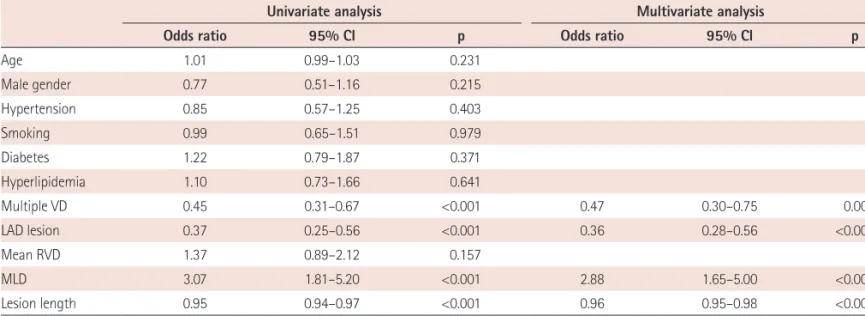
Results: Overall, 40.4% (260/643) of the lesions were mismatched, and 51.7% (218/414) and 18.3% (42/229) were FP and FN lesions, re- spectively. In a multivariate analysis, independent predictors of FP were non-left anterior descending artery location {odds ratio (OR), 0.36;

95% confidence interval (CI), 0.28–0.56; p<0.001}, shorter lesion length (OR, 0.96; 95% CI, 0.95–0.98; p<0.001), multi-vessel disease (OR, 0.47; 95% CI, 0.30–0.75; p=0.001), and larger minimal lumen diameter by QCA (OR, 2.88; 95% CI,1.65–5.00; p<0.001). Independent predictors of FN were multi-vessel disease (OR, 1.82; 95% CI, 1.24–5.27; p=0.048), aging (OR, 0.96; 95% CI, 0.93–0.99; p=0.034), smoking (OR, 0.36;

95% CI, 0.14–0.93; p=0.034), and smaller reference vessel diameter by QCA (OR, 0.30; 95% CI, 0.10–0.87; p=0.026).

Conclusion: A mismatch between FFR and angiographic lesion severity is not rare in patients with coronary artery disease; therefore, an angiog- raphy-guided evaluation could under- or over-estimate lesion severity in specific lesion subsets. (Korean Circ J 2014;44(6):394-399) KEY WORDS: Fractional flow reserve, myocardial; Coronary angiography; Coronary artery disease.

Received: June 30, 2014 / Revision Received: August 22, 2014 / Accepted: August 28, 2014

Correspondence: Chang-Wook Nam, MD, Department of Internal Medicine, Keimyung University Dongsan Medical Center, 56 Dalseong-ro, Jung-gu, Daegu 700-712, Korea

Tel: 82-53-250-7998, Fax: 82-53-250-7034, E-mail: [email protected]

• The authors have no financial conflicts of interest.

This is an Open Access article distributed under the terms of the Creative Commons Attribution Non-Commercial License (http://creativecommons.org/licenses/

by-nc/3.0) which permits unrestricted non-commercial use, distribution, and reproduction in any medium, provided the original work is properly cited.

always correlate with clinical presentation.

1)2)

Decision making for revascularization based on angiography alone without noninvasive testing can be difficult for intermediate or ambiguous coronary ste- noses.

3)

Therefore, coronary angiography alone can frequently mis- diagnose functional severity in specific lesion subsets.

4)5)

Fractional flow reserve (FFR) is a physiological index of ischemia

secondary to coronary artery stenosis, and FFR-guided coronary

(2)

revascularization with drug-eluting stents improves patient out- comes.

4)6)

We assessed predictors of mismatch between FFR and QCA analysis in patients with coronary lesions.

Subjects and Methods

Patient population and study design

A total of 673 patients (893 lesions), who underwent coronary angiography and an invasive physiological evaluation using a pres- sure wire before intervention between May 2006 and June 2012, were consecutively screened for the current analysis. In total, 462 patients with 643 lesions were finally included (Table 1) based on the following criteria. All patients had at least one target vessel with

>30% stenosis diameter measured by QCA analysis and were not

eligible for enrollment if they had: 1) undergone primary or emer- gent PCI for acute coronary syndrome, 2) prior coronary artery by- pass graft surgery, 3) multiple lesions in the same epicardial artery, 4) lesions treated previously by PCI, 5) previous infarcted lesion, 6) left main disease, primary myocardial disease, or a major life threat- ening illness, or 7) contraindications to adenosine, aspirin, or clopi- dogrel. All lesions were divided into four groups: true positive (TP), FFR ≤0.80 and diameter stenosis (DS) ≥50%; false positive (FP), FFR >0.80 and DS ≥50%; true negative (TN), FFR >0.80 and DS <50%;

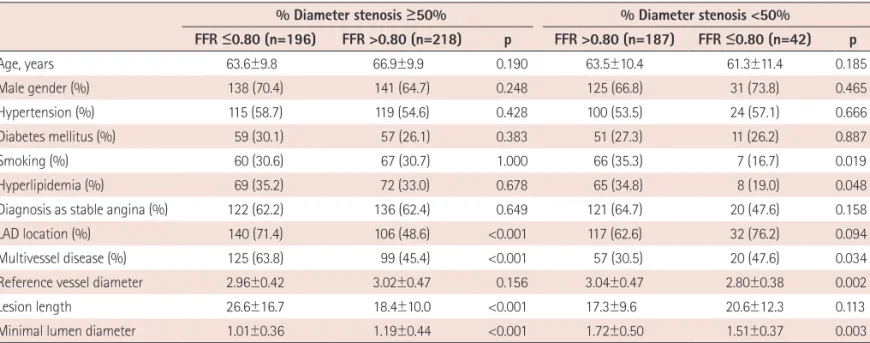
and false negative (FN), FFR ≤0.80 and DS <50%. DS was measured by QCA analysis. Clinical risk factors and lesion characteristics were compared between the FP and TP groups, and between the FN and TN groups (Table 2). The study outcomes were the incidence and predictors of coronary lesions with a function-anatomy mismatch.

Table 1. Baseline characteristics

Patient characteristics (n=462) Lesion characteristics (n=643)

Age, years 64.9±24.5 Multi-vessel disease, n (%) 301 (46.8)

Male sex, n (%) 306 (66.6) LAD artery location, n(%) 306 (66.6)

Risk factors, n (%) QCA analysis

Smoking 143 (31.0) Mean RVD (mm) 2.99±0.46

Hypertension 252 (54.5) Minimal lumen diameter (mm) 1.31±0.52

Diabetes mellitus 125 (27.1) Diameter stenosis (%) 54.7±14.9

Hyperlipidemia 144 (31.2) Lesion length (mm) 20.7±13.0

Clinical manifestation, n (%) Pressure wire

Stable angina 292 (63.2) Mean FFR 0.81±0.11

Unstable angina 103 (22.3) FFR ≤0.80, n (%) 252 (39.2)

NSTEMI 42 (9.1)  

STEMI 25 (5.4)  

NSTEMI: non ST-segment elevation myocardial infarction, STEMI: ST-segment elevation myocardial infarction, LAD: left anterior descending, QCA: quantita- tive coronary analysis, RVD: reference vessel diameter, MLD: minimal lumen diameter, FFR: fractional flow reserve

Table 2. Comparisons according to anatomical and functional significance

% Diameter stenosis ≥50% % Diameter stenosis <50%

FFR ≤0.80 (n=196) FFR >0.80 (n=218) p FFR >0.80 (n=187) FFR ≤0.80 (n=42) p

Age, years 63.6±9.8 66.9±9.9 0.190 63.5±10.4 61.3±11.4 0.185

Male gender (%) 138 (70.4) 141 (64.7) 0.248 125 (66.8) 31 (73.8) 0.465

Hypertension (%) 115 (58.7) 119 (54.6) 0.428 100 (53.5) 24 (57.1) 0.666

Diabetes mellitus (%) 59 (30.1) 57 (26.1) 0.383 51 (27.3) 11 (26.2) 0.887

Smoking (%) 60 (30.6) 67 (30.7) 1.000 66 (35.3) 7 (16.7) 0.019

Hyperlipidemia (%) 69 (35.2) 72 (33.0) 0.678 65 (34.8) 8 (19.0) 0.048

Diagnosis as stable angina (%) 122 (62.2) 136 (62.4) 0.649 121 (64.7) 20 (47.6) 0.158

LAD location (%) 140 (71.4) 106 (48.6) <0.001 117 (62.6) 32 (76.2) 0.094

Multivessel disease (%) 125 (63.8) 99 (45.4) <0.001 57 (30.5) 20 (47.6) 0.034

Reference vessel diameter 2.96±0.42 3.02±0.47 0.156 3.04±0.47 2.80±0.38 0.002

Lesion length 26.6±16.7 18.4±10.0 <0.001 17.3±9.6 20.6±12.3 0.113

Minimal lumen diameter 1.01±0.36 1.19±0.44 <0.001 1.72±0.50 1.51±0.37 0.003

Values are number of patients (%) and mean±standard deviation. FFR: fractional flow reserve, LAD: left anterior descending

(3)

Fractional flow reserve

Fractional flow reserve was defined as the ratio between mean distal coronary pressure and mean aortic pressure, measured simul- taneously at maximal hyperemia. Coronary pressure was measured using a 0.014-in sensor-tipped PCI guidewire (Pressure Wire, RADI Medical Systems, Uppsala, Sweden; Saint Jude Medical, Sylmar, CA, USA). The wire was introduced through a 6- or 7-Fr guiding catheter, equalized, and advanced distal to the stenosis as described previ- ously. The FFR value was checked after administering adenosine to induce maximal hyperemia, either intravenously (≥40 μg/kg/min) or into a coronary artery (≥40 μg in the right, or ≥80 μg in the left coronary artery).

7)8)

Angiographic analyses

The QCA analysis was performed in the core laboratory at Keimy- ung University Dongsan Medical Center by an experienced observer who was blinded to the FFR value. Reference vessel diameter (RVD), minimal lumen diameter (MLD), and lesion length (LL) were measured using the guiding catheter for calibration and an edge detection system (CAAS 5.7 QCA system, Pie Medical, Maastricht, The Nether- lands), and percent DS (%DS) was calculated.

Statistical analyses

Results are expressed as mean±standard deviations for continu- ous variables and frequencies for categorical variables. Comparisons of continuous variables were performed using Student’s t-test.

Analysis of discrete variables was performed using the chi-square test. Multiple logistic regression analysis was used, and variables with a univariate value of p<0.20 and historically proven risk fac- tors were incorporated into the multivariate models. All statistical analyses were performed using SPSS ver. 19.0.0 (IBM, Armonk, NY, USA) and a p<0.05 was considered significant.

Results

Baseline characteristics

A total of 462 patients (643 de novo lesions), who underwent cor- onary angiography and FFR assessment, were consecutively en- rolled. Baseline clinical and angiographic characteristics are sum- marized in Table 1. The incidence of diabetes was 27%. Left anterior descending artery (LAD) lesions accounted for 67% of the lesions.

Mean FFR at maximal hyperemia was 0.81±0.11. FFR ≥0.80 was seen in 37.0% of lesions.

Prevalence of angiographic and functional mismatch

The optimal cutoff value of angiographic %DS for predicting FFR

≤0.80 was 53% (area under the curve, 0.73; 95% CI, 0.69–0.77;

p<0.001), with sensitivity of 61% and specificity of 75%. The over- all incidence of function-anatomy mismatched lesions was 40.4%

(260/643 lesions). Although angiographic %DS significantly corre- lated with FFR (p<0.001, r=-0.40), FFR >0.80 as FP was seen in 218 (52.7%) among the 414 lesions with angiographic %DS ≥50%. In contrast, FFR ≤0.80 as FN was found in 42 (18.3%) among the 229 lesions with DS <50% (Fig. 1). Furthermore, if only intermediate le- sions (%DS, 30–70%) were included, 43.5% (219/503) were mis- matched; the FP rate was 60.9%, and the FN rate was 18.4%.

Predictors of angiographic and functional mismatch

The FP group had lower proportions of LAD location and multi- vessel disease (MVD), shorter LL, and larger MLD, whereas the FN group had lower frequencies of smoking and hyperlipidemia, higher frequency of MVD, and smaller mean RVD and MLD (Table 2). The multivariate analysis included the following factors; age, sex, history of hypertension, smoking, diabetes, hyperlipidemia, MVD, LAD, de- gree of RVD, MLD, and LL. The analysis revealed that independent predictors for FP were non-LAD artery location (OR, 0.36; 95% CI, 0.28–0.56; p<0.001), shorter LL (OR, 0.96; 95% CI, 0.95–0.98; p<

0.001), MVD (OR, 0.47; 95% CI, 0.30–0.75; p=0.001), and larger MLD by QCA (OR, 2.88; 95% CI, 1.65–5.00; p<0.001). Independent pre- dictors for FN were MVD (OR, 1.82; 95% CI, 1.24–5.27; p=0.048), aging (OR, 0.96; 95% CI, 0.93–0.99; p=0.034), smoking (OR, 0.36;

95% CI, 0.14–0.93; p=0.034), and smaller RVD by QCA (OR, 0.30;

95% CI, 0.10–0.87; p=0.026) (Table 3 and 4).

Discussion

The major findings of the study were: 1) anatomical-functional mismatch was not rare, with FP and FN mismatch between QCA and

Fig. 1. Incidence of mismatched lesions.

1.00

0.80

0.60

0.40

% Diameter stenosis by QCA

FFR value

0 20 40 60 80 100 False negative

18.3% (42/229) True negative

True positive

False positive

52.7% (218/414)

(4)

FFR of 52.7% and 18.3%, respectively, 2) an estimate of lesion sever- ity should be performed considering several clinical and angiographic factors, such as age, cardiovascular risk factors, disease extent, and lesion location, and 3) although QCA is more reliable than a visual estimate, precise characterization of lesion severity should include confirmation by a functional evaluation in specific lesion subsets.

Despite the development of many noninvasive imaging tests, coronary angiography remains an unsurpassed tool for cardiologists to perform revascularization.

9)

Although QCA more precisely assess- es the dimensions of a stenotic segment,

1)

QCA-calculated severity does not always correlate with clinical presentation of related symp- toms.

2)

The most important factor related to outcome in a patient with coronary artery disease is the presence and extent of inducible isch- emia.

10)11)

FFR is an accurate and lesion-specific index to indicate

whether a particular stenosis or coronary segment is responsible for ischemia.

12-14)

In this study, the overall mismatch between QCA and FFR was not rare and was detected in 40.4% (260/643) of lesions. Among the 414 lesions with angiographic DS ≥50%, 218 (52.7%) were in the FP category after the functional assessment. In contrast, among the 229 lesions with DS <50%, 42 (18.3%) were FN. Our findings are similar to those in a recent study by Park et al.,

15)

who reported a 57% incidence for FP and 16% for FN. In addition, unlike the previ- ous study, our new data analysis indicated that extents of diseased vessel were predictors of FP and FN. Therefore, FFR-guided PCI re- duces the over- or under-estimation of angiographic lesion severi- ty, particularly for intermediate and ambiguous lesions. In the highly effective drug-eluting stent era, confirming functional severity of lesions that cannot be ignored for revascularization can help prevent Table 3. Predictors of false positive between fractional flow reserve (FFR) and quantitative coronary angiography (QCA)

Univariate analysis Multivariate analysis

Odds ratio 95% CI p Odds ratio 95% CI p

Age 1.01 0.99–1.03 0.231

Male gender 0.77 0.51–1.16 0.215

Hypertension 0.85 0.57–1.25 0.403

Smoking 0.99 0.65–1.51 0.979

Diabetes 1.22 0.79–1.87 0.371

Hyperlipidemia 1.10 0.73–1.66 0.641

Multiple VD 0.45 0.31–0.67 <0.001 0.47 0.30–0.75 0.001

LAD lesion 0.37 0.25–0.56 <0.001 0.36 0.28–0.56 <0.001

Mean RVD 1.37 0.89–2.12 0.157

MLD 3.07 1.81–5.20 <0.001 2.88 1.65–5.00 <0.001

Lesion length 0.95 0.94–0.97 <0.001 0.96 0.95–0.98 <0.001

VD: vessel disease, LAD: left anterior descending, RVD: reference vessel diameter, MLD: minimal lumen diameter

Table 4. Predictors of false negative between fractional flow reserve (FFR) and quantitative coronary angiography (QCA)

Univariate analysis Multivariate analysis

Odds ratio 95% CI p Odds ratio 95% CI p

Age 0.98 0.95–1.01 0.180 0.96 0.93–0.99 0.034

Male gender 0.72 0.34–1.52 0.383

Hypertension 0.86 0.44–1.69 0.667

Smoking 0.37 0.15–0.87 0.023 0.36 0.14–0.93 0.034

Diabetes 1.06 0.45–2.26 0.887

Hyperlipidemia 2.26 0.99–5.18 0.053

Multiple VD 2.07 1.05–4.10 0.036 1.82 1.24–5.27 0.048

LAD lesion 1.92 0.89–4.13 0.098

Mean RVD 0.25 0.10–0.62 0.003 0.30 0.10–0.87 0.026

MLD 0.38 0.18–0.81 0.012

Lesion length 1.03 0.99–1.06 0.064

VD: vessel disease, LAD: left anterior descending, RVD: reference vessel diameter, MLD: minimal lumen diameter

(5)

future adverse events.

In the multivariate analysis, lesion location, extent of diseased vessels, RVD, MLD, LL, aging, and smoking were associated with mis- matched lesions. A non-LAD lesion could be an important predictor of angiographic overestimation in the current study. The large bur- den of myocardium in the LAD territory compared with that of other major coronary arteries could be an explanation for this phenome- non. Proximal LAD lesions are associated with significantly lower FFR values and a higher rate of positive FFR compared to those in the left circumflex and right coronary arteries.

16)

A significant inverse correlation is observed between the FFR value and the amount of jeopardized myocardium.

The extent of diseased vessels physiologically affects coronary stenosis. MVD was a predictor of FN lesions in the current analysis.

Because of possible diffuse disease, MVD has a lower FFR than sin- gle-vessel disease (SVD) for a given degree of stenosis. Furthermore, nonculprit lesions in MVD could be underestimated by QCA due to the diffusivity of a stenotic culprit lesion, compared with a similar stenotic SVD.

Lesion severity can be underestimated at a younger age com- pared to that in the elderly, which could be explained by a stronger response to adenosine and better microvascular circulation com- pared to those in the elderly.

17)

Smoking as an inverse predictor of FN could also be explained by microvascular dysfunction.

Because MLD and LL are main determinants of functional signif- icance in coronary lesions,

14)

larger MLD and shorter LL for a given stenosis could have been the cause for angiographic overestimation in the current study. Although it appears significant angiographi- cally, a larger MLD guarantees blood flow in the corresponding territory. Not surprisingly, lesion length can also affect lesion severi- ty. Lesion length is an important geometric variable positively cor- related with the trans-stenotic pressure gradient. In contrast, an an- giographic assessment could lead to underestimating relatively diffuse coronary disease or small artery disease.

Use of the FFR value in a functional evaluation of coronary artery disease can prevent under- or overestimating using an angiograph- ic-only assessment. Baseline risk factors such as aging and smoking, and angiographic factors such as extent of diseased vessels, MLD, RVD, and LL should be carefully considered when evaluating coro- nary lesion severity. Nevertheless, it may be difficult to determine the functional significance of the indicated lesion. Therefore, a le- sion-based functional evaluation such as FFR should be applied in specific situations.

Limitations

Several limitations of this study should be mentioned. First, this study was performed retrospectively in a single center on a relatively

small population, thereby possibly not devoid of selection bias.

However, the large number of lesions analyzed could partly over- come the latter limitation. Second, we could not co-evaluate func- tional status of other vessels, which could have affected the lesion’s FFR value in MVD. Third, factors regarding coronary dominancy that can affect coronary functional status were not evaluated. Fourth, intravascular ultrasound (IVUS) was not analyzed. IVUS more accu- rately shows lesion severity. However, in another comparative study, about 30% of lesions were still under- or overestimated by IVUS cri- teria compared with that of FFR, as in our study.

18)

Fifth, we used various adenosine administration methods, which could have lead to under- or overestimating lesion severity by FFR. Finally, clinical outcomes could not be evaluated in our study.

Conclusion

Mismatch between function assessed by FFR and anatomy by an- giography is not rare in patients with coronary artery disease. FP FFR was more common in patients with a non-LAD artery location, SVD, shorter lesion length and larger MLD, FN FFR in MVD, aging, smok- ing, and smaller reference vessel diameter. Therefore, an angiograph- ic-only dedicated lesion evaluation in the catheterization room might under- or overestimate actual coronary lesion severity.

Acknowledgments

This study was supported by a grant from The Korean Society of Cardiology in 2013 and by a grant from the Scholar Research Grant of Keimyung University in 2012.

References

1. Reiber JH, van der Zwet PM, Koning G, et al. Accuracy and precision of quantitative digital coronary arteriography: observer-, short-, and me- dium-term variabilities. Cathet Cardiovasc Diagn 1993;28:187-98.

2. Topol EJ, Nissen SE. Our preoccupation with coronary luminology. The dissociation between clinical and angiographic findings in ischemic heart disease. Circulation 1995;92:2333-42.

3. Fischer JJ, Samady H, McPherson JA, et al. Comparison between visual assessment and quantitative angiography versus fractional flow re- serve for native coronary narrowings of moderate severity. Am J Car- diol 2002;90:210-5.

4. Pijls NH, De Bruyne B, Peels K, et al. Measurement of fractional flow reserve to assess the functional severity of coronary-artery stenoses. N Engl J Med 1996;334:1703-8.

5. Melikian N, De Bondt P, Tonino P, et al. Fractional flow reserve and myocardial perfusion imaging in patients with angiographic multives- sel coronary artery disease. JACC Cardiovasc Interv 2010;3:307-14.

6. Pijls NH, Van Gelder B, Van der Voort P, et al. Fractional flow reserve. A

useful index to evaluate the influence of an epicardial coronary steno-

sis on myocardial blood flow. Circulation 1995;92:3183-93.

(6)

7. Nam CW, Hur SH, Koo BK, et al. Fractional flow reserve versus angiog- raphy in left circumflex ostial intervention after left main crossover stenting. Korean Circ J 2011;41:304-7.

8. Kim JE, Koo BK. Fractional flow reserve: the past, present and future. Ko- rean Circ J 2012;42:441-6.

9. Pijls NH, Sels JW. Functional measurement of coronary stenosis. J Am Coll Cardiol 2012;59:1045-57.

10. Shaw LJ, Iskandrian AE. Prognostic value of gated myocardial perfusion SPECT. J Nucl Cardiol 2004;11:171-85.

11. Metz LD, Beattie M, Hom R, Redberg RF, Grady D, Fleischmann KE. The prognostic value of normal exercise myocardial perfusion imaging and exercise echocardiography: a meta-analysis. J Am Coll Cardiol 2007;

49:227-37.

12. Pijls NH, van Son JA, Kirkeeide RL, De Bruyne B, Gould KL. Experimental basis of determining maximum coronary, myocardial, and collateral blood flow by pressure measurements for assessing functional stenosis severity before and after percutaneous transluminal coronary angio- plasty. Circulation 1993;87:1354-67.

13. De Bruyne B, Baudhuin T, Melin JA, et al. Coronary flow reserve calcu-

lated from pressure measurements in humans. Validation with posi- tron emission tomography. Circulation 1994;89:1013-22.

14. Koo BK, Yang HM, Doh JH, et al. Optimal intravascular ultrasound cri- teria and their accuracy for defining the functional significance of in- termediate coronary stenoses of different locations. JACC Cardiovasc Interv 2011;4:803-11.

15. Park SJ, Kang SJ, Ahn JM, et al. Visual-functional mismatch between coronary angiography and fractional flow reserve. JACC Cardiovasc In- terv 2012;5:1029-36.

16. Leone AM, De Caterina AR, Basile E, et al. Influence of the amount of myocardium subtended by a stenosis on fractional flow reserve. Circ Cardiovasc Interv 2013;6:29-36.

17. Kim HS, Tonino PA, De Bruyne B, et al. The impact of sex differences on fractional flow reserve-guided percutaneous coronary intervention: a FAME (Fractional Flow Reserve Versus Angiography for Multivessel Evaluation) substudy. JACC Cardiovasc Interv 2012;5:1037-42.

18. Kang SJ, Ahn JM, Han S, et al. Sex differences in the visual-functional

mismatch between coronary angiography or intravascular ultrasound

versus fractional flow reserve. JACC Cardiovasc Interv 2013;6:562-8.

수치

Table 2. Comparisons according to anatomical and functional significance
Fig. 1. Incidence of mismatched lesions.
Table 4. Predictors of false negative between fractional flow reserve (FFR) and quantitative coronary angiography (QCA)

참조

관련 문서

confidence interval. Correlation between serum levels of AGEs and the number of diseased vessels with obstructive coronary artery disease in diabetes patients.. Recently, Semba et

SGLT2, sodium-glucose cotransporter-2; DPP4, dipeptidyl peptidase-4; PCI, percutaneous coronary intervention; CABG, coronary artery bypass graft; T2DM, type 2 diabetes mel- litus;

fractional flow reserve for the assessment of total stenosis burden and its clinical impact in patients with coronary artery disease, NCT01621438) evaluated the clinical

Aim: In this study, we investigated the genetic determinants of lesion characteristics and the severity of coronary artery disease CAD using a genome-wide association study GWAS