Effect of Sodium-Glucose Cotransporter-2 Inhibitors versus Dipeptidyl Peptidase 4 Inhibitors on
Cardiovascular Function in Patients with Type 2 Diabetes Mellitus and Coronary Artery Disease
Sook Jung Lee, Kook Hyung Lee, Hyun Geong Oh, Hye Ji Seo, Soo Jin Jeong, Chong Hwa Kim*
Division of Endocrinology and Metabolism, Department of Internal Medicine, Sejong General Hospital, Bucheon, Korea
Background: Randomized controlled trials demonstrated lowering risks of cardiovascular events with sodium- glucose cotransporter-2 (SGLT2) inhibitors in patients with type 2 diabetes mellitus (T2DM) and high cardiovas- cular risk. We analyzed the effects of cardiovascular function on SGLT2 inhibitors compared with dipeptidyl pep- tidase-4 (DPP4) inhibitors in T2DM with atherosclerotic cardiovascular disease (ASCVD) or heart failure (HF).
Methods: This is a retrospective, observational, single center study. Data from 89 patients with ASCVD or HF from January 2015 to February 2018 were analyzed regarding the effect of SGLT2 inhibitors and DPP4 inhibitors.
Cardiovascular function was assessed by 2-D echocardiography and N-terminal prohormone of brain natriuretic peptide (NT-pro BNP).
Results: A total of 89 patients with T2DM were considered in two groups of SGLT2 inhibitors (n=41) and DPP4 inhibitors (n=48). The mean follow-up period was 2 years, with a total of 89 patient-years. Despite no significant change in systolic function, SGLT2 inhibitors improved cardiovascular function, as demonstrated by a reduced left ventricular ejection fraction less than 40%, ratio of mitral peak velocity of early filling velocity to early diastol- ic mitral annular velocity, ratio of early to late ventricular filling velocities, and NT-pro BNP compared with the DPP4 inhibitor group.
Conclusion: SGLT2 inhibitors improve cardiovascular function in T2DM with coronary artery disease compared to DPP4 inhibitors.
Key words: Sodium-glucose cotransporter-2, Dipeptidyl peptidase-4 inhibitor, Diabetes Mellitus, Coronary ar- tery disease
Received October 2, 2019 Reviewed October 31, 2019 Accepted November 28, 2019
* Corresponding author Chong Hwa Kim
https://orcid.org/0000-0002-4563-7772 Division of Endocrinology and Metabolism, Department of Internal Medicine, Sejong General Hospital, 28 Hohyeon-ro 489beon-gil, Bucheon 14754, Korea
Tel: +82-32-340-1116 Fax: +82-32-340-1236 E-mail: [email protected]
INTRODUCTION
Prevalence of type 2 diabetes mellitus (T2DM) has been in- creasing, and T2DM has become a leading cause of cardiovascular mortality in the last decades.
1In Korea, patients with T2DM also have higher risk of cardiovascular diseases.
2Patients with DM have a higher rate of obesity than non-diabetic patients, indicating that cardiovascular metabolic risk factors may be higher in the T2DM
group.
2,3Hyperglycemia is significantly related to cardiovascular mortality and morbidity, including myocardial infarction (MI), heart failure (HF), stroke, and hospitalization.
4Antihyperglycemic agents have been developed to control hyperglycemia and lower the risk of cardiovascular events.
3-5Cardiovascular benefits of sodi- um-glucose cotransporter-2 (SGLT2) inhibitors have been shown in large-scale randomized trials over the last few years.
6-8The Car- diovascular Outcome Trials, including empagliflozin, cardiovascu-
Copyright © 2019 Korean Society for the Study of Obesity
This is an Open Access article distributed under the terms of the Creative Commons Attribution Non-Commercial License (http://creativecommons.org/licenses/by-nc/4.0/) which permits unrestricted non-commercial use, distribution, and reproduction in any medium, provided the original work is properly cited.
2017-03-16 https://crossmark-cdn.crossref.org/widget/v2.0/logos/CROSSMARK_Color_square.svg
Effect of Sodium-Glucose Cotransporter-2 Inhibitors versus Dipeptidyl Peptidase 4 Inhibitors on
Cardiovascular Function in Patients with Type 2 Diabetes Mellitus and Coronary Artery Disease
Sook Jung Lee, Kook Hyung Lee, Hyun Geong Oh, Hye Ji Seo, Soo Jin Jeong, Chong Hwa Kim*
Division of Endocrinology and Metabolism, Department of Internal Medicine, Sejong General Hospital, Bucheon, Korea
Background: Randomized controlled trials demonstrated lowering risks of cardiovascular events with sodium- glucose cotransporter-2 (SGLT2) inhibitors in patients with type 2 diabetes mellitus (T2DM) and high cardiovas- cular risk. We analyzed the effects of cardiovascular function on SGLT2 inhibitors compared with dipeptidyl pep- tidase-4 (DPP4) inhibitors in T2DM with atherosclerotic cardiovascular disease (ASCVD) or heart failure (HF).
Methods: This is a retrospective, observational, single center study. Data from 89 patients with ASCVD or HF from January 2015 to February 2018 were analyzed regarding the effect of SGLT2 inhibitors and DPP4 inhibitors.
Cardiovascular function was assessed by 2-D echocardiography and N-terminal prohormone of brain natriuretic peptide (NT-pro BNP).
Results: A total of 89 patients with T2DM were considered in two groups of SGLT2 inhibitors (n=41) and DPP4 inhibitors (n=48). The mean follow-up period was 2 years, with a total of 89 patient-years. Despite no significant change in systolic function, SGLT2 inhibitors improved cardiovascular function, as demonstrated by a reduced left ventricular ejection fraction less than 40%, ratio of mitral peak velocity of early filling velocity to early diastol- ic mitral annular velocity, ratio of early to late ventricular filling velocities, and NT-pro BNP compared with the DPP4 inhibitor group.
Conclusion: SGLT2 inhibitors improve cardiovascular function in T2DM with coronary artery disease compared to DPP4 inhibitors.
Key words: Sodium-glucose cotransporter-2, Dipeptidyl peptidase-4 inhibitor, Diabetes Mellitus, Coronary ar- tery disease
Received October 2, 2019 Reviewed October 31, 2019 Accepted November 28, 2019
* Corresponding author Chong Hwa Kim
https://orcid.org/0000-0002-4563-7772 Division of Endocrinology and Metabolism, Department of Internal Medicine, Sejong General Hospital, 28 Hohyeon-ro 489beon-gil, Bucheon 14754, Korea
Tel: +82-32-340-1116 Fax: +82-32-340-1236 E-mail: [email protected]
lar outcomes, and mortality in a type 2 diabetes trial (EMPA- REG), Canagliflozin Cardiovascular Assessment Study (CAN- VAS), and dapagliflozin effect on cardiovascular events-thromboly- sis in MI 58, recently demonstrated the benefits of SGLT2 inhibi- tors in patients with cardiovascular diseases.
7,8Some SGLT2 inhibi- tors have been reported to reduce major adverse cardiovascular events, cardiovascular death, and hospitalization for HF.
3,7,8How- ever, the mechanism of SGLT2 inhibitor benefits, including reduc- tion of morbidity, mortality, and HF aggravation, remains unclear.
Regarding cardiovascular diseases, the effects of dipeptidyl pepti- dase-4 (DPP4) inhibitors were not inferior to those of other antidi- abetic drugs.
8-10A few studies of the effects of SGLT2 inhibitors have been performed in Korea. One report indicated that SGLT2 inhibitors reduced the rate of hospitalization from HF.
11For pa- tients with T2DM and coronary artery disease, few studies have been performed to investigate changes in cardiovascular markers with SLGT2 inhibitors compared with DPP4 inhibitors. Discus- sion is needed regarding differences in cardiovascular function re- lated to SGLT2 inhibitors and DPP4 inhibitors in patients with T2DM and coronary artery disease.
The purpose of this study was to investigate whether SGLT2 in- hibitors have positive effects on patients with T2DM and coronary artery disease. SGLT2 inhibitors can induce changes in cardiovas- cular markers, which may lead to differences between groups treat- ed with SGLT2 inhibitors versus DPP4 inhibitors. Differences be- tween these two groups were investigated by comparing cardiovas- cular function (systolic blood pressure [BP], diastolic BP, left ven-
tricular ejection fraction [LVEF], ratio of mitral peak velocity of early filling velocity to early diastolic mitral annular velocity [E/e’], N-terminal prohormone of brain natriuretic peptide [NT-pro BNP]), body weight, body mass index (BMI), random glucose changes, glycosylated hemoglobin (HbA1c), and hospitalization.
11METHODS Study design
This study was retrospective and observational. All patients had been diagnosed with established coronary artery diseases (MI, an- gina). If medications were used (SGLT2 inhibitors, dapagliflozin and empagliflozin vs. DPP4 inhibitors), changes in cardiovascular markers (BP, left ventricular systolic and diastolic function, NT-pro BNP), BMI, and HbA1c were measured. This study was approved by Institutional Review Board of Sejong General Hospital (IRB No. 1938). This study was a retrospective chart review with waived patient consent.
A total of 822 patients with T2DM and history of percutaneous coronary intervention (PCI) or coronary artery bypass graft (CABG) were selected from January 2015 to February 2018. CAD was diagnosed by coronary angiography or coronary computed to- mography angiography. Intervention or surgery were performed in Sejong General Hospital, Bucheon, Korea. Patients with DM had been taking different anti-diabetic agents (metformin, DPP4 inhib- itor, thiazolidinedione, SGLT2 inhibitor, sulfonylurea, and insulin).
A total of 444 patients with DM were excluded due to use of other
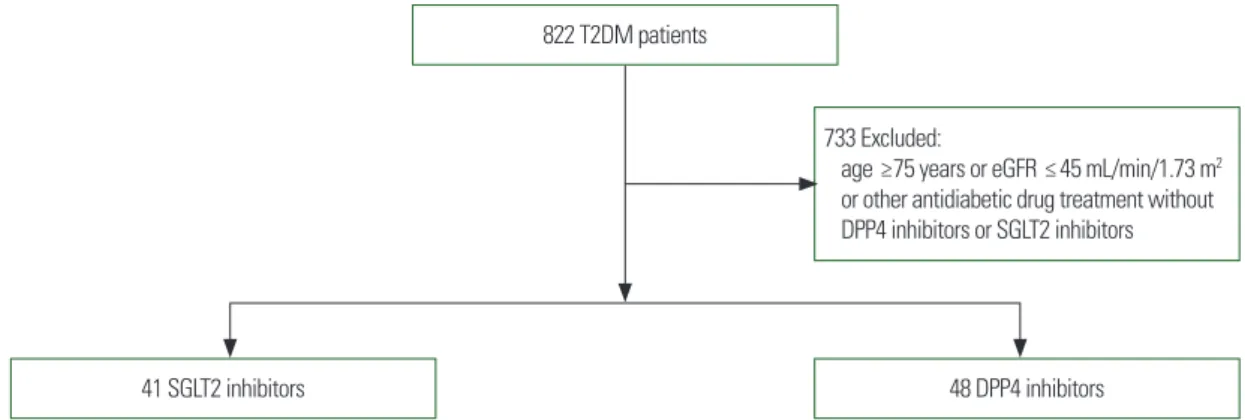
Figure 1. Flowchart of patient selection and grouping. All 822 patients had underwent percutaneous coronary intervention or coronary artery bypass graft and had type 2 diabetes mellitus (T2DM). Four hundred forty-four patients were excluded because they took antidiabetic medications other than sodium-glucose cotransporter-2 (SGLT2) inhibitors or dipeptidyl peptidase-4 (DPP4) inhibitors. Two hundred eighty-nine of 378 patients were excluded for age or estimated glomerular filtration rate (eGFR). Eighty- nine patients were distributed to SGLT2 inhibitor or DPP4 inhibitor groups.
822 T2DM patients
41 SGLT2 inhibitors 48 DPP4 inhibitors
733 Excluded:
age ≥75 years or eGFR ≤ 45 mL/min/1.73 m2 or other antidiabetic drug treatment without DPP4 inhibitors or SGLT2 inhibitors
antidiabetic agents without DPP4 inhibitors or SGLT2 inhibitors.
In summary, 157 patients on SGLT2 inhibitors and patients on 221 DPP4 inhibitors were selected. A total of 289 patients were exclud- ed for age ≥ 75 years old or estimated glomerular filtration rate (eGFR) ≤ 45 mL/min/1.73 m
2. Eighty-nine patients with T2DM were identified as new users of SGLT2 inhibitors (n= 41) or DPP4 inhibitors (n= 48). Patients were divided into two groups: SGLT2 inhibitors and DPP4 inhibitors (Fig. 1).
After PCI or CABG, patients were given SGLT2 inhibitors or DPP4 inhibitors. Echocardiography tests were performed at least twice. The first exam was performed before intervention or CABG.
SGLT2 inhibitors or DPP4 inhibitors were prescribed to patients after intervention or surgery. Follow-up echocardiography was per- formed at least 6 months after initial administration of each drug (SGLT2 inhibitors or DPP4 inhibitors). Changes from the baseline in each group were analyzed. BMI, random glucose level, systolic and diastolic BP, NT-pro BNP, echocardiographic markers (LVEF, E/e’, E/A), and hospitalization for HF were assessed. LVEF, E/e’, E/A, and other echocardiographic measures were assessed by Sie- mens (SC2000; Acuson, Mountain View, CA, USA). Two-dimen- sional echocardiography was used to evaluate systolic and diastolic cardiac function, such as LVEF, E/e’, and E/A. Cardiac structures were shown in two dimensions. LVEF was measured using a bi- plane method. Doppler was used for E/e’. NT-pro BNP was mea- sured using electrochemiluminescence immunoassay to estimate myocardial stretching status (Roche, Seoul, Korea). Myocardium- derived NT-pro BNP helps to determine cardiac function and HF progression.
Student t-test was performed to analyze baseline characteristics.
Multi-response analysis was performed for antidiabetic agents (metformin, sulfonylurea, insulin, DPP4 inhibitors, SGLT2 inhibi- tors). The SGLT2 inhibitors group and DPP4 inhibitors group were compared by P-values. P-value ≤0.05 was considered signifi- cant. Statistical computations were performed with IBM SPSS ver- sion 20.0 (IBM Corp., Armonk, NY, USA).
RESULTS
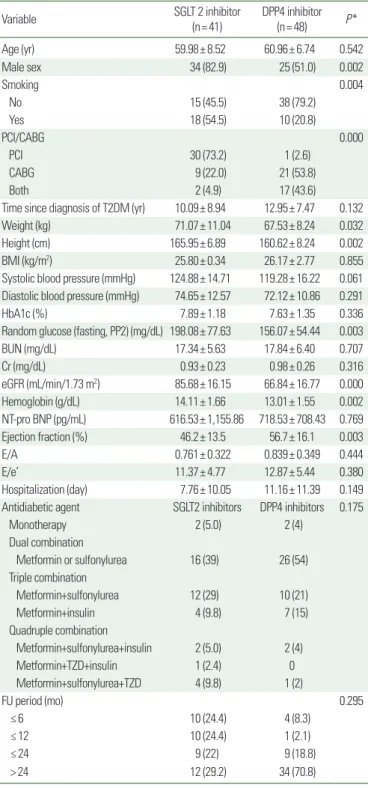
The 89 patients were divided into two groups (SGLT2 inhibitors vs DPP4 inhibitors). In the SGLT2 inhibitors group, mean baseline
Table 1. Baseline characteristics of SGLT2 and DPP4 inhibitor groups
Variable SGLT 2 inhibitor
(n= 41) DPP4 inhibitor
(n= 48) P *
Age (yr) 59.98± 8.52 60.96± 6.74 0.542
Male sex 34 (82.9) 25 (51.0) 0.002
Smoking 0.004
No 15 (45.5) 38 (79.2)
Yes 18 (54.5) 10 (20.8)
PCI/CABG 0.000
PCI 30 (73.2) 1 (2.6)
CABG 9 (22.0) 21 (53.8)
Both 2 (4.9) 17 (43.6)
Time since diagnosis of T2DM (yr) 10.09± 8.94 12.95± 7.47 0.132
Weight (kg) 71.07± 11.04 67.53± 8.24 0.032
Height (cm) 165.95± 6.89 160.62± 8.24 0.002
BMI (kg/m2) 25.80± 0.34 26.17± 2.77 0.855
Systolic blood pressure (mmHg) 124.88± 14.71 119.28± 16.22 0.061 Diastolic blood pressure (mmHg) 74.65± 12.57 72.12± 10.86 0.291
HbA1c (%) 7.89± 1.18 7.63± 1.35 0.336
Random glucose (fasting, PP2) (mg/dL) 198.08± 77.63 156.07± 54.44 0.003
BUN (mg/dL) 17.34± 5.63 17.84± 6.40 0.707
Cr (mg/dL) 0.93± 0.23 0.98± 0.26 0.316
eGFR (mL/min/1.73 m2) 85.68± 16.15 66.84± 16.77 0.000
Hemoglobin (g/dL) 14.11± 1.66 13.01± 1.55 0.002
NT-pro BNP (pg/mL) 616.53± 1,155.86 718.53± 708.43 0.769
Ejection fraction (%) 46.2± 13.5 56.7± 16.1 0.003
E/A 0.761± 0.322 0.839± 0.349 0.444
E/e’ 11.37± 4.77 12.87± 5.44 0.380
Hospitalization (day) 7.76± 10.05 11.16± 11.39 0.149 Antidiabetic agent SGLT2 inhibitors DPP4 inhibitors 0.175
Monotherapy 2 (5.0) 2 (4)
Dual combination
Metformin or sulfonylurea 16 (39) 26 (54) Triple combination
Metformin+sulfonylurea 12 (29) 10 (21)
Metformin+insulin 4 (9.8) 7 (15)
Quadruple combination
Metformin+sulfonylurea+insulin 2 (5.0) 2 (4)
Metformin+TZD+insulin 1 (2.4) 0
Metformin+sulfonylurea+TZD 4 (9.8) 1 (2)
FU period (mo) 0.295
≤ 6 10 (24.4) 4 (8.3)
≤ 12 10 (24.4) 1 (2.1)
≤ 24 9 (22) 9 (18.8)
> 24 12 (29.2) 34 (70.8)
Values are presented as mean± standard deviation or number (%).
*P< 0.05, statistically significant difference.
SGLT2, sodium-glucose cotransporter-2; DPP4, dipeptidyl peptidase-4; PCI, percutaneous coronary intervention; CABG, coronary artery bypass graft; T2DM, type 2 diabetes mel- litus; BMI, body mass index; HbA1c, glycated hemoglobin; PP2, post prandial plasma glucose 2 hours; BUN, blood urea nitrogen; Cr, creatinine; eGFR, estimated glomerular filtration rate; NT-pro BNP, N-terminal prohormone of brain natriuretic peptide; E/A, ra- tio of early (E) to late (A) ventricular filling velocities; E/e’, ratio of mitral peak velocity of early filling velocity to early diastolic mitral annular velocity; TZD, thiazolidinedione; FU, follow-up.
medications (double or triple or quadruple combination, 39% vs.
54% or 38.8% vs. 36% or 17.2% vs. 6%, respectively).
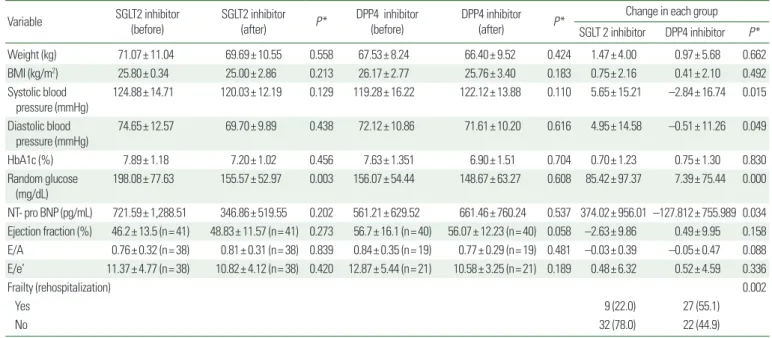
Cardiac function markers, such as NT-pro BNP (ng/mL) and BP (systole and diastole, mmHg), showed significant changes in the SGLT 2 inhibitor group compared with the DPP4 inhibitor group. Reduced systolic pressure (5.65± 15.21 mmHg, P=0.015), diastolic pressure (4.95± 14.58 mmHg, P=0.049), and NT-pro BNP (374.02± 956.01 ng/mL, P=0.034) were observed in the SGLT2 inhibitor group (Table 2). No significant difference in LVEF was observed between these two groups (Fig. 2). Subgroup analy- sis was performed based on degree of LVEF (< 40%, 40%–50%,
≥ 50%) and E/e’ (< 13, ≥ 13). The SGLT2 inhibitor group had improved LV dysfunction, especially in the reduced LVEF group (LVEF < 40%; –9.57 ± 8.39, P =0.035). Diastolic dysfunction markers (E/e’, 6.54± 2.95) and NT-pro BNP were also improved in the SGLT2 inhibitor group (P=0.008), especially in the E/e’
≥ 13 subgroup (Table 3). The DPP4 inhibitor group had a higher rate of rehospitalization (22% vs. 55.1%, P=0.002). The major cause of hospitalization in both groups was coronary artery disease (data not shown). While patients in the SGLT2 inhibitor group had reduced body weight or BMI, there was no difference in BMI
Table 2. Changes of morphologic, chemical, and cardiovascular function findings before and after treatment with SGLT2 inhibitor and DPP4 inhibitor
Variable SGLT2 inhibitor
(before)
SGLT2 inhibitor
(after) P * DPP4 inhibitor (before)
DPP4 inhibitor
(after) P * Change in each group
SGLT 2 inhibitor DPP4 inhibitor P *
Weight (kg) 71.07± 11.04 69.69± 10.55 0.558 67.53± 8.24 66.40± 9.52 0.424 1.47± 4.00 0.97± 5.68 0.662
BMI (kg/m2) 25.80± 0.34 25.00± 2.86 0.213 26.17± 2.77 25.76± 3.40 0.183 0.75± 2.16 0.41± 2.10 0.492
Systolic blood pressure (mmHg)
124.88± 14.71 120.03± 12.19 0.129 119.28± 16.22 122.12± 13.88 0.110 5.65± 15.21 –2.84± 16.74 0.015 Diastolic blood
pressure (mmHg)
74.65± 12.57 69.70± 9.89 0.438 72.12± 10.86 71.61± 10.20 0.616 4.95± 14.58 –0.51± 11.26 0.049
HbA1c (%) 7.89± 1.18 7.20± 1.02 0.456 7.63± 1.351 6.90± 1.51 0.704 0.70± 1.23 0.75± 1.30 0.830
Random glucose
(mg/dL) 198.08± 77.63 155.57± 52.97 0.003 156.07± 54.44 148.67± 63.27 0.608 85.42± 97.37 7.39± 75.44 0.000
NT- pro BNP (pg/mL) 721.59± 1,288.51 346.86± 519.55 0.202 561.21± 629.52 661.46± 760.24 0.537 374.02± 956.01 –127.812± 755.989 0.034 Ejection fraction (%) 46.2± 13.5 (n= 41) 48.83± 11.57 (n= 41) 0.273 56.7± 16.1 (n= 40) 56.07± 12.23 (n= 40) 0.058 –2.63± 9.86 0.49± 9.95 0.158 E/A 0.76± 0.32 (n= 38) 0.81± 0.31 (n= 38) 0.839 0.84± 0.35 (n= 19) 0.77± 0.29 (n= 19) 0.481 –0.03± 0.39 –0.05± 0.47 0.088 E/e’ 11.37± 4.77 (n= 38) 10.82± 4.12 (n= 38) 0.420 12.87± 5.44 (n= 21) 10.58± 3.25 (n= 21) 0.189 0.48± 6.32 0.52± 4.59 0.336
Frailty (rehospitalization) 0.002
Yes 9 (22.0) 27 (55.1)
No 32 (78.0) 22 (44.9)
Values are presented as mean± standard deviation.
*P< 0.05, statistically significant difference.
SGLT2, sodium-glucose cotransporter-2; DPP4, dipeptidyl peptidase-4; BMI, body mass index; HbA1c, glycated hemoglobin; NT-pro BNP, N-terminal prohormone of brain natriuretic peptide; E/A, ratio of early (E) to late (A) ventricular filling velocities; E/e’, ratio of mitral peak velocity of early filling velocity to early diastolic mitral annular velocity.
age was 59.98 years, diabetes duration was 10.09 years, HbA1C was 7.89%, eGFR was 815.68 mL/min/1.73 m
2, and BMI was 25.80 kg/m
2. In the DPP4 inhibitors group, mean baseline age was 60.96 years, diabetes duration was 12.95 years, HbA1C was 7.63%, eGFR was 66.84 mL/min/1.73 m
2, and BMI was 26.17 kg/m
2. At the beginning of this study, there were several significant differenc- es between these two groups. Male patients (n= 34, 82.9%) were dominant in the SGLT2 inhibitor group. Random glucose (198.08±
77.63 mg/dL) was higher in the SGLT2 inhibitor group. eGFR (85.68± 16.15 mL/min/1.73 m
2) was also higher in the SGLT2 inhibitor group. Smoking rate was higher in the SGLT2 inhibitor group (54.5% vs. 20.8%), and the number of non-smokers was lower in the DPP4 inhibitor group (45.5% vs. 79.2%) (Table 1).
Prior to PCI or CABG, there was no significant difference in anti- diabetic agent prescription between the SGLT2 inhibitor group and the DPP4 inhibitor group (P=0.175). The follow-up period was not different between the SGLT2 inhibitor group and the DPP4 inhibitor group (P=0.295 for both). However, there was a tenden- cy for a longer follow up period (especially > 24 months follow=
up, 70.8%) after PCI or CABG in the DPP4 inhibitor group (Table
1). Most patients (in both groups) had taken multiple antidiabetic
between these two groups (0.75± 2.16 vs. 0.41± 2.10 kg/m
2, P=
0.492).
DISCUSSION
This study was designed to assess differences between patients with T2DM and CAD treated with SGLT2 inhibitors or DPP4 in- hibitors. After PCI or CABG was performed, SGLT2 inhibitors or
DPP4 inhibitors were prescribed to two different groups. Patient distribution (SGLT2 inhibitors vs DPP4 inhibitors) was similar to that of the EMPA-REG trial.
7Our study included patients with CAD but not cerebrovascular diseases. Conversely, the EMPA- REG trial included patients with CAD and cerebrovascular diseases.
BP (systole, diastole), NT-pro BNP, systolic cardiac functions (LVEF), and diastolic cardiac function marker (E/e’) were signifi- cantly reduced, especially in the SGLT2 inhibitors group. No sig-
Table 3. Subgroup analysis of cardiac function according to ejection fraction and E/e’Variable SGLT2 inhibitor
(before) SGLT2 inhibitor
(after) P * DPP4 inhibitor
(before) DPP4 inhibitor
(after) P * Change in each group
SGLT 2 inhibitor DPP4 inhibitor P * Ejection fraction (%)
< 40 29.00± 6.21 (n= 13) 38.54± 9.20 (n= 13) 0.089 28.00± 6.60 (n= 6) 40.83± 10.69 (n= 6) 0.119 –9.57± 8.39 (n= 14) –10.5± 13.75 (n= 6) 0.035 40–50 45.71± 3.20 (n= 7) 49.00± 12.46 (n= 7) 0.030 45.80± 2.17 (n= 5) 50.20± 7.63 (n= 5) 0.198 –2.16± 11.43 (n= 6) –4.40± 9.04 (n= 5) 0.363 ≥ 50 57.00± 4.57 (n= 21) 55.14± 7.72 (n= 21) 0.148 64.52± 9.68 (n= 29) 61.10± 9.90 (n= 29) 0.790 1.86± 7.83 (n= 21) 3.62± 7.47 (n= 29) 0.925 E/e’
< 13 9.19± 1.78 (n= 29) 10.44± 4.38 (n= 29) 0.019 10.72± 1.29 (n= 14) 10.94± 3.85 (n= 14) 0.013 –1.25± 4.64 (n= 29) 0.33± 3.89 (n= 15) 0.553 ≥ 13 18.32± 4.65 (n= 9) 12.27± 2.62 (n= 9) 0.094 14.85± 1.19 (n= 7) 11.56± 2.43 (n= 7) 0.073 6.54± 2.95 (n= 8) 8.98± 10.05 (n= 10) 0.008 Values are presented as mean± standard deviation. Systolic function (ejection fraction), especially < 40 group, improved significantly in SGLT2 inhibitor group (P= 0.035). Diastolic dysfunction (E/e’), especially ≥ 13 group, improved in SGLT2 inhibitor group (P= 0.008).
*P< 0.05, statistically significant difference.
E/e’, ratio of mitral peak velocity of early filling (E) to early diastolic mitral annular velocity (E’); SGLT2, sodium-glucose cotransporter-2; DPP4, dipeptidyl peptidase-4.
Figure 2. Changes of cardiac markers before and after treatment with sodium-glucose co- transporter-2 inhibitor (SGLT2i) or dipeptidyl peptidase-4 inhibitor (DPP4i). Changes of blood pressure (BP; systole [A], diastole [B]), N-termi- nal prohormone of brain natriuretic peptide (NT- pro BNP [C]), ejection fraction (D), and ratio of mitral peak velocity of early filling velocity to early diastolic mitral annular velocity (E/e’ [E]) were significant with SGLT2 inhibitors.
800
600
400
200
0 Pretreated Posttreated
NT-pro BNP
P= 0.034
SGLT2 i DPP4 i C
pg/mL
76
74
72
70
68
66 Pretreated Posttreated
Diastolic BP
P= 0.049
SGLT2 i DPP4 i
20
15
10
5
0 Pretreated Posttreated
E/e’ (≥ 13)
P= 0.035
SGLT2 i DPP4 i B
E
mmHg
126
124
122
120
118
116 Pretreated Posttreated
Systolic BP
P= 0.015
SGLT2 i DPP4 i
50
40
30
20
10
0 Pretreated Posttreated
Ejection fraction (< 40%)
P= 0.035
SGLT2 i DPP4 i A
D
mmHg %