• 검색 결과가 없습니다.

The Effects of Earnings Management and Audit Quality on Cost of Equity Capital: Empirical Evidence from Indonesia

N/A
N/A
Protected

Academic year: 2021

Share "The Effects of Earnings Management and Audit Quality on Cost of Equity Capital: Empirical Evidence from Indonesia"

Copied!
8
0
0

로드 중.... (전체 텍스트 보기)

전체 글

(1)

Print ISSN: 2288-4637 / Online ISSN 2288-4645 doi:10.13106/jafeb.2021.vol8.no4.0769

The Effects of Earnings Management and Audit Quality on Cost of Equity Capital: Empirical Evidence from Indonesia

Maria Goreti Kentris INDARTI

1

, Jacobus WIDIATMOKO

2

Received: December 15, 2020 Revised: March 06, 2021 Accepted: March 15, 2021

Abstract

The focus of this study is to investigate the effect of earnings management and audit quality on the cost of equity capital and also examines whether audit quality acts as a moderating variable for the effect of earnings management on the cost of equity capital. The population in this study are companies from the consumer goods industry sector listed on the Indonesia Stock Exchange (IDX) during the 2016–2018 period.

This sector was chosen because it is a sector that is able to survive in conditions of economic decline, so it becomes a good investment opportunity in the future. The sample selection was carried out using purposive sampling technique. By using the Moderated Regression Analysis (MRA) technique, the results show that earnings management has a positive effect on the cost of equity capital. Conversely, companies with good audit quality will bear lower cost of equity capital. The moderating hypothesis test results show that audit quality moderates the effect of earnings management on the cost of equity capital. This means that, even though the company carries out earnings management, investors have more confidence in the results of audits conducted by qualified auditors so that the cost of equity capital is low.

Keywords: Earnings Management, Audit Quality, Cost of Equity Capital, Moderated Regression Analysis JEL Classification Code: M4, M41, M42

by investors as compensation for this risk. The high cost of equity capital will affect the company’s future growth.

Therefore, various efforts have been made by the company to reduce the cost of equity capital, so that the company’s value can be maximized. Low cost of equity capital reflects a low company risk, thus leading shareholders to assume that the value of the company is high. However, the facts show that the cost of equity capital borne by the company has increased every year (Kiswanto & Fitriani, 2019).

The importance of the cost of equity capital has prompted researchers to examine various variables that influence the cost of equity capital. These variables include earnings management (Kiswanto & Fitriani, 2019; Meini & Siregar, 2014; O’Callaghan, Ashton, & Hodgkinson, 2018; Utami &

Pernamasari, 2020) and audit quality (Houqe et al., 2017;

Ningsih & Ariani, 2016; Setiawan & Daljono, 2014; Wiyadi et al., 2017).

Earnings management is an action taken to get the desired earnings, by misleading the market in relation to the company’s actual performance (Caylor et al., 2015). It can be done by selecting certain accounting methods (Diri, 2017) and naturaly, cannot be separated from the characteristics in the agency relationship between shareholders and management. Managers have better, more, and faster

1

First Author and Corresponding Author. Associate Professor, Department of Accounting, Faculty of Economics and Business, Universitas Stikubank Semarang, Indonesia [Postal Address: Jalan Kendeng Barat V/52, Sampangan, Semarang 50233, Indonesia]

Email: [email protected]

2

Associate Professor, Department of Accounting, Faculty of Economics and Business, Universitas Stikubank Semarang, Indonesia. Email: [email protected]

© Copyright: The Author(s)

This is an Open Access article distributed under the terms of the Creative Commons Attribution Non-Commercial License (https://creativecommons.org/licenses/by-nc/4.0/) which permits unrestricted non-commercial use, distribution, and reproduction in any medium, provided the original work is properly cited.
1. Introduction

The cost of equity capital is one of the main concepts

in the financial literature and plays an important role in the

financial and investment decisions of companies, namely,

to ensure appropriate financial resources, determine the

cost of funding and the impact of these resources on the

risk and return of the company (Pham et al., 2012; Salehi

et al., 2020). Dhaliwal, Li, Tsang, and Yang (2011) state that

the cost of equity capital is the same as the rate of return

required by investors in relation to existing risks. The higher

the risk of an investment, the higher the return required

(2)

information than shareholders, resulting in information asymmetry (Meini & Siregar, 2014), which encourages management to carry out earnings management in order to maximize their own welfare.

Management behavior that underlies earnings management is opportunistic behavior. Accounting information plays a fundamental role as the basis for the allocation of capital in financial markets (Bhattacharya et al., 2013). Earnings is accounting information that is an important benchmark for investors in deciding to invest in a company, so that management will adjust earnings to attract investors. However, rational investors will require a premium level on agency risk which is reflected in the cost of equity capital (Utami & Pernamasari, 2020).

Kim and Sohn (2013) state that earnings management can reduce the quality of earnings information used by investors, so that the market demands a high risk premium as a result of additional premium risk due to earnings management activities. As a consequence, the cost of equity capital will increase.

The results of previous research show that earnings management practices will increase the cost of equity capital of the company (Kiswanto & Fitriani, 2019; Utami &

Pernamasari, 2020). O’Callaghan, Ashton, and Hodgkinson (2018), in their research on large private companies in the UK, stated that earnings management will increase the cost of equity capital. However, different results are shown by Meini and Siregar (2014) and Febrininta and Siregar (2014), who found that earnings management has no effect on the cost of equity capital.

Based on agency theory, quality audits are considered to have an important role in reducing agency conflicts.

Qualified auditors act as powerful monitoring mechanisms and send positive signals to the market. It is expected that investors will appreciate these companies to reduce information asymmetry, thereby reducing the cost of equity capital (Houqe et al., 2017). This occurs because the reliable financial reporting that is guaranteed by the audit can increase management accountability and become an effective tool for shareholders to monitor management duties. In addition, the existence of qualified auditors will reduce the risk of information faced by investors because their existence increases the credibility of financial reports (Pham et al., 2020; Salehi et al., 2017).

Setiawan and Daljono (2014) examined the effect of audit quality on the cost of equity capital in manufacturing companies on the Indonesia Stock Exchange. The results show that companies audited by public accounting firms affiliated to the Big Four have a lower cost of equity capital. The results of research by Ningsih and Ariani (2016) show that audit quality has a negative effect on the cost of equity capital. The same finding was also stated by Houqe et al. (2017) who conducted research on companies

listed on the Indian capital market, which showed that audit quality was able to reduce the cost of equity capital.

However, different research results were shown by Wiyadi et al. (2017), which states that audit quality has no effect on the cost of equity capital.

This research is motivated by several elements, which are also the contributions of this research. First, until now, earnings management is still a central topic in theoretical and empirical research in the field of accounting (Beyer et al., 2019). Second, this study contributes to the current literature with a focus on investigating the effect of earnings management on the cost of equity capital by including the audit quality variable as a moderating variable. This is due to the inconsistent results of research on the effect of earnings management and audit quality on the cost of equity capital.

Following Baron and Kenny (1986), inconsistent research results provide opportunities for moderating variables in the relationship between independent and dependent variables.

2. Literature Review and Hypothesis Development

2.1. Earnings Management and Cost of Equity Capital

Earnings information is basic information that users must have before making a decision (Utami & Pernamasari, 2020). The importance of company earnings information has encouraged company management to manipulate actual earnings information. It can be ascertained that managers have better, more, and faster information than shareholders, resulting in information asymmetry (Meini

& Siregar, 2014), which encourages management to carry out earnings management in order to maximize their own welfare. Manipulation is carried out by adjusting earnings to the company’s goals. However, rational investors will put a price on agency risk that reflects the level of the cost of equity capital (Utami & Pernamasari, 2020). Kim and Sohn (2013) state that earnings management can reduce the quality of earnings information used by investors, so that the market demands a high premium risk as a result of additional premium risk due to accrual earnings management activities. As a consequence, the cost of equity capital will increase.

Research by Meini and Siregar (2014), and Kiswanto and

Fitriani (2019) examined the effect of earnings management

on the cost of equity capital in Indonesia. Their results

prove that earnings management has a positive effect on

the cost of equity capital. This finding is supported by the

results of research O’Callaghan, Ashton, and Hodgkinson

(2018), as well as which show that the higher the level of

earnings management, the higher the cost of equity capital

of the company. Companies with a high level of earnings

(3)

management are considered to have high risks. As a consequence, investors will ask for a high rate of return as a consequence of the risks they bear. Based on the logic and empirical findings, the following hypothesis is formulated.

H1: Earnings management has a positive effect on the cost of equity capital.

2.2. Audit Quality and Cost of Equity Capital The presence of qualified auditors within a company can act as a powerful monitoring mechanism for management and serve to convey positive signals to the market.

Qualified auditors are also considered to play an important role in reducing agency conflicts. Reliable financial reporting guaranteed by a qualified auditor can improve management accountability and be an effective tool for shareholders to monitor management tasks (Ningsih &

Ariani, 2016). As earlier literature suggests that high audit quality will enhance the confidence of investors in the financial reporting issued by external auditors (Alawaqleh et al., 2021). It is hoped that investors will appreciate these companies for reducing information asymmetry and as a bonding mechanism so that there is greater supervision of management (Houqe et al., 2017). Companies with strict governance and good performance will voluntarily use qualified auditors to maintain their good reputation and show that they have nothing to hide. This condition will be responded positively by investors because the company is considered to have low risk, so the required rate of return will be low. Consequently, the cost of equity capital borne by the company will be low.

Research by Setiawan and Daljono (2014) shows that companies audited by public accounting firms affiliated to the Big Four have a lower cost of equity capital. This is because the quality of the audit increases the transparency of the reporting and disclosure of the company, so that the risk of the company is assessed low by investors, which will ultimately lower the rate of return demanded by investors.

This finding is supported by the results of research by Houqe et al. (2017), which shows that audit quality can reduce the cost of equity capital. Therefore, the hypothesis is formulated as follows:

H2: Audit quality has a negative effect on the cost of equity capital.

2.3. Earnings Management, Audit Quality and Cost of Equity Capital

Based on the perspective of agency theory, external auditors can be used as a monitoring mechanism to align interests between shareholders and management. This

mechanism is a manifestation of the external mechanism for corporate governance. A qualified external auditor will help minimize earnings manipulation by management, thereby reducing the asymmetry of information between the two parties (Alzoubi, 2018). Qualified external auditors, who are members of the Big Four public accounting firms, have a strong incentive to provide or maintain high quality audits due to the fact that they have: (1) a higher number of clients; (2) significant resources to support the audit process (recruitment, training and technology); (3) the possibility of suffering a greater loss if they do not report violations, such as termination of employment with clients, loss of reputation (Rusmin, 2010). In addition, the reliability and fairness of financial reports that have been verified by a qualified external auditor will improve the quality of financial information and reduce earnings management, which will have an impact on lowering the cost of equity capital.

H3: Audit quality weakens the positive influence of earnings management on the cost of equity capital.

3. Research Methods 3.1. Population and Sample

This study uses manufacturing companies in the consumer goods industry sector, which are listed on the Indonesia Stock Exchange from 2016 to 2018 as the population. This sector was chosen because the consumer goods industry is a sector that is able to survive in a downturn in economic conditions, so it becomes a good investment opportunity in the future. The sample selection method used was purposive sampling, with the following criteria: (1) presenting financial reports for the period 2016 to 2018 and (2) having complete data.

3.2. Operational Definition and Variables Measurement

The cost of equity capital as the dependent variable is proxied by using the Ohlson (1995) model. The model calculate the cost of equity capital using the formula as follows:

r = (B

t

+ X

t

+ 1 - P

t

) / (P

t

) Where:

P

t

: Share price in period t

B

t

: Book value per share for period t X

t+1

: Earnings per share in period t + 1 r : Cost of equity capital

Earnings per share for the next year (X

t + 1

) is estimated

using random walk model.

(4)

Random Walk:

E(X

t

+ 1) = X

t

+ d Where:

E(X

t

+ 1) : Estimated earnings per share in period t + 1 X

t

: Earnings per share in period t

d : Drift Term (average earnings per share for 5 years)

Earnings management is measured using a specific accrual model, namely the ratio of working capital accruals to sales. This method is considered more appropriate with sales because earnings management occurs a lot in sales accounts (Nelson et al., 2005). The formula used to calculate earnings management is:

Earnings Management (EM) = Working Capital Accural / Sales

Working Capital Accural = ∆CA - ∆CL - ∆Cash Where:

∆CA : Change in current assets in period t

∆CL : Changes in current liability in period t

∆Cash : Change in cash and cash equivalents in period t

Referring to the research of Setiawan and Daljono (2014), audit quality is measured using the dummy variable, namely, the value of 1 for companies audited by firm affiliated with Big Four audit firms and 0 for the opposite.

Auditors at Big Four audit firms are considered to have high values of independence, objectivity, and honesty. This study used two control variables, namely, leverage and firm size.

Leverage is measured by debt-to-total asset and company size is measured by the natural logarithm of the company’s total assets (Widiatmoko & Indarti, 2019).

3.3. Data Analysis Techniques

The data analysis technique used in this study is moderated regression analysis (MRA) with the following equation:

CEC = α + β

1

EM + β

2

AQ + β

3

EM_AQ + β

4

LEV + β

5

SIZE + e

Where:

CEC : Cost of equity capital α : Constant

β : Regression coefficient EM : Earnings management AQ : Audit quality

LEV : Leverage SIZE : Firm size e : Error term

4. Results and Discussion 4.1. Descriptive Statistics

Based on the criteria for selecting the sample, 131 data were obtained. After transforming the data to achieve residual normality, there were 16 outliers released so that the number of data analyzed was 115. Table 1 presents descriptive statistics for all research variables in the form of minimum values, maximum values, mean values, and deviation standard.

The average cost of equity capital is negative, indicating that the companies in the sector under study have a relatively low risk. A positive number on the average value of earnings management means that the sample companies are aggressively managing earnings. The information in Table 1 also shows that 43% of the sample companies were audited by Big Four audit firms and the remaining 57% were audited by non-Big Four audit firms. Based on the descriptions of the three variables, it can be concluded that, although the sample companies on average carry out earnings management aggressively, the level of return demanded by investors is relatively low due to low corporate risk. This occurs because of investor confidence in external auditors who are members of the Big Four audit firms.

The leverage variable as a control variable shows a minimum value of 0.1872, a maximum value of 31.0367, Table 1: Descriptive Statistics

Variables N Minimum Maximum Mean Std. Deviation

CEC 115 -1.8402 1.5870 -0.2203 0.4546

EM 115 -0.7822 1.4720 0.0008 0.2000

EM_AQ 115 -0.7822 1.4720 -0.0162 0.1857

LEV 115 0.1872 31.0367 1.3833 3.1440

SIZE 115 16.3490 26.6234 21.6833 1.8137

Variables N Audit Firm Total (%) Audit Firm Total (%)

AQ 115 Big Four 50 (43%) Non Big Four 65 (57)

Note: CEC: Cost of Equity Capital, EM: Earnings Management, AQ: Audit Quality, LEV: Leverage, Size: Firm Size.

(5)

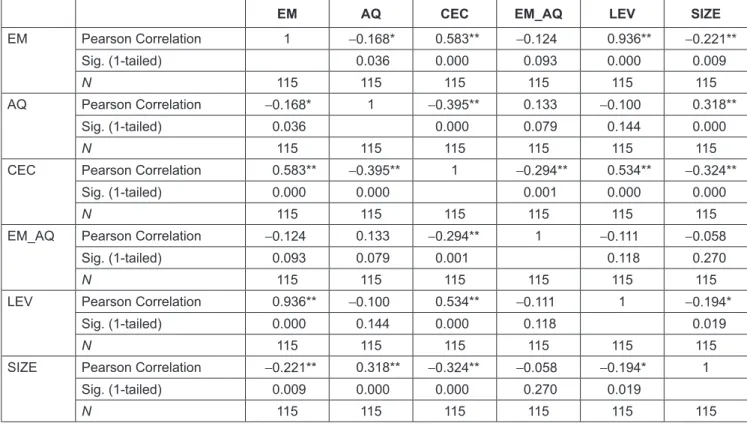
Table 2: Pearson Correlation Matrix

EM AQ CEC EM_AQ LEV SIZE

EM Pearson Correlation 1 -0.168* 0.583** -0.124 0.936** -0.221**

Sig. (1-tailed) 0.036 0.000 0.093 0.000 0.009

N 115 115 115 115 115 115

AQ Pearson Correlation -0.168* 1 -0.395** 0.133 -0.100 0.318**

Sig. (1-tailed) 0.036 0.000 0.079 0.144 0.000

N 115 115 115 115 115 115

CEC Pearson Correlation 0.583** -0.395** 1 -0.294** 0.534** -0.324**

Sig. (1-tailed) 0.000 0.000 0.001 0.000 0.000

N 115 115 115 115 115 115

EM_AQ Pearson Correlation -0.124 0.133 -0.294** 1 -0.111 -0.058

Sig. (1-tailed) 0.093 0.079 0.001 0.118 0.270

N 115 115 115 115 115 115

LEV Pearson Correlation 0.936** -0.100 0.534** -0.111 1 -0.194*

Sig. (1-tailed) 0.000 0.144 0.000 0.118 0.019

N 115 115 115 115 115 115

SIZE Pearson Correlation -0.221** 0.318** -0.324** -0.058 -0.194* 1

Sig. (1-tailed) 0.009 0.000 0.000 0.270 0.019

N 115 115 115 115 115 115

Note: CEC: Cost of Equity Capital, EM: Earnings Management, AQ: Audit Quality, LEV: Leverage, Siz: Firm Size.

** Significant at the Level of 1%, * Significant at the Level of 5%.

and an average value of 1.3833 with a standard deviation of 3.1440. These results indicate that the average level of debt owned by the company is above its total assets. Meanwhile, the company size variable shows a minimum value of 16.3490, a maximum value of 26.6234, and an average value of 21.6833 with a standard deviation of 1.8137. This condition shows that the distribution of data for company size is relatively even.

4.2. Pearson Correlation Matrix

Table 2 shows that the magnitude of the correlation between the independent variables is below 0.5, which means that in this study there is no collinearity problem. These results are in accordance with the results of the multicollinearity test presented in Table 3. Earnings management has a significant positive relationship with the cost of equity capital. This means that earnings management actions will be responded negatively by the market, thereby increasing the return demanded by investors. Conversely, audit quality has a significant negative relationship with the cost of equity capital. The financial statements audited by Big Four KAP are seen to provide better quality information, thereby reducing the cost of equity capital. The audit quality variable has a

negative correlation with earnings management, meaning that the presence of qualified auditors will be able to minimize earnings management practices. However, when the company is audited by a qualified public accounting firm, earnings management will reduce the cost of equity capital. This can be seen in the negative relationship between the interaction of earnings management and audit quality with the cost of equity capital. These results indicate that in determining the expected rate of return, investors are more based on the quality of the external auditors who audit the company.

4.3. Test Results of Moderated Regression Analysis

The results of the residual normality test as seen in Table 3

show the z-skewness number of 0.181, between ±1.96,

so that the residuals in the regression model are normally

distributed. Based on Table 3, the multicollinearity test

results show that all variables have a variance inflation

factor (VIF) value of less than 10, the durbin-watson value

is 1.605, is between the du 1.583 and 4-du values of 2.417,

and the heteroscedasticity test shows that all variables has

a significance value above 0.05, so that in the regression

model there are no multicollinearity, autocorrelation, and

heteroscedasticity problems.

(6)

The coefficient of determination in Table 3 shows a value of 0.464, which means that 46.4% of the variation in the cost of equity capital can be explained by earnings management variables, audit quality, the interaction between earnings management and audit quality, leverage, and company size, while the remaining 53.60% explained by other variables outside the model. The calculated F value shows a significant number of 20,728 at the level of 0.000, which means that together the earnings management variables, audit quality, the interaction between earnings management and audit quality, leverage, and firm size affect the cost of equity capital, so the model is declared feasible.

The results of hypothesis testing of earnings management variables show a beta coefficient value of 1.010 with a significance level of 0.029. Therefore the first hypothesis, which states that earnings management has a positive effect on the cost of equity capital, is accepted. The audit quality variable has a beta coefficient of -0.218 with a significance level of 0.02, which means that audit quality has a significant negative effect on the cost of equity capital, as hypothesized.

The interaction between earnings management variables and audit quality shows a beta coefficient value of -0.031 with a significance value of negative effect and a significant level of 0.003. As predicted, audit quality moderated the effect of earnings management on the cost of equity capital. Testing of leverage and firm size as control variables shows that firm size has a significant negative effect on the cost of equity capital, but leverage has no effect on the cost of equity capital.

4.4. Discussion

Based on the information in Table 3, it can be seen that earnings management has a positive effect on equity

capital costs. The explanation that can be given to this result is that earnings management can lower the quality of earnings information delivered by the company, so that the company is seen as risky by investors. Therefore, the market will demand higher premium risk as a result of the additional risk caused by accrual earnings management activities. As a result, the cost of equity capital will increase. Research by Meini and Siregar (2014) and Kiswanto and Fitriani (2019) conducted in Indonesia, show that earnings management has a positive effect on equity capital. These findings are supported by the findings of O’Callaghan, Ashton, and Hodgkinson (2018), which show that the higher the level of earnings management, the higher the equity capital costs incurred by the company. Companies with a high level of earnings management are considered to have high risk by the market. As a result, investors will request a high rate of return as a consequence of the risk they bear.

The results of the second hypothesis testing indicate that audit quality as measured by audit firm affiliation to Big Four and non-Big Four audit firms has a negative effect on the cost of equity capital. Audit quality is seen as a positive signal for the quality of information presented by the company (Houqe et al., 2017). This is because the quality of the audit increases the transparency of the reporting and disclosure of the company, so that the risk of the company is assessed low by investors, which will ultimately lower the rate of return demanded by investors. The results of this study are in line with the findings of Setiawan and Daljono (2014), and Houqe et al. (2017), which shows that audit quality can reduce the cost of equity capital.

The test on the third hypothesis shows that audit quality moderates the effect of earnings management on the cost of equity capital. Even though the company carries out earnings Table 3: Moderated Regression Analysis Results

Model

Unstandardized

Coefficients t Sig.

Collinearity

Statistics Heteroscedasticity Test

B Std. Error Tolerance VIF t Sig.

(Constant) 0.756 0.398 1.899 0.060 0.541 0.590

EM 1.010 0.456 2.217 0.029 0.117 8.542 -1.123 0.264

AQ -0.218 0.068 -3.206 0.002 0.847 1.180 1.877 0.063

EM_AQ -0.031 0.010 -3.016 0.003 0.956 1.046 0.710 0.479

LEV 0.100 0.485 0.206 0.837 0.120 8.350 1.032 0.304

SIZE -0.039 0.019 -2.082 0.040 0.856 1.169 0.372 0.710

Z skewness 0.181

Adjusted R Square 0.464

F Statistics: 20.728

Sig. 0.000

Note: Dependent Variable: CEC: Cost of Equity Capital, EM: Earnings Management, AQ: Audit Quality, LEV: Leverage, Size: Firm Size.

(7)

management, investors have more confidence in the quality of information on the companies audited by the big four audit firm so that the risk premium demanded by investors is low, and in the end it will reduce the cost of equity capital (Alzoubi, 2018). The reliability and fairness of financial reports that have been verified by a qualified external auditor will improve the quality of financial information and reduce earnings management, which will have an impact on lowering the cost of equity capital (Pham et al., 2020;

Rusmin, 2010; Salehi et al., 2017).

5. Conclusion

This study examines the effect of earnings management and audit quality on the cost of equity capital and examines whether audit quality acts as a moderating variable for the effect of earnings management on the cost of equity capital.

The results showed that earnings management has a positive effect on the cost of equity capital. Conversely, companies with good audit quality will bear lower cost of equity capital.

The result of the moderation hypothesis test shows that audit quality moderates the effect of earnings management on the cost of equity capital. This means that even though the company performs earnings management, investors trust the results of the audit by the Big Four KAP more so that the cost of equity capital is low.

This study has several limitations that require improvement in future research, including the relatively low ability to explain the independent variable to the variation in the dependent variable, which is 46.40%. In addition, this study only focuses on companies in the consumer goods industry sector. Therefore, further research should consider other variables that are thought to affect the cost of equity capital, such as information asymmetry (Indarti et al., 2019;

Kiswanto & Fitriani, 2019) and corporate governance (Salehi et al., 2020; Utami & Pernamasari, 2020), as well as expanding the population by including companies listed on the Indonesia Stock Exchange (IDX) from other sectors or conducting comparative studies among developing countries. Further research is also expected to use other measures of audit quality, for example, audit tenor and audit fees (Houqe et al., 2017).

References

Alawaqleh, Q. A., Almasria, N. A., & Alsawalhah, J. M. (2021).

The Effect of Board of Directors and CEO on Audit Quality:

Evidence from Listed Manufacturing Firms in Jordan. Journal of Asian Finance, Economics and Business, 8(2), 243–253.

https://doi.org/10.13106/jafeb.2021.vol8.no2.0243

Alzoubi, E. S. S. (2018). Audit quality, debt financing, and earnings management: Evidence from Jordan. Journal of International Accounting, Auditing and Taxation, 30, 69–84. https://doi.

org/10.1016/j.intaccaudtax.2017.12.001

Baron, R. M., & Kenny, D. A. (1986). The Moderator-Mediator Variable Distinction in Social Psychological Research.

Conceptual, Strategic, and Statistical Considerations. Journal of Personality and Social Psychology, 51(6), 1173–1182.

https://doi.org/10.1037/0022-3514.51.6.1173

Beyer, A., Guttman, I., & Marinovic, I. (2019). Earnings management and earnings quality: Theory and Evidence.

Accounting Review, 94(4), 77–101. https://doi.org/10.2308/

accr-52282

Bhattacharya, N., Desai, H., & Venkataraman, K. (2013). Does earnings quality affect information asymmetry? Evidence from trading costs. Contemporary Accounting Research, 30(2), 482–516. https://doi.org/10.1111/j.1911-3846.2012.01161.x Caylor, M. L., Christensen, T. E., Johnson, P. M., & Lopez, T. J.

(2015). Analysts’ and Investors’ Reactions to Consistent Earnings Signals. Journal of Business Finance and Accounting, 42(9–10), 1041–1074. https://doi.org/10.1111/jbfa.12163 Dhaliwal, D. S., Li, O. Z., Tsang, A., & Yang, Y. G. (2011).

Voluntary nonfinancial disclosure and the cost of equity capital:

The initiation of corporate social responsibility reporting.

Accounting Review, 86(1), 59–100. https://doi.org/10.2308/

accr.00000005

Diri, M. El. (2017). Introduction to earnings management.

In: Introduction to Earnings Management. https://doi.

org/10.1007/978-3-319-62686-4

Febrininta, C. N., & Siregar, S. V. (2014). Accrual Earnings Management, Real Earnings Management, and Cost of Capital.

Journal of Multiparadigm Accounting, 5(3). https://doi.

org/10.18202/jamal.2014.12.5027

Houqe, M. N., Ahmed, K., & Zijl, T. V. (2017). Audit Quality, Earnings Management, and Cost of Equity Capital: Evidence from India. International Journal of Auditing, 21(2), 177–189.

https://doi.org/10.1111/ijau.12087

Indarti, M. G. K., Puteri, I. T., & Sudarsi, S. (2019). Earning Quality, Information Asymmetry and Cost of Equity Capital in Manufacturing Companies. 86(Icobame 2018), 155–158.

https://doi.org/10.2991/icobame-18.2019.34

Kim, J. B., & Sohn, B. C. (2013). Real earnings management and cost of capital. Journal of Accounting and Public Policy, 32(6), 518–543. https://doi.org/10.1016/j.jaccpubpol.2013.08.002 Kiswanto, K., & Fitriani, N. (2019). The influence of earnings

management and asymmetry information on the cost of equity capital moderated by disclosure level. Journal of Finance and Banking, 23(1), 131–146. https://doi.org/10.26905/jkdp.

v23i1.1926

Meini, Z., & Siregar, S. V. (2014). The effect of accrual earnings management and real earnings management on earnings persistence and cost of equity. Journal of Economics, Business, and Accountancy | Ventura, 17(2), 269. https://doi.

org/10.14414/jebav.v17i2.309

Nelson, M. W., Elliott, J. A., & Tarpley, R. L. (2005). Where Do Companies Attempt Earnings Management, and When Do Auditors Prevent It? SSRN Electronic Journal. https://doi.

org/10.2139/ssrn.248129

(8)

Ningsih, R. D., & Ariani, N. E. (2016). The Effect of Information Asymmetry, Intellectual Capital Disclosure, and Audit Quality on the Cost of Equity Capital (Study on LQ 45 Companies Listed on the Indonesia Stock Exchange 2012–2014). Scientific Journal of Accounting Economics Student (JIMEKA), 1(1), 149–157.

O’Callaghan, S., Ashton, J. and Hodgkinson, L. (2018). Earnings management and managerial ownership in private firms.

Journal of Applied Accounting Research, 19(4), 648–668.

https://doi.org/10.1108/JAAR-11-2017-0124

Ohlson, J. (1995). Earnings, book-values, and dividends in equity valuation. Contemporary Accounting Research, 11(11), 661–687.

Pham, C. B. T., Vu, T. M. T., Nguyen, L. H., & Nguyen, D. D.

(2020). Audit quality and stock return co-movement: Evidence from Vietnam. Journal of Asian Finance, Economics and Business, 7(7), 139–147. https://doi.org/10.13106/jafeb.2020.

vol7.no7.139

Pham, P. K., Suchard, J., & Zein, J. (2012). Corporate Governance and the Cost of Capital: Evidence from Australian Companies.

Journal of Applied Corporate Finance, 24(3), 84–93. https://

doi.org/10.1111/j.1745-6622.2012.00392.x

Rusmin, R. (2010). Auditor quality and earnings management:

Singaporean evidence. Managerial Auditing Journal, 25(7), 618–638. https://doi.org/10.1108/02686901011061324

Salehi, M., Arianpoor, A., & Dalwai, T. (2020). Corporate governance and cost of equity: Evidence from Tehran

stock exchange. Journal of Asian Finance, Economics and Business, 7(7), 149–158. https://doi.org/10.13106/jafeb.2020.

vol7.no7.149

Salehi, M., Moradi, M., & Paiydarmanesh, N. (2017). The effect of corporate governance and audit quality on disclosure quality:

Evidence from Tehran stock exchange. Periodica Polytechnica Social and Management Sciences, 25(1), 32–48. https://doi.

org/10.3311/PPso.8354

Setiawan, J. A., & Daljono. (2014). Effect of Audit Quality on Earnings Management and Cost of Equity Capital. Diponegoro Journal of Accounting, 3(1), 1–9.

Utami, W., & Pernamasari, R. (2020). The Effect Of Earnings Management And Corporate Governance On The Cost Of Equity Capital In Listed Manufacturing Industries In Indonesia.

ACEBISS 2019. https://doi.org/10.4108/eai.26-3-2019.2290921 Widiatmoko, J., & Indarti, M. G. K. (2019). Book Tax Differences,

Operating Cash Flow, Leverage and Earning Persistence in Indonesia Manufacturing Companies. Journal of Accounting Dynamics, 11(2), 151–159. https://doi.org/10.15294/jda.

v11i2.20481

Wiyadi, Amalina, N., Trisnawati, R., & Sasongko, N. (2017).

Positive Perspectives on Earnings Management Practices: An Empirical Study of Go Public Manufacturing Companies on the Indonesia Stock Exchange. Indonesian Accounting and Financial Research, 2(1), 49–60. https://doi.org/10.23917/

reaksi.v2i1.3682

수치

Table 2:  Pearson Correlation Matrix

참조

관련 문서

This study examines the association between the mandatory disclosure of financial information and high-quality audit and financial reporting transparency by studying 102

In addition, further study of how the relevance between cost of capital and the fair value hierarchy gets affected by market risk management level and audit

This positive influence means that the increase in e-service quality would increase the e-satisfaction of college students as Internet banking users in Indonesia.. Second,