An Analysis of the Correlation between
Internal Control System Quality and Earnings Management - Focused on SSE Listed Co. in China
Meng-Jun Xu1, Dong-Il Kim2*
1Doctoral Course, Dept. of Business Adminstration, Ph.D Course, Pusan National University
2Prof., Dept. Business Administration, Professor, Pusan National University
내부통제시스템 품질과 이익조정과의 관계분석 - 중국 SSE 상장기업을 중심으로
쉬멍준1, 김동일2*
1부산대학교 경영학과 박사과정, 2부산대학교 경영학과 교수
Abstract In this study, Based on the analysis of the correlation between internal control quality and earnings management, this article discusses the correlation between internal control quality and real activity earnings management and accrued earnings management. For this study, by introducing the concept, classification, measurement method and model of internal control and earnings management, the research hypothesis of this article was proposed. In this analysis, Use the relevant measurement model to calculate the actual activity earnings management level and accrued earnings management level of the enterprise, as the explained variable, establish a model for regression and were analyzed.
Also, this study could find the final results draws a conclusion through empirical research: there is a significant negative correlation between the internal control quality of listed companies, real activity earnings management, and accrued earnings management. On the basis of this conclusion, the analysis of possible causes provides a basis for the development of internal control theory and the supervision and control of earnings management behavior in the future.
Key Words : Venture Company, Internal Control Systems, Public Company, Discretionary Accruals, Accounting Information Quality
요 약 본 연구에서는 기업 내부통제의 중요성을 토대로 내부통제 품질과 이익조정과의 상관관계 분석을 바탕으로 내부통제 품질과 실제 이익 관리와 이익조정과의 상관관계를 분석하였다. 본 연구을 위해 내부통제 및 이익조정의 개 념, 분류, 측정 방법 및 모델을 도입하여 본 논문의 연구가설을 제안하였다. 연구분석에서는 관련 측정 모델을 사용하여 기업의 실제 이익관리 수준과 이익조정 관리 수준을 설명 변수로 투입하여 회귀 모델을 설정하고 분석을 진행하였다.
연구결과, 실증 기업의 내부통제 품질, 실질적인 이익과 이익조정 간에는 통계적으로 유의미한 음의 상관관계가 있음을 확인하였으며, 실증 연구를 통해 최종 결과와 결론을 도출할 수 있었다. 이러한 연구결과는, 향후 내부통제 이론의 발전 과 더불어 경영자의 이익조정 행동에 대한 관리 및 통제를 위한 기초적 가이드라인을 제공할 수 있을 것이다.
주제어 : 벤처기업, 내부통제시스템, 상장기업, 재량적 발생액, 회계정보 질
*Corresponding Author : Dong-Il Kim([email protected]) Received January 23, 2021
Accepted February 20, 2021
Revised February 8, 2021 Published February 28, 2021
1. Introduction
In the current information age, the importance of information has become more and more prominent. As one of the important channels for companies to transmit accounting information to the public, its authenticity and reliability are particularly important. However, the separation of the two powers determines the conflict of interest and information asymmetry between managers and shareholders, and earnings management follows. The management takes accounting information as the object, and manipulates earnings by changing accounting policies and actual sales behaviors for the purpose of seeking private benefits, such as financing tax avoidance and avoiding debt contract constraints. This behavior not only affects the daily business activities of the company, but also has a bad impact on the corporate image. Controlling the level of earnings management and restraining excessive earnings manipulation has become the goal of supervisors.
In this paper, combined with the current status of the internal control system implemented by listed companies, based on the realization of the five goals of internal control compliance, reporting, asset safety, operation, and strategy, the internal control index reflecting the internal control level and risk management capabilities of listed companies is taken as the internal Control operation indicators. The existence of earnings management is one of the important reasons for the distortion of accounting information.
Earnings management behavior not only has a great destructive effect on the authenticity and effectiveness of corporate accounting information, but also has a negative impact on the overall management of the enterprise.
Supervising and controlling corporate earnings management behaviors, improving the quality of listed companies' accounting information, and
enabling accounting information to truly and reliably reflect business conditions have become one of the goals pursued by enterprises. Earnings management is generally divided into two types, real activity earnings management and accrued earnings management, and related researches are mainly aimed at accrued earnings management.
However, with the changes in the market environment, real activity earnings management, which is more concealed and lower in risk than accrued earnings management, is more favored by managers.
Research by Daniel et al.(2008)[1] found that the level of accrued earnings management experienced a steady growth during the passage of the Sarbanes-Oxley Act (1987 to 2002), but after the passage of the Act in 2002, the level of accrued earnings management declined significantly.
This paper selects the relevant data of the Shanghai Stock Exchange A-share listed companies from 2016 to 2018 as the research sample, uses relevant measurement models to calculate the company’s real activity earnings management level and accrued earnings management level, study the influence of internal control of explanatory variables on the earnings management of the explained variables, and research hypotheses are established and research models are designed on the basis of theoretical knowledge and prior research. The quantitative analysis part uses SPSS 23 statistical software, through descriptive analysis, correlation analysis and regression analysis, to study the impact of internal control on the two earnings management methods, and draw empirical conclusions.
2. Theoretical and Advanced Research 2.1 Internal control system
Internal control is based on serving corporate
governance. Through the management and coordination of all aspects of the company, the accuracy and reliability of accounting information are maximized, thereby ensuring the implementation of the company’s established policies, as well as production and operation. In China, the "DIB China Listed Companies Internal Control Index" released by Shenzhen DIB Risk Management Technology Co., Ltd. was first released in 2011. Its most important purpose is to measure the internal control level and risk management capabilities of all listed companies in China. Zhang(2016) [2] Analyzed internal control and connected transactions based on the efficiency promotion view and the hollowed-out view. Research shows that the better the internal control system, the lower the probability of abnormal connected transactions. Fan, Xiao (2014) [3] found that internal control as a special management activity of an enterprise can not only meet the needs of enterprise management, but also has a certain social significance.
Hammersley(2008)[4] Under the Sarbanes-Oxley Act, they studied stock prices and management’s disclosure of internal control deficiencies.
Ashbaugh-Skaife . (2008)[1] conducted research on the disclosure of internal control information.
The results of the study found that listed companies are voluntary when disclosing internal control deficiencies, and investors pay attention, supervision, and independent audit during the disclosure process. Relevant external factors such as teachers will affect the disclosure of internal control information. Hoitash(2008)[5] found in the same study that the more financial professionals in the board of directors and audit committees, the higher the quality of corporate internal control information disclosure.
In the preliminary research on the internal control quality, we can see that scholars measure the basic theories, influencing factors, economic consequences, and information disclosure of internal control. These studies show that internal
control has a positive effect on improving company value creation. In other words, the internal control quality has a positive effect on reducing debt financing costs, protecting debtors, and restraining earnings manipulation.
2.2 Overview of Earnings Management The management's earnings management is for the purpose of maximizing its own benefits, so as to transmit non-neutral signals to the outside world and interfere with investors' making correct decisions. The most representative of this view is Healy and Wahlen(1999)[6] explanation of earnings management in their research. They believe that managers use a professional perspective to construct transactions and prepare financial reports to whitewash corporate financial information, Earnings management will occur.
According to the management direction of earnings management, earnings management can be divided into positive earnings management and negative earnings management, also known as upward and downward earnings management.
Lian(2014)[7] While studying the differences between accrued earnings management and real activity earnings, he pointed out that companies use various methods to cover up their true operating performance in the process of accounting information processing, and accrued earnings management often manipulates accruals. The part of profit that can be manipulated to accrue profit is completed.
According to Gao(2014)[8], real activity earnings management is the behavior of managers to construct real and specific abnormal trading activities and control the trading time, and mislead shareholders and other stakeholders to believe that the company has achieved established financial goals through normal operating activities for personal benefit.
Roychowdhury(2006)[9] regards real activity earnings management as a deviation from normal production and operation activities.
Li Jiangtao(2014)[10] believes that discretionary expenses mainly include advertising expenses, management expenses, research and development expenses, etc. Since these expenses will not immediately generate obvious profits and income, managers usually choose to reduce the discretionary amount in order to increase the current reporting surplus Sexual expenses. Li Zengfu(2011)[11] found that the higher a company's debt level, the more it will prompt the management of accrued earnings management, and it will also enhance the management's real earnings management motivation.
2.3 Measurement of earnings management 2.3.1 Measurement of accrued earnings management
For the measurement of accrued earnings management, the most basic is the Jones model established by Jones in 1991, after which many scholars have improved or expanded on this basis. Dechow, Sloan, and Sweeney proposed to modify the Jones model to adjust accounts receivable by deducting the impact of credit sales on sales revenue based on the original model. This paper adopts the modified Jones model to measure corresponding earnings management.
∆
∆
( 2. 1 )
:the total accrued profit of the enterprise during the reporting period/ :the total assets of the previous period of the enterprise/
∆:changes in the income of the main business/∆ :the change in the net amount of current accounts receivable/ :the average value of fixed assets for the year.
2.3.2 Measurement of real activity earnings management
Real Earnings Management Level (Rem), this article draws on the model of Roychowdhury(2006)[9]
to measure the real earnings management level of listed companies. Based on the research results of Dechow on the relationship between earnings and cash flow, Roychowdhury[9] expressed the company's real activity earnings management level by calculating the difference between the normal expected level of operating cash flow and the actual value.
∆
(2.2)
:Net cash flow from current, operating activities/ :Current sales revenue/
∆ :The change in the amount of sales revenue in the current period. Production cost control: Roychowdhury defines production cost as the sum of inventory changes and current sales costs. Production costs have the following linear relationships with current sales, current and previous sales changes:
∆
∆
(2.3)
: Current production cost/∆ : Change in sales revenue in the previous period.
Discretionary cost control: Roychowdhury defines discretionary cost as the sum of R&D, sales and advertising expenses. In China, eligible R&D expenses and advertising expenses are
included in management expenses and sales expenses. So we choose the sum of management expenses and sales expenses to measure discretionary expenses. There is a linear relationship between discretionary expenses and sales revenue. The model is as follows:
(2.4)
: Current discretionary expenses, Put the residual values obtained from the above three models into the formula (2.5)
(2.5)
Take the residual value rem of the overall real earnings management, and take the absolute value of real earnings management Rem to represent the real earnings management level of activities, as in (2.6).
(2.6)
2.4 The relationship between internal control quality and earnings management
The theoretical basis of the relationship between internal control quality and earnings management can generally be divided into principal-agent theory, information asymmetry theory, signaling theory and efficient market hypothesis theory. Cohen(2008)[12]conducted an empirical study on the impact of real earnings management and accrued earnings management on the operating conditions of enterprises. The study found that the listed companies that used these two methods to manipulate earnings had over-investment to varying degrees at the beginning of the year (or the previous year). The results of the study showed that the use of these two methods for earnings management is not The investment decisions of enterprises that have
a great influence. Gleason(2009)[13] studied the relationship between corporate internal control deficiencies and earnings management, and found that companies with deficiencies can easily manage accrued earnings. Therefore, if internal control can be strengthened, the problems will be disclosed, then it will be able to effectively reduce the occurrence of accrued earnings management behavior. Chen Lirong, Zhou Shuguang(2010)[14] A sample of companies that conducted internal control information disclosure in 2008 found that the more disclosed, the less earnings management, and the two are negatively correlated; the more internal control defects, the more earnings the more management, the positive correlation between the two. Fan Jinghua et al.(2013)[3] studied the influence of the internal control of A-share listed companies in 2008 and 2009 on the two types of earnings management: calculated earnings management and real earnings management.
2.5 Research hypothesis
According to the difference between management's actual activity earnings management and accrued earnings management, the degree of influence of internal control on the two is also different. In the current market, the management usually applies the two earnings management methods to actual operations at the same time.
Generally, the internal control of high quality can have a greater impact on some expenditures in production activities, such as strict control of R&D expenses and advertising expenses, and such control measures will have a rapid and direct impact on the current period's earnings.
Therefore, this article proposes hypothesis 1 regarding the correlation between the level of corporate internal control and the level of actual earnings management:
H1: There is a negative correlation between the
internal control quality and the level of actual earnings management.
In accrued earnings management, management mainly manipulates the accrued part of accrued profits to change earnings. Internal control can more comprehensively supervise the operation of the enterprise, thereby improving the authenticity, reliability and effectiveness of accounting information, which has a certain inhibitory effect on earnings management and other behaviors that intend to whitewash the business results of the enterprise and confuse investors. This article proposes hypothesis 2 regarding the correlation between the quality of internal control and the level of earnings management:
H2: There is a negative correlation between the internal control quality and the level of accrued earnings management.
3. Empirical Analysis
3.1 Analysis and design
Based on the situation of A-share listed companies on the Shanghai Stock Exchange, this paper studies and analyzes the impact of corporate internal control quality on earnings management. This article analyzes the 2016-2018 financial report data of Shanghai A-share listed companies announced by the Shanghai Stock Exchange. The financial report data mainly comes from the China CSMAR database, and the internal control evaluation report comes from the DIB database. Excluding the missing and unqualified data, the final analysis of 1919 sample data of 356 Shanghai A-share listed companies in 3 years.
3.2 Hypothesis analysis
In order to compare and study the different effects of internal control on real activity earnings management and accrued earnings management, the article will analyze by establishing the following related regression models. The degree of earnings management is the explained variable, and the internal control quality is the explanatory variable.
(3.1)
(3.2)
ICI: Internal control index/ tdr: Asset indebted rate/ size: Corporate asset size/ np: 0/1(net profit>0, is 0;otherwise 1)/ mo:(Accounts receivable+inventory)/TAitgrowth: Operating income growth rate/ roe: Rate of Return on Common Stockholders’ Equity/ ao: Dummy variable 1/0 (audit opinion) / af: Dummy variable 1/0 (audit firm)
Through the real activity earnings management and accrued earnings management measurement models, the real activity earnings management level and the accrued earnings management level are calculated respectively.
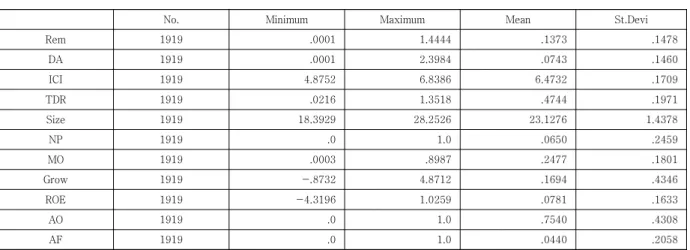
From the descriptive statistical results in Table 1, we can see that in the Shanghai A-share market, listed companies generally have earnings management.Pearson correlation analysis of the variables, through the results in Table 2, we can see that there is a negative correlation between the main variables.
The internal control index and the real earnings management variable have a negative correlation of -0.071, and the internal control index and the manageable accrued profit reflecting the level of accrued earnings management have a negative correlation of –
0.049. Therefore, it can be understood that the quality of internal control will inhibit the real
earnings management behavior and the accrued earnings management behavior. That is, the
Var. Rem DA ICI TDR Size NP MO Grow ROE AO AF
Rem 1
DA .171** 1
ICI -.071** -.049* 1
TDR .003 .014 -.034 1
Size -.111** -.051* .000 .332** 1
NP .008 .016 .013 .144** -.093** 1
MO .081** .083** -.006 .266** .008 -.028 1
Grow .163** .029 -.007 .036 .031 -.045* .033 1
ROE .093** -.026 -.010 -.097** .134** -.426** -.006 .093** 1
AO .003 -.010 -.026 .003 -.003 -.057** .021 .022 .053** 1
AF -.023 -.005 -.050* .070** .148** -.015 -.062** -.011 .004 .035 1
*p<0.005, **p<0.01, ***p<0.001
Table 2. Pearson Correlation Analysis
Independent variable
Un-standardized Coefficients
Standardized
Coefficients t VIF
B Beta
Constant .801 5.906***
ICI(Rem) -.059 -.068 -3.067*** 1.005
TDR(Rem) .019 .025 .991 1.285
Size(Rem) -.014 -.136 -5.603*** 1.200
NP(Rem) .032 .053 2.125** 1.256
MO(Rem) .059 .072 3.105*** 1.099
Grow(Rem) .053 .155 6.953*** 1.012
ROE(Rem) .110 .122 4.905*** 1.254
AO(Rem) -.003 -.008 -.346 1.007
AF(Rem) .000 -.001 -.029 1.033
F=14.212(p=0.001), DW=1.891
*p<0.005, **p<0.01, ***p<0.001
Table 3. Regression of Hypothesis 1
No. Minimum Maximum Mean St.Devi
Rem 1919 .0001 1.4444 .1373 .1478
DA 1919 .0001 2.3984 .0743 .1460
ICI 1919 4.8752 6.8386 6.4732 .1709
TDR 1919 .0216 1.3518 .4744 .1971
Size 1919 18.3929 28.2526 23.1276 1.4378
NP 1919 .0 1.0 .0650 .2459
MO 1919 .0003 .8987 .2477 .1801
Grow 1919 -.8732 4.8712 .1694 .4346
ROE 1919 -4.3196 1.0259 .0781 .1633
AO 1919 .0 1.0 .7540 .4308
AF 1919 .0 1.0 .0440 .2058
Table 1. Technical data analysis
higher the quality of internal control, the easier it is to inhibit the earnings management behavior. From the regression results in Table 3, the F value is 14.212, and the corresponding significance is 0.001; the Durbin-Watson (DW) value is 1.891, which is close to 2, indicating that there is no correlation between the residual items; and the VIF is close to 1, Which means that there is almost no problem of collinearity between variables, so this regression equation is valid. There is a negative correlation between ICI, size, ao,af with the degree of accrued earnings management, which are -3.067, -5.603, -0.345,-0.029 respectively; tdr, np, mo, growth, etc. are positively correlated with the degree of accrued earnings management, respectively, 0.991, 2.125, 3.105, 6.953 and significant correlations. For companies with high levels of internal control and large assets, the lower the probability of real earnings management behavior; the larger the debt scale, the higher the growth, and the stronger the motivation for companies with financial crises to adopt real earnings management. Therefore, it can be judged that the level of internal control has a restraining effect on the actual earnings management behavior of the enterprise.
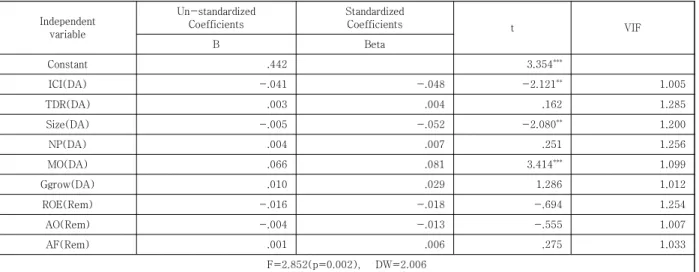
From the regression results in Table 4, the F
value is 2.852, and the corresponding significance is 0.002; the Durbin-Watson (DW) value is 2.006, which is close to 2, indicating that there is no correlation between the residual items; and the VIF is close to 1, which means that there is almost no problem of collinearity between variables, so this regression equation is valid. There is a negative correlation between the level of internal control, size, ao with the degree of accrued earnings management, which are -2.121, -2.08, -0.555; tdr, np, mo, and growth are positively correlated with the degree of accrued earnings management, which are 0.162, 0.251, 3.414, and 1.286. Both the higher the quality of internal control, the larger the scale of assets, and the higher the level of external auditing, the smaller the degree of accrued earnings management; the larger the scale of liabilities, the stronger the motivation for companies with financial difficulties to adopt accrued earnings management. Therefore, the level of internal control has a restraining effect on the enterprise's accrued earnings management behavior.
4. Conclusion
The purpose of this thesis is to explore the
Independent variable
Un-standardized Coefficients
Standardized
Coefficients t VIF
B Beta
Constant .442 3.354***
ICI(DA) -.041 -.048 -2.121** 1.005
TDR(DA) .003 .004 .162 1.285
Size(DA) -.005 -.052 -2.080** 1.200
NP(DA) .004 .007 .251 1.256
MO(DA) .066 .081 3.414*** 1.099
Ggrow(DA) .010 .029 1.286 1.012
ROE(Rem) -.016 -.018 -.694 1.254
AO(Rem) -.004 -.013 -.555 1.007
AF(Rem) .001 .006 .275 1.033
F=2.852(p=0.002), DW=2.006
*p<0.005, **p<0.01, ***p<0.001
Table 4. Regression of Hypothesis 2
relationship between internal control quality and earnings management behavior. Starting from the actual market conditions, earnings management is divided into accrued earnings management and real earnings management, and to explore internal control quality and different earnings management whether there are different links between the methods, and analyze the reasons for the formation of such links. This can not only help auditors to be more vigilant about earnings management activities, but also help establish a more complete supervision mechanism, and lay a foundation for the further improvement of the company's internal control system and the supervision and control of earnings management.
This paper analyzes the financial report data of 356 Shanghai A-share listed companies from 2016 to 2018 and draws the following main conclusions. Firstly, it is certain that there is a significant negative correlation between the quality of internal control of listed companies and the actual earnings management and accrued earnings management, which can be explained as the level of internal control will inhibit corporate earnings management behavior.
Secondly, it analyzes that when the scale of the enterprise is larger, the higher the level of external auditing, the smaller the degree of corresponding enterprise earnings management.
Finally, when a company has a financial crisis and large liabilities, there is a stronger incentive to adopt earnings management behavior. This article hopes to provide effective guidance and help for enterprises to further improve the internal control system and supervise earnings management behavior through the analysis of the correlation between the quality of internal control and different earnings management methods. This article also gives policy recommendations on strengthening supervision from various aspects in order to control the earnings management level of listed companies and make the market develop healthily. However,
although this study has achieved meaningful results, the scope of the study has certain limitations because it only reflects the listed companies on the Shanghai Stock Exchange and does not involve data on the Shenzhen Stock Exchange. And when this article studies the correlation between internal control and earnings management, the coverage of selected control variables needs to be further improved.
Therefore, in future research, research methods that can control these limited areas can be considered.
REFERENCES
[1] A. S. Hollis & A. Daniel. (2008). The Effect of SOX Internal Control Deficiencies and Their Remediation on Accrual Quality, Journal of Accounting Review, 8(12), 254-267.
[2] H. Zhang, L. Zhang & R. Rui. (2016). Internal control and related party transactions: analysis based on efficiency promotion and hollowing out views, Journal of Audit Research, 5, 89-97.
[3] X. Fan & G. Xiao. (2014). Theoretical Reflection on the Essence and Concept of Enterprise Internal Control, Journal of Accounting Research, 2014, 2, 4-11.
[4] A. S, Hammersley. (2002). Market reactions to the disclosure of internal control weaknesses and to the characteristics of those weaknesses under section 302 of the Sarbanes Oxley Act of 2002, Review of Accounting Studies, 10, 123-143.
[5] H. Rani & A. Udi, (2008). Internal Control Quality and Audit Pricing under the Sarbanes-Oxley Act, Journal of Auditing, 3, 256-260.
[6] P. M. Healy & J. M. Wahlen, (1999). A Review of the Earnings Management Literature and Its Implications for Standard Setting, Journal of Accounting Horizons, 13(4), 365-383.
[7] X. Lian. (2014). The Similarities and Differences between Accrued Earnings Management and Real Earnings Management, Northern Economics and Trade, 8(10), 239-239.
[8] B. Gao. (2016). Literature Review of Earnings Management from Real Activities of Enterprises, Finance and Accounting Newsletter, 650(30), 99-101.
[9] S. Roychowdhury. (2006). Earnings management through real activities manipulation, Journal of Accounting & Economics, 42(3), 335-370.
[10] J. Li. (2014). The impact of enforced internal control on real activity earnings management. Jiangxi University of Finance and Economics, 2, 78-81.
[11] Z. Li, Q. Zeng & X. Wei. (2011). Debt Contract, Nature of Controller and Earnings Management, Economic Review, 6, 88-96.
[12] D. A. Cohen. (2008). Real and Accrual-Based Earnings Management in the Pre- and Post-Sarbanes-Oxley Periods. Accounting Review, 12, 23-29.
[13] C, A. Gleason, M. P. Pincus & S. O. Rego. (2009).
Consequences of Material Weaknesses in Tax-Related Internal Controls for Financial Reporting and Earnings Management, Ssrn Electronic Journal, 4, 22-27.
[14] C. Lirong & Z. Shuguang. (2010). An Empirical Study on the Impact of Internal Control Efficiency on Operating Performance, Empirical Evidence from China’s Securities Market, Finance and Accounting Communications, 30, 44-49.
쉬 멍 준(Meng-Jun Xu) [정회원]
․ 2019년 2월 : 부산대학교 일반대학원 경영학석사
․ 2019년 ~ 현재 : 부산대학교 일반대학 원 경영학박사과정 학생
․ 2019년 : 부산대학교 경영연구원
․ 관심분야 : 감사제도 및 품질, 회계정 보, 내부통제시스템
․ E-Mail : [email protected]
김 동 일(Dong-Il Kim) [종신회원]
․ 1998년 7월 ~ 2000년 3월 : 텍사스 주립대(UTA) ERP센터 연구교수
․ 1999년 2월 : 명지대학교 대학원 경영 학박사
․ 2008년 1월 ~ 2010년 2월 : 텍사스 주립대(UTD) 객원교수
․ 2019년 1월 ~ 2021년 2월 : 텍사스 주립대(UTD) 방문교수
․ 2006년 1월 ~ 현재 : 부산대학교 경영학과 교수
․ 관심분야 : ERP 시스템, SCM, 회계감사 및 회계정보시스템
․ E-Mail : [email protected]