Print ISSN: 2288-4637 / Online ISSN 2288-4645 doi:10.13106/jafeb.2021.vol8.no2.0821
Earnings Quality and Income Smoothing Motives:
Evidence from Indonesia
Alwan Sri KUSTONO
1, Ahmad ROZIQ
2, Ardhya Yudistira Adi NANGGALA
3Received: November 05, 2020 Revised: January 05, 2021 Accepted: January 15, 2021
Abstract
Earnings management is very important for companies that aim for decision-making. The research was conducted to analyze the quality of earnings and income smoothing motives in manufacturing companies in Indonesia. The research approach is carried out with a quantitative approach. The sampling method using purposive sampling was associated with several criteria so that a sample of 130 was determined, which was analyzed during the 4 years of the study. The partial least square method was used for data analysis. The results of the study state that institutional ownership has no effect on earnings quality, institutional ownership has a negative effect on income smoothing, leverage has a negative effect on income smoothing, independent commissioners have a positive effect on earnings quality as well as independent commissioners have a positive effect on income smoothing. We assume that the tendency of income smoothing can affect the quality of efficient earnings. Meanwhile, income smoothing affects the quality of company earnings. Management that performs income smoothing is more aimed at conveying the company’s prospects for generating profits rather than opportunistic motives.
Keywords: Earnings Quality, Income Smoothing, Independent Commissioner JEL Classification Code: G32, O16, M41
form of dividend distribution. Dividends reduce investors’
uncertainty, causing them to discount a firm’s future earnings at a lower rate, thereby increasing the firm’s value.
The signaling theory states that corporate financial decisions are signals sent by the company’s managers to investors to shake up these asymmetries. These signals are the cornerstone of financial communication policy.
Financial reports are management instruments for delivering information, both open and private (Duru & Tsitinidis, 2013). Public information is related to company performance (Wang & Williams, 2011). Private information is related to future company performance (Ayadi & Boujelbène, 2014)
Several previous studies have shown that institutional ownership is positively related to earnings quality (Velury
& Jenkins, 2006; Ajay & Madhumathi, 2015; Slotte, 2018).
They found that firms with higher institutional ownership were found to have higher earnings quality. They are able to restrict managers from using their discretionary powers to report earnings. Higher institutional ownership encourages a better monitoring process so that profits are of higher quality.
Leverage affects earnings quality (Goshu et al., 2017;
Warrad, 2017; Manukaji, 2018). Leverage can positively influence earnings quality because managers tend to use their accounting discretion to provide information about the
1
First Author and Corresponding Author. Associate Professor, Accounting Department, Faculty of Business and Economics, University of Jember, Indonesia [Postal Address: Jl. Raya Langsep No. 79, Perumnas Patrang, Jember, East Java, 68111, Indonesia]
Email: [email protected] ; [email protected]
2
Accounting Department, Faculty of Business and Economics, University of Jember, Indonesia
3
Faculty of Economics, University of Abdurachman Saleh, Situbondo, Indonesia
© Copyright: The Author(s)
This is an Open Access article distributed under the terms of the Creative Commons Attribution Non-Commercial License (https://creativecommons.org/licenses/by-nc/4.0/) which permits unrestricted non-commercial use, distribution, and reproduction in any medium, provided the original work is properly cited.
1. Introduction
Earnings of a company provide important information to
investors and creditors. It is considered to be a significant
financial parameter as it helps to gauge a company’s
financial health. Investors’ investment decisions are based on
a company’s reported earnings which signal the company’s
potential. Investors use a company’s earnings report to
assess its financial position and determine whether to invest
in the company’s stock or not. Investors prefer high-quality
earnings because they get a bigger yield. Yield is in the
company’s prospects to lower funding costs. Other studies have found different results. According to those studies, the relationship between the two variables is non-monotonic.
Companies that have low debt are positive and turn negative when debt is high.
Previous research has shown a significant relationship between independent boards and earnings quality (Alves, 2014; Koevoets, 2017). Mashayekhi and Bazaz (2010) showed a larger board size yields a weaker earnings quality;
and an increase in the number of independent directors and frequency of the board meetings, strengthen the firm’s earnings quality in terms of earnings persistency and earnings predictability, however, they do not strengthen the accruals earnings. They, however, found no significant relationship between leadership structure and Iranian firms’ earnings quality. In contrast to these conclusions, other researchers stated that the independent board had no relationship with earnings quality or negatively affected earnings quality (An, 2016; Koevoets, 2017). The greater the percentage of the independent board, the lower the quality of inside information received. It causes the quality of monitoring to decline (Bao & Bao, 2004).
Earnings management is considered as one of the factors that affect earnings quality. One of the earning management actions that directly impact earnings quality is income smoothing (Kustono & Effendi, 2016). Income smoothing improves persistence earnings (Li et al., 2011; Young, 2015). Management’s actions to regulate reported earnings have contributed to earnings quality. This means that an increase will follow a higher degree of regulation in earnings quality. Users of financial statements assume that reported earnings show managerial performance and its prospects for the future. Other studies reveal no relationship between income smoothing and earnings quality (Kazemi & Nouri, 2012). Income smoothing does not affect earnings quality if managers do not understand the components of earnings.
These inconsistencies raise questions. One of them is that the relationship between these variables is mediated by one variable (Baron & Kenny, 1986). The relationship that occurs is not direct but through intervening variables. Research by Alves (2014) and Ajay and Madhumathi (2015) examined the relationship between board independence, earnings management, and earnings quality (Alves, 2014; Ajay &
Madhumathi, 2015). The results show that the existence of an independent board affects earnings quality by reducing earnings management. These findings provide insight into the possibility of earnings management as an intervening variable. Idris et al. (2018) found that the composition of the board of directors reduces earnings management actions.
Chi‐Yih et al. (2012) stated that independent directors allow earnings management if they are intended to convey the company’s future performance. Shaique et al. (2017) proved that independent boards are not effective in carrying out a supervisory function when they have a social affiliation with
the CEO. Boards cannot perform their duties effectively if certain board groups dominate them.
Testing the institutional effect on earnings management shows inconsistent results. Firms with higher specialized institutional ownership are more likely to even revenue.
Institutional ownership plays a role in monitoring opportunistic behavior in management. Piosik and Genge (2020) found that institutional ownership reduces earnings management.
Pratomo (2019) did not find evidence of a significant influence between institutional ownership and earnings management.
The leverage variable is thought to affect earnings management.
The amount of debt can reduce income smoothing.
In contrast to these findings, Abbadi et al. (2016) showed that companies with high leverage tend to carry out earnings management. Debt has a positive effect on earnings management. Likewise, Ghazali et al. (2015) proved that leverage has a positive effect on earnings management.
Other studies failed to prove that debt does not affect income smoothing action.
Based on the understanding that has been conveyed from the research above, this research aims to analyze the relationship between leverage, institutional ownership, independent boards, and income smoothing effect on earnings quality. The income smoothing relationship mediates the relationship between leverage, institutional ownership, and independent board and earnings quality in Indonesia’s public manufacturing companies.
2. Literature Review 2.1. Signaling Theory
According to signaling theory, management can convey information that shows signs of success or failure related to company operations (Mahmood et al., 2019). This signal can have positive or negative meaning depending on the content of the manager’s information. The perspective of signaling theory is different from agency theory. The financial report is one of the instruments used by management to report its performance to investors. Signaling theory views that management seeks to convey information about the company’s future conditions in various ways. One of these ways is through earnings management (Sohail, 2019; Ozili, 2020).
2.2. Institutional Ownership and Earnings Quality Institutional ownership is ownership by institutional investors who have better investment experience than individual investors. Institutional ownership is ownership share by an institution that has a big interest in the investment it does. These institutions can be government institutions, financial institutions, companies, and pension funds (Njah
& Jarboui, 2013; Omrani, 2016). Related to the supervisory
function, institutional ownership is believed to have the ability
to pressure management to issue quality financial reports.
Institutional investors have the power to exert pressure on management. Institutional investors can use market control mechanisms to influence management decisions.
Institutional investors have the expertise to analyze company performance better than individual investors.
They are a concentrated group with substantial financial intelligence (Fadzilah, 2017). If the institutional ownership percentage is large enough in company stock, they will have an incentive to monitor management’s actions.
Long-term institutional ownership has a strong incentive to monitor firms. Institutions may choose to invest in companies that have permanent profits and signal good quality earnings. There is a significant positive influence between institutional shareholding, the board size, board independence, investment opportunity set, firm size, and leverage to the earnings quality. Institutions will pay attention to the long-run profitability of firms and inhibit opportunistic earnings management. Institutional ownership is positively related to earnings quality (Alves, 2014; Ajay
& Madhumathi, 2015; Nariman & Ekadjaja, 2018). They found that firms with higher institutional ownership were found to have higher earnings quality. They can restrict managers from using their discretionary powers to report earnings. Higher institutional ownership encourages a better monitoring process such that profits are of higher quality.
H1: Institutional ownership has a positive effect on earnings quality.
2.3. Institutional Ownership and Income Smoothing
The capital market in Indonesia is a market that is growing. The majority of shareholders and their families control many public companies. The influence of institutional investor variables on income smoothing shows a different direction. For institutional investors who can play a role in supervision, the effect is negative. These institutional investors are interested in the company’s survival in the future because they have a long-term ownership perspective.
The investor group prefers companies that report positive returns. Both long-term or short-term oriented institutional investors prefer smooth profits for reasons of capital gains and dividend payments.
Short-term institutional ownership has a positive effect on earnings management, and long-term ownership has a negative impact. Short-term holdings prefer to sell shares of companies that cannot reach their profit target. Achieving the profit target causes these investors to feel that their interests are being fulfilled, even though this is achieved by income smoothing. Short-term institutional investors prefer smoothed profit flow because they perceive the company’s portfolio to be of higher quality.
Institutional ownership has an interest in stable company profits. To satisfy this expectation, management is encouraged to do income smoothing. The existence of institutional ownership is a factor that influences manage- ment’s motivation to perform income smoothing. In other words, the higher the institutional ownership, the higher the tendency to distribute profits. By implementing income smoothing practices, companies can maintain their portfolios to protect the interests of institutional investors. Previous research has shown that institutional ownership plays a role in encouraging efficient management behavior (Koh, 2005).
When company profits fluctuate, institutional investors are likely to encourage management to do income smoothing actions (Shah & Shah, 2014; Zheng, 2016; Suyono, 2018;
Amir et al., 2019). Firms with higher institutional ownership are more likely to even out earnings.
H2: Institutional ownership has a positive effect on income smoothing.
2.4. Leverage and Earnings Quality
Earnings quality can be defined in several ways from several perspectives. Analysts view earnings quality as the ability of reported earnings (income) to predict a company’s future earnings and make recommendations for investors.
This perspective uses the company’s stock performance in the capital market as a measure of earnings quality. The higher the effect of market earnings and returns, the higher the quality of earnings.
Financial reporting quality relates to the quality of the information that is contained in financial reports, including note disclosures. From the investor’s point of view, earnings quality is related to earnings persistence. High earnings quality indicates persistent earnings over a period of time.
More persistent earnings indicate high quality (Mashayekhi
& Bazaz, 2010; Kazemi & Nouri, 2012). Valipour and Moradbeygi (2011) studied the relationship between corporate debt financing and earnings quality and also to find the dominance of the positive influence of debt or negative influence of debt on earnings quality. The results showed that there is a negative and meaningful relationship between debt and earnings quality.
The financial leverage hypothesis explains that leverage policy has a positive effect on risk. The company uses leverage to fund most of its assets. Increased leverage will increase the risk of financial pressure and bankruptcy such that the leverage policy positively affects risk. Creditors face risks because the company is unable to pay the interest or principal on the loan. Companies that have high leverage are classified as risky companies. Creditors want credible financial statement data. The higher the company’s risk, the owner of the funds wants a more reliable financial report.
Creditors exercise strict supervision so that the profit
presented is in accordance with the conditions. Ahmad and Alrabba (2017) stated that leverage is a factor that affects earnings quality. Other researchers stated that leverage positively affects earnings quality (Shiri et al., 2012; Lin &
Lee, 2016; Warrad, 2017). Creditors expect the company to show quality profits.
H3: Leverage has a positive effect on earnings quality.
2.5. Leverage and Income Smoothing
Certain debt covenants usually regulate the relationship between creditors and debtors. The cost of debt for borrowers with low accounting quality is significantly influenced by the covenant strictness. Based on the test on the leverage variable, it is found that leverage influences income smoothing. Debt covenant design reduces the adverse effect of poor accounting quality on the cost of debt (Saksessia & Firmansyah, 2020). Management with a high proportion of leverage on assets undertakes income smoothing to improve creditors’ perceptions of the company’s financial risk and stay within the leverage covenant. Income smoothing allows managers to reduce expectations about earnings fluctuations. Companies with a high total debt to asset ratio hope to reduce the cost of borrowing. One way is to make the profit more stable.
When borrowing firms exhibit low accounting quality, lenders tend to increase debt contract strictness through debt covenant design (Spiceland et al., 2016).
Income smoothing allows managers to reduce income fluctuations and lower the likelihood of going bankrupt, thereby lowering the cost of leverage. This provides an opportunity to obtain a loan at a lower interest rate.
Shareholders’ share of welfare has not decreased much, and this condition certainly satisfies shareholders.
External parties cannot observe the company’s operations, so they cannot ensure the company’s flexibility to shift profits. Users of financial statements may detect the smoothed profit flow but cannot be sure whether this was a deliberate attempt by the company or low volatility.
Companies with high flexibility will shift earnings between periods so that the volatility of reported earnings is lower.
Creditors encourage managers to smooth the flow of profits. In this context, the higher the debt ratio, the higher the possibility for management to do income smoothing (Huang & Xue, 2016; Paiva, 2018). This argument shows that leverage has a positive effect on the tendency of income smoothing.
Other studies show that the debt ratio can encourage income smoothing. Companies that contract larger amounts of debt and with good financial performance tend to exhibit lower-quality financial reporting. The results provide strong evidence that companies have an interest in camouflaging their performance in the presence of higher levels of bank
debt (Junianto & Wisadha, 2014; Abbadi et al., 2016). The higher the leverage, the greater the risk faced by creditors.
Creditors also ask for a guarantee that the company can survive. To avoid these demands, management performs income distribution.
H4: Leverage has a positive effect on income smoothing.
2.6. Independent Commissioner and Earnings Quality
Indonesia adheres to a two-tier system consisting of the General Meeting of Shareholders (GMS), Board of Commissioners, and Board of Directors. It is different from America and England, which implement a one-tier system. This structure separates board membership, namely between the board of commissioners as supervisors and the board of directors as company executives. An independent commissioner is a member of the commissioner who (1) is not affiliated with the controlling shareholder of the listed company concerned, (2) has no affiliation with the director and/or other commissioners of the listed company concerned, (3) does not concurrently serve as a director in another company affiliated with the listed company concerned (4) and understand the laws and regulations in the capital market sector.
Independent board members are assumed to positively contribute to oversight responsibilities (Young, 2015;
Chi‐Yih et al., 2012; Al-Haddad & Whittington, 2019).
Independent board members are expected to represent the interests of public shareholders. Independent commissioners play an important role when company ownership is relatively spread out. Independent commissioners are seen as having the ability to act in the company’s best interests.
The existence of a governance structure such as the board of commissioners and audit committee implies a better monitoring function on the financial reporting process that will result in higher informativeness of earnings (Hermawan, 2011).
According to Nariman and Ekadjaja (2018), there is a positive relationship between independent directors and earnings quality. The independent commissioner acts as an arbitrator for disputes between managers and is the supervisor and advisor to the board of directors. The independent board of commissioners’ role is expected to reduce opportunistic earnings management and improve earnings quality. Independent commissioners generally have better oversight of management to reduce the fraudulent presentation of financial statements. Companies with external boards of commissioners are less likely to commit fraud than companies with large commissioners’ boards (Azeem et al., 2013; Young, 2015).
H5: Independent commissioners have a positive effect on
earnings quality.
2.7. Independent Commissioners and Income Smoothing
Empirical research on the effect of independent commissioners on earnings management shows inconsistent results. Independent commissioners are expected to be able to carry out a supervisory mechanism in public companies. The effect of independent commissioners on opportunistic management behavior is negative if independent commissioners can work effectively. An independent commissioner is a member of the board with the competence to work objectively. One of the main functions of the independent commissioners is to run a more independent supervision function for the company management framework. If the income smoothing motive is efficiency, the independent commissioner encourages management to do income smoothing. In the case of management being motivated by opportunistic motives, an independent board’s existence reduces management’s motivation to distribute earnings.
Companies with more independent boards are more likely to be involved in income smoothing (Osma et al., 2017;
Chi‐Yih et al., 2012). Independent directors allow earnings management if it is intended to convey the company’s future performance.
H6: Independent commissioners have a positive effect on income smoothing.
2.8. Income Smoothing and Earnings Quality Earnings management can improve earnings quality.
Improving earnings quality can result in information on earnings for the current year being more useful in predicting future earnings (Bao & Bao, 2004; Kirschenheiter &
Melumad, 2005; Duru & Tsitinidis, 2013). One of the earnings management actions that may have an impact on earnings persistence is income smoothing. Income smoothing improves earnings informativeness if managers use their discretion to communicate their assessment of future earnings.
This statement can be interpreted that income smoothing provides the ability for users of financial statements to predict future earnings based on current earnings information.
There have not been many studies examining the effect of income smoothing on earnings persistence. The logic of the effect of income smoothing on earnings persistence is that income smoothing is done by suppressing the fluctuation of earnings between periods. This emphasis is done by keeping profits in good periods and borrowing profits from other periods during bad periods. Managerial stock holdings and option holdings affect CEOs’ income smoothing incentives.
Given the different roles of stock holdings and option holdings in solving agency problems, managers may smooth past earnings using discretionary accruals to reveal information to help investors better predict future earnings or for hiding the volatility of past earnings (Shu & Thomas, 2019).
Income smoothing can make current and past profit more informative because it communicates future earnings.
Since earnings quality is the ability of current earnings to predict future earnings, it is expected that income smoothing can improve earnings quality. Earnings management is considered as one of the factors that influence earnings quality. Andrews (2012), Shubita (2015, 2020), and Ozili (2020) stated that income smoothing improves earnings quality. Income smoothing action is intended as efficient communication because the company’s information can significantly be used to predict future information.
H7: Income smoothing has a positive effect on earnings quality.
3. Methodology
This study was conducted to examine the relationship between antecedents variables and earnings quality. The level of earnings quality is determined by the difference between current income and previous income (earnings persistence). The leverage variable uses the debt to asset ratio, the institutional investor variable is determined by the number of shares owned compared to the total shares, while the independent commissioner determines the number of independent commissioners. Income smoothing uses the accrual index correlation to measure the income smoothing tendency (Kustono, 2011). We used the quantitative research approach. The sampling method was purposive sampling associated with several criteria. The data used was financial reports of manufacturing industries listed on the Indonesia Stock Exchange in 2013–2019. A sample of 130 companies was determined, as such, the data analyzed during the 4 (four) years of research was 848 firm years observation. The partial least square method was used for data analysis.
4. Results and Discussion
The number of public manufacturing companies registered consistently in 2013–2019 was 130 companies.
The analysis of the adequacy of the population criteria shows that the company does not meet the third (14), fourth (2) criteria, and the data cannot be processed (10). The number of companies sampled was 106 companies. All data processed and analyzed was 848 firm-years.
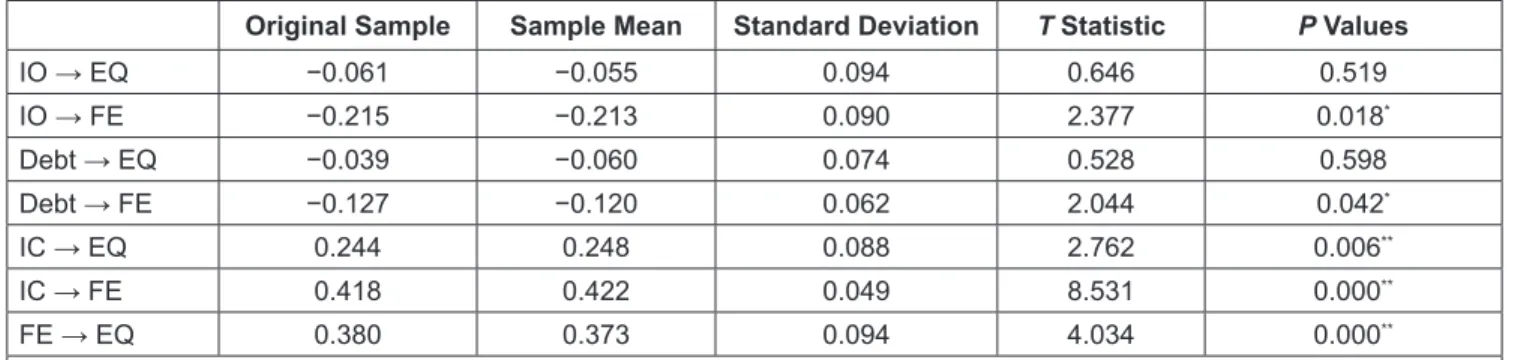
The partial least square path analysis results are carried
out by specifying the relationship between variables in the
inner model. Institutional ownership has a negative effect on
income smoothing (0.215
*). Leverage has a negative effect
on income smoothing (–0.127
*). Independent commissioners
positively affect earnings quality (0.244
**) and income
smoothing (0.418
**). Income smoothing has a positive effect
on earnings quality (0.380
**).
The results of the path analysis test are shown in Table 1.
All hypothesis testing was carried out using the least-squares partial regression technique with the smart PLS device.
The least-squares partial path analysis is carried out by determining the relationship between variables in the inner model. In addition, the analysis of indirect effects aims to identify earnings management motives.
The results in Table 1 indicate that institutional ownership does not affect earnings quality. The first hypothesis which states that institutional ownership affects earnings quality is rejected. The number of shares an investor has does not directly affect the income statement.
The second hypothesis, which states that institutional ownership positively affects income smoothing, is accepted. Institutional ownership has a positive effect on income smoothing. The third hypothesis which states that leverage has a positive effect on earnings quality is rejected. Leverage does not affect earnings quality. The fourth hypothesis which states that leverage has a positive effect on income smoothing is rejected. Leverage is expected to increase the likelihood that management will perform income smoothing. As a result, leverage has a negative effect on income smoothing.
The fifth hypothesis which states that independent commissioners affect the quality of earnings is accepted.
The independent commissioner variable has a positive effect on earnings quality. The sixth hypothesis which states that independent commissioners affect the income smoothing
tendency is accepted. Independent commissioners have a positive effect on income smoothing. The seventh hypothesis which states that there is a positive influence of income smoothing’s tendency on the quality of earnings is accepted.
The results showed that the tendency of income smoothing affects earnings quality.
The indirect effect of exogenous variables on endogenous through intervening variables (income smoothing) is shown in the following table:
The PLS test results in Table 2 show that independent commissioners have a positive indirect effect on earnings quality with a coefficient of 0.159 and p-value = 0.001.
Institutional ownership negatively affects earnings quality with a coefficient of −0.082 and a coefficient of p = 0.027.
The indirect effect of debt on earnings quality shows a value of −0.048 and a significance of p = 0.084. Debt does not affect earnings quality.
From the relationship between variables, income smoothing is not an intervening variable in the relationship between debt and earnings quality and institutional ownership.
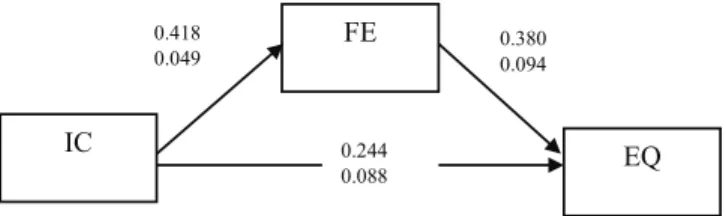
Following Baron and Kenny (1986), an intervening relationship occurs when the direct influence between the exogenous and endogenous variables is significant. From this statement, there may be a mediating relationship through income smoothing only between independent ownership and earnings quality (Figure 2).
The Sobel test is conducted to determine whether income smoothing is an intervening variable. The determination
Table 1: Path Coefficient
Original Sample Sample Mean Standard Deviation T Statistic P Values
IO → EQ −0.061 −0.055 0.094 0.646 0.519
IO → FE −0.215 −0.213 0.090 2.377 0.018
*Debt → EQ −0.039 −0.060 0.074 0.528 0.598
Debt → FE −0.127 −0.120 0.062 2.044 0.042
*IC → EQ 0.244 0.248 0.088 2.762 0.006
**IC → FE 0.418 0.422 0.049 8.531 0.000
**FE → EQ 0.380 0.373 0.094 4.034 0.000
**IS is income smoothing, EQ is earnings quality, IC is independent commissioner, IO is institutional ownership
Table 2: Indirect Effect
Original Sample Sample Mean Standard Deviation T Statistic P Values
Debt → FE → EQ −0.048 −0.045 0.028 1.739 0.084
IC → FE → EQ 0.159 0.159 0.048 3.292 0.001
IO → FE → EQ −0.082 −0.078 0.037 2.227 0.027
FE is income smoothing, EQ is earnings quality, IC is independent commissioner, IO is institutional ownership
Table 3: Sobel Test
Standard
Deviation T Statistic P Values IC → FE → EQ 0.04348064 0.47106027 0.6375977
Figure 2: The Total Effect of Independent Commissioners on Earnings Quality.
0.380 0.094 0.418
0.049
IC
FE
0.244
EQ
0.088