Print ISSN: 2288-4637 / Online ISSN 2288-4645 doi:10.13106/jafeb.2021.vol8.no1.985
Purchase Behavior of Young Consumers Toward Green Packaged Products in Vietnam
Nhu Ty NGUYEN
1, Le Hoang Anh NGUYEN
2, Thanh Tuyen TRAN
3Received: October 01, 2020 Revised: December 06, 2020 Accepted: December 14, 2020
Abstract
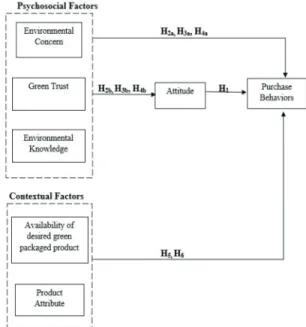
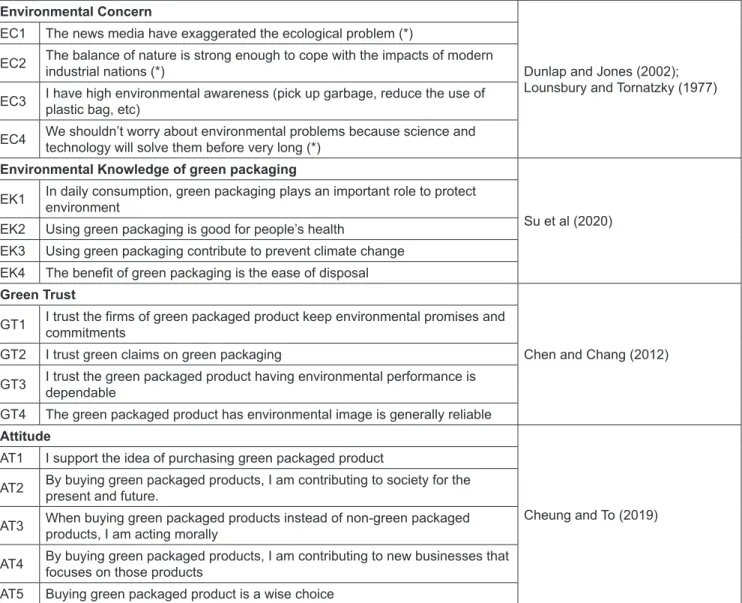
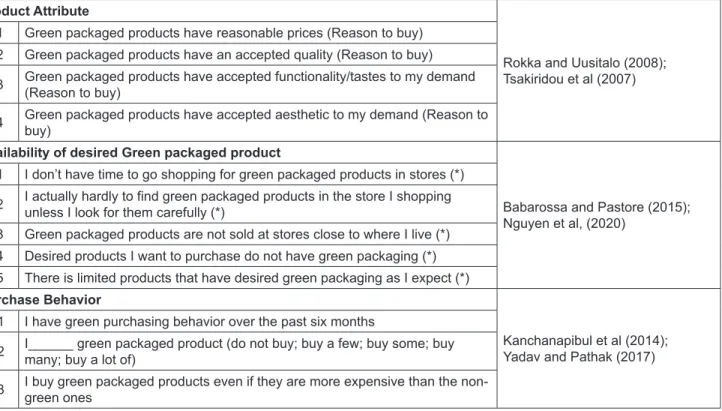
While green packaging related concerns are mainly studied in developed countries, there is a lack of knowledge to observe purchase behavior toward green packaging in developing countries, especially in Vietnam. Buying green packaged products in FMCG is not required to trade- off between sustainability and product performance. Hence, this present research aims to understand the gap attitude – behavior existing on FMCG green packaged products among Vietnamese young consumers with psychosocial factors (environmental concern, environmental knowledge of green packaging and green trust) and contextual factors (availability of desired green packaging and product attributes).
With a sample size of 396 respondents, data was collected by convenient sampling method and then was analyzed using structural equation modeling. The results reveal that all psychosocial factors are positive related to attitudes while purchase behavior is positively influenced.
The findings also report that contextual factors have positive impacts on purchase behavior, which proves the important role of contextual factors in influencing consumer choices. It suggests that green packaging is receptive to Vietnamese young consumers but it should be considered within product-related context to enhance the difference in sustainability among similar FMCG products. Practical implications for marketers and future researches have also been discussed at the end of study.
Keywords: Contextual Factors, Product Attribute, product Availability, Green Trust, Young Consumer JEL Classification Codes: M3, M14, M37, Q56
plastic packaging was returned to recycling system and only 5% of plastic packaging material value was added for second use. In Vietnam, one of the top 5 countries contributes to world’s marine plastic pollution, 0.28 – 0.73 million metric tons of plastic per year dumping to the ocean where plastic packaging became a threat (Jambeck et al., 2015). This turns into a global issue in developing countries as economy development is prioritized more than environmental improvement (Wang et al., 2019). As a result, the demands for sustainable consumption became receptive to Vietnamese consumers, as they pay attention to green packaging (Quach
& Milne, 2019). This brings opportunities and challenges for FMCG companies to engage in green production. Some companies take course of actions for achieving zero-waste in future such as Nestle Vietnam, Lavie, Coca-Cola Vietnam, etc. (Vietnam Investment Review, 2019).
Nevertheless, there is a lack of evidence to observe purchase behaviors toward green packaged products in Vietnam. In the scope of Asia, compared to Vietnam, green packaging has been more studied in India and China (Hao et al., 2019; Prakash & Pathak, 2017). Attitude-behavior model is applied for explaining green behavior (Joshi & Rahman,
1
First Author. [1] School of Business, International University, Ho Chi Minh City, Vietnam [2] Vietnam National University, Ho Chi Minh City, Vietnam. Email: [email protected]
2
[1] School of Business, International University, Ho Chi Minh City, Vietnam [2] Vietnam National University, Ho Chi Minh City, Vietnam
3
Corresponding Author. Scientific Research Center, Lac Hong University, Dong Nai, Vietnam [Postal Address: No 10, Huynh Van Nghe (Provicial Highway 24), Buu Long Ward, Bien Hoa City, Dong Nai Province, Vietnam] Email: [email protected]
© Copyright: The Author(s)
This is an Open Access article distributed under the terms of the Creative Commons Attribution Non-Commercial License (https://creativecommons.org/licenses/by-nc/4.0/) which permits unrestricted non-commercial use, distribution, and reproduction in any medium, provided the original work is properly cited.