Phytosociological Community Classification of Mountain Ridge from Guryongryeong to Mt. Yaksu in the Baekdudaegan, Korea
1aHyun-Chul An2, Gab-Chul Choo2*, Sam-Bong Park2, Hyun-Seo Cho2, Jong-Bin An3, Jeong-Geun Park3, Hyoun Woo Ha3, Jin Joong Kim3, Bong-Gyu Kim2
백두대간의 구룡령에서 약수산 마루금의 식생구조 특성에 관한 연구
1a안현철2, 추갑철2*, 박삼봉2, 조현서2, 안종빈3, 박정근3,하현우3, 김진중3, 김봉규2
ABSTRACT
To investigate the vegetation structure of mountain ridge from Guryongryeong to Mt. Yaksu, 22 plots (100
㎡) installed with random sampling method were surveyed. Three groups of Quercus mongolica-Acer pseudosieboldianum community, Q. mongolica community, Cornus controversa-Q. mongolica community were classified by cluster analysis. Q. mongolica was a major woody plant species in the ridge area from Guryongryeong to Yaksusan and Carpinus cordata and C. controversa was partly occupied in some area. High positive correlations showed between Q. mongolica and Symplocos chinensis for. pilosa, Rhododendron schlippenbachii; Tilia amurensis and Tilia mandshurica, Symplocos chinensis for. pilosa; Tilia mandshurica and S. chinensis for. pilosa, R. schlippenbachii; Betula costata and Acer mono; Symplocos chinensis for. pilosa and Rhododendron schlippenbachii, and relatively high negative correlations showed between A.
pseudosieboldianum and S. chinensis for. pilosa, R. schlippenbachii. Species diversity(H') of investigated groups were ranged 0.8170~1.1446 and it was lower compared to those of the ridge area of the national parks in Baekdudaegan.
KEY WORDS: CLUSTER ANALYSIS, Quercus mongolica, SPECIES DIVERSITY
1 접수 2014년 10월 13일, 수정(1차: 2014년 12월 8일), 게재확정 2014년 12월 9일 Received 13 October 2014; Revised (1st: 8 December 2014); Accepted 9 December 2014
2 경남과학기술대학교 산림자원학과 Dept. of Forest Resources, Gyeongnam National University of Science and Technology, Jinju(660-758), Korea
3 국립수목원 Korea National Arboretum, 415 Gwangneung Sumokweon-ro, Soheulp-eup, Pocheon-si, Gyeonggi-do(487-829) Korea a This work was supported by Gyeongnam National University of Science and Technology(2013)
* 교신저자 Corresponding author: Tel: 055) 751-3246, Fax: 055) 751-3241, E-mail: [email protected]
요 약
백두대간 구룡령-약수산 마루금에 22개의 방형구(100㎡)를 설정하여 식생을 조사하였다. 식생군집을 분석한 결과 신갈나무-까치박달나무-당단풍나무군집, 신갈나무군집, 층층나무-신갈나무군집 등 3개의 군집으로 분류되었다. 백두대 간 구룡령-약수산 마루금은 대부분 신갈나무가 우점하고 있었으며, 일부지역에서 까치박달나무와 층층나무 등이 혼효하 고 있었다. 수종간의 상관관계에서 신갈나무와 노린재나무, 철쭉; 피나무와 찰피나무, 노린재나무; 찰피나무와 노린재나 무, 철쭉; 거제수나무와 고로쇠나무; 노린재나무와 철쭉 등의 수종 간에는 높은 정의 상관이 인정되었다. 당단풍나무와
Figure 1. Location of plots surveyed from Guryongryeong to Mt. Yaksu in the Baekdudaegan
노린재나무, 철쭉 등의 수종 간에는 높은 부의 상관이 인정되었다. 조사지의 군집별 종다양성 지수는 0.8170~1.1446범위 로 백두대간에 위치한 국립공원들의 능선부 식생구조 보다는 약간 낮게 나타났다.
주요어: 식생구조, 신갈나무, 종다양성
INTRODUCTION
Baekdudaegan divides Korea into east and west and it is recognized by many people in Korea as an iconic mountains. This unique topography divides our traditional lifestyles and geographic perspectives. Baekdudaegan starts from Byeongsabong (2,744m) of Mt. Baekdu to Cheonwangbong (1,915m) of Mt. Jiri without crossing any valleys or rivers. Its length is about 1,400km and altitude of this region is about 100 to 2,744m (Cho, 2002).
Korea stretches from south to north, and cold current and warm current flow around Korea. During the winter, the cold-wind blows from northwest and the warm-wind blows from south in the spring. Therefore, it shows different and diverse floras in each regions of Korea. There are various floras such as temperate plants, subtropical plants, and subpolar plants because of the sea on three sides. Some northern plants move to south and some southern plants move to north because of subpolar climate, temperate climate, and warm temperate climate in Korea.
Thus, there are many Korea endemic, endangered and rare plants, and animals throughout Mt Baekdu, Mt. Seolak, Mt. Odae, Mt. Taebaek, Mt. Sobaek, Mt. Jiri etc. in Baekdudaegan.
As people recognize the importance of Baekdudaegan, a lot of studies about Baekdudaegan, which includes survey and concept of Baekdudaegan (Korea Forest Service and Korean Geographical Society, 1997), forest status of the Baekdudaegan (Forestry Administration and Green Korea United, 1999), settings of efficient management range of Baekdudaegan (Korea research institute for human settlements, 2000), natural ecosystem conservation and damaged land restore plan of Baekdudaegan (Korea Forest service, 2001), natural ecosystems survey and management plan of Baekdudaegan (Korea Forest service, 2002) etc.
have been conducted. Furthermore, many studies on the vegetation characteristics in Baekdudaegan have been carried out. Yun et al.(2010) studied about the vegetation
distribution and community characteristics on the Sobaeksan National Park. Park et al.(2009) reported on the vegetation types and floristic composition of native conifer forest in the ridge of the Baekdudaegan. Lee et al.(2014) investigated on the community structure of Pinus desiflora and Quercus mongolica forest in Jochimryeong to Shinbaeryeong of the Baekdudaega. Despite these much research, study on the vegetation properties from Guryongryeong to Mt. Yaksu, which is adjacent to Guryongryeong ecological tunnel, have not been carried out. Therefore the purpose of this study was to find out the vegetation structure, importance value, DBH distribution, and species diversity of the mountain ridge from Guryongryeong to Mt. Yaksu and to provide a management plan for the future.
MATERIALS AND METHODS
1. Setting of survey area
A preliminary vegetation survey was conducted on June 23 in 2011. Formal surveys were conducted from June 3 to August 5 between Guryongryeong (1,013m) and Mt.
Yaksu (1,306m) of Baekdudaegan. A total of 22 plots were surveyed in this area (Figure 1).
2. Investigation of the vegetation and environmental factor The survey area was from Guryongryeong to Mt. Yaksu.
A total of 22 plots (10 × 10m quadrat) were installed with a random sampling method and major environmental factors, soil characteristics, and vegetation for each quadrat were surveyed. Vegetation survey was conducted according to overstory layer, midstory layer, and understory layer divided by position of canopy. In the overstory layer and midstory layer, kinds of tree, population, and diameter at breast height (DBH) were measured. Kinds of tree and cover degree in the understory layer were investigated. To know the relationship between growth rates of tree and environmental factors, altitude, aspect, slope, litter layer (soil depth), and height of overstory layer were examined.
According to the meteorological data of 20 years of Inje weather station, which is adjacent to this research area, the average annual temperature and annual precipitation were 10.1℃ and 1,210.7㎜, respectively. Most of the precipitation was concentrated from Jun to September.
Highest average temperature and lowest average temperatures were 16.4℃ and 4.7℃, respectively.
3. Cluster analysis and correlation between species With population according to species collected from each plots, we tried to classify the survey plots using entire species collected from overstory layer, midstory layer, and understory layer by the method of Ludwig and Reynolds (1988). Percent Dissimilarity (P.D) was applied to calculate the distance among the surveyed plots. To investigate correlations among interspecific or environmental factors collected from 22 plots, SPSS 17.0 program was used.
4. Analysis of forest community
Importance Percentage (I.P.), which was calculated with following equation as (relative density + relative cover degree + relative frequency)/3, was calculated using vegetation data surveyed at mountain ridge of from Guryongryeong to Mt. Yaksu. Mean Importance Percentage (M.I.P.) was calculated with an equation considering the size of the
population as (overstory layer I.P. × 3 + midstory layer I.P. × 2 + understory layer I.P.)/6 (Curtis and Mclantosh, 1951). Species diversity, which shows a measure of the diversity of species composition, was comprehensively compared by species diversity (H’), evenness (J’), and dominance (D) calculated by Shannon’s formula (Pielou, 1975).
RESULTS AND DISCUSSION
1. Forest environment and characteristic of Species composition
Table 1 shows the major environmental factors and the numbers of species. The survey plots were installed by considering current vegetation at natural forests from Guryongryeong to Mt. Yaksu, which is a part of Baekdudaegan. There are located between altitudes 1,106 m to 1,275 m. The slop and litter layer were about 15。to 45。and 3 to 5 ㎝, respectively. The height of the tree was between 9 to 15.6 m in the overstory layer, 3.5 to 7.8 m in the midstory layer, and 0.6 to 2.2 m in the understory. Depending on the story, the DBH was between 15.5 to 40 ㎝ in the overstory layer and 4.7 to 12.4 ㎝ in the midstory layer. The average DBH in the overstory layer and midstory layer were 28.1㎝ and 7.5㎝, respectively. Species numbers per each plot (100㎡) of woody plants to be composed of overstory layer, midstory layer, and understory layer were from 5 to 14. This result indicates that there exists a big difference in the numbers of species among the investigated plots. It is likely that the difference results from different seedling occurrence because the surveyed sites are located in mountain ridge and the height of the tree of overstory layer is very high.
Current study shows similar results with several previous studies, which were conducted in the same area and showed 2 to 10 species in Mt. Cheongok (Choi, 2002), 4 to 12 species between from Gitdaebong to Mt. Cheongok (Choo et al., 2002), 2 to 12 species between from Mt.
Daedeok to Guemdaebong (Kim et al., 2003), 6 to 14 species in subalpine areas of Mt. Deogyu (Kim & Choo, 2004), and 4 to 15 species in Dangol valley of Mt. Taebaek located in Baekdudaegan (Cho et al., 2005). However, it shows slightly low than 11 to 26 species in nature conservation area in Mt. Gyeryong national park, 13 to
Plot number 1 2 3 4 5 6 7 8 9 10 11 Altitude(m) 1,275 1,269 1,257 1,247 1,228 1,206 1,220 1,192 1,191 1,190 1,193
Aspect S N W W NE NE NW NE NE N NW
Slope(°) 20 45 30 40 40 25 40 15 15 15 15
Litter depth(cm) 4 3 5 4 5 4 3 5 5 4 3
Number of species 7 7 9 8 8 14 6 7 11 8 9
O. L.1
Height(m) 11 11 12.5 11.5 14 15 12.5 11 11 11 9
Mean DBH(㎝) 21.1 27.3 27.1 25 30.3 25.5 33.2 29.3 20.5 30.2 31.8
Coverage(%) 45 30 30 15 15 15 10 15 20 20 60
M. L.2
Height(m) 3.5 6 6.5 8 6 6 6 7.5 6.5 5.7 5.8
Mean DBH(cm) 7.7 7.3 6.3 10.6 4.7 5.4 8.5 11.0 12.4 6.7 11.3
Coverage(%) 10 25 30 15 15 15 40 35 20 20 30
U. L.3 Height(m) 1.5 1.6 1.7 1.7 0.6 0.6 2 2.2 1.5 1.3 1.6
Plot number 12 13 14 15 16 17 18 19 20 21 22
Altitude (m) 1,194 1,196 1,201 1,196 1,189 1,181 1,189 1,185 1,166 1,149 1,106
Aspect N N NW SE E S SW SE SW E SE
Slope (°) 15 20 40 15 45 25 15 15 15 35 35
Litter depth(cm) 4 3 4 3 3 3 3 3 3 4 4
Number of species 12 8 9 11 9 7 5 6 8 6 6
O. L.
Height(m) 10.2 13 10 12 13.4 15 15.6 12.5 10 11 10
Mean DBH(㎝) 27.1 15.5 18.5 26.2 35.6 38.1 40 33.3 22.6 32.4 26.7
Coverage(%) 25 25 45 30 40 35 30 35 25 15 45
M. L.
Height(m) 3.6 3.5 7 7 7.8 7.6 6.5 6.8 6.5 7 7
Mean DBH(㎝) 6.5 5.6 6.1 7.8 8.6 8.2 5.9 6.1 5.0 5.3 7.3
Coverage(%) 20 15 35 25 25 20 20 20 30 10 25
U. L. Height(m) 0.9 1.3 1.5 1.8 2 1.9 1.6 1.8 1.5 1.6 0.7
O. L.1: Overstory layer, M. L.2: Midstory layer, U. L.3 : Understory layer Table 1. Description of physical features and vegetation for each plot
20 species between from Donghak temple and Nammaetap of Mt. Gyeryong, and 8 to 20 species between Suryeong and Sosagogae located in Baekdudaegan (Choo & Kim, 2004).
2. Structure of forest community
1) Cluster analysis
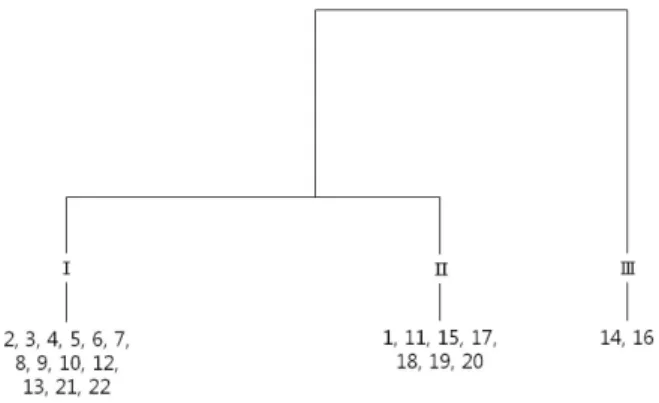
Figure 2 shows the result of the cluster analysis based on the data of 22 plots collected between Guryongryeong and Mt. Yaksu. The phylogenetic tree did not show much difference among the surveyed plots because the survey areas are relatively narrow and the geographical characteristics did not show much difference. However, they were classified into three groups with dominant species such as Quercus mongolica community, mixed forest community of subalpine zone species, and another
mixed forest community by the slope and direction of the surveyed areas. Carpinus cordata, Cornus controversa, Acer pseudosieboldianum, and Tilia amurensis were relatively major species in this study area. Group I, which includes 13 plots, was Q. mongolica-C. cordata-A. pseudosieboldianum-T.
amurensis community. Group II, which has big and old tree of Q. mongolica including 7 plots, was typical subalpine ridge community. This group contains Q. mongolica as a major species and T. amurensis, Rhododendron schlippenbachii etc. as minor species. Group III, which contains 2 plots, was C. controversa-Q. mongolica community with A. pseudosieboldianum, Betula costata, R. schlippenbachii etc. as minor species. These results indicate that the vegetation structure of the subalpine zone between Guryongryeong and Mt. Yaksu is Q. mongolica-C.
controversa-C. cordata community. Between Guryongryeong and Mt. Yaksu located in Baekdudaegan, the dominant species was Q. mongolica. This result was similar with
some results such as Dosolbong in Mt. Sobaek (Kim et al., 1993), Balbatjae-Birobong in Mt. Sobaek (Park et al., 1993), Birobong-Horyeongbong in Mt. Odae (Kim et al., 1996a), Daecheongbong-Socheongbong in Mt. Seolak (Kim et al., 1997), Daecheongbong-Hangyeryeong (Kim
& Baek, 1998a), Pijae-Doraegijae in Mt. Taebaek (Oh &
Park, 2002), Gitdaebong-Mt. Cheongok(Choo et al., 2002), Nogodan-Goribong (Kim & Choo, 2003).
However, unlike previous results, this survey areas showed that Quercus mongolica grows as a dominant species with C. cordata and Cornus controversa..
Figure 2. Dendrogram of Twenty two plots Surveyed at Guryongryeong-Mt. Yaksu
2) Analysis of Importance Percentage
Based on the cluster analysis, Importance Percentage (I.P.) and Mean Importance Percentage (M.I.P.) on the major species in three groups were calculated. Table 2 shows I.P. and M.I.P. value calculated based on the size of the tree. The highest M.I.P. in Group I was Q. mongolica as 18.79% followed by C. cordata, A. pseudosieboldianum, and T. amurensis. In group II, the highest M.I.P. was Q.
mongolica as 42.02% followed by T. amurensis, and R.
schlippenbachii, and Symplocos chinensis for. pilosawere In the last Group III, unlike two groups, which was dominant by one species, two species as C. controversa and Q. mongolica were dominant. M.I.P. value of C.
controversa and Q. mongolica was 27.83% and 24.43%, respectively. Minor dominant species in the group III were A. pseudosieboldianum, B. costata, and R. schlippenbachii.
C. controversa and Q. mongolica in the group III might compete until they become dominant species. However, it is likely that Q. mongolica might eventually be dominant species in this community.
Depending on the story, the highest I.P. of overstory layer in the GroupⅠ was Q. mongolica as 36.05% followed by T. amurensis, C. cordata, B. costata, and T. mandshurica.
In the midstory layer in groupⅠ, I.P. of A. pseudosieboldianum is the highest as 31.98% followed by C. cordata, Magnolia sieboldii, and T. amurensis. The highest I.P. of understory layer in groupⅠ was R. schlippenbachii as 40.61%
followed by Sasa borealis, Pinus koraiensis, and M.
sieboldii. Therefore, in the group I Q. mongolica was relatively dominant in overstory layer than those of other species. A. pseudosieboldianum and C. cordata in the midstory layer might compete until to be the dominant species in the future. In understory, R. schlippenbachii might be maintained as a dominant species. Therefore, it seems that it is not easy to expand other species such as P. koraiensis, M. sieboldii, Vaccinium hirtum var. koreanum.
etc. in this story.
The highest I.P. in the overstory layer in the group II was Q. mongolica (66.85%) followed by T. amurensis, P.
koraiensis, Tilia manshurica etc.. The I.P. of Q. mongolica was also the highest as 25.81% in the midstory layer in group II followed by T. amurensis, R. schlippenbachii, A.
pseudosieboldianum, S. chinensis for. pilosa. etc..
However, in the understory, the I.P. of R. schlippenbachii was the highest as 51.0% followed by S. chinensis for., V. hirtum var. koreanum., Rhododendron mucronulatum etc..
Therefore, group II was concluded that Q. mongolica is the most dominant species in the overstory layer and midstory layer. However, in the midstory layer, R.
schlippenbachii might be maintained as a dominant species for long time, if they are not artificial disturbance. In the group III, the I.P. of Q. mongolica was the highest as 37.50% in the overstory layer. The next highest I.P in the second group was C. controversa followed by B. costata, Acer pictum subsp. mono etc. In the midstory layer of the group III, the I.P. of C. controversa was the highest as 37.82% followed by A. pseudosieboldianum, Q. mongolica, Ilex macropoda, and R. schlippenbachii showed the highest I.P. as 61.32% in the understory. The next highest species was A. pseudosieboldianum followed by Sambucus
williamsii var. coreana., R. mucronulatum.
In summary of the above results, Q. mongolica was the most dominant species in the overstory layer of group III.
However, in the midstory layer, it seems that both A.
pseudosieboldianum and C. controversa might compete
Scientific name Group Ⅰ Group Ⅱ Group Ⅲ O.* M.* U.* M.I.P.* O.* M.* U.* M.I.P.* O. O.* M.* U.*
Quercus mongolica 36.05 2.30 18.79 66.85 25.81 42.02 37.5 17.02 24.43
Carpinus cordata 9.55 23.87 12.73 5.87 2.06 2.3
Acer pseudosieboldianum 0.90 31.98 1.48 11.35 11.87 2.06 4.3 29.73 12.89 12.06
Tilia amurensis 15.22 8.81 10.55 13.63 23.96 14.8
Rhododendron schlippenbachii 1.01 40.61 7.10 13.72 51.00 13.07 61.32 10.22
Magnolia sieboldii 14.92 6.88 6.12 1.56 0.52
Tilia manshurica 7.80 3.05 1.48 5.16 5.11 6.24 4.64
Pinus koraiensis 4.79 2.02 7.42 4.31 7.68 2.06 4.18
Betula costata 7.83 3.91 20.82 10.41
Fraxinus rhynchophylla 5.01 1.08 2.87 4.12 2.06
Acer mono 3.04 1.25 2.97 2.43 11.24 5.62
Abies koreana 1.62 3.66 1.48 2.28 2.06 0.34
Taxus cuspidata 2.42 1.4 1.67
Sasa borealis 9.41 1.57
Acer triflorum 2.25 1.48 1.37
Cornus controversa 0.90 2.25 1.20 2.61 1.93 1.95 30.44 37.82 27.83
Acer komarovii 1.40 2.97 0.96
Pyrus pyrifolia 1.77 0.89
Vaccinium hirtum var. koreanum 5.28 0.88 9.82 1.64
Viburnum wrightii 3.92 0.65 2.06 0.34
Syringa reticulata var. mandshurica 0.99 1.48 0.58
Philadelphus schrenkii 2.97 0.49
Symplocos chinensis for. pilosa 2.97 0.49 9.04 12.37 5.08
Spiraea fritschiana 2.97 0.49
Maackia amurensis 0.86 0.43
Rhododendron mucronulatum 1.48 0.25 6.19 1.03 12.89 2.15
Weigela subsessilis 1.48 0.25
Stephanandra incisa 1.26 0.21 4.12 0.69
Lespedeza maximowiczii 4.12 0.69
Spiraea blumei 2.06 0.34
Ilex macropoda 15.42 5.14
Sambucus williamsii var. coreana 12.89 2.15
O.*: Overstory layer, M.*: Midstory layer, U.*: Understory layer, M.I.P.*: Mean importance percentage
Table 2. Importance percentage (I.P.) and mean importance percentage (M.I.P.) of major woody plants for each plant community
until they become dominant species. In the understory, R.
schlippenbachii might be maintained as a dominant species for long time with weak competition along with A.
pseudosieboldianum, S. williamsii var. coreana, and R.
mucronulatum.
3) Interspecific correlation
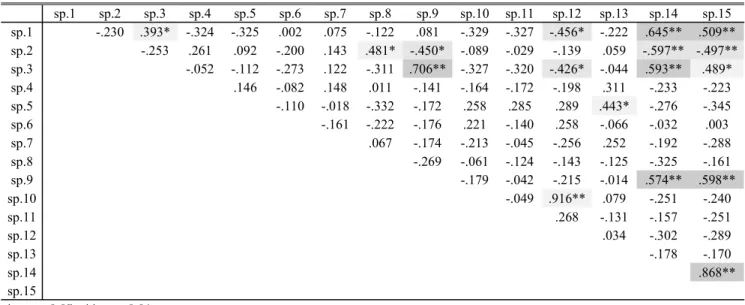
Table 3 shows the result of interspecific correlation calculated by consideration of the frequency distribution using the data collected from 22 plots. It showed relatively high positive correlations between Q. mongolica and S.
chinensis for. pilosa R. schlippenbachii; T. amurensis and T. mandshurica, S. chinensis for. pilosa; T. mandshurica and S. chinensis for. pilosa, R. schlippenbachii; B. costata and A. pictum supsp. mono; S. chinensis for. pilosa and R. schlippenbachii. Positive correlations were observed between Q. mongolica and T. amurensis, between A.
pseudosieboldianum and C. cordata, between T. amurensis and R. schlippenbachii, and between M. sieboldii and Taxus cuspidata etc. Relatively high negative correlation showed between A. pseudosieboldianum and S. chinensis for. pilosa, R. schlippenbachii and so on. Negative correlations
sp.1 sp.2 sp.3 sp.4 sp.5 sp.6 sp.7 sp.8 sp.9 sp.10 sp.11 sp.12 sp.13 sp.14 sp.15 sp.1 -.230 .393* -.324 -.325 .002 .075 -.122 .081 -.329 -.327 -.456* -.222 .645** .509**
sp.2 -.253 .261 .092 -.200 .143 .481* -.450* -.089 -.029 -.139 .059 -.597** -.497**
sp.3 -.052 -.112 -.273 .122 -.311 .706** -.327 -.320 -.426* -.044 .593** .489*
sp.4 .146 -.082 .148 .011 -.141 -.164 -.172 -.198 .311 -.233 -.223
sp.5 -.110 -.018 -.332 -.172 .258 .285 .289 .443* -.276 -.345
sp.6 -.161 -.222 -.176 .221 -.140 .258 -.066 -.032 .003
sp.7 .067 -.174 -.213 -.045 -.256 .252 -.192 -.288
sp.8 -.269 -.061 -.124 -.143 -.125 -.325 -.161
sp.9 -.179 -.042 -.215 -.014 .574** .598**
sp.10 -.049 .916** .079 -.251 -.240
sp.11 .268 -.131 -.157 -.251
sp.12 .034 -.302 -.289
sp.13 -.178 -.170
sp.14 .868**
sp.15
*: ≤ , **: ≤
sp.1: Quercus mongolica, sp.2: Acer pseudosieboldianum, sp.3: Tilia amurensis, sp.4: Abies koreana, sp.5: Magnolia sieboldii, sp.6: Cornus controversa, sp.7: Pinus koraiensis, sp.8: Carpinus cordata, sp.9: Tilia mandshurica, sp.10: Betula costata, sp.11: Fraxinus rhynchophylla, sp.12: Acer pictum subsp. mono, sp.13: Taxus cuspidata, sp.14: Symplocos chinensis for. pilosa, sp.15: Rhododendron schlippenbachii
Table 3. Pearson's product-moment correlation between all pair wise combinations of major woody plants
was observed between Q. mongolica and A. pictum subsp.
mono; A. pseudosieboldianum and T. mandshurica; T.
amurensis and A. pictum subsp. mono etc..
4) DBH distribution
Table 4 shows the DBH distribution of major woody plants for each plant communities classified by the cluster analysis. The forest succession might be estimated by DBH distribution analysis, which is an indirect expression way such as stand dynamics and age of tree (Harcombe and Mark, 1978).
In Group I, A. pseudosieboldianum was much such as seedling or small diameter tree, but C. cordata was relatively distributed less. Therefore, the I.P. of A. pseudosieboldianum might be increased. Because seedling or small diameter tree of B. costata, T. cuspidata, and C. controversa etc.
did not exist, the I.P. of B. costata, T. cuspidata, and C.
controversa might be decreased. However the I.P. of M.
sieboldii might be eventually increased.
In Group II, Q. mongolica showed relatively uniform distribution such as seedling, small diameter tree, middle diameter tree, large diameter tree. Therefore, I.P of Q.
mongolica and T. amurensis might be increased for long time, if there are not any artificial disturbance whereas,
the I.P. of C. cordata, Fraxinus rhynchophylla, P.
koraiensis, C. controversa might be decreased for a while without any artificial disturbance.
In GroupIII, Q. mongolica appeared a lot such as seedling and small diameter tree whereas, C. controversa and B. costata was hardly distributed. Therefore the I.P.
of Q. mongolica in this forest might be continually increased, but the I.P. of C. controversa and B. costata might be decreased in the future. These results indicate that these survey areas are typical subalpine vegetation of Korea.
5) Species Diversity
Table 5 shows the species diversity indices of three plant communities. A total of 29 species, which are the highest numbers of species among three communities, were found in the group I. Group II and group III were 18 and 11 species, respectively.
Gene diversity (H') in group I, group II, and group III were 1.1446, 0.9197, and 0.8170, respectively. Maximum species diversity (H' max), which was calculated by common logarithm, was 1.4472 in group I, 1.2553 in group II, and 1.0414 in group III. Evenness (J′), which was calculated by following an equation (Gene diversity (H')/
Group Scientific name D1 D2 D3 D4 D5 D6 D7 D8 D9 D10 D11 D12
Betula costata 7 2 2 2 1
Abies koreana 2 2
Carpinus cordata 18 9 9 9 2 1 1
Acer pseudosieboldianum 69 14 1 1
Fraxinus rhynchophylla 4 1 2 2 1
Ⅰ Quercus mongolica 9 8 4 7 7 9 8 4 4 2 1 1
Pinus koraiensis 10 2 1
Taxus cuspidata 1 1 1
Tilia mandshurica 2 3 4 2 1 2
Cornus controversa 1 1
Tilia amurensis 5 8 5 7 3 2 1 1 1
Magnolia sieboldii 67 6
Carpinus cordata 1 2 3
Acer pseudosieboldianum 11 4 2
Fraxinus rhynchophylla 3 2 4
Quercus mongolica 6 6 11 21 5 5 5 9 11 8 2 3
Ⅱ Pinus koraiensis 1 3 2
Tilia mandshurica 4 3 3 1
Cornus controversa 1 2 2
Tilia amurensis 13 11 8 13 7 5 2 2
Magnolia sieboldii 2 1
Betula costata 1 1 1 2
Acer pictum subsp. mono 1 2 1
Acer pseudosieboldianum 6 1
Ⅲ Ilex macropoda 2 2 1
Quercus mongolica 2 2 4 2 3 2 1
Cornus controversa 1 4 2 1
D1: 2<DBH≤7, D2: 7<DBH≤12, D3: 12<DBH≤17, D4: 17<DBH≤22, D5: 22<DBH≤27, D6: 27<DBH≤32, D7: 32
<DBH≤37, D8: 37<DBH≤42, D9: 42<DBH≤47, D10: 47<DBH≤52, D11: 52<DBH≤57, D12: 57<DBH(unit; ㎝) Table 4. The DBH distribution of major woody species for each plant community
Group No. of plots
(100㎡) (ea) No. of species (ea) Species diversity (H′) H′max Evenness (J′) Dominance (D)
Ⅰ 13 29 1.1446 1.4472 0.7909 0.2091
Ⅱ 6 18 0.9197 1.2553 0.7327 0.2673
Ⅲ 2 11 0.8170 1.0414 0.7845 0.2155
Table 5. Species diversity indices of three plant communities Maximum species diversity (H' max)), was 0.7909 in group I followed by group III and group II.
The species diversity of this study was from 0.8170 to 1.1446. These values are slightly lower than 1.0316∼
1.1776 in Hyangjeokbong of Mt. Deogyu National Park (Kim & Choo, 2004), 0.9574∼1.2845 between form Nogodan to Goribong (Kim & Choo, 2003), 0.9586~
1.1814 in Mt. Dongdae, Doonobong, and sangwangbong of Mt. Odae National Park (Kim & Choo, 2004), 0.9273~1.2167 in Taech'ongbong and Hangyeryong of Mt.
Seorak National Park (Kim & Baek, 1998a), 1.0572∼
1.0931 in Myeongseongbong and Deokpyengbong of Mt.
Jiri national park (Kim et al., 2000), 1.2973∼1.4633 in Sangwonsa, Birobong, and Horyeongbong in Mt. Odae national park (Kim et al., 1996b), and 0.9580∼1.2845 between from Nogodan to Goribong; (Kim & Choo, 2003), whereas it showed similar result with several studies such as 0.7506∼1.1512 between Suryeong and Sosagogae (Choo & Kim, 2004) and 0.991 in Jangunbong of Mt.
Taebaek (Kim & Baek, 1998b).
When dominance value is over 0.9, it is called one species dominant. When dominance value is between 0.3
∼0.7, two or three species are dominant. Dominance value below 0.3 indicates that several species are dominant (Whittaker, 1965). In this study the dominance value was between 0.2091∼0.2673, showing regions between Gyryongryeong and Mt. Yaksu are dominated by several species.
ACKNOWLEDGEMENT
This work was supported by Gyeongnam National University of Science and Technology(2013)
REFERENCES
Cho, H.S. and S.H. Choi(2002) Plant community structure of the Baekcheon valley in Taebaeksan area, the Baekdudaegan. Kor.
J. Env. Eco. 15: 369-378. (in Korean with English abstract) Cho, H.S., G.T. Kim and G.C. Choo(2005) Studies on the structure
of forest community at the Danggol valley in Taebaeksan Area, the Baekdudaegan. Kor. J. Env. Eco. 19: 55-62. (in Korean with English abstract)
Choi, S.H(2002) Community structure of the ridge area in the Cheongoksan, the Baekdudaegan. Kor. J. Env. Eco. 15:
344-353. (in Korean with English abstract)
Choo, G.C., G.T. Kim and J.O. Kim(2002) Studies on the structure of forest community at the ridge from Gittaebong to Cheongoksan. Kor. J. Env. Eco. 15: 354-360. (in Korean with English abstract)
Choo, G.C., and G.T. Kim(2004) Vegetation structure of mountain ridge from Suryeong to Sosagogae in Baekdudaegan, Korea.
Kor. J. Env. Eco. 18: 150-157. (in Korean with English abstract) Curtis, J. T. and R. P. Mclontosh(1951) The interrelations of certain
analytic and synthetic phytosocilogical characters. Ecology 31:
434-455. (in Korean with English abstract)
Forestry Administration and Korean Geographical Society(1997) A study on geography and ecology of Baekdoodaegan (Baek-Doo great mountain chain) focusing on the regional sur- vey and conservation. 157-179. (in Korean with English ab- stract)
Harcombe, P.A. and P.H. Marks(1978) Tree diameter distribution and replacement processor in southeast Texas forest. For. Sci.
24: 153-166.
Jo. S.P(1993) To Sangyeongpo . People and mountain editorial office. 109. (in Korean)
Kim, G.T., J.S. Kim and G.C. Choo(1993) Studies on the structure
of forest community at Dosolbong area in Sobaeksan. Kor. J.
Env. Eco. 6: 127-133. (in Korean with English abstract) Kim, G.T., G.C. Choo and T.W. Um(1996a) Studies on the structure
of forest community at Dongdaesan, Turobong, Sangwangbong area in Odaesan National Park. Kor. J. Env. Eco. 9: 147-155. (in Korean with English abstract)
Kim, GT., G.C. Choo and T.W. Um(1996b) Studies on the structure of forest community at Sangwonsa, Pirobong, Horyongbong area in Odaesan National Park. Kor. J. Env. Eco. 10: 151-1. (in Korean with English abstract)
Kim, G.T., G.C. Choo and T W. Um(1997) Studies on the structure of forest community at Taechongbong-Sochongbong area in Soraksan National Park. Kor. J. Env. Eco. 10: 240-250. (in Korean with English abstract)
Kim, G.T. and G.J. Baek(1998a) Studies on the structure of forest community at Taechongbong-Hangyeryong area in Soraksan National Park. Kor. J. Env. Eco. 11: 397-406. (in Korean with English abstract)
Kim, G.T. and G.J. Baek(1998b) Studies on the stand structure of Taxus cuspidata forest at Janggunbong area in Taebaeksan.
Kor. J. Env. Eco. 12: 1-8. (in Korean with English abstract) Kim, G.T., G.C. Choo and G. J. Baek(2000) Studies on the structure
of forest community at Myungsunbong, Tokpyongbong area in Chirisan National Park. Kor. J. Env. Eco. 13: 299-308. (in Korean with English abstract)
Kim, G.T. and G.C. Choo(2003) Vegetation structure of mountain ridge from Nogodan to Goribong in Baekdudaegan, Korea.
Kor. J. Env. Eco. 16: 441-448. (in Korean with English abstract) Kim, G.T., G.C. Choo and G. J. Baek(2003) Structure of forest com- munity at Daedeoksan-Geumdaebong nature ecosystem pres- ervation area in Baekdudaegan. Kor. J. Env. Eco. 17: 9-17. (in Korean with English abstract)
Kim, G.T. and G.C. Choo(2004) Forest structure of subalpine re- gion from Hyangjeukbong to 2nd Deogyusan in Deogyusan National Park, Korea. Kor. J. Env. Eco. 18: 142-149. (in Korean with English abstract)
Korea Forest Service, Green Korea United(1999) Research on for- est status of Baekdudaegan. 602. (in Korean)
Korea Forest Service(2001) Baekdudaegan natural ecosystem con- servation and devastated land research on the restore. Korea Forest service. 306. (in Korean)
Korea Forest Service(2002) Baekdudaegan natural ecosystems Survey and Management Plan Study. Korea Forest service.
270. (in Korean)
Korea Research Institute for Human Settlements(2000) Study on the effective management of Baekdudaegan set the scope of management centrally. 23-24. (in Korean)
Lee, H.Y., H.J. Kim, H.S. Shin, S.H. Han, S.Y. Ko, J.H. Song, J.H.
Lee, K.H. Jang and C.W. Yun(2014) Community structure of
Pinus densiflora and Quercus mongolica forest in Jochimryeong to Shinbaeryeong of the Baekdudaegan. J. Korean For. Soc.
103(3): 339-352. (in Korean with English abstract)
Ludwig, J.A. and J.F. Reynolds(1988) Statistical ecology. John Wiley and Sons, N.Y., 377pp.
Oh, K.K. and S.G. Park(2002) Vegetation structure of mountain ridge from Pijae to Doraegijae in the Baekdudaegan, Korea.
Kor. J. Env. Eco. 16: 330-343. (in Korean with English abstract) Park, I.H., Y.C. Choi and G. S. Moon(1993) Forest community
structure of the Dalbatjae-Birobong ridge in Sobaeksan area.
Kor. J. Env. Eco. 6: 147-153. (in Korean with English abstract) Park, S.G., H.J. Cho and C.B.Lee(2009) Vegetation types and flo-
ristic composition of native conifer forests in the ridge of the Baekdudaegan, South Korea. Jour. Korean For. Soc.
98(4):461-471.(in Korean with English abstrict)
Pielou, E.C(1975) Ecological diversity, John Wiley & Sons. New York. pp. 168.
Whittaker, R.H(1965) Dominance and diversity in land plant com- munities, Science 147 : 250-260.
Yun, J.W., S.C. Jung, G.S. Koo, J.H. Lee, C.W. Yun, S. H.
Joo(2010) Forest vegetation classification on Sobaeksan National Park in the Baekdudaegan. Kor, J. Env. Ecol. 24(6):
630-637. (in Korean with English abstract)