Introduction
Watermelon is among the top economically important horticultural crops in South Korea (Park and Cho, 2012), with
a production quantity of 534,401 tons in 2018 (Food and Agricultural Organization of the United Nations (FAO).
Watermelon is a member of the Cucurbitaceae plant family (Wehner, 2008). It is a non-seasonal fruit mainly grown in areas with long frost-free warm periods. Watermelon fruits are produced in different sizes (icebox, small, medium, large, or giant), shapes (round, oval, blocky, or elongate), rind
Lycopene Content and Fruit Morphology of Red, Pink, Orange, and Yellow Fleshed Watermelon (Citrullus lanatus) Germplasm Collections
Jae-Jong Noh
1, On-Sook Hur
2, Na-Young Ro
2, Jae-Eun Lee
2, Ae-Jin Hwang
2, Bit-Sam Kim
2, Ju-hee Rhee
3, Jung Yoon Yi
2, Ji Hyun Kim
4, Ho-Sun Lee
5, Jung-Sook Sung
6,
Myung-Kon Kim
7and Awraris Derbie Assefa
8*
1
Senior Researcher, Jeonbuk Agricultural Research and Extension Services, Iksan 54591, Korea
2
Researcher,
3Senior Researcher,
4Master’s Degree and
8Post-doc, National Agrobiodiversity Center, National Institute of Agricultural Sciences, RDA, Jeonju 54874, Korea
5
Senior Researcher, International Technology Cooperation Center, RDA, Jeonju 54875, Korea
6
Senior Researcher, Upland Crop Breeding Division, Department of Southern Area Crop Science, National Institute of Crop Science, RDA, Miryang 50424, Korea
7
Professor, Department of Food Science and Technology, Jeonbuk National University, Jeonju 54896, Korea
Abstract - High-quality and high-phytonutrient watermelon fruits have strong market opportunities besides their health related benefits. Hence, investigating quality and nutritional related traits of watermelon genetic resources could provide important baseline data in breeding for increased lycopene content thereby increasing the marketability of watermelon. To this end, we have examined some fruit morphological traits and lycopene content of 105 genetic resources. Seeds, originally obtained from 22+ countries, were obtained from the National Agrobiodiversity Center, Jeonju, South Korea, grown in an experimental field and harvested at a fully mature stage. The size of pistil scar (SPS), the width of stripes (WS), weight of fruit (WF), length of fruit (LF), width of fruit (WIF), the thickness of pericarp (TP), soluble solids content (SSC), fruit shape in longitudinal section, ground color of skin, the intensity of the green color of skin, fruit shape at the apical part, grooving distribution, conspicuousness of stripes, and main color of the flesh were recorded on the field and inside laboratory and the lycopene was measured using spectrophotometric and HPLC methods. Watermelon fruits have shown a diverse morphological characters. Red and pink fleshed fruits dominated in the entire collections. Fruits with higher thickness of rind were found to exhibit less soluble solid content (SSC). Korean origin fruits were characterized by intermediate SSC while the United States of America (USA), Russia (RUS), Tajikistan (TJK), Turkmenistan (TKM), Taiwan (TWN), and Uruguay (URY) originated fruits had the highest SSC. The lycopene content varied between 41.37 and 182.82 ㎍/g, 2.81 and 163.72
㎍/g, and 3.54 and 255.47 ㎍/g using HPLC, UV-Vis spectrophotometer, and microplate reader spectrophotometer, respectively. Red- and pink-fleshed fruits had the highest levels of lycopene content compared to the yellow- and orange-fleshed. Lycopene content had a significant positive correlation with SSC, however, no correlations were detected between lycopene and other quantitative fruit morphological characters. Our study demonstrated high diversity exists in fruit morphological traits and lycopene content of the germplasm collections which provide beneficial baseline data for a future breeding program and utilization of watermelon germplasm collections in gene banks for the maintenance and improvement of the current levels of production, marketability, and health-related benefit of watermelon fruits.
Key words – Genetic resources, HPLC, Principal component analysis, Quality traits, Spectrophotometry
*Corresponding author. E-mail : [email protected] Tel. +82-63-238-4902
Original Research Article
patterns (gray, narrow stripe, medium stripe, wide stripe, light solid, or dark solid), flesh colors (white, yellow, orange, pink, or red), and types (seeded or seedless) based on the cultivar. The red flesh, blocky shape, and large sized (8-11
㎏) from seeded types, and red flesh, oval shape, and medium sized (5-8 ㎏) from seedless types are commercially popular cultivars (Wehner, 2008; Cho et al., 2014). Typical watermelon fruit types popular in Korea are of short oval type (8-9 ㎏ /fruit), with high sugar content, green rind and dark stripe, and black rind without stripe (Park and Cho, 2012). Water- melon fruit approximately constitutes 68% flesh, 30% rind, and 2% seeds (Kumar et al., 2012), with the flesh mainly being water (about 93%) and small amounts of protein, fat, minerals, vitamins, carbohydrates, vitamin A, and lycopene (Perkins-Veazie et al., 2012; Wehner, 2008).
Lycopene is a lipophilic major carotenoid that gives a characteristic red color to fruits such as ripe tomato and pink grapefruit. Tomato is the main source of lycopene. Other sources include apricots, papaya, pink grapefruit, guava, and watermelon. Lycopene is a very efficient singlet oxygen quencher and potent scavenger of oxygen radicals among the group of carotenoids (Di Mascio et al., 1989; Islamian and Mehrali, 2015), and serves as an intermediate for the bio- synthesis of other carotenoids (Sandmann, 1994). Lycopene provides important contributions to human health. Mechanistic and epidemiological studies shown that the consumption of dietary sources of lycopene has been associated with several chronic diseases such as cardiovascular diseases (CVD), obesity, type 2 diabetes, cancer, and neurodegenerative disorders (Saini et al., 2020; Stahl and Sies, 1997) and protection of harmful UV radiation (Stahl et al., 2006).
Consumption of watermelon fruits rich in lycopene content is proven to be beneficial for disease prevention as briefly described above. On the other hand, lycopene was reported to be a highly heritable trait with no cultivar x environment interaction (Wehner et al., 2017). Several mor- phological traits of Hungarian, Korean, and Turkish watermelon genetic resource have been examined previously (Huh et al., 2014; Solmaz and Sari, 2009; Szamosi et al., 2009).
Studies on the lycopene content of watermelon germplasm collections are very scarce (Pinto et al., 2001) and mostly limited to commercial cultivars (Kalaivani, 2015; Nagal et
al., 2012; Perkins-Veazie and Collins, 2003). Thus, investi- gating the lycopene profile, quality traits, and other morphological characters of watermelon genetic resources from various countries could provide important baseline data in breeding for increased lycopene levels thereby increasing the marketability of watermelon as a healthy food. The main objective of our work has been to determine the lycopene content of the flesh of watermelon fruit genetic resources by HPLC and spectrophotometric methods. We have also examined their fruit morphological diversity using some selected traits. One hundred and five watermelon fruit samples obtained from more than 22 countries and grown at the same agricultural conditions were used.
Materials and Methods
Reagents and chemicals
Lycopene standard (purity ≥ 90%), butylated hydroxy- toluene (BHT), and tetrahydrofuran (THF) were purchased from Sigma-Aldrich (St. Louis, MO, USA). All other solvents and reagents used in extraction and analysis were of HPLC grade.
Plant materials and extraction of lycopene
Seeds of 105 watermelon genetic resources (100 germplasm collections and five commercial varieties) were obtained from the gene bank of the National Agrobiodiversity Center (NAC), Rural Development Administration (RDA), Jeonju, South Korea. Seeds were originated from 22+ countries.
Seeds were sown at the research farm of the NAC, Gochang, Republic of Korea. RDA’s recommended cultural management practices for watermelon were followed in the experimental field. Fertilizers were applied (N-P
2O
5-K
2O = 13.8-4.9-8.7 ㎏ /10a) followed by RDA’s standard and drip irrigation tape was used for watering. Seeds were sowed on April 9, 2019, and grown in a nursery bed for 37 days. Seedlings (twelve plants from each accession) were transplanted at an area of 35
㎝ × 300 ㎝ in a polyethylene film house equipped with insect
net to prevent insect pollination. Plants of the same accession
were grown in a single plot (plot area 12.6 ㎡). They were
pollinated by hand and harvested after 45 days (on average)
of pollination. Watermelon fruits were harvested at a fully
mature stage, collected, stored in polyethylene bags, and immediately transferred to a -18℃ walk-in freezer until further processing. The flesh (mesocarp) of the watermelon fruit was carefully separated from the seeds and rind manually and the edible part was, juiced, frozen at -80℃, and lyophilized using vacuum freeze drier (Ilishibiobase, Rijssen, Netherlands).
Lyophilized powdered samples were sealed to prevent moisture absorption and stored at -20℃ until analysis.
Extraction and analysis of lycopene
Lycopene was extracted from freeze-dried flesh of water- melon fruit based on modified protocol reported earlier by Fish et al. (2002). Briefly, 0.2 g of watermelon fruit flesh powder sample was transferred into a 50 mL conical tube; 3 mL distilled water was added into it; shaken until completely dissolved for five minutes. To this mixture, 20 mL solution containing 0.05% butylated hydroxytoluene (BHT) in acetone; 95% ethanol; and n-hexane in a ratio of 1:1:2 (V/V) was added; mixed for 15 minutes with a rotary shaker (180 rpm). The solution was held at room temperature for 5 minutes for the layers to separate. The upper (hexane) layer containing lycopene was used for HPLC and spectro-
photometric analysis. All steps from watermelon sample preparation to extraction were performed in subdued lighting at room temperature.
HPLC analysis of lycopene was done using Waters HPLC system equipped with a 2690 separation module and waters 996 diode array detector (Milford, MA, USA). The separation was conducted on Sunfire C
18column (4.6 × 250 ㎜, ID 5 ㎛) equipped with a C
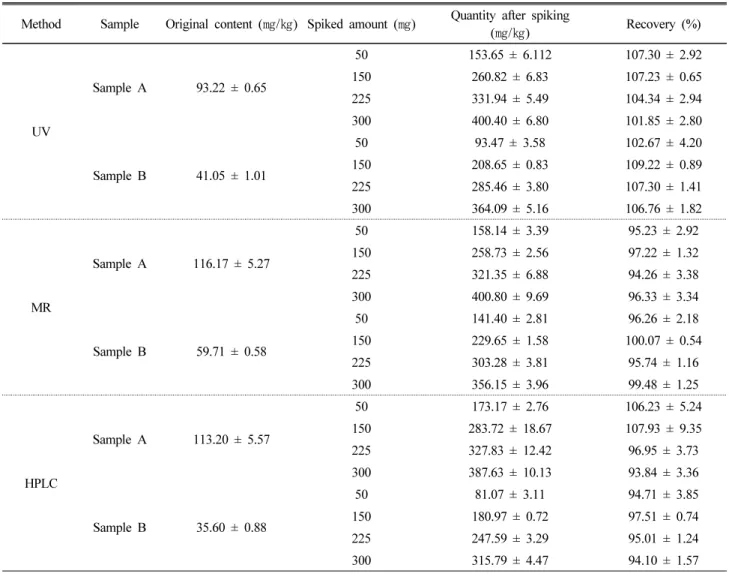
18guard column (20 ㎜ × 4.6 ㎜, 5 ㎛) obtained from Waters (Milford, MA, USA). The elution mode was isocratic 100% acetone at a flow rate of 0.5 mL/min, injection volume 10 µL, analysis time 12 min. The detection wavelength was set at 503 ㎚. Results were expressed in microgram/gram (㎍/g) on a dry weight basis and calculated using an external calibration curve equation (Y = 176483X - 110142 R
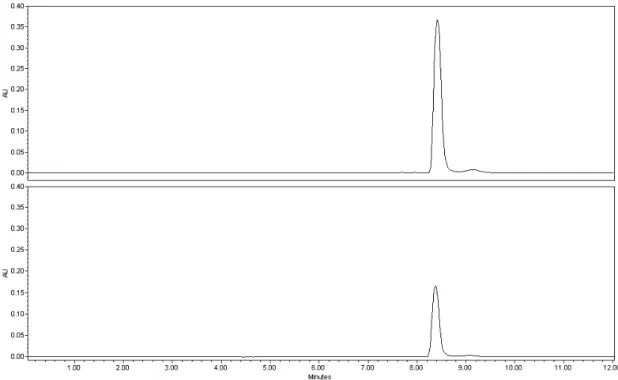
2= 0.9994; Y = peak area, X = lycopene standard concentration) prepared using serial dilu- tions of lycopene standard. Lycopene was eluted at a retention time (t
R) of 8.4 minutes (Fig. 1).
Spectrophotometric determination of lycopene was done using a Shimadzu UV-1601 UV-Visible spectrophotometer (Tokyo, Japan) and VERSAmax tunable microplate reader spectrophotometer (Molecular Devices, California, USA).
Fig. 1. A representative HPLC chromatogram showing lycopene: standard (top); watermelon fruit sample (bottom).
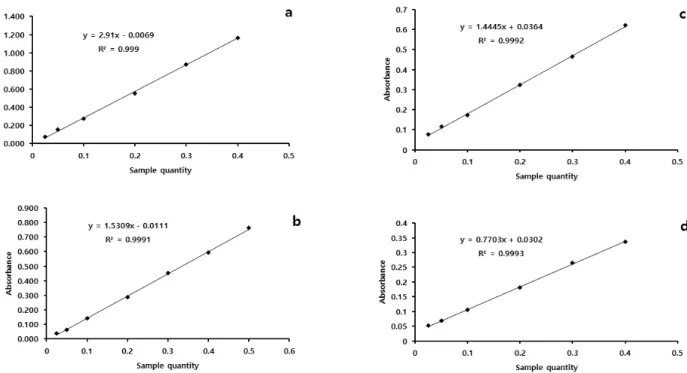
The absorbance of the extract (hexane layer) (1000 µL and 200 µL in Shimadzu UV-1601 UV-Visible (UV) and VERSAmax tunable microplate reader (MR) spectro- photometers, respectively) was measured against hexane blank at 503 ㎚ and results were calculated based on an external calibration curve constructed from the absorbance of serial dilutions of lycopene concentration. The calibration curves were Y = 0.226X + 0.0443 (R
2= 0.9989) and Y = 0.0653X + 0.0658 (R
2= 0.9995), where Y is absorbance and X is concentration of lycopene standard, for UV/Vis spectrophotometer (UV) and microplate reader (MR) spec- trophotometer, respectively. Final results were expressed as
㎍/g on a dry weight basis.
Statistical analysis
Experiments were conducted in biological triplicates. Lycopene contents are reported as mean ± standard deviation.
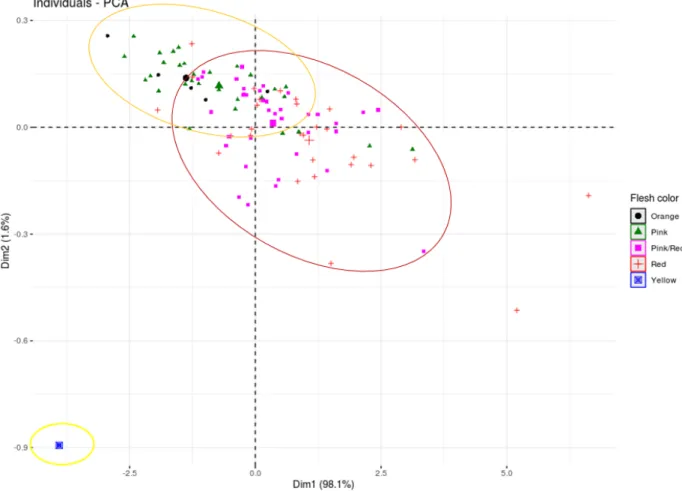
Quantitative morphological characters were reported as averages of values from 10 to 12 watermelon fruits. Correlation analysis was conducted using SPSS V25 statistical program (SPSS Inc., Chicago, The USA). PCA analysis was conducted using R-program (Version 3.6.1, RStudio, Inc.,).
Results and Discussion
Fruit morphology analysis
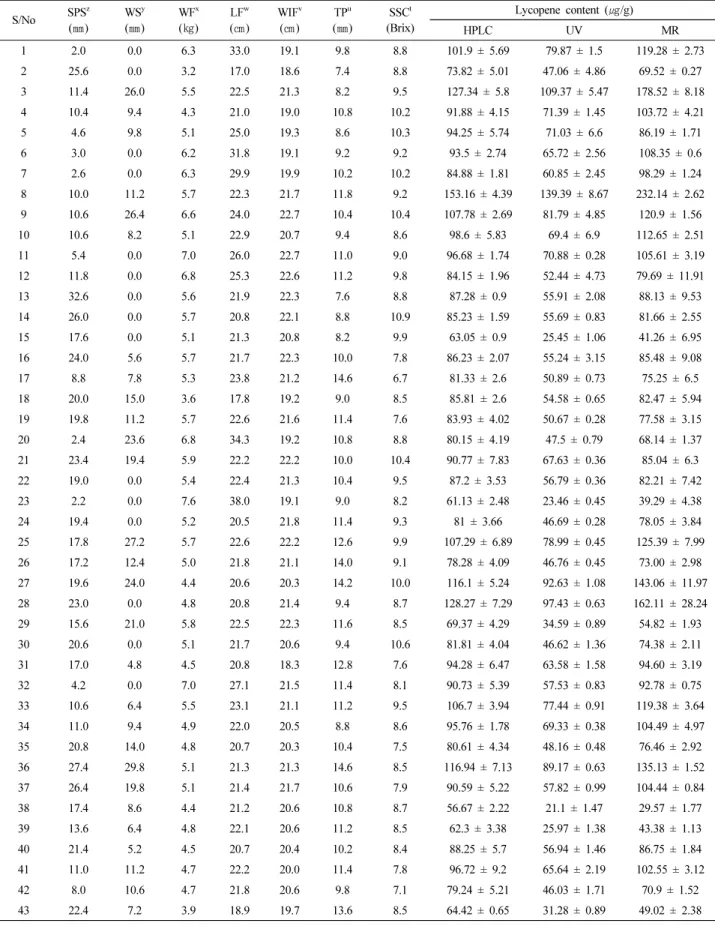
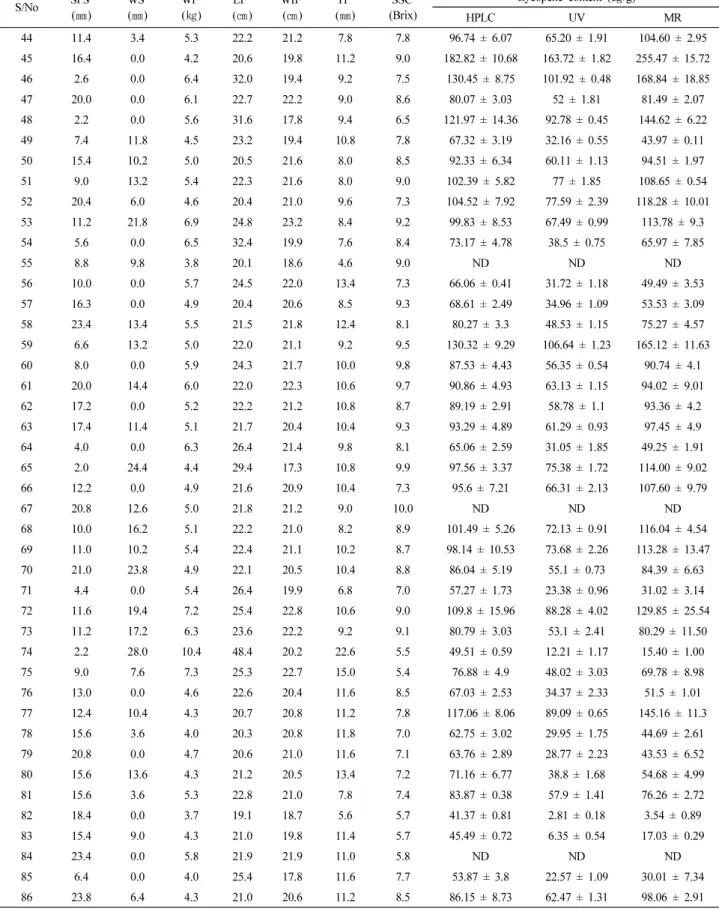
Based on the International Union for the Protection of New Varieties of Plants (UPOV) for watermelon fruits (Inter- national Union for the Protection of New Varieties of Plants (UPOV), 2019), 14 phenotypic characters of watermelon fruit were assessed. The size of pistil scar (SPS), the width of stripes (WS), weight of fruit (WF), length of fruit (LF), width of fruit (WIF), the thickness of pericarp (TP), and soluble solids content (SSC) were measured with the help of a meter, digital caliper, digital balance, and a handheld electronic refractometer as required. Other qualitative characters were recorded on the field and inside the laboratory. Quantitative characters of 105 watermelon fruit samples are presented in Table 1. Other qualitative characters including fruit shape in longitudinal section, ground color of skin, the intensity of the green color of skin, fruit shape at the apical part, grooving distribution, conspicuousness of stripes, and main color of the
flesh are presented in a supplementary file (Appendix 1).
Watermelon fruits have shown a wide range of diversity in fruit size, shape, rind color, flesh color, rind patterns, weight, and SSC. Most samples (94.3%) had green ground skin color and the remaining were white-colored. The intensity of the green color of the skin showed a wide variety which was described from very light to very dark. Most of the resources were shaped circular (60.6%) and broad elliptic (28.8%) in the longitudinal section. Truncate and little rounded shaped fruits at the apical part comprised 90.5% of the resources.
Fruit grooves are absent in 85% of the fruits and stripes were conspicuous in 66.7% of the resources. The main color of the flesh was mostly pink, red, and a mixture of the two (96 of 105). The remaining were either yellow or orange. In agreement with this study, yellow and white flesh color were quite scarce in previous reports (Sari et al., 2007; Solmaz and Sari, 2009; Szamosi et al., 2009).
The width of the stripes (0.0 to 29.8 ㎜), size of the pistil scar (2.0 to 32.6 ㎜), and thickness of the pericarp (4.6 to 22.6
㎜) showed wide diversity among the entire population. The fruit weight, soluble solids content, length, and width of watermelon fruits were also showed quite a range of diversity but the medium character was common in most of the accessions. The average values of soluble solids, rind thickness, and length and width of fruits are comparable with previous reports (Hartman et al., 2019; Huh et al., 2014;
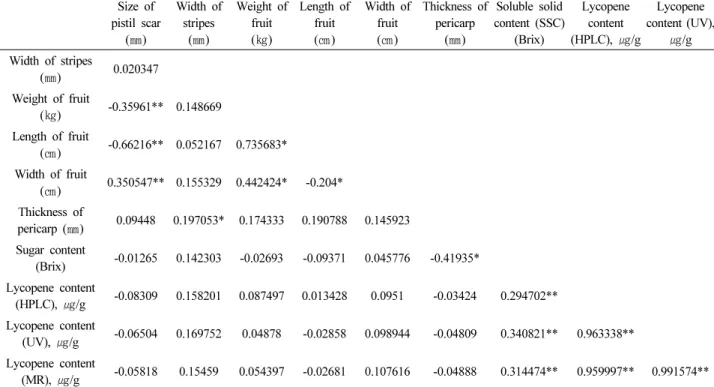
Solmaz and Sari, 2009; Soteriou et al., 2014; Szamosi et al., 2009; Wehner et al., 2017), however, the fruit weight and size of pistil scar of the resources investigated in this study are quite higher. Some of the characters had a significant correlation with each other. The weight of the fruit was signi- ficantly positively correlated with length and width, which is quite expected. Other important significant correlations (p <
0.01) observed are between the size of pistil scar and weight, length, and width of fruit, where the size of the pistil scar was negatively correlated with the former two characters and positively correlated with the later. Watermelon fruits that had a higher thickness of rind were found to exhibit less SSC (Table 2).
The origins of the genetic resources showed to affect the
morphological characteristics of some resources to a certain
extent. For instance, KOR origin watermelon fruits were
Table 1. Lycopene content and some selected quantitative morphological characters in watermelon fruit flesh samples
S/No SPS
z(㎜) WS
y(㎜) WF
x(㎏) LF
w(㎝) WIF
v(㎝) TP
u(㎜) SSC
t(Brix)
Lycopene content (㎍/g)
HPLC UV MR
1 2.0 0.0 6.3 33.0 19.1 9.8 8.8 101.9 ± 5.69 79.87 ± 1.5 119.28 ± 2.73
2 25.6 0.0 3.2 17.0 18.6 7.48.8 73.82 ± 5.01 4 7.06 ± 4 .86 69.52 ± 0.27
3 11.426.0 5.5 22.5 21.3 8.2 9.5 127.34 ± 5.8 109.37 ± 5.4 7 178.52 ± 8.18
4 10.4 9.4 4.3 21.0 19.0 10.8 10.2 91.88 ± 4.15 71.39 ± 1.45 103.72 ± 4.21
5 4.6 9.8 5.1 25.0 19.3 8.6 10.3 94.25 ± 5.74 71.03 ± 6.6 86.19 ± 1.71
6 3.0 0.0 6.2 31.8 19.1 9.2 9.2 93.5 ± 2.7465.72 ± 2.56 108.35 ± 0.6
7 2.6 0.0 6.3 29.9 19.9 10.2 10.2 84.88 ± 1.81 60.85 ± 2.45 98.29 ± 1.24
8 10.0 11.2 5.7 22.3 21.7 11.8 9.2 153.16 ± 4.39 139.39 ± 8.67 232.14 ± 2.62
9 10.6 26.4 6.6 24.0 22.7 10.4 10.4 107.78 ± 2.69 81.79 ± 4.85 120.9 ± 1.56
10 10.6 8.2 5.1 22.9 20.7 9.48.6 98.6 ± 5.83 69.4 ± 6.9 112.65 ± 2.51
11 5.40.0 7.0 26.0 22.7 11.0 9.0 96.68 ± 1.74 70.88 ± 0.28 105.61 ± 3.19
12 11.8 0.0 6.8 25.3 22.6 11.2 9.8 84.15 ± 1.96 52.44 ± 4.73 79.69 ± 11.91
13 32.6 0.0 5.6 21.9 22.3 7.6 8.8 87.28 ± 0.9 55.91 ± 2.08 88.13 ± 9.53
1426.0 0.0 5.7 20.8 22.1 8.8 10.9 85.23 ± 1.59 55.69 ± 0.83 81.66 ± 2.55
15 17.6 0.0 5.1 21.3 20.8 8.2 9.9 63.05 ± 0.9 25.45 ± 1.06 41.26 ± 6.95
16 24.0 5.6 5.7 21.7 22.3 10.0 7.8 86.23 ± 2.07 55.24 ± 3.15 85.48 ± 9.08
17 8.8 7.8 5.3 23.8 21.2 14.6 6.7 81.33 ± 2.6 50.89 ± 0.73 75.25 ± 6.5
18 20.0 15.0 3.6 17.8 19.2 9.0 8.5 85.81 ± 2.6 54.58 ± 0.65 82.47 ± 5.94
19 19.8 11.2 5.7 22.6 21.6 11.47.6 83.93 ± 4 .02 50.67 ± 0.28 77.58 ± 3.15
20 2.4 23.6 6.8 34.3 19.2 10.8 8.8 80.15 ± 4.19 47.5 ± 0.79 68.14 ± 1.37
21 23.419.45.9 22.2 22.2 10.0 10.490.77 ± 7.83 67.63 ± 0.36 85.04 ± 6.3
22 19.0 0.0 5.422.421.3 10.4 9.5 87.2 ± 3.53 56.79 ± 0.36 82.21 ± 7.4 2
23 2.2 0.0 7.6 38.0 19.1 9.0 8.2 61.13 ± 2.48 23.46 ± 0.45 39.29 ± 4.38
2419.40.0 5.2 20.5 21.8 11.49.3 81 ± 3.66 4 6.69 ± 0.28 78.05 ± 3.84
25 17.8 27.2 5.7 22.6 22.2 12.6 9.9 107.29 ± 6.89 78.99 ± 0.45 125.39 ± 7.99
26 17.2 12.4 5.0 21.8 21.1 14.0 9.1 78.28 ± 4.09 46.76 ± 0.45 73.00 ± 2.98
27 19.6 24.0 4.4 20.6 20.3 14.2 10.0 116.1 ± 5.24 92.63 ± 1.08 143.06 ± 11.97
28 23.0 0.0 4.8 20.8 21.4 9.4 8.7 128.27 ± 7.29 97.43 ± 0.63 162.11 ± 28.24
29 15.6 21.0 5.8 22.5 22.3 11.6 8.5 69.37 ± 4.29 34.59 ± 0.89 54.82 ± 1.93
30 20.6 0.0 5.1 21.7 20.6 9.4 10.6 81.81 ± 4.04 46.62 ± 1.36 74.38 ± 2.11
31 17.0 4.8 4.5 20.8 18.3 12.8 7.6 94.28 ± 6.47 63.58 ± 1.58 94.60 ± 3.19
32 4.2 0.0 7.0 27.1 21.5 11.4 8.1 90.73 ± 5.39 57.53 ± 0.83 92.78 ± 0.75
33 10.6 6.45.5 23.1 21.1 11.2 9.5 106.7 ± 3.9477.4 4 ± 0.91 119.38 ± 3.64
34 11.0 9.4 4.9 22.0 20.5 8.8 8.6 95.76 ± 1.78 69.33 ± 0.38 104.49 ± 4.97
35 20.8 14.0 4.8 20.7 20.3 10.4 7.5 80.61 ± 4.34 48.16 ± 0.48 76.46 ± 2.92
36 27.4 29.8 5.1 21.3 21.3 14.6 8.5 116.94 ± 7.13 89.17 ± 0.63 135.13 ± 1.52
37 26.4 19.8 5.1 21.4 21.7 10.6 7.9 90.59 ± 5.22 57.82 ± 0.99 104.44 ± 0.84
38 17.48.6 4 .421.2 20.6 10.8 8.7 56.67 ± 2.22 21.1 ± 1.4 7 29.57 ± 1.77
39 13.6 6.4 4.8 22.1 20.6 11.2 8.5 62.3 ± 3.38 25.97 ± 1.38 43.38 ± 1.13
40 21.4 5.2 4.5 20.7 20.4 10.2 8.4 88.25 ± 5.7 56.94 ± 1.46 86.75 ± 1.84
41 11.0 11.2 4.7 22.2 20.0 11.4 7.8 96.72 ± 9.2 65.64 ± 2.19 102.55 ± 3.12
42 8.0 10.6 4.7 21.8 20.6 9.8 7.1 79.24 ± 5.21 46.03 ± 1.71 70.9 ± 1.52
43 22.4 7.2 3.9 18.9 19.7 13.6 8.5 64.42 ± 0.65 31.28 ± 0.89 49.02 ± 2.38
Table 1. Continued
S/No SPS
z(㎜) WS
y(㎜) WF
x(㎏) LF
w(㎝) WIF
v(㎝) TP
u(㎜) SSC
t(Brix)
Lycopene content (㎍/g)
HPLC UV MR
4 411.43.45.3 22.2 21.2 7.8 7.8 96.74 ± 6.07 65.20 ± 1.91 104 .60 ± 2.95
45 16.4 0.0 4.2 20.6 19.8 11.2 9.0 182.82 ± 10.68 163.72 ± 1.82 255.47 ± 15.72
46 2.6 0.0 6.4 32.0 19.4 9.2 7.5 130.45 ± 8.75 101.92 ± 0.48 168.84 ± 18.85
47 20.0 0.0 6.1 22.7 22.2 9.0 8.6 80.07 ± 3.03 52 ± 1.81 81.49 ± 2.07
48 2.2 0.0 5.6 31.6 17.8 9.4 6.5 121.97 ± 14.36 92.78 ± 0.45 144.62 ± 6.22
49 7.4 11.8 4.5 23.2 19.4 10.8 7.8 67.32 ± 3.19 32.16 ± 0.55 43.97 ± 0.11
50 15.410.2 5.0 20.5 21.6 8.0 8.5 92.33 ± 6.3460.11 ± 1.13 94 .51 ± 1.97
51 9.0 13.2 5.422.3 21.6 8.0 9.0 102.39 ± 5.82 77 ± 1.85 108.65 ± 0.54
52 20.46.0 4 .6 20.4 21.0 9.6 7.3 104 .52 ± 7.92 77.59 ± 2.39 118.28 ± 10.01
53 11.2 21.8 6.9 24.8 23.2 8.4 9.2 99.83 ± 8.53 67.49 ± 0.99 113.78 ± 9.3
545.6 0.0 6.5 32.4 19.9 7.6 8.473.17 ± 4 .78 38.5 ± 0.75 65.97 ± 7.85
55 8.8 9.8 3.8 20.1 18.6 4.6 9.0 ND ND ND
56 10.0 0.0 5.7 24.5 22.0 13.4 7.3 66.06 ± 0.41 31.72 ± 1.18 49.49 ± 3.53
57 16.3 0.0 4.9 20.4 20.6 8.5 9.3 68.61 ± 2.49 34.96 ± 1.09 53.53 ± 3.09
58 23.413.45.5 21.5 21.8 12.4 8.1 80.27 ± 3.3 4 8.53 ± 1.15 75.27 ± 4 .57
59 6.6 13.2 5.0 22.0 21.1 9.2 9.5 130.32 ± 9.29 106.64 ± 1.23 165.12 ± 11.63
60 8.0 0.0 5.9 24.3 21.7 10.0 9.8 87.53 ± 4.43 56.35 ± 0.54 90.74 ± 4.1
61 20.0 14.4 6.0 22.0 22.3 10.6 9.7 90.86 ± 4.93 63.13 ± 1.15 94.02 ± 9.01
62 17.2 0.0 5.2 22.2 21.2 10.8 8.7 89.19 ± 2.91 58.78 ± 1.1 93.36 ± 4.2
63 17.4 11.4 5.1 21.7 20.4 10.4 9.3 93.29 ± 4.89 61.29 ± 0.93 97.45 ± 4.9
64 4.0 0.0 6.3 26.4 21.4 9.8 8.1 65.06 ± 2.59 31.05 ± 1.85 49.25 ± 1.91
65 2.0 24.4 4.4 29.4 17.3 10.8 9.9 97.56 ± 3.37 75.38 ± 1.72 114.00 ± 9.02
66 12.2 0.0 4.9 21.6 20.9 10.4 7.3 95.6 ± 7.21 66.31 ± 2.13 107.60 ± 9.79
67 20.8 12.6 5.0 21.8 21.2 9.0 10.0 ND ND ND
68 10.0 16.2 5.1 22.2 21.0 8.2 8.9 101.49 ± 5.26 72.13 ± 0.91 116.04 ± 4.54
69 11.0 10.2 5.4 22.4 21.1 10.2 8.7 98.14 ± 10.53 73.68 ± 2.26 113.28 ± 13.47
70 21.0 23.8 4.9 22.1 20.5 10.4 8.8 86.04 ± 5.19 55.1 ± 0.73 84.39 ± 6.63
71 4.4 0.0 5.4 26.4 19.9 6.8 7.0 57.27 ± 1.73 23.38 ± 0.96 31.02 ± 3.14
72 11.6 19.47.2 25.422.8 10.6 9.0 109.8 ± 15.96 88.28 ± 4 .02 129.85 ± 25.54
73 11.2 17.2 6.3 23.6 22.2 9.2 9.1 80.79 ± 3.03 53.1 ± 2.41 80.29 ± 11.50
74 2.2 28.0 10.4 48.4 20.2 22.6 5.5 49.51 ± 0.59 12.21 ± 1.17 15.40 ± 1.00
75 9.0 7.6 7.3 25.3 22.7 15.0 5.476.88 ± 4 .9 4 8.02 ± 3.03 69.78 ± 8.98
76 13.0 0.0 4.6 22.6 20.4 11.6 8.5 67.03 ± 2.53 34.37 ± 2.33 51.5 ± 1.01
77 12.410.44 .3 20.7 20.8 11.2 7.8 117.06 ± 8.06 89.09 ± 0.65 14 5.16 ± 11.3
78 15.6 3.6 4.0 20.3 20.8 11.8 7.0 62.75 ± 3.02 29.95 ± 1.75 44.69 ± 2.61
79 20.8 0.0 4.7 20.6 21.0 11.6 7.1 63.76 ± 2.89 28.77 ± 2.23 43.53 ± 6.52
80 15.6 13.6 4.3 21.2 20.5 13.4 7.2 71.16 ± 6.77 38.8 ± 1.68 54.68 ± 4.99
81 15.6 3.6 5.3 22.8 21.0 7.8 7.483.87 ± 0.38 57.9 ± 1.4 1 76.26 ± 2.72
82 18.4 0.0 3.7 19.1 18.7 5.6 5.7 41.37 ± 0.81 2.81 ± 0.18 3.54 ± 0.89
83 15.4 9.0 4.3 21.0 19.8 11.4 5.7 45.49 ± 0.72 6.35 ± 0.54 17.03 ± 0.29
8423.40.0 5.8 21.9 21.9 11.0 5.8 ND ND ND
85 6.40.0 4 .0 25.4 17.8 11.6 7.7 53.87 ± 3.8 22.57 ± 1.09 30.01 ± 7.34
86 23.8 6.4 4.3 21.0 20.6 11.2 8.5 86.15 ± 8.73 62.47 ± 1.31 98.06 ± 2.91
Table 1. Continued
S/No SPS
z(㎜) WS
y(㎜) WF
x(㎏) LF
w(㎝) WIF
v(㎝) TP
u(㎜) SSC
t(Brix)
Lycopene content (㎍/g)
HPLC UV MR
87 24.8 13.2 5.9 21.9 22.7 11.2 7.1 54.83 ± 1.8 21.1 ± 1.03 30.36 ± 1.95
88 20.8 12.4 4.7 21.3 20.7 10.2 8.0 61.22 ± 5.99 32.68 ± 2.17 49.16 ± 0.63
89 13.413.0 5.8 23.1 22.8 10.8 8.6 67.17 ± 1.2 32.4 6 ± 1.01 53.16 ± 7.56
90 12.8 14.0 4.1 19.6 20.2 15.6 5.1 52.43 ± 4.1 16.08 ± 0.63 30.23 ± 0.4
91 19.0 4.8 4.0 21.0 20.3 12.6 8.0 71.59 ± 7.05 47.28 ± 2.08 65.31 ± 3.84
92 18.6 5.0 5.2 20.7 21.8 11.47.7 79.85 ± 5.65 54 .87 ± 1.85 77.56 ± 6.09
93 15.4 10.6 3.7 20.6 19.2 12.6 8.0 72.5 ± 10.25 51.48 ± 4.23 77.02 ± 9.77
94 17.2 0.0 4.9 20.4 21.6 14.2 6.7 ND ND ND
95 21.2 13.2 3.9 20.9 20.4 11.4 8.7 74.89 ± 7.73 53.69 ± 2.17 83.36 ± 1.41
96 17.0 8.8 4.9 22.1 20.5 11.6 8.7 69.04 ± 3.57 41.67 ± 0.58 55.68 ± 2.78
97 16.6 0.0 4.7 21.1 20.9 12.4 9.0 73.18 ± 2 45.14 ± 1.71 70.38 ± 1.03
98 19.6 0.0 4.3 20.5 19.7 10.6 9.0 76.44 ± 5.19 54.36 ± 1.36 76.16 ± 5.95
99 23.0 3.8 3.8 21.2 22.2 17.48.6 97.19 ± 5.96 83.93 ± 1.91 126.04 ± 3.17
100 6.6 0.0 3.9 27.1 18.0 15.6 6.6 50.38 ± 1.38 17.34 ± 0.99 23.59 ± 0.77
101 2.4 11.4 4.5 22.6 19.5 6.0 10.9 65.36 ± 0.18 34.89 ± 0.72 43.88 ± 1.08
102 5.2 12.2 4.5 22.7 19.6 7.4 9.7 111.21 ± 0.65 87.25 ± 1.27 133.33 ± 2.33
103 5.8 14.4 5.2 25.6 21.0 8.0 9.3 52.27 ± 0.21 24.27 ± 0.79 28.38 ± 0.57
104 11.4 5.6 3.8 23.7 17.7 4.6 12.3 68.96 ± 1.01 41.9 ± 1.06 66.81 ± 2.32
105 8.0 12.6 5.9 25.2 21.5 9.2 10.1 68.15 ± 0.25 38.21 ± 1.1 54.21 ± 0.68
z
SPS = Size of pistil scar (㎜);
yWS = Width of stripes (㎜);
xWF = Weight of fruit (㎏);
wLF = Length of fruit (㎝);
vWIF = Width of fruit (㎝);
u