Journal of Forest and Environmental Science
Journal of Forest and Environmental Science Vol. 31, No. 4, pp. 261-266, November, 2015 http://dx.doi.org/10.7747/JFES.2015.31.4.261
Analysis of Habitat Characteristics of the Yellow-throated Marten Martes flavigula
(Carnivora : Mustelidae) Using Geographic Information System (GIS)
Sang-Jin Lim, Ji-Hong Min and Yung-Chul Park*
Department of Forest Environment System Graduate School, Kangwon National University, Chuncheon 24341, Republic of Korea
Abstract
We investigated habitat characteristics of the yellow-throated marten Martes flavigula (Carnivora : Mustelidae) using geographic information system (GIS). GPS coordinates of the target mammal traces and seven habitat factors were used for the GIS analysis. The Odaesan National Park (ONP) is selected as a study area for GIS analysis of the habitat characteristics. According to the GIS analysis of whole area of ONP, main forest type was broadleaf trees which occupy 72% of forests. Trees of 4th to 6th age-calss account for 93% of the ONP forests. The mean elevation and slope of ONP was 901 m and 22.1o, respectively. According to the GIS analysis of M. flavigula habitats in ONP, most M. flavigula traces were found in borad-leaf forests and coniferous forests which are main forest types of ONP. In addition, the yellow-throated marten recorded a relatively high appearance rate of 7% in unstocked forests, which account for much less than 1% of the area of ONP. Most of the marten traces were found in forests with trees of 4th to 6th age-classes.
The traces were found in the forest types in higher elevation (1,080.3 m) and lower slope (15.0o) on average, compared with those of ONP. Appearance rate of the marten traces was 96% in range less than 600 m from the water. The traces were frequently found in areas far distantly beyond 1,400 m range from human residental areas and cultivated areas.
Key Words: endangered species, habitat characteristics, yellow-throated marten, Odaesan National Park
Received: October 31, 2015. Revised: November 9, 2015. Accepted: November 11, 2015.
Corresponding author: Yung Chul Park
Department of Forest Environment System Graduate School, Kangwon National University, Chuncheon 24341, Republic of Korea Tel: 82-33-250-8366, Fax: 82-33-257-8361, E-mail: [email protected]
Introduction
Carnivorous mammals at the top of the food chain, as predators, can have profound effects on the trophic levels below them and play very important roles in ecosystems through their control of the population size of preys in low- er levels in food chain. There are 245 species of the order Carnivora recognized in worldwide (Estes et al. 2011;
Hunt 2011). Since mammals of Carnivora have relatively low population density and wide home range, they tend to
be sensitive to environmental change of habitats (Noess et al. 1996) such as reduction and fragmentation of habitats and poaching (Ripple et al. 2014).
The martens of the genus Martes within the subfamily Mustelinae, in the family Mustelidae, consist of nine spe- cies (Wozencraft 2005). They are distributed in coniferous and deciduous forests across the northern hemisphere. The yellow- throated marten Martes flavigula (Carnivora : Mustelidae) is an Asian species of martens which is widely distributed and present as relatively stable population (Abramov et al.
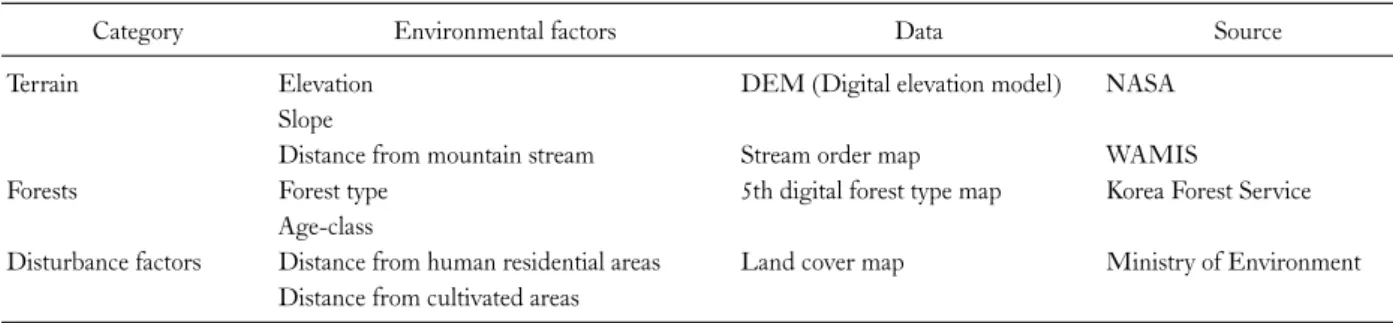
Table 1. Environmental factors used for GIS analysis of the yellow-throated marten (Martes flavigula) habitats
Category Environmental factors Data Source
Terrain Elevation DEM (Digital elevation model) NASA
Slope
Distance from mountain stream Stream order map WAMIS
Forests Forest type 5th digital forest type map Korea Forest Service
Age-class
Disturbance factors Distance from human residential areas Land cover map Ministry of Environment Distance from cultivated areas
Fig. 1. Geographical distribution of GPS coordinates of the yellow-throated marten (Martes flavigula) traces in Odaesan National Park (ONP). Most of traces were found in the mountain ridges. Mountain streams were indicated by the lines.
2008). The species occurs in mountainous forests, ranging from the Himalayas to eastern Russia and Taiwan. It also occurs in central and northeastern China and the Korean Peninsula (Proulx et al. 2004; Zalewski and Jedrzejewski 2006). In South Korea where carnivorous mammals of large body size, such as tigers, leopards and wolves, have al- ready disappeared, M. flavigula is listed as an endangered species. Despite their important ecological roles in the Korean forests, little is known about their natural habitats or characteristics of habitat use. Only home range and food habits have ever been investigated in M. flavigula in Jirisan National Park and Songnisan National Park (NIER 2011;
Woo 2014).
In this study, we investigated geographical distribution of M. flavigula in Odaesan National Park and character- istics of M. flavigula habitats were examined using geo- graphic information system (GIS)
Materials and Methods
For analyses of characteristics of M. flavigula habitats, to- tal 94 GPS coordinates of M. flavigula traces (catching sight of martens, fecal materials and foot prints) were col- lected from 2013 to 2015 in Odaesan National Park (ONP) (Fig. 1).
For GIS analysis, seven environmental factors to give ef- fects to habitat use and selection of M. flavigula (Table 1), depending on previous studies, were selected as follows:
forest type, age-class, slope (oC), elevation (m), distance from mountain stream (m), distance from human resi- dential areas (m), Distance from cultivated areas (m) (Seo and Park 2000; Choi 2003; Lee and Song 2008; Seo et al.
2008; NPRI 2011; Kwon et al. 2012; Song and Kim 2012;
Lim et al. 2015).
The seven factors were classified into three categories of forests (forest type and age class), terrain (slope, elevation and distance from mountain stream), and disturbance (distance from human residential areas and distance from cultivated areas) (Table 1). Layers of the seven factors (Fig. 2) and geo- graphical distribution of M. flavigula traces (Fig. 1) were produced and overlapped. Layers of forest factors were produced according to the 5th digital forest type map pro- vided by Korean Forest Service. All the layers were ana- lyzed by every 200 m. Forest type and terrain characteristics of ONP previously published (Lim et al. 2015) were used for comparison with those of M. flavigula habitats. Resolu- tion for the layers was adjusted to 30 m and all the analyses were conducted using ArcGIS 10.0 (ESRI Inc, USA).
Fig. 2. Spatial distribution of seven environmental factors in Odaesan National Park.
Fig. 3. Analysis of two forest factors, forest type (A) and age class (B), in Martes flavigula habitats. Slash boxes indicate relative ratios of forest compo- sition and age-class in the forests of whole ONP. Dark boxes indicate rela- tive ratios of forest composition and age class at the place where Martes fla- vigula traces were found.
Results and Discussion
Characteristics of forests (tree type and age class) that M.
flavigula has used as their habitats were revealed from GIS analysis based on GPS coordinates of total 94 localities that traces were found. Broad-leaf forests were found to have the highest appearance of M. flavigula traces, which ac- count for 61% of total appearance of traces, and then fol- lowed by coniferous forests (26%) and unstocked forest areas (11%) (Fig. 3A). Most traces were found in the for- ests with trees of the 4th to 6th age-classes, with the highest appearance in forests with the 5th age-classes (Fig. 3B).
Thus, the results of GIS analysis indicate that the martens of M. flavigula in ONP prefer broad-leaf forests, which consist of trees of the 5th age-class, as their habitats (Fig.
3B). These results are well agreement with those of the GIS analysis based on GPS coordinates of M. flavigula home range collected using radio telemetry techniques in Jirisan National Park (Woo 2014).
Characteristics of forest type and age class were com- pared between forests of whole ONP and those of M. flavi- gula habitats. In case of the forest types, most ONP forests
Fig. 4. Analysis of three terrain factors, elevation (A), slope (B) and distance from mountain stream (C), in Martes flavigula habitats. Slash boxes indicate relative ratio of elevation and slope of whole ONP. Dark boxes indicate rela- tive ratios of elevation, slope and distance from mountain stream at the pla- ces where Martes flavigula traces were found.
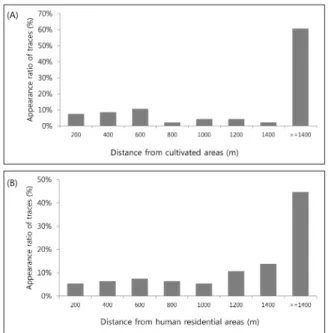
Fig. 5. Relationship between disturbed areas (A: human residential areas and B: cultivated areas) and Martes flavigula habitats.
consist of broad-leaf forests and coniferous forests. As in the tree components of ONP forests, similarly, habitats of M. flavigula consist of borad-leaf forests and coniferous for- ests, with a relatively very high ratio when compared to the others (mixed forests and unstocked forest area and non-forests). In case of the unstocked forest area, interest- ingly, its relative ratio in ONP was less than 0.05%. Traces of M. flavigula, however, shows relatively high appearance of 7% (Fig. 3A).
In comparison of tree age-class between the ONP forests and M. flavigula habitats (Fig. 2B), trees of 4th to 6th age-classes account for 93% of the ONP forests. Although trees of the 5th age-class (35%) and the 4th age-class (32%) are similarly distributed in ONP, M. flavigula traces were found to be much higher in the forests with trees of the 5th
age-class (47%) than those of the 4th age-class (22%). In case of the forests with trees of the 6th age-class, although the range ratio (26%) that they occupy in ONP is lower than that (32%) of the forests with trees of the 4th age-class, appearance (28%) of M. flavigula traces is higher than the trace appearance (22%) in the forests of trees with the 4th age-class.
According to comparative analyses between terrains of whole ONP and M. flavigula habitats, M. flavigula traces were more frequently found in the forests above 1,080 m higher than average elevation (901 m) of ONP (Fig. 4A).
Slope (15.0o) of M. flavigula habitats was lower than that of average slope (22.1o) of ONP (Fig. 4B). Most of M. flavi- gula traces (96%) were found in the ranges within 600m near mountain stream (Fig. 4C).
Appearance of M. flavigula traces was relatively lower in the ranges within 600m from the disturbed areas such as human residential area (18%) and cultivated areas (27%) (Fig. 5). As shown in previous studies (Choi and Choi 2007; Woo 2014), the results indicate that M. flavigula pre- fer the interior of forests than edge of forests or disturbed forests near human residential area or cultivated area.
In conclusion, the statistical analysis of M. flavigula hab- itats shows that M. flavigula prefers broad-leaf forests with
Table 2. GIS-based statistical analysis of environmental factors of the yellow-throated marten (Martes flavigula) habitats
Category N*
Mean±SD Range Effective value Missing value**
Age-class (per 10 years) 93 1 5.1±0.8 4∼7
Slope (oC) 94 0 15±8.4 2.8∼39.3
Elevation (m) 94 0 1,080.3±286.8 539∼1,551
Distance from mountain stream (m) 94 0 298±202 0.2∼961.5
Distance from human residential areas (m) 94 0 1,500.6±940.8 42.4∼3,920.4
Distance from cultivated areas (m) 94 0 1,598±1,017.2 30∼3,748.6
*N: Number of samples.
**Missing value: Number of emergence of non-forest area.
trees of the 5th age-class, the forests above 1,080m higher than average elevation (901 m) of ONP, the slope (15.0o) lower than that of average slope (22.1o) of ONP, the ranges within 600m near mountain stream, and the ranges beyond at least 1,400m from human-disturbed areas (Table 2).
Environmental conditions for suitable wildlife habitats re- quire foods, cover, water, space and well arrangement of the four components (Lee et al. 2010). In this study, the food resources were not included. Thus, ecological data in rela- tion to food resources and food chains will more required for habitat use of M. flavigula in further studies.
Acknowledgements
This work was carried out with support of "Cooperative Research Program for Agricultural Science&Technology Development (Project No. PJ01085902), Rural Develop- ment Administration, Republic of Korea.
Conflict of interest
The authors declare that they have no competing interests.
Ethics approval
All animal experiments throughout the study were con- ducted in accordance with guidelines of Kangwon National University for the care and use of animals.
References
Abramov A, Timmins RJ, Roberton S, Long B, Than Zaw, Duckworth JW. 2008. Martes flavigula. IUCN Red List of Threatened Species. Version 2014. 2. International Union for Conservation of Nature.
Choi SY. 2003. Development of habitat suitability evaluation model for Korean water deer (Hydropotes inermis argyropus) in Daebu is- land, Korea. MS thesis. Seoul National University, Seoul, Korea. (in Korean)
Choi TY, Choi HM. 2007. Trace picture book of wild animals.
Dolbegae, Seoul.
Estes JA, Terborgh J, Brashares JS, Power ME, Berger J, Bond WJ, Carpenter SR, Essington TE, Holt RD, Jackson JB, Marquis RJ, Oksanen L, Oksanen T, Paine RT, Pikitch EK, Ripple WJ, Sandin SA, Scheffer M, Schoener TW, Shurin JB, Sinclair AR, Soulé ME, Virtanen R, Wardle DA. 2011. Trophic downgrading of planet Earth. Science 333: 301-306.
Hunt L. 2011. Carnivores in the world. Princeton University Press, Princeton, NJ.
Kwon HS, Seo CW, Park JH. 2012. Development of species dis- tribution models and evaluation of species richness in Jirisan region. J Korean Soc Geosp Inf Syst 20: 11-18.
Lee DK, Song WK. 2008. A study on the analytic unit of habitat suitability assessment and selection in conservation areas for leopard cat (Prionailurus bengalensis)-focus on Chungcheong province area. J Korean Inst Landscape Architect 36: 64-72.
Lee WS, Park CY, Im SJ, Heo WH, Jung OS, Choi CY, Park YS, Lee EJ. 2010. Wildlife ecology management. Life Science Publishing Co, Seoul.
Lim SJ, Kim JY, Park YC. 2015. Analysis of habitat characteristics of leopard cat (Prionailurus bengalensis) in Odaesan National Park. J Agric Life Sci 49: 99-111.
NIER (National Institute of Environmental Research). 2011.
Management of ecological corridor to conserve wildlife popula- tion. 3rd ed. National Institute of Environmental Research, Incheon.
NPRI (National Park Research Institute). 2011. Cartographic method suitable for species habitat using GIS, National Park Research Institute.
Ripple WJ, Estes JA, Beschta RL, Wilmers CC, Ritchie EG, Hebblewhite M, Berger J, Elmhagen B, Letnic M, Nelson MP, Schmitz OJ, Smith DW, Wallach AD, Wirsing AJ. 2014.
Status and ecological effects of the world's largest carnivores.
Science 343: 1241484.
Seo CW, Choi TY, Choi YS, Kim DY. 2008. A study on wildlife habitat suitability modeling for goral (Nemorhaedus caudatus rad- deanus) in Seoraksan National Park. J Korea Soc Environ Restor Technol 11: 28-38.
Seo CW, Park JH. 2000. Wild Boar (Sus scrofa corranus Heude) habitat modeling using GIS and logistic regression. J Korea Spat Inf Soc 8: 85-99.
Song WK, Kim EY. 2012. A comparison of machine learning spe- cies distribution methods for habitat analysis of the Korea water deer (Hydropotes inermis argyropus). Korean J Remote Sens 28:
171-180.
Woo DG. 2014. A Study on ecological characteristics and con- servation of yellow-throated marten. Doctor’s thesis. Seoul National University, Seoul, Korea. (in Korean)
Wozencraft WC. 2005. Order Carnivora. In: Mammal species of the world: A taxonomic and geographic reference (Wilson DE, Reeder DM, eds). 3rd ed. Johns Hopkins University Press, Baltimore.
Zalewski A, Jedrzejewski W. 2006. Spatial organisation and dy- namics of the pine marten Martes Martes population in Bialowieza forest (E Poland) compared with other European woodlands. Ecography 29: 31-43.