
Provinol Inhibits Catecholamine Secretion from the Rat Adrenal Medulla
11
0
0
전체 글
(2) 230. JH Lee, et al. was increased after drinking red wine, but not after drinking the same quantity of alcohol in white wine or vodka (Shimada et al., 1999). The endothelium-dependent vasodilation was also improved after acute intake of 500 ml of red wine or red wine without alcohol in men, as determined by ultrasonography of the brachial artery (Hashimoto et al., 2001). It has been suggested that the mechanisms of vasorelaxation induced by resveratrol are heterogeneous, two mechanisms participating partially in the relaxation of the isolated porcine coronary artery were detected in the study, one being the nitric oxide released from the endothelium, 2+ the other causing inhibition of Ca influx, but estrogen receptors were not involved in resveratrol-induced relaxation (Liu et al., 2006). Lim (2008) has shown that resveratrol inhibits cholinergic stimulation-evoked secretion of catecholamines (CA) through suppression of ion influx into the rat adrenomedullary cells due to the increased NO production. There is, however, little evidence regarding the effects of provinol on the CA secretion from the adrenal medulla. Therefore, the aim of the present study was to investigate whether provinol can modify the CA secretion evoked by stimulation of cholinergic receptors and direct membrane-depolarization in the perfused model of normotensive rats, and to establish its mechanism of action.. METHODS Experimental procedure Male Sprague-Dawley rats, weighing 200 to 300 grams, were anesthetized with thiopental sodium (40 mg/kg) intraperitoneally. The adrenal gland was isolated using some modification of the methods described previously (Wakade, 1981). The abdomen was opened by a midline incision, and the left adrenal gland and surrounding area were exposed by placing three hook retractors. The stomach, intestine and portion of the liver were not removed, but pushed over to the right side and covered by saline-soaked gauge pads and urine in bladder was removed in order to obtain enough working space for tying blood vessels and cannulations. A cannula, used for perfusion of the adrenal gland, was inserted into the distal end of the renal vein after all branches of adrenal vein (if any), vena cava and aorta were ligated. Heparin (400 IU/ml) was injected into vena cava to prevent blood coagulation before ligating vessels and cannulations. A small slit was made into the adrenal cortex just opposite the entrance of the adrenal vein. Perfusion of the gland was started, making sure that no leakage was present, and the perfusion fluid was released only from the slit made in the adrenal cortex. Then the adrenal gland, along with ligated blood vessels and the cannula were carefully removed from the animal and placed on a platform of a leucite chamber. The chamber was continuously circuo lated with water heated at 37±1 C. Perfusion of adrenal gland The adrenal glands were perfused by means of an ISCO pump (WIZ Co.) at a rate of 0.33 ml/min. The perfusion was carried out with Krebs-bicarbonate solution of the following composition (mM): NaCl, 118.4; KCl, 4.7; CaCl2, 2.5; MgCl2, 1.18; NaHCO3, 25; KH2PO4, 1.2; glucose, 11.7. The solution was constantly bubbled with 95% O2+5% CO2 and. the final pH of the solution was maintained at 7.4∼7.5. The solution contained disodium EDTA (10 μg/ml) and ascorbic acid (100 μg/ml) to prevent oxidation of CA. Drug administration −4. −4. The perfusion of DMPP (10 M) and McN-A-343 (10 −3 M) for 2 minutes and/or a single injection of ACh (5.32×10 M) and KCl (5.6×10⁻² M) in a volume of 0.05 ml were made into the perfusion stream via a three-way stopcock, respec−4 −5 tively. Veratridine (10 M), Bay-K-8644 (10 M) and cy−5 clopiazonic acid (10 M) were also perfused for 4 min, respectively. In the preliminary experiments, it was found that upon administration of the above drugs, secretory responses to ACh, KCl, McN-A-343, veratridine, Bay-K-8644 and cyclopiazonic acid returned to preinjection level in about 4 min, but the responses to DMPP returned in 8 min. Collection of perfusate As a rule, prior to stimulation with various secretagogues, the perfusate was collected for 4 min to determine the spontaneous secretion of CA (background sample). Immediately after the collection of the background sample, collection of the perfusates was continued in another tube as soon as the perfusion medium containing the stimulatory agent reached the adrenal gland. Stimulated sample's perfusate was collected for 4 to 8 min. The amounts secreted in the background sample had been subtracted from that secreted from the stimulated sample to obtain the net secretion value of CA, which is shown in all of the figures. To study the effect of provinol on the spontaneous and evoked secretion, the adrenal gland was perfused with Krebs solution containing quinine for 20 min, then the perfusate was collected for a certain period (background sample). Then the medium was changed to the one containing the stimulating agent alone or with provinol, and the perfusates were collected for the same period of time as that for the background sample. The adrenal gland's perfusate was collected in chilled tubes. Measurement of catecholamines CA content of perfusate was measured directly using the fluorometric method of Anton and Sayre (1962) without the intermediate purification alumina for the reasons described earlier (Wakade, 1981) using a fluorospectrophotometer (Kontron Co., Milano, Italy). A volume of 0.2 ml of the perfusate was used for the reaction. The CA content in the perfusate of stimulated glands by the secretagogues used in the present work was high enough to obtain readings several folds greater than the reading of the control samples (unstimulated). The sample blanks were also lowest for perfusates of the stimulated and non-stimulated samples. The content of CA in the perfusate was expressed in terms of norepinephrine (base) equivalents. Measurement of NO release NO release was measured using a NO-selective microelectrode (amiNO-700, innovative Instruments Inc) and an amplifier (inNO meter, Innovative Instruments). Platelet NO production was quantified as the integrated signal de-.
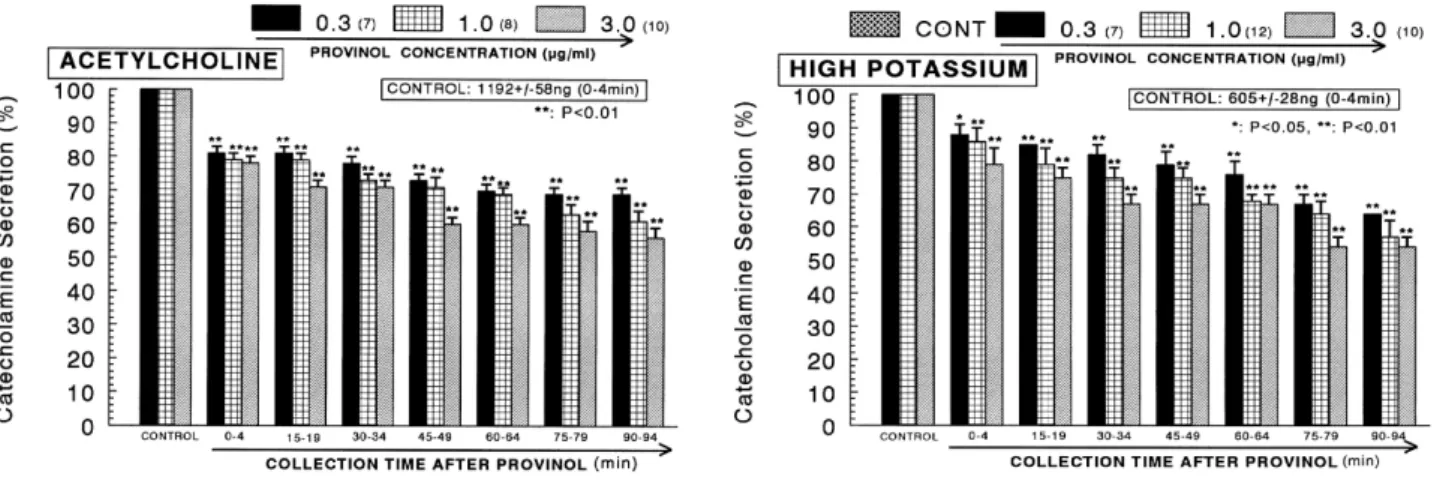
(3) 231. Provinol Inhibits Catecholamine Secretion. tected by the microelectrode after platelet activation, as previously described (Freedman et al., 2000). The electrode was calibrated by producing standardized concentrations of NO in 0.5% (wt/vol) KI in 0.1 mol/L H2SO4 from NaNO2 standards. NO release was quantified as the current detected at the electrode 30 min after the presence of provinol at room temperature. NO release was calculated in picomoles. NO production was also measured indirectly by measuring the nitrite content in the supernatant. Statistical analysis The statistical difference between the control and pretreated groups was determined by the Student’s t and ANOVA tests. A p value of less than 0.05 was considered to represent statistically significant changes unless specifically noted in the text. Values given in the text refer to the means and the standard errors of the mean (S.E.M.). The statistical analysis of the experimental results was made using the computer program described by Tallarida and Murray (1987). Drugs and their sources The following drugs were used: Provinol [(purchased product, mixture of polyphenols developed by INRA (Institut National de Recherche Agronomique, Montpellier- France) in partnership with the Société Française de Distilleries Co. in France)], 1.1-dimethyl-4 -phenyl piperazinium iodide (DMPP), acetylcholine chloride, norepinephrine bitartrate, ω potassium chloride (KCl), N -nitro-L-arginine methyl ester hydrochloride (L-NAME), methyl-1,4-dihydro-2,6-dimethyl3-nitro-4-(2-trifluoromethyl-phenyl)-pyridine-5-carboxylate (BAY-K-8644), cyclopiazonic acid, veratridine hydrochloride (Sigma Chemical Co., U.S.A.), and (3-(m-cholro-phenyl-carbamoyl- oxy)-2-butynyltrimethyl ammonium chloride [McNA-343] (RBI, U.S.A.). Drugs were dissolved in distilled water (stock) and added to the normal Krebs solution as required except Bay-K-8644, which was dissolved in 99.5% ethanol and diluted appropriately with Krebs-bicarbonate. solution (final concentration of alcohol was less than 0.1%). Concentrations of all drugs except provinol used are expressed in terms of their molar base.. RESULTS Effects of provinol on the CA secretion evoked by ACh, high K+ , DMPP and McN-A-343 from the perfused rat adrenal medulla After the perfusion with oxygenated Krebs-bicarbonate solution for 1 hr, the basal CA release from the perfused rat adrenal glands amounted to 22±3 ng for 2 min (n=9). Since provinol at the concentration producing the maximal endothelium-dependent relaxation, restored the relaxation of the femoral artery to acetylcholine abolished by superoxides and enhanced partially the relaxant responses of sodium nitroprusside suggesting the ability of provinol to preserve NO from degradation (Zenebe et al., 2003; Pecháňová et al., 2006), there was an initial attempt to examine the effects of provinol itself on CA secretion from the perfused model of the rat adrenal glands. However, in the present study, provinol (0.3∼3 μg/ml) itself did not produce any effect on basal CA output from perfused rat adrenal glands (data not shown). Therefore, it was decided to investigate the effects of provinol on cholinergic receptor stimulationand membrane depolarization-mediated CA secretion. Secretagogues were given at 15 to 20 min-intervals. Provinol was present for 90 minutes after the establishment of the control release. In the perfused rat adrenal medulla, stimulation of nicotinic acetylcholine receptor-ion channels with acetylcholine, a physiological secretagogue, injected into the perfusion stream in a volume of 0.05 ml greatly increased the CA secretion (1,192±58 ng for 0∼4 min), as shown in Fig. 1 (left). However, the pretreatment with provinol in the range of 0.3∼3 μg/ml for 90 min relatively inhibited ACh-stimulated CA secretion in a concentration- and time- dependent manner. In the presence of provinol as shown in Fig. 1 (left),. Fig. 1. Dose-dependent effects of provinol on the secretory responses of catecholamines (CA) evoked by acetylcholine (left) and high potassium −3 + −2 (right) from the perfused rat adrenal medulla. The CA secretion by a single injection of ACh (5.32×10 M) and K (5.6×10 M) in a volume of 0.05 ml was evoked at 15 min intervals during loading with 0.3, 1.0 and 3.0 μg/ml of provinol for 90 min as indicated by the arrow marks, respectively. The numbers in parentheses indicate the number of rat adrenal glands. Vertical bars on the columns represent the standard error of the mean (S.E.M.). Ordinate: the amounts of CA secreted from the adrenal gland (% of control). Abscissa: collection time of perfusate (min). Statistical difference was obtained by comparing the corresponding control (CONTROL) with each concentration-treated group of provinol. ACh- and high K+-induced perfusates were collected for 4 minutes, respectively. **p<0.01..
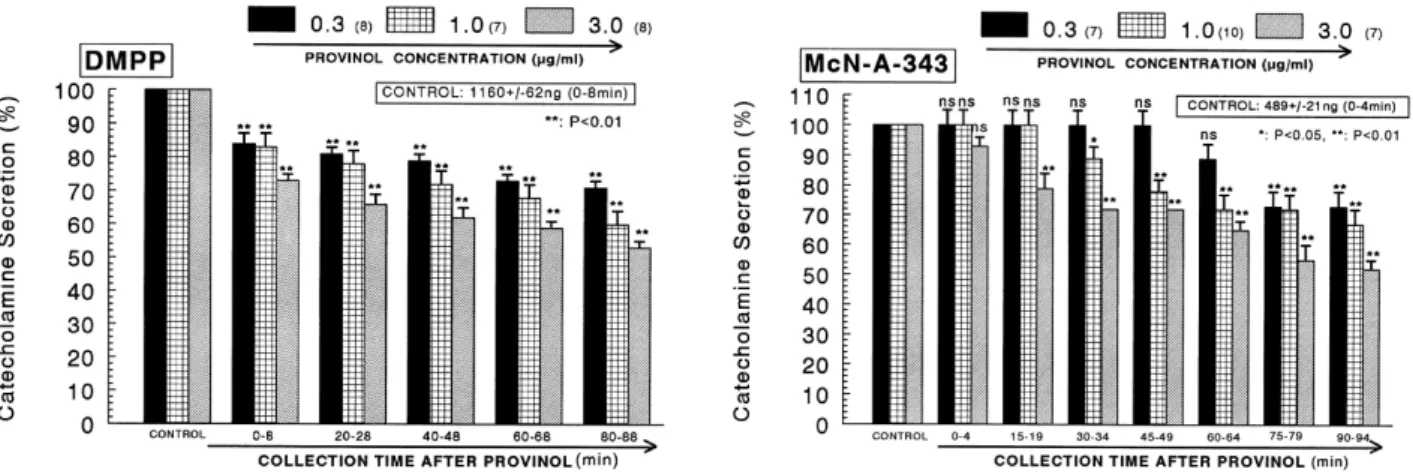
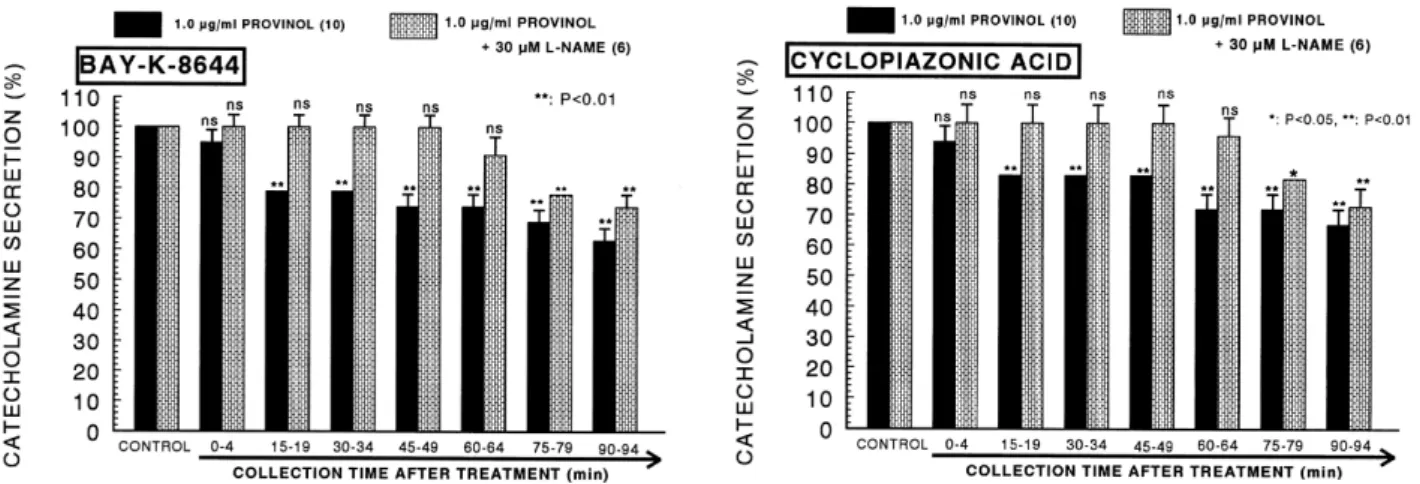
(4) 232. JH Lee, et al. CA releasing responses were inhibited to 56% of the corresponding control release (100%). Also, it has been found that depolarizing agent like KCl, an activator of voltage-dependent Ca2+ channels, markedly stimulates CA secretion (605±28 ng for 0∼4 min). However, following the + −2 pretreatment with provinol (0.3∼3 μg/ml), high K (5.6×10 M)-stimulated CA secretion was significantly inhibited to 54% of the control after 75 min period (Fig. 1- right). DMPP −4 (10 M), which is a selective nicotinic NN-receptor agonist in autonomic sympathetic ganglia, evoked a sharp and rapid increase in CA secretion (1,160±62 ng for 0∼8 min). However, as shown in Fig. 2 (left), DMPP-stimulated CA secretion after pretreatment with provinol was maximally reduced to 53% of the control release in the last period (80∼ −4 88 min). McN-A-343 (10 M), which is a selective muscarinic M1-agonist (Hammer and Giachetti, 1982), perfused into an adrenal gland for 4 min caused an increased CA secretion (489±21 ng for 0∼4 min). However, McN-A-343-stimulated CA secretion in the presence of provinol was markedly depressed to 52% of the corresponding control secretion. (100%) as depicted in Fig. 2 (right). Effects of provinol on the CA secretion evoked by Bay-K-8644, cyclopiazonic acid and veratridine from the perfused rat adrenal medulla Since Bay-K-8644 is known to be a calcium channel acti2+ vator, which enhances basal Ca uptake (Garcia et al., 1984) and CA release (Lim et al., 1992), it was of interest to determine the effects of provinol on Bay-K-8644-stimulated CA secretion from the isolated perfused rat adrenal glands. −5 Bay-K-8644 (10 M)-stimulated CA secretion in the presence of provinol (1 μg/ml) was greatly blocked to 63% of the control release except for the initial 0∼4 min as compared to the corresponding control release (486±17 ng for 0∼4 min) from 10 rat adrenal glands as shown in Fig. 3 (left). In order to investigate the effect of provinol on the mobi2+ lization of intracellular Ca , the effect of provinol on the CA secretion evoked by cyclopiazonic acid, as a secretagogue, was examined. Cyclopiazonic acid, a mycotoxin from. Fig. 2. Dose-dependent effects of provinol on the CA secretory responses evoked by DMPP (left) and McN-A-343 (right) from the perfused rat adrenal medulla. The CA secretion by perfusion of DPPP (10−4 M) and McN-A-343 (10−4 M) for 2 min was induced at 15 and 20 min intervals during loading with 0.3, 1.0 and 3.0 μg/ml of provinol for 90 min, respectively. Statistical difference was obtained by comparing the corresponding control (CONTROL) with each concentration-pretreated group of provinol. DMPP- and McN-A-343-induced perfusates were collected for 8 and 4 minutes, respectively. Other legends are the same as in Fig. 1. *p<0.05, **p<0.01. ns: Not statistically significant.. Fig. 3. Time-course effects of provinol on the CA secretion evoked by Bay-K-8644 (left) and cyclopiazonic acid (right) from the perfused rat adrenal medulla. Bay-K-8644 (10−5 M) and cyclopiazonic acid (10−5 M) were perfused into an adrenal vein for 4 min at 15 min intervals during loading with provinol (1.0 μM) for 90 min. Other legends are the same as in Fig. 1. **p<0.01. ns: Not statistically significant..
(5) Provinol Inhibits Catecholamine Secretion. Aspergillus and Penicillium, has been described as a highly 2+ selective inhibitor of Ca -ATPase in skeletal muscle sarcoplasmic reticulum (Goeger and Riley, 1989; Seidler et al., 1989). As shown in Fig. 3 (right), in the presence of provinol −5 in 10 rat adrenal glands, cyclopiazonic acid (10 M)-evoked CA secretion was also inhibited to 67% of the control response (461±21 ng for 0∼4 min). + The voltage-dependent Na channels consist of the principal α-subunit, which is associated with noncovalently attached β1-subunits, and a disulfide-linked β2-subunit (Catterall, 2000). The α-subunits issued from a large multigene contain the ion-pore and the toxin binding sites, i.e., site 1 for tetrodotoxin, site 2 for veratridine, site 3 for αScorpion toxin (α-ScTx), site 4 for β-Scorpion toxin (β-ScTx), and site 5 for P. brevis toxin-3 (PbTx-3) (Catterall, 2000). It has also been known that veratridine-induced Na+ influx. Fig. 4. Time-course effects of provinol on the CA secretion evoked by veratridine from the perfused rat adrenal medulla. Veratridine (10−4 M) was perfused into an adrenal vein for 4 min at 15 min intervals during loading with provinol (1.0 μM) for 90 min. Other legends are the same as in Fig. 1. **p<0.01.. 233. mediated through Na+ channels increased Ca2+ influx via 2+ channels and proactivation of voltage-dependent Ca duced the exocytotic secretion of CA in cultured bovine adrenal medullary cells (Wada et al., 1985a). To characterize the pharmacological action of provinol on voltage-dependent + Na channels, the effect of provinol on the CA secretion induced by veratridine was examined here. As shown in Fig. 4, veratridine greatly produced CA secretion (1,184±21 ng for 0∼4 min). However, in the presence of provinol (1 μg/ml), veratridine (100 μM)-evoked CA secretion from 8 glands was greatly inhibited to 46% of the corresponding control release in a time-dependent manner. Effects of provinol plus L-NAME on the CA release evoked by ACh, high K+ , DMPP and McN-A-343 from the perfused rat adrenal medulla It has also been found that, as shown in Fig. 1∼4, provinol inhibits the CA secretory response evoked by cholinergic stimulation in the perfused rat adrenal gland. Therefore, to study the relationship between NO and provinol-induced inhibitory effects on the CA release from the rat adrenal glands, provinol-induced inhibitory responses of CA secretion evoked by cholinergic receptor-stimulation as well as membrane depolarization was examined in the presence of L-NAME. In the simultaneous presence of provinol (1 μM) and L-NAME (30 μM) for 90 min, ACh-evoked CA release recovered to 74∼94% of the corresponding control release compared to results after loading of provinol + alone as illustrated in Fig. 5 (left). High K (56 mM)-evoked CA release in the simultaneous presence of provinol (1 μM) and L-NAME (30 μM) for 90 min also recovered to 75∼ 100% of the corresponding control release during all periods in comparison to the data of treatment with provinol alone (Fig. 5-right). As shown in Fig. 6 (left), the simultaneous perfusion of provinol and L-NAME for 90 min overcame the DMPPevoked CA release to 77∼89% of the control response compared to the corresponding control response in comparison to that of the provinol-treatment alone. Moreover, in the presence of provinol (1 μM) and L-NAME (30 μM), the CA. Fig. 5. Effects of provinol plus L-NAME on the CA secretory responses evoked by acetylcholine (left) and high potassium (right) from the perfused rat adrenal medulla. The CA secretion by a single injection of ACh (5.32×10⁻³ M) and K+ (5.6×10⁻² M) in a volume of 0.05 ml was evoked at 15 min intervals during simultaneous loading with provinol (1.0 μM) plus L-NAME (30 μM) for 90 min. Statistical difference was obtained by comparing the corresponding control (CONTROL) with provinol-treated group or group treated with provinol+ L-NAME. Other legends are the same as in Fig. 1. *p<0.05, **p<0.01. ns: Not statistically significant..
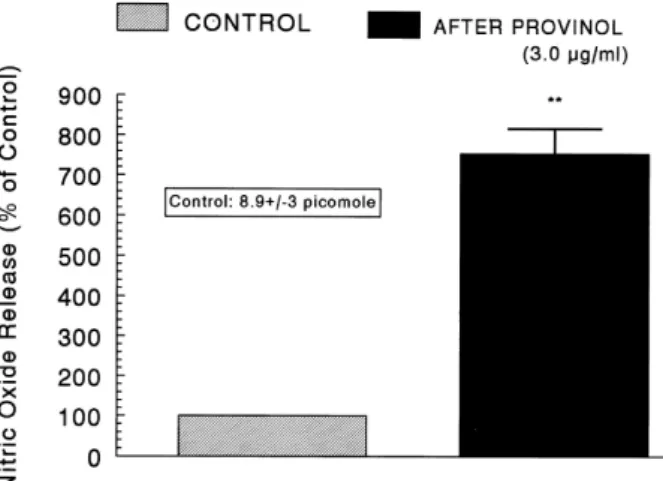
(6) 234. JH Lee, et al. secretory response evoked by McN-A-343 (10−4 M for 4 min) recovered to 75∼100% of the corresponding control release compared to results of the provinol-treatment alone, as shown in Fig. 6 (right).. with provinol alone (Fig. 7-right).. Effects of provinol plus L-NAME on the CA release evoked by BAY-K-8644 and cyclopiazonic acid from the perfused rat adrenal medulla. As shown in Fig. 5∼7, it has been shown that provinol-induced inhibitory effects on the CA secretory responses evoked by ACh, high K+, DMPP, McN-A-343, BAY-K-8644 and cyclopiazonioc acid from the perfused rat adrenal glands greatly recovered to a considerable extent of the corresponding control secretion from simultaneous treatment with L-NAME, an inhibitor of NO synthase, compared to the inhibitory effects of provinol-treatment alone. Therefore, it was of interest to determine directly the level of nitric oxide released from adrenal medulla following the perfusion of provinol-containing Krebs-bicarbonate solution. As shown in Fig. 8, the basal level of NO before loading of provinol was 8.9±3 picomole. However, 30 min after the presence of provinol (3 μg/ml), it was greatly enhanced to. As shown in Fig. 7 (left), the simultaneous perfusion of provinol (1 μM) and L-NAME (30 μM) for 90 min made the CA release evoked by Bay-K-644 (10 μM, an activator of voltage-dependent L-type calcium channel) to 74∼100% of the corresponding control response compared to the results of provinol-treatment alone. After the simultaneous perfusion with provinol and L-NAME, cyclopiazonic acid (10 μM, 2+ an inhibitor of Ca -ATPase of endoplasmic reticulum)-evoked CA release also recovered to 73∼100% of the control release in comparison to the results following the treatment. Effect of provinol on the level of nitric oxide released from the perfused rat adrenal medulla. Fig. 6. Effects of provinol plus L-NAME on the CA secretory responses evoked by DMPP (left) and McN-A-343 (right) from the perfused rat adrenal medulla. The CA secretion by perfusion of DPPP (10−4 M) and McN-A-343 (10−4 M) for 2 min was induced at 15 and 20 min intervals after preloading with provinol (1.0 μM) plus L-NAME (30 μM) for 90 min, respectively. Other legends are the same as in Fig. 1 and 5. *p<0.05, **p<0.01. ns: Not statistically significant.. Fig. 7. Effects of provinol plus L-NAME on the CA secretory responses evoked by Bay-K-8644 (left) and cyclopiazonic acid (right) from −5 −5 the perfused rat adrenal medulla. Bay-K-8644 (10 M) and cyclopiazonic acid (10 M) were perfused into an adrenal vein for 4 min at 15 min intervals during simultaneous loading with provinol (1.0 μM) for 90 min. Other legends are the same as in Fig. 1 and 5. *p<0.05, **p<0.01. ns: Not statistically significant..
(7) Provinol Inhibits Catecholamine Secretion. Fig. 8. Effects of provinol on nitric oxide (NO) production in the perfused rat adrenal medulla. Perfusate sample was taken for 8 min after loading the perfusion of provinol (3.0 μM) at a rate of 0.31 ml/min. Ordinate: the amounts of NO released from the adrenal medulla (% of control). Abscissa: Treatment (before and after provinol). Statistical difference was made by comparing the control with provinol-treated group. **p<0.01.. 650% of the control release. Consequently, it was confirmed that provinol practically increase the level of NO released from the rat adrenal medulla.. DISCUSSION The present results provide the first evidence that provinol significantly inhibits the CA secretory responses evoked by stimulation of cholinergic (both muscarinic and nicotinic) receptors and direct membrane-depolarization from the perfused adrenal gland of the normotensive rats. This inhibitory effect of provinol seems to be exerted by inhibiting the influx of both ions through voltage-dependent Na+ and 2+ Ca channels into the rat adrenal medullary cells as well 2+ as by blocking Ca release from the cytoplasmic calcium store, which is mediated at least partly by the increased NO production due to the activation of nitric oxide synthase. In support of this idea, it was documented that provinol elicited endothelium-dependent relaxation of rat femoral 2+ artery by the Ca -induced increase of NO synthase activity and by protecting NO from degradation (Zenebe et al., 2003). Because the action of PCRW has been associated with the improvement of endothelium-dependent relaxation and elevation of NO synthase activity and/or expression in several in vitro and in vivo experiments (Andriambeloson et al., 1998; Pecháňová et al., 2004), there may be some assumtions about possible therapeutic effect of provinol in diseases associated with reduced NO bioavailability such as endothelial dysfunction or atherosclerosis. Furthermore, in the simultaneous presence of L-NAME (an inhibitor of nitric oxide synthase) and provinol, the CA secretory responses evoked by cholinergic stimulation and direct membrane-depolarization significantly recovered to a considerable level of the corresponding control secretion in comparison to inhibition of treatment with provinol alone. This result is well consistent with report that PCRC produced the endothelium-NO-dependent relaxation through an ex-. 235. tracellular Ca2+-dependent mechanism (Andriambeloson et al., 1999). Amongst the different classes of polyphenolic compounds present in provinol, anthocyanins and oligomeric condensed tannins had the same pharmacological profile as provinol (Andriambeloson et al., 1998). Of the different anthocyanins identified in wine, only delphinidin caused endothelium-dependent relaxation, although it was slightly less potent than provinol (Andriambeloson et al., 1998). Moreover, it has been reported that the NO synthase inhibitor, L-NAME enhances K+-stimulated CA secretion in cultured bovine chromaffin cells (Torres et al., 1994) and that sodium nitroprusside (SNP) inhibits ACh-induced CA secretion in bovine chromaffin cells (Rodriguez-Pascual et al., 1996). These studies suggest that NO may play an inhibitory role in the control of CA secretion. Moreover, the presence of endothelial cells has been reported to inhibit + the K -induced or the nicotinic receptor agonist DMPP-induced CA secretion in cultured bovine chromaffin cells (Torres et al., 1994), suggesting that not only nNOS but also eNOS may play roles in modulating adrenal CA secretion. On the contrary, it has been reported that L-NAME inhibits ACh-induced CA secretion in bovine chromaffin cells (Uchiyama et al., 1994) and that the NO donor SNP enhances nicotine-induced CA secretion in cultured bovine chromaffin cells (O'Sullivan and Burgoyne, 1990). These findings suggest that NO may facilitate cholinergic agonist-induced CA secretion. On the other hand, a few in vivo studies have suggested that NO does not play a role in regulation of adrenal CA secretion (Breslow et al., 1992; Breslow et al., 1993). In the light of above findings, the present studies suggest that provinol can activate nNOS in the rat adrenal medullary chromaffin cells, in addition to the direct inhibitory effects on the CA secretion. PCRW is also found to right blood pressure in normotensive and hypertensive rats (Mizutani et al., 1999; Diebolt et al., 2001). It has been shown that in endothelium-dependent fashion, red wines and grapes exhibit vasorelaxation via enhanced generation and/or increased biological activity of NO, leading to the elevation of cGMP levels (Fitzpatrick et al., 1993; Fitzpatrick et al., 1995; Andriambeloson et al., 1997; Fitzpatrick et al., 2000; Zenebe et al., 2003). Recently, provinol reduced blood pressure only in BHR. Data suggest that reduction of BP in BHR as well as the improvement of vasorelaxation in provinol-treated WKY rats were associated with other rather than NO-dependent mechanisms (Bernátová et al., 2007). Moreover, provinol partially prevents L-NAME induced hypertension via the different mechanisms depending on the duration of treatment in male Wistar rats. Prevention of oxidative damage in the brain with modulating effect on NO synthase activity is suggested (Jendeková et al., 2006). Based on these findings, the present experimental results indicate that provinol-induced inhibitory activity of CA secretory response evoked by stimulation of nicotinic receptors might contribute at least partly to its hypotensive mechanism. Polyphenolic compounds have been documented to relax pre-contracted smooth muscle of the arteries with intact endothelium. Moreover, some of them were also shown to relax endothelium-denuded arteries (Fuster et al., 1992; Andriambeloson et al., 1997). Several authors have reported that extracts from grapes and wine induce endothelium-dependent relaxation via enhanced generation and/or increased biological activity of NO which leads to the elevation of cGMP level (Fitzpatrick et al., 1993; Andriambeloson et al., 1997). The increase in the intra-.
(8) 236. JH Lee, et al. cellular Ca2+ level proceeds via a redox-sensitive pathway the activation of NO synthase, the production of NO and thus endothelium-dependent vasodilatation in different types of arteries from different species (Andriambeloson et al., 1999; Zenebe et al., 2003; Duarte et al., 2004). Another therapeutic effect of flavonoids may be their ability to interact with the generation of NO from vascular endothelium, which leads not only to vasodilatation, but also to the expression of genes that protect the cardiovascular system (Middleton et al., 2000; Zenebe and Pecháňová, 2002; Curin and Andriantsitohaina, 2005). In terms of these findings, the results of the present study seem likely that provinol can cause the depressor effect by the inhibition of CA secretion from the adrenal medulla. In the present study, provinol also time-dependently depressed the CA secretory response evoked by Bay-K-8644, 2+ which is known to activate L-type voltage-dependent Ca channels (Schramm et al., 1983; Garcia et al., 1984). This result indicates that provinol may inhibit Ca2+ influx to the rat adrenomedullary cells. In support of this idea, in cultured bovine adrenal medullary cells, nicotinic (but not muscarinic) receptors mediate the Ca2+-dependent secretion of CA (Yanagihara et al., 1979; Fisher et al., 1981). It has also been known that the activation of nicotinic receptors stimulates CA secretion by increasing Ca2+ entry 2+ through receptor-linked and/or voltage-dependent Ca channels in both perfused rat adrenal glands (Wakade and Wakade, 1983; Lim and Hwang, 1991) and isolated bovine adrenal chromaffin cells (Kilpatrick et al., 1981 & 1982; Knight and Kesteven, 1983). Wada and his coworkers (1985b) have found that the adrenomedullary chromaffin cells have (i) nicotinic receptor-associated ionic channels, + responsible for carbachol-induced Na influx, (ii) voltage+ dependent Na channels, responsible for veratridine-in+ 2+ duced Na influx and (iii) voltage-dependent Ca chan+ nels, suggesting that the influx of Na caused either by carbachol or by veratridine leads to activate voltage2+ dependent Ca channels by altering membrane potentials, + 2+ whereas high K directly activates voltage-dependent Ca + channels without increasing Na influx. In the present + study, the finding that high K -induced CA secretory response was depressed by pretreatment with provinol indicates that this inhibitory effect of provinol is exerted through the direct inhibition of calcium influx into the rat adrenal chromaffin cells. Furthermore, slight elevation in the extracellular potassium concentration increases both the frequency of spontaneous action potentials and the secretion of CA (Kidokoro and Ritchie, 1980), suggesting that the influx of calcium that occurs during action potentials is directly linked to the rate of secretion. These findings that provinol inhibited CA secretion evoked by Bay-K-8644 as well as by high K+ suggest that provinol inhibits directly 2+ the voltage-dependent Ca channels. In the bovine chromaffin cells, stimulation of nicotinic, but not muscarinic ACh receptors is known to cause CA secretion by increasing 2+ 2+ Ca influx largely through voltage-dependent Ca channels (Oka et al., 1979; Burgoyne, 1984). Therefore, it seems that provinol inhibits the DMPP- evoked CA secretion by 2+ 2+ influx through voltage-dependent Ca inhibiting Ca channels. The mechanism by which the stimulation of ACh re2+ ceptors activates voltage-dependent Ca channels in adrenal medullary cells is well understood. It has also been shown that ACh depolarizes chromaffin cell membranes + and that this is dependent on the inward movement of Na. into the cells (Douglas et al., 1968). Kidokoro and Ritchie + (1980) demonstrated that ACh generates Na -dependent action potentials and that these are mediated by nicotinic (but not muscarinic) ACh receptors. Taking these previous observations into account, it has been suggested that the + influx of Na via nicotine receptor-associated ionic channels leads to the activation of voltage-dependent Ca2+ channels by altering the membrane potentials (Wada et al., I985b). In the present study, provinol suppressed the veratridine-evoked CA secretory response. This result suggests that the inhibitory effect of provinol on the CA secretion evoked by veratridine as well as by ACh and DMPP is responsible for the inhibition of Ca2+ influx, resulting in reduced CA secretion. Therefore, it seems likely that the predominant site of action of provinol is nicotinic receptor-gated ionic channels in the rat adrenomedullary chromaffin cells. + Veratridine-induced influx of Na is a requisite for trig2+ gering Ca influx and the CA secretion (Wada et al., 1985a & 1985b). Therefore, the inhibition by provinol of volt+ age-dependent Na channels is responsible for the in2+ hibition of Ca influx and the CA secretion. Voltage-dependent Na+ channels are indispensable for axonal conduction in central and peripheral neurons. The present study has also shown that provinol inhibits the CA secretion evoked by cyclopiazonic acid. Cyclopiazon2+ ic acid is known to be a highly selective inhibitor of Ca -ATPase in skeletal muscle sarcoplasmic reticulum (Goeger and Riley, 1989; Seidler et al., 1989) and a valuable phar2+ macological tool for investigating intracellular Ca mobi2+ lization and ionic currents regulated by intracellular Ca (Suzuki et al., 1992). Therefore, it is felt that the inhibitory effect of provinol on CA secretion evoked by cholinergic stimulation as well as by membrane-depolarization may be associated with the mobilization of intracellular Ca2+ from the cytoplasmic calcium store. This indicates that the prov2+ inol has an inhibitory effect on the release of Ca from the intracellular pools induced by stimulation of muscarinic ACh receptors, which is weakly responsible for the secre2+ tion of CA. It has been shown that Ca -uptake into intracellular storage sites susceptible to caffeine (Ilno, 1989) is almost completely abolished by treatment with cyclopia2+ zonic acid during the proceeding Ca load (Suzuki et al., 1992). This is consistent with the findings obtained in skinned smooth muscle fibers of the longitudinal layer of the 2+ guinea-pig ileum, where Ca -uptake was also inhibited by cyclopiazonic acid (Uyama et al., 1992). Suzuki and his coworkers (1992) have shown that cyclopiazonic acid easily penetrates into the cytoplasm through the plasma membrane and reduces Ca2+-ATPase activity in sarcoplasmic/ endoplasmic reticulum, resulting in increase in the sub2+ sequent Ca release from those storage sites. Moreover, in bovine adrenal chromaffin cells, stimulation of muscarinic ACh receptors is also proposed to cause activation of phosphoinositide metabolism, resulting in the formation of inositol 1,4,5-trisphosphate, which induces the mobilization 2+ of Ca from the intracellular pools (Cheek et al., 1989; Challis et al., 1991). The present results suggest that provinol-induced depression of the CA secretion evoked by McNA-343 and cyclopiazonic acid may be due to the inhibition 2+ release from the intracellular pools induced by of Ca stimulation of muscarinic ACh receptors. However, in the present study, it is uncertain whether the inhibitory effect 2+ of provinol on Ca movement from intracellular pools is due to its direct effect on the response of phosphoinositides or the indirect effects..
(9) Provinol Inhibits Catecholamine Secretion. Some epidemiological studies indicate an association between moderate consumption of red wine and reduced risk of coronary heart disease (Renaud and de Lorgeril, 1992; German and Walzem, 2000). It has been shown that provinol promotes the endothelium-dependent relaxation, activates NO synthase, inhibits platelet aggregation, and prevents oxidation of LDL-cholesterol (Fitzpatrick et al., 1993; Frankel et al., 1993a; Demrow and Slane, 1995; Andriambeloson et al., 1997; Flesch et al., 1998; Leikert et al., 2002). The polyphenolic compound resveratrol presented in red wine is thought to be responsible for the beneficial cardiovascular effects. Since resveratrol has similar effects to PCRW such as promotion of vasodilation, activation of nitric oxide synthase, inhibition of platelet aggregation and leukocyte activation, prevention of oxidation of LDL-cholesterol and reduction of cholesterol synthesis (Frankel et al., 1993b; Pace-Asciak et al., 1995; Chen and Pace-Asciak, 1996; Rotondo et al., 1998; Wallerath et al., 2002). In addition to these pharmacological effects of provinol, in the present study, it was shown that provinol inhibits the CA induced by cholinergic (both nicotinic and muscarinic) receptor stimulation, suggesting that provinol can attenuate the CA secretion induced by stress or emotional excitation, thus causing the stimulation of sympathetic nerves and the adrenal medulla. Although the CA plays a pivotal role in the regulation of normal functions in cardiovascular systems, stress-induced overexpression of the CA would contribute to the involvement and augmentation of cardiovascular diseases such as heart failure, atherosclerosis, coronary heart disease and hypertension. Indeed, chronic heart failure is associated with activation of the sympathetic nervous system as manifested by increased circulating level of norepinephrine and increased regional activity of the sympathetic nervous system (Kaye et al., 1995; Freedman and Lefkowitz, 2004; Westfall and Westfall, 2005; Lymperopoulos et al., 2007). The results of the present study conclusively demonstrate that provinol inhibits the CA secretion by stimulation of cholinergic nicotinic receptors as well as by membrane depolarization from the perfused adrenal glands of the normotensive rats. It seems that this inhibitory effect of provinol + 2+ is mediated by blocking the influx of Na and Ca ions through calcium and sodium channels into the rat adrenal medullary chromaffin cells as well as by inhibiting the re2+ lease of Ca from the cytoplasmic calcium store, which are exerted at least partly by the increased NO production due to the activation of nitric oxide synthase. These experimental results may greatly contribute to the hypotensive effect of provinol components, through inhibition of the CA secretion from adrenomedullary cells and consequent reduction of the CA level in the circulation.. REFERENCES Andriambeloson E, Kleschyov AL, Muller B, Beretz A, Stoclet JC, Andriantsitohaina R. Nitric oxide production and endotheliumdependent vasorelaxation induced by wine polyphenols in rat aorta. Br J Pharmacol 120: 1053−1058, 1997. Andriambeloson E, Magnier C, Haan-Archipoff G, Lobstein A, Anton R, Beretz A, Stoclet JC, Andriantsitohaina R. Natural dietary polyphenolic compounds cause endothelium-dependent vasorelaxation in rat thoracic aorta. J Nutr 128: 2324−2333, 1998. Andriambeloson E, Stoclet JC, Andriantsitohaina R. Mechanism of endothelial nitric oxide-dependent vasorelaxation induced by. 237. wine polyphenols in rat thoracic aorta. J Cardiovasc Pharmacol 33: 248−254, 1999. Anton AH, Sayre DF. A study of the factors affecting the aluminum oxide trihydroxy indole procedure for the analysis of catecholamines. J Pharmacol Exp Ther 138: 360−375, 1962. Bernátová I, Púzserová A, Navarová J, Csizmadiová Z, Zeman M. Crowding-induced alterations in vascular system of WistarKyoto rats: role of nitric oxide. Physiol Res 56: 667−669, 2007. Breslow MJ, Tobin JR, Bredt DS, Ferris CD, Snyder SH, Traystman RJ. Nitric oxide as a regulator of adrenal blood flow. Am J Physiol (Heart Circ Physiol) 264: H464−H469, 1993. Breslow MJ, Tobin JR, Bredt DS, Ferris CD, Snyder SH, Traystman RJ. Role of nitric oxide in adrenal medullary vasodilation during catecholamine secretion. Eur J Pharmacol 210: 105−106, 1992. Burgoyne RD. Mechanism of secretion from adrenal chromaffin cells. Biochem Biophys Acta 779: 201−216, 1984. Catterall WA. From ionic currents to molecular mechanisms: the structure and function of voltage-gated sodium channels. Neuron 26: 13−25, 2000. Challiss RAJ, Jones JA, Owen PJ, Boarder MR. Changes in inositol 1,4,5-trisphosphate and inositol 1,3,4,5-tetrakisphosphate mass accumulations in cultured adrenal chromaffin cells in response to bradykinin and histamine. J Neurochem 56: 1083−1086, 1991. Cheek TR, O'Sullivan AJ, Moreton RB, Berridge MJ, Burgoyne RD. Spatial localization of the stimulus-induced rise in cytosolic Ca2+ in bovine adrenal chromaffin cells: Distinct nicotinic and muscarinic patterns. FEBS Lett 247: 429−434, 1989. Chen CK, Pace-Asciak CR. Vasorelaxing activity of resveratrol and quercetin in isolated rat aorta. Gen Pharmacol 27: 363−366, 1996. Cishek MB, Galloway MT, Karim M, German JB, Kappagoda CT. Effects of red wine on endothelium dependent-relaxation in rabbits. Clin Sci 93: 507−511, 1997. Curin Y, Andriantsitohaina R. Polyphenols as potential therapeutical agents against cardiovascular diseases. Pharmacol Rep 57: 97−107, 2005. De Lorgeril M, Salen P, Martin JL, Mamelle N, Monjaud I, Touboul P, Delaye J. Effect of a Mediterranean type of diet on the rate of cardiovascular complications in patients with coronary artery disease. Insights into the protective effect of certain nutrients. J Am Coll Cardiol 28: 1103−1108, 1996. Demrow HS, Slane PR. Administration of wine and grape juice inhibits in vivo platelet activity and thrombosis in stenosed canine coronary arteries. Circulation 91: 1182−1188, 1995. Diebolt M, Bucher B, Andriantsitohaina R. Wine polyphenols decrease blood pressure, improve NO vasodilatation, and induce gene expression. Hypertension 38: 159−165, 2001. Douglas WW. Stimulus-secretion coupling: The concept and clues from chromaffin and other cells. Br J Pharmacol 34: 451−474, 1968. Duarte J, Andriambeloson E, Diebolt M, Andriantsitohaina R. Wine polyphenols stimulate superoxide anion production to promote calcium signaling and endothelial-dependent vasodilatation. Physiol Res 53: 595−602, 2004. Fisher SK, Holz RW, Agranoff BW. Muscarinic receptors in chromaffin cell culture mediate enhanced phospholipid labeling but not catecholamine secretion. J Neurochem 37: 491−487, 1981. Fitzpatrick DF, Fleming RC, Bing B, Maggi DA, O'Malley R. Isolation and characterization of endothelium-dependent vasorelaxing compounds from grape seeds. J Agric Food Chem 48: 6384−6390, 2000. Fitzpatrick DF, Hirschfield SL, Coffey RG. Endothelium-dependent vasorelaxing activity of wine and other grape products. Am J Physiol 265: H77-78, 1993. Fitzpatrick DF, Hirschfield SL, Ricci T, Jantzen P, Coffey RG. Endothelium-dependent vasorelaxation caused by various plant extracts. J Cardiovasc Pharmacol 26: 90−95, 1995. Flesch M, Schwarz A, Bolun M. Effects of red and white wine on endothelium-dependent vasorelaxation of rat aorta and human coronary arteries. Am J Physiol 275: H1183−H1190, 1998. Frankel EN, Kanner J, German JB, Parks E, Kinsella JE..
(10) 238. JH Lee, et al. Inhibition of oxidation of human low-density lipoprotein by phenolic substances in red wine. Lancet 341: 454−457, 1993a. Frankel EN, Waterhouse AL, Kinsella JE. Inhibition of human LDL oxidation by resveratrol. Lancet 341: 1103−1104, 1993b. Freedman JE, Li L, Sauter R, Keaney JF Jr. alpha-Tocopherol and protein kinase C inhibition enhance platelet-derived nitric oxide release. FASEB J 14: 2377−2379, 2000. Freedman NJ, Lefkowitz RJ. Anti-β1-adrenergic receptor antibodies and heart failure: causation, not just correlation. J Clin Invest 113: 1379−1382, 2004. Fuster V, Badimon JJ, Chesebro JH. The patogenesis of coronary artery disease and the acute coronary syndromes. New Engl J Med 326: 242−250, 1992. Garcia AG, Sala F, Reig JA, Viniegra S, Frias J, Fonteriz R, Gandia L. Dihydropyridine Bay-K-8644 activates chromaffin cell calcium channels. Nature 309: 69−71, 1984. German JB, Walzem RL. The health benefits of wine. Annu Rev Nutr 20: 561−593, 2000. Goeger DE, Riley RT. Interaction of cyclopiazonic acid with rat skeletal muscle sarcoplasmic reticulum vesicles. Effect on Ca2+ binding and Ca2+ permeability. Biochem Pharmacol 38: 3995− 4003, 1989. Hammer R, Giachetti A. Muscarinic receptor subtypes: M1 and M2 biochemical and functional characterization. Life Sci 31: 2992− 2998, 1982. Hashimoto M, Kim S, Eto M, Iijima K, Ako J, Yoshizumi M, Akishita M, Kondo K, Itakura H, Hosoda K, Toba K, Ouchi Y. Effect of acute intake of red wine on flow-mediated vasodilatation of the brachial artery. Am J Cardiol 88: 1457−1460, 2001. Hertog MGL, Kromhout D, Aravanis C, Blackburn H, Buzina R, Fidanza F, Giampaoli S, Jansen A, Menotti A, Nedeljkovic S. Flavonoid intake and long term risk of cardiovascular disease in the Seven Countries Study. Arch Intern Med 155: 381−386, 1995. Huang Y, Chan NWK, Lau CW, Yao XQ, Chan FL, Chen ZY. Involvement of endothelium/nilvicoxide in vasorelaxation induced by purified green tea (-) epicatechin. Biochim Biophys Acta 1427: 322−328, 1999. Huang Y, Zhang AQ, Lau CW, Chen ZY. Vasorelaxant effect of purified green tea epicatechin derivatives in rat mesenteric artery. Life Sci 63: 275−283, 1998. Ilno M. Calcium-induced calcium release mechanism in guinea pig taenia caeci. J Gen Physiol 94: 363−383, 1989. Jendeková L, Kojsová S, Andriantsitohaina R, Pechánová O. The time-dependent effect of provinols on brain NO synthase activity in L-NAME-induced hypertension. Physiol Res 55: S31−37, 2006. Kaye DM, Lefkowits J, Jennings GL, Bergin P, Broughton A, Esler MD. Adverse consequences of high sympathetic nervous activity in the failing human heart. J Am Coll Cardiol 26: 1257−1263, 1995. Kidokoro Y, Ritchie AK. Chromaffin cell action potentials and their possible role in adrenaline secretion from rat adrenal medulla. J Physiol 307: 199−216, 1980. Kilpatrick DL, Slepetis RJ, Corcoran JJ, Kirshner N. Calcium uptake and catecholamine secretion by cultured bovine adrenal medulla cells. J Neurochem 38: 427−435, 1982. Kilpatrick DL, Slepetis RJ, Kirshner N. Ion channels and membrane potential in stimulus-secretion coupling in adrenal medulla cells. J Neurochem 36: 1245−1255, 1981. Knight DE, Kesteven NT. Evoked transient intracellular free Ca2+ changes and secretion in isolated bovine adrenal medullary cells. Proc R Soc Lond Biol Sci 218: 177−199, 1983. Leikert JF, Räthel TR, Wohlfart P, Cheynier V, Vollmar AM, Dirsch VM. Red wine polyphenols enhance endothelial nitric oxide release from endothelial cells. Circulation 106: 1614−1617, 2002. Lim DY. Resveratrol inhibits catecholamine release from the adrenal medulla. J Hypertens 26: S366, 2008. Lim DY, Hwang DH. Studies on secretion of catecholamines evoked by DMPP and McN-A-343 in the rat adrenal gland. Korean J Pharmacol 27: 53−67, 1991. Lim DY, Kim CD, Ahn KW. Influence of TMB-8 on secretion of catecholamines from the perfused rat adrenal glands. Arch. Pharm Res 15: 115−125, 1992. Liu S, Hu Y, Wang X, Zhong J, Lin Z. High content of resveratrol in lettuce transformed with a stilbene synthase gene of Parthenocissus henryana. J Agric Food Chem 54: 8082−8085, 2006. Lymperopoulos A, Rengo G, Funakoshi H, Eckhart AD, Koch WJ. Adrenal GRK2 upregulation mediates sympathetic overdrive in heart failure. Nat Med 13: 315−323, 2007. Marley PD, McLeod J, Anderson C, Thomson KA. Nerves containing nitric oxide synthase and their possible function in the control of catecholamine secretion in the bovine adrenal medulla. J Auton Nerv Syst 54: 184−194, 1995. Middleton EJR, Kandaswami C, Theoharides TC. The effect of plant flavonoids on mammalian cells: Implications for inflammation, heart disease and cancer. Pharmacol Rev 52: 673−751, 2000. Mizutani K, Ikeda K, Kawai Y, Yamori Y. Extract of wine phenolics improves aortic biomechanical properties in stroke-prone spontaneously hypertensive rats (SHRSP). J Nutr Sci Vitaminol (Tokyo) 45: 95−106, 1999. Oka M, Isosaki M, Yanagihara N. Isolated bovine adrenal medullary cells: studies on regulation of catecholamine synthesis and release. In: Usdin E, Kopin IJ, Brachas J ed, Catecholamines: Basic and Clinical frontiers. Pergamon Press, Oxford, p 70−72, 1979. Oset-Gasque MJ, Parramon M, Hortelano S, Bosca L, Gonzalez MP. Nitric oxide implication in the control of neurosecretion by chromaffin cells. J Neurochem 63: 1693−1700, 1994. O'Sullivan AJ, Burgoyne RD. Cyclic GMP regulates nicotineinduced secretion from cultured bovine adrenal chromaffin cells: effects of 8-bromo-cyclic GMP, atrial natriuretic peptide, and nitroprusside (nitric oxide). J Neurochem 54: 1805−1808, 1990. Pace-Asciak CR, Hahn SE, Diamandis EP, Soleas G, Goldberg DM. The red wine phenolics trans-resveratrol and quercetin block human platelet aggregation and eicosanoid synthesis: implication for protection against coronary heart disease. Clin Chim Acta 235: 207−219, 1995. Palacios M, Knowles RG, Palmer RM, Moncada S. Nitric oxide from L-arginine stimulates the soluble guanylate cyclase in adrenal glands. Biochem Biophys Res Commun 165: 802−809, 1989. Palmer RM, Ashton DS, Moncada S. Vascular endothelial cells synthesize nitric oxide from L-arginine. Nature 333: 664−666, 1988. Pechánová O, Bernátová I, Babál P, Martínez MC, Kyselá S, Stvrtina S, Andriantsitohaina R. Red wine polyphenols prevent cardiovascular alterations in L-NAME-induced hypertension. J Hypertens 22: 1551−1559, 2004. Pecháňová O, Zicha J, Kojšová S, Jendeková L, Sládková M, Paulis L, Janega P, Csizmádiová Z, Bernátová I, Dobešovš Z, Šimko F, Babál P, Andriantsitohaina R, Kuneš J. Significance of antioxidants in experimental hypertension. Physiol Res 55: 3, 2006. Renaud S, de Lorgeril M. Wine alcohol, platelet and the French paradox for coronary heart disease. Lancet 339: 1523−1526, 1992. Rodriguez-Pascual F, Miras-Portugal MT, Torres M. Effect of cyclic GMP-increasing agents nitric oxide and C-type natriuretic peptide on bovine chromaffin cell function: inhibitory role mediated by cyclic GMP-dependent protein kinase. Mol Pharmacol 49: 1058− 1070, 1996. Rotondo S, Rajtar G, Manarinis S. Effect of trans-resveratrol, a natural polyphenolic compound, on human polymorphonuclear leukocyte function. Br J Pharmacol 123: 1691−1699, 1998. Sakuma I, Stuehr DJ, Gross SS, Nathan C, Levi R. Identification of arginine as a precursor of endothelium-derived relaxing factor. Proc Natl Acad Sci USA 85: 8664−8667, 1988. Schramm M, Thomas G, Towart R, Franckowiak G. Novel dihydropyridines with positive inotropic action through activation of Ca2+ channels. Nature 303: 535−537, 1983. Schwarz PM, Rodriguez-Pascual F, Koesling D, Torres M, Förstermann U. Functional coupling of nitric oxide synthase and soluble guanylyl cyclase in controlling catecholamine secretion from bovine chromaffin cells. Neuroscience 82: 255−265, 1998. Seidler NW, Jona I, Vegh N, Martonosi A. Cyclopiazonic acid is.
(11) Provinol Inhibits Catecholamine Secretion. a specific inhibitor of the Ca2+-ATPase of sarcoplasmic reticulum. J Biol Chem 264: 17816−17823, 1989. Shimada K, Watanabe H, Hosoda K, Takeuchi K, Yoshikawa J. Effect of red wine on coronary flow-velocity reserve. Lancet 354: 1002, 1999. Suzuki M, Muraki K, Imaizumi Y, Watanabe M. Cyclopiazonic acid, an inhibitor of the sarcoplasmic reticulum Ca2+-pump, reduces Ca2+-dependent K+ currents in guinea-pig smooth muscle cells. Br J Pharmacol 107: 134−140, 1992. Tallarida RJ, Murray RB. Manual of pharmacologic calculation with computer programs. 2nd ed. Speringer-Verlag, New York, p 132, 1987. Torres M, Ceballos G, Rubio R. Possible role of nitric oxide in catecholamine secretion by chromaffin cells in the presence and absence of cultured endothelial cells. J Neurochem 63: 988−996, 1994. Uchiyama Y, Morita K, Kitayama S, Suemitsu T, Minami N, Miyasako T, Dohi T. Possible involvement of nitric oxide in acetylcholine-induced increase of intracellular Ca2+ concentration and catecholamine release in bovine adrenal chromaffin cells. Jpn J Pharmacol 65: 73−77, 1994. Uyama Y, Imaizumi Y, Watanabe M. Effects of cyclopiazonic acid, a novel Ca2+-ATPase inhibitor on contractile responses in skinned ileal smooth muscle. Br J Pharmacol 106: 208−214, 1992. Wada Y, Satoh K, Taira N. Cardiovascular profile of Bay-K-8644, a presumed calcium channel activator in the dog. NaunynSchmiedebergs Arch Pharmacol 328: 382-387, 1985a. Wada A, Takara H, Izumi F, Kobayashi H, Yanagihara N. Influx. 239. of 22Na through acetylcholine receptor-associated Na channels: relationship between 22Na influx, 45Ca influx and secretion of catecholamines in cultured bovine adrenal medullary cells. Neuroscience 15: 283−292, 1985b. Wakade AR. Studies on secretion of catecholamines evoked by acetylcholine or transmural stimulation of the rat adrenal gland. J Physiol 313: 463−480, 1981. Wakade AR, Wakade TD. Contribution of nicotinic and muscarinic receptors in the secretion of catecholamines evoked by endogenous and exogenous acetylcholine. Neuroscience 10: 973−978, 1983. Wallerath T, Deckert G, Ternes T, Anderson H, Li H, Witte K, Förstermann U. Resveratrol, a polyphenolic phytoalexin present in red wine, enhances expression and activity of endothelial nitric oxide synthase. Circulation 106: 1652−1658, 2002. Westfall TC, Westfall DP. Adrenergic agonists and antagonists. In: Brunton LL, Lazo JS, Parker KL ed, Goodman & Gilman the pharmacological basis of therapeutics. 11th ed. McGraw-Hill, New York, p 237−295, 2005. Yanagihara N, Isosaki M, Ohuchi T, Oka M. Muscarinic receptormediated increase in cyclic GMP level in isolated bovine adrenal medullary cells. FEBS Lett 105: 296−298, 1979. Zenebe W, Pecháóová O. Effects of red wine polyphenolic compounds on the cardiovascular system. Bratisl Lek Listy 103: 159−165, 2002. Zenebe W, Pecháóová O, Andriantsitohaina R. Red wine polyphenols induce vasorelaxation by increased nitric oxide bioactivity. Physiol Res 52: 425−432, 2003..
(12)
수치

+2
관련 문서
Simultaneous perfusion of PD 123319 and CGP 42112 perfused into an adrenal vein for 90 minutes rather more potently inhibited the CA seretory responses evoked by Ach, high K+,
