101
ABBREVIATIONS: CA, catecholamines; DMPP, 1.1-dimethyl-4-phenyl piperazinium iodide, methyl-1,4-dihydro-2; BAY-K8644, 6-dimethyl-3- nitro-4-(2-trifluoromethyl-phenyl)-pyridine-5 -carboxylate; McN-A-343, 3-(m-cholro-phenyl-carbamoyl-oxy)-2-butynyltrimethyl ammonium chloride.
Corresponding to: Dong-Yoon Lim, Department of Pharmacology, College of Medicine, Chosun University, 375, Seosuk-dong, Dong-gu, Gwangju 501-759, Republic of Korea. (Tel) 82-62-230-6335, (Fax) 82-62-227-4693, (E-mail) [email protected]
Influence of Ketamine on Catecholamine Secretion in the Perfused Rat Adrenal Medulla
Young-Yeob Ko
1, Yong-Hoon Jeong
2, and Dong-Yoon Lim
2Departments of
1Internal Medicine (Cardiology),
2Pharmacology, College of Medicine, Chosun University, Gwangju 501-759, Korea
The aim of the present study was to examine the effects of ketamine, a dissociative anesthetics, on secretion of catecholamines (CA) secretion evoked by cholinergic stimulation from the perfused model of the isolated rat adrenal gland, and to establish its mechanism of action, and to compare ketamine effect with that of thiopental sodium, which is one of intravenous barbiturate anesthetics.
Ketamine (30∼ 300μ M), perfused into an adrenal vein for 60 min, dose- and time-dependently inhibited the CA secretory responses evoked by ACh (5.32 mM), high K
+(a direct membrane- depolarizer, 56 mM), DMPP (a selective neuronal nicotinic NN receptor agonist, 100μ M) and McN-A-343 (a selective muscarinic M1 receptor agonist, 100μ M). Also, in the presence of ketamine (100μ M), the CA secretory responses evoked by veratridine (a voltage-dependent Na
+channel activator, 100μ M), Bay-K-8644 (an L-type dihydropyridine Ca
2+channel activator, 10μ M), and cyclopiazonic acid (a cytoplasmic Ca
2+-ATPase inhibitor, 10μ M) were significantly reduced, respectively. Interestingly, thiopental sodium (100μ M) also caused the inhibitory effects on the CA secretory responses evoked by ACh, high K
+, DMPP, McN-A-343, veratridine, Bay-K-8644, and cyclopiazonic acid. Collectively, these experimental results demonstrate that ketamine inhibits the CA secretion evoked by stimulation of cholinergic (both nicotinic and muscarinic) receptors and the membrane depolarization from the isolated perfused rat adrenal gland. It seems likely that the inhibitory effect of ketamine is mediated by blocking the influx of both Ca
2+and Na
+through voltage-dependent Ca
2+and Na
+channels into the rat adrenal medullary chromaffin cells as well as by inhibiting Ca
2+release from the cytoplasmic calcium store, which are relevant to the blockade of cholinergic receptors. It is also thought that, on the basis of concentrations, ketamine causes similar inhibitory effect with thiopental in the CA secretion from the perfused rat adrenal medulla.
Key Words: Ketamine, thiopental, Catecholamine secretion, Adrenal medulla, Cholinergic receptors
INTRODUCTION
Ketamine is an intravenous anesthetic and also used clin- ically to induce a dissociative anesthesia. It has also been known to produce analgesic, psychotropic and sympathomi- metic effects (Domino et al, 1965; Traber et al, 1968).
During the initial phase of anesthesia, ketamine elicits a pronounced rise in blood pressure and heart rate (Gemperle et al, 1973; Lanning & Harmel, 1975; Rust et al, 1978).
Ketamine has also been shown to produce pressor effect (Domino et al, 1965; Corssen & Domino, 1966; Kreuscher
& Gauch, 1967; Virtue et al, 1967; Traber et al, 1968) on the cardiovascular dynamics. The increase in systolic and diastolic pressure in animals, as well as in man, is mainly due to enhanced cardiac output (Domino et al, 1965; Virtue et al, 1967; Schwartz & Horwitz, 1975). Moreover, A num- ber of investigators have reported that ketamine sup- presses [
3H]NA uptake in various sympathetic nervous tis- sues (Taube et al, 1975; Azzaro & Smith, 1977; Garty et
al, 1990; Graf et al, 1995) and the adrenal medulla (Hara et al, 1998; Hara et al, 2002). Local administration of ket- amine was also found to induce an increased nor- epinephrine (NE) levels in dialysate in anesthetized cats (Kitagawa et al, 2002).
In contrast, it has been known that ketamine produces depressor effect (McGrath et al, l975; Diaz et al, 1976). The depressor effect has been ascribed to the direct action of ketamine on the heart (Dowdy & Kaya, 1968; Traber et al, 1968; Goldberg et al, 1970; Schwartz & Horwitz et al, 1975;
Diaz et al. 1976) and blood vessels (Yamanaka & Dowdy,
1974). Several reports showed that ketamine inhibited the
CA secretion caused by acetylcholine receptor agonists from
the isolated dog adrenals perfused with modified Locke's
solution (Sumikawa et al, 1983), by nicotinic agonist at con-
centrations which did not alter secretion induced by ele-
vated K
+depolarization from cultured bovine adrenal chro-
maffin cells (Purifoy & Holz, 1984), and by acute cold ex-
posure anesthesia in adult rhesus monkeys (Kolka et al,
1983). Ketamine also inhibited carbachol-induced
45Ca in- flux and CA secretion from cultured bovine adrenal medul- lary cells in a concentration-dependent manner (Takara et al, 1986).
On the other hand, some investigators have reported that ketamne causes biphasic effects (McCarthy et al, 1965;
Dowdy & Kaya, 1968) on the cardiovascular dynamics.
Okamoto and his co-workers (1996) demonstrated that ket- amine depresses dopamine (DA) efflux related to membrane depolarization (K
+) from rat pheochromocytoma (PC-12) cells as a model of sympathetic nervous system but it pro- motes a number of spontaneous DA efflux. In dogs, no alter- ation of circulating CA after injection of ketamine was found (Hensel et al, 1972; Klose & Peter, 1973).
Anyway, it seems that there are so many conflicting re- sults concerning effects of ketamine on the cardiovascular system and its neuraI regulatory systems. Therefore, the present study was designed to investigate the effects of ket- amine on the CA secretion by cholinergic receptor stim- ulation and membrane depolarization from the perfused model of the isolated rat adrenal gland, and to clarify its mechanism of action.
METHODS Experimental procedure
Male Sprague-Dawley rats, weighing 180 to 300 grams, were anesthetized with thiopental sodium (40 mg/kg) intraperitoneally. The adrenal gland was isolated by the methods described previously (Wakade, 1981). The abdo- men was opened by a midline incision, and the upper adre- nal gland and surrounding area were exposed by the place- ment of three-hook retractors. The stomach, intestine and portion of the liver were not removed, but pushed over to the lower side and covered by saline-soaked gauge pads and urine in bladder was removed in order to obtain enough working space for tying blood vessels and cannulations.
A cannula, used for perfusion of the adrenal gland, was inserted into the distal end of the renal vein after all branches of adrenal vein (if any), vena cava and aorta were ligated. Heparin (400 IU/ml) was injected into vena cava to prevent blood coagulation before ligating vessels and cannulations. A small slit was made into the adrenal cortex just opposite entrance of adrenal vein. Perfusion of the gland was started, making sure that no leakage was pres- ent, and the perfusion fluid escaped only from the slit made in adrenal cortex. Then the adrenal gland, along with li- gated blood vessels and the cannula, was carefully removed from the animal and placed on a platform of a leucite chamber. The chamber was continuously circulated with water heated at 37±1
oC.
Perfusion of adrenal gland
The adrenal glands were perfused by means of ISCO pump (WIZ Co., U.S.A.) at a rate of 0.33 ml/min. The perfu- sion was carried out with Krebs-bicarbonate solution of fol- lowing composition (mM): NaCl, 118.4; KCl, 4.7; CaCl
2, 2.5;
MgCl
2, 1.18; NaHCO
3, 25; KH
2PO
4, 1.2; glucose, 11.7. The solution was constantly bubbled with 95% O
2+5% CO
2and the final pH of the solution was maintained at 7.4∼7.5.
The solution contained disodium EDTA (10μg/ml) and as- corbic acid (100μg/ml) to prevent oxidation of CA.
Drug administration
The perfusions of DMPP (10
−4M) for 2 minutes and/or a single injection of ACh (5.32×10
−3M) and KCl (5.6×10
−2M) in a volume of 0.05 ml were made into perfusion stream via a three-way stopcock, respectively. McN-A-343 (10-4 M), veratridine (10
−4M), Bay-K-8644 (10
−5M) and cyclo- piazonic acid (10
−5M) were also perfused for 4 min, respectively. In the preliminary experiments, it was found that upon administration of the above drugs, secretory re- sponses to ACh, KCl, McN-A-343, veratridine, Bay-K-8644 and cyclopiazonic acid returned to pre-injection level in about 4 min, but the responses to DMPP in 8 min.
Collection of perfusate
As a rule, prior to stimulation with various secreta- gogues, the perfusate was collected for 4 min to determine the spontaneous secretion of CA (background sample).
Immediately after the collection of the background sample, collection of the perfusates was continued in another tube as soon as the perfusion medium containing the stimulatory agent reached the adrenal gland. Stimulated sample's was collected for 4 to 8 min. The amounts secreted in the back- ground sample have been subtracted from that secreted from the stimulated sample to obtain the net secretion val- ue of CA, which is shown in all of the figures.
To study the effect of ketamine or thiopental on the spon- taneous and evoked secretion, the adrenal gland was per- fused with Krebs solution containing ketamine or thio- pental for 60 min, and then the perfusate was collected for a certain period (background sample). Then the medium was changed to the one containing the stimulating agent or along with ketamine or thiopental, and the perfusates were collected for the same period as that for the back- ground sample. The adrenal gland's perfusate was collected in chilled tubes.
Measurement of catecholamines
CA content of perfusate was measured directly by the flu- orometric method of Anton and Sayre (Anton & Sayre, 1962) without the intermediate purification alumina for the reasons described earlier (Wakade, 1981) using fluorospec- trophotometer (Kontron Co., Milano, Italy).
A volume of 0.2 ml of the perfusate was used for the reaction. The CA content in the perfusate of stimulated glands by secretagogues used in the present work was high enough to obtain readings several folds greater than the reading of control samples (unstimulated). The sample blanks were also lowest for perfusates of stimulated and non-stimulated samples. The content of CA in the perfusate was expressed in terms of norepinephrine (base) equi- valents.
Statistical analysis
The statistical difference between the control and pre-
treated groups was determined by the Student's t-test. A
P-value of less than 0.05 was considered to represent stat-
istically significant changes unless specifically noted in the
text. Values given in the text refer to means and the stand-
ard errors of the mean (S.E.M.). The statistical analysis of
the experimental results was made by computer program
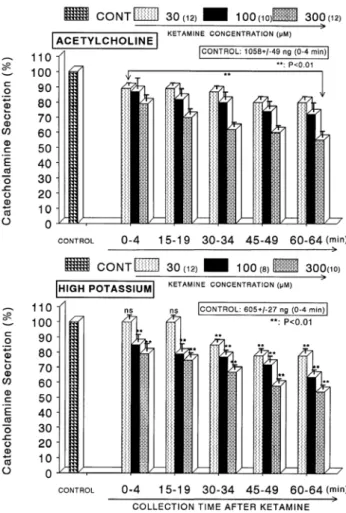
Fig. 1. Concentration-dependent effects of ketamine on the secretory responses of catecholamines (CA) from the perfused rat adrenal glands evoked by acetylcholine (ACh, Upper) and by high K
+(Lower). CA secretion by a single injection of ACh (5.32×10
−3M) or K
+(56 mM) in a volume of 0.05 ml was evoked at 15 min intervals after preloading with 30, 100 and 300μM of ketamine, respectively, for 60 min as indicated at an arrow mark. Numbers in the parenthesis indicate number of rat adrenal glands. Vertical bars on the columns represent the standard error of the mean (S.E.M.). Ordinate: the amounts of CA secreted from the adrenal gland (% of control). Abscissa: collection time of perfusate (min).
Statistical difference was obtained by comparing the corresponding control with each concentration-pretreated group of ketamine.
Pefusates induced by ACh and high K
+were collected for 4 minutes, respectively. **p<0.01.
described by Tallarida and Murray (1987).
Drugs and their sources
The following drugs were used: ketamine hydrochloride (Yuhan Corporation, Seoul, Korea), acetylcholine chloride, 1.1-dimethyl-4-phenyl piperazinium iodide (DMPP), vera- tridine, norepinephrine bitartrate, methyl-1,4-dihydro-2,6- dimethyl-3-nitro-4-(2-trifluoromethylphenyl)-pyridine-5- carboxylate (BAY-K-8644) (Sigma Chemical Co., U.S.A.), cyclopiazonic acd, (3-(m-cholro-phenyl-carbamoyl-oxy)-2- butynyltrimethyl ammonium chloride [McN-A-343] (RBI, U.S.A.), thiopental sodium (Choongwae Pharmaceutical Corporation, Seoul, Korea). Drugs were dissolved in dis- tilled water (stock) and added to the normal Krebs solution as required except Bay-K-8644, which was dissolved in 99.5
% ethanol and diluted appropriately (final concentration of alcohol was less than 0.1 %). Concentrations of all drugs used are expressed in terms of molar base.
RESULTS
Effect of ketamine on CA secretion evoked by ACh, excess K
+, DMPP and McN-A-343 from the perfused rat adrenal glands
After the perfusion with oxygenated Krebs-bicarbonate solution for 1 hr, basal CA release from the isolated per- fused rat adrenal glands amounted to 22±2.1 ng/2 min (n=8). It was attempted initially to examine the effects of ketamine itself on CA secretion from the perfused model of the rat adrenal glands. However, in the present study, ketamine (3×10
−5∼3×10
−4M) itself did not produce any effect on basal CA output from perfused rat adrenal glands (data not shown). Therefore, it was decided to investigate the effects of ketamine on cholinergic receptor stimulation- as well as membrane depolarization-mediated CA secretion.
Secretagogues were given at 15∼20 min-intervals.
Ketamine was perfused for 60 min.
When ACh (5.32×10
−2M) in a volume of 0.05 ml was injected into the perfusion stream, the amount of CA se- creted was 1058±49 ng for 4 min. However, as shown in Fig. 1 (Upper), in the presence of ketamine (3×10
−5∼3×10
−4M) for 60 min, ACh-evoked CA releasing responses were inhibited by 55% of the corresponding control release (100%) in concentration- and time-dependent fashion. Also, KCl (5.6×10
−2M), the direct membrane-depolarizing agent, markedly evoked the CA secretion (605±27 ng for 0∼4 min). As shown in Fig. 1 (Lower), following the pretreat- ment with ketamine (3×10
−5M∼3×10
−4M), excess K
+(5.6
×10
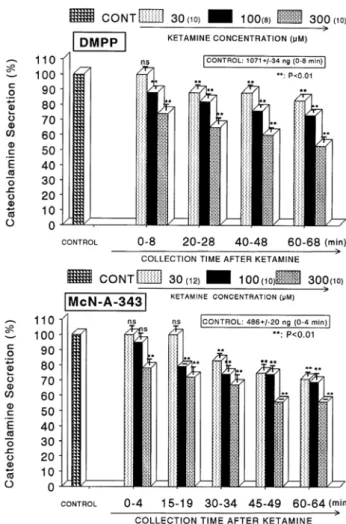
−2M)-stimulated CA secretion was significantly in- hibited to 54% of the control release. When perfused through the rat adrenal gland, DMPP (10
−4M), which is a selective nicotinic receptor agonist in autonomic sym- pathetic ganglia, evoked a sharp and rapid increase in CA secretion (1,071±34 ng for 0∼8 min). However, as shown in Fig. 2 (Upper), DMPP-stimulated CA secretion after pre- treatment with ketamine was greatly reduced to 53% of the corresponding control release. McN-A-343 (10
−4M), which is a selective muscarinic M1-agonist (Hammer & Giachetti, 1982), perfused into an adrenal gland for 4 min caused an increased CA secretion (486±20 ng for 0∼4 min). However, McN-A-343-stimulated CA secretion in the presence of ket-
amine was markedly depressed to 56% of the corresponding control secretion as depicted in Fig. 2 (Lower).
Effect of ketamine on CA secretion evoked by Bay-K- 8644, cyclopiazonic acid and veratridine from the perfused rat adrenal glands
Since Bay-K-8644 is known to be a calcium channel acti-
vator, which enhances basal Ca
2+uptake (Garcia et al,
1984) and CA release (Lim et al, 1992), it was of interest
to determine the effects of ketamine on Bay-K-8644-stimu-
lated CA secretion from the isolated perfused rat adrenal
glands. Bay-K-8644 (10
−5M)-stimulated CA secretion in
the presence of ketamine was inhibited to 72% of the corre-
Fig. 2. Concentration-dependent effects of ketamine on the CA secretory responses evoked by DMPP (Upper) and McN-A-343 (Lower) from the perfused rat adrenal glands. The CA secretory responses by the perfusion of DMPP (10
−4M) and McN-A-343 (10
−4M) for 4 min at 20 and 15 min intervals were induced after preloading with 30, 100 and 300μM of ketamine for 60 min, respectively. Pefusates induced by DMPP and McN-A-343 were collected for 8 and 4 minutes, respectively. Other legends are the same as in Fig. 1. **P<0.01. ns: Statistically not significant.
Fig. 3. Time course effect of ketamine on the CA release evoked by Bay-K-8644 (Upper) and cyclopiazonic acid (Lower) from the perfused rat adrenal glands. Bay-K-8644 (10
−5M) and cyclopiazonic acid (10
−5M) were perfused into an adrenal vein for 4 min at 15 min intervals after preloading with 100μM of ketamine for 60 min, respectively. Other legends are the same as in Fig. 1. *P<0.05,
**P<0.01. ns: Statistically not significant.
Fig. 4. Time course effect of ketamine on the CA release evoked by veratridine from the perfused rat adrenal glands. Veratridine (10
−4M) was perfused into an adrenal vein for 4 min at 15 min intervals after preloading with 100μM of ketamine for 60 min.
Other legends are the same as in Fig. 1. **P<0.01.
sponding control release (461±21 ng for 0∼4 min) from 10 glands as shown in Fig. 3 (Upper).
Cyclopiazonic acid, a mycotoxin from Aspergillus and Penicillium, has been described as a highly selective in- hibitor of Ca
2+-ATPase in skeletal muscle sarcoplasmic re- ticulum (Goeger & Riley, 1989; Seidler et al, 1989). The cyclopiazonic acid (10
−5M)-evoked CA secretory response prior to treatment with ketamine was 435±21 ng for 0-4 min. As shown in Fig. 3 (Lower), however, in the presence of ketamine (10
−4M) in 10 rat adrenal glands, cyclopiazonic acid (10
−5M)-evoked CA secretion was depressed to 71%
of the control response.
It has been known that veratridine-induced Na
+influx
mediated through Na
+channels increased Ca
2+influx via
activation of voltage-dependent Ca
2+channels and pro-
duced the exocytotic secretion of CA in cultured bovine
adrenal medullary cells (Wada et al, 1985a). As shown in
Fig. 4, veratridine greatly produced CA secretion (1,254±63
ng for 0∼4 min). Ketamine (100μM) also attenuated vera-
Fig. 5. Time course effect of of thiopental on the secretory responses of catecholamines (CA) from the perfused rat adrenal glands evoked by acetylcholine (ACh, Upper) and by high K
+(Lower). CA secretion by a single injection of ACh (5.32×10
−3M) or K
+(56 mM) in a volume of 0.05 ml was evoked at 15 min intervals after preloading with 100μM thiopentall for 60 min as indicated at an arrow mark. Other legends are the same as in Fig. 1. **P<0.01.
Fig. 6. Time course effect of of thiopental on the CA secretory responses evoked by DMPP (Upper) and McN-A-343 (Lower) from the perfused rat adrenal glands. The CA secretory responses by the perfusion of DMPP (10
−4M) and McN-A-343 (10
−4M) for 4 min at 20 and 15 min intervals were induced after preloading with 100μM thiopental for 60 min, respectively. Other legends are the same as in Fig. 1. **P<0.01. ns: Statistically not significant.
tridine-induced CA secretion by 53% of the corresponding control release in a time-dependent manner.
Effect of thiopental on CA secretion evoked by ACh, excess K
+, DMPP and McN-A-343 from the perfused rat adrenal glands
In order to compare the effect of thiopental with that of ketamine, it was likely of interest to examine effect of thio- pental on CA secretion evoked by ACh, high K
+and DMPP from the isolated perfused rat adrenal glands. In order to test the effect of thiopental on cholinergic receptor-stimu- lated CA secretion as well as membrane depolariza- tion-mediated secretion, concentration of 10
−4M thiopental was loaded into the adrenal medulla. In the present study, ACh (5.32 mM)-evoked CA release before perfusion with thiopental (10
−4M) was 1440±125 ng (0∼4 min) from 8 rat adrenal glands. However, in the presence of thiopental (10
−4M) for 60 min, it was significantly attenuated to 71%
of the control release (Fig. 5-Upper). High K
+(56 mM)-e- voked CA release under the presence of thiopental (10
−4M) was also reduced to 71% of the corresponding control secretion (614±32 ng, 0∼4 min) from 10 glands, as shown in Fig. 5 (Lower). In 6 rat adrenal glands, DMPP (10
−4M) perfused into the adrenal gland produced great CA secre- tion (1,024±47 ng, 0∼8 min) prior to loading with thiopental. Following perfusion with thiopental (10
−4M) it was diminished to 75% of the corresponding control release (Fig. 6-Upper). Moreover, in the presence of thiopental (10
−4M), McN-A-343-evoked CA secretory response was also time-dependently inhibited by 72% of the control secretion (461±21 ng, 0∼4 min) from 10 glands, as shown in Fig.
6 (Lower).
Effect of thiopental on CA secretion evoked by Bay-K- 8644, cyclopiazonic acid and veratridine from the perfused rat adrenal glands
In the presence of thiopental (10
−4M), the secretory re-
sponses evoked by Bay-K-8644 (10
−5M) and cyclopiazonic
acid (10
−5M) given into the adrenal gland for 4 min were
greatly depressed to 69% and 71% of their the correspond-
Fig. 8. Time course effect of thiopental on the CA release evoked by veratridine from the perfused rat adrenal glands. Veratridine (10
−4M) was perfused into an adrenal vein for 4 min at 15 min intervals after preloading with 100μM of thiopental for 60 min.
Other legends are the same as in Fig. 1. **P<0.01.
Fig. 7. Time course effect of thiopental on the CA release evoked by Bay-K-8644 (Upper) and cyclopiazonic acid (Lower) from the perfused rat adrenal glands. Bay-K-8644 (10
−5M) and cyclopiazonic acid (10
−5M) were perfused into an adrenal vein for 4 min at 15 min intervals after preloading with 100μM of thiopental for 60 min, respectively. Other legends are the same as in Fig. 1. *P<0.05,
**P<0.01. ns: Statistically not significant.
ing control responses (410±17 ng for 4 min and 435±21 ng for 4 min), respectively (Fig. 7). The CA secretion evoked by veratridine (10
−4M), an activator of Na
+channels, was greatly increased to 1203±44 ng for 0-4 min before loading of ketamine. However, in the presence of thiopental, it was inhibited to 53% of the corresponding control secretion, as shown in Fig. 8.
DISCUSSION
The experimental results obtained from the present study demonstrate that ketamine dose- and time-dependently in- hibits the CA secretion evoked by the stimulation of chol- inergic (both nicotinic and muscarinic) receptors and direct membrane depolarization in concentration- and time-de- pendent manners from the isolated perfused rat adrenal gland. It seems likely that the inhibitory effect of ketamine is mediated by blocking both the calcium influx into the rat adrenal medullary chromaffin cells and Ca
2+release from the cytoplasmic calcium store through the blockade of voltage-dependent Ca
2+channels as well as voltage- de-
pendent Na
+channels on the rat adrenal medullary chro- maffin cells, which are relevant to the blockade of chol- inergic receptors.
The present results are in agreement with the findings by Purifoy and Holz (1984) that ketamine inhibited the CA secretion evoked by a nicotinic agonist DMPP in cultured bovine adrenal chromaffin cells in a noncompetitive fashion. In the present work, the in vitro concentrations of ketamine for inhibiting the effect of various secreta- gogues used in the rat perfused adrenal medulla are not much different from those attained in vivo in laboratory animals and humans (Dowdy & Kaya, 1968: Traber et al, 1968; Goldberg et al, 1970: Yamanaka & Dowdy, 1974;
Schwartz & Horwitz et al, 1975; McGrath et al, l975; Diaz et al. 1976; Kolka et al, 1983; Sumikawa et al, 1983; Purifoy
& Holz, 1984; Takara et al, 1986).
In the present work, ketamine concentration-dependently suppressed the CA secretory responses evoked by ACh and DMPP. These results suggest that ketamine inhibits the nicotinic receptor stimulation-induced CA secretion by in- terfering with the influx of Ca
2+. In this experiment, ket- amine as well as thiopental also depressed the CA secretion induced by Bay-K-8644, which is found to enhance the CA release by increasing Ca
2+influx through L-type Ca
2+channels in chromaffin cells (Garcia et al, 1984). These find- ings that ketamine inhibited the CA secretion evoked by high K
+and also by Bay-K-8644 suggest that ketamine di- rectly inhibits the voltage-dependent Ca
2+channels through nicotinic receptor stimulation, just like Ca
2+chan- nel blockers (Cena et al, 1983), which have direct actions on voltage-dependent Ca
2+channels. In the bovine chro- maffin cells, stimulation of nicotinic, but not muscarinic ACh receptors is known to cause CA secretion by increasing Ca
2+influx largely through voltage-dependent Ca
2+chan- nels (Oka et al, 1979; Burgoyne, 1984). Some previous re- ports also showed that Bay-K-8644 selectively potentiates the CA secretory responses mediated through the activation of voltage-sensitive Ca
2+channels; during nicotine or high-K stimulation (Ladona et al, 1987; Uceda et al, 1992).
Therefore, it seems that ketamine inhibits DMPP-evoked
CA secretion through inhibition of Ca
2+influx through volt-
age-dependent Ca
2+channels activated by nicotinic ACh receptors. However, in the present study, thiopental also inhibited the secretion of CA from the perfused rat adrenal glands induced by Bay-K-8644 as well as high potassium, suggesting that both ketamine and thiopental suppress in- flux of Ca
2+induced by an activator of L-type volt- age-sensitive Ca
2+channels such as Bay-K-8644, which is thought to pass through voltage-sensitive Ca
2+channels and to stimulate CA secretion.
In support of this idea, it has been shown that ketamine also inhibited the carbachol-induced influx of
45Ca
2+with a concentration-inhibition curve similar to that for the CA secretion (Takara et al, 1986). This finding suggests that ketamine inhibited the carbachol-induced secretion of CA by interfering with the influx of Ca
2+. However, it is not likely that ketamine suppressed directly the volt- age-dependent Ca
2+channels themselves since the influx of
45Ca
2+due to high K
+was not affected by ketamine. This result is not in agreement with that of the present work.
This difference is not clearly find out, but seems to be differ- ence between concentrations, preparations and the ex- perimental methods used in studies. It has been reported that the impairment of the righting reflex in rats anes- thetized with ketamine was reversed when the free plasma concentration of the anesthetic decreased to 17μM (Cohen et al, 1973). However, a much higher concentration of ket- amine in plasma (60μM) was also demonstrated in pa- tients 5 min after the intravenous injection of 2 mg/kg (Idvall et al, 1979). In humans, the free plasma concen- tration of ketamine 5 min after intravenous injection of 2.5 mg/kg was approximately 103μM (Wieber et al, 1975).
Concentrations of ketamine between 20μM and 100μM are attained during anesthesia (Domino et al, 1982).
The mechanism by which the stimulation of ACh re- ceptors activates voltage-dependent Ca
2+channels in adre- nal medullary cells is well understood. It has also been shown that ACh depolarizes chromaffin cell membranes and that this is dependent on the inward movement of Na
+into the cells (Douglas et al, 1967). Kidokoro and his co-workers (1982) demonstrated that ACh generates Na
+-dependent action potentials and that these are mediated by nicotinic (but not muscarinic) ACh receptors. Taking these previous observations into account, it has been sug- gested that the influx of Na
+via nicotine receptor-asso- ciated ionic channels leads to the activation of volt- age-dependent Ca
2+channels by altering the membrane po- tentials (Wada et al, I985b). In the present study, ketamine suppressed the veratridine-evoked CA secretory response.
This result suggests that the inhibition by ketamine of the veratridine-evoked CA secretion as well as by ACh and DMPP is responsible for the inhibition of Ca
2+influx and the CA secretion. Ketamine was also found to inhibit the carbachol-induced influx of
22Na
+at the same concen- trations as it inhibited carbachol- induced
45Ca
2+influx and the CA secretion (Takara et al, 1986). It has also been re- ported to depress synaptic transmission in the neuro- muscular junction by interacting with the ionic channels of nicotine receptors (Maleque et al, 1981; Volle et aI., 1982). Therefore, it seems likely that the predominant site of action of ketamine is nicotinic receptor-gated ionic chan- nel in the rat adrenomedullary chromaffin cells.
Takara and his colleagues (1986) also found that ket- amine, at higher concentrations, reduced the vera- tridine-induced influx of
22Na
+,
45Ca
2+and the secretion of CA with a similar potency (IC50 260μM). Veratridine-in-
duced influx of Na
+is a requisite for triggering Ca
2+influx and the CA secretion (Wada et al, 1985a; 1985b). Therefore, the inhibition by ketamine of voltage-dependent Na
+chan- nels is responsible for the inhibition of Ca
2+influx and the CA secretion. Voltage-dependent Na
+channels are indis- pensable for axonal conduction in central and peripheral neurons. However, based on the present results, since ket- amine depressed the veratridine-evoked CA secretion at concentrations (30∼100μM) used clinically, it seems likely that the inhibition of voltage-dependent Na
+channels might be produced during clinical anesthesia.
In in vivo (Clanachan & McGrath, 1976) and in vitro (Juang et al, l980; Mahmoodi et al, 1980) experiments, ket- amine has been shown to depress synaptic transmission at peripheral sympathetic ganglia. In cultured adrenal medul- lary cells, which are devoid of preganglionic innervation, the effects of ketamine are confined to the postsynaptic ac- tion of the anesthetic. In this study, it looks likely that, in the isolated perfused adrenal gland, ketamine acts on the postsynaptic membrane and could selectively inhibit nicotine receptor-associated ionic channels. The present re- sults are consistent with those of electrophysiological ex- periments (Gallagher et al, 1976): i.e. ketamine suppressed the postganglionic action potentials elicited by iontophoreti- cally applied ACh, while ketamine had little effect on pre- ganglionic axonal conduction.
In the present study, both ketamine and thiopental also suppressed the CA secretion evoked by McN-A-343, a se- lective muscarinic M1-receptor agonist. Generally, it has been shown that muscarinic stimulation generates a depo- larizing signal which triggers the firing of action potentials, resulting in the increased CA release in the rat chromaffin cells (Akaike et al, 1990; Lim & Hwang, 1991). The ele- vation of intracellular Ca
2+mobilized from intracellular storage sites is thought to contribute to the muscarinic re- ceptor-mediated secretion of adrenal CA (Harish et al, 1987; Misbahuddin et al, 1985; Nakazato et al, 1988).
Furthermore, it has been shown that muscarinic receptor activation depolarizes the adrenal chromaffin cells of chick- ens (Knight & Baker, 1986), rats (Akaike et al, 1990), and guinea pigs (Inoue & Kuriyama, 1991). In terms of these findings, in this study, the inhibitory effect of ketamine on the muscarinic receptor-mediated secretion of CA can be explained in the same manner as for the nicotinic re- ceptor-mediated secretion.
In this study, both ketamine and thiopental also in- hibited the CA secretory response evoked by cyclopiazonic acid, which is known to be a highly selective inhibitor of Ca
2+-ATPase in skeletal muscle sarcoplasmic reticulum (Goeger & Riley, 1989; Seidler et al, 1989) and a valuable pharmacological tool for investigating intracellular Ca
2+mobilization and ionic currents regulated by intracellular Ca
2+(Suzuki et al, 1992). Therefore, this result suggests that the inhibitory effect of ketamine on the CA secretion evoked by cholinergic muscarinic stimulation might be as- sociated with the mobilization of intracellular Ca
2+in the rat adrenal chromaffin cells. This indicates that ketamine has an inhibitory effect on the release of Ca
2+from the in- tracellular pools induced by stimulation of muscarinic ACh receptors, which is weakly responsible for the CA secretion.
It has been shown that Ca
2+-uptake into intracellular stor-
age sites susceptible to caffeine (Ilno, 1989) is almost com-
pletely abolished by treatment with cyclopiazonic acid dur-
ing the proceeding Ca
2+load (Suzuki et al, 1992). This is
consistent with the findings obtained in skinned smooth
muscle fibers of the longitudinal layer of the guinea-pig ileum, where Ca
2+-uptake was also inhibited by cylopia- zonic acid (Uyama et al, 1992). Suzuki and his coworkers (1992) have shown that cyclopiazonic acid easily penetrates into the cytoplasm through the plasma membrane and re- duces Ca
2+-ATPase activity in sarcoplasmic/endoplasmic reticulum, resulting in increase in the subsequent Ca
2+re- lease from those storage sites. Moreover, in bovine adrenal chromaffin cells, stimulation of muscarinic ACh receptors is also proposed to cause activation of phosphoinositide me- tabolism, resulting in the formation of inositol 1,4,5-tri- sphosphate, which induces the mobilization of Ca
2+from the intracellular pools (Cheek et al, 1989; Challis et al, 1991). However, in the present study, it is uncertain wheth- er the inhibitory effect of ketamine on Ca
2+mobilization from intracellular pools is due to its direct effect on the PI response or an indirect effect.
In conclusion, these experimental results demonstrate that ketamine inhibits the CA secretion evoked by stim- ulation of cholinergic (both nicotinic and muscarinic) re- ceptors and the membrane depolarization from the isolated perfused rat adrenal gland. It seems likely that the in- hibitory effect of ketamine is mediated by blocking the cal- cium influx through voltage-dependent Ca
2+channels into the rat adrenal medullary chromaffin cells as well as Ca
2+release from the cytoplasmic calcium store partly through the blockade of voltage-dependent Na
+channels on the rat adrenal medullary chromaffin cells, which are at least rele- vant to the blockade of cholinergic receptors.
ACKNOWLEDGMENTS
This study was supported partly by Chosun University (2006).
REFERENCES
Akaike A, Mine Y, Sasa M, Takaori S. Voltage and current clamp studies of muscarinic and nicotinic excitation of the rat adrenal chromaffin cells. J Pharmacol Exp Ther 255: 333−339, 1990 Anton AH, Sayre DF. A study of the factors affecting the aluminum
oxidetrihydroxy indole procedure for the analysis of catecho- lamines. J Pharmacol Exp Ther 138: 360−375, 1962
Azzaro AJ, Smith DJ. The inhibitory action of ketamine HCl on [
3H]5-hydroxytryptamine accumulation by rat brain synapto- somal-rich fractions: comparison with [
3H]catecholamine and [
3H]
γ-aminobutyric acid uptake. Neuropharmacology 16: 349−
356, 1977
Burgoyne RD. Mechanisms of secretion from adrenal chromaffin cells. Biochim Biophys Acta 779: 201−216, 1984
Cena V, Nicolas GP, Sanchez-Garcia P, Kirpekar SM, Garcia AG.
Pharmacological dissection of receptor-associated and voltage- sensitive ionic channels involved in catecholamine release.
Neuroscience 10: 1455−1462, 1983
Challis RA, Jones JA, Owen PJ, Boarder MR. Changes in inositol 1,4,5-trisphosphate and inositol 1,3,4,5-tetrakisphosphate mass accumulations in cultured adrenal chromaffin cells in response to bradykinin and histamine. J Neurochem 56: 1083−1086, 1991 Cheek TR, O'Sullivan AJ, Moreton RB, Berridge MJ, Burgoyne RD.
Spatial localization of the stimulus-induced rise in cytosolic Ca
2+in bovine adrenal chromaffin cells: Distinct nicotinic and muscarinic patterns. FEBS Lett 247: 429−434, 1989
Clanachan AS, McGrath JC. Effects of ketamine on the peripheral autonomic nervous system of the rat. Br J Pharmacol 58: 247−
252, 1976
Cohen ML, Chan SL, Way WL, Trevor AJ. Distribution in the brain and metabolism of ketamine in the rat after intravenous administration. Anesthesiology 39: 370−376, 1973
Corssen G, Domino EF. Dissociative anesthesia: further pharma- cologic studies and first clinical experience with the phency- clidine derivative CI-581. Anesth Analg 45: 29−40, 1966 Diaz FA, Bianco JA, Bello A, Beer N, Velarde H, Izquierdo JP, Jaen
R. Effects of ketamine on canine cardiovascular function. Br J Anaesth 48: 941−946, 1976
Domino EF, Chodoff P, Corssen G. Pharmacologic effects of CI-581, a new dissociative anesthetic in man. Clin Pharmacol Ther 6:
279−291, 1965
Domino EF, Zsigmond EK, Domino LE, Domino KE, Kothary SP, Domino SE. Plasma levels of ketamine and two of its metabolites in surgical patients using a gas chromatographic mass fragmen- tographic assay. Anesth Analg 61: 87−92, 1982
Douglas WW, Kanno T, Sampson SR. Influence of the ionic environment on the membrane potential of adrenal chromaffin cells and on the depolarizing effect of acetylcholine. J Physiol l91: I07−121, l967
Dowdy EG, Kaya K. Studies of the mechanism of cardiovascular responses to CI-581. Anesthesiology 29: 931−943, 1968 Gallagher JP, Dun N, Higashi H, Nisihi S. Actions of ketamine
on synaptic transmission in frog sympathetic ganglia. Neuro- pharmacology 15: 139−143, 1976
Garcia AG, Sala F, Reig JA, Viniegra S, Frias J, Fonteriz R, Gandia L. Dihydropyridine Bay-K-8644 activates chromaffin cell calcium channels. Nature 309: 69−71, 1984
Garty M, Deka-Starosta A, Stull R, Kopin IJ, Goldstein DS. Effects of general anesthetics on plasma levels of catechols in intact and in adrenal-demedullated rats. Biogenic Amines 7: 435−443, Gemperle M, Szappanyos G, Rifat K. Neuroleptanesthesia in 1990
gerontosurgery. Int Anesthesiol Clin 11: 125−138, 1973 Goeger DE, Riley RT. Interaction of cyclopiazonic acid with rat
skeletal muscle sarcoplasmic reticulum vesicles. Effect on Ca
2+binding and Ca
2+permeability. Biochem Pharmacol 38: 3995−
4003, 1989
Goldberg AH, Keane PW, Phear WP. Effects of ketamine on contractile performance and excitability of isolated heart muscle.
J Pharmacol Exp Ther 175: 388−394, 1970
Graf BM, Vicenzi MN, Martin E, Bosnjak ZJ, Stowe DF. Ketamine has stereospecific effects in the isolated perfused guinea pig heart. Anesthesiology 82: 1426−1437, 1995
Hammer R, Giachetti A. Muscarinic receptor subtypes: M1 and M2 biochemical and functional characterization. Life Sci 31: 2991−
2998, 1982
Hara K, Minami K, Ueno S, Toyohira Y, Tsutsui M, Shigematsu A, Yanagihara N. Up-regulation of noradrenaline transporter in response to prolonged exposure to ketamine. Naunyn Schmiede- berg's Arch Pharmacol 365: 406−412, 2002
Hara K, Yanagihara N, Minami K, Ueno S, Toyohira Y, Sata T, Kawamura M, Bruss M, Bonisch H, Shigematsu A, Izumi F.
Ketamine interacts with the noradrenaline transporter at a site partly overlapping the desipramine binding site. Naunyn- Schmiedeberg's Arch Pharmacol 358: 328−333, 1998
Harish OE, Kao LS, Raffaniello R, Wakade AR, Schneider AS.
Calcium dependence of muscarinic receptor-mediated catecho- lamine secretion from the perfused rat adrenal medulla. J Neurochem 48: 1730−1735, 1987
Hensel I, Braun U, Kettler D, Knoll D, Martel J, Paschen K. Studies on circulatory and metabolic changes during ketamine anae- sthesia. Anaesthesist 21: 44−49, 1972
Idvall J, Ahlgren I, Aronsen KF, Stenberg P. Ketamine infusions:
pharmacokinetics and clinical effects. Br J Anaesth 51: 1167−
1173, 1979
Ilno M. Calcium-induced calcium release mechanism in guinea pig taenia caeci. J Gen Physiol 94: 363−383, 1989
Inoue M, Kuriyama H. Muscarinic receptor is coupled with a cation channel through a GTP-binding protein in guinea-pig chromaffin cells. J Physiol (Lond) 436: 511−529, 1991
Juang MS, Yonemura K, Morita T, Tanaka T. Ketamine acts on
the peripheral sympathetic nervous system of guinea pigs.
Anesth Analg 59: 45−49, 1980
Kidokoro Y, Miyazaki S, Ozawa S. Acetylcholine-induced mem- brane depolarization and potential fluctuations in the rat adrenal chromaffin cell. J Physiol 324: 203−220, 1982 Kitagawa H, Yamazaki T, Akiyama T, Yahagi N, Kawada T, Mori
H, Sunagawa K. Modulatory effects of ketamine on catecho- lamine efflux from in vivo cardiac sympathetic nerve endings in cats. Neurosci Lett 324: 232−236, 2002
Klose R, Peter K. Clinical studies on single-drug anesthesia using ketamine in patients with burns. Anaesthesist 22: 121−126, Knight DE, Baker PF. Observations on the muscarinic activation 1973 of catecholamine secretion in the chicken adrenal. Neuroscience 19: 357−366, 1986
Kolka MA, Elizondo RS, Weinberg RP. Sympathoadrenal responses to cold and ketamine anesthesia in the rhesus monkey. J Appl Physiol 54: 896−900, 1983
Kreuscher H, Gauch H. The effect of phencylidine derivatives ketamine (CI 581) on the cardiovascular system of the man.
Anaesthesist 16: 229−233, 1967
Ladona MG, Aunis D, Gandia AG, Garcia AG. Dihydropyridine modulation of the chromaffin cell secretory response. J Neurochem 48: 483−490, 1987
Lanning CF, Harmel MH. Ketamine anesthesia. Annu Rev Med 26:
137−141, 1975
Lim DY, Hwang DH. Studies on secretion of catecholamines evoked by DMPP and McN-A-343 in the rat adrenal gland. Korean J Pharmacol 27: 53−67, 1991
Lim DY, Kim CD, Ahn KW. Influence of TMB-8 on secretion of catecholamines from the perfused rat adrenal glands. Arch Pharm Res 15: 115−125, 1992
Mahmoodi V, Byrne AJ, HeaIy TE, Hussain SZ. Effect of ketamine on transmission in sympathetic ganglia. Br J Anaesth 52: 371−
375, 1980
Maleque MA, Warnick JE, Albuquerque EX. The mechanism and site of action of ketamine on skeletal muscle. J Pharmacol Exp Ther 219: 638−645, 1981
McCarthy DA, Chen G, aup DH, Ensor C. General anesthetic and other pharmacological properties of 2-(O-chlorophenyl)-2- methylamino cyclohexane HCl (CI-581). J New Drugs 5: 21−33, McGrath JC, MacKenzie JE, Millar RA. Circulatory responses to 1965 ketamine: dependence on respiratory pattern and background anaesthesia in the rabbit. Br J Anaesth 47: 1149−1156, 1975 Misbahuddin M, Isosaki M, Houchi H, Oka M. Muscarinic
receptor-mediated increase in cytoplasmic free Ca
2+in isolated bovine adrenal medullary cells. Effects of TMB-8 and phorbol ester TPA. FEBS Lett 190: 25−28, 1985
Nakazato Y, Ohga A, Oleshansky M, Tomita U, Yamada Y.
Voltage-independent catecholamine release mediated by the activation of muscarinic receptors in guinea-pig adrenal glands.
Br J Pharmacol 93: 101−109, 1988
Oka M, Isosaki M, Yanagihara N. Isolated bovine adrenal medullary cells: studies on regulation of catecholamine synthesis and release. In: Usdin E, Kopin IJ, Brachas J ed, Catecho- lamines: Basic and Clinical frontiers. Pergamon Press, Oxford, p 70−72, 1979
Okamoto T, Okutani R, Tashiro C. The dual effect of ketamine on dopamine release from rat pheochromocytoma (PC-12) cells.
Masui 45: 1083−1087, 1996
Purifoy JA, Holz RW. The effects of ketamine, phencyclidine and lidocaine on catecholamine secretion from cultured bovine
adrenal chromaffin cells. Life Sci 35: 1851−1857, 1984 Rust M, Landauer B, Kolb E. Ketamine--a suitable agent for
emergency situations. Anaesthesist 27: 205−212, 1978 Schwartz DA, Horwitz LD. Effects of ketamine on left ventricular
performance. J Pharmacol Exp Ther 194: 410−414, 1975 Seidler NW, Jona I, Vegh N, Martonosi A. Cyclopiazonic acid is
a specific inhibitor of the Ca
2+-ATPase of sarcoplasimc reticu- lum. J Biol Chem 264: 17816−17823, 1989
Sumikawa K, Matsumoto T, Amenomori Y, Hkano H, Amakata Y.
Selective actions of intravenous anesthetics on nicotinic- and muscarinic-receptor-mediated response of the dog adrenal medulla. Anesthesiology 59: 412−416, 1983
Suzuki M, Muraki K, Imaizumi Y, Watanabe M. Cyclopiazonic acid, an inhibitor of the sarcoplasmic reticulum Ca
2+-pump, reduces Ca
2+-dependent K
+currents in guinea-pig smooth muscle cells.
Br J Pharmacol 107: 134−140, 1992
Takara H, Wada A, Arita M, Sumikawa K, Izumi F. Ketamine inhibits
45Ca influx and catecholamine secretion by inhibiting
22