
Influence of PD 123319 (AT2
16
0
0
전체 글
(2) Influence of PD 123319 on CA Secretion. type 1 (AT1) and type 2 (AT2) receptors, which are lo-. play a role in mediating CA secretion by the adrenal me-. calized on the surface of plasma membrane of various tis-. dulla of anesthetized dogs in response to Ang II receptor. sues throughout the body.1-5) Ang II is a secretogogue for. agonist administration in vivo.23) PD 123319 (AT2 antago-. secretion of catecholamines (CA) that is believed to be. nist) and CGP 42112 (AT2 agonist) inhibited the increase. mediated through inositol-1,4,5-triphosphate (IP3) pro-. in adrenal CA secretion induced by local administration of. 6,7). Indeed, it has been shown that Ang. Ang II without any agonist actions.23) Notwithstanding,. II-induced CA release is mediated by AT1 in the rat adre-. such a functional implication of AT2 receptors in the iso-. duction by AT1. 6). AT1-mediated phospholipase C activation. lated perfused adrenal medulla has yet to be confirmed in. 2+. and subsequent IP3 formation may increase cytosolic Ca. other species. Therefore, the present study was designed to. levels by releasing Ca2+ from intracellular storage, with. evaluate whether AT2 receptors are functionally involved in. nal medulla.. 7). Moreover, it has. the CA secretion in the perfused model of the isolated rat. been found that addition of IP3 to permeabilized bovine. adrenal medulla. The specific purpose of the present study. subsequent activation of CA release.. 2+ 8). chromaffin cells releases intracellular Ca . Also, addition 2+. of Ca. to permeabilized bovine chromaffin cells was re-. was to analyze modulations of the CA secretion from the perfused rat adrenal gland in response to locally ad-. 9). ported to cause CA secretion. In the adrenal medulla, Ang. ministered several secretagogues including AngII in the. II increases the basal CA output through the activation of. presence of either PD 123319 or CGP 42112, both of. AT1 receptors either in vitro1,10,11) or in vivo.12) However,. which are highly specific and selective ligands to angio-. a number of previous studies have shown that the selective. tensin AT2 receptor in various tissues.24). blockade of AT1 receptors did not abolish the increase of Ang II-evoked CA secretion in adrenal medulla.6,12-14). Subjects and methods. These observations suggest the existence of additional mechanisms other than those mediated through AT1. 1. Experimental procedure. receptors. Generally, both AT1 and AT2 Ang II receptors. All procedures involving animal experiment were approved. are expressed in the adrenal medulla. In the rat, AT2 re-. by the committee of experimental animals, Chosun. ceptors predominate, AT1 receptors representing only 5%. University School of Medicine. Male Sprague-Dawley rats,. 15,16). In fact,. weighing 250 to 350 g, were anesthetized with thiopental. AT2 is also abundantly expressed in the adrenal medulla of. sodium (50 mg/kg) intraperitoneally. The adrenal gland was. to 10% of the total number of Ang II receptors. 17,18). Previous studies have demonstrated that the. isolated by the methods described previously.25) The abdo-. CA-releasing effect of Ang II is mediated primarily via the. men was opened by a midline incision, and the left adre-. activation of AT2 receptors in adrenal medullary fragments. nal gland and surrounding area were exposed by the place-. adult rats.. 19,20). and also in cultured. ment of three-hook retractors. The stomach, intestine and. porcine adrenal medullary chromaffin cells.21) In contrast, it. portion of the liver were not removed, but pushed over to. has been suggested that the AT2 agonist, CGP 42112, in-. the right side and covered by saline-soaked gauge pads and. hibits CA biosynthesis through a decrease in cyclic guano-. urine in bladder was removed in order to obtain enough. sine monophosphate (cGMP) production in cultured por-. working space for tying blood vessels and cannulations.. isolated from the rat adrenal gland,. 22). cine adrenal medullary cells.. AT2 receptors are known to. 24 The Korean Society of Hypertension. A cannula, used for perfusion of the adrenal gland, was.
(3) Soon-Pyo HongㆍBhandary BidurㆍMee-Sung ChoiㆍYoung-Hwan SeoㆍDong-Yoon Lim. inserted into the distal end of the renal vein after all. tro-4-(2-trifluoro-methyl-phenyl)-pyridine-5-carboxylate. branches of adrenal vein (if any), vena cava and aorta. (Bay-K-8644, 10-5 M) and cyclopiazonic acid (10-5 M). were ligated. Heparin (400 IU/mL) was injected into. were also perfused for 4 minutes, respectively. In the pre-. vena cava to prevent blood coagulation before ligating. liminary experiments, it was found that upon admin-. vessels and cannulations. A small slit was made into the. istration of the above drugs, the secretory responses to. adrenal cortex just opposite entrance of adrenal vein.. Ang II, ACh, KCl, McN-A-343, veratridine, Bay-K-8644,. Perfusion of the gland was started, making sure that no. and cyclopiazonic acid returned to preinjection level in. leakage was present, and the perfusion fluid escaped only. about 4 minutes, but the responses to DMPP in 8 minutes.. from the slit made in adrenal cortex. Then the adrenal gland, along with ligated blood vessels and the cannula,. 4. Collection of perfusate. was carefully removed from the animal and placed on a. As a rule, prior to stimulation with various secreta-. platform of a leucite chamber. The chamber was con-. gogues, the perfusate was collected for 4 minutes to de-. tinuously circulated with water heated at 37°C ± 1°C.. termine the spontaneous secretion of CA (background sample). Immediately after the collection of the back-. 2. Perfusion of adrenal gland. ground sample, collection of the perfusates was continued. The adrenal glands were perfused by means of peri-. in another tube as soon as the perfusion medium contain-. staltic pump (ISCO pump; WIZ Co., Lincoln, NE, USA). ing the stimulatory agent reached the adrenal gland.. at a rate of 0.33 mL/min. The perfusion was carried out. Stimulated sample’s perfusate was collected for 4 to 8. with Krebs-bicarbonate solution of following composition. minutes. The amounts secreted in the background sample. (mM): NaCl 118.4, KCl 4.7, CaCl2 2.5, MgCl2 1.18,. have been subtracted from that secreted from the stimu-. NaHCO3 25, KH2PO4 1.2, and glucose 11.7. The sol-. lated sample to obtain the net secretion value of CA,. ution was constantly bubbled with 95% O2 + 5% CO2. which is shown in all of the figures.. and the final pH of the solution was maintained at 7.4 to. To study the effect of PD 123319 on the spontaneous. 7.5. The solution contained disodium ethylenediamine tet-. and evoked secretion, the adrenal gland was perfused with. raacetate (10 μg/mL) and ascorbic acid (100 μg/mL) to. Krebs solution containing PD 123319 for 90 minutes, and. prevent oxidation of catecholamines.. then the perfusate was collected for a certain period (background sample). Then the medium was changed to. 3. Drug administration. the one containing the stimulating agent or along with PD. The perfusions of Ang II (10-7 M) and 1,1-dimethyl-4-phe-. 123319, and the perfusates were collected for the same. nylpiperazinium iodide (DMPP, 10-4 M) for 1 minute. period as that for the background sample. The adrenal. and/or a single injection of acetylcholine (Ach, 5.32 ×. gland’s perfusate was collected in chilled tubes.. 10-3 M) and KCl (5.6 × 10⁻² M) in a volume of 0.05 mL were made into perfusion stream via a three-way stop-. 5. Measurement of catecholamines. cock, respectively. 3-(m-chloro-phenyl-carbamoyl-oxy)-2-b-. CA content of perfusate was measured directly by the. utynyltrimethyl ammonium chloride (McN-A-343, 10-4. fluorometric method of Anton and Sayre26) without the. M), veratridine (10-4 M), 4-dihydro-2, 6-dimethyl-3-ni-. intermediate purification alumina for the reasons de-. J Korean Soc Hypertens 2013;19(1):23-38. 25.
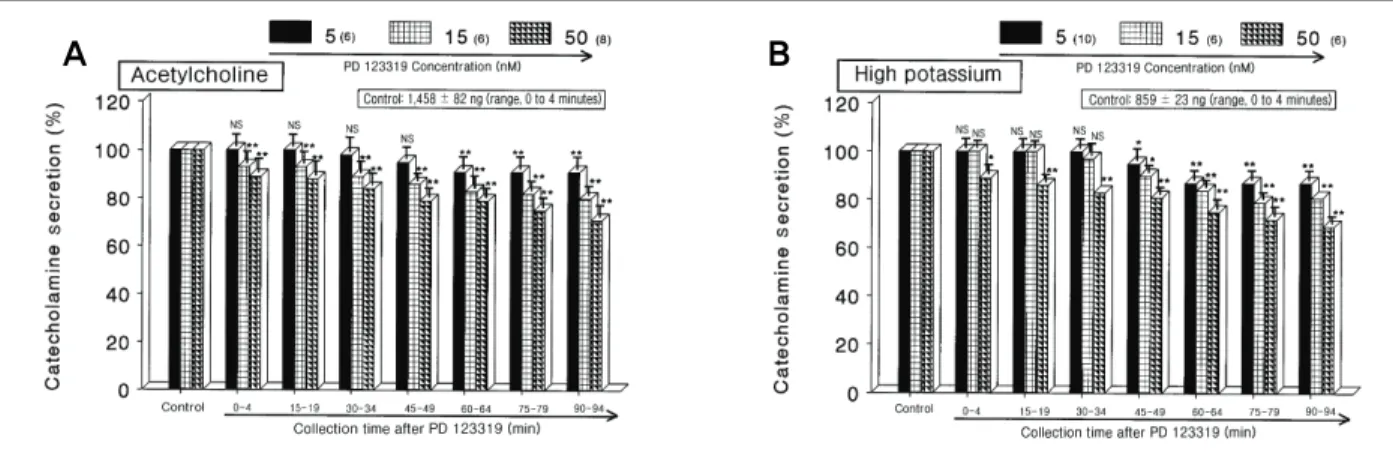
(4) Influence of PD 123319 on CA Secretion. scribed earlier25) using fluorospectrophotometer (Kontron Co., Milano, Italy). A volume of 0.2 mL of the perfusate was used for the reaction. The CA content in the perfusate of stimulated glands by secretagogues used in the present work was high enough to obtain readings several folds greater than the reading of control samples (unstimulated). The sample blanks were also lowest for perfusates of stimulated and non-stimulated samples. The content of CA in the perfusate was expressed in terms of norepinephrine (NE, base) equivalents.. 7. Drugs and their sources The following drugs were used: PD 123319, CGP 42112, cyclopiazonic acid, acetylcholine chloride, DMPP, norepinephrine bitartrate, methyl-1, BAY-K-8644, veratridine hydrochloride, Ang II acetate salt (Sigma Chemical Co., St. Louis, MO, USA), and McN-A-343 (RBI, Natick, MA, USA). Drugs were dissolved in distilled water (stock) and added to the normal Krebs solution as required except Bay-K-8644, which was dissolved in 99.5% ethanol and diluted appropriately with Krebs-bicarbonate solution (final concentration of alcohol was less than 0.1%). Concentrations. 6. Statistical analysis. of all drugs are expressed in terms of molar base.. The statistical difference between the control and pretreated groups was determined by the Student’s t-test and. Results. analysis of variance test. A p-value of less than 0.05 was considered to represent statistically significant changes unless specifically noted in the text. Values given in the text refer to means and the standard errors of the mean. The statistical analysis of the experimental results was made by 27). computer program described by Tallarida and Murray.. A. 1. Influence of PD 123319 on the CA secretion evoked by ACh, high K+, DMPP and McN-A-343 from the perfused rat adrenal glands We determined the effects of PD 123319 on the CA secretion from the isolated perfused model of rat adrenal. B. Fig. 1. Dose-dependent effects of PD 123319 on the secretory responses of catecholamines (CA) evoked by acetylcholine (ACh) (A) and high potassium (B) from the perfused rat adrenal medullas. The CA secretion by a single injection of ACh (5.32 mM) or high K+ (56 mM) in a volume of 0.05 mL was evoked at 15 intervals during loading with 5, 15, and 50 nM of PD 123319 for 90 minutes as indicated at an arrow mark, respectively. Numbers in the parenthesis indicate number of rat adrenal glands. Vertical bars on the columns represent the standard error of the mean. Ordinate: the amounts of CA secreted from the adrenal gland (% of control). Abscissa: collection time of perfusate (min). Statistical difference was obtained by comparing the corresponding control (control) with each concentration-treated group of PD 123319. ACh- and high K+-induced perfusates were collected for 4 minutes, respectively. NS, statistically not significant. *p < 0.05, **p < 0.01.. 26 The Korean Society of Hypertension.
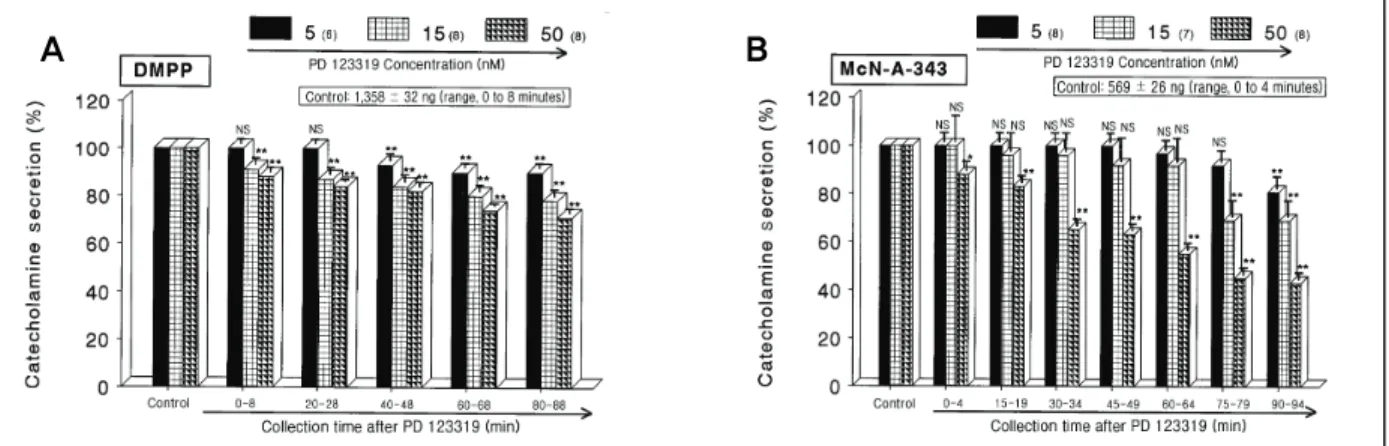
(5) Soon-Pyo HongㆍBhandary BidurㆍMee-Sung ChoiㆍYoung-Hwan SeoㆍDong-Yoon Lim. medulla stimulated by some choligergic agonists and high. (range, 5 to 50 nM), high K+ (5.6 × 10⁻² M)-stimulated. potassium. When the rat adrenal medullae were perfused. CA secretion was significantly inhibited by about 69% of. with PD 123319 for 90 minutes, the CA secretion evoked. the control at last period (range, 90 to 94 minutes) as. by these secretagogues was significantly diminished. After. shown in Fig. 1B. To further confirm the actions of PD. the perfusion with oxygenated Krebs-bicarbonate solution. 123319 on nicotinic acetylcholine receptors, using the. for 1 hour, basal CA release from the perfused rat adrenal. perfused rat adrenal medulla, we examined the effects of. medulla was 20 ± 3 ng for 2 minutes (n = 12).. PD 123319 on the DMPP-induced CA secretion. PD. -3. When ACh (5.32 × 10 M) in a volume of 0.05 mL. 123319 (15 μM) greatly reduced the DMPP-induced se-. was injected into the perfusion stream, the amount of CA. cretion from the adrenal medulla. DMPP (10-4 M), which. secreted was 1,458 ± 82 ng for 4 minutes. However, in. is a selective nicotinic (NN) receptor agonist in autonomic. the presence of PD 123319 in the range of 5 to 50 nM. sympathetic ganglia, evoked a sharp and rapid increase in. for 90 minutes, ACh-evoked CA secretion was concen-. CA secretion (1,358 ± 32 ng for 0 to 8 minutes).. tration- and time-dependently reduced by PD 123319. As. However, as shown in Fig. 2A, DMPP-evoked CA secre-. shown in Fig. 1A, the treatment of PD 123319 inhibited. tion during loading with PD 123319 was also maximally. ACh-evoked CA releasing responses by maximally 71%. reduced to 71% of the control release at last period. It. +. of the corresponding control release. Also, high K di-. has been found that in voltage-clamped guinea-pig chro-. rectly depolarizes the cell membranes without Na+ influx. maffin cells, muscarine produced a transient intracellular. 2+. 2+. Ca2+ concentration increase and CA release.29) McN-A-343. channels and, consequently, catecholamine secretion.28). (10-4 M), which is a selective muscarinic M1-receptor ag-. High potassium markedly evoked the CA secretion from. onist,. the rat adrenal medulla (859 ± 23 ng for 0 to 4 minutes).. so caused an increased CA secretion (569 ± 26 ng for 0. However, following the pretreatment with PD 123319. to 4 minutes). However, in the presence of PD 123319,. and results in Ca. A. influx through voltage-dependent Ca. 30). perfused into an adrenal gland for 4 minutes al-. B. Fig. 2. DDose-dependent effects of PD 123319 on the catecholamines (CA) secretory responses evoked by 1,1-dimethyl-4 -phenylpiperazinium iodide (DMPP) (A) and McN-A-343 (B) from the perfused rat adrenal medullas. The CA secretion by perfusion of DMPP (100 μM) for 1 minute and 3-(m-chloro-phenyl-carbamoyl-oxy)-2-butynyltrimethyl ammonium chloride (McN-A-343, 100 μM) for 4 minutes was induced at 20 and 15 intervals during loading with 5, 15, and 50 nM of PD 123319 for 90 minutes, respectively. DMPP- and McN-A-343-induced perfusates were collected for 8 and 4 minutes, respectively. NS, statistically not significant. *p < 0.05, **p < 0.01.. J Korean Soc Hypertens 2013;19(1):23-38. 27.
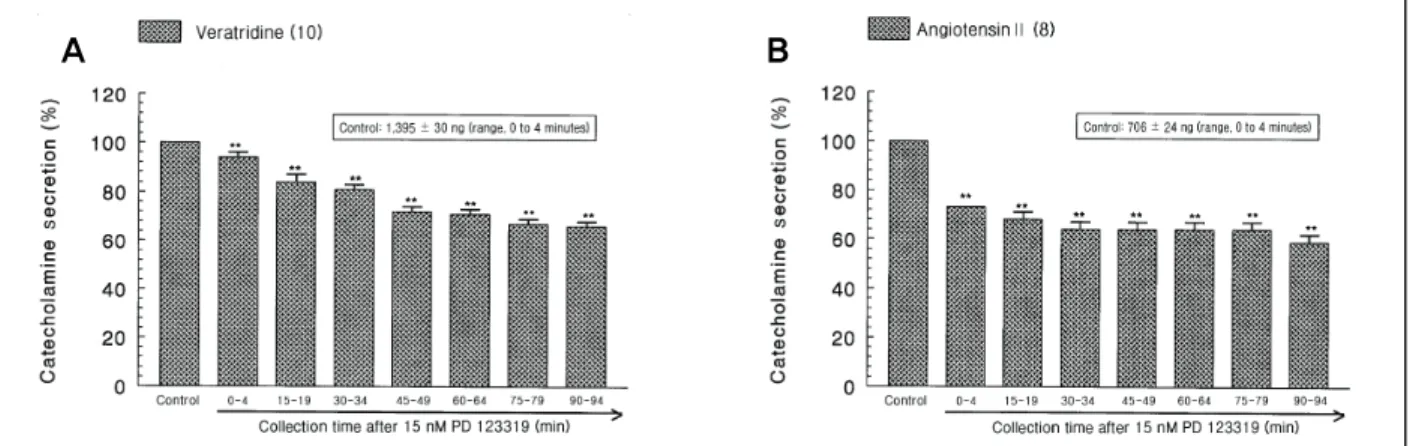
(6) Influence of PD 123319 on CA Secretion. McN-A-343-evoked CA secretion was markedly de-. It has been described that cyclopiazonic acid, a myco-. pressed to about 43% of the corresponding control secre-. toxin from Aspergillus and Penicillium, as a highly se-. tion (Fig. 2B).. lective inhibitor of Ca2+-ATPase in skeletal muscle sarcoplasmic reticulum.33,34) The inhibitory action of PD 123319. 2. Influence of PD 123319 on the CA secretion evoked by Bay-K-8644, cyclopiazonic acid, veratridine and Ang II from the perfused rat adrenal glands +. 2+. It is well-known that Na and Ca. on cyclopiazonic acid-evoked CA secretory response was observed as shown in Fig. 3B. In the presence of PD 123319 (15 μM) from 10 adrenal glands, cyclopiazonic acid (10-5 M)-evoked CA secretion was also inhibited to. influxes into chro-. maffin cells through the nicotinic ACh receptor-operated cation and voltage-sensitive Ca2+ channels, respectively, are essential for the ACh-evoked CA secretion from the adrenomedullary cells. Since Bay-K-8644 is known to be 2+. a calcium channel activator, which enhances basal Ca. uptake31) and CA release,32) it was of interest to examine the effect of PD 123319 on Bay-K-8644-evoked CA secretion from the perfused rat adrenal glands. Bay-K-8644 -5. (10. M)-evoked CA secretion in the presence of PD. 123319 (15 nM) was reduced to maximally 63% of the control at 75 to 94 minutes period as compared to the corresponding control release (525 ± 13 ng for 0 to 4 minutes) from 10 adrenal glands as shown in Fig. 3A.. A. 70% of the control response (512 ± 10 ng for 0 to 4 minutes) at 45 to 94 minutes period. It has also been found that veratridine-induced Na+ influx mediated through Na+ channels increased Ca2+ influx via activation of voltage-dependent Ca2+ channels and produced the exocytotic secretion of CA in cultured bovine adrenal medullary cells.35) To characterize the pharmacological action of PD 123319 on voltage-dependent Na+ channels, the effect of PD 123319 on veratridine-evoked CA secretion was examined here. As shown in Fig. 4A, veratridine (10-4 M) greatly produced the CA secretion (1,395 ± 30 ng for 0 to 4 minutes). However, in the presence of PD 123319 (15 μM), veratridine-evoked CA secretion was greatly inhibited to 66%. B. Fig. 3. Time-course effects of PD 123319 on the catecholamines (CA) release evoked by 4-dihydro-2,6-dimethyl-3-nitro -4-(2-trifluoro-methyl-phenyl)-pyridine-5-carboxylate (Bay-K-8644) (A) and cyclopiazonic acid (B) from the perfused rat adrenal medullas. Bay-K-8644 (10 μM) and cyclopiazonic acid (10 μM) were perfused into an adrenal vein for 4 minutes at 15-minute intervals during loading with PD 123319 (15 nM) for 90 minutes, respectively. NS, statistically not significant. *p < 0.05, **p < 0.01.. 28 The Korean Society of Hypertension.
(7) Soon-Pyo HongㆍBhandary BidurㆍMee-Sung ChoiㆍYoung-Hwan SeoㆍDong-Yoon Lim. A. B. Fig. 4. Time-course effects of PD 123319 on the catecholamines (CA) release evoked by veratridine (A) and angiotensin II (B) from the perfused rat adrenal medullas. Veratridine (100 μM) for 4 minutes and angiotensin II (100 nM) for 1 minute were perfused into an adrenal vein and at 15-minute intervals during loading with PD 123319 (15 nM) for 90 minutes, respectively. **p < 0.01.. of the corresponding control release.. production. Therefore, in order to investigate the influ-. Since it has been demonstrated that AT2 stimulation in-. ence of CGP 42112 on PD 123319-induced inhibitory ef-. duces CA secretion in cultured porcine chromaffin. fects, it was likely of interest to examine effect of PD. 21). 11). have suggested that Ang II in-. 123319 plus CGP 42112 on the CA secretion evoked by. crease epinephrine release from the adrenal medulla via. ACh, high K+, and DMPP from the perfused rat adrenal. the AT1 receptors, it was likely interesting to examine the. glands. In the present study here, CGP 42112 (15 nM) it-. effect of Ang II on the CA rease. Ang II (10-7 M) sig-. self did not affect basal CA output from perfused rat. nificantly evoked the CA secretory response (706 ± 24. adrenal glands (data not shown). In subsequent experi-. ng for 0 to 4 minutes) whereas, in the presence of PD. ments, PD 123319 (15 nM) plus CGP 42112 (15 nM). 123319 (15 μM), Ang II (100 nM)-evoked CA secretion. were simultaneously loaded into the rat adrenal medulla. was greatly inhibited to 59% of the corresponding control. for 90 minutes immediately after establishment of control. release (Fig. 4B).. responses to cholinergic receptor-stimulation as well as. cells,. but Hano et al.. direct membrane-depolarization. ACh (5.32 mM)-evoked. 3. Influence of PD 123319 plus CGP 42112 on the CA secretion evoked by ACh, excess K+, DMPP and Ang II from the perfused rat adrenal glands. CA release before perfusion with PD 123319 plus CGP. As shown in Figs. 1, 2, PD 123319 inhibited the CA. nM) plus CGP 42112 (15 nM) for 90 minutes, it was. secretory response evoked by cholinergic stimulation as. more attenuated to 69% of the control release (Fig. 5A).. ell as by direct membrane depolarization in the perfused. High K+ (56 mM)-evoked CA release under the coex-. rat adrenal gland. It has also been demonstrated that AT2. istence of PD 123319 (15 nM) plus CGP 42112 (15 nM). receptpr agonist (CGP 42112) reduces both tyrosine hy-. was also reduced to 71% of the corresponding control se-. droxylase (TH)-enzyme activity and TH-synthesis in cul-. cretion (854 ± 22 ng for 0 to 4 minutes), as shown in. tured porcine adrenal medullary cells and that these in-. Fig. 5B. DMPP (10-4 M) perfused into the adrenal gland. hibitory effects could be mediated by decrease of cGMP. produced great CA secretion (1,088 ± 32 ng for 0 to 8. 42112 was 1,372 ± 46 ng (range, 0 to 4 minutes). However, in the simultaneous presence of PD 123319 (15. J Korean Soc Hypertens 2013;19(1):23-38. 29.
(8) Influence of PD 123319 on CA Secretion. A. B. Fig. 5. Influence of PD 123319 (or PD) plus CGP 42112 (CGP) on the catecholamines (CA) secretory responses evoked by acetylcholine (A) and high potassium (B) from the perfused rat adrenal medulla. The CA secretion by a single injection of acetylcholine (Ach) (5.32 mM) or high K+ (56 mM) in a volume of 0.05 mL was evoked at 15 intervals during simultaneous loading with PD (15 nM) plus CGP (15 nM) for 90 minutes. Statistical difference was obtained by comparing the corresponding control (control) with group of PD 123319-treated alone or group treated with PD + CGP. NS, statistically not significant. *p < 0.05, **p < 0.01.. minutes) prior to loading with PD 123319 plus CGP 42112, but following perfusion with PD 123319 plus CGP 42112 it was markedly diminished to 51% of the. 4. Influence of PD 123319 plus CGP 42112 on the CA secretion evoked by Bay-K-8644 and veratridine from the perfused rat adrenal glands. corresponding control release (Fig. 6A). Moreover, in the. In the simultaneous presence of PD 123319 plus CGP. presence of PD 123319 plus CGP 42112, Ang II-evoked. 42112, the secretory responses evoked by Bay-K-8644 (10-5. CA secretory responses was also more potently inhibited. M) given into the adrenal gland for 4 minutes were greatly. by 42% of the control secretion (660 ± 21 ng for 0 to. depressed to 42% of the corresponding control responses. 4 minutes), as shown in Fig. 6B.. (596 ± 15 ng for 4 minutes) (Fig. 7A). The CA secretion. A. B. Fig. 6. Effects of PD 123319 plus CGP 42112 on the catecholamines (CA) secretory responses evoked by 1,1-dimethyl4-phenylpiperazinium iodide (DMPP) (A) and angiotensin II (B) from the perfused rat adrenal medulla. The CA secretion by perfusion of DMPP (100 μM) and angiotensin II for 1 minute was induced at 20- and 15-minute intervals during simultaneous loading with PD (15 nM) plus CGP (15 nM) for 90 minutes, respectively. **p < 0.01.. 30 The Korean Society of Hypertension.
(9) Soon-Pyo HongㆍBhandary BidurㆍMee-Sung ChoiㆍYoung-Hwan SeoㆍDong-Yoon Lim. evoked by veratridine (10-4 M), an activator of Na+ chan-. as well as by inhibiting the release of Ca2+ from cyto-. nels, was greatly elevated to 1,351 ± 24 ng for 4 minutes. plasmic store through the blockade of Ang II receptors. before loading of PD 123319 plus CGP 42112. However,. located on the presynatic membrane of the rat adrenome-. in the simultaneous presence of PD 123319 (15 nM) plus. dullary chromaffin cells, which are also relevant to adre-. CGP 42112 (15 nM), it was significantly inhibited to 59%. nal nicotinic receptor blockade.. of the corresponding control secretion, as shown in Fig. 7B.. We found that perfusion of PD 123319 into the adrenal gland resulted in a significant decrease in the CA secretory. Discussion. responses evoked by cholinergic stimulation as well as by direct membrane-depolarization in time- and dose-depend-. In this study, PD 123319 inhibited the CA secretory re-. ent fashion while PD 123319 itself did not affect the basal. sponses evoked by ACh, DMPP and McN-A-343 as well. CA secretion. We also demonstrated that PD 123319, a se-. +. as by high K and Ang II from the perfused rat adrenal. lective antagonist to AT2 receptors, a time-dependently di-. medulla in a concentration-dependent manner (Figs. 1, 2,. minished Ang II-evoked CA release in the perfused rat. 4). It also did a time-dependently reduce the CA secre-. adrenal gland. In support of this idea, it has been well es-. tion evoked by Bay-K-8644, veratridine, and cyclo-. tablished that PD 123319 expresses highly selective and. piazonic acid (Figs. 3, 4). These results strongly suggest. specific affinity to AT2 receptors in various tissues, includ-. that PD 123319 can inhibit the CA secretion evoked by. ing the adrenal medulla.1,36) Furthermore, PD 123319 is. cholinergic (both nicotininc and muscarinic) receptor as. widely accepted to be a selective nonpeptide AT2 receptor. well as by Ang II receptor stimulation from the rat adre-. antagonist.37) For example, in the rat portal vein, which. nal medulla. This inhibitory effect of PD 123319 seems. contains both AT1 and AT2 receptors, Ang II-induced con-. to be mediated by blocking both receptor-operated cation. tractions were partially inhibited by selective AT2 receptor. channels and the voltage-sensitive Ca2+ or Na+ channels. blockade with PD 123319.38) In the adrenal gland, AT2 re-. A. B. Fig. 7. Effects of PD 123319 plus CGP 42112 on the catecholamines (CA) secretory responses evoked by 4-dihydro2,6-dimethyl-3-nitro-4-(2-trifluoro-methyl-phenyl)-pyridine-5-carboxylate (Bay-K-8644) (A) and veratridine (B) from the perfused rat adrenal medulla. Bay-K-8644 (10 μM) and veratridine (100 μM) were perfused into an adrenal vein for 4 minutes at 15-minute intervals during simultaneous loading with PD (15 nM) plus CGP (15 nM) for 90 minutes. NS, not statistically significant. **p < 0.01.. J Korean Soc Hypertens 2013;19(1):23-38. 31.
(10) Influence of PD 123319 on CA Secretion. ceptors have been implicated in cortisol secretion in re-. II markedly increased the basal CA secretion in a. sponse to Ang II in bovine adrenal fasciculata cells in vitro. dose-dependent manner within the dose range similar to. as PD 123319 significantly diminished the secretion of cor-. that used for CGP 42112.12) The increase in adrenal CA. tisol induced by Ang II.39) Therefore, it suggests that the. output in response to Ang II was inhibited by about 80%. PD 123319-induced inhibitory effect on the CA release. following the largest dose of PD 123319, and CGP. may be mediated with AT2 receptor blockade. This ob-. 42112 significantly attenuated the CA response to Ang II. servation is compatible with previous result indicating that. by about 70%.23) Furthermore, both PD 123319 and CGP. PD 123319 inhibits Ang II-evoked CA release from rat. 42112 inhibited the increase in adrenal CA secretion in-. 19,20). as well as from the adre-. duced by local administration of Ang II.23) In isolated rat. nal gland of the anesthetized dogs.23) These in vitro and in. hearts, CGP 42112A has been shown to suppresse nerve. vivo results are in accordance with this hypothesis that the. stimulation-induced NE overflow in the same way as the. CA secretory effect evoked by Ang II as well as chol-. combination of Ang II and losartan, and this suppression. inergic receptors stimulation involves, at least in part, acti-. was abolished by PD 123319.45) Moreover, it has been. vation of AT2 receptors localized on the rat adrenal medul-. shown that the binding potency of CGP 42112 at AT2. lary chromaffin cells.. receptors is significantly greater than that of Ang II.41). adrenal medullary fragments. It has also been found that CGP 42112 affects AT2 re-. Therefore, the absence of any positive effect of CGP. ceptors in tissues with a highly heterogeneous dis-. 42112 on the basal CA secretion is compatible with the. tribution of receptor subtypes by virtue of its high affin-. view that CGP 42112 is devoid of any agonist activity. ity, high selectivity, low nonspecific binding, and high. in the canine adrenal medulla in vivo.23) However, the. stability.40,41) CGP 42112 is considered to be a selective. absence of any agonist activity on AT2 receptors is. 37). AT2 agonist.. However, unlike PD 123319, the pharma-. sharply contrasted with the recent observation in rat. cological activity of CGP 42112 is likely to vary de-. adrenal medullary fragments in which basal CA release. pending on tissues and species studied. For example,. increased significantly in response to CGP 42112 in a. CGP 42112 has been claimed to act as a full AT2 ago-. concentration-dependent manner within the range from. 42). and in the rat adrenal me-. 0.001 to 1.0 mM.19) The reason for this discrepancy is. dullary fragments in vitro.19) However, in this work, the. at present unclear. It may be accounted for by the differ-. findings that simultaneous perfusion of PD 123319 plus. ent experimental conditions (in vivo vs. in vitro. CGP 42112 more strongly inhibited the CA release. [perfused model]) or the different animal species (dog. evoked by ACh, high K+, DMPP, veratridine and Ang. vs. rat) employed in those studies. Indeed, chromaffin. II are not consistent with the results acting as a full AT2. cells in adrenal medullary fragments in vitro may differ. agonist. By contrast, CGP 42112 was found to behave. from those in adrenal medulla in vivo in their reactivity. as a selective AT2 antagonist in cultured rat cardiac my-. in response to Ang II. For example, chromaffin cells PD. ocytes43) as well as in the duck adrenal gland and sub-. 123319, had to be incubated with Ang II for 90 minutes. nist in intact PC12W cells. 44). In this study, CGP 42112, by. to obtain an appropriate CA response,19) while adrenal. itself, did not affect basal CA output at a dose used in. medulla tissues studied in vivo are affected when ex-. the experiment. It has been previously shown that Ang. posed to Ang II for only 1 minute at an infusion rate. fornical organ in vitro.. 32 The Korean Society of Hypertension.
(11) Soon-Pyo HongㆍBhandary BidurㆍMee-Sung ChoiㆍYoung-Hwan SeoㆍDong-Yoon Lim. of 0.5 mL/min12,23) and also the perfused rat adrenal. those results that adrenal CA secretion is mediated. gland increased the CA release when exposed to Ang II. through AT2 receptors. On the other hand, Armando et. for only 1 minute at an perfusion rate of 0.31 mL/min.46). al.48) have demonstrated that both adrenomedullary AT1. Furthermore, the distinctive reactivity of such tissues. and AT2 receptor types maintain and promote the adreno-. may differ among species. In the present stud, it has. medullary CA synthesis and the transcriptional regulation. been demonstrated that adrenal CA release evoked by. of TH in rats. Instead of opposing effects, these results. Ang II as well as cholinergic stimulation and direct. indicate a complex synergistic regulation between the. membrane depolarization is rather potently inhibited in. AT1 and AT2 receptor types.. the coexistance of PD 123319 and CGP 42112.. The nicotinic receptor is a neurotransmitter-gated cati-. Takekoshi et al.22) have shown that CGP 42112 (AT2 ag-. on-conducting ion channel that is opened by binding of. onist) reduces both TH-enzyme activity and TH-syn-. agonists such as ACh and DMPP.49) The opening of this. thesis biosynthesis in cultured porcine adrenal medullary. channel triggers Ca2+ uptake and secretion of CA from. cells and that these inhibitory effects could be mediated. chromaffin cells.35) To determine if the inhibition of. by decrease of cGMP production. Because CGP 42112. DMPP-stimulated secretion by AT2 antagonist was due to. is highly selective to AT2 receptors with low nonspecific. an effect on the activity of the nicotinic receptor, the ef-. 40,41). it is plausible that the CGP 42112-induced. fect of PD 123319, on DMPP-stimulated CA secretion. inhibition of the CA release is primarily attributable to. was examined. As shown in Fig. 2A, treatment with PD. specific blockade of AT2 receptors in the adrenal. 123319 greatly inhibited DMPP-evoked CA secretion, re-. medulla. Based on the results obtained from studying the. ducing by 71% of the corresponding control release. It. nonpeptidic AT2 antagonist PD 123319, these results. seems to be plausible that PD 123319 can activate a sig-. support the hypothesis that AT2 receptors are function-. nal transduction pathway that changes the activity of both. ally involved in local regulation of CA secretion in the. nicotinic receptors and voltage-sensitive Na+ channels.. binding,. In the present study, PD 123319 inhibited the CA se-. perfused rat adrenal medulla. In contrast, it has been reported that, in cultured por-. cretory responses evoked by high potassium, a direct. cine chromaffin cells, AT2 stimulation induces CA secre-. membrane depolarizer, as well as by Bay-K-8644, an ac-. tion by mobilizing Ca2 through voltage-dependent Ca2+. tivator of voltage-dependent L-type Ca2+ channels, which. channels without affecting intracellular pools and that. facilitates the influx of Ca2+ into the chromaffin cells.. these effects could be mediated by a decrease in cGMP. This findings that AT1-selective antagonist inhibited the. 21). 47). have also speculated that. CA secretion evoked by Bay-K-8644 was surprising, as. Ang II through binding to both receptor subtypes (both. Takekoshi et al.21) have reported that removal of external. AT1 and AT2) facilitates the sympathoadrenal reflex re-. Ca2 significantly suppressed either Ang II plus CV-11974. sponse by actions at several anatomical levels of the neu-. (AT1 antagonist, 100 nM; which simulates specific AT2. ral pathways involved in the sympathoadrenal reflex re-. stimulation) or CGP 42112 (AT2 agonist)-induced CA se-. sponse elicited during insulin-induced hypoglycemia in. cretion in cultured porcine adrenomedullary chromaffin. conscious chronically instrumented rats. In light of these. cells. It is unclear how the blockade of AT2 receptors re-. results, the present findings seem to be disagreement with. sults in the inhibition of secretion seen in these cells. The. production.. Worck et al.. J Korean Soc Hypertens 2013;19(1):23-38. 33.
(12) Influence of PD 123319 on CA Secretion. simplest explanation is that the decrease in Ca2+ uptake. tory process induced by activation of muscarinic. by PD 123319 is responsible for the inhibition of the CA. M1-receptors in the rat adrenal medulla. In supporting. secretion. However, such an explanation is complicated. this concept, it has been reported that cyclopiazonic acid. because of the complex relationship between the CA se-. easily penetrates into the cytoplasm through the plasma. cretion and intraceIlular free Ca2+ levels. Both the intra-. membrane and reduces Ca2+-ATPase activity in sarco-. cellular location of the Ca2+ level increase50,51) and the. plasmic/endoplasmic reticulum, resulting in increased the. 2+. can affect the re-. subsequent Ca2+ release from those storage sites and. lationship between intracellular free Ca2+ levels and. thereby increase of Ca2+-dependent K+-current.53) Moreover,. secretion. Holz et al.52) have reported that when Ca2+ up-. in bovine adrenal chromaffin cells, stimulation of mus-. take is large, changes in Ca2+ uptake resulted in less than. carinic ACh receptors is also proposed to cause activation. proportional changes in CA secretion. Consequently, al-. of phosphoinositide metabolism, resulting in the for-. though the decrease in Ca2+ uptake (influx) into the adre-. mation of inositol 1,4,5-trisphosphate, which induces the. nal chromaffin cells may explain the decrease by PD. mobilization of Ca2+ from the intracellular pools.50,54). 123319 in CA secretion, it is still unclear whether this is. However, in the present study, it is not clear whether PD. only or even most important factor contributing to the in-. 123319-induced inhibitory effect on Ca2+ movement from. hibition of CA secretion by the AT2 antagonist. However,. intracellular pools is mediated to their direct effect on the. in view of these results, it seems that the volt-. PI response or an indirect effect as a result of AT2 re-. magnitude of the Ca. 2+. 52). level increase. channels located on the rat chromaffin. ceptor blockade by PD 123319. Based on previous re-. cell membrane could be the target site for PD 123319. sults, the finding of the present study suggests that AT2. mediated inhibition of CA secretion.. receptor blockade-induced inhibition by PD 123319 may. age-sensitive Ca. In this study, PD 123319 also inhibited the CA secre-. be involved in regulating CA secretion evoked by mus-. tory responses evoked by cyclopiazonic acid, which is. carinic M1-receptor stimulation in the rat adrenal medul-. 2+. known to be a highly selective inhibitor of Ca -ATPase. lary chromaffin cells.. in skeletal muscle sarcoplasmic reticulum.33,34) Therefore,. Collectively, these results show that PD 123319 inhibits. it is thought that PD 123319-induced inhibitory effect on. the CA secretion evoked by cholinergic receptor as well. the CA secretion evoked by ACh or McN-A-343 may be. as by Ang II receptor stimulation from the perfused rat. 2+. in. adrenal medulla. PD 123319 seems to possess antagonist. the rat chromaffin cells. This result suggests that the. activity at nicotinic receptors of the rat adrenal medulla.. associated with the mobilization of intracellular Ca 2+. blockade of AT2 receptors can inhibit the Ca. release. It is also thought that PD 123319-induced inhibitory effect. from the intracellular pools induced by stimulation of. is exerted by blocking the influx of both Na+ and Ca2+. muscarinic ACh receptors, which is weakly responsible. through their channels into the rat adrenomedullary chro-. for the CA secretion. In the present work, PD 123319 al-. maffin cells as well as by inhibiting the Ca2+ release from. so time- and concentration-dependently inhibited the CA. its cytoplasmic calcium store, which is likely to be rele-. secretion evoked by McN-A-343, a selective muscarinic. vant to AT2 receptor blockade. Based on these findings, it. M1-agonist. This finding suggests new other concept that. is thought that PD 123319 has different activity from pre-. AT2 receptors are involved in regulating the CA secre-. viously known AT2 antagonist activity in the perfused. 34 The Korean Society of Hypertension.
(13) Soon-Pyo HongㆍBhandary BidurㆍMee-Sung ChoiㆍYoung-Hwan SeoㆍDong-Yoon Lim. adrenal medulla, and that AT2 receptors may be involved. 나타나며, 이는 AT2수용체 차단작용과 관련이 있는 것으. in regulating the rat adrenomedullary CA secretion.. 로 생각된다. 이와 같은 연구결과로 보아, PD 123319는 흰쥐 관류 부신수질에서 이전에 알려진 AT2수용체 길항. Summary. 제 활성과 다른 작용을 가지며, 또한 AT2수용체가 흰쥐 부신수질의 CA 분비에 관여하는 것으로 생각된다.. 연구배경: 본 연구의 목적은 흰쥐 부신의 적출관류모델 에서 선택성 AT2수용체 차단제인 PD 123319가 카테콜아. Conflict of interest. 민 유리에 영향을 미치는지를 검색하는데 있다. 방법: Wakade방법을 약간 변형하여 흰쥐에서 부신을 적출하여 leucite chamber에 고정한 후 Krebs-bicarbonate. No potential conflict of interest relevant to this article was reported.. 용액으로 관류하면서 약물을 처치한 후 관류액을 채집 하여 형광분도기를 이용하여 카테콜아민 함량을 측정하. Acknowledgements. 였다. 결과: PD 123319 (범위, 5-50 μM)을 부신정맥 내로 90 분간 관류 시 acetylcholine (ACh), 고칼륨, 1,1-dimethyl-4. This study was supported partly by the fund of Chosun University (2008-2009).. -phenylpiperazinium iodide (DMPP), 및 McN-A-343에 의한 catecholamines (CA) 분비반응을 비교적 용량 및 시. References. 간 의존적으로 유의하게 억제하였다. 또한, 90분 동안 PD. 1. Timmermans PB, Wong PC, Chiu AT, Herblin WF, Benfield P, Carini DJ, et al. Angiotensin II receptors and angiotensin II receptor antagonists. Pharmacol Rev. 1993;45:205-51.. 123319 (15 μM) 존재하에서, L형 칼슘통로 활성화제인 Bay-K-8644, 세포질의 내형질세망막에서 Ca2+-ATPase 억제제인 cyclopiazonic acid, 선택성 나트륨통로 활성화 제인 veratridine 및 angiotensin II (Ang II)에 의한 CA 분 비반응이 뚜렷이 억제되었다. PD 123319 자체는 기초 CA 분비량에 영향을 미치지 않았다. 그러나 PD 123319 와 CGP 42112 공존하에서, ACh, 고칼륨, DMPP, Bay-K-8644, veratridine 및 Ang II에 의한 CA 분비반응 은 PD 123319 단독처치 시에 비해 오히려 더욱 억제되었 다. 결론: 이와 같은 연구결과를 종합하여 보면, 흰쥐 적출 관류 부신수질에서 PD 123319는 Ang II뿐만 아니라 콜 린성 수용체 흥분에 의한 CA 분비작용을 유의하게 억제 함을 제시하였다. 이들 두 약물은 흰쥐 부신수질의 니코 틴 수용체에서 길항작용을 나타내는 것으로 여겨진다. 또 한 이러한 PD 123319의 CA 분비 억제작용은 흰쥐 적출 부신수질의 크롬친화세포 내로 전압의존성 Na+ 및 Ca2+ 이온통로를 통한 세포 내로 이들 이온의 유입을 차단하고 세포질 내 칼슘저장고로부터 칼슘유리를 억제함으로써. 2. Mukoyama M, Nakajima M, Horiuchi M, Sasamura H, Pratt RE, Dzau VJ. Expression cloning of type 2 angiotensin II receptor reveals a unique class of seven-transmembrane receptors. J Biol Chem. 1993;268:24539-42. 3. Kambayashi Y, Bardhan S, Takahashi K, Tsuzuki S, Inui H, Hamakubo T, et al. Molecular cloning of a novel angiotensin II receptor isoform involved in phosphotyrosine phosphatase inhibition. J Biol Chem. 1993;268:24543-6. 4. Unger T, Chung O, Csikos T, Culman J, Gallinat S, Gohlke P, et al. Angiotensin receptors. J Hypertens Suppl. 1996;14:S95-103. 5. Ardaillou R. Angiotensin II receptors. J Am Soc Nephrol. 1999;10 Suppl 11:S30-9. 6. Wong PC, Hart SD, Zaspel AM, Chiu AT, Ardecky RJ, Smith RD, et al. Functional studies of nonpeptide angiotensin II receptor subtype-specific ligands: DuP 753 (AII-1) and PD123177 (AII-2). J Pharmacol Exp Ther. 1990;255:584-92. 7. Dendorfer A, Raasch W, Tempel K, Dominiak P. Interactions between the renin-angiotensin system (RAS) and the sympathetic system. Basic Res Cardiol. 1998;93 Suppl 2:24-9. 8. Stoehr SJ, Smolen JE, Holz RW, Agranoff BW. Inositol tri-. J Korean Soc Hypertens 2013;19(1):23-38. 35.
(14) Influence of PD 123319 on CA Secretion. sphosphate mobilizes intracellular calcium in permeabilized adrenal chromaffin cells. J Neurochem. 1986;46:637-40. 9. Dunn LA, Holz RW. Catecholamine secretion from digitonin-treated adrenal medullary chromaffin cells. J Biol Chem. 1983;258:4989-93. 10. Balla T, Baukal AJ, Eng S, Catt KJ. Angiotensin II receptor subtypes and biological responses in the adrenal cortex and medulla. Mol Pharmacol. 1991;40:401-6. 11. Hano T, Mizukoshi M, Baba A, Nakamura N, Nishio I. Angiotensin II subtype 1 receptor modulates epinephrine release from isolated rat adrenal gland. Blood Press Suppl. 1994;5:105-8. 12. Martineau D, Yamaguchi N, Briand R. Inhibition by BMS 186295, a selective nonpeptide AT1 antagonist, of adrenal catecholamine release induced by angiotensin II in the dog in vivo. Can J Physiol Pharmacol. 1995;73:459-64. 13. Bunn SJ, Marley PD. Effects of angiotensin II on cultured, bovine adrenal medullary cells. Neuropeptides. 1989;13:121 -32. 14. Powis DA, O’Brien KJ. Angiotensin II increases catecholamine release from bovine adrenal medulla but does not enhance that evoked by K+ depolarization or by carbachol. J Neurochem. 1991;57:1461-9. 15. Israel A, Stromberg C, Tsutsumi K, Garrido MR, Torres M, Saavedra JM. Angiotensin II receptor subtypes and phosphoinositide hydrolysis in rat adrenal medulla. Brain Res Bull. 1995;38:441-6. 16. Lu X, Grove KL, Zhang W, Speth RC. Pharmacological characterization of angiotensin II AT(2) receptor subtype heterogeneity in the rat adrenal cortex and medulla. Endocrine. 1995;3:255-61. 17. Chiu AT, Herblin WF, McCall DE, Ardecky RJ, Carini DJ, Duncia JV, et al. Identification of angiotensin II receptor subtypes. Biochem Biophys Res Commun. 1989;165:196 -203. 18. Whitebread S, Mele M, Kamber B, de Gasparo M. Preliminary biochemical characterization of two angiotensin II receptor subtypes. Biochem Biophys Res Commun. 1989;163:284-91. 19. Belloni AS, Andreis PG, Macchi V, Gottardo G, Malendowicz LK, Nussdorfer GG. Distribution and functional significance of angiotensin-II AT1- and AT2-receptor subtypes in the rat adrenal gland. Endocr Res. 1998;24:1-15.. 36 The Korean Society of Hypertension. 20. Mazzocchi G, Gottardo G, Macchi V, Malendowicz LK, Nussdorfer GG. The AT2 receptor-mediated stimulation of adrenal catecholamine release may potentiate the AT1 receptor-mediated aldosterone secretagogue action of angiotensin-II in rats. Endocr Res. 1998;24:17-28. 21. Takekoshi K, Ishii K, Kawakami Y, Isobe K, Nakai T. Activation of angiotensin II subtype 2 receptor induces catecholamine release in an extracellular Ca(2+)-dependent manner through a decrease of cyclic guanosine 3’,5’-monophosphate production in cultured porcine adrenal medullary chromaffin Cells. Endocrinology. 2001;142:3075-86. 22. Takekoshi K, Ishii K, Isobe K, Nanmoku T, Kawakami Y, Nakai T. Angiotensin-II subtype 2 receptor agonist (CGP-42112) inhibits catecholamine biosynthesis in cultured porcine adrenal medullary chromaffin cells. Biochem Biophys Res Commun. 2000;272:544-50. 23. Martineau D, Lamouche S, Briand R, Yamaguchi N. Functional involvement of angiotensin AT2 receptor in adrenal catecholamine secretion in vivo. Can J Physiol Pharmacol. 1999;77:367-74. 24. Nahmias C, Strosberg AD. The angiotensin AT2 receptor: searching for signal-transduction pathways and physiological function. Trends Pharmacol Sci. 1995;16:223-5. 25. Wakade AR. Studies on secretion of catecholamines evoked by acetylcholine or transmural stimulation of the rat adrenal gland. J Physiol. 1981;313:463-80. 26. Anton AH, Sayre DF. A study of the factors affecting the aluminum oxide-trihydroxyindole procedure for the analysis of catecholamines. J Pharmacol Exp Ther. 1962;138:360-75. 27. Tallarida RJ, Murray RB. Manual of pharmacologic calculations with computer programs. 2nd ed. New York: Springer-Verlag, 1987:132. 28. Ishikawa K, Kanno T. Influences of extracellular calcium and potassium concentrations on adrenaline release and membrane potential in the perfused adrenal medulla of the rat. Jpn J Physiol. 1978;28:275-89. 29. Ohta T, Wakade AR, Yonekubo K, Ito S. Functional relation between caffeine- and muscarine-sensitive Ca2+ stores and no Ca2+ releasing action of cyclic adenosine diphosphate-ribose in guinea-pig adrenal chromaffin cells. Neurosci Lett. 2002;326:167-70. 30. Hammer R, Giachetti A. Muscarinic receptor subtypes: M1 and M2 biochemical and functional characterization. Life Sci. 1982;31:2991-8..
(15) Soon-Pyo HongㆍBhandary BidurㆍMee-Sung ChoiㆍYoung-Hwan SeoㆍDong-Yoon Lim. 31. Garcia AG, Sala F, Reig JA, Viniegra S, Frias J, Fonteriz R, et al. Dihydropyridine BAY-K-8644 activates chromaffin cell calcium channels. Nature. 1984;309:69-71. 32. Lim DY, Kim CD, Ahn GW. Influence of TMB-8 on secretion of catecholamines from the perfused rat adrenal glands. Arch Pharm Res. 1992;15:115-25. 33. Goeger DE, Riley RT. Interaction of cyclopiazonic acid with rat skeletal muscle sarcoplasmic reticulum vesicles. Effect on Ca2+ binding and Ca2+ permeability. Biochem Pharmacol. 1989;38:3995-4003. 34. Seidler NW, Jona I, Vegh M, Martonosi A. Cyclopiazonic acid is a specific inhibitor of the Ca2+-ATPase of sarcoplasmic reticulum. J Biol Chem. 1989;264:17816-23. 35. Wada A, Takara H, Izumi F, Kobayashi H, Yanagihara N. Influx of 22Na through acetylcholine receptor-associated Na channels: relationship between 22Na influx, 45Ca influx and secretion of catecholamines in cultured bovine adrenal medulla cells. Neuroscience. 1985;15:283-92. 36. Bumpus FM, Catt KJ, Chiu AT, DeGasparo M, Goodfriend T, Husain A, et al. Nomenclature for angiotensin receptors: a report of the Nomenclature Committee of the Council for High Blood Pressure Research. Hypertension. 1991;17:720-1. 37. De Gasparo M, Catt KJ, Inagami T. Angiotensin receptors. In: Girdlestone D, editor. The IUPHAR compendium receptor characterization and classification. Cambridge: The Burlington Press, 1998:80-6. 38. Pelet C, Mironneau C, Rakotoarisoa L, Neuilly G. Angiotensin II receptor subtypes and contractile responses in portal vein smooth muscle. Eur J Pharmacol. 1995;279:15-24. 39. Defaye G, Lecomte S, Chambaz EM, Bottari SP. Stimulation of cortisol production through angiotensin AT2 receptors in bovine fasciculata cells. Endocr Res. 1995;21:183-7. 40. Whitebread SE, Taylor V, Bottari SP, Kamber B, de Gasparo M. Radioiodinated CGP 42112A: a novel high affinity and highly selective ligand for the characterization of angiotensin AT2 receptors. Biochem Biophys Res Commun. 1991;181 :1365-71. 41. Heemskerk FM, Saavedra JM. Quantitative autoradiography of angiotensin II AT2 receptors with [125I]CGP 42112. Brain Res. 1995;677:29-38. 42. Brechler V, Jones PW, Levens NR, de Gasparo M, Bottari SP. Agonistic and antagonistic properties of angiotensin analogs at the AT2 receptor in PC12W cells. Regul Pept. 1993; 44:207-13.. 43. Lokuta AJ, Cooper C, Gaa ST, Wang HE, Rogers TB. Angiotensin II stimulates the release of phospholipid-derived second messengers through multiple receptor subtypes in heart cells. J Biol Chem. 1994;269:4832-8. 44. Schafer F, Muller AR, Schmid HA, Gerstberger R, Simon E. Angiotensin II receptor subtypes in the duck subfornical organ: an electrophysiological and receptor autoradiographic investigation. Brain Res. 1996;711(1-2):118-24. 45. Sasaoka T, Egi Y, Tawa M, Yamamoto A, Ohkita M, Takaoka M, et al. Angiotensin II type 2 receptor-mediated inhibition of norepinephrine release in isolated rat hearts. J Cardiovasc Pharmacol. 2008;52:176-83. 46. Noh HJ, Kang YS, Lim DY. Effects of losartan on catecholamine release in the isolated rat adrenal gland. Korean J Physiol Pharmacol. 2009;13:327-35. 47. Worck RH, Frandsen E, Ibsen H, Petersen JS. AT1 and AT2 receptor blockade and epinephrine release during insulin-induced hypoglycemia. Hypertension. 1998;31(1 Pt 2):384-90. 48. Armando I, Jezova M, Bregonzio C, Baiardi G, Saavedra JM. Angiotensin II AT1 and AT2 receptor types regulate basal and stress-induced adrenomedullary catecholamine production through transcriptional regulation of tyrosine hydroxylase. Ann N Y Acad Sci. 2004;1018:302-9. 49. McGehee DS, Role LW. Physiological diversity of nicotinic acetylcholine receptors expressed by vertebrate neurons. Annu Rev Physiol. 1995;57:521-46. 50. Cheek TR, O’Sullivan AJ, Moreton RB, Berridge MJ, Burgoyne RD. Spatial localization of the stimulus-induced rise in cytosolic Ca2+ in bovine adrenal chromaffin cells: distinct nicotinic and muscarinic patterns. FEBS Lett. 1989;247:429-34. 51. Ghosh A, Greenberg ME. Calcium signaling in neurons: molecular mechanisms and cellular consequences. Science. 1995;268:239-47. 52. Holz RW, Senter RA, Frye RA. Relationship between Ca2+ uptake and catecholamine secretion in primary dissociated cultures of adrenal medulla. J Neurochem. 1982;39:635-46. 53. Suzuki M, Muraki K, Imaizumi Y, Watanabe M. Cyclopiazonic acid, an inhibitor of the sarcoplasmic reticulum Ca(2+)-pump, reduces Ca(2+)-dependent K+ currents in guinea-pig smooth muscle cells. Br J Pharmacol. 1992;107:134-40.. J Korean Soc Hypertens 2013;19(1):23-38. 37.
(16) Influence of PD 123319 on CA Secretion. 54. Challis RA, Jones JA, Owen PJ, Boarder MR. Changes in inositol 1,4,5-trisphosphate and inositol 1,3,4,5- tetraki -sphosphate mass accumulations in cultured adrenal. 38 The Korean Society of Hypertension. chromaffin cells in response to bradykinin and histamine. J Neurochem. 1991;56:1083-6..
(17)
수치

+3


관련 문서
It considers the energy use of the different components that are involved in the distribution and viewing of video content: data centres and content delivery networks
When pin 42 (GSET) is high (simultaneous gain set mode), the full-scale output current for both DACs is determined by the ratio of the internal reference voltage (1.2 V) and
After first field tests, we expect electric passenger drones or eVTOL aircraft (short for electric vertical take-off and landing) to start providing commercial mobility
(g) Use MATLAB to plot the step response of the position servo system for values of the gain K = 0.5, 1, and Þnd the overshoot and rise time of the three step responses
1 John Owen, Justification by Faith Alone, in The Works of John Owen, ed. John Bolt, trans. Scott Clark, "Do This and Live: Christ's Active Obedience as the
Wright, Meixiao Shen, Aizhu Tao, Jianhua Wang, “Automated segmentation and fractal analysis of high-resolutionnon-invasive capillary perfusion maps of the human
(d) displays the CA curves of the Ni2P2O7 electrocatalyst at an applied potential of 1.47 V (vs. • The steady-state CA curve acquired by the Ni 2 P 2 O 7 microsheets
Trends in age-standardized smoking prevalence difference (PD), prevalence ratio (PR), slope index of inequality (SII) and relative index of inequality (RII) by
