• 검색 결과가 없습니다.

Cilostazol Decreases Ethanol-Mediated TNFalpha Expression in RAW264.7 Murine Macrophage and in Liver from Binge Drinking Mice

N/A
N/A
Protected

Academic year: 2022

Share "Cilostazol Decreases Ethanol-Mediated TNFalpha Expression in RAW264.7 Murine Macrophage and in Liver from Binge Drinking Mice"

Copied!
8
0
0

로드 중.... (전체 텍스트 보기)

전체 글

(1)

131 http://dx.doi.org/10.4196/kjpp.2012.16.2.131

ABBREVIATIONS: TNF, tumor necrosis factor; LPS, lipopolysac- charide; AMPK, AMP-activated protein kinase; PDE, phospho- diesterase; cAMP, cyclic AMP; AICAR, 5-Aminoimidazole-4-carbo- xamide 1-β-D-ribofuranoside; CTZ, cilostazol; PTX, pentoxifylline.

Received February 28, 2012, Revised March 15, 2012, Accepted April 3, 2012

Corresponding to: Jong Ryeol Eun, Department of Internal Medi- cine, School of Medicine, Yeungnam University, 317-1, Daemyung 5-dong, Daegu 705-717, Korea. (Tel) 82-53-620-3985, (Fax) 82-53- 654-8386, (E-mail) [email protected]

This is an Open Access article distributed under the terms of the Creative Commons Attribution Non-Commercial License (http://

creativecommons.org/licenses/by-nc/3.0) which permits unrestricted non-commercial use, distribution, and reproduction in any medium, provided the original work is properly cited.

Cilostazol Decreases Ethanol-Mediated TNFalpha Expression in RAW264.7 Murine Macrophage and in Liver from Binge Drinking Mice

Youn Ju Lee

1

, and Jong Ryeol Eun

2

1

Department of Pharmacology, School of Medicine, Catholic University of Daegu, Daegu 705-718,

2

Department of Internal Medicine, Yeungnam University College of medicine, Daegu 705-717, Korea

Alcoholic hepatitis is a leading cause of liver failure in which the increased production of tumor necrosis factor α (TNFα) plays a critical role in progression of alcoholic liver disease. In the present study, we investigated the effects of cilostazol, a selective inhibitor of type III phosphodiesterase on ethanol-mediated TNFα production in vitro and in vivo, and the effect of cilostazol was compared with that of pentoxifylline, which is currently used in clinical trial. RAW 264.7 murine macrophages were pretreated with ethanol in the presence or absence of cilostazol then, stimulated with lipo- polysacchride (LPS). Cilostazol significantly suppressed the level of LPS-stimulated TNFα mRNA and protein with a similar degree to that by pentoxifylline. Cilostazol increased the basal AMP- activated protein kinase (AMPK) activity as well as normalized the decreased AMPK by LPS. AICAR, an AMPK activator and db-cAMP also significantly decreased TNFα production in RAW264.7 cells, but cilostazol did not affect the levels of intracellular cAMP and reactive oxygen species (ROS) production. The in vivo effect of cilostazol was examined using ethanol binge drinking (6 g/kg) mice model. TNFα mRNA and protein decreased in liver from ethanol gavaged mice compared to that from control mice. Pre- treatment of mice with cilostazol or pentoxifylline further reduced the TNFα production in liver. These results demonstrated that cilostazol effectively decrease the ethanol-mediated TNFα production both in murine macrophage and in liver from binge drinking mice and AMPK may be responsible for the inhibition of TNFα production by cilostazol.

Key Words: Alcoholic hepatitis, AMPK, Cilostazol, Macrophage, Tumor necrosis factor α

INTRODUCTION

Alcohol consumption is one of the major causes of liver disease, which is a spectrum including simple alcoholic steatosis, alcoholic hepatitis and cirrhosis. Severe alcoholic hepatitis can be life-threatening and a common reason for hospitalization after heavy alcohol drinking. The progres- sion of alcoholic liver diseases is regulated by various fac- tors and the increased levels of pro-inflammatory factors are known to be important contributors. Heavy alcohol in- take causes increase of endotoxin/lipopolysaccharide (LPS) in the blood, which in turn activates Kupffer cells, the resi- dent hepatic macrophage, leading to the increased produc-

tion of several proinflammatory cytokines, such as TNFα and interleukin-6. In particular, TNFα has been shown to play a critical role in the progression of alcoholic liver dis- ease [1,2]. Previous animal studies have shown that rats treated with TNFα antibody and TNFα receptor I knock- out mice are resistant to alcohol-induced liver injury [3,4].

In addition, the treatment of antibiotics which reduce the level of blood endotoxin prevents the hepatic steatosis and inflammation in rats after exposure to alcohol [5].

A significant amount of studies, therefore, have focused on the regulation of TNFα production in liver exposed to alcohol to develop effective therapies for alcoholic hepatitis.

The expression of TNFα in LPS-stimulated Kupffer cell is

regulated by a number of signal molecules, including re-

active oxygen species (ROS) and cAMP [6,7]. Among the

regulators of TNFα expression, it has been clearly demon-

strated that the elevation of cyclic AMP (cAMP) suppresses

the expression of TNFα in macrophage [8,9]. In consistent

with these observations, phosphodiesterase (PDE) inhibi-

tors suppressed TNFα production in macrophage through

elevating intracellular cAMP [10-12].

(2)

holic hepatitis due to its safety compared to glucocorticoids [13]. However, the studies on its efficacy are limited and its effects are unclear in some clinical situations [14]. At this time, no other therapeutic modalities for severe alco- holic hepatitis are available. Therefore, more studies on pentoxifylline are needed as well as new pharmacological therapy is urgent.

Cilostazol is a selective PDE3 inhibitor, which is known to inhibit platelet aggregation by increase of intracellular cAMP. Thus, cilostazol is widely used for treatment of pe- ripheral vascular diseases [15,16]. In addition to its anti- platelet effect, recent studies have suggested its various pharmacologic effects including anti-inflammatory, anti- oxidant and anti-apoptotic effects via cAMP-dependent and -independent pathways [17-19]. Cilostazol has also shown a beneficial effect on liver steatosis in non-alcoholic fatty liver disease animal model [20].

In the present study, we have examined the effects of cilostazol on ethanol-mediated TNFα expression in in vitro and in vivo model using RAW264.7 murine macrophage and binge drinking mice and the effect of cilostazol was com- pared to that of pentoxifylline.

METHODS Materials

Cilostazol was donated by Otsuka Pharmaceuticals (Tokushima, Japan). Dulbecco’s modified eagle’s medium (DMEM), fetal bovine serum (FBS) and penicillin/strepto- mycin, and 5-(and-6)-carboxy-2’,7’-dichlorodihydrofluores- cein diacetate (carboxy-H2DCFDA) were purchased from Invitrogen (Carlsbad, CA, USA). LPS (Escherichia coli 0111:B4), db-cAMP, 5-Aminoimidazole-4-carboxamide 1-β- D-ribofuranoside (AICAR), pentoxifylline, ethanol, carbox- ymethylcellulose, 3-(4,5-dimethylthiazole-2yl)-2,5-diphenyl- 2H-tetrazolium bromide (MTT) and protease inhibitors (aprotinin, leupentin, pepstatin A) were obtained from Sigma-Aldrich (St. Louis, MO, USA). The phospho-AMPK antibody was from Cell Signaling Technology (Beverly, MA) and GAPDH antibody was from Santa Cruz Biotechnology (Santa Cruz, CA, USA).

Cell culture and treatment

The RAW264.7 murine macrophage was obtained from the Korean Cell Line bank (Seoul, Korea) and cultured in DMEM containing 10% FBS, 100 U/ml penicillin, 100 μg/

ml streptomycin and maintained at 37

o

C in a humidified incubator with 5% CO

2

atmosphere. For experiments, cells were plated at a density of 1×10

5

/cm

2

and treated with 25 mM ethanol for 24 h in the presence or absence of cilostazol and pentoxifylline [21,22]. Then, cells were stimulated with 50 ng/ml LPS.

Ethanol binge

Seven-week old male C57BL/6 (18∼22 g) mice were ob- tained from Central Lab. Animal Inc. (Seoul, Korea). Mice were housed in a specific pathogen-free animal care facility under a 12 h light/dark cycle and were allowed to free ac-

en groups: control, ethanol (6 g/kg body weight, p.o.), cil- ostazol (100 mg/kg/day, i.p.), cilostazol (50 and 100 mg/

kg/day, i.p.)+ethanol, pentoxifylline (50 and 100 mg/kg/

day, i.p.)+ethanol. Mice were administered cilostazol, pen- toxifylline, or vehicle (0.5% carboxyl methylcellulose) for 4 days before ethanol administration. Ethanol was diluted with sterile water (32% w/v) and was given orally 1 h after the last treatment with cilostazol or pentoxifylline. Mice were sacrificed 6 h after ethanol administration and liver was collected. The doses of cilostazol or pentoxifylline used in this study were selected by following previous studies reported by others [20,24-26]. The protocol for animal care and use was approved by Animal Care and Use Committee of Yeungnam University.

Cell viability

Cell viability was measured based on the conversion of water soluble tetrazolium MTT to water-insoluble blue for- mazan by viable cells. Cells were treated with various con- centrations of cilostazol or pentoxifylline in the presence or absence of 25 mM ethanol for 24 and 48 h. Then, cells were treated with MTT (5 mg/ml in PBS) and incubated for 4 h. The formation of formazan was dissolved in DMSO and the optical density was measured at 570/620 nm.

Protein extracts

Cells were lysed on ice in lysis buffer (20 mM HEPES (pH 7.5), 1 mM EDTA, 1 mM EGTA, 50 mM NaF, 2 mM MgCl

2

, 150 mM NaCl, 10 mM KCl, 1% NP-40, 1 mM Na

3

VO

4

, 1 mM DTT, 1 mM benzamide, 1 mM PMSF, and protease inhibitors). Liver was homogenized in lysis buffer supplemented with 1% glycerol. After centrifugation at 13,000 g, the supernatant was taken and protein concen- tration was determined by Bradford reagent (Sigma, St.

Louis, MO).

Enzyme-linked immunosorbent assay (ELISA) of TNFα The levels of TNFalpha in cell and liver were determined using mouse TNFα ELISA kit (R&D Systems, Inc., Min- neapolis, MN). One hundred microliter of cell culture media or liver extract was used and the assay was performed ac- cording to protocol provided by manufacturer. The amount of TNFα production was expressed as pg/mg protein.

Semiquantative- and real time RT-PCR

Total RNA was extracted from RAW264.7 macrophage or

liver using Tri reagent (Sigma, St. Louis, MO). RNA was

reverse transcribed to cDNA from 1 μg of total RNA using

a High-Capacity cDNA Reverse Transcription Kit (Applied

Biosystems, Foster City, CA, USA). For semiquantitative

PCR, the following primers were used: TNFα (307 bp: for-

ward, 5'-GGCAGG-TCTACTTTGGAGTCATTGC-3'; rever-

se, 5'-ACATTCGAGGCTCCAGTGAATTCGG-3’); 18s rRNA

(209 bp: forward, 5'-CCCGGGGAGGTAGTGACGAAAAAT-

3'; reverse 5'-CGCCCGCTCCCAAGATCCAACTAC-3'). Quanti-

tative real-time PCR was performed using the Real-Time

PCR 7500 system and Power SYBR Green PCR master mix

(Applied Biosystems) according to the manufacturer’s

(3)

Fig. 1. The effects of cilostazol and pentoxifylline on viability of RAW264.7 cells. Cells were pretreated with cilo- stazol (0∼100 μM) or pentoxifylline (100 μM) for 1 h followed by treat- ment with 25 mM ethanol or vehicle control (culture media) for 24 h (A) and 48 h (B). Data represented as percentage of cell survival over the control cells are mean±SEM of four independent experiments. *p<0.05 vs. control (CTZ, cilostazol; PTX, pentoxifylline; EtOH, ethanol).

Fig. 2. The effects of cilostazol and pentoxifylline on LPS-stimu- lated TNFα expression in RAW264.7 cells exposed to ethanol. Cells were treated with 25 mM ethanol in presence of cilostazol (50 and 100 μM), pentoxifylline (100 μM) or DMSO (vehicle control) for 24 h. Then, cells were stimulated with 50 ng/ml LPS for 4 h. (A) The accumulation of TNFα in cell culture media was measured by ELISA and normalized by the amount of protein of each sample.

Data represented as percentage of TNFα production over DMSO group are mean±SEM of four independent experiments. (B) The level of TNFα mRNA was measured by RT-PCR. *p<0.05 vs.

DMSO group (CTZ, cilostazol; PTX, pentoxifylline).

instructions. The thermal cycling conditions were initial in- cubation at 95

o

C for 10 minutes, followed by 45 cycles of 95

o

C for 15 seconds, 55

o

C for 20 seconds, and 72

o

C for 35 seconds. Primers for mouse TNFα (71 bp: forward, 5'- CTATCTCCAGGTTCTCTTCAA-3'; reverse, 5'-GCAGAG- AGGAGGTTGACTTTC) and β-actin (121 bp: forward, 5'- TGGACAG-TGAGGCAAGGATAG-3'; reverse, 5'-TACTG- CCCTGGCTCCTAGCA-3') were designed using the Primer Express program (Applied Biosystem). The expression level of β-actin was used as an internal control.

Reactive oxygen species (ROS) measurement

To determine ROS generation, FACS analysis was per- formed. Cells were incubated with 50 μM carboxy- H2DCFDA (Invitrogen, Carlasbad, CA) for 40 min. Cells were washed with PBS and subjected to flow cytometry us- ing a Becton-Dickinson FACS Caliber and analyzed by Cell Quest software (Becton-Dickinson, San Jose, CA).

Intracellular cAMP measurement

The concentration of cAMP was measured using cAMP EIA kit (Cayman, Ann Arbor, MI) according to the manu- facturer’s protocols. Briefly, cells were lysed in 1 ml of lysis buffer and 50 μl of supernatant after centrifugation was used for assay and then the absorbance was measured at 405 nm.

Western blotting

Equal amounts of proteins from cell lysates were sepa- rated by 10% SDS-PAGE gel and transferred to nitro- cellulose membrane (Bio-Rad, Hercules, CA). The mem- brane was blocked with 5% non-fat dry milk in Tris- buf- fered saline. The blots were incubated with primary anti- body for phospho-AMPK (Cell signaling, Beverly, MA) and then, reacted with a peroxidase-conjugated secondary anti- body. The protein bands were detected using an enhanced chemiluminescence detection system (Millipore, Billerica, MA). The density of respective bands was analyzed by the LAS-3000 imaging system (Fuji film, Tokyo, Japan). The membrane was reprobed with anti-GAPDH antibody, which was used as loading control.

Statistics

Data are expressed as means±SEM. Statistical analyses

were made by the Student’s t-test to compare values be-

tween two groups or by one way ANOVA followed by

Tukey’s post hoc test to compare values among more than

three groups. A value of p<0.05 was considered significant.

(4)

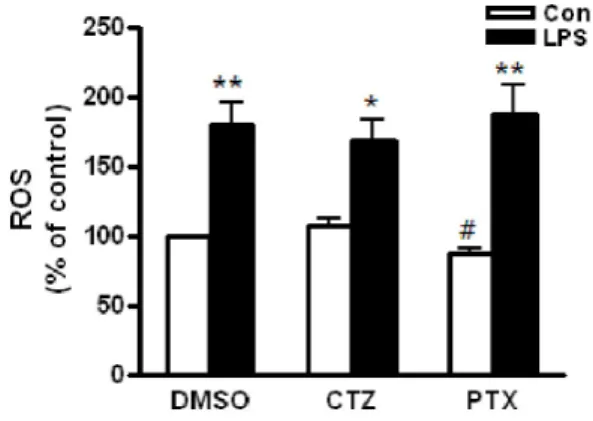
Fig. 3. The effects of cilostazol and pentoxifylline on LPS-induced ROS production in RAW264.7 cells exposed to ethanol. Cells were treated with 25 mM ethanol in presence of cilostazol (100 μM), pentoxifylline (100 μM) or DMSO for 24 h. Then, cells were stimulated with 50 ng/ml LPS for 4 h. After incubation of cells with 50 μM carboxy-H2DCFDA for 40 min, the production of ROS was measured by flow cytometry. Data represented as percentage increases over the DMSO control and are expressed as mean±SEM of three independent experiments. *p<0.05, **p<0.01 vs. control.

#

p<0.05 vs. corresponding DMSO-treated cells (Con, control; CTZ, cilostazol; PTX, pentoxifylline).

production in RAW264.7 macrophage exposed to ethanol

We first examined the cytotoxic effects of cilostazol and pentoxifylline on RAW264.7 cells after ethanol exposure.

The treatment of cells with cilostazol (0∼100 μM) or pen- toxifylline (100 μM) for 24 h did not cause cytotoxicity at any concentration used regardless of the presence of ethanol. At 48 h, pentoxifylline reduced cell viability ∼8%

and ethanol did not have any effects on cell viability (Fig.

1). In the subsequent experiments, cells were treated with cilostazol or pentixifylline for 24 h.

Next, the effect of cilostazol on LPS-stimulated TNFα expression in the presence of 25 mM ethanol was deter- mined. LPS increased about 260 fold (∼29 ng/mg protein) of TNFα production in culture media, which was sig- nificantly reduced to 56%, 65% and 76% by pretreatment with 100 μM cilostazol, 50 μM cilostazol and 100 μM pen- toxifylline, respectively, compared to DMSO, a vehicle con- trol (Fig. 2A). The level of TNFα mRNA was also sub- stantially reduced by cilostazol and pentoxifylline, showing similar results to that of ELISA (Fig. 2B). These results indicate that cilostazol reduces LPS-stimulated TNFα pro- duction in RAW 264.7 cells exposed to ethanol in dose-de- pendent manner and the degree of its inhibition is com- parable to that by pentoxifylline.

The role of ROS, cAMP and AMPK in the inhibition of TNFα production by cilostazol

Since ROS has been shown to be an important contributor to LPS-stimulated TNFα production in macrophage [7,27], the effect of cilostazol on ROS production in RAW264.7 macrophage was examined to elucidate the underlying

or pentoxylline. This result indicates that suppression of ROS production is not involved in the action of cilostazol or pentoxifylline. Next, the role of cAMP in the action of cilostazol was examined. As shown in Fig. 4A, pretreatment with db-cAMP, a cell-permeable cAMP analog significantly reduced LPS-stimulated TNFα production by 39%. Howev- er, the intracellular cAMP was not changed by cilostazol or pentoxifylline (Fig. 4B), indicating that the inhibition of TNFα by cilostazol occurs via cAMP-independent pathway.

Recent studies have shown the regulation of TNFα ex- pression by AMP-activated protein kinase (AMPK) [28,29].

We therefore examined whether the inhibition of LPS- stimulated TNFα production by cilostazol in macrophage exposed to ethanol was attributable to activation of AMPK.

The cells were treated with LPS (50 ng/ml) for different time (0∼4 h) and the activation of AMPK was measured by Western blotting. The treatment with LPS decreased AMPK activation about 60% at 30 min (Fig. 4C). In con- trast, cilostazol treatment (0∼4 h) increased AMPK activa- tion about 2 fold within 5 min and then gradually returned to basal. A pharmacological activator of AMPK, AICAR in- creased AMPK activation about 30%. The pretreatment with cilostazol increased basal AMPK activity about 2- fold and normalized the level of AMPK activation in LPS-stimu- lated RAW264.7 cells, whereas pentoxifyllin did not affect the activation of AMPK (Fig. 4D). Consistent with this re- sult, AICAR reduced LPS-stimulated TNFα production in RAW264.7 cells exposed to ethanol (Fig. 4A). These results indicate that AMPK but not cAMP is involved in the in- hibition of TNFα production by cilostazol in RAW264.7 cells.

The inhibition of TNFα expression by cilostazol in binge drinking mice

The effects of cilostazol on TNFα production by ethanol was examined in in vivo animal model. Acute ethanol ex- posure to mice by gavage at a single dose 6 g/kg body weight has shown to significantly increase TNFα production with maximum increase at 6 h after ethanol administration [30,31]. The same protocol was followed in the present study for development of binge drinking model. The levels of TNFα mRNA and protein in liver after ethanol admin- istration were determined by real-time PCR and ELISA, respectively. Unexpectedly, the level of TNFα mRNA was decreased at 6 h after ethanol treatment by 25~30%. The pretreatment with cilostazol (50 and 100 mg/kg) and pen- toxifylline (50 and 100 mg/kg) further reduced the TNFα mRNA, although cilostazol itself did not change the level of TNFα expression (Fig. 5A). The ELISA assay also shows similar results (Fig. 5B). These results indicate that cil- ostazol decreases the expression of TNFα mRNA and pro- tein in liver after ethanol exposure in vivo with similar ex- tent to pentoxifylline, although ethanol treatment reduced the level of TNFα in this model.

DISCUSSION

The results from this study have shown that cilostazol

significantly suppressed LPS-stimulated TNFα production

in RAW 264.7 murine macrophage exposed to ethanol and

(5)

Fig. 4. The role of cAMP and AMPK in the effects of cilostazol on inhibition of TNFα production in RAW264.7 cells. (A) Cells were treated with 25 mM ethanol in presence of cilostazol (100 μM), db-cAMP (100 μM), AICAR (1 mM) or DMSO for 24 h and then, stimulated with 50 ng/ml LPS for 4 h. The level of TNFα production from cell culture media was measured by ELISA and normalized by the amount of protein of each sample. Data are represented as percentage of TNFα production over LPS-stimulated cells in vehicle control (DMSO) group and are expressed as mean±SEM of three independent experiments. (B) Cells were treated with cilostazol, pentoxifylline and db-cAMP for 15 min, and then intracellular cAMP was measured. The concentrations of cAMP (pmol/ml) are represented as fold increase over the control and are expressed as mean±SEM of three independent experiments. (C) Cells were treated with 50 ng/ml LPS or 100 μM cilostazol for different time (0∼4 h) and 1 mM AICAR for 1 h, or (D) cells were treated with 50 ng/ml LPS in the presence or absence of cilostazol (100 μM) or pentoxifylline (100 μM) for 30 min. Whole cell extracts were prepared and the activation of AMPK was detected by Western blotting. The blots are representative of three independent experiments. *p<0.05, **p<0.01 vs. DMSO control group (CTZ, cilostazol; PTX, pentoxifylline).

in liver from binge drinking mice.

Numerous clinical and experimental studies have shown that the increased level of hepatic TNFα and monocyte TNFα production in alcoholic hepatitis are positively corre- lated with disease severity [2,32]. Chronic ethanol exposure enhances LPS-stimulated TNF production in RAW264.7 cells as well as Kupffer cells [21,22]. In accordance with this observation, inhibition of TNFα by TNFα antibody reduced liver injury in alcohol fed rats [3]. Recent clinical reports have provided beneficial effects of pentoxifylline, a TNFα suppressor for treatment of alcoholic hepatitis and

have suggested this treatment as an alternative to gluco-

corticoids [13]. At this time, however, its efficacy on surviv-

al benefit is controversial [14,33]. It is necessary to conduct

more studies on the effects of pentoxifylline while the devel-

opment of new pharmacological therapy for alcoholic hep-

atitis is needed. Our results show that cilostazol sig-

nificantly suppresses LPS-stimulated TNFα production in

ethanol-primed RAW264.7 as well as binge drinking mice

and the extent of inhibition by cilostazol is comparable to

that of pentoxifylline. The overproduction of TNFα by

ethanol has been shown to be associated with increased

(6)

TNF mRNA expression [22,34]. In agreement with these results, the level of TNFα mRNA was increased by ethanol and LPS in RAW264.7 cells, which was decreased by cil- ostazol and pentoxifylline. These data suggest that both cil- ostazol and pentoxifylline suppress the production of TNFalpha at transcription level.

The underlying mechanisms by which ethanol increases TNFα expression in macrophage have been extensively studied. LPS increases ROS production in Kupffer cells and ethanol exposure further increase LPS-induced ROS pro- duction, which leads to increase of TNFα production [7].

We have also observed that LPS simulation increases ROS production in RAW264.7 cells exposed to ethanol. However, neither cilostazol nor pentoxifylline reduced LPS-stimu- lated ROS production. This indicates that the inhibition of TNFα production by cilostazol occurs via ROS-independent pathway. Although previous study has shown that cil- ostazol attenuates NADPH oxidase-derived ROS production in macrophage [35], intracellular ROS can be generated from various sources including NADPH oxidase and mi- tochondrial electron transport chain [36]. A lot of studies have shown that mitochondria plays a critical role in etha- nol-induced ROS production and liver injury [37,38]. Fur- thermore, Chandel et al. [27], have shown that antioxidants had no effect on LPS-induced TNFα expression in murine macrophage.

Enhanced intracellular cAMP has been well known to sup- press LPS-stimulated TNFα production in macrophage in vivo and in vitro [39,40]. Moreover, chronic ethanol ex- posure results in decrease of cAMP, which is one of mecha-

nisms responsible for increased TNFα production from Kupffer cells and macrophages [21,22]. Concomitant with these observations, previous studies have documented that various cAMP elevating agents including adenylyl cyclase activator and PDE inhibitors invariably suppress TNFα production in macrophages. Our data also shows that db-cAMP significantly reduced TNFα production in RAW264.7 cells, supporting previous reports by others. However, cilostazol and pentoxifylline did not increase intracellular cAMP lev- els in the present study, indicating that cilostazol inhibition of TNFα production in ethanol treated macrophage is cAMP-independent. Similarly, previous studies have also shown that cilostazol did not change intracellular cAMP in RAW264.7 macrophage [19,24].

The activation of AMPK has been shown to repress in- flammatory responses stimulated with LPS in vitro and in vivo [28,29]. Recent studies have shown that the anti-in- flammatory effects of cilostazol in vascular smooth muscle cells and endothelial cells occur by activation of AMPK pathway which is independent of cAMP [28,29]. Our data support this findings demonstrating that AICAR, an activa- tor of AMPK suppressed ethanol-mediated TNFα produc- tion and cilostazol enhanced LPS decreased AMPK activa- tion in RAW264.7 cells exposed to ethanol. These results suggest that cilostazol exerts the inhibitory effects on TNFα production in ethanol-primed RAW264.7 cells through acti- vation of AMPK.

Various alcohol binge animal models have been employed

to study alcoholic hepatitis [41,42]. In preliminary experi-

ments, we observed significant increase in serum ALT/AST,

Fig. 5. The effects of cilostazol and pentoxifylline on TNFα expres-

sion in liver from binge drinking mice. Mice were treated with

cilostazol (50 and 100 mg/kg) or pentoxifyline (50 and 100 mg/kg)

for 4 days by intraperitoneal injection and control mice were

treated with vehicle (0.5% carboxyl methylcellulose). Then, mice

were intragastrically administered with 6 g/kg ethanol and sa-

crificed 6 h after ethanol administration. Liver was collected to

measure TNFα mRNA (A) and protein (B) by real-time PCR and

ELISA, respectively. Data are represented as mean±SEM (n=5∼6

mice). *p<0.05 vs. control group (CTZ, cilostazol; PTX, pentoxi-

fylline; EtOH, ethanol).

(7)

makers of liver injury and hepatic TNFα mRNA expression 6 h after gavage of a single dose of 6 g/kg or three doses of 5 g/kg ethanol, similar results to previous reports by oth- ers [31,42]. In subsequent repeated experiments, however, we obtained the opposite results that TNFα expression was rather decreased in mice gavaged with 6 g/kg ethanol compared with that in control mice. Recent study has shown similar finding that the administration of either a single dose or three dose of ethanol (5 g/kg) to rats sup- pressed TNFα expression in liver collected 4 h after etha- nol gavage [41]. Several previous studies have demon- strated that binge ethanol causes dual effects, pro- and an- ti-inflammatory responses; mostly anti-inflammatory ef- fects at early after ethanol treatment (0∼6 hr) and pro-in- flammatory effects later after ethanol treatment (after 24 hr) [43,44]. In addition, the differential effects of binge alco- hol drinking on hepatic TNFα production in animal model may be due to different animal species and different animal batches used in experiments. Although we failed to present the increase of hepatic TNFα expression by ethanol binge itself, our data clearly show that cilostazol does decrease the expression of TNFα in liver exposed to ethanol in vivo and the degree of inhibition by cilostazol is similar to that by pentoxifylline. However, additional studies to examine the effect of cilostazol on the TNFα production in ethanol- fed animal model are needed to make concrete conclusion.

Taken together, these data demonstrate that cilostazol suppresses ethanol-mediated TNFα expression in RAW264.7 macrophage and in liver from binge drinking mice and the effects of cilostazol involves AMPK activation. Furthermore, the effects of cilostazol are comparable to that of pentoxi- fylline.

ACKNOWLEDGEMENTS

This research was supported by Basic Science Research Program through the National Research Foundation of Korea (NRF) funded by the Ministry of Education, Science and Technology (No. 2009-0069506).

REFERENCES

1. Thurman RG. II. Alcoholic liver injury involves activation of Kupffer cells by endotoxin. Am J Physiol. 1998;275:G605-611.

2. Vidali M, Stewart SF, Albano E. Interplay between oxidative stress and immunity in the progression of alcohol-mediated liver injury. Trends Mol Med. 2008;14:63-71.

3. Iimuro Y, Gallucci RM, Luster MI, Kono H, Thurman RG.

Antibodies to tumor necrosis factor alfa attenuate hepatic necrosis and inflammation caused by chronic exposure to ethanol in the rat. Hepatology. 1997;26:1530-1537.

4. Yin M, Wheeler MD, Kono H, Bradford BU, Gallucci RM, Luster MI, Thurman RG. Essential role of tumor necrosis factor alpha in alcohol-induced liver injury in mice. Gastro- enterology. 1999;117:942-952.

5. Adachi Y, Bradford BU, Gao W, Bojes HK, Thurman RG.

Inactivation of Kupffer cells prevents early alcohol-induced liver injury. Hepatology. 1994;20:453-460.

6. Tannenbaum CS, Hamilton TA. Lipopolysaccharide-induced gene expression in murine peritoneal macrophages is selec- tively suppressed by agents that elevate intracellular cAMP.

J Immunol. 1989;142:1274-1280.

7. Thakur V, Pritchard MT, McMullen MR, Wang Q, Nagy LE.

Chronic ethanol feeding increases activation of NADPH oxidase by lipopolysaccharide in rat Kupffer cells: role of increased

reactive oxygen in LPS-stimulated ERK1/2 activation and TNF-alpha production. J Leukoc Biol. 2006;79:1348-1356.

8. Fischer W, Schudt C, Wendel A. Protection by phospho- diesterase inhibitors against endotoxin-induced liver injury in galactosamine-sensitized mice. Biochem Pharmacol. 1993;45:

2399-2404.

9. Beavo JA, Brunton LL. Cyclic nucleotide research-still expanding after half a century. Nat Rev Mol Cell Biol. 2002;

3:710-718.

10. Smith KR, Leonard D, McDonald JD, Tesfaigzi Y. Inflam- mation, mucous cell metaplasia, and Bcl-2 expression in response to inhaled lipopolysaccharide aerosol and effect of rolipram. Toxicol Appl Pharmacol. 2011;253:253-260.

11. Michel O, Dentener M, Cataldo D, Cantinieaux B, Vertongen F, Delvaux C, Murdoch RD. Evaluation of oral corticosteroids and phosphodiesterase-4 inhibitor on the acute inflammation induced by inhaled lipopolysaccharide in human. Pulm Pharmacol Ther. 2007;20:676-683.

12. Yoshikawa M, Suzumura A, Tamaru T, Takayanagi T, Sawada M. Effects of phosphodiesterase inhibitors on cytokine production by microglia. Mult Scler. 1999;5:126-133.

13. Akriviadis E, Botla R, Briggs W, Han S, Reynolds T, Shakil O. Pentoxifylline improves short-term survival in severe acute alcoholic hepatitis: a double-blind, placebo-controlled trial.

Gastroenterology. 2000;119:1637-1648.

14. Louvet A, Diaz E, Dharancy S, Coevoet H, Texier F, Thévenot T, Deltenre P, Canva V, Plane C, Mathurin P. Early switch to pentoxifylline in patients with severe alcoholic hepatitis is inefficient in non-responders to corticosteroids. J Hepatol.

2008;48:465-470.

15. Kambayashi J, Liu Y, Sun B, Shakur Y, Yoshitake M, Czerwiec F. Cilostazol as a unique antithrombotic agent. Curr Pharm Des. 2003;9:2289-2302.

16. Liu Y, Shakur Y, Kambayashi J. Phosphodiesterases as targets for intermittent claudication. Handb Exp Pharmacol. 2011;

204:211-236.

17. Lee JH, Oh GT, Park SY, Choi JH, Park JG, Kim CD, Lee WS, Rhim BY, Shin YW, Hong KW. Cilostazol reduces atherosclerosis by inhibition of superoxide and tumor necrosis factor-alpha formation in low-density lipoprotein receptor-null mice fed high cholesterol. J Pharmacol Exp Ther. 2005;313:

502-509.

18. Kim MJ, Lee JH, Park SY, Hong KW, Kim CD, Kim KY, Lee WS. Protection from apoptotic cell death by cilostazol, phosphodiesterase type III inhibitor, via cAMP-dependent protein kinase activation. Pharmacol Res. 2006;54:261-267.

19. Park WS, Jung WK, Lee DY, Moon C, Yea SS, Park SG, Seo SK, Park C, Choi YH, Kim GY, Choi JS, Choi IW. Cilostazol protects mice against endotoxin shock and attenuates LPS-induced cytokine expression in RAW 264.7 macrophages via MAPK inhibition and NF-kappaB inactivation: not involved in cAMP mechanisms. Int Immunopharmacol. 2010;10:1077- 1085.

20. Fujita K, Nozaki Y, Wada K, Yoneda M, Endo H, Takahashi H, Iwasaki T, Inamori M, Abe Y, Kobayashi N, Kirikoshi H, Kubota K, Saito S, Nagashima Y, Nakajima A. Effectiveness of antiplatelet drugs against experimental non-alcoholic fatty liver disease. Gut. 2008;57:1583-1591.

21. Shi L, Kishore R, McMullen MR, Nagy LE. Chronic ethanol increases lipopolysaccharide-stimulated Egr-1 expression in RAW 264.7 macrophages: contribution to enhanced tumor necrosis factor alpha production. J Biol Chem. 2002;277:

14777-14785.

22. Gobejishvili L, Barve S, Joshi-Barve S, Uriarte S, Song Z, McClain C. Chronic ethanol-mediated decrease in cAMP primes macrophages to enhanced LPS-inducible NF-kappaB activity and TNF expression: relevance to alcoholic liver disease. Am J Physiol Gastrointest Liver Physiol. 2006;291:G681-688.

23. Carson EJ, Pruett SB. Development and characterization of a binge drinking model in mice for evaluation of the immu- nological effects of ethanol. Alcohol Clin Exp Res. 1996;20:

132-138.

(8)

Atherosclerosis. 2010;213:135-141.

25. Robin MA, Demeilliers C, Sutton A, Paradis V, Maisonneuve C, Dubois S, Poirel O, Lettéron P, Pessayre D, Fromenty B.

Alcohol increases tumor necrosis factor alpha and decreases nuclear factor-kappab to activate hepatic apoptosis in gene- tically obese mice. Hepatology. 2005;42:1280-1290.

26. Kudo H, Takahara T, Yata Y, Kawai K, Zhang W, Sugiyama T. Lipopolysaccharide triggered TNF-alpha-induced hepatocyte apoptosis in a murine non-alcoholic steatohepatitis model. J Hepatol. 2009;51:168-175.

27. Chandel NS, Trzyna WC, McClintock DS, Schumacker PT. Role of oxidants in NF-kappa B activation and TNF-alpha gene transcription induced by hypoxia and endotoxin. J Immunol.

2000;165:1013-1021.

28. Aoki C, Hattori Y, Tomizawa A, Jojima T, Kasai K.

Anti-inflammatory role of cilostazol in vascular smooth muscle cells in vitro and in vivo. J Atheroscler Thromb. 2010;17:

503-509.

29. Hattori Y, Suzuki K, Tomizawa A, Hirama N, Okayasu T, Hattori S, Satoh H, Akimoto K, Kasai K. Cilostazol inhibits cytokine-induced nuclear factor-kappaB activation via AMP- activated protein kinase activation in vascular endothelial cells.

Cardiovasc Res. 2009;81:133-139.

30. Lambert JC, Zhou Z, Wang L, Song Z, McClain CJ, Kang YJ.

Preservation of intestinal structural integrity by zinc is independent of metallothionein in alcohol-intoxicated mice. Am J Pathol. 2004;164:1959-1966.

31. Zhou Z, Wang L, Song Z, Lambert JC, McClain CJ, Kang YJ.

A critical involvement of oxidative stress in acute alcohol- induced hepatic TNF-alpha production. Am J Pathol. 2003;163:

1137-1146.

32. Sougioultzis S, Dalakas E, Hayes PC, Plevris JN. Alcoholic hepatitis: from pathogenesis to treatment. Curr Med Res Opin.

2005;21:1337-1346.

33. Mathurin P. Corticosteroids for alcoholic hepatitis--what's next? J Hepatol. 2005;43:526-533.

35. Yun MR, Park HM, Seo KW, Kim CE, Yoon JW, Kim CD.

Cilostazol attenuates 4-hydroxynonenal-enhanced CD36 ex- pression on murine macrophages via inhibition of NADPH oxidase-derived reactive oxygen species production. Korean J Physiol Pharmacol. 2009;13:99-106.

36. Li Y, Trush MA. Diphenyleneiodonium, an NAD(P)H oxidase inhibitor, also potently inhibits mitochondrial reactive oxygen species production. Biochem Biophys Res Commun. 1998;253:

295-299.

37. Hoek JB, Pastorino JG. Ethanol, oxidative stress, and cytokine-induced liver cell injury. Alcohol. 2002;27:63-68.

38. Chacko BK, Srivastava A, Johnson MS, Benavides GA, Chang MJ, Ye Y, Jhala N, Murphy MP, Kalyanaraman B, Darley-Usmar VM. Mitochondria-targeted ubiquinone (MitoQ) decreases ethanol-dependent micro and macro hepatosteatosis.

Hepatology. 2011;54:153-163.

39. Zidek Z. Adenosine - cyclic AMP pathways and cytokine expression. Eur Cytokine Netw. 1999;10:319-328.

40. Haraguchi S, Good RA, Day-Good NK. A potent immuno- suppressive retroviral peptide: cytokine patterns and signaling pathways. Immunol Res. 2008;41:46-55.

41. Aroor AR, Jackson DE, Shukla SD. Elevated activation of ERK1 and ERK2 accompany enhanced liver injury following alcohol binge in chronically ethanol-fed rats. Alcohol Clin Exp Res. 2011;35:2128-2138.

42. Song Z, Deaciuc I, Song M, Lee DY, Liu Y, Ji X, McClain C.

Silymarin protects against acute ethanol-induced hepatoto- xicity in mice. Alcohol Clin Exp Res. 2006;30:407-413.

43. Yamashina S, Wheeler MD, Rusyn I, Ikejima K, Sato N, Thurman RG. Tolerance and sensitization to endotoxin in Kupffer cells caused by acute ethanol involve interleukin-1 receptor-associated kinase. Biochem Biophys Res Commun.

2000;277:686-690.

44. Nishiyama D, Ikejima K, Honda H, Hirose M, Takei Y, Sato

N. Acute ethanol administration down-regulates toll-like

receptor-4 in the murine liver. Hepatol Res. 2002;23:130-137.

수치

Fig. 1. The effects of cilostazol and  pentoxifylline on viability of RAW264.7 cells. Cells were pretreated with  cilo-stazol (0∼100  μM) or pentoxifylline  (100 μM) for 1 h followed by  treat-ment with 25 mM ethanol or vehicle  control (culture media) for
Fig. 3. The effects of cilostazol and pentoxifylline on LPS-induced  ROS production in RAW264.7 cells exposed to ethanol
Fig. 4. The role of cAMP and AMPK in the effects of cilostazol on inhibition of TNFα production in RAW264.7 cells

참조

관련 문서

In this study, sequential solvent fractions of hot water extract and 70% ethanol extract were prepared from domestic (Imsil region) and foreign (Chile

20) Marc Hermeking, “Culture and Internet Consumption: Contributions from Cross-Cultural Marketing and Advertising Research”, in Journal of

These results demonstrated that a positive role of Slug and Twist in tumor invasion in CRA, and inverse correlation between Twist and Slug expression

• Theory can extent to molten polymers and concentrated solutions.. The single-molecule bead spring models.. a)

mandibular P-18 inncisor from Nfic-deficient mice (×3,000)... In this study, histological and immunohistochemical studies were carried out to investigate

포에서 We s t e r nbl ot 을 통해 HJ ME가 i NOS의 단백질 발현을 농도의존적으로 저해 하는 것을 확인하였다( Fi g.6) .그러므로 환삼덩굴은 i NOS의 발현을

The vapors of light alcohols are distilled in second column to ethanol and mixture of

The greater tubercle is palpable on the line from the lateral epicondyle of the distal humerus in the direction of the humeral longitudianl axis and just below the acromion