Korean J Radiol 9(2), April 2008 175
Reversible Lansoprazole-Induced Interstitial Lung Disease Showing Improvement after Drug Cessation
Lansoprazole is an acid proton-pump inhibiting drug that is used for the treat- ment of duodenal or gastric ulcers, H. pylori infection, gastroesophageal reflux disease or Zollinger-Ellison syndrome. Although lansoprazole is well known for its gastrointestinal and dermatologic adverse effects, mild pulmonary symptoms are also known to develop from taking this drug. There have been no reports about lansoprazole-induced interstitial lung disease. We report here a case of lansopra- zole-induced interstitial lung disease that developed in a 66-year-old man.
ansoprazole is an acid proton-pump inhibitor that is similar to omepra- zole. It is used to treat duodenal or gastric ulcers, H. pylori infection, gastroesophageal reflux disease (GERD) or Zollinger-Ellison syndrome.
Common adverse effects of lansoprazole are diarrhea, abdominal pain, skin rash and/or itching. Information from U.S. National Library of Medicine warns that this drug can on rare occasion cause cough or cold-like symptoms. The pathophysiological mechanisms of lansoprazole-related pulmonary symptoms are not yet understood. In particular, there are no known reports regarding lansoprazole-induced interstitial lung diseases. We report here a case of interstitial lung disease (ILD) induced by oral administration of lansoprazole, which showed a pattern of nonspecific interstitial pneumonia (NSIP) as detected from a video-assisted thoracoscopic lung biopsy. We believe that this is the first report of a case of pathologically proven lansoprazole- induced ILD for which a surgical lung biopsy was performed.
CASE REPORT
The patient was a 66-year-old man without a smoking history. The patient had been previously healthy until he was diagnosed with GERD a month prior, and began treatment with lansoprazole. He had a history of working at a dusty place several weeks before hospitalization, where he did not experience any respiratory symptoms.
However, a few days after initiation of lansoprazole treatment, cough and dyspnea developed along with a febrile sense. After suffering from a progressively aggravating cough and dyspnea for a month, the patient visited our hospital.
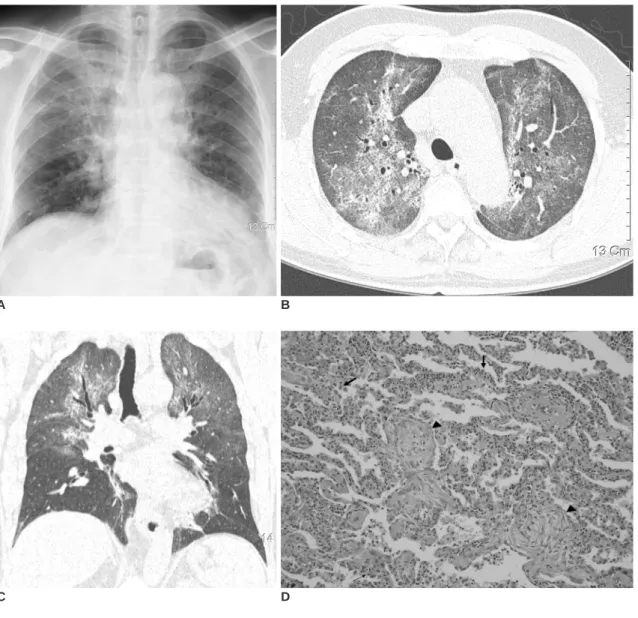
Vital signs of the patient were stable and the laboratory studies including eosinophil count were all in the normal ranges. An initial chest radiograph showed diffuse ground-glass opacities in both lungs with upper lobe predominance, and we diagnosed differentiated diffuse interstitial lung disease or interstitial pneumonia, such as Pneumocystis carinii pneumoniae pneumonia (Fig. 1A). High-resolution computed tomographic scans (HRCT) showed focal areas of diffuse ground-glass opacity in both Kyu-won Hwang, MD1
Ok Hee Woo, MD1 Hwan Seok Yong, MD1 Bong Kyung Shin, MD2 Jae Jeong Shim, MD3 Eun-Young Kang, MD1
Index terms : Lansoprazole
Interstitial lung disease Computed tomography (CT) DOI:10.3348/kjr.2008.9.2.175
Korean J Radiol 2008 ; 9 : 175-178 Received January 10, 2006; accepted after revision March 22, 2007.
Departments of 1Radiology, 2Pathology and 3Internal Medicine, College of Medicine, Korea University, Guro Hospital, Seoul 152-703, Korea
Address reprint requests to : Ok Hee Woo, MD, Department of Radiology, Korea University Guro Hospital, 97 Guro-dong, Guro-gu, Seoul 152-703, Korea.
Tel. (822) 818-6198 Fax. (822) 863-9282 e-mail: [email protected]
L
lungs with upper lung predominance, similar to those of the plain radiographs (Figs. 1B, C). The patient was hospitalized for further evaluation and treatment. A transbronchial lung biopsy was performed, and the
histopathological result was acute lung injury with marked type II pneumocyte hyperplasia, interstitial edema and interstitial infiltration of lymphocytes. After only one day of symptomatic treatment, both the clinical symptoms and Hwang et al.
176 Korean J Radiol 9(2), April 2008
A B
Fig. 1. Lansoprazole-induced interstitial lung disease.
A. Posteroanterior chest radiograph shows diffuse ground-glass opacities in both lungs, which are predominant in upper lung zones.
B, C. Axial (B) and coronal (C) reconstruction high-resolution CT images show areas of diffuse ground-glass opacity in both lungs with upper lung predominance, similar to those seen in chest radiograph (A).
D. Histopathological specimen shows mixed interstitial infiltration of lymphocytes and plasma cells, suggestive of nonspecific interstitial pneumonia pattern. Note active hyperplasia of type II pneumocytes (arrows) and Massons’ body (arrowheads).
E. Follow-up high resolution CT image shows markedly improved opacities in both lungs. Faint areas of ground-glass opacity still remain.
C D
E
chest radiographic findings rapidly improved. Considering his recent history of working at a dusty place, we thought that the clinical, radiologic, and histopathological findings represented hypersensitivity pneumonitis and we decided to start prednisolone therapy (30 mg/day). However, on the third day of prednisolone therapy, the patient complained of sudden aggravation of dyspnea. Blood gas analysis showed hypoxemia (SaO2 80% on room air), and the chest radiographic findings showed aggravation of diffuse bilateral infiltration. We performed a video-assisted thoracoscopic lung biopsy to decide on further treatment planning. The specimen showed a NSIP pattern with frequent Masson’s bodies, active type II pneumocyte hyperplasia and mixed interstitial inflammation without hyaline membrane formation (Fig. 1D). The next day following the operation, the respiratory symptoms and chest radiographic findings all improved spontaneously, which was difficult to explain.
It was difficult to explain the cause of the sudden aggravation of symptoms and the imaging findings during the hospitalization of the patient. Therefore, we carefully reexamined the clinical course of the patient during the hospitalization. It was noted that the patient stopped taking lansoprazole immediately after admission in preparation for the transbronchial lung biopsy, and he restarted taking the drug along with prednisolone after the biopsy. The patient again stopped taking lansoprazole prior to the thoracoscopic lung biopsy. Such a temporal relationship between the ingestion of lansoprazole and the worsening of symptoms led us to conclude that the
symptomatic, radiological, and histopathological findings in the patient actually represented a drug-induced interstitial disease. Therefore, we stopped giving lansoprazole to the patient and restarted prednisolone therapy. The clinical symptoms and the pulmonary opacities on the follow-up chest radiographs progressively improved. The follow-up HRCT scans performed two days after the restart of prednisolone therapy showed a marked improvement of the ground glass opacities in both lungs (Fig. 1E).
DISCUSSION
Drug induced interstitial lung disease (DI-ILD) shows various clinicoradiographical findings that range from non- symptomatic infiltration to severe acute respiratory distress syndrome (ARDS). For example, amiodarone or
methotrexate treatment may lead to nonspecific interstitial pneumonia (NSIP), treatment with bleomycin, nitrofuran- toin or sulfasalazine to acute organizing pneumonia (alternatively called bronchiolitis obliterans organizing pneumonia [BOOP]), and treatment with nonsteroidal
antiinflammatory drugs NSAIDs (nonsteroidal antinflam- matory drugs) or some antibiotics to acute eosinophilic pneumonia. These manifestations can lead to the clinicora- diographically gas-exchange pattern of ARDS (1, 4).
Drug induced interstitial lung disease may present several hours to several weeks after the introduction of the causative drug. The clinical findings of DI-ILD include very nonspecific symptoms such as a nonproductive cough, dyspnea and fever, or crackles upon auscultation. The laboratory results can show a range of findings from normal to eosinophilia and/or leukocytosis (2). The radiological findings of DI-ILD are also highly variable (3).
Although it is not pathognomic, the radiological findings are sometimes very suggestive for certain types of DI-ILD.
Invasive diagnostic examinations (bronchoalveolar lavage, transbronchial or thoracoscopic biopsy) are sometimes needed to rule out other lung diseases, especially when the medication history does not clearly meet the criteria of drug-induced lung diseases (1). Among many types of DI- ILD, NSIP is the second most common form of a
histopathological pattern, after usual interstitial pneumo- nia. Clinically, NSIP usually starts as insidious dyspnea and dry cough. Diffuse, heterogeneous ground-glass opacities in both lungs, predominantly in the lower lobes are a typical finding on chest radiography. An HRCT scan shows focal or diffuse areas of ground-glass opacities with intersti- tial fibrosis (4). In our case, despite the histopathological findings consistent with NSIP, it was difficult to diagnose our patient as having drug-induced NSIP, due to the clinical and radiological differences when compared to typical cases of the disease.
In fact, although a large number of drugs are known to cause pulmonary complications, it is difficult to diagnosis drug-induced lung disease (5). There are several reasons that make such a diagnosis difficult. First, the clinical and radiological findings are nonspecific and they can mimic other pulmonary diseases (6). Many new drugs are being developed and their adverse effects are have not been fully characterized. Sometimes, both patients and clinicians do not consider the adverse effects of a drug as a cause of pulmonary symptoms. In some cases, there is no clear temporal relationship between the initiation of a drug and the onset of symptoms.
To the best of our knowledge, this is the first description of DI-ILD caused by lansoprazole. The diagnosis was made by considering the radiological, histopathological and clinical findings, including the close temporal relationship between lansoprazole exposure and symptom severity.
Other possible causes were excluded due to a lack of a temporal relationship between the symptoms and work history or prednisolone therapy, and no other history of Reversible Lansoprazole-Induced Interstitial Lung Disease
Korean J Radiol 9(2), April 2008 177
Hwang et al.
178 Korean J Radiol 9(2), April 2008
specific allergen exposure.
When there is diffuse interstitial lung disease with an unknown etiology, it is important to remember that drugs can be the cause of pulmonary symptoms and it is crucial to take a careful patient history. If there is a recent history of taking lansoprazole in a patient with clinical and radiological findings of diffuse interstitial lung disease, we recommend stopping the medication to see if there is clinical and radiological improvement. That way, one can avoid using invasive procedures to diagnose a lansopra- zole-induced interstitial lung disease.
References
1. Pietra GG. Pathologic mechanism of drug-induced lung disorders. J Thoracic Imaging 1991;61:1-7
2. Kohno S, Yamaguchi K, Yasuoka A, Koga H, Hayashi T, Komori K, et al. Clinical evaluation of 12 cases of antimicrobial drug-induced pneumonitis. Jpn J Med 1990;29:248-254 3. Akira M, Ishikawa H, Yamamoto S. Drug-induced pneumonitis:
thin-section CT findings in 60 patients. Radiology 2002;224:852-860
4. Rossi SE, Erasmus JJ, McAdams HP, Sporn TA, Goodman PC.
Pulmonary drug toxicity: radiologic and pathologic manifesta- tion. Radiographics 2000;20:1245-1259
5. Cleverley JR, Screaton NJ, Hiorns MP, Flint JD, Muller NL.
Drug-induced lung disease: high-resolution CT and histologic findings. Clin Radiol 2002;57:292-299
6. Fraser RS, Muller NL, Colman N, Pare PD. Fraser & Pare:
Diagnosis of disease of the chest, 4th ed. Philadelphia:
Saunders, 1999:2537-2540