Comparison of Two Different Doses of Single Bolus Steroid Injection to Prevent Atrial Fibrillation Recurrence
after Radiofrequency Catheter Ablation
Da-Rae Kim,
1Hoyoun Won,
1Jae-Sun Uhm,
1Jong-Youn Kim,
1Jung-Hoon Sung,
2Hui-Nam Pak,
1Moon-Hyoung Lee,
1and Boyoung Joung
11Division of Cardiology, Department of Internal Medicine, Yonsei University College of Medicine, Seoul;
2Division of Cardiology, Department of Internal Medicine, Bundang CHA Medical Center, CHA University, Seongnam, Korea.
Received: February 13, 2014 Revised: May 20, 2014 Accepted: May 27, 2014
Corresponding author: Dr. Boyoung Joung, Division of Cardiology,
Department of Internal Medicine, Yonsei University College of Medicine, 50-1 Yonsei-ro, Seodaemun-gu, Seoul 120-752, Korea.
Tel: 82-2-2228-8460, Fax: 82-2-393-2041 E-mail: [email protected]
∙ The authors have no financial conflicts of interest.
© Copyright:
Yonsei University College of Medicine 2015 This is an Open Access article distributed under the terms of the Creative Commons Attribution Non- Commercial License (http://creativecommons.org/
licenses/by-nc/3.0) which permits unrestricted non- commercial use, distribution, and reproduction in any medium, provided the original work is properly cited.
Purpose: Steroids may play a role in preventing the early recurrence of atrial fibril- lation (AF) after radiofrequency catheter ablation (RFCA). However, optimal doses and route of steroid delivery have not yet been determined. This study evaluated the effect of two different doses of a single bolus injection of steroids on AF recurrence after RFCA. Materials and Methods: Of 448 consecutive AF patients who under- went RFCA, a single steroid bolus was injected into 291 patients. A low-dose ste- roid group (n=113) received 100 mg of hydrocortisone and a moderate-dose steroid group (n=174) received 125 mg of methylprednisolone. We used propensity-score matching to select patients as follows: control (n=95), low-dose (n=95), and moder- ate-dose steroid groups (n=97). Results: Pericarditis developed in 1 (1.1%) control patient, 2 (2.1%) low-dose patients and 0 moderate-dose patients. Maximum body temperature and C-reactive protein were significantly decreased in the moderate- dose steroid group compared to the other groups (p<0.01). The number of patients of early AF recurrence (≤3 months) did not differ among three groups. Early recur- rence was 24 (25%) in the control, 24 (25%) in the low-dose and 25 (26%) in the medium-dose groups (p=0.99). Compared with control group, low-dose or moder- ate-dose steroid treatment did not effectively decrease mid-term (3‒12 months) AF recurrence [22 (23%) vs. 23 (24%) vs. 18 (19%); p=0.12]. Conclusion: A single in- jection of moderate-dose steroid decreased inflammation. However, single bolus in- jections of low-dose or moderate-dose steroids were not effective in preventing im- mediate, early or midterm AF recurrence after RFCA.
Key Words: Atrial fibrillation, ablation, steroid
INTRODUCTION
The incidence of atrial fibrillation (AF) is increasing. AF is associated with a consid- erable number of comorbidities including a 3-fold increase in the risk of heart failure and a 5-fold increase in the risk of stroke.1-3 Radiofrequency catheter ablation (RFCA) is an effective treatment for drug-refractory AF with 33‒86% of patients
ty Hospital (Seoul, Korea) from July 2007 through Decem- ber 2012. All patients were newly enrolled in this study and none had a history of ablation. As a control group, 161 AF patients who underwent radiofrequency ablation for AF during the same period were analyzed. Patients who had previously undergone RFCA were excluded. All patients had symptomatic, paroxysmal or persistent AF. The deci- sion to treat patients with low-dose or moderate-dose ste- roids was made by operating physicians. One physician (Dr. Joung) used a strategy of treatment with corticosteroids after catheter ablation and the other physicians (Dr. Lee and Dr. Pak) did not use this strategy. Patients were randomly assigned to operating physicians without this information.
All operating physicians used the same ablation protocol.
In this triple cohort study, the corticosteroid group had two subgroups based on corticosteroid potency. The low- dose steroid group (n=113) received 100 mg hydrocortisone sodium succinate (Solu-Cotef, Pfizer Manufacturing, Puurs, Belgium) in 5 mL of 0.9% sodium chloride. The moderate- dose steroid group (n=174) received a bolus injection of methyl prednisolone 125 mg (Solu-Medrol, Pfizer Manu- facturing, Puurs, Belgium) in 5 mL of 0.9% sodium chlo- ride (625 mg as in hydrocortisone equivalence). Steroid solu- tions were administered intravenously within 30 minutes after RFCA. Patients in the control group (n=161) were treat- ed conservatively without steroids after ablation. From the cohort, we selected age- and gender-matched cohorts by propensity scores. The final cohorts were control (n=95, 80 men), low-dose (n=95, 80 men), and moderate-dose steroid group (n=97, 82 men) (Fig. 1).
Paroxysmal AF was defined as an AF episode that spon- taneously terminated and lasted for more than 30 s, but less than 7 days. Persistent AF was defined as an AF episode that either lasted longer than 7 days or required termination by cardioversion, either with anti-arrhythmic drugs (AADs) or by direct current cardioversion. All AADs were discon- tinued at 5 half-lives before the ablation procedure. Other drugs were administered throughout the study period. The study protocol was approved by the Institutional Review Board of Severance Cardiovascular Hospital, Seoul, Korea and complied with the Declaration of Helsinki.
Catheter ablation
Three-dimensional geometry of the left atrial (LA) was re- constructed with a CARTO (Biosense Webster, Inc., Dia- mond Bar, CA, USA) or NavXTM (St. Jude Medical, Inc., St.
Paul, MN, USA) electroanatomic mapping system. Before achieving favorable outcomes.4-6 However, studies on long-
term outcomes after RFCA commonly report recurrence of AF, especially within the first few weeks after RFCA.7 For early recurrences, inflammation during RFCA is suggested to be a major precipitating factor. The role of inflammation in initiating and perpetuating AF is under investigation since in- flammation is suggested to be an important cause of the high incidence of post-operative AF in cardiac surgeries.8,9 A few studies reported independent relationships between inflam- matory markers and AF incidence. These studies propose that acute inflammation transiently induces electrical and structural remodeling of the left atrium.10 According to stud- ies that investigated early AF recurrence after RFCA, inflam- mation might cause early recurrence, as reflected in elevated inflammatory markers and body temperatures.11,12
To prevent early AF recurrence after RFCA, corticosteroid injection is used to reduce post-procedure inflammation. Cor- ticosteroids are potent inhibitors of the pro inflammatory cas- cade. Corticosteroids reduce inflammatory markers such as interleukin (IL)-6, IL-8, tumor necrosis factor α, C-reactive protein (CRP), and oxygen-free radicals after cardiac sur- gery.13-16 A randomized controlled trial by Koyama, et al.12 showed that a small amount of corticosteroid administered after RFCA seems to prevent immediate AF recurrence.
However, the use of corticosteroids for secondary preven- tion of AF has not yet been confirmed and has not been thor- oughly studied in a large population. In addition, an appro- priate corticosteroid dosage has not been determined. Side effects of corticosteroids such as infections, hyperglycemia, gastrointestinal bleeding, adrenal suppression, hallucination, and depression have been acknowledged, and physicians re- alize that the benefits of steroids must outweigh their poten- tially dangerous side effects. Moreover, high-dose steroids are reported to cause ventricular arrhythmia and even pro- mote AF.13 Thus, studies investigating adequate minimal dose for steroids and appropriate method of steroid adminis- tration that will prevent early AF recurrence after RFCA are warranted. This study evaluated the effect of a single bolus intravenous injection of low-dose or moderate-dose cortico- steroids on preventing AF recurrence after RFCA.
MATERIALS AND METHODS
Patients
This study enrolled 448 patients with drug-resistant AF who underwent RFCA. Patients were treated at Yonsei Universi-
catheter ablation.
After discharge, all patients underwent follow-up at 1 week and 1 month post-procedure and every three months thereafter. At each hospital visit, patients underwent 12-lead electrocardiography and intensive questioning regarding ar- rhythmia-related symptoms (palpitation, chest discomfort and dizziness) since the previous follow-up visit. Holter monitoring for 24 hour was performed at 1 and 3, 6, 12, 18, and 24 months after RFCA. Portable event electrocardio- graphic monitoring (EV-101, Parama-Tech, Fukuoka, Ja- pan) was performed to evaluate arrhythmic assessment in patients with intermittent symptoms.
We defined early recurrence as any episode of AF or atri- al tachycardia (AT) of at least 30 seconds that occurred within 3 months after AF ablation. Mid-term recurrence was defined as any AF or AT of at least 30 seconds that oc- curred between 3 and 12 months.18
Three patients: 1 (1.1%) from the control group, and 2 (2.1%) from the low-dose group developed pericarditis af- ter RFCA; these patients were excluded from the analysis of recurrence because they were treated with higher doses of corticosteroids for pericarditis.
If electrocardiograms (ECGs) showed any AF episodes during the follow-up, patients received a diagnosis of clini- cal recurrence of AF, irrespective of the presence of symp- toms.19 Patients with AF recurrence were treated temporarily with Class I, II, III, and/or IV AADs, and AADs were dis- ablation, triggers were evaluated after direct current cardio-
version of AF. Circumferential pulmonary vein isolation (PVI) was performed on all patients using a 3.5-mm irrigat- ed-tip catheter (ThermoCool, Biosense Webster, Diamond Bar, CA, USA) with the maximum temperature set at 50ºC and power output 25‒35 W. We used a circular mapping catheter (Lasso, Biosense Webster) to confirm PVI. The end- point of the PVI was creation of a bidirectional conduction block between the atrium and the pulmonary veins (PVs). A cavo-tricuspid isthmus block line was created with confirma- tion of the bidirectional block. After PVI, if AF was sus- tained, additional ablation, consisting of linear ablation, com- plex fractionated atrial electrogram (CFAE) ablation and/or superior vena cava (SVC) isolation, was performed.17 If AF did not terminate, sinus rhythm was restored by transthoracic cardioversion.17
Follow-up
Patients remained hospitalized under continuous rhythm monitoring (IntelliVue Telemetry System, Philips Health- care, Amsterdam, the Netherlands) for at least 48 hours after RFCA with subsequent follow-up. Body temperature was measured on the morning of the ablation and every 8 hours for 72 hours after ablation using an eardrum thermometer (Infrared thermometer IRT4020, Braun GmbH, Kronberg, Germany) in the ear canal. CRP, C3, C4 levels and complete blood cell counts were measured 1 day and 1 week after
Fig. 1. Flow diagram describing outcome of RFCAs. AF, atrial fibrillation; RFCA, radiofrequency catheter ablation.
Control group Catheter ablation
≤3 month
12 months
Pericarditis 120
95
24 (25%)
22 (23%)
71 (74%)
73 (77%)
24 (25%)
23 (24%)
71 (74%)
72 (76%)
25 (26%)
18 (19%)
72 (73%)
79 (81%) 1
8 16 14 57 5 19 18 53 6 19 12 60
2 0
113
95
174
97
recurrenceAF
recurrenceAF
recurrenceAF
recurrenceAF
recurrenceAF
recurrenceAF No AF
recurrence
No AF recurrence
No AF recurrence
No AF recurrence
No AF recurrence
No AF recurrence
Pericarditis Pericarditis
Low dose steroid group Moderate dose steroid group
morbidities, and echocardiographic parameters were not dif- ferent among the 3 groups. Although the proportion of pa- tients taking class III AADs was different among the 3 groups [39 (41%) vs. 22 (23%) vs. 30 (31%), p=0.04], other medica- tions were not significantly different among the groups.
Ablation procedure
Catheter ablation parameters and recurrence rates of AF are presented in Table 2. Circumferential PVI was successfully performed in all patients, and bidirectional conduction block was created at all 4 PVs. A cavo-tricuspid isthmus block line with confirmation of bidirectional block was successfully created in 81 (90%) in the control group, 88 (98%) in the low-dose group, and 84 (91%) in the moderate-dose group.
No differences were observed in linear ablation, CFAE or su- perior vena cava (SVC) isolation, except posterior box and lateral box linear ablations. Total procedure duration time, to- tal fluoroscopy time and duration of RFCA were not statisti- cally different among the three groups.
Inflammatory responses and pericarditis 3 days after ablation
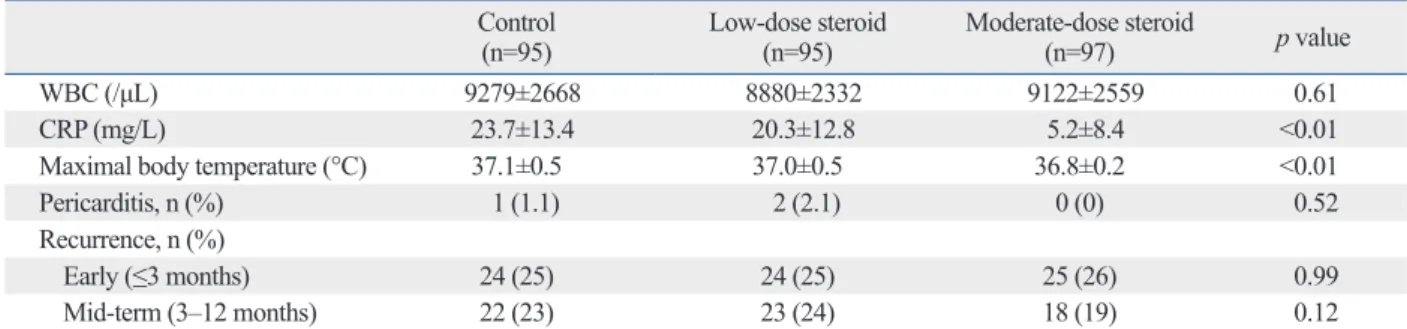
We measured white blood cell (WBC) counts, CRP, and body temperature after RFCA (Table 3). Patients in the moderate- continued if stable sinus rhythm was maintained. Discontin-
uation of AADs was attempted in patients whose recurrent AF disappeared after temporary treatment; if sinus rhythm was maintained, the drugs were stopped permanently.
Statistical analysis
SPSS version 19.0 (SPSS Inc., Chicago, IL, USA) was used for statistical analysis. Continuous variables were ex- pressed as mean±standard deviation, and categorical vari- ables were described using numbers or percentages. Com- parisons of differences between two groups were made by chi-square analysis and unpaired Student’s t-test. Time to atrial fibrillation recurrence 31 days after catheter ablation was estimated by the Kaplan-Meier method, with compari- sons made using the log-rank test. A p value <0.05 was considered statistically significant.
RESULTS
Baseline characteristics
Baseline clinical characteristics are shown in Table 1. The groups contained 95, 95, and 97 patients, respectively. Base- line characteristics of mean age, gender predominance, co Table 1. Baseline Characteristics
Control
(n=95) Low-dose steroid
(n=95) Moderate-dose steroid
(n=97) p value
Age, yrs 56±10 56±9 56±10 0.93
Male sex, n (%) 80 (85) 80 (84) 82 (84) 0.98
Paroxysmal AF, n (%) 60 (63) 58 (63) 61 (64) 0.96
Comorbidities, n (%)
Congestive heart failure 2 (2) 3 (3) 5 (5) 0.44
Hypertension 40 (42) 46 (48) 49 (52) 0.38
Age >75 yrs 2 (2) 2 (2) 2 (2) 0.73
Diabetes 10 (10) 6 (6) 13 (14) 0.24
Stroke 3 (3) 6 (6.3) 9 (9.6) 0.19
Coronary artery disease 2 (2) 1 (1.1) 3 (3.2) 0.54
Echocardiographic parameters
LA diameter, mm 42±6 41±5 42±7 0.74
LV end-diastolic dimension, mm 52±8 49±5 50.6±4 0.15
LV ejection fraction, % 61±6 64±7 62±9 0.79
Antiarrhythmic drugs, n (%)
Class I c 54 (57) 61 (64) 61 (63) 0.54
Class III 39 (41) 23 (24) 30 (31) 0.04
Medications, n (%)
ACEIs or ARBs 17 (18) 22 (23) 24 (26) 0.41
Beta-blockers 5 (18) 15 (20) 24 (26) 0.51
Statins 11 (12) 15 (16) 21 (23) 0.09
ACEI, angiotensin converting enzyme inhibitor; AF, atrial fibrillation; ARB, angiotensin receptor blocker; LA, left atrial; LV, left ventricular.
Values are mean±SD.
3 groups. Early recurrence was 24 (25%) in the control, 24 (25%) in the low-dose and 25 (26%) in the medium-dose groups (p=0.99). Low-dose and moderate-dose steroids did not decrease mid-term AF recurrence (3‒12 months) [22 (23%) vs. 23 (24%) vs. 18 (19%); p=0.12] after ablation, compared with controls (Table 3).
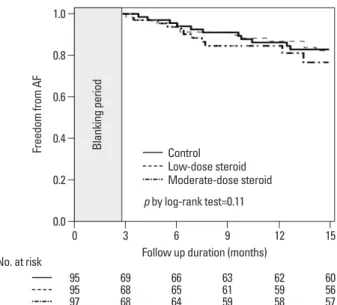
Fig. 2 shows Kaplan-Meier survival curves for AF recur- rence in each group, with no significant differences in the rates of patients with no AF recurrence (p=0.11 by log-rank test). The first three months was presumed to be a blanking period, because AF recurrences early after RFCA are consid- ered to be transient.17 By multivariate Cox-regression analy- sis, persistent AF (HR 1.67, 95% CI 1.18‒2.37; p=0.04) was the only independent predictor of late recurrence after ad- justing for steroid use, age >75, diabetes mellitus, LA size and ablation time.
DISCUSSION
The main finding of this study was that a single bolus injec- tion of low-dose or moderate-dose corticosteroids did not prevent AF recurrence after RFCA. Moderate doses of corti- dose steroid group had the lowest maximal body temperature
(37.1±0.5°C control vs. 37.0±0.5°C low-dose vs. 36.8±0.2°C moderate-dose; p<0.01) and the lowest CRP (23.7±13.4 mg/
L control vs. 20.3±12.8 mg/L low-dose vs. 5.2±8.4 mg/L moderate-dose; p<0.01). Although not statistically significant, the control group had the highest mean WBC count com- pared to low- and moderate-dose steroid group (9279±2668/
μL control vs. 8880±2332/μL low-dose vs. 9122±2559/μL moderate-dose; p=0.61). Post-RFCA complications, specifi- cally development of pericarditis, were 1 (1.1%) in control, 2 (2.1%) in low-dose and 0 in moderate-dose.
Post-ablation course and AF recurrence
No major complications were documented in any group during the follow-up period, which had a median of 26±12 months. Rates of infection and hematoma were not differ- ent among the 3 groups. One year after RFCA, 16 of 24 (67%) early AF recurrence patients in control group main- tained sinus rhythm (Fig. 1). For low-dose and moderate- dose steroid group, 19 of 24 (79%) and 19 of 25 (76%) early AF recurrence maintained to be sinus rhythm. We compared recurrence rates among the 3 groups. The number of patients of early AF recurrence (≤3 months) did not differ among the Table 2. Catheter Ablation
Control
(n=95) Low-dose steroid
(n=95) Moderate-dose steroid
(n=97) p value
Ablation procedure, n (%)
Circumferential PV isolation 95 (100) 95 (100) 97 (100) 0.37
CTI ablation 81 (90) 88 (98) 84 (91) 0.09
Linear ablation 35 (37) 36 (38) 35 (36) 0.95
CFAE 7 (8) 2 (2) 7 (7) 0.19
SVC isolation 6 (7) 2 (2) 14 (15) 0.01
Catheter ablation (min)
Total duration of procedure 192±52 182±46 168±40 0.13
Total fluoroscopy time 48±16 58±19 43±13 0.68
Duration of RF ablation 86±24 77±27 68±23 0.98
CFAE, complex fractionated atrial electrogram; CTI, cavo-tricuspid isthmus ablation; PV, pulmonary vein; RF, radiofrequency; SVC, superior vena cava.
Values are mean±SD.
Table 3. Inflammation Markers, Body Temperature, Pericarditis and Recurrence Control
(n=95) Low-dose steroid
(n=95) Moderate-dose steroid
(n=97) p value
WBC (/μL) 9279±2668 8880±2332 9122±2559 0.61
CRP (mg/L) 23.7±13.4 20.3±12.8 5.2±8.4 <0.01
Maximal body temperature (°C) 37.1±0.5 37.0±0.5 36.8±0.2 <0.01
Pericarditis, n (%) 1 (1.1) 2 (2.1) 0 (0) 0.52
Recurrence, n (%)
Early (≤3 months) 24 (25) 24 (25) 25 (26) 0.99
Mid-term (3–12 months) 22 (23) 23 (24) 18 (19) 0.12
CRP, C-reactive protein; WBC, white blood cell.
rence are not fully established, even in cardiac surgery stud- ies. An intermediate-dose group (50‒210 mg dexametha- sone, 1333‒5600 mg as in hydrocortisone equivalence) significantly reduced incidences of AF after cardiothoracic surgery, compared with placebo.21,24 Both low-dose (<200 mg/d) and high-dose steroids (>1000 mg/d) were ineffective compared to moderate doses (200‒1000 mg/d) of cortico- steroid for preventing AF after cardiac surgery.20 However, high-dose steroids do not prevent postoperative AF.21,25,26 Moreover, high-dose steroids induced AF by modulating potassium channels. Our previous study showed that a bo- lus injection of low-dose steroids was not effective in pre- venting AF recurrence.27
Whether a single bolus injection of steroids is effective for prevent inflammation is unknown. A previous study that investigated steroid doses to affect survival in acute respira- tory distress syndrome suggested that more than a single bolus injection of steroids was effective at reducing system- ic inflammatory responses.28 In this study, however, a single bolus injection of moderate-dose steroids significantly low- ered inflammation after RFCA without noticeable side ef- fects of corticosteroid.
Study limitations
This study had several limitations. First, data were reviewed retrospectively and low-dose or moderate-doses of steroids were not randomly allocated. However, using propensity score matching, no significant difference was seen in patient baseline characteristics, ablation protocol, or procedural costeroids resulted in decreased inflammation after RFCA,
which was reflected in significantly lower WBC counts, CRP, and body temperature, compared to the control group.
However, the decrease in inflammatory markers was not accompanied by a decreased incidence in recurrence. Our data suggested that a single bolus injection of low-dose or moderate-dose corticosteroids might not be sufficient to prevent post-ablation AF recurrence.
Steroids and AF prevention
The use of corticosteroids to prevent AF has mainly been evaluated in cardiothoracic surgery.20,21 Meta-analyses re- vealed that corticosteroid therapy is associated with a de- crease in more than 50% postoperative AF episodes,20 al- though heterogeneity in variable dosages and steroid dosing intervals must be considered. AF after cardiac and non car- diac surgery had been known to be usually prevented with steroid, however, it must be noted that the surgery is differ- ent from catheter ablation, causing more severe systemic inflammation and infection.
Dernellis and Panaretou22 demonstrated that 16 mg meth- yl prednisolone for 4 weeks, tapering to 4 mg for 4 months, significantly reduced AF recurrence (50% vs. 2.9%, p<
0.001). Koyama, et al.12 reported that intravenous hydrocor- tisone (2 mg/kg) immediately after ablation and oral pred- nisolone (0.5 mg/kg/day) for 3 days after the procedure re- sulted in a marked decrease in immediate AF recurrence.
Moreover, AF-free states were maintained without AADs in a corticosteroid-treated group (85% vs. 71%, p<0.05). The efficacy of steroids and proper doses and dosing intervals to prevent AF recurrence after RFCA are still debatable.
In this study, single doses of steroids did not prevent AF recurrence after RFCA. The total dosage of steroid was not different between our study and the study by Koyama, et al.12 For example, a total dosage of steroid given to a 60 kg body weight patient was 625 mg as in hydrocortisone equiva- lence for moderate-dose group of our study, while 480 mg as in hydrocortisone equivalence was injected in the study by Koyama, et al.12 Therefore, the negative result of this study is more likely caused by administration method. Re- cently, Nascimento, et al.23 reported that a single prophylac- tic corticosteroid before AF ablation did not prevent system- ic inflammation or alter the healing of the ablation lesion in pigs. This result is consistent with our study.
Dosage and route of steroids
Effective doses or dosing intervals to decrease AF recur-
Fig. 2. Kaplan-Meier survival curves for AF recurrence. No difference was seen in cumulative rates of absence of late AF recurrence among control, low-dose, and moderate-dose patients (p=0.11 by log-rank test). AF, atrial fibrillation.
No. at risk Follow up duration (months) 0.0
0.2 0.4 0.6 0.8 1.0
Freedom from AF
0
9595 97
3
6968 68
6
6665 64
9
6361 59
12
6259 58
15
6056 57
Blanking period Control
Low-dose steroid Moderate-dose steroid p by log-rank test=0.11
ation and perpetuation of atrial fibrillation: a systematic review of the published data. J Am Coll Cardiol 2007;50:2021-8.
9. Bruins P, te Velthuis H, Yazdanbakhsh AP, Jansen PG, van Harde- velt FW, de Beaumont EM, et al. Activation of the complement system during and after cardiopulmonary bypass surgery: postsur- gery activation involves C-reactive protein and is associated with postoperative arrhythmia. Circulation 1997;96:3542-8.
10. Aviles RJ, Martin DO, Apperson-Hansen C, Houghtaling PL, Rautaharju P, Kronmal RA, et al. Inflammation as a risk factor for atrial fibrillation. Circulation 2003;108:3006-10.
11. McCabe JM, Smith LM, Tseng ZH, Badhwar N, Lee BK, Lee RJ, et al. Protracted CRP elevation after atrial fibrillation ablation.
Pacing Clin Electrophysiol 2008;31:1146-51.
12. Koyama T, Tada H, Sekiguchi Y, Arimoto T, Yamasaki H, Kuroki K, et al. Prevention of atrial fibrillation recurrence with corticoste- roids after radiofrequency catheter ablation: a randomized con- trolled trial. J Am Coll Cardiol 2010;56:1463-72.
13. Chiappini B, El Khoury G. Risk of atrial fibrillation with high- dose corticosteroids. Expert Opin Drug Saf 2006;5:811-4.
14. Jahangiri M, Camm AJ. Do corticosteroids prevent atrial fibrilla- tion after cardiac surgery? Nat Clin Pract Cardiovasc Med 2007;
4:592-3.
15. Liakopoulos OJ, Schmitto JD, Kazmaier S, Bräuer A, Quintel M, Schoendube FA, et al. Cardiopulmonary and systemic effects of methylprednisolone in patients undergoing cardiac surgery. Ann Thorac Surg 2007;84:110-8.
16. Bourbon A, Vionnet M, Leprince P, Vaissier E, Copeland J, Mc- Donagh P, et al. The effect of methylprednisolone treatment on the cardiopulmonary bypass-induced systemic inflammatory response.
Eur J Cardiothorac Surg 2004;26:932-8.
17. Oral H, Chugh A, Lemola K, Cheung P, Hall B, Good E, et al.
Noninducibility of atrial fibrillation as an end point of left atrial circumferential ablation for paroxysmal atrial fibrillation: a ran- domized study. Circulation 2004;110:2797-801.
18. Calkins H, Kuck KH, Cappato R, Brugada J, Camm AJ, Chen SA, et al. 2012 HRS/EHRA/ECAS Expert Consensus Statement on Catheter and Surgical Ablation of Atrial Fibrillation: recommen- dations for patient selection, procedural techniques, patient man- agement and follow-up, definitions, endpoints, and research trial design. Europace 2012;14:528-606.
19. Koyama T, Sekiguchi Y, Tada H, Arimoto T, Yamasaki H, Kuroki K, et al. Comparison of characteristics and significance of imme- diate versus early versus no recurrence of atrial fibrillation after catheter ablation. Am J Cardiol 2009;103:1249-54.
20. Marik PE, Fromm R. The efficacy and dosage effect of corticoste- roids for the prevention of atrial fibrillation after cardiac surgery: a systematic review. J Crit Care 2009;24:458-63.
21. Ho KM, Tan JA. Benefits and risks of corticosteroid prophylaxis in adult cardiac surgery: a dose-response meta-analysis. Circula- tion 2009;119:1853-66.
22. Dernellis J, Panaretou M. Relationship between C-reactive protein concentrations during glucocorticoid therapy and recurrent atrial fibrillation. Eur Heart J 2004;25:1100-7.
23. Nascimento T, Mota F, dos Santos LF, de Araujo S, Okada M, Franco M, et al. Impact of prophylactic corticosteroids on system- ic inflammation after extensive atrial ablation in pigs. Europace 2012;14:138-45.
24. Baker WL, White CM, Kluger J, Denowitz A, Konecny CP, Cole- man CI. Effect of perioperative corticosteroid use on the incidence of postcardiothoracic surgery atrial fibrillation and length of stay.
time among the 3 groups. Second, since we used conven- tional electrocardiogram and ambulatory Holter monitoring, asymptomatic AF recurrence might not be detected. A con- tinuous recording for a longer period would provide more insight into the efficacy of steroids.
Conclusions
A single injection of moderate-dose steroid decreased in- flammation. However, single bolus injections of low-dose or moderate-dose steroids were not effective in preventing immediate, early or midterm AF recurrence after RFCA.
Our study suggested that a single dose of corticosteroids might not be effective to prevent AF after RFCA.
ACKNOWLEDGEMENTS
This study was supported in part by the Basic Science Re- search Program through the National Research Foundation of Korea, funded by the Ministry of Education, Science and Technology (NRF-2010-0021993, NRF-2012R1A2A2A 02045367), and the Korean Healthcare Technology R&D Project, Ministry of Health & Welfare (HI12C1552).
REFERENCES
1. Wilke T, Groth A, Mueller S, Pfannkuche M, Verheyen F, Linder R, et al. Incidence and prevalence of atrial fibrillation: an analysis based on 8.3 million patients. Europace 2013;15:486-93.
2. Wang TJ, Larson MG, Levy D, Vasan RS, Leip EP, Wolf PA, et al.
Temporal relations of atrial fibrillation and congestive heart failure and their joint influence on mortality: the Framingham Heart Study.
Circulation 2003;107:2920-5.
3. Chin JY, Youn HJ. The effect of ablation for paroxysmal atrial fi- brillation on left atrial volume and function: a one-year follow-up study. Yonsei Med J 2014;55:895-903.
4. Gerstenfeld EP, Callans DJ, Dixit S, Zado E, Marchlinski FE. In- cidence and location of focal atrial fibrillation triggers in patients undergoing repeat pulmonary vein isolation: implications for abla- tion strategies. J Cardiovasc Electrophysiol 2003;14:685-90.
5. Shah DC, Haïssaguerre M, Jaïs P, Hocini M, Yamane T, Deisen- hofer I, et al. Electrophysiologically guided ablation of the pulmo- nary veins for the curative treatment of atrial fibrillation. Ann Med 2000;32:408-16.
6. Gerstenfeld EP, Guerra P, Sparks PB, Hattori K, Lesh MD. Clini- cal outcome after radiofrequency catheter ablation of focal atrial fibrillation triggers. J Cardiovasc Electrophysiol 2001;12:900-8.
7. Oral H, Knight BP, Ozaydin M, Tada H, Chugh A, Hassan S, et al.
Clinical significance of early recurrences of atrial fibrillation after pulmonary vein isolation. J Am Coll Cardiol 2002;40:100-4.
8. Issac TT, Dokainish H, Lakkis NM. Role of inflammation in initi-
1999;67:1006-11.
27. Won H, Kim JY, Shim J, Uhm JS, Pak HN, Lee MH, et al. Effect of a single bolus injection of low-dose hydrocortisone for preven- tion of atrial fibrillation recurrence after radiofrequency catheter ablation. Circ J 2013;77:53-9.
28. Minneci PC, Deans KJ, Banks SM, Eichacker PQ, Natanson C.
Meta-analysis: the effect of steroids on survival and shock during sepsis depends on the dose. Ann Intern Med 2004;141:47-56.
Heart Rhythm 2007;4:461-8.
25. Morariu AM, Loef BG, Aarts LP, Rietman GW, Rakhorst G, van Oeveren W, et al. Dexamethasone: benefit and prejudice for pa- tients undergoing on-pump coronary artery bypass grafting: a study on myocardial, pulmonary, renal, intestinal, and hepatic in- jury. Chest 2005;128:2677-87.
26. Chaney MA, Nikolov MP, Blakeman BP, Bakhos M, Slogoff S.
Hemodynamic effects of methylprednisolone in patients undergo- ing cardiac operation and early extubation. Ann Thorac Surg