74
Open Access
Assessment of Myocardial Function in Patients With Fibromyalgia and the Relationship to Chronic Emotional and Physical Stress
Kyoung Im Cho, MD1, Ji Hyun Lee, MD2, Hyeon Gook Lee, MD1, Seong Man Kim, MD1 and Tae Ik Kim, MD1
1Divisions of Cardiology and 2Rheumatology, Maryknoll Medical Center, Busan, Korea
ABSTRACT
Background and Objectives: An association between emotional or physical stressful triggers and adverse cardio- vascular events, such as death and myocardial infarction, has been recognized for many years. The clinical fea- tures of transient left apical ballooning syndrome have been clearly described, but the effect of chronic stress on the myocardium is unknown. Our objective was to assess left ventricular (LV) function in patients with fibromyal- gia (FM) with chronic emotional and physical stress. Subjects and Methods: We investigated 30 consecutive post- menopausal women (mean age, 48±8 years) satisfying the criteria for FM with atypical chest pain and 20 age- matched healthy controls by means of standard and 2-dimensional strain (2DS) echocardiography. Patients with hypertension, coronary heart disease, or diabetes were excluded. Global and segmental longitudinal deformation parameters of LV function from 3 apical views were analyzed, and patients underwent a manual tender point sur- vey for the number of tender points and tender point counts, and completed the Fibromyalgia Impact Question- naire (FIQ), which was comprised of physical and feel scores, the Brief Fatigue Inventory (BFI), and the Beck Depression Inventory (BDI). Results: Both global and segmental longitudinal LV strains were significantly reduced in FM patients with high FIQ scores (>50) compared to FM patients with low FIQ scores (-18.98% vs. -22.72%).
Various emotional and physical stress indexes were significantly correlated with global LV strain. Conclusion: Global and segmental LV strains were negatively associated with fatigue, tender point count, and FIQ score.
However, there was no significant association between depression and LV strain. This study demonstrated that ch- ronic emotional or physical stress in FM patients might reduce myocardial longitudinal deformation. (Korean Circ J 2010;40:74-80)
KEY WORDS: Fibromyalgia; Emotional stress; Echocardiography; Strains.
Introduction
Physical or emotional stress has long been known to have an impact on the cardiovascular system. Reversible electrocardiographic and echocardiographic changes have been reported in patients under emotional stress1)2) or physical stress,3) including non-cardiac illnesses. Acute stress with catecholamine release has numerous well-
known effects on the cardiovascular system, including increased heart rate, cardiac output, and peripheral vas- cular constriction, leading to a short-term increase in blood pressure. Chronic stress is thought to contribute to the risks for cardiovascular disease through persist- ent activation of the sympathetic nervous system and Hypothalamic-pituitary-adrenal (HPA) axis.4) Brief men- tal stress can cause transient endothelial dysfunction in healthy individuals.5)6) In animal models, psychologic st- ress produces actual endothelial injury7)8) and chronic car- diovascular stimulation can also lead to vascular hyper- trophy and chronically elevated blood pressure.
Fibromyalgia (FM) is characterized by widespread musculoskeletal pain lasting at least 3 months with dis- crete points of tenderness (>11 of 18 sites).9) Patients with FM experience a variety of other symptoms, in- cluding sleep disturbance, fatigue, stiffness, cognitive dys- function, and non-cardiac chest pain. There is an over-
Received: May 19, 2009 Accepted: June 15, 2009
Correspondence: Kyoung Im Cho, MD,Division of Cardiology, Maryknoll Me- dical Center, 4-12 Daecheong-dong, Jung-gu, Busan 600-730, Korea Tel: 82-51-461-2349, Fax: 82-51-465-7470
E-mail: [email protected]
○ cc This is an Open Access article distributed under the terms of the Creative Commons Attribution Non-Commercial License (http://creativecommons.
org/licenses/by-nc/3.0) which permits unrestricted non-commercial use, distribution, and reproduction in any medium, provided the original work is properly cited.
lap between FM and depression, and the correlation be- tween coronary heart disease and depression is docu- mented. Also, there is a study which has demonstrated a significantly higher proportion of FM, an increased level of tenderness to touch, and higher scores on the Fibromyalgia Impact Questionnaire (FIQ) scale among patients with pathologic findings on coronary angio- graphy.10) Several studies have shown that beliefs or per- ceptions regarding pain may influence the intensity of pain,11)12) and patients who have perceptions of catas- trophic illness experience more pain, feel more disabl- ed by their pain, suffer more psychologic distress, and have poor outcomes following pain treatment.13) The aim of the present study was to determine myocardial function in patients with FM with 2-dimensional st- rain (2DS) echocardiography, and to examine the rel- ationship between chronic mental and physical stress and myocardial function.
Subjects and Methods
Study population
The study was approved by the Maryknoll Medical Center Institutional Review Board. FM patients with atypical chest pain were recruited from the Rheumato- logy and Cardiology Services at the Maryknoll Medical Center between September 2008 and March 2009. Par- ticipants were selected according to the following crite- ria: postmenopausal and experiencing pain from FM at the time they completed the survey. The patients then received informed consent according to Institutional Re- view Board guidelines and a set of questionnaires. The echocardiographic examination was obtained after the survey, and an exercise stress test was performed to ex- clude ischemic heart disease.
The control group included 20 age-matched healthy postmenopausal females with normal echocardiograms and exercise stress tests. Patients were excluded for the following reasons: hypertension, coronary artery disease (CAD), diabetes mellitus, significant valvular heart dise- ase, advanced arrhythmia, and the inability to provide informed consent.
Assessments
To provide confirmation of FM, a clinical examina- tion was performed by a rheumatologist in which the 1990 American College of Rheumatology (ACR) crite- ria were applied. Subjects had to have at least 11 of 18 tender points and widespread musculoskeletal pain, above and below the waist, of 3 months’ duration or longer to qualify for entry into the research program.
During the survey, all participants completed the FIQ, an Index of change in FM-related symptomatology, which correlates with the degree of disability.14) The Ko- rean version of the FIQ is comprised of 10 questions.15)
The first question contains 11 items related to the abi- lity to perform large muscle tasks; each question is rated on a 4-point scale. Items 2 and 3 ask the patient to mark the number of days they felt well and the number of days they were unable to work (including housework) because of FM symptoms. Items 4 through 10 are hori- zontal linear scales marked in 10 increments on which the patient rates work difficulty, pain, fatigue, morning tiredness, stiffness, anxiety, and depression. The FIQ is a self-administered instrument that takes approxima- tely 3-5 minutes to complete. The directions are simple and the scoring is self-explanatory, so a higher score indicates a greater impact of the syndrome on the per- son. Each of the 10 items has a maximum possible score of 10, thus the maximum possible score is 100. The av- erage FM patient scores about 50; severely afflicted patients usually score ≥70. The study participants were divided 2 groups based on whether the FIQ score was
>50 (group A) or <50 (group B).
The self-administered questionnaires, the Beck De- pression Inventory (BDI) scale and the Brief Fatigue In- ventory (BFI), assess symptoms of depression and fati- gue, respectively. The BDI evaluates 21 symptoms of de- pression; 14 cognitive-affective symptoms and 7 soma- tic symptoms. Each symptom is rated on a 4-point in- tensity scale and scores are added to give a total rang- ing from 0-63. The higher scores represent more severe depression. A BFI consists of 9 items; fatigue and its in- terference are measured on numeric scales from 0-10.
The global score for the BFI is calculated as the mean value of these 9 items. Severity of fatigue can be cate- gorized as mild, moderate, or severe, as follows: 1-3, mild; 4-6, moderate; and 7-10, severe fatigue. Detailed demographic data were collected from medical records or participant interviews and included age, race, gen- der, marital status, concomitant illnesses, vital signs, phy- sical examination results, and medications.
Echocardiographic evaluation
A standard 2DS echocardiographic examination was performed on all subjects lying in the left lateral su- pine position using a 3.5-MHz transducer on Vivid 7 Dimension ultrasound equipment (General Electric, Horten, Norway). Two-dimensional grayscale imaging (frame rate ≥70s) and color Doppler tissue imaging (frame rate ≥115s) were performed in the apical 2-, 3-, and 4-chamber views using a narrow sector angle.
Images from the apical chamber views of the left ventri- cle (LV) were obtained at end-expiratory apnea and were stored in cineloop format for subsequent offline analy- sis. Three heartbeats were collected from each view and the selected 1-cycle was analyzed off-line with an Echo PAC Dimension system (General Electric). Peak systo- lic strains were measured and averaged to assess global longitudinal myocardial regional function (GLS). The
endocardial borders were traced at the end-systolic frame, and an automated tracking algorithm outlined the myo- cardium in successive frames throughout the cardiac cycle.
The tracking quality was verified for each segment (with subsequent manual adjustment of the region of interest, if necessary), and myocardial motion was analyzed by speckle tracking within the region of interest bound by endocardial and epicardial borders. Inadequate track- ed segments were automatically excluded from analysis.
In this situation, the local strain in each segment was calculated. GLS was obtained by averaging all segment strain values from the apical 4-chamber, 2-chamber, and long axis views.
Statistical analysis
All data are expressed as the mean±standard devia- tion. Data were analyzed using standard statistical soft- ware {Statistical Package for the Social Sciences (SPSS) package, version 11.0; SPSS, Inc., Chicago, IL, USA} and comparisons of all measurements were made with paired Student’s t-test for continuous variables and the Pear- son correlation test for correlation. A p<0.05 indicat- ed statistical significance.
Results
General characteristics of patients
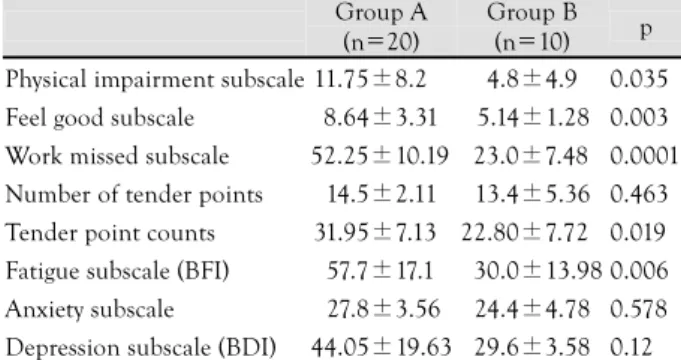
The major demographic and clinical characteristics are given in Table 1. The mean age was 48±8 years (range, 42-66 years), and global LV systolic function, LV chamber dimension, and wall thickness were nor- mal in all patients with fibromyalgia syndrome. The disease duration, number of tender points, and BDI showed no differences between the groups. However, the physical score, feel score, tender point counts, and BFI were significantly higher in the high FIQ score group (group A, n=20) than the low FIQ score group (group B, n=10) (Table 2).
Strain echocardiographic findings
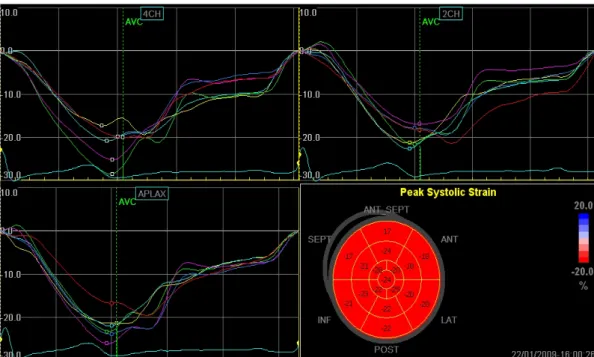
There were no significant differences in the mitral inflow parameters and myocardial performance index (Tei index) between the groups (Table 3). However, sig- nificant decreases were noted in the values of global LV strain (GLS) of group A versus group B (-18.61±
3.09% vs. -22.72±1.38%, p=0.001), specifically a lo- wer mean systolic strain of the apical 4-chamber view (-18.21±3.05% vs. -22.88±1.63%, p=0.001), mean systolic strain of the apical 2-chamber view (-18.98±
3.24% vs. -22.44±1.38%, p=0.002), and mean peak systolic strain of the apical long axis view (-18.32±
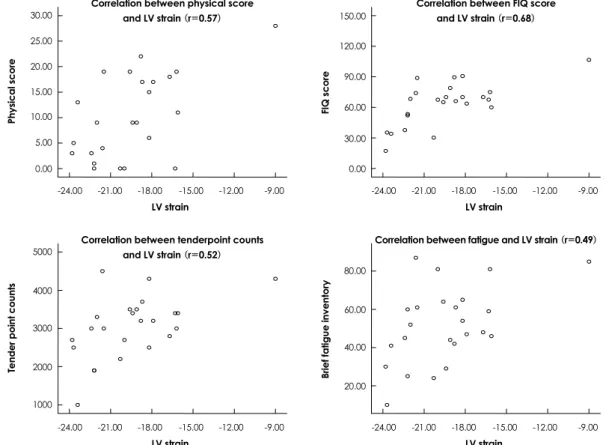
3.42% vs. -22.72±1.75%, p=0.002) (Figs. 1 and 2) (Table 4). The FIQ score had a strong correlation with global and segmental LV strain (Fig. 3). The physical and feel scores of the FIQ also demonstrated signi- ficant correlations with the corresponding GLS (0.58 and 0.42 respectively, p<0.05). The value of the GLS correlated robustly with the 10 items of the FIQ, the highest correlations being with tender point counts (r=0.52), missed work (r=0.49), anxiety (r=0.49), and fatigue (r=0.49). The scale of the GLS also showed a strong correlation with the Tei index (r=0.72, p=0.007).
The number of tender points and depression generally showed a poor correlation with GLS. Inter- and intra- observer variability was tested by independent analysis
Table 2. Comparisons of clinical variables between the FMS pa- tients
Group A (n=20)
Group B (n=10) p Physical impairment subscale 11.75±8.2 4.8±4.9 0.035 Feel good subscale 8.64±3.31 5.14±1.28 0.003 Work missed subscale 52.25±10.19 23.0±7.48 0.0001 Number of tender points 14.5±2.11 13.4±5.36 0.463 Tender point counts 31.95±7.13 22.80±7.72 0.019 Fatigue subscale (BFI) 57.7±17.1 30.0±13.98 0.006 Anxiety subscale 27.8±3.56 24.4±4.78 0.578 Depression subscale (BDI) 44.05±19.63 29.6±3.58 0.12 All values are described as the mean±SD. FMS: fibromyalgia syn- drome, BFI: brief fatigue inventory, BDI: beck depression inventory
Table 3. Parameters of 2-dimensional echocardiography between the FMS patients and controls
Group A (n=20)
Group B (n=10)
Control (n=20) LVEDd (mm) 46.02±3.72 44.34±1.35 45.45±2.25
FS 35.45±2.68 35.00±1.58 34.75±2.19
EF (%) 65.00±2.90 63.78±3.06 67.8±9.5
RWT 0.42±0.04 0.41±0.03 0.39±0.7
LVMI (g/m2) 94.8±18.06 88.40±8.96 90.1±12.7 LAD (mm) 37.94±2.85 35.22±1.61 36.18±1.93 Tei index 0.33±0.63 0.28±0.90 0.32±0.78 All values are described as the mean±SD. FMS: fibromyalgia syn- drome, LVEDd: left ventricular end diastolic dimension, FS: frac- tional shortening, EF: ejection fraction, RWT: relative wall thick- ness, LVMI: left ventricular mass index, LAD: left atrial dimension Table 1. Baseline demographic characteristics of FMS patients
and controls
Group A (n=20)
Group B (n=10)
Control (n=20) Age (years) 48.4±8.7 46.8±7.9 45.6±8.6 BMI (kg/m2) 23.8±3.5 23.1±3.8 23.8±4.8 Systolic BP (mmHg) 124.4±14.0 127.4±12.8 123.8±11.9 Diastolic BP (mmHg) 78.1±7.7 76.1±8.3 76.2±9.3
HR (bpm) 72.8±8.7 73.9±6.7 74.1±5.8
Hemoglobin 12.3±1.4 12.1±1.7 12.4±1.5 Serum creatinine 0.7±0.32 0.8±0.27 0.8±0.34 Disease duration after
diagnosis (years) 3.57±4.71 3.75±2.75 0 All values are described as the mean±SD. FMS: fibromyalgia syn- drome, BMI: Body Mass Index, BP: blood pressure, HR: heart rate
by two independent observers (C.K.I and L.S.H.) and by repeated measurement of these segments on another occasion by the same observer (C.K.I.). The interob- server variability was <12% and the intraobserver va- riability was 8%. The main reason for interobserver variability was a different location of the sample volume.
Once sample volume was placed on a mutually agreed location within the myocardium, the measurements became virtually identical.
Discussion
The relationship between psychosocial factors, such as stress and CAD, has drawn significant attention. Ch- ronically stressful situations, such as work stress, mari- tal stress, caregiver strain, low social support, and low socioeconomic status, have been linked to an increas- ed risk of CAD and adverse cardiac events.18) There is also evidence that emotional stressors can act as trig-
Fig. 1. A case of longitudinal strain analysis in patients with FMS and a low FIQ score by 2-dimensional speckle tracking strain analysis, which showed normal segmental and global left ventricular strain. FMS: fibromyalgia syndrome, FIQ: Fibromyalgia Impact Question- naire.
Fig. 2. A case of longitudinal strain analysis in patients with FMS and a high FIQ score by 2-dimensional speckle tracking strain analy- sis, which showed abnormal segmental and global left ventricular strain. FMS: fibromyalgia syndrome, FIQ: fibromyalgia impact question- naire.
gers for acute cardiovascular events.19) The present study tested the hypothesis that chronic stress may exert ne- gative effects on LV function in patients with FM. The physical definition of strain is the relative change in length of a material related to its original length. The strain rate is the temporal derivative of the strain and so it expresses the local dynamics of myocardial perform- ance. The longitudinal systolic strain rate has been shown to be linearly correlated with the maximal value of the first LV pressure time derivative and also with the peak elastance, which are both global measures of LV systolic function and contractility. The 2DS meas- urements, as determined by speckle tracking, have re- cently been used for the quantitative evaluation of LV
function, and this method has been validated for the evaluation of longitudinal function.20) Subclinical LV dysfunction relates to the structure-function relation- ship and characterizes a preclinical stage of myocardial damage that can be detected by a decrease in longitu- dinal myocardial function, the vulnerability of suben- docardial fibers, that occurs before the development of abnormalities in conventional measures of LV per- formance, such as LV ejection fraction.16) The main findings of this study were that global and segmental longitudinal LV strains were significantly reduced in FM patients with high FIQ scores than patients with low FIQ scores, despite comparable radial LV contrac- tion parameters, such as ejection fraction and fractional
Table 4. Parameters of mitral inflow pattern and strain between the FMS patients
Group A (n=20) Group B (n=10) Control (n=20)
E velocity (cm/sec) 72.25±14.03 75.40±19.04 74.45±12.32
A velocity (cm/sec) 69.70±10.61 70.20±6.91 68.78±9.29
E/Ea 8.81±2.04 8.71±0.93 7.92±1.52
Peak systolic strain, LAX (%) -18.32±3.42*† -22.72±1.75 -21.63±4.21
Peak systolic strain, A4C (%) -18.21±3.05*† -22.88±1.63 -24.22±6.82
Peak early diastolic strain, A2C (%) -18.98±3.24*† -22.44±1.38 -23.35±6.46
Global LV strain (%) -18.61±3.09*† -22.72±1.46 -22.82±9.62
All values are described as the mean±SD. *p<0.05 vs. group B, †p<0.05 vs. control. FMS: fibromyalgia syndrome, E: peak early velocity, A:
peak atrial velocity, Ea: early diastolic mitral annular velocity, LAX: apical long axis view, A4C: apical 4-chamber view, A2C: apical 2-chamber view, LV: left ventricular
30.00 25.00 20.00 15.00 10.00 5.00 0.00
Physical score
-24.00 -21.00 -18.00 -15.00 -12.00 -9.00 LV strain
Correlation between physical score
and LV strain (r=0.57) 150.00
120.00 90.00 60.00 30.00 0.00
FIQ score
-24.00 -21.00 -18.00 -15.00 -12.00 -9.00 LV strain
Correlation between FIQ score and LV strain (r=0.68)
5000
4000
3000
2000
1000
Tender point counts
-24.00 -21.00 -18.00 -15.00 -12.00 -9.00 LV strain
Correlation between tenderpoint counts and LV strain (r=0.52)
80.00
60.00
40.00
20.00
Brief fatigue inventory
-24.00 -21.00 -18.00 -15.00 -12.00 -9.00 LV strain
Correlation between fatigue and LV strain (r=0.49)
Fig. 3. Correlation between parameters of stress and global left ventricular strain (GLS). The value of the GLS showed modest negative correlation with parameters of physical stress score, Fibromyalgia Impact Questionnaire (FIQ), tender point counts, and fatigue (all p<0.01).
shortening, implicating subclinical LV dysfunction. Al- though insignificant reductions in the ejection frac- tion and Tei index were observed in patients with FM with high FIQ scores, the Tei index was significantly correlated with LV strain. Both global and segmental LV strain was negatively associated with fatigue, anxie- ty, tender point count, and FIQ score. However, there was no significant association between depression and LV strain. This study demonstrated that severity of emo- tional or physical distress in patients with FM might be correlated with LV function and chronic distress might reduce myocardial longitudinal deformation by possi- ble microcirculatory impairment or endothelial dys- function due to excess activation of the sympathetic nervous system. Several mechanisms concomitant with or downstream to sympathetic nervous system activa- tion have been proposed. Recent data suggest that ele- vated systemic levels of catecholamines are central to the pathophysiology of this disorder.21) Catecholamines have been known to exert a toxic effect on the myocar- dium. Excessive catecholamine production in patients with pheochromocytoma induces reversible LV dys- function analogous to tako-tsubo-like LV dysfunction.22) The exact mechanism of catecholamine-induced myo- cardial damage, however, is thought to be multifacto- rial. Postulated mechanisms include persistent activa- tion of calcium channels, membrane damage, and mi- crovascular spasm.23) Microvascular endothelial dysfunc- tion can sensitize the coronary circulation to the vaso- constrictor effects of catecholamines.24) Microvascular spasm and cardiac syndrome X are also associated with female predominance, particularly in the postmenopau- sal years,25)26) congruent with the gender differences which exist in transient LV dysfunction. In the peripheral cir- culation, microvascular abnormalities are exacerbated by sympathetic nerve activation.27) Given the associat- ion with physical or emotional stress in patients with transient LV dysfunction, chronic stress may play a role in changes in LV function. In this study, we have found, for the first time, myocardial longitudinal deformation assessed by 2DS echocardiography was reduced in pa- tients with FM with chronic emotional or physical st- ress. Considering the good correlation between stress parameters and LV strain, further clinical evaluation of LV function with long-term follow-up is warranted, es- pecially for the patients with FM and a high FIQ score.
This study had some limitations that should be con- sidered. We did not evaluate the strain rate because this could not be obtained using automated function imaging software. However, as strain is a fundamental parameter that can be directly measured using the speckle tracking method, it might be a more relevant parameter than the strain rate.28) Second, there was no significant difference in LV strain between patients with FM with a low FIQ score and age-matched healthy
controls. The absence of a difference might be because the amount of stress was not severe enough to induce a change in LV function or FM patients with a low FIQ scorewere not susceptible to stress. However, whether the findings of reduced LV longitudinal deformation in FM patients with a high FIQ score is due to stress itself or disease characteristics are not convincing. As our present study was a cross-section study and the study population was small, a further prospective study will be required. Finally, the possible mechanism of ob- served LV dysfunction in FM patients with a high FIQ score was not investigated in this study, so a study fo- cusing on vascular and endothelial function, such as brachial artery flow-mediated dilation by ultrasound and measurement of systemic levels of catecholamines will also be required.
REFERENCES
1) Brandspiegel HZ, Marinchak RA, Rials SJ, Kowey PR. A broken heart. Circuation 1998;98:1349.
2) Lee HH, Gwon HC, Kim BJ, et al. Clinical manifestation of no- vel stress-induced cardiomyopathy mimicking acute myocardial infarction: single center prospective registry. Korean Circ J 2002;
32:1054-63.
3) Sharkey SW, Shear W, Hodges M, Herzog CA. Reversible myo- cardial contraction abnormalities in patients with an acute non- cardiac illness. Chest 1998;114:98-105.
4) McEwen BS. Protective and damaging effects of stress media- tors: central role of the brain. Dialogues Clin Neurosci 2006;8:
367-81.
5) Ghiadoni L, Donald AE, Cropley M, et al. Mental stress induces transient endothelial dysfunction in humans. Circulation 2000;
102:2473-8.
6) Spieker LE, Hurlimann D, Ruschitzka F, et al. Mental stress induces prolonged endothelial dysfunction via endothelin-A re- ceptors. Circulation 2002;105:2817-20.
7) Henry JP, Ely DL, Stephens PM, Ratcliffe HL, Santisteban GA, Shapiro AP. The role of psychosocial factors in the development of arteriosclerosis in CBA mice: observations on the heart, kid- ney, and aorta. Atherosclerosis 1971;14:203-18.
8) Strawn WB, Bondjers G, Kaplan JR, et al. Endothelial dysfunc- tion in response to psychosocial stress in monkeys. Circ Res 1991;
68:1270-9.
9) Lawrence RC, Helmick CG, Arnett FC, et al. Estimates of the prevalence of arthritis and selected musculoskeletal disorders in the United States. Arthritis Rheum 1998;41:778-99.
10) Ablin JN, Beilinson N, Aloush V, Elkayam O, Finkelstein A. As- sociation between fibromyalgia and coronary heart disease and coronary catheterization. Clin Cardiol 2009;32:E7-11.
11) Arntz A, Claassens L. The meaning of pain influences its experi- ences intensity. Pain 2004;109:20-5.
12) Lame IE, Peters ML, Vlaeyen JW, van Kleef M, Patijn J. Quality of life in chronic pain is more associated with beliefs about pain, than with pain intensity. Eur J Pain 2005;9:15-24.
13) Vlaeyen JW, Linton SJ. Fear-avoidance and its consequences in chronic musculoskeletal pain: a state of the art. Pain 2000;85:
317-32.
14) Abeles M, Solitar BM, Pillinger MH, Abeles AM. Update on fibromyalgia therapy. Am J Med 2008;121:555-61.
15) Kim YA, Lee SS, Park K. Validation of a Korean version of the fibromyalgia impact questionnaire. J Korean Med Sci 2002;17:
220-4.
16) Chan J, Hanekom L, Wong C, Leano R, Cho GY, Marwick TH.
Differentiation of subendocardial and transmural infarction us- ing two-dimensional strain rate imaging to assess short-axis and long-axis myocardial function. J Am Coll Cardiol 2006;48:2026- 33.
17) Becker M, Hoffmann R, Kuhl HP, et al. Analysis of myocardial deformation based on ultrasonic pixel tracking to determine tr- ansmurality in chronic myocardial infarction. Eur Heart J 2006;
27:2560-6.
18) Rozanski A, Blumenthal JA, Davidson KW, Saab PG, Kubzan- sky L. The epidemiology, pathophysiology, and management of psychosocial risk factors in cardiac practice: the emerging field of behavioral cardiology. J Am Coll Cardiol 2005;45:637-51.
19) Tofler GH, Muller JE. Triggering of acute cardiovascular dise- ase and potential preventive strategies. Circulation 2006;114:
1863-72.
20) Becker M, Bilke E, Kuhl H, et al. Analysis of myocardial de- formation based on pixel tracking in two dimensional echocar- diographic images enables quantitative assessment of regional left ventricular function. Heart 2006;92:1102-8.
21) Wittstein IS, Thiemann DR, Lima JA, et al. Neurohumoral fea- tures of myocardial stunning due to sudden emotional stress. N
Engl J Med 2005;352:539-48.
22) Hong KW, Park DG, Choi HH, et al. Tako-Tsubo cardiomyo- pathy by transient dynamic left midventricular obstruction. Ko- rean Circ J 2009;39:37-41.
23) Zaroff JG, Rordorf GA, Titus JS, et al. Regional myocardial perfusion after experimental subarachnoid hemorrhage. Stroke 2000;31:1136-43.
24) Vita JA, Treasure CB, Yeung AC, et al. Patients with evidence of coronary endothelial dysfunction as assessed by acetylcholine infusion demonstrate marked increase in sensitivity to constric- tor effects of catecholamines. Circulation 1992;85:1390-7.
25) Mohri M, Koyanagi M, Egashira K, et al. Angina pectoris caus- ed by coronary microvascular spasm. Lancet 1998;351:1165-9.
26) Maseri A, Crea F, Kaski JC, Crake T. Mechanisms of angina pectoris in syndrome X. J Am Coll Cardiol 1991;17:499-506.
27) Ako J, Kozaki K, Yoshizumi M, Ouchi Y. Transient left ventri- cular apical ballooning without coronary artery stenosis: a form of stunning-like phenomenon. J Am Coll Cardiol 2002;39:741-2.
28) Choi JO, Cho SJ, Yang JH, et al. Systolic long axis function of the left ventricle, as assessed by 2-D Strain, is reduced in the pa- tients who have diastolic dysfunction and a normal ejection frac- tion. Korean Circ J 2008;38:250-6.