11
Percutaneous Cardiopulmonary Support for Emergency In-Hospital Cardiac Arrest or Cardiogenic Shock
Il Rhee, MD, Hyeon-Cheol Gwon, MD, Jinho Choi, MD, Kiick Sung, MD,
Young Tak Lee, MD, Sung-Uk Kwon, MD, Dae Kyoung Cho, MD, Seong-Hoon Lim, MD, Seon Woon Kim, MD, Sang Hoon Lee, MD, Kyung Pyo Hong, MD and Joung Euy Park, MD
Cardiac and Vascular Center, Samsung Medical Center Sungkyunkwan University School of Medicine, Seoul, Korea
ABSTRACT
Background and Objectives:Percutaneous cardiopulmonary support (PCPS) provides hemodynamic stability for the treatment of patients suffering with cardiogenic shock or cardiac arrest, and it can be used in a wide variety of clinical settings without the need for chest exploration. In this study, we summarize a single center’s experience with performing PCPS in the patients who suffered with severe cardiopulmonary failure. Subjects and Methods:
We retrospectively reviewed 30 consecutive patients with cardiac arrest or severe cardiogenic shock who received PCPS for cardiac resuscitation from November 2003 to July 2005. The self-priming, heparin-coated circuit of the Emergency Bypass System® was used in all the patients. Cannulation was performed via the femoral artery and vein with using an arterial (17 to 21 French) and venous cannula (21 to 28 French), percutaneously or with a small incision. Results:The Indications for PCPS were: ischemic heart disease before coronary revascularization, myocardial disease, PCI-associated complications and post-operative hemodynamic collapse. Of the 30 patients we evaluated, 19 patients (63%) were successfully weaned off of the PCPS; 14 of these patients (47%) were later discharged from the hospital. For the survivors, the time interval from cardiac arrest or severe cardiogenic shock to the onset of PCPS was significantly shorter (p=0.01), and the urine output for the initial 24 hours was signi- ficantly higher (p=0.04). Conclusion:This retrospective analysis demonstrates the effectiveness of using PCPS for the treatment of critically unstable patients with cardiac arrest or cardiogenic shock. Larger scale studies of PCPS are now needed to confirm these findings. (Korean Circulation J 2006;36:11-16)
KEY WORDS:Shock, cardiogenic;Cardiac arrest.
Introduction
Temporary mechanical circulatory support has been widely used for postoperative cardiac support in the pat- ients suffering with severe cardiopulmonary failure. The cannulas have typically been inserted into the right atrium and the ascending aorta through an open tho- racotomy. Recent advances in catheters, bypass circuits, membrane oxygenators and percutaneous cannulation techniques have made it possible to start a closed-chest cardiopulmonary bypass outside of the operating room.
Many investigators have employed percutaneous card- iopulmonary support(PCPS) with varying degrees of
success as a therapeutic option in a variety of clinical settings.1-3) The recently introduced Emergency Bypass system®(EBS®: Terumo, Inc., Tokyo, Japan) is a PCPS system that can be easily used when needed. In this study, we report our experience with using the EBS® in those patients suffering with severe cardiopulmon- ary failure.
Subjects and Methods
SubjectsFrom November 2003 to July 2005 at the Samsung Medical Center, thirty patients suffering with severe cardiopulmonary failure, including cardiogenic shock and cardiac arrest, underwent hemodynamic support using EBS®, and these patients were included in this study. We started PCPS in those patients with profound cardiopulmonary failure when they were not respon- sive to aggressive pharmacologic treatment and when IABP support was not effective. The indications for
Received:November 14, 2005 Accepted:December 17, 2005
Correspondence:Hyeon-Cheol Gwon, MD,Cardiac and Vascular Center, Samsung Medical Center Sungkyunkwan University School of Medicine, 50 Ilwon-dong, Gangnam-gu, Seoul 135-230, Korea
Tel: 82-2-3410-3995, Fax: 82-2-3410-0483 E-mail: [email protected]
PCPS included: 1) ischemic heart disease before coro- nary revascularization, 2) myocardial disease, including acute fulminant myocarditis, 3) PCI-associated with events, including left main dissection and acute/suba- cute stent thrombosis, and 4) post-cardiac surgery with hemodynamic collapse.
PCPS procedure
The PCPS system used in our study was the Capiox Emergency Bypass System®(Terumo, Inc., Tokyo, Japan), which is an all-in-one package of a heparin-coated mem- brane oxygenator that is preassembled with bypass cir- cuits and a cone for the centrifugal pump. The console has a fully automatic priming function and takes only several minutes to prepare it for use. Therefore, this system has the advantage of allowing quick start-up for instituting PCPS; this is especially important for treating patients who present with cardiopulmonary arrest.
The PCPS apparatus is ready for emergencies, and it is used by a well-trained team at our hospital to prepare the patient for pump placement within minutes. For the percutaneous technique, the tip of the arterial cannula is advanced and positioned in the common iliac artery;
the tip of the venous catheter is placed at the junction of the right atrium and the superior vena cava through a rigid backup guidewire and under fluoroscopic gui- dance. Long venous cannulas, DLP®(Medtronic inc.
Minneapolis, MN) from 17Fr to 28Fr, were used for the venous cannulations; RMI® arterial cannulas(Ed- wards’s Lifescience LLC, Irvine, CA), from 16Fr to 21Fr were used for the arterial cannulations. If the percuta- neous cannulation failed, then direct surgical exposure of the femoral vessels was done and cannulation was performed under direct visualization.
The patients were fully heparinized with continuous injection at the rate of 3 mg/kg/min to maintain the activated clotting time at greater than 200 sec. Extra- corporeal circulation was initiated after the pump and cannulas were purged. The centrifugal pump provides a non-pulsatile flow at a rate between 1 and 5 L/min.
The flow can be increased or decreased with inotropics or fluids as needed during the procedure. In most patients who showed the obvious signs of leg ischemia, a perfusion catheter was inserted distally into the femoral artery. When weaning the patient from the pump, both cannulas were clamped and the pump was interrupted.
There were no cases that required protamine to reverse the effects of circulating heparin in our patients, the same as was previously reported,4) and the cannulas were surgically removed.
Clinical follow-up
The patients’ medical records were reviewed for ev- aluating the PCPS. All the patients who survived and were discharged from the hospital were closely followed
by telephone and they were clinically reevaluated when needed. The mean clinical follow-up period was 9.8±
7.3 months.
Statistics
The data are expressed as means±standard deviations for the continuous variables, and as absolute and relative frequencies for the categorical variables. Student’s un- paired t test was used to compare the continuous vari- ables between the groups. A p<0.05 was considered to be statistically significant. Categorical variables were compared with using the Chi-square test. Probability values <0.05 were considered to be statistically signi- ficant.
Results
Baseline characteristicsFourteen patients who displayed cardiogenic shock and 16 patients who displayed cardiac arrest were in- cluded in this study. The number of male patients was 20 and their average age was 53±20 years(Table 1). The most common clinical diagnosis on admission was myo- cardial infarction, and this was followed by myocarditis.
Table 1. Baseline characteristics of the patients requiring emergency PCPS
Cardiogenic shock (n=14)
Cardiac arrest (n=16)
All patients (n=30)
Age (years) 44±21 60±16 53±20
Male (%) 7 (50%) 13 (81%) 20 (67%) Diagnosis on admission
Myocardial infarction 5 7 12
Unstable angina 1 2 13
Stable angina 0 1 11
Myocarditis 5 2 17
Dilated cardiomyopathy 1 1 12 Valular heart disease 0 1 11
Others* 2 2 14
Findings of CAG
CAG not done 6 5 11
Normal CAG 2 1 13
1 vessel disease 0 1 11
2 or 3 vessel disease 5 7 12
Left main disease 1 2 13
Risk factors
Hypertension 4 6 10
Diabetes mellitus 5 6 11
Smoking 0 6 16
Cerebrovascular disease 0 0 10 Chronic renal failure 0 1 11 Pre-procedural LVEF (%) 23±13 39±18 32±17%
Others* include primary pulmonary hypertension, aortic dissection.
Ebstein anomaly, and cardiac amyloidosis. CAG: coronary angio- graphy, LVEF: left ventricular ejection fraction, PCPS: percutaneous cardiopulmonary support
The others diagnoses(Table 1) included: primary pul- monary hypertension, aortic dissection, Ebstein anomaly, and cardiac amyloidosis in 1 patient each, respectively.
Diabetes mellitus was noted in 11 patients(37%). The mean ejection fraction was 32±17% on the pre-proce- dural echocardiography and the ejection fraction was less than 20% in 9(30%) patients.
Indications for PCPS
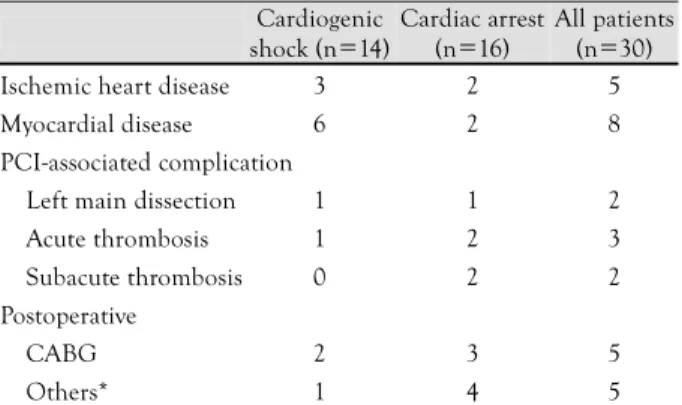
The indications for PCPS were ischemic heart disease before coronary revascularization in 5 patients, myo- cardial disease in 8 patients(7 fulminant myocarditis patients and 1 patient with cardiac amyloidosis), PCI- associated complications in 7 patients and post-operative hemodynamic collapse in 10 patients(Table 2). The PCI-associated complications included left main dis- section in 2 patients, acute thrombosis after prolonged kissing ballooning for a left main bifurcated lesion, rotablator procedures, prolonged manipulation of a in- travascular ultrasound catheter and subacute thrombosis in the left main artery that occurred within 1 day of the procedure. The surgical procedures in the post-operative group included CABG in 5 patients, total arch repla- cements in 2 patients and aortic valve replacements in 3 patients.
Clinical outcome of PCPS
Procedural success was initially achieved in all the patients. The duration of PCPS, the time for weaning from PCPS, the requirement for using concomitant intra-aortic balloon pump(IABP) support, the number of cases of continuous veno-venous hemofiltration for the management of acute renal failure and the number of survivors are all listed in Table 3. Only 1 patient sur- vived out of the 5 patients(20%) who showed ischemic heart disease and hemodynamic collapse that was not associated with coronary revascularization, whereas 4 patients survived out of the 8 patients(50%) who suf- fered with myocardial disease, and 9 patients survived out
of 17 patients(53%) during or after PCI or cardiac sur- gery(p=0.42). All of the patients in the PCI-associated complication group underwent PCPS in the catheteriz- ation laboratory and they required complete revascula- rization; 6 patients were treated by PCI and 1 patient was treated by CABG. Five of the 7 patients(71%) were weaned from PCPS and later discharged from the hos- pital.
The patients were treated with either PCI(n=6), a surgical procedure(n=5) or medical management(n=
19) after performing PCPS. Seven out of 19 patients (37%) survived with instituting medical management;
however, 7 out of 11 patients(64%) survived with per- forming PCI or cardiac surgery(p=0.26).
19 patients(63%) were successfully weaned from PCPS, and 14 patients(47%) survived and were later discharged from the hospital at an average of 26±14 days after their procedures. No major adverse cardiac events occurred during the 9.8±7.3 months of follow- up for all 14 survivors.
For the 11 patients who could not be weaned, the medical team discontinued PCPS maintenance because there were no signs of cardiac recovery in 8 patients, as well as severe irreversible non-cardiac causes such as multi-organ failure and respiratory failure in 3 patients.
Five patients were initially weaned from PCPS, but they failed to survive after weaning; 2 patients died suddenly from refractory ventricular fibrillation, 2 patients died from low cardiac output and 1 patient died from acute rejection after heart transplantation.
Procedure-related complications were noted in 10 patients(33%); these complications were major bleed-
Table 2. Indications for percutaneous cardiopulmonary support (PCPS)
Cardiogenic shock (n=14)
Cardiac arrest (n=16)
All patients (n=30)
Ischemic heart disease 3 2 5
Myocardial disease 6 2 8
PCI-associated complication
Left main dissection 1 1 2
Acute thrombosis 1 2 3
Subacute thrombosis 0 2 2
Postoperative
CABG 2 3 5
Others* 1 4 5
Others* mean total arch replacements and aortic valve replacements.
PCI: percutaneous coronary intervention, CABG: coronary artery bypass graft
Table 3. Outcome of the patients treated with PCPS according to the indications and the final treatment modalities
PCPS time hour
Weaning n (%)
IABP n (%)
CVVH n (%)
Survival n (%) Overall (n=30) 67±63 19 (163) 16 (153) 14 (47) 14 (147) Indications
Ischemic heart
disease (n=5) 61±54 12 (140) 3 (160) 12 (40) 1 (120) Myocardial
disease (n=8) 96±61 15 (163) 3 (138) 13 (38) 4 (150) PCI-associated
(n=7) 36±38 14 (157) 6 (186) 11 (15) 4 (157) Post-operative,
(n=10) 61±61 18 (180) 5 (150) 16 (60) 5 (150) Treatment modalities
Medical therapy
(n=19) 60±50 11 (158) 7 (137) 19 (47) 7 (137) PCI (n=6) 59±49 14 (167) 6 (100) 12 (33) 4 (167) CABG (n=1) 6 11 (100) 1 (100) 10 (10) 1 (100) Other cardiac
surgery (n=4) 132±126 13 (175) 2 (150) 13 (75) 2 (150) PCPS: percutaneous cardiopulmonary support, IABP: intra-aortic balloon pump, CVVH: continuous veno-venous hemofiltration, PCI: percutaneous coronary intervention, CABG: coronary artery bypass graft. Other are cardiac surgeries including septostomy, aortic replacement and heart transplantation
ing that required more than two units of packed red blood cells in 4 patients(13%), ischemic stroke in 2 patients(7%), clinically evident hemolysis in 3 patients (10%), and catheter-related infection in 3 patients(10%).
Any cannulation-related vascular complications or lower extremity ischemia was not noted in any patient.
Prognostics factors after PCPS
The clinical variables were compared between the patients with successful weaning vs. those who failed at weaning, and between the survivors vs. the non-sur- vivors(Table 4, 5). The adoption rate of IABP and the amount of urine for the initial 24 hours were signi- ficantly higher in the group who showed successful
weaning(p=0.03 for IABP, p=0.01 for the 24-hour urine volume). There was also a tendency for a shorter time interval from the cardiogenic shock or cardiac arrest to the onset of PCPS for the patients who were successfully weaned(p=0.06). For the survivors, the time interval from the cardiogenic shock or cardiac ar- rest to the onset of PCPS was significantly shorter(p=
0.01), and the urine volume for the initial 24 hours was higher(p=0.04).
Discussion
Applications of percutaneous cardiopulmonary sup- port have been reported on in the Western countries where it is used due to the advantages of convenience and the quick start up of hemodynamic support for the vital organs during circulatory collapse.5) In Korea, there have been several case reports of PCPS for the patients who are treated with a left ventricular assist device or extracorporeal membrane oxygenation.6)7) This study is the first systematic report of using PCPS for the Korean patients suffering with severe cardiopulmonary collapse.
In our series, we included 30 patients with cardiogenic shock or cardiac arrest. Successful weaning was achieved in 19 patients(63%); 14(47%) patients survived and were then discharged from the hospital. The favorable prognostic factors were a shorter time interval from the cardiogenic shock or cardiac arrest to the onset of PCPS, the use of IABP and a higher amount of urine produ- ction over the initial 24 hours.
Indications of PCPS
We considered initiating PCPS for those patients suf- fering with profound cardiopulmonary failure and whose clinical course seemed to be inevitably fatal without de- finitive hemodynamic support. PCPS was started when the patients were not responsive to conventional cardio- pulmonary resuscitation, and when IABP support did not seem to be adequate or feasible.
In our series, the patients were categorized as having ischemic heart disease before revascularization; these diseases included myocardial diseases, PCI-associated complications and post-operative circulatory collapse.
Among the patients with myocardial disease, 7 patients suffered from acute fulminant myocarditis and 4 of them survived. All 4 patients have had no adverse cardiac events since their discharge. Acute fulminant myocarditis has been thought to be a fatal disease; however, if the patients initially recover, they reportedly return to a normal life with a good long-term prognosis. PCPS can play an important role in supporting some of these ful- minant myocarditis patients and helping them resume a normal life.
The application of PCPS was useful for the patients with circulatory collapse during or after PCI. Circul-
Table 4. A comparison of the periprocedural factors between pat- ients who were unable to be weaned (failed weaning) and those weaned from PCPS (weaned)
Factors Failed weaning
(n=11)
Weaning (n=19) p Male gender 8 (27%) 12 (40%) 0.59
Age>70 years 3 12 0.24
Ischemic heart disease as an
indication 3 12 0.33
Medical management 8 11 0.42
LVEF<30% 7 11 0.76
Use of IABP 3 13 0.03
Time from shock to PCPS (min) 43±23 29±16 0.06 PCPS running time, hr 63±74 70±58 0.79 Initial mean PCPS flow
(L/min/m2) 4.2±0.7 3.8±0.8 0.14 Initial cardiac index (L/min/m2) 2.8±0.9 2.6±0.6 0.37 Urine volume/24 h (L) 1.8±1.9 3.7±1.9 0.01 24 hour serum creatinine
(mg/dL) 1.9±1.4 1.7±1.1 0.61
PCPS: percutaneous cardiopulmonary support, LVEF: left ventricular ejection fraction
Table 5. A comparison of the periprocedural factors between the patients who died in the hospital (nonsurvivors) and those discharged from the hospital (survivors)
Factors Nonsurvivors
n=16
Survivors n=14 p Male gender 11 (37%) 9 (30%) 0.59
Age>70 years 4 1 0.25
Ischemic heart disease as an
indication 4 1 0.33
Medical management 12 7 0.16
LVEF<30% 11 4 0.56
Use of IABP 7 9 0.52
Time from shock to PCPS, min 42±23 25±80 0.01 PCPS running time (hr) 84±84 52±33 0.19 Initial mean PCPS flow
(L/min/m2) 4.1±0.7 3.9±0.9 0.33 Initial cardiac index (L/min/m2) 2.7±0.8 2.7±0.6 0.97 Urine volume/24h (L) 2.2±1.9 3.8±1.9 0.04 24 hour serum creatinine
(mg/dL) 2.0±1.4 1.6±1.1 0.39
PCPS: percutaneous cardiopulmonary support, LVEF: left ventricular ejection fraction
atory collapse in previously stable patients during PCI is a much feared outcome for the cardiac interventionist.
In our series, PCPS was required during the PCI pro- cedures due to left main artery dissection or acute thro- mbosis in 5 patients, and the PCPS procedures were started within 1 day after the PCI procedures because of subacute stent thrombosis. Four patients survived when the PCPS was started early enough to prevent irreversible cardiac and cerebral damage.
Outcome of PCPS
Several prior studies have also demonstrated the variable effectiveness of PCPS for treating the critical coronary patients who suffer with cardiac arrest or cardiogenic shock during PCI and cardiac surgery. Rei- chman et al.8) have reported on a series of 38 patients who underwent PCPS after cardiac arrest; seven patients in this series underwent CABG after PCPS. Seven pat- ients were early survivors, and all 3 long-term survivors underwent CABG after PCPS. Matsuwaka et al.9) have reported the results of instituting PCPS for severe card- iogenic shock after acute myocardial infarction. In their series of 16 patients, 13 underwent emergency sur- gery; CABG was done in 4 patients and closure of left ventricular rupture was done in 9 patients. Only 2 pat- ients were in-hospital survivors: one patient underwent CABG and another patient underwent closure of left ventricular rupture. Suarez de Lezo et al.10) reported a series of 24 patients with acute myocardial infarction and circulatory collapse who required PCI. Ten were early survivors, and 9 of these ten were also long-term survivors. The survival rate for those who underwent PCI or CABG was 25-43% in these reports. The large variation in outcome may be caused by several factors such as patient selection, a variable delay to the onset of PCPS and varying degrees of experience with the technique.11)
In our series, the survival rate after PCPS was 47%, which is somewhat higher than that in the previous reports. The most likely explanation is patient selection.
We included many patients with procedure- or surgery- associated complications. Patients with myocarditis are known to have a better prognosis than those patients with ischemic heart disease who present with cardiogenic shock or cardiac arrest. Another possible reason for a better survival rate may have been the quick start up of PCPS after circulatory collapse. We used the Capiox Emergency Bypass System®(Terumo, Inc., Tokyo, Japan) in all patients, which is an all-in-one package of a mem- brane oxygenator preassembled with bypass circuits that have a fully automatic priming function. In a clinical setting, the system can be up and ready for use within 10 minutes when required. The percutaneous approach to cannulation also saves time in emergency situations.
In our series, the average time from cardiogenic shock
or cardiac arrest to PCPS was 34±20 minutes.
Although PCPS provides stable hemodynamic con- ditions, the mal-perfusion of the infarction-related coro- nary arteries still persists.12) It has been suggested that patients with ischemic heart disease should undergo coronary intervention even if hemodynamic stability has been achieved by PCPS; this is because myocardial reco- very is affected by the duration of ischemia. One of the major factors related to patient survival is the ability to correct the underlying causes of the hemodynamic ins- tability.8)13) In our series, PCPS was required as an emer- gency procedure for 7 patients who displayed circulatory collapse in the catheterization laboratory during PCI.
After PCPS was instituted, PCI was then carried out in 6 patients and CABG was done in 1. Five of the 7 patients(71 %) were weaned from PCPS and then dis- charged from the hospital(71%), whereas only 1 patient survived out of 5 patients with ischemic heart disease and who were followed without revascularization. Patient selection played a major role in the outcome; therefore, a more aggressive approach to revascularization may im- prove the outcomes.
The main causes of death for our patients who were unable to be weaned from PCPS were multiorgan failure, complications with respiratory failure and deterioration of heart failure; whereas for the 5 patients who could be weaned from PCPS, they died from multiorgan failure due to prolonged low cardiac output or deterioration of heart failure, acute rejection after heart transplant- ation, and refractory ventricular fibrillation that pers- isted during the postoperative CABG period. Therefore, multi-organ failure and other concomitant disease con- tinue to play a major role in the survival of patients with circulatory, collapse, even full hemodynamic sup- port is instituted.
Prognostic factors
As for the factors affecting the outcomes, the time interval from the onset of the cardiogenic shock or cardiac arrest to PCPS institution, and the initial 24- hour urine volume were significant factors that affected both weaning from PCPS and the hospital mortality;
in our study, the concomitant use of an IABP signifi- cantly affected the rate of weaning from PCPS.
In our series, the time interval from the onset of cardiogenic shock to the institution of PCPS was almost always less than 75 minutes and the mean interval was 34±20 min. For the survivors, the time delay was 25
±8 minutes, whereas a 42±23 minute delay was re- corded for the non-survivors(p=0.01). As the time interval from the onset of the cardiogenic shock or cardiac arrest to the institution of PCPS increased, the mortality generally increased.13) Therefore, to minimize impairment of the cardiac function, it is important to start PCPS as quickly as possible. The amount of the
initial 24-hour urine volume, after the institution of PCPS, was much higher for the survivors than for the nonsurvivors. This output may be a predictor of the renal failure leading to multiorgan failure and also the outcomes of such patients in this study.
IABP may also be a useful method for achieving pro- tection from coronary revascularization or from condi- tions of low cardiac output. Because IABP in diastole is not equivalent to the strong output and favorable conditions provided by PCPS, it could not provide sup- port during such extreme conditions as cardiac arrest or malignant arrhythmia, which frequently appear with cardiogenic shock.10) Because PCPS itself has a nonphy- siological directional circulation, this leads to an increase in the left ventricular afterload, left ventricular disten- sion and myocardial injury, and it is less likely to pro- mote recovery of the left ventricular function unless the left atrium is decompressed.14) Therefore, for optimal clinical results, the concomitant use of an IABP would be required for the recovery of cardiac function during an PCPS operation.15)
Complications of PCPS
Several complications related to PCPS have been re- ported, and these include limb ischemia, thromboembo- lism and bleeding,5) but they are relatively infrequent.
We have encountered some of these complications, including major bleeding and ischemic stroke; major bleeding was the predominant problem that contribu- ted to the significant morbidity associated with PCPS, although the effect of bleeding on mortality remains controversial. Yamashita et al.16) have identified bleeding and consecutive multiorgan failure as main causes of death in their study. All the 4 patients with substantial bleeding in our study population were nonsurvivors.
We did not encounter femoral vessel injury or leg ische- mia that required surgical intervention; this is thought to be a result of performing separate cannulation of the superficial or popliteal artery, which is an important maneuver and particularly for the patient with small femoral arteries.
Limitation of this study
Our study is not a prospective, randomized, controlled study. The non-randomized small sample size should be noted when interpreting our data. The number of cases for the groups we analyzed was small. To defini- tively confirm the safety and efficacy of PCPS, a large, multicenter, randomized, controlled study is required to compare the outcome of the PCPS-treated patients and conventionally treated patients.
Conclusion
This retrospective analysis demonstrated the effecti-
veness of using PCPS for treating critically unstable patients with cardiac arrest or cardiogenic shock that would have inevitably been fatal without hemodynamic support. Large scale prospective studies are now needed to confirm these findings.
REFERENCES
1) Reedy JE, Swartz MT, Raithel SC, Szukalski EA, Pennington DG. Mechanical cardiopulmonary support for refractory card- iogenic shock. Heart Lung 1990;19:514-23.
2) Shawl FA, Domanski MJ, Punja S, Hemandez TJ. Emergency percutaneous cardiopulmonary bypass support in cardiopul- monary shock from acute myocardial infarction. Am J Cardiol 1989;64:967-70.
3) Guarneri EM, Califana JR, Schatz RA, Morris NB, Teirstein PS.
Utility of standby cardiopulmonary support for elective coronary interventions. Catheter Cardiovasc Interv 1999;46:32-5.
4) Pan M, Suarez de Lezo J, Medina A, et al. In-laboratory removal of femoral sheath following protamin administration in patients having intracoronary stents implantation. Am J Cardiol 1997;
80:1336-8.
5) Orime Y, Shino M, Hata H, et al. Clinical experiences of per- cutaneous cardiopulmonary support: its effectiveness and limit.
Artif Organs 1998;22:498-501.
6) Park JI, Jeon ES. Mechanical circulatory supports in the treat- ment of fulminant myocarditis. Korean Circ J 2005;35:563-72.
7) Sung BY, Lim BK, Kim YC, et al. A case of histologically confirmed coxsackieviral myocarditis supported by a left vent- ricular assist device. Korean Circ J 2000;30:1275-80.
8) Reichman RT, Joyo CI, Dembitsky WP, et al. Improved patient survival after cardiac arrest using a cardiopulmonary support system. Ann Thorac Surg 1990;49:101-5.
9) Matsuwaka R, Sakakibara T, Shintani H, et al. Emergency card- iopulmonary bypass support in patients with severe cardiogenic shock after acute myocardial infarction. Heart Vessels 1996;
11:27-9.
10) Suarez de Lezo J, Pan M, Medina A, et al. Percutaneous cardio- pulmonary support in critical patients needing coronary inter- ventions with stents. Catheter Cardiovasc Interv 2002;57:467-75.
11) William DC, Atkins PJ, Dembisky WP, Jaski BE, Gocka I. An- alysis of clinical trends in a program of emergent ECLS for caediovascular collapse. ASAIO J 1997;43:65-8.
12) Ree MR, Browne T, Sivananthan UM, et al. Cardiac resusci- tation with percutaneous cardiopulmonary support. Lancet 1992;
340:513-4.
13) Hill JG, Bruhn PS, Cohen SE, et al. Emergent applications of cardiopulmonary support: a multiinstitutional experience. Ann Thorac Surg 1992;54:699-704.
14) Scholz KH, Figulla HR, Schroder T, et al. Pulmonary and left ventricular decompression by artificial pulmonary valve incom- petence during percutaneous cardiopulmonary bypass support in cardiac arrest. Circulation 1995;91:2664-8.
15) Murashita T, Eya K, Miyatake T, et al. Outcome of the perio- perative use of percutaneous cardiopulmonary support for adult cardiac surgery: factors affecting hospital mortality. Artif Organs 2004;28:189-95.
16) Yamashita C, Ataka T, Azami T, Nakagiri K, Wakiyama H, Okada M. Usefulness of postoperative percutaneous cardiopulmonary support using a centrifugal pump: retrospective analysis of com- plications. Artif Organs 1999;23:360-5.