Case Report
J Vet Sci 2015, 16(3), 385-388ㆍhttp://dx.doi.org/10.4142/jvs.2015.16.3.385
JVS
Received 4 Feb. 2015, Revised 17 Mar. 2015, Accepted 4 Apr. 2015
*Corresponding author: Tel: +82-2-880-1184; Fax: +82-2-873-1213; E-mail: [email protected]
Journal of Veterinary Scienceㆍⓒ 2015 The Korean Society of Veterinary Science. All Rights Reserved.
This is an Open Access article distributed under the terms of the Creative Commons Attribution Non-Commercial License (http://creativecommons.org/licenses/
by-nc/4.0) which permits unrestricted non-commercial use, distribution, and reproduction in any medium, provided the original work is properly cited.
pISSN 1229-845X
eISSN 1976-555X
Anaplasma sp. and hemoplasma infection in leopard cats ( Prionailurus bengalensis euptilurus ) from Korea
Jusun Hwang
1,2, Dae-Hyun Oh
2, Hang Lee
2, Myung-Sun Chun
2,*
1
Department of Veterinary Pathology, College of Veterinary Medicine, University of Georgia, Athens, GA30605, USA
2
College of Veterinary Medicine, Seoul National University, Seoul 151-742, Korea
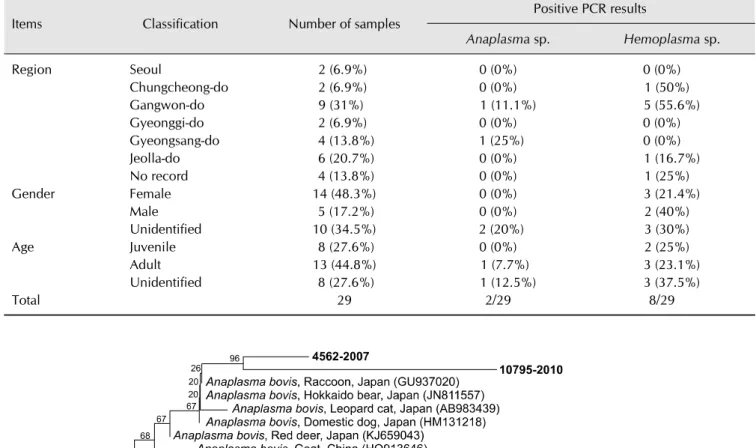
This study examined the occurrence of Anaplasma spp. and hemoplasma infection in leopard cats, Prionailurus bengalensis euptilurus, in Korea. Twenty-nine biological samples were tested by molecular analysis. Two (6.9%) and eight (27.6%) tested specimens were positive for Anaplasma bovis and hemoplasma infection, respectively. Based on our results, Anaplasma/Ehrlichia spp. and hemoplasma are regularly infecting leopard cat populations of Korea. Considering their endangered status, regular monitoring of infection by arthropod-borne pathogens known to cause clinical symptoms in feline hosts such as Anaplasma/Ehrlichia spp. and hemoplasma would be crucial as part of ongoing conservation efforts.
Keywords: Anaplasma bovis, arthropod-borne pathogens, endangered species, hemoplasma, leopard cats
The leopard cat (Prionailurus bengalensis euptilurus) is one of the few top predator species in Korean wildlife that has been designated as an endangered wildlife species by the Ministry of the Environment, Korea. A recent study reported that many wildlife species in Korea (including raccoon dogs, rodents, water deer and leopard cats) carry tick species known to function as vectors of various tick-borne pathogens [7]. Among tick-borne pathogens, Anaplasma (A.) phagocytophilum, Ehrlichia (E.) canis and hemoplasma are critical agents that can cause clinical symptoms in feline hosts such as thrombocytopenia and severe anemia [14]. In addition, A. phagocytophilum and E.
canis are well known for causing human granulocytic anaplasmosis (HGA) and canine ehrlichiosis, respectively [4,9].
Occurrence of Anaplasma spp. and Ehrlichia spp. infection has previously been reported in several Korean wildlife hosts, including water deer, weasels and several species of rodent [8,9]. However, it is not known if these pathogens are infecting leopard cats in Korea. It is essential to understand the prevalence of pathogens that may influence the health status of endangered species as part of ongoing conservation efforts.
In this study, we used samples of leopard cats provided by the Conservation Genome Resource Bank for Korean Wildlife (CGRB), which maintain archives of biological samples of wildlife collected for research purposes. Sixteen frozen blood
samples and 13 frozen spleen tissues samples were collected in 2003 through 2011 from various regions of Korea. Detailed information describing the samples used in this study is provided in Table 1.
Total DNA was extracted from spleen or blood samples using a DNeasy Blood & Tissue Kit (Qiagen, Germany). Conventional PCR was conducted to amplify the 16S rRNA gene of hemoplasma and Anaplasma/Ehrlichia spp. as previously described [2,4].
The primer set used for hemoplasma detection produces a 595
base pair (bp) amplicon from Mycoplasma (M.) haemofelis and
a 618 bp amplicon from M. haemominutum, whereas the size of
the amplicon from Anaplasma/Ehrlichia spp. PCR was
approximately 431 bp [4]. Amplified products were separated
by electrophoresis on a 2% agarose gel, after which positive
PCR amplicons were sequenced directly using an ABI prism
3730 DNA sequence analyzer (PE Applied Biosystems, USA)
at the National Instrumentation Center for Environmental
Management (NICEM) sequencing facility (Seoul, Korea). The
homology of the 16S rRNA genes of the positive samples were
examined using the Basic Local Alignment Search Tool
(BLAST) network service. Additionally, sequences from this
study were compared with those available in the GenBank
database (National Center for Biotechnology Information,
USA) using the ClustalW algorithm followed by analysis with