Research Article
Delays in the Management of Patients with Acute Ischemic Stroke during the COVID-19 Outbreak Period: A Multicenter Study in Daegu, Korea
Sang-Hun Lee, 1 You Ho Mun , 2 Hyun Wook Ryoo, 3 Sang-Chan Jin, 1 Jung Ho Kim, 2 Jae Yun Ahn, 3 Tae Chang Jang, 4 Sungbae Moon, 3 Dong Eun Lee, 5 and Hyungjong Park 6
1
Department of Emergency Medicine, Dongsan Medical Center, Keimyung University, Daegu 42601, Republic of Korea
2
Department of Emergency Medicine, Yeungnam University College of Medicine, Daegu 42415, Republic of Korea
3
Department of Emergency Medicine, School of Medicine, Kyungpook National University, Daegu 41944, Republic of Korea
4
Department of Emergency Medicine, School of Medicine, Daegu Catholic University, Daegu 42472, Republic of Korea
5
Department of Emergency Medicine, Kyungpook National University Chilgok Hospital, School of Medicine, Kyungpook National University, Daegu 41404, Republic of Korea
6
Department of Neurology, Dongsan Medical Center, Keimyung University, Daegu 42601, Republic of Korea
Correspondence should be addressed to You Ho Mun; [email protected]
Received 17 December 2020; Revised 4 March 2021; Accepted 10 March 2021; Published 24 March 2021 Academic Editor: Yan-Ren Lin
Copyright © 2021 Sang-Hun Lee et al. This is an open access article distributed under the Creative Commons Attribution License, which permits unrestricted use, distribution, and reproduction in any medium, provided the original work is properly cited.
Background. Timely treatment is important for patients with acute ischemic stroke (AIS). However, the coronavirus disease 2019 (COVID-19) outbreak may have caused delays in patient management. Therefore, we analyzed the prognosis and the time spent at the prehospital and hospital stages in managing patients diagnosed with AIS during the COVID-19 outbreak. Methods. This retrospective study evaluated patients diagnosed with AIS in the emergency department (ED) at five medical centers in Daegu city between February 18 and April 17 each year from 2018 to 2020. Data on the patients’ clinical features and time spent on management were collected and compared according to COVID-19 and pre-COVID-19 summaries. Results. From a total of 533 patients diagnosed with AIS, 399 patients visited the ED before COVID-19 and 134 during the COVID-19 outbreak. During the COVID-19 outbreak, compared with pre-COVID-19, AIS patients had poor National Institute of Health Stroke Scale scores at the initial hospital visit (6 vs. 4, p � 0.013) and discharge (3 vs. 2, p � 0.001). During the COVID-19 outbreak, the proportion of direct visits to hospitals through public emergency medical services (EMS) increased, and the onset of symptoms-to-ED door time via the public EMS was delayed (87 min vs. 68 min, p � 0.006). Conclusions. The prognosis of AIS patients during the COVID-19 outbreak was worse than that of pre-COVID-19 patients with delays at the prehospital stage, despite the need for timely care.
1. Introduction
The coronavirus disease 2019 (COVID-19) caused by the novel severe acute respiratory syndrome coronavirus 2 (SARS-CoV-2) was spread worldwide in March 2020 and was declared a pandemic by the World Health Organization [1]. As of October 1, 2020, more than 30 million people have been infected with COVID-19 globally, resulting in a sig- nificant public health impact [2]. Unfortunately, the transmission route for COVID-19 is not completely un- derstood [3]. The SARS-CoV-2 symptoms vary and are
atypical, including neurological symptoms and typical fever- related respiratory symptoms [1]. Therefore, it is not easy to detect COVID-19 infection based on a patient’s initial symptoms alone. Treatment of acute ischemic stroke (AIS) is extremely time-sensitive. The factors that delay treatment and reduce the critical timeframe can be related to the patient or medical system circumstances [4]. The fear of transmitting SARS-CoV-2 was very high during the COVID-19 outbreak, making patients hesitant to visit the emergency department (ED) [5]. To prevent the spread of COVID-19, many protocols are required not only in
Volume 2021, Article ID 6687765, 7 pages
https://doi.org/10.1155/2021/6687765
hospitals but also in the prehospital stage, causing delays in medical care [6, 7]. Thus, it is expected that the management of AIS would be affected by these changes during the COVID-19 outbreak. Some previous studies have analyzed the impact in the clinical setting; however, studies involving the prehospital stage are lacking.
The first case in Daegu occurred on February 18, 2020.
Since then, the number of confirmed cases has increased exponentially, and the cumulative number of confirmed cases in the first month reached 6,000. As a single city, Daegu recorded the highest rising trend and number of confirmed cases since the beginning of the pandemic at Wuhan City (Figure 1). During this period, 27 ED shutdowns occurred in six level 1 and 2 EDs in Daegu city due to quarantine failure, and each shutdown continued for approximately 16 hours.
Therefore, Daegu’s emergency medical system was on the verge of collapse [8]. In this study, we investigated the delay in medical care and its impact on patients with AIS in Daegu city.
2. Materials and Methods
2.1. Study Design and Search Strategy. As of December 2019, Daegu has a population of 2.47 million and is the fourth largest city in Korea. There were 16 level 3, 4 level 2, and 2 level 1 EDs, 1 fire department, and 8 fire stations, along with 48 affiliated safety centers [9]. When a rescue report is re- ceived, it is dispatched from the nearest safety center.
Emergency medical personnel are transported in accordance with the first-aid instructions in the emergency room from levels 1 to 3 [10]. This retrospective study included adult patients (aged ≥18 years) diagnosed with AIS and managed in the ED from February 18, 2020, to April 17, 2020. For comparison, data were collected from patients with an ED visit diagnosed with AIS between February 18 and April 17, 2018, and 2019. The study included two of the five medical centers in Daegu city that offer essential treatment for AIS patients, including endovascular procedures. The study protocol was approved by the Institutional Review Board of the Kyungpook National University Hospital (2020-07-017) and exempted from prior consent requirements due to the retrospective nature of the study.
We screened for AIS by verifying all patients who visited the ED with an International Classification of Diseases, 10th Revision, Clinical Modification (ICD-10-CM) diagnosis of cerebrovascular disease (I60–I64). AIS was diagnosed through neurological symptoms and neuroimaging, such as computed tomography (CT) and magnetic resonance im- aging, confirmed by specialists in the Department of Emergency Medicine, Neurology, Neurosurgery, and Ra- diology on the day of treatment [11]. In this study, patient data were collected from 2018, and patients were enrolled if they received standard care for early management within 6 hours after symptom development based on the 2015 American Heart Association/American Stroke Association guidelines [12]. The time of symptom onset was based on the first abnormal time (FAT) perceived by the patient or witness. We excluded patients if the hospital and emergency response team records did not match, refused treatment, or
had already received early management treatment in other hospitals, or if the transient ischemic attack was not con- firmed by objective neuroimaging. A board-certified emergency medicine doctor independently reviewed the medical records to determine the final diagnosis of AIS.
Patient data including age, sex, comorbid diseases, hospital course, mortality, and mental status scores were retrieved from the patients’ electronic medical records (EMRs). The National Institute of Health Stroke Scale (NIHSS) scores were measured at the time of the visit and discharge. The type of patient transportation to the hospital and the dates associated with the development of symptoms, examinations, management, and last normal time (LNT) based on the last time the patient had no symptoms were also collected through EMRs. In the group of patients who were transported to the hospital using the public emergency medical service (EMS), data for symptom onset-to-ED door were subdivided into EMS call time, on-scene arrival time, and the first medical examination. This record was collected using an EMS runsheet.
2.2. Statistical Analysis. Continuous variables are reported as mean ± standard deviation or median and interquartile range. Parametric data were compared using Student’s t-test and the Mann–Whitney U test for nonparametric data.
Categorical variables were reported as number (%) and were compared using the χ2 test with Yates’ correction or Fisher’s exact test, as warranted. All statistical analyses were per- formed using IBM SPSS (version 21.0; IBM Corp., Armonk, NY, USA), with a two-sided p value <0.05, considered statistically significant.
3. Results
During the 2 months of 2020 selected for the study period during the COVID-19 outbreak, 134 AIS patients visited five hospitals in Daegu (DongSan Medical Center, Kyungpook National University Hospital, Yeungnam University Med- ical Center, Daegu Catholic University Medical Center, Daegu Fatima Hospital). During the same period in 2018 and 2019, 196 and 203 AIS patients visited the same five hospitals in Daegu (Figure 2).
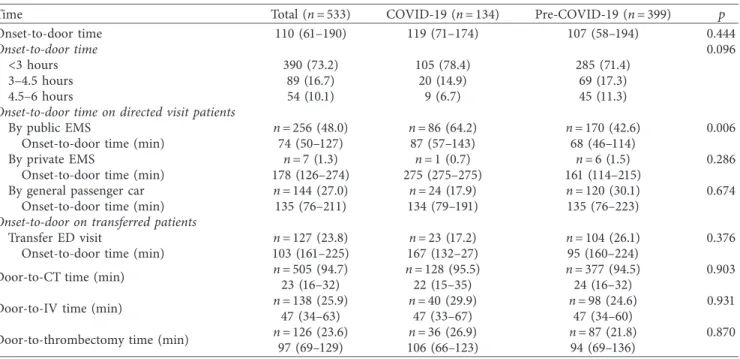
For a total sample of 533 AIS patients, the mean age was 69.5 years and consisted of 326 (61.2%) men. During COVID-19, there were more direct ED visits than transfers from other hospitals (82.9% vs. 73.9%, p � 0.022), and the patients used more public EMS during COVID than during the prepandemic period when visiting the ED (64.2% vs.
42.6%, p < 0.001). During in-hospital management, there was a higher rate of thrombectomy during COVID-19 and a relatively lower rate of conservative management (p � 0.045). During the outbreak, the NIHSS scores at the ED visit and discharge were higher than in the previous years (6 vs. 4, p � 0.013 and 3 vs. 2, respectively, p � 0.001).
During the outbreak, the mean duration of stay in the in-
tensive care unit was longer (5.7 days vs. 4.4 days, p � 0.047)
and in-hospital mortality was higher (9.7% vs. 2.3%,
p < 0.001) (Table 1).
AIS patients feb. 18 ~ apr. 17, from 2018 to 2020
first abnormal time < 6 hours
n = 533Pre-COVID-19 (2018, 2019) AIS patients
n = 399
COVID-19 outbreak (2020) AIS patients
n = 134
Acute ischemic stroke (AIS) patients
feb. 18 ~ apr. 17, from 2018 to 2020 first abnormal time <6 hours
n = 627
Exclusion
Missing data (
n = 11)Did not want treatment (n = 3)
Already received management in other hospitals (
n = 7)Transient ischemic attack (n = 73)
(i) (ii) (iii) (iv)
Figure 2: Flowchart of the study patients.
0 1000 2000 3000 4000 5000 6000 7000 8000
0 100 200 300 400 500 600 700 800
21-Jan 28-Jan 4-Feb 11-Feb 18-Feb 25-Feb 3-Mar 10-Mar 17-Mar 24-Mar 31-Mar 7-Apr 14-Apr 21-Apr 28-Apr 5-May 12-May 19-May 26-May
New cases Cumulative cases
Study period between February 18 and April 17