Background and Purpose We aimed to determine whether the care process and outcomes in patients with acute stroke who received recanalization therapy changed during the outbreak of coronavirus disease 2019 (COVID-19) in South Korea.
Methods We used data from a prospective multicenter reperfusion therapy registry to com- pare the care process—including the time from symptom onset to treatment, number of treat- ed patients, and discharge disposition—and treatment outcomes between before and during the COVID-19 outbreak in South Korea.
Results Upon the COVID-19 outbreak in South Korea, the number of patients receiving en- dovascular treatment to decrease temporarily but considerably. The use of emergency medical services by stroke patients increased from 91.5% before to 100.0% during the COVID-19 out- break (p=0.025), as did the median time from symptom onset to hospital visit [median (inter- quartile range), 91.0 minutes (39.8–277.0) vs. 176.0 minutes (56.0–391.5), p=0.029]. Further- more, more functionally dependent patients with disabilities were discharged home (59.5% vs.
26.1%, p=0.020) rather than staying in a regional or rehabilitation hospital. In contrast, there were no COVID-19-related changes in the times from the hospital visit to brain imaging and treatment or in the functional outcome, successful recanalization rate, or rate of symptomatic intracerebral hemorrhage.
Conclusions These findings suggest that a prehospital delay occurred during the COVID-19 outbreak, and that patients with acute stroke might have been reluctant to visit and stay in hospi- tals. Our findings indicate that attention should be paid to prehospital care and the behavior of patients with acute stroke during the COVID-19 outbreak.
Key Words reperfusion, therapy, stroke, outcome, coronavirus disease 2019.
Care Process of Recanalization Therapy for Acute Stroke during the COVID-19 Outbreak in South Korea
INTRODUCTION
The world is currently being affected by an ongoing pandemic of a novel coronavirus-re- lated acute respiratory illness called coronavirus disease 2019 (COVID-19). The onset of the COVID-19 outbreak in February 2020 in South Korea prompted the Korea Centers for Disease Control and Prevention (KCDC) to strongly recommend social distancing, mini- mizing outdoor activity, and the use of personal protective equipment. The KCDC also made daily announcements of the number of confirmed cases of COVID-19 and per- formed extensive contact tracking and testing when each new confirmed case of COV- ID-19 was detected. All of these activities were announced daily via the mass media and social network services. In the midst of these announcements, many Koreans were over- whelmed by a fear of COVID-19 and so stayed at home. Given the rapid disease spread, the government designated numerous public relief hospitals and COVID-19 screening centers for the care and testing of COVID-19.
Young Dae Kima,b, Hyo Suk Nama,b Sung-Il Sohnc, Hyungjong Parkc Jeong-Ho Hongc, Gyu Sik Kimd Kwon-Duk Seod, Joonsang Yood Jang-Hyun Baeke
Jung Hwa Seof, JoonNyung Heoa Minyoul Baika, Hye Sun Leeg Ji Hoe Heoa,b
on behalf of the SMART-EST Study Group
a Department of Neurology,
Yonsei University College of Medicine, Seoul, Korea
b Integrative Research Center for Cerebrovascular and Cardiovascular Diseases,
Yonsei University College of Medicine, Seoul, Korea
c Department of Neurology, Brain Research Institute,
Keimyung University School of Medicine, Daegu, Korea
d Department of Neurology, National Health Insurance Service Ilsan Hospital, Ilsan, Korea
e Department of Neurology, Kangbuk Samsung Hospital, Sungkyunkwan University School of Medicine, Seoul, Korea
f Department of Neurology, Busan Paik Hospital, Inje University College of Medicine, Busan, Korea
g Biostatistics Collaboration Unit, Yonsei University College of Medicine, Seoul, Korea
pISSN 1738-6586 / eISSN 2005-5013 / J Clin Neurol 2021;17(1):63-69 / https://doi.org/10.3988/jcn.2021.17.1.63
Received June 10, 2020 Revised September 12, 2020 Accepted September 16, 2020 Correspondence
Ji Hoe Heo, MD, PhD Department of Neurology,
Yonsei University College of Medicine, 50-1 Yonsei-ro, Seodaemun-gu, Seoul 03722, Korea
Tel +82-2-2228-1605 Fax +82-2-393-0705 E-mail [email protected]
cc This is an Open Access article distributed under the terms of the Creative Commons Attribution Non-Com- mercial License (https://creativecommons.org/licenses/by-nc/4.0) which permits unrestricted non-commercial use, distribution, and reproduction in any medium, provided the original work is properly cited.
JCN
Open AccessORIGINAL ARTICLE
Care Process for Stroke and COVID-19
JCN
Recanalization therapies such as intravenous thromboly- sis and endovascular thrombectomy (EVT) have been dem- onstrated to be effective for eligible patients with acute isch- emic stroke.
1,2These interventions will be effective if the patient presents early to the hospital and receives rapid treat- ment.
3However, the COVID-19 outbreak may affect the be- havior of patients with stroke in terms of the probability of them making hospital visits and the in-hospital care process itself.
To determine whether the behavior of patients with stroke and the in-hospital care process have changed during the COVID-19 outbreak, we compared various related factors between before and during the COVID-19 outbreak in pa- tients who received reperfusion therapy in South Korea us- ing data obtained from a prospective multicenter reperfusion therapy registry.
METHODS
Patients
Data were derived from the Specialized Multi-center Attrib- uted Registry of sTroke—EndovaScular or Thrombolytic ther- apy (SMART-EST) registry (clinicaltrials.gov NCT04066556).
The SMART-EST is a prospective multicenter registry con- taining information on consecutive patients with acute isch- emic stroke who have received the standard reperfusion ther- apy since July 2019 in 18 hospital centers in South Korea.
The SMART-EST was the successor to the nationwide mul- ticenter registry project [SElection CRiteria in Endovascular Thrombectomy and thrombolytic therapy registry (clinical- trials.gov NCT02964052)].
4Written informed consent was obtained from patients or their next of kin for inclusion in the registry. The use of the registry was approved by the Institutional Review Board of each participating hospital (4-2019-0486, KBSMC 2019-11- 013-001, DSMC 2019-09-011, NHIMC 2019-09-013-003, 19- 0158).
The number of confirmed cases of COVID-19 in South Ko- rea has increased dramatically since February 20, 2020. There- fore, for the purpose of this study, we included patients who received reperfusion therapy before and during the COVID-19 outbreak, between October 21, 2019 and April 20, 2020. Five hospital centers that had entered complete data for all con- secutive patients who received reperfusion therapy during the study period into the SMART-EST registry participated in this study. All five hospitals were designated as public relief hospitals and COVID-19 screening centers by the government.
Data and time parameters
In addition to demographic information, we obtained data
on treatment time parameters, including the time (in minutes) from symptom onset to the emergency department (ED) visit and the times (in minutes) from arrival at the ED to initial brain imaging, bolus injection of intravenous thrombolytics, femoral puncture for EVT, and final recanalization. When the onset time was unclear, we used the time last-known well as a proxy for the onset time. The location of the culprit le- sion was classified as the internal carotid artery, middle ce- rebral artery, vertebrobasilar artery, or other. Stroke severity was assessed using the National Institutes of Health Stroke Scale (NIHSS). We also determined the method of transpor- tation to the ED, such as emergency medical services (EMS) or arriving in their own car.
At hospital discharge, we obtained the modified Rankin Scale (mRS) score and the discharge disposition. Successful recanalization in EVT was defined as thrombolysis in cerebral infarction grade 2b or 3 on conventional angiography, where- as successful recanalization in intravenous thrombolysis was defined as an arterial occlusive lesion score of 3 in computed tomography angiography or magnetic resonance angiogra- phy at 24 hours. We also determined if patients experienced a symptomatic intracerebral hemorrhage, defined as any type of hemorrhage causing neurological deterioration with an NIHSS score of ≥4 or leading to death or surgery within 7 days of stroke onset. Finally, we obtained information on whether a patient was tested for COVID-19 and whether the patient tested positive.
Statistical analyses
Data were expressed as frequency (percentage), median (in- terquartile range), or mean±standard-deviation values. Con- tinuous variables were compared using independent-samples
t-tests or Mann-Whitney tests, while categorical variableswere compared using chi-square tests or Fisher’s exact tests, as appropriate. We compared baseline characteristics, time parameters, outcomes, and discharge disposition between be- fore the COVID-19 outbreak (from November 20, 2019 to January 20, 2020) and during the COVID-19 outbreak (from February 19 to April 20, 2020). We also evaluated the num- ber of patients who received reperfusion therapy per month during the 5-month study period. All statistical analyses were performed using the Windows SPSS software (version 23.0, IBM Corporation, Armonk, NY, USA).
RESULTS
There were 151 consecutive patients who received reperfu-
sion therapy during the 5-month study period: 94 before and
57 during the COVID-19 outbreak, respectively. The use of
EMS for transport to the ED was more common during the
Kim YD et al.
JCN
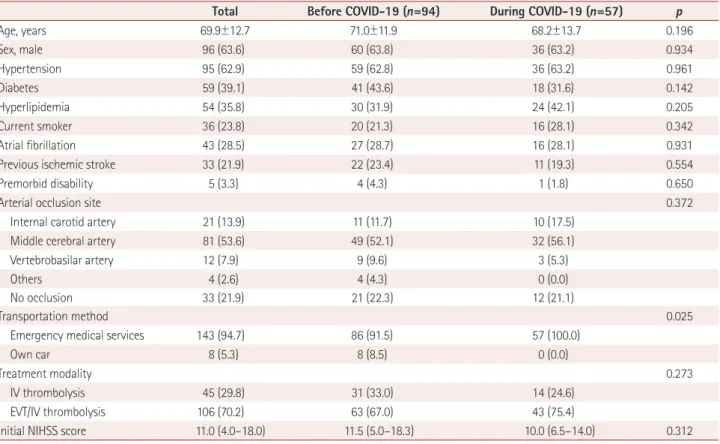
COVID-19 outbreak (100.0%) than before the COVID-19 outbreak (91.5%, p=0.025). The remaining baseline charac- teristics did not differ between before and during the COV- ID-19 outbreak (Table 1). All of the 57 patients who were treated during the COVID-19 outbreak were screened for COVID-19, of which 14 were tested for COVID-19, with none of them testing positive.
The number of patients who received reperfusion therapy at the study hospitals decreased considerably when the CO- VID-19 outbreak began in South Korea. However, the fre- quency of reperfusion therapy returned to pre-COVID-19 levels during the month after the initial outbreak (Fig. 1). The time from symptom onset to the ED visit was significantly lon- ger during the COVID-19 outbreak (median=176.0 minutes, interquartile range=56.0–391.5 minutes) than before the CO- VID-19 outbreak (median=91.0 minutes, interquartile range=
39.8–277.0 minutes, p=0.029). However, the times from ED arrival to initial brain imaging, intravenous thrombolysis, fem- oral puncture, and final recanalization did not differ between before and during the COVID-19 outbreak (all p>0.05) (Ta- ble 2).
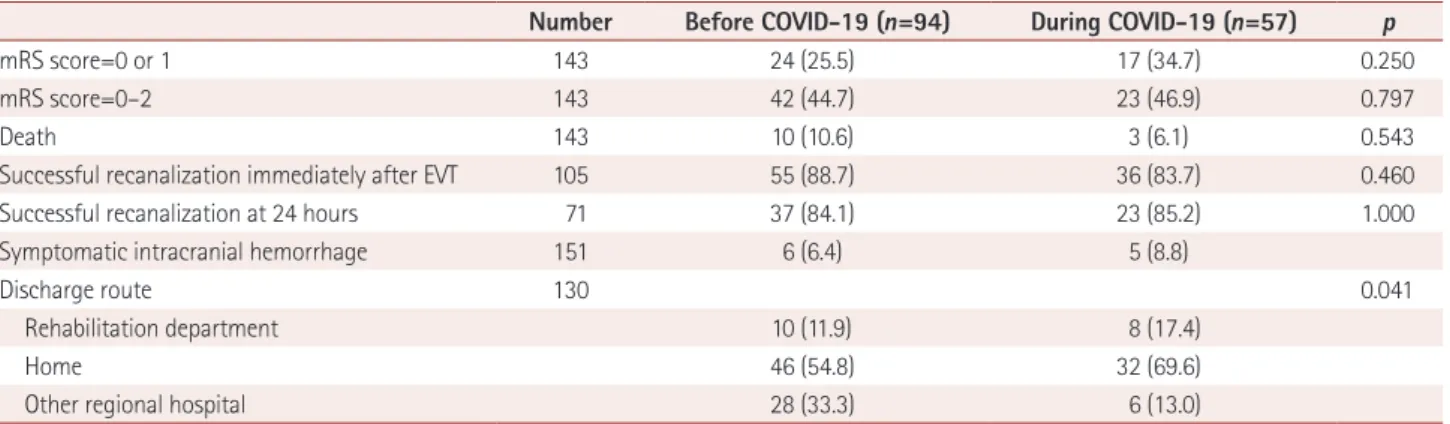
The rate of successful recanalization, frequency of symp-
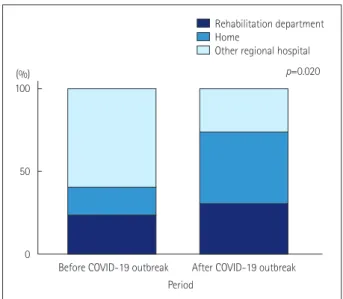
tomatic intracerebral hemorrhage, mRS score at discharge, and mortality rate did not differ between before and during the COVID-19 outbreak (Tables 2 and 3). While the function- al outcome (mRS score) at discharge did not differ among the 130 survivors, the proportion of patients discharged home (rather than to a rehabilitation facility or another hospital) was significantly larger during the COVID-19 outbreak (n=32, 69.6%) than before the COVID-19 outbreak (n=46, 54.8%) (p=0.041). Sixty-five of the 130 stroke survivors had a disabil- ity requiring functional dependence (mRS score=3–5) at dis- charge. These patients typically require further rehabilitation therapy in regional hospitals after discharge, but the propor- tion who were transferred to other regional hospitals or nurs- ing homes was significantly smaller during the COVID-19 out- break (26.1%) than before the COVID-19 outbreak (59.5%,
p=0.020) (Fig. 2).The times from symptom onset to ED visit and from ED visit to final recanalization were longer for the 14 patients who were tested for COVID-19 during the COVID-19 out- break than for the 43 patients who were not tested (Supple- mentary Table 1 in the online-only Data Supplement).
Table 1. Comparison of the baseline characteristics of patients upon their arrival at the hospital emergency department between before and dur- ing the COVID-19 outbreak
Total Before COVID-19 (n=94) During COVID-19 (n=57) p
Age, years 69.9±12.7 71.0±11.9 68.2±13.7 0.196
Sex, male 96 (63.6) 60 (63.8) 36 (63.2) 0.934
Hypertension 95 (62.9) 59 (62.8) 36 (63.2) 0.961
Diabetes 59 (39.1) 41 (43.6) 18 (31.6) 0.142
Hyperlipidemia 54 (35.8) 30 (31.9) 24 (42.1) 0.205
Current smoker 36 (23.8) 20 (21.3) 16 (28.1) 0.342
Atrial fibrillation 43 (28.5) 27 (28.7) 16 (28.1) 0.931
Previous ischemic stroke 33 (21.9) 22 (23.4) 11 (19.3) 0.554
Premorbid disability 5 (3.3) 4 (4.3) 1 (1.8) 0.650
Arterial occlusion site 0.372
Internal carotid artery 21 (13.9) 11 (11.7) 10 (17.5)
Middle cerebral artery 81 (53.6) 49 (52.1) 32 (56.1)
Vertebrobasilar artery 12 (7.9) 9 (9.6) 3 (5.3)
Others 4 (2.6) 4 (4.3) 0 (0.0)
No occlusion 33 (21.9) 21 (22.3) 12 (21.1)
Transportation method 0.025
Emergency medical services 143 (94.7) 86 (91.5) 57 (100.0)
Own car 8 (5.3) 8 (8.5) 0 (0.0)
Treatment modality 0.273
IV thrombolysis 45 (29.8) 31 (33.0) 14 (24.6)
EVT/IV thrombolysis 106 (70.2) 63 (67.0) 43 (75.4)
Initial NIHSS score 11.0 (4.0–18.0) 11.5 (5.0–18.3) 10.0 (6.5–14.0) 0.312
Data are n (%), mean±standard-deviation, or median (interquartile range) values.
COVID-19: coronavirus disease 2019, EVT: endovascular thrombectomy, EVT/IV thrombolysis: EVT only or EVT after IV thrombolysis, IV: intravenous, NI- HSS: National Institutes of Health Stroke Scale.
Care Process for Stroke and COVID-19
JCN
DISCUSSION
In this study we found that during the COVID-19 outbreak, the time from stroke onset to ED arrival and the frequency of EMS use among stroke patients increased and that more
stroke patients were discharged home rather than to another regional hospital, despite having a disability. However, no in-hospital delays were observed from hospital arrival to eval- uation and reperfusion therapy.
The findings of this study suggest that there were noticeable
Nov. 20 Dec. 20 Jan. 20 Feb. 20 Mar. 20 Apr. 20
2019 2019 2020 2020 2020 2020
Number of cases with recanalization therapy Cumulative number of cases with COVID-19
40 30 20 10 0
10,000
5,000
0 All reperfusion therapy
Endovascular treatment Intravenous tPA
Fig. 1. Secular trends in the number of patients who received reperfusion therapy. The total number of acute stroke cases involving reperfusion therapy is displayed for each month on the left axis. The total number of confirmed cases of COVID-19 in South Korea per day is displayed on the right axis. COVID-19: coronavirus disease 2019, tPA: tissue plasminogen activator.
Table 2. Comparison of times (in minutes) from symptom onset to in-hospital treatments between before and during the COVID-19 outbreak
Parameter Number Before COVID-19 (n=94) During COVID-19 (n=57) p
Symptom onset to ED arrival 151 91.0 (39.8–277.0) 176.0 (56.0–391.5) 0.029
ED arrival to initial brain imaging 150 18.5 (14.0–27.0) 16.0 (12.0–21.8) 0.068
ED arrival to tPA bolus 86 37.0 (28.0–49.0) 35.0 (21.0–48.0) 0.248
ED arrival to femoral puncture 107 102.0 (78.3–130.3) 94.0 (79.0–114.0) 0.403
ED arrival to final recanalization 82 149.0 (114.5–204.0) 153.0 (112.5–183.5) 0.590
Data are median (interquartile range) values.
COVID-19: coronavirus disease 2019, ED: emergency department, tPA: tissue plasminogen activator.
Table 3. Comparison of patient outcomes at hospital discharge between before and during the COVID-19 outbreak
Number Before COVID-19 (n=94) During COVID-19 (n=57) p
mRS score=0 or 1 143 24 (25.5) 17 (34.7) 0.250
mRS score=0–2 143 42 (44.7) 23 (46.9) 0.797
Death 143 10 (10.6) 3 (6.1) 0.543
Successful recanalization immediately after EVT 105 55 (88.7) 36 (83.7) 0.460
Successful recanalization at 24 hours 71 37 (84.1) 23 (85.2) 1.000
Symptomatic intracranial hemorrhage 151 6 (6.4) 5 (8.8)
Discharge route 130 0.041
Rehabilitation department 10 (11.9) 8 (17.4)
Home 46 (54.8) 32 (69.6)
Other regional hospital 28 (33.3) 6 (13.0)
Data are n (%) values.
COVID-19: coronavirus disease 2019, EVT: endovascular thrombectomy, mRS: modified Rankin Scale.
Kim YD et al.
JCN
Fig. 2. Comparison of the discharge disposition among patients with functionally dependent disabilities (modified Rankin Scale score=3–5) between before and during the COVID-19 outbreak. COVID-19: coro- navirus disease 2019.
behavioral changes in patients who experienced an acute stroke during the COVID-19 outbreak. Many patients with stroke visit hospitals using their own cars in South Korea.
5Af- ter the first case of COVID-19 in January 20, 2020, the KCDC strongly recommended people to call a regional public health service center when they experienced any symptoms suspi- cious of COVID-19 or had direct/indirect contact with a con- firmed case of COVID-19. Therefore, during the COVID-19 outbreak, people may rely more on government-derived pub- lic health services and be more likely to call EMS when they appear to have developed stroke-like symptoms.
The use of EMS transport usually shortens the time from symptom onset to hospital arrival.
6However, despite the in- creased use of EMS, the time from symptom onset to ED ar- rival increased significantly during the COVID-19 outbreak, which may be ascribed to various factors related to the care system and patients. When being transported from the home to the hospital via the EMS, prehospital delay attributable specifically to the COVID-19 outbreak may occur at any step, including when the staff are donning personal protective equipment or cleaning the ambulance bed, and/or during the screening process performed by EMS personnel.
7In addi- tion, some hospitals were closed due to in-hospital COV- ID-19 outbreaks and some hospitals were fully designated to COVID-19 patient care. Medical resources for controlling this infectious crisis (including medical personnel and infra- structure) were prioritized by the government, and so many ambulances and EMS personnel played a primary role in delivering patients with confirmed or suspected COVID-19 to COVID-19 centers. Although these changes were neces-
sary and inevitable, they may have also contributed to prehos- pital delay among patients who did not have COVID-19 but who needed EMS, including those with acute stroke. Prehos- pital delay in acute stroke patients is associated with increased infarction size, neurological worsening, and complications, which subsequently lead to unfavorable outcomes.
8,9There- fore, interventions for delivering acute stroke patients at the prehospital level should be considered. For example, it would be beneficial to reduce time delays by choosing the closest hospital, ensuring mutual communication with receiving hos- pitals, and implementing a prenotification system.
7The delayed hospital arrival among patients who were test- ed for COVID-19 further suggests that patient-related fac- tors are at least partly responsible for the prehospital delay.
Patients who are tested for COVID-19 may have had fever, re- spiratory symptoms, or a recent history of visits to areas with COVID-19 outbreaks. In such cases the EMS personnel would have taken extra preparations to prevent potential disease transmission. Also, the ambulance may have had to bypass the hospital closest to the patient’s home since it was not des- ignated as a public relief hospital, further contributing to the delay.
The number of patients who received reperfusion therapy decreased during the analysis period in this study. Some Ko- reans might be concerned about hospital-acquired COVID-19, given the experiences with a previous outbreak of Middle Eastern respiratory syndrome (MERS) in South Korea.
10The MERS outbreak began in the ED of a large tertiary hospital in South Korea, and so some patients with acute stroke may have hesitated about visiting the ED of a large hospital when they developed stroke symptoms. During the initial COV- ID-19 outbreak in South Korea, the number of patients who visited the study hospitals and received reperfusion treatment did indeed decrease considerably. Other factors such as ex- cluding patients with indications outside the strict guidelines
11or a lack of proper transportation
12,13could have influenced these findings. Furthermore, the proportion of patients with functional dependence due to a disability who were dis- charged home also increased significantly during the COV- ID-19 outbreak. These findings suggest that some patients with stroke may have felt safer staying at home than being ad- mitted to a hospital or rehabilitation center. It is also possible that some regional hospitals were reluctant to accept hospi- tal-to-hospital patient transfers due to the shortage of med- ical and human resources during the COVID-19 outbreak.
In contrast to the prehospital delay during the COVID-19 outbreak, there were no in-hospital delays from ED arrival to initial brain imaging and reperfusion treatment. In each of our study hospitals, every patient arriving at the ED was first screened for COVID-19-related symptoms, body temper-
(%) 100
50
0
Before COVID-19 outbreak After COVID-19 outbreak p=0.020 Rehabilitation department Home
Other regional hospital
Period
Care Process for Stroke and COVID-19
JCN
ature, the recent history of direct or close contact with any COVID-19 patient, and the recent history of visits to areas with COVID-19 outbreaks. During this screening process, patients who were suspected of having COVID-19 were sent to a screening station, tested for COVID-19, and then quaran- tined until the result of the screening test was available.
14,15However, patients with symptoms of acute stroke who were indicated for reperfusion therapy (code stroke) were screened rapidly at most of our study hospitals in order to prevent time delays after entering the ED. Moreover, the primary screen- ing process had already been performed by EDS personnel.
The treatment outcomes did not differ between before and during the COVID-19 outbreak. The Korean Stroke Society has provided statements on optimal stroke care including re- perfusion therapy during the COVID-19 pandemic,
16and many stroke centers including the present study hospitals tried to implement the new protocols for the triage and care of hyperacute stroke patients, such as applying a rapid screen- ing tool to patients with stroke symptoms and performing EVT in a negatively pressurized or properly isolated room by medical staff wearing personal protective equipment be- fore receiving the confirmed result from the COVID-19 test.
These aspects of the in-hospital care process for COVID- 19-free patients with acute ischemic stroke were not signifi- cantly affected by the COVID-19 outbreak, which might ex- plain why the outcomes during the COVID-19 outbreak were similar to those before the outbreak. However, this finding was based on short-term observations, and there are also other potential reasons, such as the possibility that patients treated during the COVID-19 outbreak had favorable characteristics such as a good imaging profile (e.g., good collaterals).
Recent studies of COVID-19 in stroke patients have focused on the prevalence, pathogenesis, and outcomes of stroke in COVID-19 patients, and on developing guidelines or state- ments for the acute care of patients with stroke who also have COVID-19.
16-20However, a large proportion of patients with acute stroke are COVID-19-free. Our findings indicate that the COVID-19 outbreak may affect the prehospital delivery process and how patients with acute stroke and their fami- lies behave after the occurrence of stroke symptoms. In ad- dition to the care provided to stroke patients with confirmed COVID-19, hospital and government policymakers should also be concerned about the behavior of general patients with acute stroke and the prehospital delivery process during the COVID-19 pandemic. Urgent efforts by support networks (i.e., academic stroke society) and policymakers may be re- quired, including the designation of COVID-19-safe stroke centers, providing public education about stroke awareness and the actions to take when stroke symptoms develop, plan- ning for discharge disposition, rehabilitation plans for pa-
tients with disability who are discharged home, and prioritiz- ing stroke patients using EMS.
This study was subject to some limitations. First, the find- ings were based on data obtained from only a few tertiary hospitals in South Korea over a relatively short time period.
The prevalence of COVID-19 and the use of prehospital and in-hospital stroke care systems, including the EMS, may dif- fer between countries. Second, the behavior of people during the COVID-19 outbreak may differ between countries and cultures. These factors mean that our findings are not gener- alizable. However, a decrease in the number of patients re- ceiving EVT and an increase in the time between stroke on- set and treatment have also been observed in other regions and countries.
11,12,19,21These previous findings together with our current findings suggest the presence of common prob- lems that need to be addressed in the countries affected by the COVID-19 outbreak.
In conclusion, this study has demonstrated that the COV- ID-19 outbreak may affect the prehospital delivery process and the behavior of COVID-19-free patients with acute stroke.
In addition to managing stroke patients with confirmed CO- VID-19, attention needs to be paid to the prehospital care and behavior of general patients with acute stroke during the COVID-19 outbreak.
Supplementary Materials
The online-only Data Supplement is available with this arti- cle at https://doi.org/10.3988/jcn.2021.17.1.63.
Author Contributions
Conceptualization: Young Dae Kim, Ji Hoe Heo. Formal analysis: Hye Sun Lee, Young Dae Kim. Funding acquisition: Young Dae Kim, Hyo Suk Nam.
Investigation: all authors. Supervision: Young Dae Kim, Ji Hoe Heo. Writ- ing—original draft: Young Dae Kim, Ji Hoe Heo. Writing—review & edit- ing: Hyo Suk Nam, Sung-Il Sohn, Hyungjong Park, Jeong-Ho Hong, Gyu Sik Kim, Kwon-Duk Seo, Joonsang Yoo, Jang-Hyun Baek, Jung Hwa Seo, JoonNyung Heo, Minyoul Baik, Hye Sun Lee.
ORCID iDs
Young Dae Kim https://orcid.org/0000-0001-5750-2616 Hyo Suk Nam https://orcid.org/0000-0002-4415-3995 Sung-Il Sohn https://orcid.org/0000-0002-6900-1242 Hyungjong Park https://orcid.org/0000-0002-6112-2939 Jeong-Ho Hong https://orcid.org/0000-0002-8235-9855 Gyu Sik Kim https://orcid.org/0000-0002-0096-7065 Kwon-Duk Seo https://orcid.org/0000-0003-3154-8864 Joonsang Yoo https://orcid.org/0000-0003-1169-6798 Jang-Hyun Baek https://orcid.org/0000-0002-6733-0683 Jung Hwa Seo https://orcid.org/0000-0003-0207-2772 JoonNyung Heo https://orcid.org/0000-0001-6287-6348 Minyoul Baik https://orcid.org/0000-0002-6582-0953 Hye Sun Lee https://orcid.org/0000-0001-6328-6948 Ji Hoe Heo https://orcid.org/0000-0001-9898-3321 Conflicts of Interest
The authors have no potential conflicts of interest to disclose.
Kim YD et al.
JCN
Acknowledgements
This research was supported by a grant of the Korea Health Technology R&D Project through the Korea Health Industry Development Institute, funded by the Ministry of Health & Welfare, Republic of Korea (HC19C 0028), and by the “Dongwha” Faculty Research Assistance Program of Yonsei University College of Medicine (6-2019-0191).
REFERENCES
1. Donnan GA, Fisher M, Macleod M, Davis SM. Stroke. Lancet 2008;
371:1612-1623.
2. Goyal M, Menon BK, van Zwam WH, Dippel DW, Mitchell PJ, Demchuk AM, et al. Endovascular thrombectomy after large-vessel ischaemic stroke: a meta-analysis of individual patient data from five randomised trials. Lancet 2016;387:1723-1731.
3. Powers WJ, Rabinstein AA, Ackerson T, Adeoye OM, Bambakidis NC, Becker K, et al. Guidelines for the early management of patients with acute ischemic stroke: 2019 update to the 2018 guidelines for the early management of acute ischemic stroke: a guideline for healthcare professionals from the American Heart Association/American Stroke Association. Stroke 2019;50:e344-e418.
4. Kim YD, Heo JH, Yoo J, Park H, Kim BM, Bang OY, et al. Improving the clinical outcome in stroke patients receiving thrombolytic or endo- vascular treatment in Korea: from the SECRET study. J Clin Med 2020;
9:717.
5. Kim JY, Kang K, Kang J, Koo J, Kim DH, Kim BJ, et al. Executive summary of stroke statistics in Korea 2018: a report from the epidemi- ology research council of the Korean Stroke Society. J Stroke 2019;21:
42-59.
6. Song D, Tanaka E, Lee K, Sato S, Koga M, Kim YD, et al. Factors as- sociated with early hospital arrival in patients with acute ischemic stroke. J Stroke 2015;17:159-167.
7. Goyal M, Ospel JM, Southerland AM, Wira C, Amin-Hanjani S, Fra- ser JF, et al. Prehospital triage of acute stroke patients during the COVID-19 pandemic. Stroke 2020;51:2263-2267.
8. Saver JL. Time is brain--quantified. Stroke 2006;37:263-266.
9. Shkirkova K, Saver JL, Starkman S, Wong G, Weng J, Hamilton S, et al. Frequency, predictors, and outcomes of prehospital and early postarrival neurological deterioration in acute stroke: exploratory anal- ysis of the FAST-MAG randomized clinical trial. JAMA Neurol 2018;
75:1364-1374.
10. Oh MD, Park WB, Park SW, Choe PG, Bang JH, Song KH, et al. Mid- dle East respiratory syndrome: what we learned from the 2015 out- break in the Republic of Korea. Korean J Intern Med 2018;33:233-246.
11. Kerleroux B, Fabacher T, Bricout N, Moïse M, Testud B, Vingadassa- lom S, et al. Mechanical thrombectomy for acute ischemic stroke amid the COVID-19 outbreak: decreased activity, and increased care delays. Stroke 2020;51:2012-2017.
12. Rudilosso S, Laredo C, Vera V, Vargas M, Renú A, Llull L, et al. Acute stroke care is at risk in the era of COVID-19: experience at a compre- hensive stroke center in Barcelona. Stroke 2020;51:1991-1995.
13. Zhao J, Li H, Kung D, Fisher M, Shen Y, Liu R. Impact of the COV- ID-19 epidemic on stroke care and potential solutions. Stroke 2020;51:
1996-2001.
14. Khosravani H, Rajendram P, Notario L, Chapman MG, Menon BK.
Protected code stroke: hyperacute stroke management during the coronavirus disease 2019 (COVID-19) pandemic. Stroke 2020;51:
1891-1895.
15. Kwon KT, Ko JH, Shin H, Sung M, Kim JY. Drive-through screening center for COVID-19: a safe and efficient screening system against massive community outbreak. J Korean Med Sci 2020;35:e123.
16. Kim BJ, Kim ES, Shin MJ, Kim HB, Lee HY, Hong KS, et al. Manage- ment of acute stroke patients amid the coronavirus disease 2019 pan- demic: scientific statement of the Korean Stroke Society. J Stroke 2020;
22:203-205.
17. Leira EC, Russman AN, Biller J, Brown DL, Bushnell CD, Caso V, et al. Preserving stroke care during the COVID-19 pandemic: potential issues and solutions. Neurology 2020;95:124-133.
18. Oxley TJ, Mocco J, Majidi S, Kellner CP, Shoirah H, Singh IP, et al.
Large-vessel stroke as a presenting feature of COVID-19 in the young.
N Engl J Med 2020;382:e60.
19. Pop R, Quenardelle V, Hasiu A, Mihoc D, Sellal F, Dugay MH, et al.
Impact of the COVID-19 outbreak on acute stroke pathways-insights from the Alsace region in France. Eur J Neurol 2020;27:1783-1787.
20. Qureshi AI, Abd-Allah F, Al-Senani F, Aytac E, Borhani-Haghighi A, Ciccone A, et al. Management of acute ischemic stroke in patients with COVID-19 infection: report of an international panel. Int J Stroke 2020;15:540-554.
21. Teo KC, Leung WCY, Wong YK, Liu RKC, Chan AHY, Choi OMY, et al. Delays in stroke onset to hospital arrival time during COVID-19.
Stroke 2020;51:2228-2231.