고압 효소 액화 장치를 이용한 백년초 점질물 분해 공정의 최적화
임성빈1,2, 이형재3, 심재용4, 김태락5, 김대옥1,2*
Optimization of Demucilage Process of Opuntia ficus-indica var. sabo- ten Fruit using High Hydrostatic Pressure Enzyme Dissolution
Sungbin Im1,2, Hyungjae Lee3, Jae-Yong Shim4, Tae-Rahk Kim5, and Dae-Ok Kim1,2*
Received: 1 September 2014 / Revised: 16 December 2014 / Accepted: 3 April 2015
© 2015 The Korean Society for Biotechnology and Bioengineering
Abstract: This study aimed to develop and optimize a demu- cilaging process of Opuntia ficus-indica var. saboten (OFI) fruit to increase its usability as functional food ingredient and food additive. Viscozyme and Novozym 33095 as multi- enzyme complex having a broad spectrum of carbohydrases and pectolytic enzymes, respectively, were used in enzymatic dissolution along with high hydrostatic pressure liquefaction.
To optimize the liquefaction process using high hydrostatic pressure liquefying extractor, response surface methodology with 3-factor central composite design was employed with re- action factors such as temperatures (25, 32, 40, 48, and 55
oC), pressures (20, 40, 60, 80, and 100 MPa), and times (15, 30,
45, 60, and 75 min). At optimum conditions (25
oC, 100 MPa, and 58.275 min) for high hydrostatic pressure liquefaction process, the processed OFI fruit juice was predicted to have viscosity at 2.917 poise, partly due to the release of free sug- ars such as fructose and glucose detected using HPLC-ELSA system. The results above suggests that the OFI fruit juice with decreased viscosity may be used for various manufactur- ing processes of food, beverage, ice cream, and cosmetics.
Keywords: Carbohydrases, HPLC-ELSD, Pectolytic enzymes, Response surface methodology, Viscosity
1. INTRODUCTION
백년초 (Opuntia ficus-indica var. saboten)는 세계적으로 널리 분포되어 있는 선인장과의 식물로서, 국내에서는 제주도를 비롯한 남부지방에서 자생한다. 식용으로 사용되는 열매는 다량의 씨앗과 점질물을 띠는 펄프와 질긴 껍질로 이루어져 있다. 해외 품종의 경우 열매의 색상이 노란색, 주황색 등 다 양하나, 국내산의 경우 붉은색을 띠는 자주색 품종이 주로 재 배되고 있다. 이러한 색상은 식용색소인, 노란색의 베타잔틴 (betaxanthin)과 붉은색의 베타시아닌 (betacyanin)으로 구분 되는 베타레인 (betalain)으로부터 유래한다 [1]. 비타민, 무기 질, 폴리페놀 등을 함유하고 있으며 이러한 특성으로 인해 두 부, 젤리 등에서 식품첨가물로서 백년초의 연구가 활발하게 진행되어 왔다 [2]. 민간에서는 소염, 해열, 천식, 관절염, 위 궤양 등의 치료제로서 열매와 줄기 모두가 사용되었고, 알러 지 [3], 당뇨 [4], 염증 [5], 궤양 [6] 등의 다양한 질병에 관한
1경희대학교 식품생명공학과
1Department of Food Science and Biotechnology, Kyung Hee Univer- sity, Yongin 446-701, Korea
Tel: +82-31-201-3796, Fax: +82-31-204-8116 e-mail: [email protected]
2경희대학교 피부생명공학센터
2Skin Biotechnology Center, Kyung Hee University, Suwon 443-766, Korea
3단국대학교 식품공학과
3Department of Food Engineering, Dankook University, Cheonan 330- 714, Korea
4국립한경대학교 식품생물공학과
4Department of Food and Biotechnology, Hankyong National Univer- sity, Ansung 456-749, Korea
5(주)엘씨에스바이오텍
5Department of New Business Development, LCS Biotech, Suwon 441-853, Korea
연구논문
효능이 보고되었다.
백련초는 선인장과 (Cactaceae) 식물 특유의 점질물 때문에 산업적 이용이 제한되어 왔다. 중성 다당류 및 우론산 (uronic acid) 등으로 이루어진 선인장 점질물 [7]은 높은 함수성, 점 성으로 인해 점증제 (thickener) 등의 식품첨가물로 사용 가능 하나, 음료 및 식품 색소 등에 활용될 경우에는 물에 녹지 않 고 서로 뭉쳐져 끈적한 겔 (gel) 혹은 점액의 형태를 띄기 때 문에 가공적, 관능적으로 나쁜 영향을 끼칠 수 있다. 또한 농 축, 여과 등의 공정에서 공정 편의성을 저해하기 때문에, 다 양한 분야로의 산업적 이용을 고려할 때 점질물은 제거되거 나 저분자 물질로 분해되어야 한다. 많은 연구들이 천, 필터 등을 이용한 물리적 분리 [8], 알콜 등을 이용한 침전 [9]의 방 법으로 백년초 내의 점질물을 분리해내지만, 수율 저하와 더 불어 다당류 구조물에 둘러싸여 있을 수 있는 부가적인 생리 활성 물질 등의 손실이 우려된다. 실제로 미세여과 (microfil- tration)와 한외여과 (ultrafiltration)를 사용하여 백년초의 점 질물을 물리적으로 분리한 연구 [8]에 의하면, 여과박 (filter cake) 에 잔존하는 백년초 점질물의 경우 플라보노이드 (fla- vonoid), 베타시아닌, 베타잔틴 등의 지표물질이 대부분 보존 되었으나, 여과 (filter)를 통하여 점질물이 제거된 백년초 주 스의 경우 약 20~100%의 지표물질 손실 및 약 10% 가량의 총 항산화능 손실이 확인되었다. 또한 칼슘, 칼륨 등의 무기 질이 점질물에 다량 함유되어 있는 것으로 보고된 바가 있다 [10].
높은 온도 및 장시간의 공정 등으로 인해 산화에 약한 항산 화 물질의 특성상, 비열 및 저온열처리 등 제품에 가해지는 열을 최소화하는 공정에 대한 수요가 높아지고 있다. 효소를 이용한 공정도 그 중 하나인데, 실제로 주스의 청징 및 분리 정제 등 다양한 분야에서 효소를 이용한 공정이 사용되고 있 다. 고압의 영향을 받은 효소는 수소결합 및 전반적인 구조 가 압력으로 인해 축소되어 외부요인으로 인한 변성에 강한 내성을 가지게 되며, 또한 구조적 유연성을 갖추게 되어 기 질과의 반응 효율도 상승하게 된다. 실제로 pectin methyle- sterase (PME) 혹은 polygalacturonase (PG)처럼 제품의 점도 조절에 영향을 주는 효소들에 대해서 고압 환경에서의 활성 및 안정성 변화가 보고되어 있다 [11].
백년초의 점질물은 대부분이 식이섬유로 이루어져 있기 때 문에, 이를 분해하였을 때 식이섬유로부터 얻을 수 있는 정장 작용, 콜레스테롤 제거 등의 효능은 미미해진다 [12]. 하지만 효소를 이용한 활성물질의 추출 효율 증대 등의 효과가 보고 되었으며 [13], 높은 압력이 가해진 효소반응에서 그렇지 않 을 때보다 더 많은 생리활성물질의 추출이 보고된 바 [14], 백 년초의 점질물 분해에 관한 적절한 접근이 이루어진다면, 건 강기능식품, 음료 등의 시장에서 경쟁력을 확보할 수 있을 것이다. 그러므로, 본 연구에서는 백련초 과실의 점질물 분해 를 위해 효소의 활성을 높여 전체적인 공정을 단축하고자 비 열처리 공정인 고압 조건에서 탄수화물 분해효소와 펙틴 분 해효소가 가미된 고압액화추출장치(high hydrostatic pressure liquefying extrator)를 이용하였다. 점질물의 분해 (dissolution)
를 통하여 백년초가 가지고 있는 항산화 물질과 영양성분의 손실을 최소화함과 동시에 백년초 열매의 점도를 줄여 가공 편의성을 증대시키고자 반응표면분석법 (response surface methodology)을 이용하여 효소 반응을 가속화할 고압 액화추 출 장치의 작동조건을 최적화하고자 하는게 본 연구의 목적 이다.
2. MATERIALS AND METHOD
2.1. 백년초
백년초는 제주시 한림읍에서 2011년 1월에서 2월 사이에 수 확된 것을 사용하였다. 백년초는 수세 뒤 -20
oC 에서 보관하였 다. 고압 액화공정을 위한 효소 처리 전 백년초를 해동하여 믹서기 (HM-331, 한일전기, 서울, 대한민국)로 150초 동안 분 쇄하였다.
2.2. 효소 처리
시판되는 다양한 탄수화물 분해효소, 펙틴 분해효소를 이용 하여 사전 실험을 진행하였고, 상온에서 가장 좋은 분해 효능 을 보인 Viscozyme (Novozyme, Denmark)과 Novozym 33095 (Novozyme)를 선별하였다. Viscozyme은 아라바네이즈 (ara- banase), 베타-글루카네이즈 (β-glucanase), 자일라네이즈 (xy- lanase), 셀룰레이즈 (cellulase), 헤미셀룰레이즈 (hemicellu- lase) 등으로 이루어진 탄수화물 분해 효소 복합체 (carbohy- drase complex)다. Viscozyme은 식물체의 비전분 다당류 (non- starch polysaccharide)를 분해함으로써 점도를 줄이고, 세포 벽의 pectin-like substance를 분해하여 전체적인 추출 효율을 증대시키는 용도로 많이 사용된다. Novozym 33095는 식물 세포벽을 분해하는 폴리갈락투로네이즈 (polygalacturonase) 활성 등 광범위한 펙틴 분해 효소 활성을 갖는 펙틴 분해효소 (pectin lyase)이다. 각각의 효소는 시료와의 혼합이 용이하도 록 25
oC의 물에 10% 농도로 혼합하였다(물: Viscozyme : No- vozym 33095 = 80:10:10 (v/v)). 이 효소 혼합액을 백년초 주 스에 전체 농도의 10%가 되게 섞어 준 후 150초 동안 추가로 교반하여 고압 액화 추출 공정에 사용하였다.
2.3. 고압 액화 추출공정
효소 반응을 가속화하기 위해 백년초-효소 혼합물을 고압액 화추출장치 (TFS-2L, High hydrostatic pressure liquefying ex- tractor, Toyo Koatsu Co., Ltd., Hiroshima, Japan) 에 넣고 반응 표면분석법에 의해 다양한 반응조건에서 반응시켰다.
2.4. 실험 설계
반응표면분석법은 중심합성계획 (central composite design) 을 이용하여 고압액화추출장치의 작동요소인 온도 (25, 32, 40, 48, 55
oC), 압력 (20, 40, 60, 80, 100 MPa), 반응시간 (15, 30, 45, 60, 75 min)을 독립변수로 하는 실험을 설계하였다.
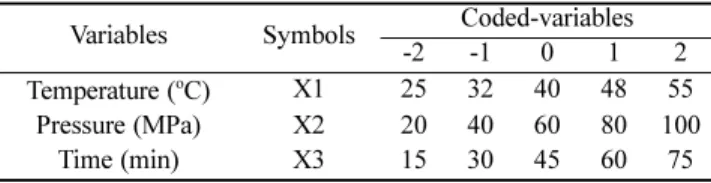
독립변수는 각각 0, ±1, ±2로 부호화하였고 (Table 1), 이를
조합하여 총 15개의 실험군을 생성하였다 (Table 2). 상기 독 립변수를 근거로 한 실험 결과 생성된 백년초 주스의 점성 (Y1) 을 종속변수로 설정하였다. 공정의 최적화를 위해 종속 변수의 최저값을 목표로 설정하고, 이를 만족하는 온도, 압 력, 시간을 회귀분석을 통하여 구하였다. 최적조건의 예측은 SAS (ver. 9.1, SAS Institute, Cary, NC, USA) 를 이용하여 3차 원 반응표면분석으로 나타내었다. 사용한 회귀식은 아래와 같다.
2.5. 점도 측정
고압 액화 추출 반응을 통해 얻어진 백년초 주스의 점도는 AR-2000 advanced rheometer (TA Instrument, New Castle, DE, USA) 를 이용하여 측정하였다. 점도는 25
oC 에서 측정되었으 며, 지름 40 mm의 cross-hatched plate를 센서로 이용하였다.
전단률을 1~10/s의 측정 범위로 하여 멱수법칙 (power law)을 이용하고 겉보기 점도 (apparent viscosity)를 구하였다.
2.6. HPLC-ELSD 분석
HPLC-ELSD system (Agilent 1100, Hewlett Packard, Palo Alto,
CA, USA) 과 carbohydrate column (4.6×250 mm, 5 µm, Waters, Milford, MA, USA)를 이용하여 단당류 함량을 측정하였다.
물 (용매 A)과 아세토나이트릴 (용매 B)을 이용하여 0분, 10% A/90% B; 3 분, 10% A/90% B; 20분, 40% A/60% B; 25 분, 40% A/60% B; 27분, 10% A/90% B; 30분, 10% A/90% B 과 같은 조건에서 분석하였다. 유속 (flow rate)은 1 mL/min 이고, 시료 주입량 (injection volume)은 20 µL였다.
3. RESULTS AND DISCUSSION
3.1. 점도 측정
설계된 반응조건에 의해 얻어진 백년초 주스의 점도는 Table 2 와 같다. 반응표면분석법을 통해서 얻어진 15개의 모든 조 건에서 대조군보다 점도가 감소하였다. 조건 6 (40
oC, 20 MPa, 45 min)에서 가장 낮은 점도 (4.646 P)를 얻을 수 있었 으며, 이는 대조군 (9.511 P)과 비교하였을 때 약 51%의 점도 감소를 보였다. 조건 9 (40
oC, 60 MPa, 15 min)에서 가장 높은 점도 (8.054 P)가 도출되었으며 이는 대조군과 비교하였을 때 약 15%의 점도 감소를 보였다.
3.2. HPLC-ELSD 분석
HPLC-ELSD를 이용하여 Viscozyme과 Novozym 33095 혼합 효소로 처리 후 가장 낮은 점도를 보였던 6번 실험군 (40
oC, 20 MPa, 45 min)과 효소 비처리 군인 대조군에서의 유리당을 분석한 결과는 Table 3과 같다. Figure 1의 HPLC 크로마토그 램 (chromatogram)에 보이는 것처럼, 효소를 처리하지 않은 대조군에서 볼 수 없었던 주요한 피크 (peak)가 Viscozyme 과 Novozym 33095의 혼합 효소를 처리한 실험군에서 나타 났다. 이들 새로운 피크는 포도당 (glucose)과 과당 (fructose) 인 것으로 HPLC-ELSD 분석을 통해 확인하였다 (Fig. 1B). 고 압 효소 액화 반응을 40
oC, 20 MPa, 45 min의 조건에서 수행 한 결과, 환원당인 포도당과 과당이 각각 2.69 g/L와 2.70 g/L 이 생성이 되었다 (Table 3). 포도당, 과당 등과 같은 유리당의 생성은 Viscozyme과 Novozym 33095 혼합 효소의 반응에 의 해서 기질인 고분자의 다당류가 저분자의 당류로 분해가 되 는 과정에서 발생을 했을 것으로 생각된다. HPLC-ELSD를 이용한 유리당 분석을 통해 백련초 주스의 점도 감소는 백년 초 다당류의 분해에 의한 단당류의 생성 때문인 것으로 확인 되었다. 본 연구의 결과와 유사하게, 발효 쌀겨에 펙틴 및 셀
Y = b
0+ b
1X
1+ b
2X
2+ b
3X
3+ b
12X
1X
2+ b
13X
1X
3+ b
23X
2X
3+ b
11X
12+ b
22X
22+ b
33X
32Table 1. Variables and levels for central composite design of surface response method for high hydrostatic pressure liquefying process
Variables Symbols Coded-variables
-2 -1 0 1 2
Temperature (oC) X1 25 32 40 48 55
Pressure (MPa) X2 20 40 60 80 100
Time (min) X3 15 30 45 60 75
Table 2. Viscosity of Opuntia ficus-indica var. saboten fruit juices under central composite design of surface response method using high hydrostatic pressure liquefying extraction with Viscozyme and Novozym 33095 mixtures
Sample
No. Temperature Pressure Time Viscosity (P)
1 -2 0 0 5.937±0.187
2 -1 -1 -1 6.076±0.234
3 -1 -1 1 5.549±0.085
4 -1 1 -1 5.539±0.165
5 -1 1 1 5.342±0.151
6 0 -2 0 4.646±0.114
7 0 2 0 5.202±0.349
8 0 0 0 6.614±0.437
9 0 0 -2 8.054±0.324
10 0 0 2 6.742±0.512
11 1 -1 -1 6.379±0.028
12 1 -1 1 6.524±0.385
13 1 1 -1 6.656±0.159
14 1 1 1 6.922±0.091
15 2 0 0 5.551±0.030
Control - - - 9.511±0.910
Table 3. Contents of fructose and glucose of Opuntia ficus-indica var. saboten fruit juices under high hydrostatic pressure liquefying conditions (40
oC, 20 MPa, and 45 min) with Viscozyme and No- vozym 33095 mixtures
Treatment Fructose (g/L juice) Glucose (g/L juice)
Liquefied 2.70±0.10 2.69±0.17
Control1) U.D. 2) U.D.
1)
No treatment with Viscozyme and Novozym 33095 mixtures.
2)
U.D.: Under detection limit.
룰로스 분해효소 처리와 병행한 고압 공정을 통해서 환원당 의 생성이 증가하였다 [14].
3.3. 회귀 방정식
반응표면분석법의 중심합성계획 (central composite design) 을 이용하여 각각의 독립변수와 반응변수에 대한 회귀분석 을 수행한 결과, 아래와 같은 회귀식을 얻을 수 있었다.
반응표면분석법의 결과로써 25
oC, 100 MPa, 58.275 분에서 점도 감소율이 최대를 이루며 동일한 반응조건에서의 백년
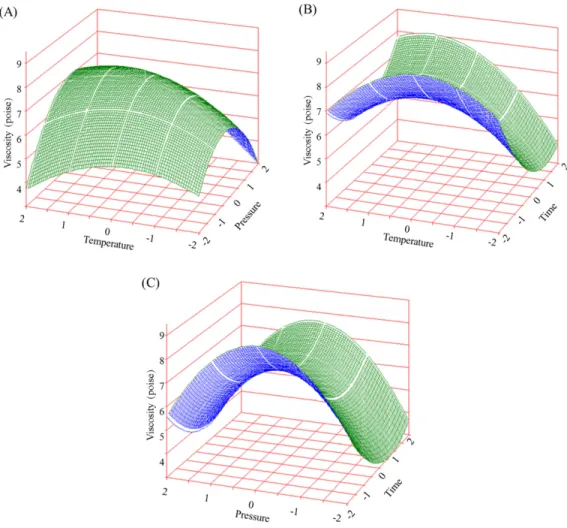
초 주스의 점도는 2.917 P로 예측되었다. 이는 실온에서 어떠 한 처리도 하지 않은 백년초 주스에 비해 약 70%의 점도 감 소를 가지는 것으로 확인되었다. 반응표면분석법을 통해 온 도와 압력에서는 최저점 (minimum point)을, 시간에서는 안 장점 (saddle point)을 갖는 결과를 보였다 (Fig. 2). 온도가 낮 아질수록, 압력이 높아질수록 점도가 최저점을 보이는 것을 확인하였으며, 반응시간은 약 45분에서 60분 사이의 범위에 서 안장점을 보였다. 이는 반응에 사용된 효소의 활성온도 (약 25~45
oC), 고압처리를 통한 반응 가속의 최대화, 효소반응을 위한 충분한 시간 확보 및 반응 완료 후 aggregation의 방지를 통한 점도 유지 등의 이유에 의한 것으로 예상할 수 있다. 고 압 처리를 통해서 알로에 [15], 토마토 퓨레 [16]에서 점도 증
Y = 6.573 0.200X +
1+ 0.065X
2– 0.184X
3+ 0.177X
1X
2+ 0.142X
1X
3+ 0.056X
2X
3– 0.212X
12– 0.417X
22+ 0.201X
32Fig. 1. HPLC-ELSD chromatograms of Opuntia ficus-indica var. saboten fruit juice under non-treatment (A) and treatment (B) with the mixtures of Viscozyme and Novozym 33095. peak 1, fructose; peak 2, glucose.
가가 이루어졌으며, 펙티나아제 배합 (pectinase formula- tion)을 함께 사용한 200~300 MPa의 고압 처리의 경우에서도 펙틴용액 (pectin solution)의 점도가 감소하였다 [17].
4. CONCLUSION
본 연구에서는 반응표면분석법을 통해 고압액화추출장치와 탄수화물 분해효소와 펙틴 분해효소의 혼합 효소를 이용하 여 백년초 주스의 점질물 분해 공정에서 최적 조건을 확립하 였다. 3요소 중심합성 계획을 통해 온도 (25, 32, 40, 48, 55
oC), 압력 (20, 40, 60, 80, 100 MPa), 반응시간 (15, 30, 45, 60, 75 min) 에서 15가지 실험 조건을 설계하였다. 조건 6 (40
oC, 20 MPa, 45분)에서 가장 낮은 점도를 얻을 수 있었다. 반응표면 분석법의 회귀분석 결과를 통해서 25
oC, 100 MPa에서 약 58.275분 반응시켰을 때 최적의 점도인 2.917 P로 효소 비처 리 대조군에 비해 70% 가량의 점도 감소가 된 백년초 주스 를 얻을 수 있는 것으로 예측되었다. 이로 인한 가공 편의성
증대는 기능성 식품소재 및 식품 첨가물로서의 백년초의 활 용 범위를 넓힐 수 있을 것으로 보인다. 또한 고압 환경에서 과산화효소 (peroxidase), 폴리페놀 산화효소 (polyphenol oxi- dase)와 같이 영양적 손실을 초래하는 효소들의 불활성화가 보고되었고 [18], 안토시아닌 등의 생리활성물질 추출 수율 의 증가 또한 알려진 바 [19], 백년초의 항산화능 및 베타레인 같은 주요 생리활성물질의 추출 수율 등의 관점에서 고압 효 소 분해에 대한 추가 연구가 이루어진다면, 백년초가 가지고 있는 색상, 영양성분 등의 장점을 살릴 수 있는 아이스크림, 음료, 건강기능식품 분야 등에서 이용 가능한 식품소재로서 의 백년초의 경쟁력을 더욱 강화시킬 수 있을 것으로 예상한 다.
Acknowledgements
본 연구는 산업통상자원부 광역경제권 연계협력사업 (R000 0452) 으로 지원되었습니다.
Fig. 2. 3-D response surface analysis of viscosity of Opuntia ficus-indica var. saboten fruit juice with respect to each independent variable.
(A) temperature (x-axis) vs. pressure (y-axis), (B) temperature (x-axis) vs. time (y-axis), (C) pressure (x-axis) vs. time (y-axis).
REFERENCES
1. Fernández-López, J. A. and L. Almela (2001) Application of high- performance liquid chromatography to the characterization of the betalain pigments in prickly pear fruits. J. Chromatogr. A 913: 415- 420.
2. Son, M. J., K. Whang, and S. P. Lee (2005) Development of jelly fortified with lactic acid fermented prickly pear extract. J. Korean Soc. Food Sci. Nutr. 34: 408-413.
3. Lee, N. H., J. S. Yoon, B. H. Lee, B. W. Choi, and K. H. Park (2000) Screening of the radical scavenging effects, tyrosinase inhi- bition and anti-allergic activities using Opuntia ficus-indica. Korean J. Pharmacog. 31: 412-415.
4. Frati, A. C., E. Jiménez, and C. R. Ariza (1990) Hypoglycemic effect of Opuntia ficus-indica in non insulin-dependent diabetes mellitus patients. Phytother. Res. 4: 195-197.
5. Park, E. H., J. H. Kahng, S. H. Lee, and K. H. Shin (2001) An anti- inflammatory principle from cactus. Fitoterapia 72: 288-290.
6. Galati, E. M., M. R. Mondello, D. Giuffrida, G. Dugo, N. Miceli, S. Pergolizzi, and M. F. Taviano (2003) Chemical characterization and biological effects of Sicilian Opuntia ficus indica (L.) Mill.
fruit juice: Antioxidant and antiulcerogenic activity. J. Agric. Food Chem. 51: 4903-4908.
7. Matsuhiro, B., L. E. Lillo, C. Sáenz, C. C. Urzúa, and O. Zárate (2006) Chemical characterization of the mucilage from fruits of Opuntia ficus indica. Carbohydr. Polym. 63: 263-267.
8. Cassano, A., C. Conidi, and E. Drioli (2010) Physico-chemical parameters of cactus pear (Opuntia ficus-indica) juice clarified by microfiltration and ultrafiltration processes. Desalination 250:
1101-1104.
9. Cai, W., X. Gu, and J. Tang (2008) Extraction, purification, and characterization of the polysaccharides from Opuntia milpa alta.
Carbohydr. Polym. 71: 403-410.
10. Sepúlveda E., C. Sáenz, E. Aliaga, and C. Aceituno (2007) Extrac- tion and characterization of mucilage in Opuntia spp. J. Arid Envi- ron. 68: 534-545.
11. Eisenmenger, M. J. and J. I. Reyes-De-Corcuera (2009) High pres- sure enhancement of enzymes: A review. Enzyme Microb. Tech- nol. 45: 331-347.
12. Sáenz, C., E. Sepúlveda, and B. Matsuhiro (2004) Opuntia spp mucilage's: A functional component with industrial perspectives. J.
Arid Environ. 57: 275-290.
13. Wang, T., R. Jónsdóttir, H. G. Kristinsson, G. O. Hreggvidsson, J.
Ó. Jónsson, G. Thorkelsson, and G. Ólafsdóttir (2010) Enzyme- enhanced extraction of antioxidant ingredients from red algae Pal- maria palmata. LWT-Food Sci. Technol. 43: 1387-1393.
14. Kim, D. and G. D. Han (2012) High hydrostatic pressure treat- ment combined with enzymes increases the extractability and bio- activity of fermented rice bran. Innov. Food Sci. Emer. Technol. 16:
191-197.
15. Opazo-Navarrete, M., G. Tabilo-Munizaga, A. Vega-Gálvez, M.
Miranda, and M. Pérez-Won (2012) Effects of high hydrostatic pressure (HHP) on the rheological properties of Aloe vera suspen- sions (Aloe barbadensis Miller). Innov. Food Sci. Emer. Technol.
16: 243-250.
16. Krebbers, B., A. M. Matser, S. W. Hoogerwerf, R. Moezelaar, M.
M. M. Tomassen, and R. W. van den Berg (2003) Combined high- pressure and thermal treatments for processing of tomato puree:
Evaluation of microbial inactivation and quality parameters. Innov.
Food Sci. Emer. Technol. 4: 377-385.
17. Tomlin, B.D., S. E. Jones, A. A. Teixeira, M. J. Correll, J. I. Reyes- De-Corcuera (2014) Kinetics of viscosity reduction of pectin solu- tions using a pectinase formulation at high hydrostatic pressure. J.
Food Eng. 129: 47-52.
18. Garcia-Palazon, A., W. Suthanthangjai, P. Kajda, and I. Zabetakis (2004) The effects of high hydrostatic pressure on β-glucosidase, peroxidase and polyphenoloxidase in red raspberry (Rubus idaeus) and strawberry (Fragaria× ananassa). Food Chem. 88: 7-10.
19. Corrales M., A. F. García, P. Butz, and B. Tauscher (2009) Extrac- tion of anthocyanins from grape skins assisted by high hydrostatic pressure. J. Food Eng. 90: 415-421.