*1 Received on March 14, 2012; accepted on March 22, 2012
*2 Dept. of Forest Biometerials Engineering, College of Forest and Environmental Sciences, Kangwon National University, Chuncheon 200-701, Korea.
† Corresponding author : Young-Soo Bae (e-mail: [email protected])
Antioxidative Activity of Prunus sargentii Outer Bark Extractives*
1Se Yeong Park*
2and Young Soo Bae*
2†ABSTRACT
The outer bark of Prunus sargentii was collected, air-dried and extracted with 70% aqueous acetone.
Then it was successively partitioned with n-hexane, dichloromethane (CH
2Cl
2), ethyl acetate (EtOAc) and H
2O. From the EtOAc soluble fraction, four compounds were isolated by the repeated Sephadex LH-20 column chromatography. The isolated compounds were determined as (+)-catechin (1), (-)-epicatechin (2), taxifolin ( 3), and neosakuranin (4) by the spectroscopic analysis including
1H,
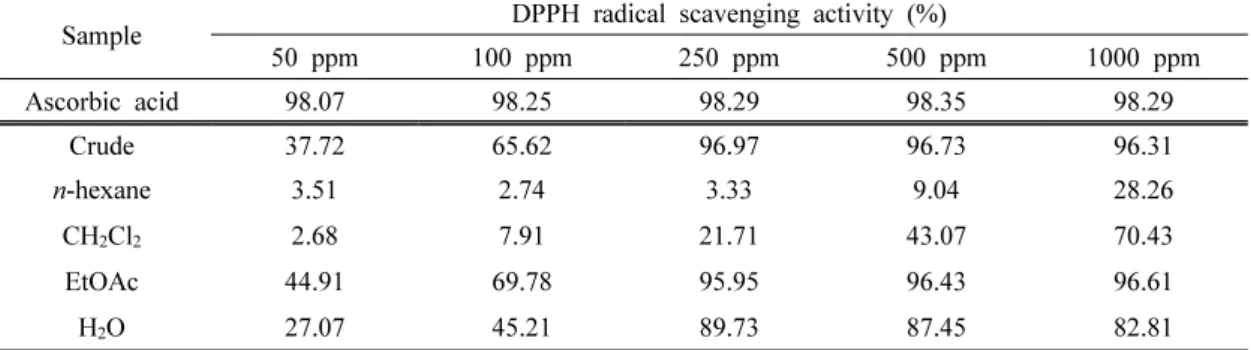
13C-NMR, and 2D-NMR spectrometers. The antioxidative activities on the isolated compounds and the separated fractions were evaluated by DPPH radical scavenging assay. The crude, EtOAc, and H
2O soluble fractions indicated good antioxidative potential compared to the CH
2Cl
2and n-hexane soluble fractions.
Keywords : Prunus sargentii, bark, EtOAc fraction, neosakuranin, antioxidant
1. INTRODUCTION
Prunus sargentii Rehder (Rosaceae) is a na- tive cherry tree to Korea, Japan and Sakhalin (Russia). This is a deciduous tree that grows 6
∼8 m in height. The crown spreads to a width of 6∼8 m and can tolerate wind, but not air pollution[1]. The tree is suitable for use as a roadside tree. The bark has been used for the treatment of inflammatory or skin diseases. The main constituents of the species are taxifolin, naringenin, pinostobin including sakuranin[1]
and the domestic previous works have reported antioxidant, immunosuppression and tyrosinase inhibition activities on the heartwood extractives
of Prunus sargentii[1,2]. However, they have not studied on the chemical constituents and bi- ological activities of the bark which can have rather the higher functional potential.
Thus, this work was to carried out to study the chemical constituents and antioxidative ac- tivity of the outer bark to evaluate the bioactive potential for the functional uses.
2. MATERIALS and METHODS 2.1. Plant Material
The bark of P. sargentii was collected in
April 2011 on the campus forest, Kangwon
National University and debarked. Bark were dried for four weeks at room temperature and then ground to a fine powder using a Wiley mill before extraction.
2.2. General Experimental
1
H,
13C-NMR, including 2D-NMR HMBC (Heteronuclear Multiple Bond Correlation) and HMQC (Heteronuclear Multiple Quantum Co- rrelation) were measured with a Bruker DPX 400 (Germany) spectrometer using tetramethy- lsilane (TMS) as an internal standard, and chemical shift were given in δ (ppm). Column chromatography was done on a lipophilic Se- phadex LH-20 column. TLC was performed on DC-Plastikfolien Cellulose F (Merck, Germany) plates and developed with TBA [t-BuOH- HOAc-H
2O (3 : 1 : 1, v/v/v)] and 6% aqueous acetic acid (HOAc). Spots were detected under UV (254 and 365 nm) radiation and spraying with vanillin [vanillin : HCl : EtOH (4.8 : 12 : 480, w/v/v)] followed by heating.
2.3. Extraction and Isolation
The dried bark powder (780 g) was extracted with 70% aqueous acetone for 5 days at room temperature. The filtrates were combined and evaporated using a rotary evaporator under re- duced pressure at 40°C. The crude extract was suspended in H
2O and then successively parti- tioned using n-hexane, CH
2Cl
2, and EtOAc.
A portion of the EtOAc fraction (9.46 g) was chromatographed on a Sephadex LH-20 column using aqueous MeOH-H
2O (1 : 1, v/v) to give 5 fractions (Fr. 1∼5). Fr. 2 was reapplied on a Sephadex LH-20 column with MeOH-H
2O (3:7, v/v) to give compound 1 (148.9 mg). From Fr.
2-1 was rechromatographed using MeOH-H
2O (2 : 3, v/v) to get compound 2 (44.4 mg). Fr.
2-4 and 2-5 were further treated on a Sephadex
LH-20 column with EtOH-hexane (3 : 1, v/v) to separate compound 3 and 4 (11.1 mg).
2.3.1. Compound 1
1
H-NMR (400 MHz, δ, CD
3OD) : 2.41 (1H, dd, J = 8.1 and 16.1 Hz, H-4ax), 2.75 (1H, dd, J = 5.4 and 16.1 Hz, H-4eq), 3.89 (1H, m, H-3), 4.47 (1H, d, J = 7.5 Hz, H-2), 5.77 (1H, d, J = 2.2 Hz, H-6), 5.84 (1H, d, J = 2.2 Hz, H-8), 6.64 (1H, dd, J = 1.8 and 8.1 Hz, H-6'), 6.68 (1H, d, J = 8.1 Hz, H-5'), 6.75 (1H, d, J
= 1.8 Hz, H-2').
13C-NMR (100 MHz, δ, CD
3OD) : 28.55 (C-4), 68.84 (C-3), 82.88 (C-2), 95.53 (C-8), 96.32 (C-6), 100.85 (C-10), 115.28 (C-2'), 116.12 (C-5'), 120.08 (C-6'), 132.24 (C-1'), 146.26 (C-3'), 146.28 (C-4'), 156.95 (C-9), 157.61 (C-5), 157.86 (C-7).
2.3.2. Compound 2
1
H-NMR (400 MHz, δ, CD
3OD) : 2.63 (1H, dd, J = 2.9 and 16.8 Hz, H-4ax), 2.83 (1H, dd, J = 4.5 and 16.7 Hz, H-4eq), 4.08 (1H, m, H-3), 4.75 (1H, s, H-2), 5.81 (1H, d, J = 2.4 Hz, H-6), 5.84 (1H, d, J = 2.4 Hz, H-8), 6.75 (1H, d, J = 7.5 Hz, H-5'), 6.80 (1H, dd, J = 1.8 and 8.3 Hz, H-6'), 6.8 (1H, d, J = 1.8 Hz, H-2').
13C-NMR (100 MHz, δ, CD
3OD) : 28.28 (C-4), 66.49 (C-3), 78.87 (C-2), 94.94 (C-8), 95.44 (C-6), 99.12 (C-10), 114.34 (C-2'), 114.94 (C-5'), 118.45 (C-6'), 131.30 (C-1'), 144.77 (C-3'), 144.94 (C-4'), 156.38 (C-9), 156.65 (C-5), 157.00 (C-7)
2.3.3. Compound 3
1
H-NMR (400 MHz, δ, CD
3OD) : 4.50 (1H,
d, J = 11.5 Hz, H-3 ), 4.96 (1H, d, J = 11.6
Hz, H-2), 5.89 (1H, d, J = 2.0 Hz, H-6), 5.92
(1H, d, J = 1.6 Hz, H-8), 6.80 (1H, d, J = 8.2
Hz, H-5'), 6.84 (1H, dd, J = 1.8 and 9.2 Hz,
H-6'), 6.96 (1H, d, J = 1.8 Hz, H-2').
13C-
OH OH
HO O
OH OH 21'
3 5 4 6
7 8
9 2'
3' 4'
6' 5' 10
(+)-catechin (1)
OH OH
HO O
OH OH
(-)-epicatechin ( 2)
OH
HO O
OH OH 2 1'
3 5 6
7 8
9 2' 3'
4' 6' 5' 10
O
4 OH
Taxifolin ( 3)
OH
OH
MeO
O O
O OH HO
HO
OH 2'1'
4' 6'
2 4
6 ß'
a
Neosakuranin ( 4) Fig. 1. Chemical structures of the isolated compounds from the P. sargentii outer bark.
NMR(100 MHz, CD
3OD) : 73.689 (C-3), 85.14 (C-2), 96.58 (C-8), 97.34 (C-6), 102.00 (C-10), 116.17 (C-2'), 116.36 (C-5'), 120.93 (C-6'), 130.3 (C-1'), 146.33 (C-3) 147.16 (C-4'), 164.57 (C-9), 165.32 (C-5), 168.72 (C-7), 198.54 (C-4).
2.3.4. Compound 4
1