• 검색 결과가 없습니다.

Radical scavenging activity of ethanol extract and solvent partitioned fractions of lotus seeds

N/A
N/A
Protected

Academic year: 2021

Share "Radical scavenging activity of ethanol extract and solvent partitioned fractions of lotus seeds"

Copied!
8
0
0

로드 중.... (전체 텍스트 보기)

전체 글

(1)

OPEN ACCESS

Citation: Kim HJ, Lee AY, Kim BK, Cho YK, Lee SH, Cho EJ, Kim HY. 2016. Radical scavenging activity of ethanol extract and solvent partitioned fractions of lotus seeds. Korean Journal of Agricultural Science 43:186-193.

DOI: http://dx.doi.org/10.7744/kjoas.20160021

Editor: Ki Teak Lee, Chungnam National University, Korea

Received: January 29, 2016 Revised: March 16, 2016 Accepted: June 13, 2016

Copyright: ©2016 Korean Journal of Agricultural Science.

This is an Open-Access article distributed under the terms of the Creative Commons Attribution Non- Commercial License which permits unrestricted non- commercial use, distribution, and reproduction in any medium, provided the original work is properly cited.

PLANT & FOREST

Radical scavenging activity of ethanol extract and solvent partitioned fractions of lotus seeds

Hyun Jin Kim

1

, A Young Lee

2

, Byung Kwan Kim

1

, Yong Kweon Cho

3

, Sanghyun Lee

4

, Eun Ju Cho

2

, Hyun Young Kim

5

*

1

Cosmetics and Beauty Care, Graduate School of Public Health, Changwon National University, Changwon 51140, Korea

2

Department of Food Science and Nutrition, Pusan National University, Busan 46241, Korea

3

Department of Bio-Health Science, Changwon National University, Changwon 51140, Korea

4

Department of Integrative Plant Science, Chung-Ang University, Anseong 17546, Korea

5

Department of Food Science, Gyeongnam National University of Science and Technology, Jinju 52725, Korea

*Corresponding author: [email protected]

Abstract

This study focused on the evaluation of the antioxidative effects of lotus seeds from golden colored flowers. The lotus seeds were extracted with ethanol and then fractionated into 4 fractions, ethyl acetate (EtOAc), n-butanol, methylene chloride, and n-hexane. The comparison of antioxidative activities of the extract and fractions from the lotus seeds was carried out using an in vitro radical scavenging model and the total phenol content was analyzed. Of the tested extracts and fractions, the EtOAc fraction of the lotus seeds showed the strongest 1,1-diphenyl-2-picrylhydrazyl radical scavenging activity with 96.24% at a concentration of 100 µg/mL. In addition, the hydroxyl radical scavenging activity of the lotus seed EtOAc fraction was also increased in a concentration dependent manner with the concentrations tested ranging from 5 to 100 µg/mL. Moreover, the EtOAc fraction showed the highest scavenging activity for nitric oxide and superoxide anion radicals. In particular, of all the extracts and fractions, the EtOAc fraction showed highest contents of total phenols. These results indicate that lotus seeds have potential as an antioxidative agent against oxidative stress involving reactive oxygen species. Furthermore, the EtOAc fraction of lotus seeds includes promising oxidative stress-protective compounds.

Keywords: antioxidative agent, hydroxyl radical, lotus seeds, nitric oxide, superoxide anion, 1,1-diphenyl-2-picrylhydrazyl

Introduction

유산소 호흡을 하는 거의 모든 생물체의 세포에서 발생 reactive oxygen species (ROS)는 생체

물질의 자가 산화, 방사선, 화학물질에 의한 외부자극에 의해 생성될 수 있는 것으로 알려져 있다

(Fridovich, 1978; Kodama, 1988). 이러한 활성산소의 종류로는 superoxide anion (O

2-

), hydrogen

peroxide (H

2

O

2

), singlet oxygen (

1

O

2

), hydroxyl radical (·OH), peroxyl radical (RO·) 등이 있다. 이

(2)

들 활성산소는 여러 가지 환경적 요인이나 병리적인 요인들에 의하여 과잉으로 생성될 수 있으며 이들의 과다 생성 과 활성산소를 제거하고 방어하는 항산화 방어체계의 결핍은 항산화 방어체계간의 불균형을 일으켜, 산화적 스트레 스를 발생시킨다(Cadenas and Davies, 2000; Bokov, 2004). 또한 산화적 스트레스의 증가는 암과 심혈관 질환 및 알 츠하이머와 같은 만성 질환의 병리학적 진행과 노화과정의 중요한 원인이 되는 것으로 알려져 있다(Cavalca et al., 2001; Gibson and Huang, 2005).

연꽃(Nelumbo nucifera Gaertner)은 수련과(Nymphaeaceae)에 속하는 여러해살이풀로 연못이나 늪에서 자란다.

물 속 땅에서 옆으로 길게 뻗어 자라는 원통모양의 뿌리줄기는 연근이라고 하여 식용으로 사용되며 연잎은 차나 연 잎밥 등으로 이용되고 있다. 연자육은 연꽃의 잘 익은 종자를 가을에 수확하여 과피를 제거하여 말린 것으로 연밥 혹 은 연자로 불리며, 예부터 한방 및 민간에서 약재 혹은 식용으로 널리 사용되어져 왔다. 연자육은 한방에서 주로 지 혈, 어혈제거, 해혈, 토혈, 혈뇨, 혈변을 치료하는데 사용되고 있으며(Bensky and Gamble, 1993), 기능성에 대한 연구 로는 지사, 이뇨, 해열, 항균, 항당뇨 및 항산화효과 등이 보고되어 있다(Mukherice et al., 1995A, 1996A, 1996B, 2002, 1995B, 1995C; Hu, 2002; Jung et al., 2003; Park et al., 2010). 연자육에 대한 성분연구로는 주로 alkaloid 성분에 대한 연구가 집중적으로 행해졌으며 nuciferine, N-nornuciferine, O-nornuciferine, roemerine 등의 aporphine계 alkaloid (Luo and Yao, 2005) 와 liensinine, isoliensinine, neferine 등의 phenolic alkaloid (Wu and Pan, 2004) 및 (+)-1(R)-coclaurine, (-)-1(S)-norcoclaurine 등 benzylisoquinoline alkaloid (Kashiwada et al., 2005) 성분들이 보고되 고 있다. 그밖에 (+)-catechin, (+)-gallocatechin, quercetin, kaempferol 등의 flavonoid 화합물(Kim et al., 2001) 및 tryptophan, asparagin, tyrosine 등 amino acid 성분들이 보고되어 있다. 최근에는 식물 호르몬인 dihydrophaseic acid 의 분리 동정되었고, 돌연변이원성에 대한 효과, 우울증의 치료에 대한 효과, 세포독성 보호효과, 심장질환 치료효과 및 항경련효과(Seo et al., 2006; Song et al., 1997; Lee et al., 2006; Kim and Oh 2009; Ann et al., 2010; Kim and Choi, 2011) 등이 보고되었다. 그러나 본 실험에 사용한 황금색연꽃의 종자에 대한 항산화 활성연구는 전무한 실정으로, 본 연구에서는 황금색연꽃의 종자 추출물 및 분획물을 이용하여 free radical 소거 효과를 통한 항산화 효과에 대해 검 토하였다.

Materials and Methods

시료의 제조 및 시약

2014 년에 충청남도 부여군 규암면에서 생산된 황금색연꽃(Nelumbo nucifera)의 종자 2,800.8 g을 껍질째 분쇄하 여 7,000 mL의 ethanol (EtOH)로 3시간 동안 10회 반복하여 추출하여 얻어진 추출물을 모은 후, 회전식 감압농축기 를 이용하여 농축하여 EtOH 추출물(232.1 g)을 얻었다. 농축한 EtOH 추출물을 물에 현탁시킨 후 n-hexane으로 분획 하여 n-hexane 분획물(42.2 g)을 얻었으며, 남은 수층을 methylene chloride (MC)으로 분획하여 MC 분획물(59.1 g)을 얻었다. 또한, 남은 수층을 ethyl acetate (EtOAc)로 분획하여 EtOAc 분획물(1.4 g)을 얻고, n-butanol (BuOH)로 분획 하여 BuOH 분획물 (12.4 g)을 각각 얻었다. 실험에 사용한 1,1-Diphenyl-2-picrylhydrazyl (DPPH)는 Sigma-Aldrich Co. (Missouri, USA) 사의 제품을 trichloroacetic acid (TCA)는 Kanto Chemical Co. (Tokyo, Japan)사의 제품을, griess reagent 는 Sigma Chemical Co. (St. Louis, USA) 제품을 사용하였으며, 추출용 용매는 모두 분석용을 사용하였다.

DPPH 소거능

농도별로 EtOH에 녹인 시료 100 μL와 60 μM DPPH 용액 100 μL를 96-well plate에 혼합하여 30분간 빛을 차단하

여 실온에 방치시킨 후, 540 nm에서 흡광도를 측정하였다. 시료를 첨가하지 않은 대조군과 비교하여 free radical 소

거 효과를 백분율(%)로 나타내었다(Hatano et al., 1989; Koleva et al., 2002).

(3)

Hydroxyl radical (∙OH) 소거능

Fenton 반응에 따라 10 mM FeSO

4

∙7H

2

O-EDTA 에 10 mM 2-deoxyribose solution과 농도별 시료용액을 혼합한다 음, 10 mM의 H

2

O

2

를 첨가하여 37℃에서 4시간 동안 반응하였다. 이 혼합액에 2.8% TCA와 1.0% thiobarbituric acid (TBA) solution 을 각각 첨가하여 10분간 boiling한 후 cooling하여 490 nm에서 흡광도를 측정하였다(Chung et al., 1997).

Nitric oxide (NO) 소거능

각 농도별 시료는 10 mM sodium nitroprusside (SNP)와 혼합하여 25℃에서 60분간 반응하였다. 이 반응 혼합액은 96-well plate 에 주입하여 griess reagent을 넣어 실온에서 15분간 반응한 후 540 nm에서 흡광도를 측정하였다 (Sreejayan et al., 1997).

O

2 -

소거능

50 mM PBS 에 0.125 mM ethylenediamminetetraacetate (EDTA), 62 μM nitro blue tetrazolium (NBT), 98 μM NADH 를 혼합한 용액을 96-well plate에 200 μL를 취하고, 50 mM의 phosphate-buffer에 녹인 각 농도별 시료 25 μL를 혼합한 후, 33 μM의 phenazine methosulfate를 혼합하여 540 nm에서 흡광도를 측정하였다(Ewing and Janero, 1995).

Total phenol 함량

총 phenol 함량은 Vinson et al. (1998)의 방법을 이용하였으며, 건조한 샘플을 50% methanol과 1.2 M HCl 용액에 혼합하여 90℃에서 2시간 가열 추출한 후 0.45 μm membrane filter로 여과하여 수집한 추출액은 -20℃에서 보관하며 실험에 사용하였다. 추출액 100 μL를 취하여 methanol에 희석하여 folin-ciocalteau reagent와 20% sodium carbonate 와 혼합하여 23℃에서 1시간 반응한 후 760 nm에서 흡광도를 측정하였다. 이 때 표준곡선은 taninic acid를 농도별로 조제하여 사용하였다.

통계분석
대조군과 각 시료들로부터 얻은 실험 결과들은 평균 ± 표준편차로 나타내었고, SAS 4.2를 이용하여 각 실험 결과 로부터 ANOVA (analysis of variance)를 구한 후 Duncan’s multiple test (p < 0.05)를 이용하여 각 군의 평균 간의 유의 성을 검정하였다.

Results and Discussion

DPPH radical 소거 활성법은 화학적으로 유도되는 비교적 안정한 radical로서 시료의 free radical 소거 능력이나

수소 공여능력을 평가하는 방법이다. DPPH는 cystein, glutathion과 같은 함황아미노산과 L-ascorbic acid 및

Butylated hydroxyanisole 등에 의해 환원되어 탈색되므로 다양한 천연소재로부터 항산화 능력을 알아보기 위한 측

정법으로 가장 쉽고 널리 알려진 방법이다(Hatano et al., 1989; Koleva et al., 2002). 짙은 자색을 띄는

diphenylpicrylhydrazyl 이 항산화제에 의해 diphenylpicrylhydazine으로 환원되면서 구조적인 변화로 인해 색깔이 사

라지는 것을 540 nm의 파장에서 분광흡광계를 이용하여 관찰한다. 황금색연꽃 종자 추출물 및 분획물의 항산화 활

성을 알아보기 위하여 황금색연꽃 종자 추출물 및 분획물(EtOH, Hx, MC, EtOAc, BuOH)에서의 DPPH radical 소거

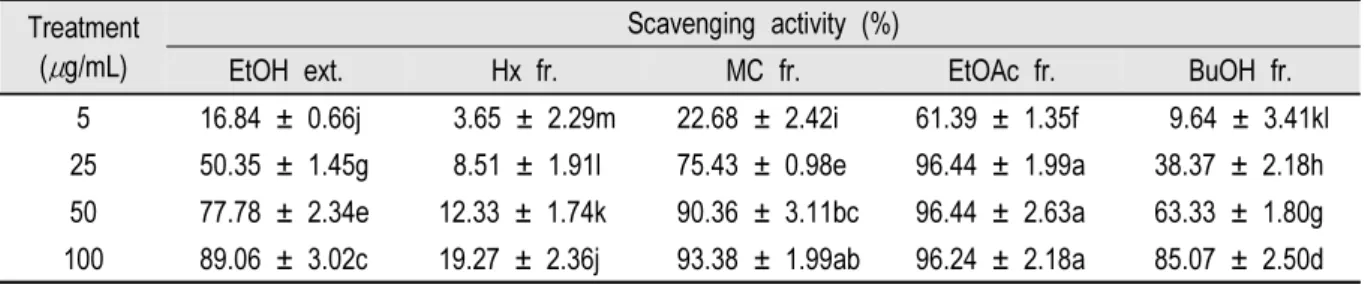
효과를 살펴보았다. Table 1은 그 결과를 나타낸 것으로 100 μg/mL에서 EtOH 추출물 및 MC, EtOAc, BuOH 분획물

이 모두 85% 이상의 소거능을 나타내었고, 특히 EtOAc는 96.24%로 다른 분획에 비해 가장 높은 활성을 나타내었다.

(4)

·OH 은 활성산소종 중에서 가장 반응성이 크고 인접한 생체 분자에 심각한 손상을 야기하는 것으로 알려져 있다.

Macrophages 와 leukocytes의 phagocytosis 또한 ·OH 생성 원인이 되며, 이러한 ·OH는 fenton 반응에 의해 O

2-

와 H

2

O

2

로부터 생성되며, 활성질소종인 ONOO

-

의 분해에 의해 생성되기도 한다(Chung et al., 1997). Table 2는 황금색연꽃 종자 추출물 및 분획물의 ·OH 소거능에 대한 결과이다. 황금색연꽃 종자 추출물 및 분획물을 농도별로 처리한 결과 유의적으로 소거율이 증가하였으며 50 μg/mL에서 모두 75%이상의 ·OH 소거능을 나타내었다.

Table 1. DPPH radical scavenging activity of lotus seeds extract and fractions.

Treatment ( μg/mL)

Scavenging activity (%)

EtOH ext. Hx fr. MC fr. EtOAc fr. BuOH fr.

5 16.84 ± 0.66j 3.65 ± 2.29m 22.68 ± 2.42i 61.39 ± 1.35f 9.64 ± 3.41kl 25 50.35 ± 1.45g 8.51 ± 1.91l 75.43 ± 0.98e 96.44 ± 1.99a 38.37 ± 2.18h 50 77.78 ± 2.34e 12.33 ± 1.74k 90.36 ± 3.11bc 96.44 ± 2.63a 63.33 ± 1.80g 100 89.06 ± 3.02c 19.27 ± 2.36j 93.38 ± 1.99ab 96.24 ± 2.18a 85.07 ± 2.50d Values are mean ± SD.

a-m: Means with different letters are significantly different (p < 0.05) by Duncan’s multiple range test.

Table 2. Hydroxyl radical scavenging activity of lotus seeds extract and fractions.

Treatment ( μg/mL)

Scavenging activity (%)

EtOH ext. Hx fr. MC fr. EtOAc fr. BuOH fr.

5 36.14 ± 1.29j 26.30 ± 2.06k 27.71 ± 1.63k 15.88 ± 2.49m 23.95 ± 1.69l 25 76.18 ± 1.53fg 73.82 ± 1.40h 73.83 ± 1.31h 67.50 ± 1.38i 73.67 ± 1.08h 50 79.80 ± 1.58bcd 79.98 ± 1.57bcd 78.63 ± 1.43cde 75.20 ± 1.42gh 78.01 ± 1.21def 100 81.04 ± 1.08b 86.79 ± 1.36a 81.14 ± 1.43b 77.34 ± 1.25efg 80.51 ± 1.36bc Values are mean ± SD.

a-m: Means with the different letters are significantly different (p < 0.05) by Duncan’s multiple range test.

NO 는 생체내에서 기질인 L-arginine이 nitric oxide synthase (NOS)의 작용으로 citrulline과 함께 생성되며 인체 면 역반응과 혈관 확장에 중요한 역할을 한다. 생체내에서 과량 생성된 NO는 미토콘드리아의 기능 억제, 분자적 산소 와 함께 nitrosating agent를 형성하는 자동산화 과정을 거쳐 DNA deamination을 통한 돌연변이 유발, FeS 함유 효소 기능 저하 및 각종 효소의 작용을 억제하는 것으로 알려져있다(Cui et al., 2006). 따라서 NO의 생성을 억제함으로써 항염효과 및 NO에 의한 독성으로부터 보호 효과를 기대할 수 있다(Imal et al., 1993). Table 3은 NO 소거효과를 알아 보기 위해 SNP로 NO를 생성시킨 후 황금색연꽃 종자 추출물 및 분획물을 처리하여 NO 소거효과를 측정한 결과이 다. In vitro에서 황금색연꽃 종자 추출물 및 분획물을 농도별로(10, 50, 100 μg/mL) 처리한 뒤 NO 소거 효과를 나타낸 결과, EtOH 추출물과 MC, EtOAc 분획물은 40% 이상의 소거 효과를 나타내는 것을 확인할 수 있었다. 특히 EtOAc 분획물은 농도 의존적으로 NO 소거능이 증가했으며 100 μg/mL 농도에서 53.25%의 가장 높은 소거능을 나타내었다.

O

2-

는 활성산소 중 가장 먼저 생성되고 반응성이 약하지만 일부 분자를 직접 공격할 수 있다. 예를 들어, O

2-

·OH 보다 훨씬 느리기는 하나 glutathione peroxidase를 불활성화 시킬 수 있으며 부분적으로 catalase를 불활성화 시

킬 수 있다. 또한 O

2-

는 DNA를 직접적으로 변형시키지는 못하지만 반응을 촉진할 수 있을 정도의 transition metals

이 존재할 때 hydroxyl radicals 형성을 촉진한다.

(5)

2O

2-

+ 2H+ → H

2

O

2

Me

3+

+ O

2-

→ Me

2+

+ O

2

Me

2+

+ H

2

O

2

→ Me

3+

+ ·OH + OH-

첨가하는 항산화제의 농도에 따라 이 반응은 억제되거나 촉진된다. O

2-

소거능은 NBT 환원법에 의해 O

2-

가 NBT 에 의해 발색되는 정도를 560 nm에서 측정하였다. Table 4는 황금색연꽃 종자 추출물과 분획물의 in vitro상에서 O

2-

소거 효과를 확인한 결과이다. EtOH 추출물과 EtOAc, BuOH 분획물을 처리하였을 때 30% 이상의 O

2-

소거능을 나 타내었다. 그 중에서 특히 EtOAc 분획물은 농도 의존적으로 O

2-

소거 활성이 증가하는 것을 확인할 수 있었으며 50 μ g/mL 농도에서 71.46%로 O

2-

의 소거효과가 가장 뛰어난 것을 알 수 있었다.

Table 4. O

2-

radical scavenging activity of lotus seeds extract and fractions.

Treatment ( μg/mL)

Scavenging activity (%)

EtOH ext. Hx fr. MC fr. EtOAc fr. BuOH fr.

10 8.15 ± 2.70g 13.04 ± 3.11fg 1.93 ± 5.05h 54.73 ± 0.90b 8.15 ± 0.43g 50 32.41 ± 2.67cd - 14.99 ± 1.11f 71.46 ± 1.13a 32.14 ± 0.79cd 100 36.64 ± 0.74c - 21.40 ± 1.32e 68.66 ± 1.93a 27.98 ± 1.42d Values are mean ± SD.

a-h: Means with the different letters are significantly different (p < 0.05) by Duncan’s multiple range test.

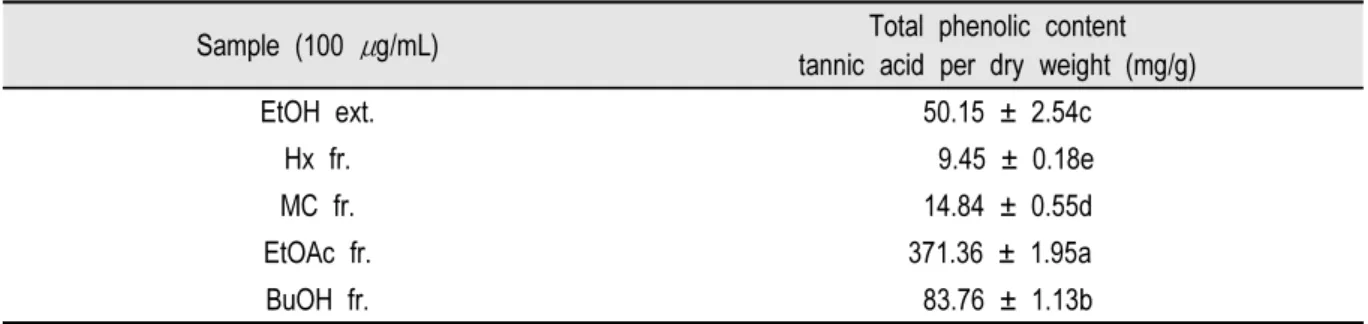
식물에는 다양한 phenol성 또는 polyphenol성 화합물들이 shikimate, mevalonate 그리고 phenylpropanoid pathway 를 통한 2차 생성물로 생성되어 단당류나 이당류와 결합하거나 다당류, 지질, 아민등과 복합체를 형성하여 다양한 구조나 양으로 존재하게 된다. 이러한 phenol성 화합물은 μ-electron system 주위의 delocalization에 의한 unpaired electron 을 지원하고, 또한 aromatic hydroxyl group에서 활성 산소로 hydrogen 원자를 쉽게 내어줌으로써 항산화능 을 나타내는 데 중요한 요인이 된다(Duthie and Crozier, 2000). Table 5는 황금색연꽃 종자 추출물 및 분획물의 총 phenol 함량을 나타낸 결과이다. Tannic acid를 표준으로 하여 나타내었을 때, EtOAc 분획물에 371.36 mg/g으로 가 장 많은 폴리페놀이 존재하는 것으로 나타났다. BuOH 분획물과 EtOH 추출물의 총 폴리페놀 함량은 83.76, 50.15 mg/g 이 존재하고, Hx 분획물이 9.45 mg/g으로 가장 낮은 함량이 존재함을 확인하였다.

Table 3. NO radical scavenging activity of lotus seeds extract and fractions.

Treatment ( μg/mL)

Scavenging activity (%)

EtOH ext. Hx fr. MC fr. EtOAc fr. BuOH fr.

10 50.34 ± 2.37b 37.67 ± 2.16f 46.41 ± 1.08d 42.60 ± 0.31e 35.50 ± 1.21fg 50 49.76 ± 1.34bc 32.90 ± 0.85gh 44.53 ± 2.34d 47.24 ± 0.74cd 31.09 ± 1.67hi 100 47.34 ± 1.26cd 32.81 ± 2.92gh 32.86 ± 1.16gh 53.25 ± 1.89a 29.05 ± 2.03i Values are mean ± SD.

a-i: Means with the different letters are significantly different (p < 0.05) by Duncan’s multiple range test.

(6)

Table 5. Comparison of total phenolic contents in lotus seeds extract and fractions.

Sample (100 μg/mL) Total phenolic content

tannic acid per dry weight (mg/g)

EtOH ext. 50.15 ± 2.54c

Hx fr. 9.45 ± 0.18e

MC fr. 14.84 ± 0.55d

EtOAc fr. 371.36 ± 1.95a

BuOH fr. 83.76 ± 1.13b

Values are mean ± SD.

a-e: Means with the different letters are significantly different (p < 0.05) by Duncan’s multiple range test.

Conclusion

본 연구에서는 황금색연꽃 종자의 항산화활성을 확인하기 위해 황금색연꽃 종자의 에탄올 추출물 및 다양한 용매 분획물을 제조하여 in vitro 항산화 활성(DPPH, OH-, NO, O

2-

) 을 라디칼 소거능을 통해 검토하였다. 황금색연꽃 종자 추출물 및 분획물 중에서 EtOAc 분획물이 DPPH 라디칼에 대한 소거능이 뛰어났다. ·OH는 EtOH 추출물이, NO와 O

2-

는 EtOAc 분획물에서 높은 소거활성을 나타내었다. 또한, 채소류의 항산화 기능성과 관련이 있다고 알려져 있는 총 폴리페놀 함량도 EtOAc 분획물에서 가장 높았다. 이상의 결과로 볼 때 황금색연꽃 종자는 높은 항산화 활성을 가 지며 활성산소로부터 야기되는 산화적 스트레스로 인한 질병을 예방하는 천연 항산화제로서 역할을 할 것으로 기대 된다. 또한, 높은 라디칼 소거능을 보여준 EtOAc 분획물내의 항산화 성분에 관한 연구가 필요하다고 사료된다.

Acknowledgements

이 논문은 2015년도 경남과학기술대학교 대학회계 연구비 지원에 의하여 연구되었음.

References

Ann CJ, lee GH, Kim YS, Hong MC, Bae HS, Kim JH, Shin MG. 2010. Effect of Nelumbinis semen on the recovery of the cardiac muscle activity by proteome analysis. Korean Journal of Oriental Physiology & Pathology 24:962-969. [in Korean]

Bensky D, Gamble A. 1993. Chinese Herbal Medicine; Materia Medica. 2nd ed., pp. 262. Eastland press, Seattle, WA, USA.

Bokov A, Chaudhuri A, Richardson A. 2004. The role of oxidative damage and stress in aging. Mechanisms of Ageing and Development 125:811-826.

Cadenas E, Davies KJ. 2000. Mitochodrial free radical generation, oxidative stress, and aging. Free Radical Biology and Medicine 29:222-230.

Cavalca V, Cighetti G, Bamonti F, Loaldi A, Bortone L, Novembrino N, De Franceschi M, Belardinelli R, Guazzi MD. 2001. Oxidative stress and homocysteine in coronary artery disease. Clinical Chemistry 47:887-892.

Chung SK, Osawa T, Kawakishi S. 1997. Hydroxyl radical-scavenging effects of spices and scavengers from brown mustard (Brassica nigra). Bioscience Biotechnology and Biochemistry 61:118-123.

Cui FJ, Li TZ, Lee SJ, Park SJ, Lim Y, Kim KA, Chang BJ, Lee JH, Lee MH, Choe NH. 2006. The effects of air-borne particulate matters on the alveolar macrophages for the iNOS expression and nitric oxide with nitrotyrosilated-proteins formation.

Tuberculosis and Respiratory Diseases 60:426-436.

(7)

Duthie G, Crozier A. 2000. Plant-derived phenolic antioxidants. Current Opinion in Clinical Nutrition and Metabolic Care 3:447-451.

Ewing JF, Janero DR. 1995. Microplate superoxide dismutase assay employing a nonenzymatic superoxide generator. Analytical Biochemistry 232:243-248.

Fridovich I. 1978. The biology of oxygen radicals. Science 201:875-880.

Gibson GE, Huang HM. 2005. Oxidative stress in alzheimmer’s disease. Neurobiology of Aging 26:575-578.

Hatano T, Edamatsu R. Hiramatsu M, Mori A, Fujita Y, Yasuhara T, Yoshida T, Okuda T. 1989. Effects of the interaction of tannins with co-existing substances, Ⅵ. Effects of tannins and related polyphenols on superoxide anion radical, and on 1,1-diphenyl-2- picrylhydrazyl radical. Chemical and Pharmaceutical Bulletin 37:2016-2021.

Hu M, Skibsted LH. 2002. Antioxidative capacity of rhizome extract and rhizome knot extract of edible lotus (Nelumbo nuficera). Food Chemistry 76:327-333.

Imal Y, Kolb H, Burkart V. 1993. Nitric oxide production from macrophages is regulated by arachidonic acid metabolites. Biochemical and Biophysical Research Communications 197:105-109.

Jung HA, Kim JE, Chung HY, Choi JS. 2003. Antioxidant principles of Nelumbo nucifera Stamens. Archives of Pharmacal Research 26:279-285.

Kashiwada, Y, Aoshima A. Ikeshiro Y. Chen YP, Furukawa H, Itoigawa M, Fujioka T, Mihashi K, Cowedtino LM, Morris-Natschke SL.

Lee KH. 2005, Anti-HIV benzylisoquinoline alkaloids and flavonoids from the leaves of Nelumbo nucifera and structure-activity correlations with related alkaloids. Bioorganic & Medicinal Chemistry Letters 13:443-448.

Kim HG, Oh MS. 2009. Protective effects of Nelumnbinis Semen against neurotoxicity induced by 6-hydroxydopamine in dopaminergic cells. The Korea Journal of Herbology 24:87-92. [in Korean]

Kim JS, Cho SM, Kim JH. Lee MW. 2001, Phenolic compounds from the node of Lotus Rhizome. Yakhak Hoeji 45:599-603.

Kim SH, Choi JW. 2011. Action mechanism of anticonvulsive effect of Nelumbo Nucifera in pentylenetetrazole- induced animal models. Korean Journal of Oriental Physiology & Pathology 25:614-619. [in Korean]

Kodama M. 1988. Role of oxygen species in carcinogenesis. Tanpakushitsu Kakusan Koso 33:3136-3143.

Koleva II, Van Beek TA, Linssen JPH, de Groot A, Evstatieva LN. 2002. Screening of plant extracts for antioxidant activity: a comparative study on three testing methods. Phytochemical Analysis 13:8-17.

Lee JW, Hong MC, Shin MK, Bae HS. 2006. Comparison of Nelumbis semen extract with hypericum perforatum and fluoxetine in animal model of depression. Korean Journal of Oriental Physiology & Pathology 20:830-843. [in Korean]

Luo X. Yao S. 2005, Simultaneous analysis of N-nornuciferine, O-nornuciferine, nuciferine, and roemerine in leaves of Nelumbo nucifera Gaertn by high-performance liquid chromatography-photodiode array detection- electrospray mass spectrometry.

Analytica Chimica Acta 538:129-133.

Mukherice PK, Das J, Balasubramanian R, Saha K, Pa lM, Saha B. 1995A. antidiarrhoeal evaluation of Nelumbo nucifera rhizome extract. Indian Journal of Pharmacology 27:262-264.

Mukherice PK, Das J, Saha K, Pal M, Saha BP. 1996A. Diuretic activity of the rhizomes of Nelumbo nucifera Gaertn. Phytotherapy Research 10:424-425.

Mukherice PK, Das J, Saha K, Pal M, Saha BP. 1996B. Antipyretic activity of Nelumbo nucifera rhizome extract. Indian Journal of Experimental Biology 34:275-276.

Mukherice PK. 2002. Quality control of herbal drugs-an approach to evaluation of botanicals. pp. 604. Business Horizons, New Delhi, India.

Mukherice PK, Balasubramanian R, Saha K, Pal M, Saha BP. 1995B. Antibacterial efficiency of Nelumbo nucifera (Nymphaeaceae)

rhizome extract. Indian Drugs 32:274-276.

(8)

Mukherice PK, Pal SR, K. Saha K, Saha BP. 1995C. Hypoglycemic activity of Nelumbo nucifera rhizome (methanolic extract in streptozotocin induced diabetic rats. Phytotherapy Research 9:522-524.

Park JH, Kim DW, Lee BG, Byun KI. 2010. Antioxidant activities and inhibitory effect on oxidative DNA damage of Nelumbinis semen extracts. The Korea Journal of Herbology 25:55-59. [in Korean]

Seo JH, Choi YH, Yoo MY, Hong KS, Lee BH, Yon GH, Kim YS, Kim YK, Ryu SY. 2006. Isolation of dihydrophaseic acid from seed extract of Nelumbo nucifera. Korean Journal of Pharmacognosy 37:290-293. [in Korean]

Song GS, Ahn BY, Lee KS, Maen LK, Choi DS. 1997. Effect of hot water extracts from medicinal plants on the mutagenicity of indirect mutagens. The Journal of Food Science and Technology 29:1288-1294. [in Korean]

Sreejayan and Rao MN. 1997. Nitric oxide scavenging by curcuminoids. Journal of Pharmacy and Pharmacology 49:105-107.

Vinson JA, Hao Y, Su X, Zubik L. 1998. Phenol antioxidant quantity and quality in foods:vegetables. Journal of Agricultural and Food Chemistry 46:3630-3634.

Wu S. Pan Y. 2004, Preparative counter-current chromatography isolation of liensinine and its analogues from embryo of the seed of

Nelumbo nucifera Gaertn using upright coil planet centrifuge with for multilayer coil connected in series. Journal of Chromatography

A 1041:153-162.

수치

Table 1. DPPH radical scavenging activity of lotus seeds extract and fractions.
Table 3. NO radical scavenging activity of lotus seeds extract and fractions.
Table 5. Comparison of total phenolic contents in lotus seeds extract and fractions.

참조

관련 문서

After first field tests, we expect electric passenger drones or eVTOL aircraft (short for electric vertical take-off and landing) to start providing commercial mobility

1 John Owen, Justification by Faith Alone, in The Works of John Owen, ed. John Bolt, trans. Scott Clark, &#34;Do This and Live: Christ's Active Obedience as the

DPPH radical scavenging radical activity of jelly products added with different levels of Tribeli paprika powder.. ABTS radical scavenging radical activity of

In this study, sequential solvent fractions of hot water extract and 70% ethanol extract were prepared from domestic (Imsil region) and foreign (Chile

To measure antioxidant effects of the yuzu seed oil, DPPH radical scavenging and lipid peroxidation were investigated... DPPH radical scavenging

In chlorination, the transition state resembles the reactant (small radical character), therefore the tertiary radical is slightly more stable than the primary one. In

DPPH radical scavenging activity of Yanggaeng added with different levels of Molokhia( Corchorus olitorius L.) powder.. Bars with different letters

Antiinflammatory and superoxide radical scavenging activities of procyanidins containing extract from the bark of Pinus pinaster Sol.. and