1. Introduction
Retrieval of aerosols from satellite remote sensed data is not straightforward because no single algorithm can work with all land surface types. The main state- of-the art aerosol retrieval algorithms are classified either i. for dark land (e.g. vegetation), ii. for bright
land (e.g. desert, urban area), or iii. for ocean. To accomplish these, many sensors have been designed with their purposes specifically for aerosol retrieval as opposed to those which are not explicitly designed for this application such as the Advanced Very High Resolution Radiometer (AVHRR) whose primary purpose is the measurement of sea surface temperature
Aerosol Optical Thickness Retrieval Using a Small Satellite
Man Sing Wong*, Kwon Ho Lee** , Janet Nichol*, and Young J. Kim***
*Department of Land Surveying and Geo-Informatics, The Hong Kong Polytechnic University, Hung Hom, Kowloon, Hong Kong
**Department of Satellite Geoinformatics Engineering, Kyungil University, Gyungsan 712-701, Republic of Korea
***Advanced Environmental Monitoring Research Center, Department of Environmental Science and Engineering, Gwangju Institute of Science and Technology, Gwangju 500-712, Republic of Korea
Abstract : This study demonstrates the feasibility of small satellite, namely PROBA platform with the compact high resolution imaging spectrometer (CHRIS), for aerosol retrieval in Hong Kong. The rationale of our technique is to estimate the aerosol reflectances by decomposing the Top of Atmosphere (TOA) reflectances from surface reflectance and Rayleigh path reflectances. For the determination of surface reflectances, the modified Minimum Reflectance Technique (MRT) is used on three winter ortho-rectified CHRIS images: Dec-18-2005, Feb-07-2006, Nov-09-2006. For validation purpose, MRT image was compared with ground based multispectral radiometer measurements and atmospherically corrected Landsat image. Results show good agreements between CHRIS-derived surface reflectance and both by ground measurement data as well as by Landsat image (r>0.84). The Root-Mean-Square Errors (RMSE) at 485, 551 and 660nm are 0.99%, 1.19%, and 1.53%, respectively. For aerosol retrieval, Look Up Tables (LUT) which are aerosol reflectances as a function of various AOT values were calculated by SBDART code with AERONET inversion products. The CHRIS derived Aerosol Optical Thickness (AOT) images were then validated with AERONET sunphotometer measurements and the differences are 0.05~0.11 (error=10~18%) at 440nm wavelength. The errors are relatively small compared to those from the operational moderate resolution imaging spectroradiometer (MODIS) Deep Blue algorithm (within 30%) and MODIS ocean algorithm (within 20%).
Key Words : CHRIS, Aerosol, Look Up Table, Radiative transfer model, Surface reflectance.
Received April 28, 2010; Revised July 20, 2010; Accepted August 1, 2010.
Corresponding Author: Kwon-Ho Lee ([email protected])
(SST) and vegetation index. The Total Ozone Mapping Spectrometer (TOMS) whose primary purpose is for monitoring ozone content (Herman et al., 1997; Hsu et al., 1999), the Sea-viewing Wide Field-of-view Sensor (SeaWiFS) which is developed to study ocean color and marine biogeochemical processes. However EOS TERRA with the instruments of the Moderate Resolution Imaging Spectroradiometer (MODIS) and the Multiangle Imaging SpectroRadiometer (MISR) do provide capabilities for atmosphere, as well as land and ocean studies (Tanré et al., 1997; Wanner et al., 1997).
Small satellites have the advantages of its lower costs, programmable positioning and sensor modes, which can be customised for environmental monitoring. In addition, small satellites with their high temporal, spatial and spectral resolutions can be used for monitoring aerosol concentration especially for complex land covers. This study demonstrates the feasibility of small satellite images for retrieving aerosols in stated accuracy and at detailed level.
Aerosol retrieval using remote sensing technique can be classified into three major methodologies.
These are multi-wavelength retrieval (MODIS, MISR, AVHRR), polarization retrieval (POLDER), and active measurement (Lidar). In the current study, focus will be placed on studies using multi- wavelength algorithms. Following the launch of MODIS, a number of algorithms for aerosol retrieval were devised. These state-of-the-art methodologies include i. Dense Dark Vegetation (DDV) algorithm (known as collection 4 algorithm) (Kaufman and Tanré, 1998), ii. Second generation MODIS operation algorithm (known as collection 5 algorithm) (Levy et al., 2007), iii. Deep Blue algorithm (Hsu et al. 2004, 2006) and iv. Finer resolution (500m) urban aerosol retrieval algorithm (Lee et al., 2006, 2008a; Wong et al. 2009, in press).
The finer resolution (500m) urban aerosol retrieval
algorithm was developed based on local aerosol optical properties and MODIS 500m (MODHKM) images. Strong correlations (Lee et al., 2006, 2008a;
Wong et al. 2009, 2010) (ca. r=0.86) were obtained between satellite-derived aerosol optical thickness (AOT) and the Aerosol Robotic Network (AERONET, http://aeronet.gsfc.nasa.gov/) sunphotometer measurements. This methodology will be modified and applied in this study.
2. Study area and Dataset
Hong Kong, an affluent city with a service-based economy is situated at the mouth of the Pearl River, whose delta region, spanning Hong Kong, Macau and Guangdong Province of China, has undergone lightning- paced industrial and urban development over the last 20 years. The adverse effect such as air pollution has suffered Hong Kong citizen for the last few years.
Concerning about this, a study area was chosen in the Kowloon peninsula of Hong Kong, comprises steep, rugged countryside and flat urban areas.
The Compact High Resolution Imaging Spectrometer (CHRIS) sensor carried by the PROBA satellite is the first European Space Agency (ESA) small satellite built for small scientific missions, and is classified as a small satellite with a mass of 94kg and size of 80cm x 60cm x 60cm (see Fig. 1). The PROBA carries this sensor (CHRIS) in a sun- synchronous elliptical polar orbit at an altitude of about 600 km. The pointing capability of PROBA permits a CHRIS imagery repeat cycle of approximately 7 days. The CHRIS band selection and region of interest are programmable so that each application can use the most appropriate set of bands and study on their research areas.
CHRIS is a hyperspectral instrument whose
original objective is the collection of Bidirectional
Reflectance Distribution Function (BRDF) data for a better understanding of spectral reflectances. CHRIS provides 19 spectral bands in the VNIR range (400 - 1050 nm) at a GSD (Ground Sampling Distance) of 17 m. Each nominal image forms a square of 13 km x 13 km on the ground (at perigee). CHRIS can be
reconfigured to provide 63 spectral bands at a spatial resolution of about 34 m. The CHRIS design is capable of providing up to 150 channels over the spectral range of 400-1050 nm.
Three CHRIS satellite images were acquired on the dates of Dec-18-2005, Feb-07-2006 and Nov-09- Fig. 1. (left) PROBA satellite and (right) CHRIS instrument.
Fig. 2. CHRIS images, acquired on (a) Dec-18-2005, (b) Feb-07-2006, and (c) Nov-09-2006.
(c)
(a) (b)
2006 (Fig. 2). These CHRIS images are in mode 3 (land mode) which offers 18 narrow (mainly 10nm) VNIR wavebands from 430-1019nm at 18m spatial resolution and 12 bit radiometric resolution. They were post-processed by i. noise removal: stripes were found on the images caused by mis-alignment of the sensor and thermal fluctuations during orbit (Garcia and Moreno, 2004), ii. image geo-positioning: image orthorectification with Rational Function Model (Tao and Hu, 2001) was applied on the images and the RMSEs were limited to 1 pixel, iii. conversion to TOA reflectance: the Flemming (2003) algorithm was adopted to convert DN values to reflectances in the study.
3. Methodology
The rationale of the aerosol retrieval is to first estimate the aerosol reflectances by decomposing the Top of Atmosphere (TOA) reflectances from surface reflectance and Rayleigh path reflectances. Aerosol retrieval over land is ill-posed problem since radiation intensity is reflected by various surface conditions such as dark to bright and geometrical position.
Aerosol retrieval over land, therefore, requires that highly accurate knowledge of surface reflectance.
Previous studies have been shown that the operational satellite retrieved products had a positive bias in comparison to ground truth data (e.g. Chu et al., 2002; Levy et al., 2005). Certain inherent problems in determining surface reflectance are major error source (Remer et al., 2005; Lee et al., 2007b; 2008b).
These results imply that inaccurate surface properties can lead to errors in aerosol retrieval.
For the determination of surface reflectances, a modified Minimum Reflectance Technique (MRT) (Herman and Celarier, 1997; Koelemeijer et al., 2003) is used. For conversion of aerosol reflectance to AOT,
comprehensive LUTs are constructed which consider the properties of local (Hong Kong) aerosol types from AERONET inversion data, as well as sun-viewing geometry, in the radiative transfer calculations. The schematic diagram is shown in Fig. 3.
1) Rayleigh scattering correction
Rayleigh scattering correction was first applied on three post-processed CHRIS satellite images using a fine resolution Digital Elevation Model (DEM).
Bucholtz (1995) introduced the following equation for calculating of the Rayleigh scattering optical thickness (Equation 1).
t
Ray(l) = A l
_(B+Cl+D/l)(Eq 1)
where A, B, C, D are the constants of the total Rayleigh scattering cross-section and the total Rayleigh volume scattering coefficient at standard atmospheric. P(z) is the pressure relevant to the height and it was determined by parameterised
p(z)
p
0Fig. 3. Schematic diagram of the methodology.
barometric equation (Equation 2).
p(z) = p
0exp [ ] (Eq 2)
The DEM (height z) was used for calculating the pressure p(z) on each pixel. g is the gravity acceleration (9.807ms
-2) and T
surfis the surface temperature which was assumed as 298K (Lee et al., 2007a).
2) Minimum Reflectance image
To determine referenced surface reflectance image, the MRT is used to extract the minimum reflectances among those series of CHRIS images from Rayleigh corrected images. The land cover changes and seasonal differencing are assumed to be neglectable.
A 5 by 5 kernel was generated and the minimum and maximum 20% of the pixels inside the window were removed due to the shadow and cloud effects. The reminding 60% of the pixels were averaged and then resampled to 90m. Since only nadir images were selected for surface reflectance estimation, BRDF effect was not accounted during the process.
3) Look Up Table construction
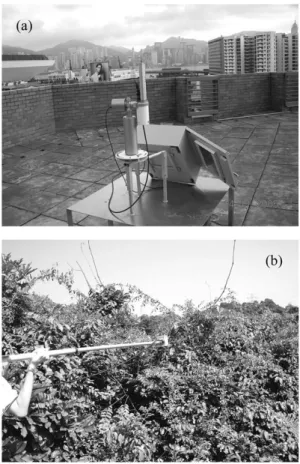
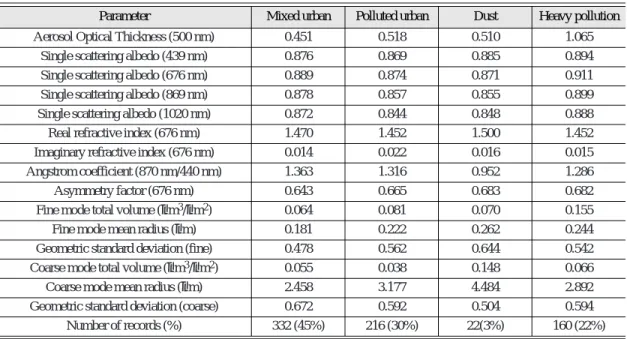
The satellite measured aerosol reflectances decomposing from TOA reflectances, surface reflectances and Rayleigh path radiance can be fitted to values calculated from known aerosol optical properties to derive the AOT from the image wavelengths. This study adopted the Santa Babara DISORT Radiative Transfer (SBDART; Ricchiazzi et al., 1998) model for creating the LUTs. Four aerosol types namely mixed urban, polluted urban, dust, and heavy pollution were derived using cluster analysis on three years of AERONET measurements in Hong Kong (instrument is shown in Fig. 4a). Table 1 shows the aerosol and microphysical properties, as well as the number of records for each cluster. For the
LUT construction, the above 4 aerosol models with particular solar zenith angles, view zenith angles, relative sun/satellite azimuth angles were considered.
The SBDART code uses the aerosol properties associated with a given model, plus the combinations of parameters to compute the hypothetical AOT.
Then, the satellite observed aerosol reflectances are compared to the set of hypothetical aerosol reflectances in LUT. For these comparisons, an optimal spectral shape-fitting technique was executed to select the aerosol model with the smallest systematic errors (Kaufman and Tanré, 1998; Costa et al., 1999; Torricella et al., 1999; Lee et al., 2007a) (Equation 3).
_
29.87 g 0.75 z 8.315 (T
SURF_g 0.75 z)
Fig. 4. (a) CIMEL sunphotometer operating at HKPU site and
(b) MSR-16R multispectral radiometer for surface
reflectance measurement.
x
2= ( )2 (Eq 3)
The error term of x
2is described as the residual of the measured aerosol reflectances r
mAer(l
i) from CHRIS and modeled aerosol reflectances r
cAer(l
i) from aerosol models. The minimum residual of is selected from the four aerosol types for each pixel.
Thus, the appropriate aerosol type is selected and the corresponding AOT values are then derived for each pixel.
4. Results
1) Validation with surface reflectance
Thirty nine ground-based reflectances were measured with MSR-16R multispectral radiometer (see Fig. 4b) on four winter dates: 21-Oct-2006, 29- Oct-2006, 05-Nov-2006 and 29-Dec-2006 (Fig. 5b).
It is assumed that vegetation does not change much in
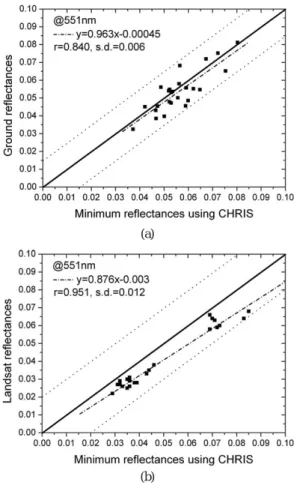
terms of reflectance in winter time, thus ground measurements taken by MSR-16R multispectral radiometer were used to validate the results from the winter MRT image. Fig. 6a depicts the relationship between ground-based reflectances and minimum reflectances at 551nm. It was found that the general differences between minimum reflectances and ground reflectances are within +/-1.5% and a high correlation (r=0.840) was obtained.
The ground-based measurements were only taken on vegetation areas. For those on bright and dark urban surfaces, check points were created based on atmospheric corrected Landsat Thematic Mapper (TM5) image on Dec-28-2006 (Fig. 5a). The Rayleigh and aerosol corrections were applied on the image and thirty-nine points were created (Fig. 5b).
The scatter plot in Fig. 6b shows the general differences are within +/-2% and strong correlation (r=0.951) are observed. And the RMSEs of both ground-based reflectances measured by MSR-16R radiometer and Landsat image are 0.99%, 1.19%, and r
mAer(l
i)
_r
aAer(l
i)
r
mAer(l
i)
n i=1