Reliability and Validity of the Korean Translation of the Pediatric Evaluation of Disability Inventory in School-Aged Children With Cerebral Palsy
Won-ho Kim, Ph.D., P.T.
Dept. of Physical Therapy, Ulsan College Eun-young Park, Ph.D., P.T.
Dept. of Secondary Special Education, College of Education, Jeonju University So-yeon Park, Ph.D., P.T.
Dept. of Physical Therapy, College of Alternative Medicine, Jeonju University
Abstract1
1)The purposes of this study were to examine the reliability and validity of Korean translation of Pediatric Evaluation of Disability Inventory (PEDI-K) in school-aged children with cerebral palsy (CP).
The PEDI-K, Functional Independence Measure for Children (WeeFIM) and Gross Motor Function Classification System (GMFCS) were completed in 104 school-aged children with CP by therapists. The internal consistency of the PEDI-K was calculated by Cronbach’s alpha (α) for assessing reliability.
Concurrent validity was evaluated by correlation with the subsets of WeeFIM. Discriminant validity was assessed by comparing GMFCS levels with tests of the PEDI-K. The results showed that internal con- sistency was good (Cronbach’s α ranged from .97~.98). Concurrent validity was demonstrated. The corre- lation with WeeFIM was high in the Functional Skills (self-care, r=.74~.94; mobility, r=.59~.91; social function, r=.65~.93) and in the Caregiver Assistance (self-care, r=.75~.94; mobility, r=.63~.90; social function, r=.78~.96). Discriminant validity was demonstrated on significant decreases in domain scores with increasing GMFCS levels. Reliability and validity have been demonstrated on the PEDI-K. This study extends usage of PEDI-K in clinical activities and research.
Key Words: Cerebral palsy; PEDI-K; Reliability; Validity.
Introduction
Assessment of the children with cerebral palsy (CP) is necessary for diagnosis, identifying cause, and evaluation of motor function and associated problems (Aneja, 2004; Gunel et al, 2009; Kwolek et al, 2001). The assessment tools for measuring of outcome use functional performance of the child with CP and establish the care plan (Msall et al, 1997). A new definition of CP requires the perspective of ac- tivity restriction and disability (Bax et al, 2005).
Children with CP have a difficulty in daily activ- ities, including dressing and walking (McCarthy et al, 2002). International Classification of Function, Disability and Health (ICF) encourage data collection
about activity limitation and impairment and study of the correlation between activity limitation and impair- ment (World Health Organization, 2001). Futhermore, recent studies on the rehabilitation of children with CP have focused on independence of functionality in daily living (Mayston, 2001). As concern over the measure of function has arisen, instruments for func- tional measure of CP have been developed such as Gross Motor Function Measure (Russell et al, 1989), the Pediatric Evaluation of Disability Inventory (PEDI) (Haley et al, 1992), the Functional Mobility Scale (Graham et al, 2004), and Functional Independence Measure for Children (WeeFIM) (Ottenbacher et al, 1997). As importance of assessment inpatients with CP has increased, researchers have tried to develop a Corresponding author: Eun-young Park [email protected]
standardized instrument that has high reliability and validity (Oeffinger et al, 2004).
The most popular instruments for evaluation used in children’s clinics are the PEDI and WeeFIM (Erkin et al, 2007). The PEDI is the clinical evalua- tion tool for measuring functional capacities and per- formance in healthy children less than 7.5 years of age and children with disabilities whose functional performance are lower than that anticipated of a child of 7.5 years. The PEDI include three subsets of Functional Skills, Caregiver Assistance, and Modifications. The PEDI is composed of a total of 201 items. The PEDI is designed to capture a differ- ent aspect of the child's self-care, mobility, and so- cial function domain (Haley et al, 1992).
The physical and psychosocial health of children can be evaluated in a standardized way, but choosing the most appropriate measure for a specific application depends on many factors, including characteristics of the study sample, practical issues such as burden of respondents and mode of administration, the original intent of candidate instruments, and their psychometric properties (McHorney et al, 1994). This is because the psychometric properties of the instrument can vary between different population groups. Therefore it is important to assess the psychometric properties sys- tematically before an instrument's widespread use within a specific patient population (Wren et al, 2008). The reliability and validity of the translated PEDI was investigated in Turkish (Erkin et al, 2007;
Wassenberg-Severijnen et al, 2003), Chinese (Cen et al, 2009), and Spanish languages (Wren et al, 2008).
The validity of the translated PEDI may be different from the original version of PEDI when translated in- to other languages (Wassenberg-Severijnen et al, 2003) because the PEDI is developed and standardized instrument by English.
There is an insufficiency of functional tools for CP in Korea. In considering this situation in Korea, PEDI is expected to be used for measuring functional performance in CP. For this to occur, the reliability and validity of PEDI translated into Korean must
first be investigated.
Although all types of validity are important to de- cide the availability of test, criterion validity is com- monly used to investigate validity of a newly devel- oped instrument. For that reason, concurrent validity is identified by correlation between the Korean trans- lation of PEDI (PEDI-K) and WeeFIM and the dis- criminant validity is examined according to difference of level of the gross motor functional classification system (GMFCS) in this study.
The purpose of this study was to examine the re- liability and validity of the PEDI-K in children with CP by analyzing internal consistency, concurrent and discriminant validity.
Methods
Subjects
Table 1 presented characteristics and accompany- ing co-morbidity conditions of children. This study was performed on children with CP in Korea. The inclusion criteria were having been diagnosed with CP by a doctor, being at elementary school for physical disabilities or received rehabilitation therapy at hospital being in the age range of 6~12 years, and having accepted participation in the study.
Generally, the PEDI was used to measure functional outcome for children with disabilities who’re functional performance are lower than that anticipated of a child of 7.5 years. According to the PEDI manual, each subscale average score of functional skills is 96.8 (Self-care), 98.9 (Mobility), and 86.4 (Social Function) in healthy children above seven years old (Haley et al, 1992). The measurement results of functional do- mains of PEDI-K were lower than average score of healthy child of 7 years in this study (Table 2).
One out of 105 children was excluded from the study because of insufficient measurement information.
The total participants had a mean age of 10 years 4 month (SD=2.01). Forty-two subjects were female (40.4%) and 62 were male (59.6%). Forty-eight children
Characteristic Frequency %
Sex Female 42 40.4
Male 62 59.6
Types of CP by Swedish classification system
Quadriparetic 48 46.2
Diparetic 46 44.2
Hemiparetic 10 9.6
Types of CP by Surveillance of CP in Europe
Spastic 80 76.9
Athetotic 15 14.4
Dystonic 4 3.9
Ataxic 5 4.8
Co-Morbidity conditions
Vision problems 30 28.9
Speech disorders 53 51.0
Seizures, epilepsy 27 26.0
IQ status
>70 47 45.2
50~70 7 6.7
<50 50 48.1
Table 1. Characteristics and accompanying co-morbidity conditions of children with cerebral palsy
Level Ⅰ (n1=18)
Level Ⅱ (n2=11)
Level Ⅲ (n3=15)
Level Ⅳ (n4=6)
Level Ⅴ (n5=54)
Total (N=104) Functional Skills
Self-care 63.00±12.1a 55.82±12.38 50.80±16.84 48.17±16.50 17.15±16.09 36.19±24.91 Mobility 56.00±3.09 4.55±9.87 32.13±14.37 28.50±8.69 7.57±8.17 24.62±21.29 Social Function 53.67±15.61 49.91±14.17 46.80±22.50 6.00±14.85 23.77±20.79 36.44±23.18 Caregiver Assistance
Self-care 32.11±9.62 24.91±8.08 21.20±11.74 22.67±11.69 5.80±7.40 15.57±13.78 Mobility 32.22±3.35 26.00±5.39 20.47±8.83 16.17±9.22 2.78±5.43 13.65±13.43 Social Function 19.56±6.49 18.27±6.29 16.27±9.17 15.17±6.21 7.96±8.56 12.67±9.34
aMean±SD.
Table 2. Mean for Functional Skills of the PEDI-K by different GMFCS Level (N=104)
were quadriparetic (46.2%), forty-six children were di- paretic (44.2%), and ten children were hemiparetic (9.6%). Eighty children had a spastic type of CP (76.9%), an athetotic type was 15 (14.4%), a dystonic type was 4 (3.9%) and an ataxic type was 5 (4.8%).
The estimated cognitive levels (IQ) of the children were determined using answered form, which was filled-in by the families of the children. The learning disability was defined as mild in children with an IQ level of 50 to 70 and severe if the IQ level was less than 50 (Colver and SPARCLE Group, 2006).
Measurement Instrument
The child's functional capability was measured by using the PEDI-K. The PEDI-K includes three sets of scales: Functional Skills, Caregiver Assistance, and Modifications. The Functional Skills scales con- sist of 197 questions concerning 3 domains: self-care, mobility, and social function. Each question is scored positive (score 1) or negative (score 0). The Caregiver Assistance and Modification scales consist of 20 items concerning 3 same domains of the Functional Skills. Caregiver Assistance scale is rated
from 5 (independent) to 0 (totally dependent). The Modification scales have 4 categories of N (none), C (child-oriented modification), R (rehabilitation equip- ment or assistive devices required) and E (extensive modifications required). The Modification scales were excluded for analyzing of reliability and validity of the PEDI-K because the Modification scales mean a frequency count of type (Haley et al, 1992).
In this study, we used the PEDI-K modified by Jung (2006). The English version of PEDI was translated into Korean by Jung and a bilingual physical therapist. After the initial translation, three bilingual users who were educated in the US verified the accuracy of its trans- lation and thirty-eight allied child health professionals reviewed item compatibility verification using questionnaires. Jung suggested the "Use a knife to but- ter bread, cut soft foods" item on the self-care domain needed to be modified into "Use chopsticks to pick up food and brings to mouth" because of cultural difference between Korean and the US (Jung, 2006).
The WeeFIM were used for examining for con- current validity of the PEDI-K. WeeFIM is the most used for measurement of functional outcome of chil- dren with CP. Various psychometric properties are re- ported and normed data is collected in many countries (Wong et al, 2002). The WeeFIM instrument contains six areas with a total of 18 items. The items are categorized as six self-care, two sphincter control, three transfers, two locomotion, two communication, and three social cognition items. Each item of the areas is scored on a scale of 1~7, where 1 indicates total assistance and 7 shows complete independence.
The minimum total score is 18 (complete dependence) and the maximum score is 126 (complete in- dependence) (Oeffinger et al, 2004).
To evaluate the discriminant validity of the PEDI-K, the Gross Motor Function Classification System (GMFCS) was used to assess the functional level of each child (Palisano et al, 2000). The discrminant val- idity in this paper was used to determine whether the PEDI-K can distinguish between children with CP ac- cording to different functional level (Osterhaus, 2009;
Wren, 2008). The GMFCS is standard and a widely used functional classification system for children with CP. Children in level Ⅰ can perform walks without restrictions, and have limitations in more advanced gross motor skills. Children in level Ⅱ can walks without restrictions but with limitations to walking outdoors and in the community. Children in level Ⅲ can walk with assistive mobility devices, though limi- tations to walking outdoors and in the community persist. Children in level Ⅳ have self-mobility with limitations and can be transported or use power mobi- lity outdoors and in the community. Children in level
Ⅴ have difficulty controlling their head and trunk pos- ture in most positions and in achieving any voluntary control (Morris and Bartlett, 2004).
Statistical Analysis
The reliability of the PEDI-K was assessed by calculating the internal consistency of Cronbach’s α.
The concurrent validity of the PEDI-K was analyzed in the context of the correlation with WeeFIM. The relation of PEDI and WeeFIM domains were ana- lyzed with the Spearman correlation test. The dis- criminant validity of the PEDI-K based on the GMFCS level was examined. Scores for each GMFCS level were compared using Kruscal Wallis one-way analysis of variance (ANOVA) by ranks followed by multiple comparisons. Each pariwise comparison is tested against a minimum significant difference based on the equation of multiple compar- ison for the Kruscal Wallis ANOVA (Portney and Watkins, 1993). The construct validity of PEDI-K was analyzed by correlation between subscales through the Spearman correlation test.
Results
Table 2 listed descriptive data for 3 functional do- mains of the Functional Skills and Caregiver Assistance of the PEDI-K for children with cerebral palsy with different GMFCS levels.
Reliability
The results of internal consistency reliability were above .90 for all domains of the PEDI-K. The Cronbach’s α of self-care, mobility and social func- tion in the Functional Skills domain were .98, .98, and .98 respectively. In the Caregiver Assistance do- main, the Cronbach’s α of self-care was .97, and that of mobility and social function was .97.
Concurrent Validity
Spearman correlation coefficients were presented in Table 3. The PEDI-K was had a significant correla- tion with the WeeFIM (p<.01).
Discriminant Validity
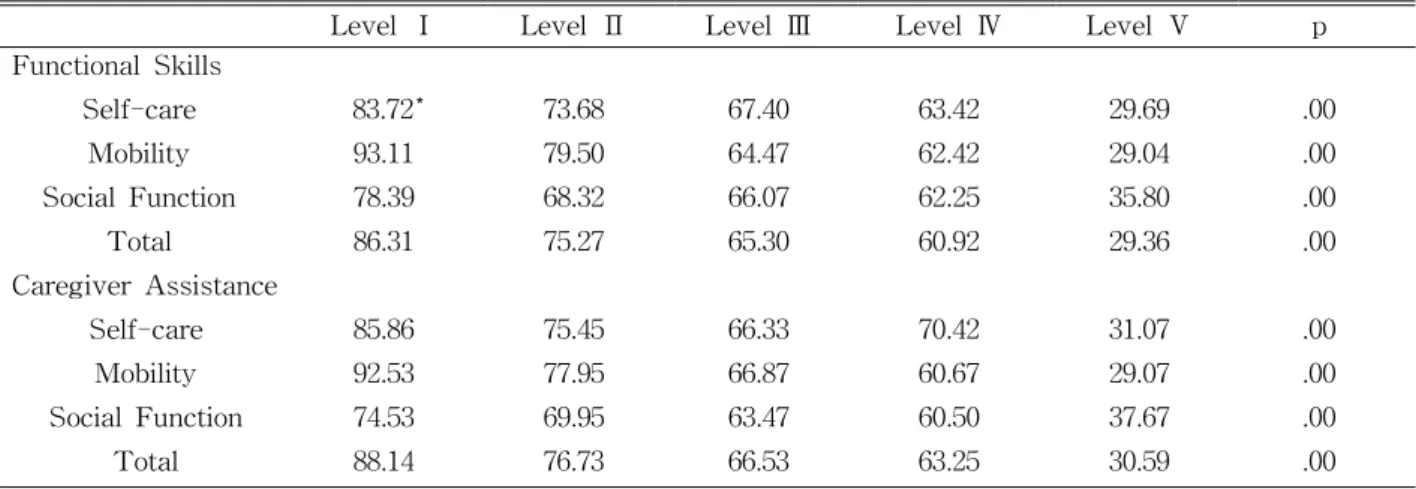
Table 2 presented the domain scores by GMFCS level and Table 4 showed the results of Kruscal Wallis ANOVA. Scores decreased significantly with increasing GMFCS level for all domains. There were significance differences between individual GMFCS levels (p<.01). In the Functional Skills domain, all groups differed significantly except levels Ⅱ and Ⅲ for social function domain and levels Ⅲ and Ⅳ for all domains (p<.05). In the Caregiver Modification domain, all groups differed significantly except levels
Ⅲ and Ⅳ for self-care, social function, and total of this sub-domain (p<.05).
Discussion
The purpose of this study was to evaluate the re- liability and validity of the PEDI-K for measuring school-aged children with CP. The internal con- sistency of PEDI-K domains was assessed for reli- ability and concurrent and discriminant validity was analyzing in 104 children with CP.
The PEDI was designed as a functional assessment tool for children with a disability aged from 6 months to 7.5 years. The PEDI is the most commonly used assessment for children with a disability (Berg et al, 2008). Although the PEDI is not yet commonly used
in Korea, but the frequent usage of the PEDI for as- sessment of children with CP has increased in Korea due to insufficient availability of measurement tools.
It is important to examine psychometric properties of translated instruments. Instruments to be used in evaluation of child functions should be adapted to the society where they are used according to language and cultural contexts, and their validity should be proven. For that reason, previous studies have fo- cused on analyzing the cross-cultural validity of the PEDI normative data. One study was executed on cross-cultural validation of the PEDI norms in a randomized Norwegian population (Berg et al, 2008).
Another study investigated validity and reliability of the Turkish translation of the PEDI in 573 healthy Turkish children. That study reported the acceptable internal construct validity confirmed by good fit to the Rash measurement model (Erkin et al, 2007).
In addition to cross-cultural validation, the PEDI need to provide a validated and standardized tool that can be used with children with CP. For this, the PEDI-K was measured for children with CP in Korea. The internal consistency of PEDI-K was good. The value of Cronbach’s α was interpreted that below .50 is poor, .50~.75 is moderate, .75~.90 is good and above .90 is high (Cronbach, 1951). The Cronbach’s α in each domain of PEDI-K was above .90 in this study. The Cronbach’s α of PEDI was excellent in studies on the original (Haley et al, 1992), Turkish translation (Erkin et al, 2007), and Chinese version of the PEDI (Chen et al, 2009).
Concurrent validity can be examined by correlation with the test which utilizes the same concept for evaluation (Sim and Arnell, 1993). The PEDI was standardized by obtaining normative data for 412 American nondisabled children (Haley et al, 1992).
Correlations with WeeFIM found during the stand- ardization for the Functional Skills range was .40
~.97. Our Correlations were .59~.96. The PEDI-K functional skills seem to have higher correlations values. While correlations with WeeFIM for func- tional skills of the original PEDI were .71~.93 for
PEDI-K
WeeFIM domains Self-care Sphincter
Control Mobility Locomotion Communication Social
Cognition Total Functional Skills
Self-care .93* .83* .84* .82* .74* .79* .94*
Mobility .86* .78* .89* .91* .60* .59* .87*
Social Function .79* .81* .68* .65* .87* .93* .87*
Total .92* .86* .86* .85* .78* .83* .96*
Caregiver Assistance
Self-care .93* .85* .85* .82* .75* .78* .94*
Mobility .88* .80* .90* .90* .63* .66* .89*
Social Function .81* .75* .68* .66* .84* .89* .86*
Total .93* .86* .87* .86* .78* .81* .96*
*p<.01.
Table 3. Spearman correlation coefficient between the PEDI-K Functional Skills and WeeFIM
Level Ⅰ Level Ⅱ Level Ⅲ Level Ⅳ Level Ⅴ p
Functional Skills
Self-care 83.72* 73.68 67.40 63.42 29.69 .00
Mobility 93.11 79.50 64.47 62.42 29.04 .00
Social Function 78.39 68.32 66.07 62.25 35.80 .00
Total 86.31 75.27 65.30 60.92 29.36 .00
Caregiver Assistance
Self-care 85.86 75.45 66.33 70.42 31.07 .00
Mobility 92.53 77.95 66.87 60.67 29.07 .00
Social Function 74.53 69.95 63.47 60.50 37.67 .00
Total 88.14 76.73 66.53 63.25 30.59 .00
*Mean rank.
Table 4. Results of Kruscal Wallis ANOVA according to GMFCS level (N=104)
self-care, .74~.94 were found this study. Mobility had .59~.97 correlations in the original PEDI and .5 9~.91 in the PEDI-K. While social function and sum of functional skills showed .40~.85 and .75~.92, and .65~.93 and .76~.96 in the current study respectively.
The correlation of the Caregiver Assistance was also high. The correlations of the original PEDI of Caregiver Assistance were ranged from .38 to .95.
The PEDI-K of Caregiver Assistance had correlations ranged from .63 to .96. We could find two studies on the correlation the PEDI and WeeFIM. One study that examined correlation with WeeFIM reported
greater than .88 Spearman correlation coefficients for self-care, transportation/locomotion, and communica- tion/social function in children with developmental disabilities and acquired brain injuries (Ziviani et al, 2001). The other study reported a high correlation between .92∼.99 of a Chinese version of the PEDI in which children with CP participated (Chen et al, 2009). Correlations of self-care, mobility and social function were also high in this study.
The discriminant validity is the extent of separa- tion between the latent variables. To examine dis- criminant validity of the PEDI-K, subscale scores
according to GMFCS level were calculated. One pre- vious study examined discriminant validity of PEDI based on GMFCS level. That study reported that scores decreased significantly with increasing GMFCS level for all domain of PEDI (Wren et al, 2008). The scores of self-care, mobility and social function decreased with increasing GMFCS level and they were significant in present study.
This study is a preliminary research of the PEDI-K, because of the following limitations. First, the sample size was small and leaned too much to- ward GMFCS level Ⅴ. For the validation of PEDI-K, the researches need to employ large or selected sam- ple for clinical group. Second, only one test used for assessing reliability of the PEDI-K. Future studies of the PEDI-K should assess various reliabilities such as test-retest, inter-rater and intra-rater.
Conclusion
This study has demonstrated reliability and validity of the PEDI-K, for the first time. The reliability of the PEDI-K was good. Concurrent validity through examining correlation with WeeFIM and discriminant validity through analyzing differences in subscale scores across GMFCS levels was demonstrated on usefulness of the PEDI-K. In further study, various reliability and validity of the PEDI-K should be ex- amined for the clinical usefulness of this measurement.
References
Aneja S. Evaluation of a child with cerebral palsy.
Indian J Pediatr. 2004;71(7):627-634.
Berg M, Aamodt G, Stanghelle J, et al. Corss-cul- tural validation of the Pediatric Evaluation of Disability Inventory (PEDI) norms in a random- ized Norwegian population. Scand J Occup Ther.
2008;15(3):143-152.
Bax M, Goldstein M, Rosenbaum P, et al. Proposed
definition and classification of cerebral palsy, April 2005. Dev Med Child Neurol.
2005;47(8):571-576.
Chen KL, Hsieh CL, Sheu CF, et al. Reliability and validity of a Chinese version of the Pediatric Evaluation of Disability Inventory in children with cerebral palsy. J Rehabil Med.
2009;41(4):273-278.
Colver A, SPARCLE Group. Study protocol:
SPARCLE-a multi-centre European study of the relationship of environment to participation and quality of life in children with cerebral palsy.
BMC Public Health. 2006;6:105.
Cronbach LJ. Coefficient alpha and the internal struc- ture of tests. Psychometrika. 1951;16(3):297-334.
Erkin G, Elhan AH, Aybay C, et al. Validity and re- liability of the Turkish translation of the Pediatric Evaluation of Disability Inventory (PEDI). Disabil Rehabil. 2007;29(16):1271-1279.
Graham HK, Harvey A, Rodda J, et al. The Functional Mobility Scale (FMS). J Pediatr Orthop. 2004;24(5):514-520.
Gunel MK, Mutlu A, Tarsuslu T, et al. Relationship among the Manual Ability Classification System (MACS), the Gross Motor Function Classification System (GMFCS), and the functional status (WeeFIM) in children with spastic cerebral palsy. Eur J Pediatr. 2009;168(4):477-485.
Haley SM, Coster WJ, Ludlow LH, et al. Pediatric Evaluation of Disability Inventory (PEDI).
Version 1.0. Development, standardization and administration manual. Boston, MA, Trustees of Boston University, Center for Rehabilitation Effectiveness, 1992.
Jung B. Adaptation of the pediatric evaluation of disability inventory in korean setting:
Preliminary study. Seoul, Yonsei University, Master's Thesis, 2006.
Kwolek A, Majka M, Pabis M. The rehabilitation of children with cerebral palsy: Problems and cur- rent trends. Ortop Traumatol Rehabil.
2001;3(4):499-507.
This article was received September 28, 2010, and was accepted October 31, 2010.
Mayston MJ. People with cerebral palsy: Effects of and perspectives for therapy. Neural Plast.
2001;8(1-2):51-69.
McCarthy ML, Silberstein CE, Atkins EA, et al.
Comparing reliability and validity of pediatric instruments for measuring health and well-being of children with spastic cerebral palsy. Dev Med Child Neurol. 2002;44(7):468-476.
McHorney CA, Ware JE Jr, Lu JF, et al. The MOS 36-item Short-Form Health Survey (SF-36): Ⅲ.
Tests of data quality, scaling assumptions, and reliability across diverse patient groups. Med Care. 1994;32(1):40-66.
Morris C, Bartlett D. Gross Motor Function Classification System: Impact and utility. Dev Med Child Neurol. 2004;46(1):60-65.
Msall ME, Rogers BT, Ripstein H, et al.
Measurements of functional outcomes in children with cerebral palsy. Ment Retard Dev Disabil Res Rev. 1997;3:194-203.
Oeffinger DJ, Tylkowski CM, Rayens MK, et al.
Gross Motor Function Classification System and outcome tools for assessing ambulatory cerebral palsy: A multicenter study. Dev Med Child Neurol. 2004;46(5):311-319.
Ottenbacher KJ, Msall ME, Lyon NR, et al. Interrater agreement and stability of the Functional Independence Measure for Children (WeeFIM):
Use in children with developmental disabilities.
Arch Phys Med Rehabil. 1997;78(12):1309-1315.
Osterhaus JT, Purcaru O, Richard L. Discriminant validity, responsiveness and reliability of the rheumatoid arthritis-specific Work Productivity Survey (WPS-RA). Arthritis Res Ther.
2009;11(3):R73.
Palisano RJ, Hanna SE, Rosenbaum PL, et al.
Validation of a model of gross motor function for children with cerebral palsy. Phys Ther.
2000;80(10):974-985.
Portney LG, Watkins MP. Foundations of Clinical Research: Applications to practice. Appleton &
Lange, Norwalk, Connecticut ISBN, 1993.
Russell DJ, Rosenbaum PL, Cadman DT, et al. The Gross Motor Function Measure: A means to evaluate the effects of physical therapy. Dev Med Child Neurol. 1989;31(3):341-352.
Sim J, Arnell P. Measurement validity in physical therapy research. Phys Ther. 1993;73(2):102-110.
Wassenberg-Severijnen JE, Custers JW, Hox JJ, et al. Reliability of the Dutch Pediatric Evaluation of Disability Inventory (PEDI). Clin Rehabil.
2003;17(4):457-462.
Wong V, Wong S, Chan K, et al. Function Independence Measure (WeeFIM) for Chinese Children: Hong Kong Cohort. Pediatrics.
2002;109(2):E36.
World Health Organization. International Classification of Function, Disability and Health.
Geneva, World Health Organization, 2001.
Wren TA, Sheng M, Bowen RE, et al. Concurrent and discriminant validity of Spanish language instruments for measuring functional health status. J Pediatr Orthop. 2008;28(2):199-212.
Ziviani J, Ottenbacher KJ, Shephard K, et al.
Concurrent validity of the Functional Independence Measure for Children (WeeFIM) and the Pediatric Evaluation of Disabilities Inventory in children with developmental dis- abilities and acquired brain injuries. Phys Occup Ther Pediatr. 2001;21(2-3):91-101.