Received: 16 November, 2015 Revised: 2 December, 2015 Accepted: 2 December, 2015 Corresponding author: Seungwon Lee
Department of Physical Therapy, Sahmyook University, 815 Hwarang-ro, Nowon-gu, Seoul 01795, Republic of Korea Tel: 82-2-3399-1637 Fax: 82-2-3399-1639 E-mail: [email protected]
This is an Open-Access article distributed under the terms of the Creative Commons Attribution Non-Commercial License (http://creativecommons.org/licens es/by-nc/4.0) which permits unrestricted non-commercial use, distribution, and reproduction in any medium, provided the original work is properly cited.
Copyright © 2015 Korean Academy of Physical Therapy Rehabilitation Science
http://dx.doi.org/10.14474/ptrs.2015.4.2.115 pISSN 2287-7576
eISSN 2287-7584
Phys Ther Rehabil Sci 2015, 4 (2), 115-120 www.jptrs.org
Electromyographic analysis according to shoe weight during ambulation
Eunsang Lee
a, Byunghoon Lee
b, Juchul Cho
a,c, Yongwoo Lee
d, Seungwon Lee
daDepartment of Physical Therapy, The Graduate School, Sahmyook University, Seoul, Republic of Korea
bDepartment of Physical Therapy, Gwangju Health University, Gwangju, Republic of Korea
cRehabilitation Team, Konyang University Hospital, Daegu, Republic of Korea
dDepartment of Physical Therapy, Sahmyook University, Seoul, Republic of Korea
Objective: To examine the effects of different shoe weights on lower leg muscle fatigue when walking by electromyographic (EMG) analysis due to the most effective weight for loading not being established.
Design: Cross-sectional study.
Methods: Thirty healthy university students (15 male, 15 female) were enrolled and randomly assigned into three conditions, which included wearing athletic shoes with an addition of 300 g, 500 g, and 1,000 g weights respectively. Prior to walking, all sub- jects were instructed to sit in a chair for 10 minutes. All subjects walked at a speed of 3.6 m/s on a treadmill for 20 minutes without rest. EMG measurements were taken using the median power frequency to assess for the effect of the different weight of shoes on muscle fatigue of the soleus, gastrocnemius, and tibialis anterior while walking on a treadmill in an upright posture. EMG meas- urements were taken during the first and last 30 seconds of walking.
Results: In terms of muscle fatigue, for the soleus, the median power frequency was significantly lower with 1,000 g compared with 300 g and 500 g (p<0.05). For the tibialis anterior, the median power frequency was significantly lower with 1,000 g than 300 g and 500 g (p<0.05). For the gastrocnemius, the median power frequency was significantly lower with 1,000 g compared with 300 g (p<0.05).
Conclusions: Increased shoe weight increases soleus, gastrocnemius, and tibialis anterior muscle fatigue during ambulation.
Key Words: Electromyography, Gait, Lower extremity, Shoe
Introduction
Increased energy intake and reduced physical activity are responsible for numerous chronic diseases, such as obesity, diabetes, ischemic heart disease and so on, worldwide [1].
Accordingly, several governments and non-governmental organizations worldwide have emphasized the importance of increasing physical activity, and have provided guidelines for physical activity as an essential aspect to improving health. These guidelines also emphasize the importance of walking, suggesting 10,000 steps per day as the minimum amount of walking that should be incorporated into every-
day life [2]. Walking refers to the action of transporting the
body to another location by repetitive movements of both
legs, and is one of the most natural and fundamental actions
in humans [3]. It can also be described as a continuous and
repetitive movement of individual segments of the body in
order to gradually transport the body in a consistent direc-
tion, while maintaining the required speed [4]. Health con-
ditions and age can be recognized by a person’s gait, rela-
tionship between walking speed and walk [5], shoes type
and walking [6], and walking on the steps and slope and ob-
stacles [7] etc., there have been many studies to date quanti-
fying and specifying gait.
Table 1. Demographic and anthropological characteristics of the subjects (N=30)
Characteristic 300 g (n=10) 500 g (n=10) 1,000 g (n=10) F (p)
Age (yr) 24.18 (2.31) 23.44 (0.96) 24.71 (1.81) 0.188 (0.884)
Height (cm) 167.63 (2.71) 166.84 (3.11) 166.36 (2.51) 1.03 (0.561)
Weight (kg) 64.61 (9.43) 62.4 (9.70) 65.11 (4.43) 0.793 (0.322)
Shoes size (mm) 247.2 (0.81) 245.5 (0.47) 246.1 (0.42) 0.331 (0.721)
Values are presented as mean (SD).
and disease has been conducted for many years, recently, there have also been studies using various methods, such as motion analysis, electromyography (EMG) analysis, bal- ance test, to examine the exercise effects of walking, which is the most active activity of daily living.
Various elements are involved in the energy consumption from walking, such as the walker’s body weight and walking method [8] and the state of the ground [9]. Upright walking produces forces of impact due to interactions between the feet and the ground, and when excessive movements arise from the continual accumulation of these forces, the joints and muscles can become overloaded, leading to injury [10].
Humans frequently wear shoes to mitigate this impact, and there have been multifaceted studies of alterations to shoes to increase the efficiency of walking exercise [11,12], such as changing the thickness of the soles or the weight of the shoes [13,14].
Shoes are the most basic tool in walking, and help provide stability to prevent injuries to the feet. Hence, the majority of studies on the topic have aimed to modify footwear in a way that improves stability to prevent ankle sprains. However, recently, a new method of shoe design has been conceived that increases the exercise effects rather than function, which induces greater energy consumption and promotes over-exercise; in turn, this provides stability when walking [15,16]. Further, there has been persistent development of methods of weight-loading using shoes or sandbags, as a way of increasing the effects of classical exercise [17].
Gwak et al. [18] suggested that the weight-loading method was effective for improving gait efficiency and respiratory circulation, and that increasing weight using shoes was a good method, because it was not limited in terms of the time and place of exercise. However, indiscriminate weight-load- ing can have a negative effect on the joints of the lower limb, such as arthritis and ligament damage. In fact, Chung [19]
detected a weight-dependent change in joint moment, which affected the joint rate of work and the muscle performance,
joint moment. Recently, light-weight footwear has been em- phasized, and while various studies have been conducted on running efficiency and joint moment in relation to lower limb weight-loading, the most effective weight for loading has not been established.
Therefore, the present study aimed to determine a more effective weight for gait training by using weights of 300 g, 500 g, and 1,000 g, with 300 g being the standard weight for a shoe, and by analyzing the effects of these loads on differ- ent lower limb muscles using EMG.
Methods Subjects
Among the subjects who agreed to participate in the ex- periment after hearing an explanation of the aims and meth- ods, 15 male and 15 female healthy, adult subjects in their 20s who wore shoes for at least 5 hours, 3 times a week, had normal gait and foot shape, and had no internal or external abnormalities in the last year were selected for the study. The physical characteristics of the subjects are summarized in Table 1.
Experimental design
This study is a non-experimental study that examined the effect of weight of shoes on the muscle fatigue of the lower limbs, and was based on cross-sectional study that examines the state of subjects by single measurement at a certain point.
Based on the method proposed by Gwak et al. [18], the weight of shoes and attachment method was decided within the range between 1% and 5%, according to the finding that the minimum additional weight is 2% of the body weight.
However, due to circumstances, it was impossible to adjust
shoe weight to the body weight of subjects and, therefore,
two types of weights were made by using lead, which were
then hung on the area close to the ankle, in order to evenly dis-
tribute the weight on the anterior-posterior-medial-lateral of
Figure 2. Electromyographic Device. The BTS FREEEMG 300 (BTS Bioengineering, Milan, Italy).
Figure 1. Attachment sites of weight.
the shoes. In the test, the weight of shoes was 300 g for group A, 500 g for group B, and 1,000 g for group C, with 300 g be- ing the basic weight of the shoes, 500 g being the shoe weight added by 200 g weight and the weight of light hiking shoes, and 1,000 g being the shoe weight added by 700 g weight and the weight of medium-weight hiking shoes.
The weight difference between shoes of different sizes was not taken into account because there is only about 5 g of difference per 5 mm of the shoe size.
Procedure
This experiment used three types of shoe weights – 300 g, 500 g, and 1,000 g – and to reduce errors in the weight-de- pendent data, used the same model of shoes from the same brand MRT580DS (Newbalance, Boston, MA, USA) (Figure 1). Measurements were made in the morning to minimize er- rors due to the accumulation of muscle fatigue during the day, and a prior investigation was performed to identify the appropriate shoe sizes. For the walking exercise, the partic- ipants were instructed to arrive at the laboratory 20 minutes before the experiment and were made to sit in a chair and rest for 10 minutes after arrival. The subjects wore artificially weighted shoes and walked on a treadmill in an upright pos- ture for 20 minutes, without rest, at a constant speed of 3.6 km/h, pertaining to an average walking speed. EMG meas- urements were taken for 30 seconds during the exercise ini- tiation, and again for 30 seconds at the last 30 seconds prior to the end of exercise, and these measurements were used to calculate the muscle activity and fatigue using the median power frequency (MPF) value with a base value calculated as a percentage during the first and last 30 seconds of walk- ing [20,21].
Measurements
Muscle fatigue during treadmill walking were measured for the bilateral tibialis anterior, soleus, and medial gastro-
cnemius using BTS FREEEMG 300 (BTS Bioengineering, Milan, Italy) (Figure 2), by a protocol set using Myolab soft- ware (BTS Bioengineering). After the measurements, the data were sent to a personal computer using a wireless net- work device and the participant’s protocol was set using Myolab software. In order to avoid technical errors that may affect the results, body hair was removed prior to the experi- ment, before wiping the area clean with an ethanol swab and attaching the surface electrodes. Disposable 2225H (3M Korea Ltd., Seoul, Korea) electrodes, which are compatible with the BTS FREEEMG 300, were used, and these were placed such that the distance between each electrode EMG probe was attached to the adhesion interval. The electrodes were attached to the locations suggested by the surface elec- tromyography for the non-invasive assessment of muscles [22], as shown in Figure 3. Muscle fatigue was measured based on median frequency of EMG that was generated dur- ing the 20 minutes of walking, and muscle activity was based on root mean square, to analyze the eletromyogram patterns.
Data analysis
Statistical processing in this study was performed using PASW ver. 18.0 for Windows (IBM Co., Armonk, NY, USA). One-way ANOVA (analysis of variance) was used to compare the effects of different loads on muscle fatigue for the three muscles.
Where the one-way ANOVA showed a significant differ- ence, post-hoc testing was performed using Scheffe’s test.
The statistical significance level was set as α=0.05.
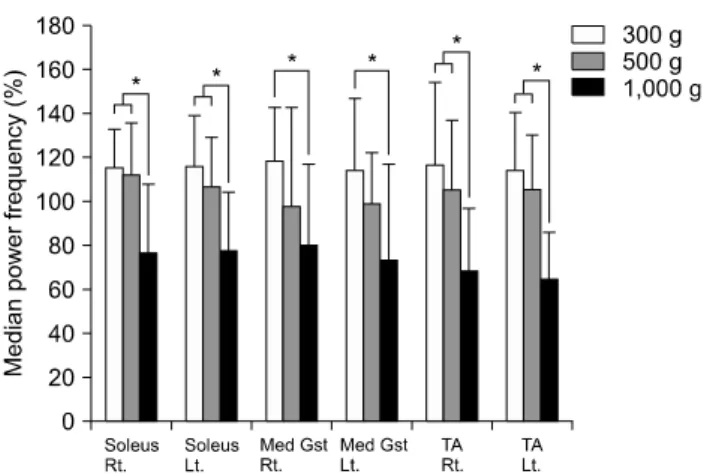
Figure 3. Locations of the surface electromyography electrodes. Figure 4. Muscle fatigue analysis. Groups A, B, and C were in- structed to wear athletic shoes weighing 300 g, 500 g, and 1,000 g, respectively. Rt.: right, Lt.: left, Med: medial, Gst: gastrocnemius, TA: tibialis anterior. *p<0.05.
Results
Differences in lower limb muscle fatigue according to shoe weight
The effects of different shoe weights on muscle fatigue in the lower limbs are shown in Figure 4. Comparison of the mean muscle fatigue according to shoe weight showed that the mean fatigue increased with increasing weight, from 300 g to 500 g, to 1,000 g. After post-hoc testing, both the right and left soleus muscles showed no significant difference in muscle fatigue between 300 g and 500 g (p>0.05), whereas 1,000 g showed significantly lower median power fre- quency than 300 g and 500 g (p<0.05). Moreover, after post-hoc testing, the right medial gastrocnemius muscle showed a significant difference between 300 g and 1,000 g (p<0.05), and the left medial gastrocnemius muscle showed a significant difference between 300 g and 1,000 g (p<0.05).
Both the right and left tibialis anterior muscles showed no significant difference in muscle fatigue between 300 g and 500 g after post-hoc testing, whereas 1,000 g showed sig- nificantly lower median power frequency than 300 g and 500 g (p<0.05).
Discussion
For rehabilitation and improvement of health, an exercise effect needs to be achieved through diverse physical activ- ities suited to the individual patient. However, this is not easy to implement in reality, and hence, recently, to achieve greater efficiency, various methods that effectively utilize movements in activities of daily living, such as standing, walking, or sitting, have been researched. Of these, walking
exercise has often been recommended, with multiple studies reporting it to be an effective cardiovascular exercise that does not cause excessive stress to joints and that helps to pre- vent secondary disease in obese or overweight individuals.
Consequently, there has been increasing interest in methods that effectively increase the energy consumption during walking without over-exerting the joints and muscles [15,23].
One way to increase the effects of walking is to alter the hardness, shape, or weight of the shoes, which has been re- ported to result in changes in energy expenditure and gait patterns when walking. In order to confirm these changes, most studies have investigated changes in body energy con- sumption and muscle activity after altering the shape or weight of the footwear, and there have been numerous stud- ies reporting an effect on the walking outcomes when shoes are loaded with additional weight [9,24,25].
Hence, the present study aimed to produce a more effec- tive analysis of walking with weighted shoes and to provide more detailed and accurate evidence for the effects thereof.
To this end, we used EMG to investigate differences in the fatigue and activity of the lower leg muscles according to different shoe weights.
Previous research has demonstrated an effect of attaching
weights to shoes on the respiratory circulation, effects of at-
taching different weights at different positions, and changes
in walking efficiency due to the response of the respiratory
system. In the present study, the volunteers were divided in-
to 3 groups according to shoe weight (300 g, 500 g, and
1,000 g), and measurements were taken bilaterally from the
soleus, medial gastrocnemius, and tibialis anterior. The re- sults showed that there was no significant difference in mus- cle median power frequency between groups A and B for the soleus or tibialis anterior, whereas there was a significant de- crease in group C compared to groups A and B (p<0.05).
Meanwhile, the medial gastrocnemius only showed a sig- nificant decrease between groups A and C (p<0.05).
Gwak [17] studied the ankle inversion angle, angular speed, ground reaction force, and impact with different shoe weights, although this study used weight categories of 150 g, 250 g, and 350 g. The results showed a decrease in ground reaction force is that 150 g is 1,902 N, 250 g is 1,855 N, 350 g is 1,822 N as the weight increased to 350 g, in addition to a decrease in the peak impact force 1,407 N, 1,403 N, 1,302 N with increasing shoe weight. Combined with the results of our study, as the weight of footwear increases, in accordance with the equation F=M·A, the force that the body imparts on the ground also increases, and by the law of action-reaction, this seems to result in greater absorption of the reactionary force and impact force between the shoes and ground. In ad- dition, a study by Boozari et al. [26] comparing normal and flat feet found that muscle fatigue was higher for flat feet, and that during walking, the arch collapsed in flat feet, meaning that it was unable to absorb the impact between the body and the ground, thus leading to fatigue. Hence, a sig- nificant association can be predicted between impact force and muscle fatigue, and this suggests that reductions in the ground reaction force and impact force causes a reduction not only in the impact conveyed to the body, but also in mus- cle fatigue. Furthermore, in one previous study [17], the an- kle inversion angle did not change significantly with in- creasing shoe weight, but rather increased somewhat.
Biomechanically, an increase in the ankle inversion angle would increase the activity in the medial gastrocnemius dur- ing walking.
Although the present study did not find a significant dif- ference in medial gastrocnemius fatigue between groups A and B or groups B and C, there was a significant difference between groups A and C, which had a weight difference of 700 g. This also appears to be relevant when compared with the previous study showing no significant change in ankle inversion angle with increase weight, and with more thor- ough research into the effects on the ankle inversion angle with different shoe weights, it might be possible to achieve even more effective rehabilitation or exercise by utilizing different shoes.
With reference to previous studies on shoe weight, Gwak
et al. [18] found a significant increase in the heat rate of male
is 115, 117, 121, 123, 126, female is 118, 122, 135, 141, 144, 146 (p>0.05) with increased shoe weight, in addition to sig- nificant increases in oxygen consumption, carbon dioxide emission, and energy consumption. Further, according to a study by Kim [27], who studied changes in respiratory func- tion and energy consumption according to shoe weight and walking speed, while there was no significant difference in energy consumption and respiratory function with different shoe weights at normal walking speed, at a fast walking speed, there was a significant difference. These previous studies suggest that the respiratory function and energy me- tabolism were stimulated by increased load during walking, and as a reason for this, changes in energy consumption due to increased muscle activity required for walking under heavier loads cannot be excluded.
Comparing these results with those of the present study, the overall muscle activity increased, but only the tibialis an- terior showed a significant increase, while the gastrocne- mius and soleus showed non-significant increases. The joint for the gastrocnemius and soleus is a class 2 lever, and due to its mechanical properties, even a small force produces a large force in response. Meanwhile, the tibialis anterior is a class 3 lever, and it is thought to show more activity during walking because it has minimal mechanical gain. Given that the tibialis anterior is a muscle that always needs to be at- tended to in ankle sprain patients, it seems that it may be pos- sible to effectively exercise the tibialis anterior and reduce muscle fatigue by using weighted shoes.
Furthermore, the study by Kim [27] showed a significant weight-dependent difference in energy consumption for rap- id walking 380 to 511 cal but 373 to 456 cal not for normal walking, demonstrating that more significant differences can be seen when there is more work. Similarly, in the pres- ent study, it was considered that a significant difference might have been seen if the experiment was conducted for a longer time, or at a faster walking pace.
In conclusion, this study provided a scale for the choice of
footwear by quantifying the effects of different shoe weights
on muscle fatigue in the lower limbs. The results of the pres-
ent study can be used as basic data for rehabilitation or ex-
ercise using walking, and suggest that rather than light and
comfortable footwear, selecting footwear suited to the
symptoms, requirements, and conditions of the individual,
such as the active use of weight-loading, can be helpful in
achieving the therapist’s goals in an improved environment,
by effective rehabilitation and reduction of fatigue. When
ing, it is thought that heavier shoes may be able to contribute to reducing muscle fatigue and correcting gait patterns.
This study had limitations because, first, the maximum available number of probes of BTS FREEEMG was eight, and, therefore, the study did not measure various muscles while walking. Second, due to difficulties with making shoes, weights were added to shoes instead of using shoes that were suitable for the weight. The result of this study can be used for future research and shoe manufacturers. Lastly, only a small number of subjects was used considering the design of the test, because only subjects who satisfied the relevant criteria were selected.
Conflict of Interest
The authors declared no potential conflicts of interest with respect to the authorship and/or publication of this article.
References
1. Popkin BM, Adair LS, Ng SW. Global nutrition transition and the pandemic of obesity in developing countries. Nutr Rev 2012;70:3-21.
2. Tudor-Locke C, Craig CL, Brown WJ, Clemes SA, De Cocker K, Giles-Corti B, et al. How many steps/day are enough? For adults.
Int J Behav Nutr Phys Act 2011;8:79.
3. Chao EY, Rim K. Application of optimization principles in de- termining the applied moments in human leg joints during gait. J Biomech 1973;6:497-510.
4. Perry J. Gait analysis: normal and pathological function. Thorofare, NJ: Slack; 1992. p. 413-22.
5. Helbostad JL, Moe-Nilssen R. The effect of gait speed on lateral balance control during walking in healthy elderly. Gait Posture 2003;18:27-36.
6. Ramstrand N, Thuesen AH, Nielsen DB, Rusaw D. Effects of an unstable shoe construction on balance in women aged over 50 years. Clin Biomech (Bristol, Avon) 2010;25:455-60.
7. Son H, Kim K. A kinematic analysis of patients with knee osteo- arthritis during gait on level ground, ramps and stairs. J Phys Ther Sci 2013;25:277-80.
8. VanSwearingen JM, Perera S, Brach JS, Cham R, Rosano C, Studenski SA. A randomized trial of two forms of therapeutic ac- tivity to improve walking: effect on the energy cost of walking. J Gerontol A Biol Sci Med Sci 2009;64:1190-8.
9. Bosco C, Saggini R, Viru A. The influence of different floor stiff- ness on mechanical efficiency of leg extensor muscle. Ergonomics 1997;40:670-9.
ent walking speeds in obese and normal people. Korean J Sport Sci 2007;18:497-510.
11. Fong DT, Hong Y, Li JX. Cushioning and lateral stability func- tions of cloth sport shoes. Sports Biomech 2007;6:407-17.
12. Wezenberg D, de Haan A, van Bennekom CA, Houdijk H. Mind your step: metabolic energy cost while walking an enforced gait pattern. Gait Posture. 2011;33:544-9.
13. Sekizawa K, Sandrey MA, Ingersoll CD, Cordova ML. Effects of shoe sole thickness on joint position sense. Gait Posture. 2001;
13:221-8.
14. Murley GS, Landorf KB, Menz HB. Do foot orthoses change lower limb muscle activity in flat-arched feet towards a pattern observed in normal-arched feet? Clin Biomech (Bristol, Avon) 2010;25:728-36.
15. Nigg B, Hintzen S, Ferber R. Effect of an unstable shoe con- struction on lower extremity gait characteristics. Clin Biomech (Bristol, Avon) 2006;21:82-8.
16. Romkes J, Rudmann C, Brunner R. Changes in gait and EMG when walking with the Masai Barefoot Technique. Clin Biomech (Bristol, Avon) 2006;21:75-81.
17. Gwak CS. Effects of shoe weight and midsole hardness of run- ning shoes on running economy and its application. Korean J Phys Educ 2001;40:955-73.
18. Gwak CS, Lee GS, Kim HS. Effects of shoe weights on the walk- ing economy. Korean J Phys Educ 2003;42:677-86.
19. Chung HK. The changes of joint moments according to weight loading gait on normal adults. J Korean Acad Phys Ther 2003;
10:53-61.
20. Cheung JT, Zhang M, An KN. Effects of plantar fascia stiffness on the biomechanical responses of the ankle-foot complex. Clin Biomech (Bristol, Avon) 2004;19:839-46.
21. Hong Y, Li JX, Fong DT. Effect of prolonged walking with back- pack loads on trunk muscle activity and fatigue in children. J Electromyogr Kinesiol 2008;18:990-6.
22. Hermens HJ, Freriks B, Disselhorst-Klug C, Rau G. Develop- ment of recommendations for SEMG sensors and sensor place- ment procedures. J Electromyogr Kinesiol 2000;10:361-74.
23. Seo YW, Lee HJ, Yun KE, Park HS. Energy intake and resting en- ergy expenditure of middle-aged obese korean women. Korean J Obes 2009;18:31-7.
24. Long JT, Klein JP, Sirota NM, Wertsch JJ, Janisse D, Harris GF.
Biomechanics of the double rocker sole shoe: gait kinematics and kinetics. J Biomech 2007;40:2882-90.
25. Vanderpool MT, Collins SH, Kuo AD. Ankle fixation need not increase the energetic cost of human walking. Gait Posture 2008;
28:427-33.
26. Boozari S, Jamshidi AA, Sanjari MA, Jafari H. Effect of func- tional fatigue on vertical ground-reaction force in individuals with flat feet. J Sport Rehabil 2013;22:177-83.
27. Kim UG. The effects of cardiorespiratory response and energy economy to walking exercise with added shoe weight, and to verify the shoe weight and walking economy. Korea Sport Res 2005;
16:155-64.