177
JOURNALOF KOREAN FOREST SOCIETY ISSN 0445-4650(Print), ISSN 2289-0904(Online) http://e-journal.kfs21.or.kr
7 가지 시비처리가 물푸레나무, 들메나무, 잣나무, 전나무 묘목의 생장 및 양분농도에 미치는 영향
한시호1·변재경2·조민석3·안지영4·박관수1·김세빈1·박병배1*
1충남대학교 산림환경자원학과, 2한국임업진흥원,
3국립산림과학원 산림생산기술연구소, 4교토대학교 산림생물자원학과
The Effects of 7 Fertilizers on the Growth and Nutrient Concentrations of Fraxinus rhynchophylla, Fraxinus mandshurica, Pinus koraiensis,
and Abies holophylla Seedlings
Si Ho Han1, Jae Kyung Byun2, Min Seok Cho3, Ji Young An4, Gwan Soo Park1, Se Bin Kim1 and Byung Bae Park1*
1Department of Environment and Forest Resources, Chungnam National University, Daejeon 34134, Korea
2Korea Forestry Promotion Institute, Seoul 07570, Korea
3Forest Practice Research Center, National Institute of Forest Science, Pocheon 11187, Korea
4Division of Forest and Biomaterials Science, Kyoto University, Kyoto 606-8502, Japan
요 약: 시비는 고정포지에서 연속적인 묘목 생산에 의해 발생할 수 있는 양분 부족을 예방하고 건전한 묘목 생산 을 위해 필수적이다. 본 연구에서는 물푸레나무, 들메나무, 잣나무, 전나무 묘목을 대상으로 무처리인 대조구를 포함 하여, 단일원소비료 질소(N 13.8 g·m−2), 인(P 6.1 g·m−2), 칼륨(K 7.5 g·m−2) 처리와 NPK복합비료 1x(N 6.9 g·m−2, P 3.05 g·m−2, K 3.75 g·m−2), 2x(1x의 2배량), 4x(1x의 4배량) 처리가 묘목의 생장과 양분 변화에 미치는 영향을 양분벡 터분석법(Vector diagnosis method)으로 정량화하였다. 토양 pH는 시비량이 증가할수록 감소하는 경향을 보였으며, 치 환성 칼슘과 마그네슘은 질소와 복합비료 처리에서 감소하였다. 물푸레나무와 들메나무는 질소와 복합비료 시비에서 수고와 근원경이 유의하게 증가하였고, 잣나무와 전나무는 처리에 따른 차이가 없었다. 물푸레나무와 들메나무는 대 조구에 비해 복합비료 처리에서 약 2배의 물질량 증가를 보였다. 양분벡터반응은 수종과 시비처리에 따라 상이한 경 향을 보였는데, 물푸레나무는 식물체 내 질소 농도와 함께 질소함량이 감소되는 “양분희석” 현상이 나타났고, 식물 체 인과 칼륨은 4x처리에서 식물체 농도 변동 없이 함량이 증가하는 “양분최적” 현상을 보였다. 들메나무는 질소, 인, 칼륨의 단일원소비료 처리에서 건중량의 변화 없이 질소 함량을 감소시키는 “체내이동” 현상을 보였으며, 복합 비료 처리는 정도는 다르지만 “양분희석” 현상을 보였다. 본 연구는 양묘과정에서 물푸레나무와 들메나무는 적절한 시비가 요구되지만, 잣나무와 전나무는 시비가 필수적이지 않음을 보여주고 있다.
Abstract: Fertilization is required to keep the balance of tissue nutrients and to produce high quality seedlings at the permanent nursery. This study was conducted to verify the optimum fertilization method for Fraxinus rhynchophylla, F. mandshurica, Pinus koraiensis, and Abies holophylla seedlings with vector diagnosis method.
Seven treatments include nitrogen (N, 13.8 g·m−2), phosphorus (P, 6.1 g·m−2), potassium (K, 7.5 g·m−2) fertilization and 1x (N 6.9·g m−2, P 3.05 g·m−2, K 3.65 g·m−2), 2x (twice of 1x), 4x (four times of 1x) fertilization and no fertilization. Soil pH decreased as fertilization increased. Nitrogen and NPK fertilization decreased exchangeable Ca2+ and Mg2+ concentrations. Height and root collar diameter of F. rhynchophylla and F. mandshurica significantly increased with N and NPK fertilization, but those of P. koraiensis and A. holophylla did not. The biomass of F.
rhynchophylla and F. mandshurica was about twice higher at NPK fertilization compared to the control. The responses of vector diagnosis were different by tree species and fertilization treatment: F. rhynchophylla was in the status of N “dilution”, which means the N concentration decreases with N content. Phosphorus and K were
“sufficiency” state with 4x fertilization. F. mandshurica showed “retranslocation” as N content decreased without change of dry weight at N, P, K fertilization, but “dilution” state at NPK fertilization. This result suggested that optimal fertilization was required for F. rhynchophylla and F. mandshurica in seedling production stage, but was not essential for P. koraiensis and A. holophylla.
Key words: biomass, fertilization, seedling quality, vector diagnosis method, Yongmun Nursery Station
*Corresponding author E-mail: [email protected]
서 론
지속가능하게 산림을 경영하기 위해서는 우량한 묘목 생산이 필수적이며, 양묘생산단계에서 비료주기는 이를 위한 필수적인 기술이다(Park et al., 2010a; 2010b; Park et al., 2012; Shin et al., 1999; Son et al., 1998). 토양환 경과 수종에 맞는 시비는 묘목 생산으로 인해 부족해진 양분을 공급하고, 묘목 생장의 개선, 묘목의 내건성, 내한 성, 내병성을 증가시키며, 묘목을 이식하는 과정에서 발생 할 수 있는 스트레스를 저감시켜 초기 활착률을 증가시킨 다(Carlson, 1981; Imo and Timmer, 1999; Quoreshi and Timmer, 2000).
포지에서 수종과 토양환경을 고려하지 않은 지속적인 화학비료 사용은 토양의 질을 저감시키고, 발아율과 묘목 생장을 저하시키며, 포지 주변의 토양과 지하수의 오염을 유발할 수 있다(Andersen and Hansen, 2000; Broschat, 1995). 이를 방지하기 위해서는 수종과 포지 토양조건을 고려한 비료 종류와 시비량의 기준 정립이 요구된다.
양분벡터분석(Vector diagnosis analysis)은 시비에 따른 묘목의 양분 상태를 판단하기 위해 한대수종을 대상으로 개발된 기술이며(Timmer and Stone, 1978), 식물체의 건 중량, 양분 농도, 식물체가 흡수한 양분량의 변화를 한 지 면에서 동시에 생장과 양분상태를 정량적으로 분석할 수 있다. 이러한 양분벡터분석 방법은 양묘장 포지의 양분균 형, 혼농임업에서 양분동태 파악에 활용되어 왔다(Haase and Rose, 1995; Issac and Kimaro, 2011). 국내에서는 활 엽수와 침엽수 묘목을 대상으로 질소, 인, 칼륨 비료의 시 비효과를 정량화하는데 양분벡터분석이 시도되었다(Park et al., 2010a; 2010b).
본 연구에서는 경제림 육성 수종이면서 시비량과 원소 비율에 반응이 다른 물푸레나무, 들메나무, 잣나무, 전나 무 묘목을 대상으로 단일원소비료인 질소, 인, 칼륨 처리 와 NPK 복합비료 처리량에 따른 생장 및 양분변화를 양 분벡터분석을 통해 정량적으로 비교하여, 수종에 맞는 적 절한 시비방법을 제시하고자 하였다.
재료 및 방법
1. 연구대상지 및 연구대상 수종
본 연구는 경기도 양평에 위치한 산림청 용문양묘사업 소(경기도 양평군 용문면 어수길 91)에서 이루어졌다. 이 지역의 평균기온은 11.5oC, 연평균강수량은 1,438 mm 이 다(Korea Meteorological Administration, 2011).
물푸레나무와 전나무의 묘목은 경기도 양평의 용문묘 포장에서 생산되었다. 들메나무 묘목은 강원도 정선의 정 선 양묘사업소, 잣나무 묘목은 강원도 양구의 사설 묘포
장에서 생산되었다. 물푸레나무와 들메나무는 2006년 봄 에 파종한 1년생 묘목, 잣나무는 2005년 봄에 파종한 2년 생 묘목을 이용하였다. 전나무는 2004년 봄에 파종한 후, 2년생이 되는 2006년에 옮겨 심은 2-1년생 묘목을 이용하 였다.
2. 실험 설계
기존에 묘포장으로 이용된 포지를 깊게(45 cm) 경운한 후에 1 m×20 m의 묘상을 동서로 배치하였다. 묘상 위에 는 1 m×1 m 크기의 조사구를 만들고, 조사구 사이에는 100 cm 이상 거리를 두어 완충역할과 동시에 작업로로 이 용하였다. 묘목 식재 전 토양의 토성과 화학성을 분석하 기 위해 무작위로 2 지점을 선정하고 0~10 cm와 10~30 cm 깊이의 토양 시료를 채취하여 아래의 토양분석 방법으로 분석하였다.
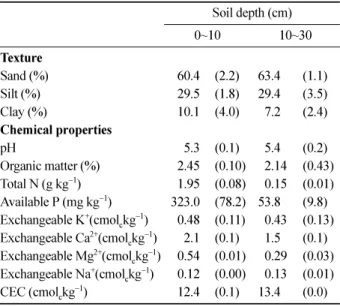
2007년 4월, 묘고와 근원경(RCD)이 비슷한 묘목들을 선 정하여, 산림청 양묘시업기준에 따라 물푸레나무와 들메 나무는 1 m×1 m 처리구에 64본(묘목과 묘목 사이의 식재 거리 12.5 cm), 잣나무는 100본(묘목과 묘목 사이의 식재 거리 10 cm), 전나무는 81본(묘목과 묘목 사이의 식재 거 리 11 cm)을 식재하였다. 묘목 식재는 하루 안에 이루어졌 고, 식재 후 충분히 관수하였다. 시험지 토양은 사양토이 며, pH는 5.3으로 일반적인 묘포토양의 특성을 보였다 (Table 1).
묘목 식재 4주 후에 비료를 주지 않은 대조구를 포함하 여 일곱 가지 비료를 처리하였다(Table 2). 주요 원소의 효 과를 알아보기 위하여 질소(N), 인(P), 칼륨(K)이 주성분
Table 1. Soil texture and chemical analysis of nursery bed.
Available P, CEC and EC represent H2PO4−, cation exchange capacity, and electrical conductivity, respectively. Total N is the sum of organic N and inorganic N. Parenthesis is standard error (n=2 for nursery soil).
Soil depth (cm)
0~10 10~30
Texture
Sand (%) 60.4 (2.2) 63.4 (1.1)
Silt (%) 29.5 (1.8) 29.4 (3.5)
Clay (%) 10.1 (4.0) 07.2 (2.4)
Chemical properties
pH 5.3 (0.1) 05.4 (0.2)
Organic matter (%) 2.45 (0.10) 02.14 (0.43) Total N (g kg−1) 1.95 (0.08) 00.15 (0.01) Available P (mg kg−1) 323.0 (78.2) 53.8 (9.8) Exchangeable K+(cmolckg−1) 0.48 (0.11) 00.43 (0.13) Exchangeable Ca2+(cmolckg−1) 2.1 (0.1) 01.5 (0.1) Exchangeable Mg2+(cmolckg−1) 0.54 (0.01) 00.29 (0.03) Exchangeable Na+(cmolckg−1) 0.12 (0.00) 00.13 (0.01) CEC (cmolckg−1) 12.4 (0.1) 13.4 (0.0)
인 단일비료 3가지 처리와 처리량의 효과를 알아보기 위 하여 복합비료인 NPK 혼합비료를 기존 시비(2x)를 기준 으로 50% 처리(1x), 2배 처리(4x) 하였다.
비료를 묘목과 묘목 사이에 흩어뿌림 방식으로 처리하 였고 모든 처리는 3회 반복을 포지에 무작위로 배치하였 다(4수종×7 비료처리×3 반복=84시험구). 식재 후 4주 동 안 3일 간격으로 관수하였고, 그 후 건조 시에 충분히 관 수하였다. 실험 기간 동안 연 3회 잡초를 제거하였다. 묘목 식재 2주 후에 묘고와 근원경을 측정하였다. 근원경은 지 상으로부터 1 cm 높이에서 측정하였으며, 측정한 자리에 흰 페인트로 표시하여 이후에도 같은 위치를 측정할 수 있도록 하였다.
3. 생장 측정
비료주기 처리에 따른 생장반응을 측정하기 위해 비료 주기 처리 20주 후에 4수종을 대상으로 묘고와 근원경을 측정하였다. 지상부와 지하부의 물질량 생장 측정은 물푸 레나무와 들메나무를 대상으로 하였으며, 가장자리 효과 를 제거하기 위하여 시험구의 가장자리 2줄을 제외하고 안쪽 중심부에서 임의로 6본을 선정하여 굴취하였다. 굴 취된 묘목은 흐르는 물로 3번 이상 씻어 뿌리 표면의 흙 을 제거하였다. 씻은 묘목을 잎, 줄기, 뿌리로 나누어 65oC 의 항온기에서 1주일간 건조시킨 후 부위별 건중량을 측 정하였다.
4. 토양 및 식물체 양분 분석
토성 및 양분분석을 위해 묘목 굴취 전에 토양시료를 채 취하였다. 처리당 모든 시험구의 0~10 cm 깊이에서 토양 100 g씩을 채취한 뒤 섞어 하나의 시료를 만들었다. 모든 토양시료는 분석 전까지 4oC에서 냉장 보관하였다.
토성은 30oC에서 hydrometer 법을 사용하여 측정하였다.
유기물 함량은 Tyurin 법으로 측정하였으며, 토양산도(pH) 는 10 g의 토양을 증류수에 1:5 비율로 희석하여 측정하 였다. 전질소는 1 g의 토양시료를 Micro-Kjeldahl 법으로 측정하였고, 유효인산(P2O5)은 Lancaster 법을 이용하였다.
치환성 양이온 K+, Ca2+, Mg2+, Na+은 1 N의 NH4OAc을 이용해 추출한 뒤 Atomic Absorption Spectrometer (AA280FS, Varian, USA)를 사용해 측정하였다. 양이온치 환능력(CEC)은 1 N의 HN4OAc와 CH3COOH용액으로 양 이온을 추출한 후 Brown 법으로 측정하였다.
양분 N, P, K 농도를 측정하기 위해 건조한 식물체를 부 위별로 나누어 Wiley mill로 곱게 간 후, H2SO4와 HClO4
혼합용액을 이용하여 Block digestor(BD-46, Lachat INS., USA) 방법으로 유기물을 분해하였다. 전처리를 마친 시 료는 Automated Ion Anlyzer(Quik Chem AE, Lachat Ins., USA)를 이용해 식물체 N, P 농도를 측정하였고, Atomic Absorption Spectrometer를 이용해 식물체 K 농도 를 측정하였다.
5. 양분벡터분석 (Vector diagnosis)
처리에 따른 생장과 양분변화를 설명하기 위해 물질량 을 측정한 물푸레나무와 들메나무을 대상으로 수정된 양 분벡터분석(Haase and Rose, 1995; Timmer, 1996)을 적 용하였다(Figure 1). 양분벡터분석에 대한 해석은 다음과 같다. 식물체 양분농도가 식물 생장과 식물체 양분함량 증 가만큼 증가하지 않을 때 “양분결핍”으로 판단한다(vector C). 적정한 양분농도에서 생장과 양분함량이 증가하는 동 안 농도가 일정하게 유지되는 경우 “양분최적”으로 판단 한다(vector B). 농도는 증가하지만 생장 변화가 없는 경 우는 양분을 과다하게 소비하는 “양분과다” 상태로 판단 한다(vector D). 생장이 감소하는 경우는 양분에 의한 “과 량집적” 또는 “양분결핍” 상태로 판단할 수 있다(E, F).
“양분희석”(vector A) 은 특정 원소의 결핍으로 인한 생장 제한이 다른 원소에 의해 해소될 때 나타나는 것으로 판 단된다. “체내이동”(vector G)은 원소의 결핍 및 생장의 변 Table 2. Properties of applied fertilizer for 1 m2 area at the
nursery.
Treatments Amount of fertilizer Nursery (g·m−2)
Control 0
N N 13.8
P P 6.1
K K 7.5
1x N 6.9, P 3.05, K 3.75
2x N 13.8, P 6.1, K 7.5
4x N 27.6, P 12.2, K 15.0
Figure 1. Vector interpretations of directional changes in relative dry mass (m), nutrient content (t), and nutrient concentration (c) of plants grown at different fertilizer applications. Vector length reflects the magnitude of differences among individual plant parameters (modified from Salifu and Timmer, 2003).
화가 나타나지 않았을 때 나타나는 것으로 판단된다.
6. 통계분석
토양은 시비처리별로 3개의 조사구에서 채취한 샘플을 하나로 혼합하여 토양분석을 수행하였기 때문에 통계적 비교를 수행할 수 없었다. 수종별 처리에 따른 수고와 근 원경, 지상부와 지하부의 바이오매스 생장은 Tukey의 다 중비교검정(Tukey’s multiple comparison tests)을 이용하여 유의수준 5%에서 통계 분석하였다.
결과 및 고찰
1. 토양 특성
토양 특성은 수종에 따른 차이보다는 비료종류와 시비 수준에 따른 변화를 보였다(Table 4). 이 연구에서는 수종, 비료종류, 시비량 조합 조사구별로 3반복 토양 샘플링 후 에 혼합하여 하나의 샘플을 분석하였기 때문에 통계적인 분석은 할 수 없었다. 토양 pH는 5.5~6.2 범위였고, 대체 로 시비량이 증가할수록 pH는 감소하는 경향을 보였다.
총질소량과 치환성 칼륨은 수종과 시비처리에 따른 차이 가 적었고, 가용성 인은 전나무를 제외하고 대조구에 비 해 복합비료 처리에 의해 증가하는 경향을 보였다. 치환 성 칼슘과 마그네슘은 질소처리 또는 복합비료 처리(2x 또는 4x)에서 가장 낮은 값을 보였다(Table 4).
시비에 의해 토양으로 유입된 양분은 이온화되어 토양 입자 및 유기물에 부착되거나 토양미생물 또는 식물체에 이용된다. 질소와 칼륨 비료의 이온화 속도는 높고 인은 낮은 특성이 있으며, 토양 조건에 따라 이온화된 양분의 이동성은 달라진다(Brady and Weil, 2002). 시비에 따른 토양 pH 변화는 크진 않았지만, 질소 비료와 복합비료 처 리에서 토양 pH가 감소된 결과는 기존의 연구와 유사했 다(Aldrich et al., 1945; Kwon et al., 1998). NPK복합비 료 처리에서 토양 칼슘과 마그네슘이 감소된다고 보고되 었는데(Park, 1997; Kwon et al., 1998), 본 연구에서도 칼 슘, 마그네슘이 감소하는 경향을 보였다. 토양 pH와 양이 온의 변화는 시비 처리로 증가한 토양수의 수소이온이 점
토 및 유기물에 부착된 양이온을 치환·용탈시키거나 (Kwon et al., 1998), 식물의 흡수량 증가로 토양 내 칼슘 과 마그네슘이 감소된 것으로 판단된다.
2. 수고, 근원경, 물질생장
시비처리는 물푸레나무(P<0.01)와 들메나무(P<0.01)의 수고 생장에 유의한 영향을 주었으나, 잣나무(P=0.28)와 전나무(P=0.42)의 수고 생장에는 영향을 주지 못했다 (Figure 2). 물푸레나무의 수고생장은 복합비료 2x와 4x처 리에서 가장 높았으며, 무처리에서 가장 낮았다. 단일원소 비료 처리에서는 질소에 대한 반응이 가장 높았다. 들메 나무의 수고생장은 복합비료 처리량이 증가할수록 유의 한 증가를 보였으며, 물푸레나무처럼 단일원소비료 처리 에서는 질소에 대한 반응이 가장 높았다. 시비 처리에 따 른 근원경 생장은 들메나무(P=0.02)를 제외하고 다른 수 종에서 유의한 차이가 없었다(Figure 2). 들메나무의 근원 경 생장은 4x처리에서 가장 높았고, 인 처리에서 낮은 생 장을 보였다. 수고와 근원경의 비율은 잣나무가 높고 다 른 수종이 낮았지만, 비료 종류와 복합비료 처리량에 따 른 경향이 없었다(Figure 2).
물푸레나무의 지상부와 지하부 물질 생산량은 4x처리 가 무처리보다 각각 2.1배와 1.5배 높았으나, 수고와 근원 경 생장과 다르게 처리에 따른 유의한 차이가 없었다(각 각 P=0.29와 P=0.55; Figure 3(a)). 처리에 따른 지상부와 지하부 물질량 분배는 유의적인 차이가 없었지만(P= 0.15), 대조구와 1x처리에서 11% 높고, 2x처리에서 25% 낮은 경 향을 보였다.
들메나무는 복합비료 처리량이 증가함에 따라 지상부 물질량이 유의하게 증가하였고(P=0.01), 단일원소비료 처 리 중 질소 시비 처리에서 높은 생장량을 보였다(Figure 3(b)). 지하부 물질 생장량은 대조에 비해 4x처리에서 1.9 배의 높은 증가가 있었지만, 처리에 따른 유의한 차이는 없었다(P=0.38). 처리에 따른 지상부와 지하부 물질량 분 배는 대조구, 칼륨, 인 처리에서 22% 높고, 나머지 처리에 서 12% 낮은 경향을 보였다(P=0.10).
토양의 질소, 인, 칼륨은 식물생장을 제한하는 요인이며 Table 3. The interpretation for vector analysis. The reference status (R) is usually normalized to 100. Vector shifts (A to G) indicate an increase (+), decrease (−) or no change (0) in dry mass and nutrient status relative to the reference status.
Direction of shift Mass Concentration Content Interpretation Possible diagnosis
A + - + Dilution Non-limiting
B + 0 + Sufficiency Non-limiting
C + + + Deficiency Limiting
D 0 + + Luxury consumption Non-toxic
E - + + ± Excess Toxic
F - - - Excess Antagonistic
G 0, - - - Depletion Retranslocation
(Marschner, 2002; Vitousek et al., 2002), 농업생산성을 결정하는 중요 인자 중의 하나이다. 수목은 농작물에 비 해 비료시비에 대한 반응이 느리지만, 초기 생장 단계에 서는 수목의 반응이 빠르다. 본 연구에서 활엽수종인 물 푸레나무와 들메나무는 단일비료 및 복합비료 처리에 따 른 반응을 보였으나, 잣나무와 전나무는 유의한 반응을 보 이지 않았다. Park et al.(2013)의 연구에서도 유사한 결과
를 보였으며, 이는 첫째로 수종간의 생장 패턴 차이를 들 수 있다. 물푸레나무와 들메나무는 자유생장을 하는 수종 으로 시비 후 유입된 양분이 당년의 장기간 생장에 영향 을 미치지만 잣나무와 전나무는 고정생장하는 수종으로 전년도에 형성된 동아가 당년 이른 봄에 줄기 생장을 멈 추기 때문에 시비처리의 영향이 적을 것으로 보인다(Byun et al., 2007). 둘째, 각 수종별로 생장 초기의 양분 요구량 Table 4. Soil characteristics after fertilizer application and planting seedlings for 20 weeks.
Element Species Treatments
Cont N P K 1x 2x 4x
pH
Fraxinus rhynchophylla 6.20 6.00 6.00 6.10 6.10 5.90 5.60
Fraxinus mandshurica 6.00 5.90 6.00 6.10 5.70 5.70 5.50
Pinus koraiensis 6.00 5.70 6.10 6.10 5.80 5.70 5.60
Abies holophylla 6.10 5.60 5.70 5.70 5.70 5.70 5.60
Organic matter(%)
Fraxinus rhynchophylla 1.30 1.40 1.50 1.50 1.80 1.90 1.50
Fraxinus mandshurica 2.20 1.90 1.30 2.00 2.10 1.80 2.10
Pinus koraiensis 1.80 1.60 2.00 2.30 2.10 1.80 1.80
Abies holophylla 1.30 1.40 1.20 1.60 1.60 1.20 1.50
Total N (g·kg−1)
Fraxinus rhynchophylla 1.40 1.50 1.40 1.40 1.50 1.50 1.40
Fraxinus mandshurica 1.40 1.50 1.40 1.40 1.50 1.40 1.40
Pinus koraiensis 1.30 1.20 1.40 1.30 1.30 1.10 1.30
Abies holophylla 1.30 1.30 1.40 1.30 1.30 1.30 1.30
Available P (mg·kg−1)
Fraxinus rhynchophylla 273 601 527 518 495 660 587
Fraxinus mandshurica 573 619 647 536 665 596 802
Pinus koraiensis 514 491 436 518 555 518 812
Abies holophylla 472 546 559 559 481 523 509
Exchangeable K+ (cmolc·kg−1)
Fraxinus rhynchophylla 0.30 0.26 0.22 0.30 0.24 0.25 0.39
Fraxinus mandshurica 0.28 0.25 0.24 0.34 0.36 0.34 0.34
Pinus koraiensis 0.25 0.19 0.23 0.39 0.27 0.25 0.31
Abies holophylla 0.23 0.18 0.22 0.33 0.28 0.30 0.24
Exchangeable Ca2+
(cmolc·kg−1)
Fraxinus rhynchophylla 3.80 3.20 3.40 4.00 3.70 3.20 2.30
Fraxinus mandshurica 3.90 3.60 3.30 3.70 3.30 2.60 2.50
Pinus koraiensis 4.00 2.70 4.20 3.70 2.90 2.40 2.70
Abies holophylla 3.00 1.70 2.30 1.90 2.00 1.90 2.00
Exchangeable Mg2+
(cmolc·kg−1)
Fraxinus rhynchophylla 0.64 0.60 0.53 0.67 0.63 0.47 0.40
Fraxinus mandshurica 0.67 0.59 0.65 0.65 0.56 0.43 0.46
Pinus koraiensis 0.62 0.33 0.66 0.57 0.44 0.39 0.49
Abies holophylla 0.52 0.27 0.42 0.32 0.34 0.33 0.36
Exchangeable Na+ (cmolc·kg−1)
Fraxinus rhynchophylla 0.05 0.06 0.06 0.06 0.07 0.06 0.08
Fraxinus mandshurica 0.06 0.06 0.06 0.06 0.07 0.06 0.06
Pinus koraiensis 0.06 0.06 0.06 0.06 0.06 0.05 0.06
Abies holophylla 0.05 0.06 0.05 0.05 0.05 0.06 0.06
CEC (cmolc·kg−1)
Fraxinus rhynchophylla 11.20 10.10 9.00 9.60 8.90 11.20 9.10 Fraxinus mandshurica 10.50 10.90 9.50 10.30 9.90 9.20 10.60
Pinus koraiensis 9.80 10.20 11.00 8.40 10.1 9.40 11.80
Abies holophylla 9.70 9.10 9.70 10.70 9.20 9.40 9.10
EC (dS·m−1)
Fraxinus rhynchophylla 0.17 0.17 0.15 0.20 0.16 0.35 0.17
Fraxinus mandshurica 0.21 0.18 0.18 0.16 0.21 0.17 0.22
Pinus koraiensis 0.19 0.15 0.20 0.20 0.17 0.19 0.21
Abies holophylla 0.15 0.14 0.32 0.20 0.14 0.14 0.16
이 다를 수 있다. 물푸레나무와 들메나무는 초기 생장이 빠르면서 양분요구도가 높지만, 음수적 특성이 있으면서 초기 생장이 느린 잣나무와 전나무는 상대적으로 양분 요 구도가 낮다(Son et al., 2005). 따라서 적정 양분을 초과하 는 과다한 시비는 묘목 생장에 대한 시비 효과를 저감시 킬 뿐만 아니라(Kwon et al., 1998), 양분 과다 축적으로 생장의 감소를 유발할 수도 있다(Shin et al., 1999).
3. 양분벡터분석 및 해석
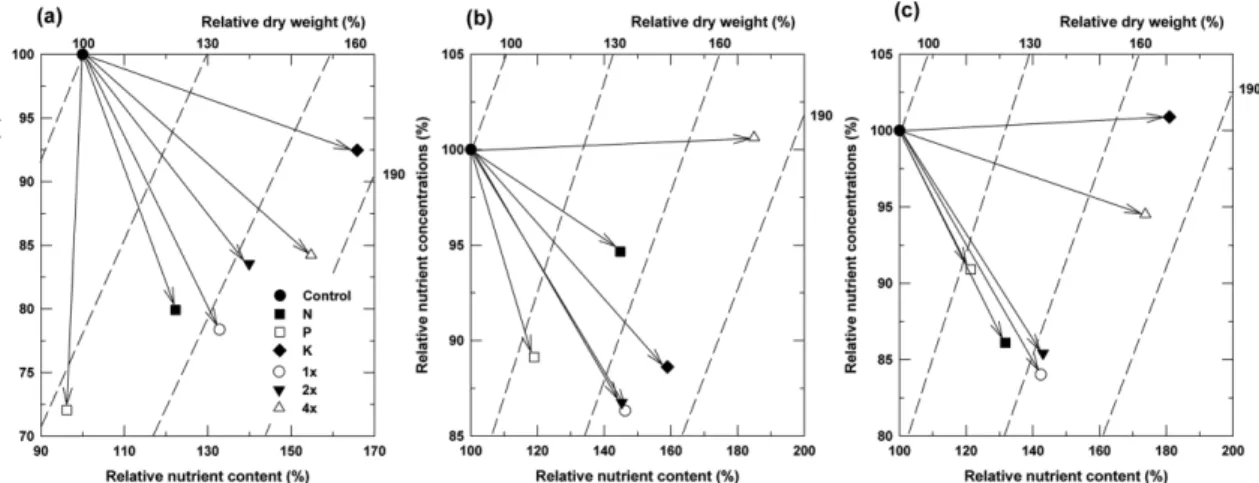
시비처리에 대한 양분벡터분석 결과는 수종과 양분에 따라 상이한 경향을 보였다. 모든 시비처리는 물푸레나무 생장을 무처리인 대조에 비하여 31~77% 더 증가시켰다 (Figure 4). 건중량과 양분함량을 고려한 식물체의 질소, 인, 칼륨의 양분벡터분석 결과는 원소에 따라 차이가 있 었다. 모든 처리는 대조에 비하여 생장을 증가시키고 식
물체 내 질소 농도를 감소시켜 질소함량이 감소된 “양분 희석” 현상을 보였다[Figure 4(a)]. 이는 생장의 증가에 의 해 식물체의 질소 농도가 감소하는 결과를 보였으며 이런 현상은 인 시비에서 가장 크게 나타났다. 식물체 인도 질 소처럼 대부분 처리에서 “양분희석” 현상을 보였으나, 4x 처리에서는 식물체 인 농도 변화 없이 인 함량이 증가하 는 “양분최적” 현상을 보였다[Figure 4(b)]. 칼륨에 대한 벡 터분석 결과는 칼륨시비처리와 4x처리에서 칼륨농도의 변 화 없이 양분함량을 증가시키는 “양분최적” 현상을 보였 으며, 나머지 처리에서는 정도는 다르지만 유사한 “양분 Figure 2. Growth responses of (a) F. rhynchophylla, (b) F.
mandshurica, (c) P. koraiensis, and (d) A. holophylla at the different fertilizer treatments. Symbols mean: ●, height growth; ▽, root collar diameter; ■, height to root collar diameter ratio. Numbers indicate the average value of height to root collar diameter ratio. Means with same letters are not significantly different among the treatments (α=0.05; Tukey’s multiple comparison test). Vertical bars show standard errors (n=3).
Figure 3. Leaf, stem and root dry weight of (a) F. rhynchophylla and (b) F. mandshurica at the different fertilizer treatments.
Means with same letters are not significantly different among the treatments (α=0.05; Tukey’s multiple comparison test). Vertical bars show standard errors (n=3).
희석” 현상을 보였다[Figure 4(c)].
들메나무는 물푸레나무의 생장과 다르게, 무처리인 대 조에 비하여 1~106% 생장하여 처리에 따른 생장반응의 범위가 넓었다(Figure 5). 들메나무의 질소, 인, 칼륨 농도 는 처리에 따라 다양한 반응을 보였는데, 질소, 인, 칼륨의 단일비료 처리는 건중량의 증가 없이 질소 함량을 감소시 키는 “체내이동” 현상을 보였고, 이것은 인 처리에서 크 게 나타났다. 식물체 질소는 복합비료 1x, 2x, 4x처리에 의 해 그 정도는 다르지만 “양분희석” 현상을 보였다(Figure 5(a)). 식물체 인의 벡터분석은 4x처리에서 “양분희석” 현 상을 보였고, 단일비료 질소처리와 2x처리에서 약한 “양 분희석” 또는 “체내이동” 현상을 보였다. 단일비료 인과 칼륨, 1x처리는 비슷한 크기의 “체내이동” 현상을 보이면 서 식물체 내의 인 농도가 감소되었다[Figure 5(b)]. 칼륨 에 대한 벡터분석 결과는 4x처리가 칼륨농도의 변화 없이 양분함량을 크게 증가시키는 “양분최적” 현상을 보였으 며, 칼륨시비처리에서는 생장 변동 없이 적은 양이지만 칼 륨이 식물체 내에 축적되는 “양분과다” 현상을 보였다 (Figure 5(c)). 식물체내 질소와 인의 벡터분석 결과처럼 칼
륨의 경우에도 단일원소비료 질소와 인 처리는 약한 “체 내이동” 현상을 보였으며, 1x처리는 강한 “양분희석” 현 상을 보였다.
양분벡터분석 결과는 비료종류와 시비량에 따라 식물 체 질소, 인, 칼륨의 반응 방향과 크기가 다름을 보여주고 있다(Figure 4 and 5). 이는 물푸레나무와 들메나무가 같 은 속(family)으로 비슷한 생리·생태적 특징을 보이지만 주요 양분을 흡수하는 정도가 다름을 나타내며, 이것은 수 종에 따른 정밀한 시비기준 정립이 필요함을 시사한다. 물 푸레나무 식물체 내 질소의 경우, 흡수한 양분보다 생장 이 더 증가하여 기존의 시비량보다 많은 양의 시비도 가 능할 것으로 보인다. 들메나무는 단일원소비료보다는 복 합비료 시비량이 증가할수록 생장이 뚜렷하게 증가하였 으므로, 복합비료의 사용량 증가도 가능한 것으로 판단된 다. Park et al.(2013)은 물푸레나무는 식물생장과 식물체 양분함량은 증가하였지만 양분농도는 증가하지 않는 “양 분결핍” 현상을, 들메나무는 본 연구와 동일한 “양분희석”
현상을 보였다고 보고하였다. 이처럼 양분벡터분석은 식 물체의 건중량, 양분 농도, 흡수 양분량 변화를 동시에 분 Figure 4. Vector analysis of F. rhynchophylla for (a) N, (b) P, and (c) K after fertilization.
Figure 5. Vector analysis of F. mandshurica for (a) N, (b) P, and (c) K after fertilization.
석할 수 있어 수종에 따른 비료의 종류와 시비량을 규명 할 때 유용하게 활용될 수 있을 것이다.
결 론
본 연구는 식물체의 생장과 같은 형태적 특성과 함께 양 분벡터분석을 실시하여 수종에 따라 비료 종류와 시비량 을 다르게 적용해야 함을 보여주고 있다. 물푸레나무와 들 메나무는 단일원소비료보다는 기존 시비량보다 많은 양 의 NPK복합비료를 시비하는 것이 요구되지만 잣나무와 전나무는 시비량과 시비 비율에 큰 영향을 받지 않았다.
이는 토양조건과 수종에 적합한 비료종류와 시비량 기준 정립을 통해 우량한 묘목을 생산할 수 있을 뿐만 아니라 적합하지 않은 시비에 의해 발생할 수 있는 토양 및 주변 지역 수질 저하를 방지하면서 조림비용을 절감시킬 수 있 음을 보여주고 있다.
감사의 글
포지를 만들고, 묘목 식재와 관리를 해주신 박성윤, 이 채현, 그리고 양평양묘사업소 직원께 감사드린다. 이명종 교수님과 손요환교수님께서는 본 연구의 시험설계에 많 은 도움을 주셨다. 본 연구는 산림청 ‘산림과학기술개발 사업(과제번호 : S211415L010110)’ 지원을 받아 일부 수 행되었습니다.
References
Aldrich, D.G., Parker, E.R., and Chapman, H.D. 1945. Effects of several nitrogenous fertilizers and soil amendments on the physical and chemical properties of an irrigated soil.
Soil Science 59(4): 299-312.
Andersen, L. and Hansen, C.W. 2000. Leaching of nitrogen from container plants grown under controlled fertigation regimes.
Journal of Environmental Horticulture 18: 8-12.
Bayala, J., Dianda, M., Wilson, J., Ouédraogo, S., and Sanon, K. 2009. Predicting field performance of five irrigated tree species using seedling quality assessment in Burkina Faso, West Africa. New Forests 38: 309-322.
Brady, N.C. and Weil, R.R. 2002. The nature and properties of soils. Pearson Education, Inc. New Jersey. pp. 960.
Broschat, T.K. 1995. Nitrate, phosphate, and potassium leach- ing from container-grown plants fertilized by several meth- ods. Hort Science 30: 74-77.
Byun, J.K., Kim, Y.S., Yi, M.J., Son, Y., Kim, C.S., Jeong, J.H., Lee, C.H., and Jeomg, Y.H. 2007. Growth response of Pinus densiflora, Larix leptolepis, Betula platyphylla var. japonica and Quercus acutissima seedlings at vari- ous levels of fertilizations. Journal of Korean Forest Soci-
ety 96(3): 693-698.
Carlson, W.C. 1981. Effects of controlled-release fertilizers on the shot and root development of outplanted western hem- lock (Tsuga heterophylla Raf. Sarg.) seedlings. Canadian Journal of Forest Research 11: 752-757.
Haase, D.L. and Rose, R. 1995. Vector analysis and its use for interpreting plant nutrient shifts in response to silvi- cultural treatments. Forest Science 41: 54-66.
Issac, M.E. and Kimaro, A.A. 2011. Diagnosis of nutrient imbalances with vector analysis in Agroforestry systems.
Journal of Environmental Quality 40: 860-866.
Imo, M. and Timmer, V.R. 1999. Vector competition analysis of black spruce seedling responses to nutrient loading and vegetation control. Canadian Journal of Forest Research 29: 474-486.
Korea Meteorological Administration. 2011. Climatological Nor- mals of Korea. pp. 678.
Kwon, G.W., Park, G.S., and Lee, D.K. 1998. Effects of NPK fertilization on growth of Betula platyphylla var. japon- ica, Fraxinus rhynchophylla, Pinus koraiensis, and Acer mono seedlings, and chemical properties of soil. Korean Journal of Agriculture Science 25(2): 160-167.
Marschner, H. 2002. Mineral nutrition of higher plants. 2nd edition. Academic Press, San Diego, U.S.A. pp. 889.
Park, B.B., Byun, J.K., Kim, W.S., and Sung, J.H. 2010a.
Growth and tissue nutrient responses of Fraxinus rhyn- chophylla, Fraxinus mandshurica, Pinus koraiensis, and Abies holophylla seedlings fertilized with nitrogen, phos- phorus, and potassium at a nursery culture. Journal of Korean Forest Society 99(1): 85-95.
Park, B.B., Byun, J.K., Park, P.S., Lee, S.W., and Kim, W.S.
2010b. Growth and tissue nutrient responses of Fraxinus rhynchophylla, Fraxinus mandshurica, Pinus koraiensis, and Abies holophylla seedlings fertilized with nitrogen, phosphorus, and potassium. Journal of Korean Forest Society 99(2): 186-196.
Park, B.B., Byun, J.K., Sung, J.H., and Cho, M.S. 2013. Study of optimal fertilization with vector analysis in hardwood and softwood seedlings. Journal of Agriculture and Life Sci- ence 47(5): 95-107.
Park, B.B., Cho, M.S., Lee, S.W., Yanai, R.D., and Lee, D.K.
2012. Minimizing nutrient leaching and improving nutri- ent use efficiency of Liriodentron tulipifera and Larix leptole- pis in a container nursery system. New Forests 43: 57-68.
Park, G.S. 1997. Soil chemistry changes after N, P, and K fertilization in a willow (Salix spp.) bioenergy plantation.
Journal of Korean Forest Society 86(3): 311-318.
Quoreshi, M. and Timmer, V.R. 2000. Early outplanting per- formance of nutrient-loaded containerized black spruce seedlings inoculated with Laccaria Biocolor: A bioassay study. Soil Science Society of America Journal 30: 744- 752.
Salifu, K.F. and Timmer, V.R. 2003. Nitrogen retranslocation
response of young Picea marianna to nitrogen-15 sup- ply. Soil Science Society of America Journal 67: 309-317.
Shin, J.A., Son, Y., Hong, S.G., and Kim, Y.K. 1999. Effect of N and P fertilization on nutrient use efficiency of Pinus densiflora, Larix leptolepis, and Betula platyphylla var. japonica seedlings. Korean Journal of Environmental Agriculture 18(4): 304-309.
Son, Y.H., Kim, Z.S., Hwang, J.H., and Park J.S. 1998. Fer- tilization effects on growth, foliar nutrients and extract concentrations in ginkgo seedlings. Journal of Korean Forest Society 87(1): 98-105.
Son, Y.H., Seo, K.Y., Kim, R.H., Koo, J.W., Yi, M.J., and Kim, J.H. 2005. Biomass and nutrient distribution of Pinus koraiensis seedlings invading a mixed forest dominated by Quercus mongolica. Forest Science and Technology
1(1): 8-12.
Timmer, V.R. 1996. Exponential nutrient loading: a new fer- tilization technique to improve seedling performance on competitive sites. New Forests 13: 275-295.
Timmer, V.R. and Stone, E.L. 1978. Comparative foliar analy- sis of young balsam fir fertilized with nitrogen, phosphorus, potassium, and lime. Soil Science Society of America Jour- nal 42: 125-130.
Vitousek, P.M., Cassman, K., Cleveland, C., Crews, T., Field, C.B., Grimm, N.B., Howarth, R.W., Marino, R., Marti- nelli, L., Rastetter, E.B., and Sprent, J.I. 2002. Towards an ecological understanding of biological nitrogen fixa- tion. Biogeochemistry 57(1): 1-45.
(Received: February 18, 2016; Accepted: April 25, 2016)